1 Introduction
This article is concerned with fricative realisations of plosives, in particular /t/, in comparison with the realisation of other plosives and the acoustic characteristics of other fricatives in Dublin and Middlesbrough English. The realisation of a historical or lexically underlying plosive as a fricative in some phonological environments is a widespread phenomenon cross-linguistically. Casual speech frication of plosives has been observed in languages which are not usually described as having fricated plosives, for example, Standard British and American English (Brown Reference Brown1977; Shockey & Gibbon Reference Shockey and Gibbon1993; see also Lavoie Reference Lavoie2002; Shockey Reference Shockey2003: 27–8; Simpson Reference Simpson2001: 33), Austrian German (Moosmüller & Ringen Reference Moosmüller and Ringen2004), and Standard Greek (Nicolaidis Reference Nicolaidis2001: 70–1). In these cases, the frication is most likely to be a low-level phonetic effect due to an incomplete closure of the plosive (articulatory undershoot; see Beckman, de Jong, Jun & Lee Reference Beckman, de Jong, Jun and Lee1992) with the right aerodynamic conditions for the generation of frication (audible turbulence), such as an appropriate area of constriction, sufficient airflow, and a high enough oral pressure. Details on the production of fricatives can be found in Shadle (Reference Shadle, Hardcastle and Marchal1990, Reference Shadle, Hardcastle and Laver1997) and Stevens (Reference Stevens1998).
Over time the low-level frication of plosives as a feature of casual speech may become generalised in particular environments as a characteristic of a variety, i.e. it may be phonologised. Liverpool English is often regarded as a prime example of a variety which has regularly fricated plosives (Sangster Reference Sangster2001; Wells Reference Wells1982; but see Honeybone Reference Honeybone2001); for example, the word snake is often realised as [sneɪx] with a final velar fricative instead of a velar plosive (Wells Reference Wells1982: 371). Elsewhere, frication of plosives occurs in Tuscan (Florentine) Italian dialect, which has [kaɸo] for Standard capo ‘head, boss’ (Kirchner Reference Kirchner, Hayes, Kirchner and Steriade2004: 317); and German has fricatives in the words Wasser ‘water’ and was ‘what’ corresponding to plosives in the cognates in Standard English and also in Dutch water and wat as the result of a historical change (see Beckman et al. Reference Beckman, de Jong, Jun and Lee1992).
The process behind such alternations has been given various names in various frameworks. It is generally regarded as a kind of weakening or lenition (Bauer Reference Bauer1988; Honeybone Reference Honeybone2001) because a lesser degree of stricture is seen in the fricative relative to the plosive. Other terms used are spirantisation (Yu Reference Yu, Billings, Boyle and Griffith1999), and assibilation (Hall, Hamann & Zygis Reference Hall, Hamann and Zygis2006; Kim Reference Kim2001) or fricativisation (Lavoie Reference Lavoie2001). Some patterns are excluded from consideration as lenition depending on the outcome of the process. Kirchner (Reference Kirchner2001, Reference Kirchner, Hayes, Kirchner and Steriade2004), for example, excludes from consideration as lenition any process which results in a sibilant or strident fricative (see also Lavoie Reference Lavoie2001: 33). As the terms sibilant or strident lack any uniform phonetic definition, with varying views on, for example, the [strident] nature of English /f/ put forward by Chomsky & Halle (Reference Chomsky and Halle1968), Utman & Blumstein (Reference Utman and Blumstein1994) and Ladefoged & Maddieson (Reference Ladefoged and Maddieson1996), Kirchner's distinction between lenition outcomes seems untenable. Despite the proliferation of more or less well-founded subdivisions, fricative forms of plosives are likely to emerge in a limited range of phonological environments, typically in intervocalic or in syllable coda position (Honeybone Reference Honeybone2001; Kirchner Reference Kirchner2001). In this study, the term ‘frication’ is used to refer to the process, whether synchronic or diachronic, whereby a plosive alternates with or becomes a fricative, with no particular view expressed on whether the outcome is to be regarded as a weakening or strengthening. Frication also refers to the audible turbulence present in the speech signal.
Frication of plosives in casual speech may have two origins: it may occur as a sporadic, low-level phonetic effect, perhaps more commonly with some speakers than with others, or, it may occur if the variety in question has a regular phonological process of frication in certain contexts. Clearly, the use of casual speech as a data source on the incidence of frication is problematic if one is interested in determining whether fricated realisations of plosives are regular phonologically determined realisations common to all speakers of that variety. Loakes & McDougall (Reference Loakes, McDougall, Cassidy, Cox, Mannell and Palethorpe2004: 174) found that frication of /p/ and /k/ occurred in casual Australian English speech, but not in more formal data, a finding which indicates that frication of /p/ and /k/ is a surface phenomenon in this variety of English (but see Jones & McDougall Reference Jones, McDougall, Warren and Watson2006 on Australian English fricated /t/). A better understanding of the nature of ‘background’ frication rates in casual speech is required before uncontrolled and only partially comparable data samples are used.
In addition, the aerodynamic conditions required for the generation of frication may be affected by a whole range of interactions in casual speech between, for example, coarticulatory effects on the tongue and jaw which affect constriction area, and coarticulation of nasalisation and voicing which may affect oral pressure. Nicolaidis (Reference Nicolaidis2001) reports on a simultaneous articulatory (electropalatographic, EPG) and acoustic analysis of casual Greek speech in which only around 30 per cent of tokens of /t/ which were incompletely occluded in the EPG record showed frication in the acoustic signal, presumably because the aerodynamic conditions for frication were not met. Although the Greek data refer to a casual speech process, a process of plosive frication which is regularly occurring under optimal speaking conditions may be variable in casual speech. The variable nature of frication reported in studies like Honeybone (Reference Honeybone2001) could be artefacts of the casual speech data sample. For this reason, controlled data of relatively formal speech are required to investigate the nature of plosive frication.
Other indications about the nature of frication may come from the quality of frication itself. Categorical change between plosive and fricative in all appropriate contexts can be viewed as rule-governed. Sporadic incidence of categorical frication in a single phonological environment could be a sociolinguistically active process and governed by a variable rule. Frication may apply at the lexical level as the result of morphophonological alternation, or post-lexically in connected speech, and may involve neutralisation of a particular contrast, for example, between /t/ and /s/, or introduce a novel surface contrast between fricated /t/ and /s/. The locus of the process could be in the phonological component or in the language-specific phonetic component of a modular grammar (see Keating Reference Keating1990). Gradient frication in individual tokens in controlled data showing a range of realisations intermediate between /t/ and /s/ may be the result of a low-level phonetic implementation effect, which will occur in any language if the phonetic conditioning factors are met. Though slightly oversimplistic, the categorical phonological vs gradient phonetic diagnostic is longstanding; see Myers (Reference Myers, Burton-Roberts, Carr and Docherty2000) for an overview of ideas and problems, and, for example, Cohn (Reference Cohn1993) for exemplification.
2 Frication of /t/ in Dublin and Middlesbrough English
The focus of this article is the frication of plosives in Dublin and Middlesbrough English. Frication of /t/ has been widely reported generally for Irish English (Hickey Reference Hickey1984, Reference Hickey1986; Ó Baoill Reference Ó Baoill1997; Pandeli, Eska, Ball & Rahilly Reference Pandeli, Eska, Ball and Rahilly1997; Wells Reference Wells1982), and more specifically for Dublin English (Hickey Reference Hickey1999). The fricated realisation of /t/ in Irish English is often referred to as slit-/t/, and has been the subject of prior phonetic study (Pandeli et al. Reference Pandeli, Eska, Ball and Rahilly1997). In articulatory terms, slit-/t/ is described as a voiceless alveolar slit fricative (Wells Reference Wells1982: 429), or a voiceless apico-alveolar fricative (Hickey Reference Hickey1984: 234, 246). Pandeli et al. (Reference Pandeli, Eska, Ball and Rahilly1997: 68) report ‘an apical alveolar fricative formed with a broad central channel’ for a single male subject used to collect electropalatographic data, and suggest the symbol [ɵ]. For Hickey (Reference Hickey1984: 246) the slit-/t/ is nonstrident. For Ó Baoill ‘a phonetic contrast exists between two sibilant fricatives in such pairs as hit/hiss’ (Ó Baoill Reference Ó Baoill1997: 82). The acoustic analysis of duration presented in Pandeli et al. (Reference Pandeli, Eska, Ball and Rahilly1997) shows that slit-/t/ is shorter in duration than /s/ or /ʃ/. There is some debate as to the origin of slit-/t/ as a contact feature due to the Irish substrate (Hickey Reference Hickey1984, Reference Hickey1986).
Recently, frication of /t/ in varieties of English spoken in north-eastern England has been reported: Docherty & Foulkes (Reference Foulkes and Docherty1999) and Watt & Allen (Reference Watt and Allen2003) for Newcastle and Tyneside English; Jones & Llamas (Reference Jones and Llamas2003) for Middlesbrough English. Jones and Llamas (Reference Jones and Llamas2003) used methodology very similar to that employed here to compare the quality of frication in fricated /t/ with that in /s/ and /ʃ/ for three subjects from Middlesbrough and one from Dublin. The results showed acoustic similarity between fricated realisations of /t/ and /s/ in Middlesbrough, but between fricated realisations of /t/ and /ʃ/ in Dublin. The IPA symbol [t̞] can be employed for the more /s/-like realisation of Middlesbrough English. Llamas (Reference Llamas2001) notes fricated realisation of /k/ in auditory analysis of conversational data on Middlesbrough English, but apart from frication of /t/, frication of plosives at other places of articulation is not mentioned specifically for any of the varieties mentioned above.
3 Research aims
The main aims of the study are to ascertain whether regular frication of voiceless plosives occurs regardless of place of articulation in Dublin and Middlesbrough English, and to compare the resulting frication of /t/ with the phonetic characteristics of other fricatives. For Middlesbrough English, the comparison will involve /f, ɵ, s/ and /ʃ/. Dublin English is said to lack /ɵ/ (Hickey Reference Hickey1999; Ó hÚrdail Reference Ó hÚrdail1997), and so the fricated /t/ in Dublin English will be compared with /f, s/ and /ʃ/ only. As previous literature reports fricated /t/, but not fricated /p/ or /k/, a comparison of frication rates across plosive places of articulation will indicate whether /t/ is actually fricated more frequently or more systematically than plosives at other places of articulation, or whether frication of /p/ and /k/ occurs as often and as systematically as frication of /t/, but has escaped the attention of previous accounts for some reason. A comparison of the phonetic character of fricated /t/ with other fricatives will indicate whether there is likely to be neutralisation involving an existing fricative contrast, or the addition of surface fricative contrast in these varieties. The results of this investigation will have implications for perception of fricatives at both localities, and also for systemic adaptations in fricative production, perhaps involving the ‘enhancement’ of existing contrasts. Honeybone (Reference Honeybone2001: 215–16) makes a case for studies of nonstandard speech which place the characteristics of the phenomenon itself at the centre of the investigation, and this is the line taken here. The present study is not concerned with the sociolinguistic distribution of the phenomena, but with the characteristics of the phenomena themselves when they occur. Sociolinguistic patterning will be addressed in future work.
The collection of data from two localities will also allow a comparison of the phonetic characteristics of fricated /t/ between Dublin and Middlesbrough English. There is a history of Irish immigration to Middlesbrough (Chase Reference Chase1995; Llamas & Jones Reference Llamas and Jones2006; Willis Reference Willis2003) and frication of /t/ in other varieties of English has been linked to contact with Irish English, for example, Liverpool English (Wells Reference Wells1982: 371–2), Newfoundland English (Clarke Reference Clarke, Harris, Little and Singleton1986; Trudgill Reference Trudgill1986) and Australian English (Jones & McDougall Reference Jones, McDougall, Warren and Watson2006; Tollfree Reference Tollfree, Blair and Collins2001). In a similar way, Middlesbrough English fricated /t/ could also be the result of historical contact with Irish English. An assessment of the similarity of fricated /t/ at these localities could throw some light on the likelihood of a direct historical connection. A note of caution is required, however. As frication of plosives is such a common process across languages, there is no need to posit an external origin for Middlesbrough English fricated /t/; it may simply be a parallel development. Consequently, in this study anything short of considerable phonetic similarity between Dublin English and Middlesbrough English fricated /t/ will be interpreted as support for a parallel development. To argue for some direct link, even given favourable historical conditions, between phonetically different instantiations of such a common crosslinguistic process is problematic.
Finally, the nature of the process – phonological, categorical phonetic, gradient sporadic – will be addressed. Irish English fricated /t/ has been observed as characteristic of the variety for a long period of time, and so might be regarded as a regular phonological process. However, Hickey (Reference Hickey1984: 237) states that ‘in formal styles, such as reading a text aloud, Irish English speakers only have a stop realization of /t/. . .’, suggesting that slit-/t/ derives from a low-level casual speech process. Its occurrence in controlled data in Pandeli et al. (Reference Pandeli, Eska, Ball and Rahilly1997) calls Hickey's assessment into question. Middlesbrough fricated /t/ has only been reported recently, and it could be a more sporadic and gradient feature of that variety. To assess the nature of /t/ frication, controlled data are required, as set out above.
4 Experiment 1: frication rates for word-final intervocalic /p, t, k/
4.1 Method
Ten subjects were recorded in the field at each locality. Subjects were four males and six females at each locality, native speakers of the variety of English concerned. Dublin subjects are referred to as DbF1 (Dublin female 1), DbM1 (Dublin male 1), etc., and were 15 or 16 at the time of recording, except DbF6 who was 35. The Middlesbrough subjects are referred to as MbF1 (Middlesbrough female 1, etc.) and were mostly aged between 16 and 18, though MbF4 was 28, MbF5 and MbM4 were 38, and MbF5 was 67. The same recorded material from the same subjects at each locality provided data for both of the experiments reported below. The elicitation materials were identical at each locality and consisted of test words spoken in the carrier phrase ‘Say [test word] again’. The sentences with the test words were interspersed between instances of the carrier phrase containing numerous phonologically diverse foils (54, including all words analysed). Word-final plosives were all post-tonic intervocalic before unstressed schwa with the preceding vowel /a/. Five repetitions of each test word were elicited for analysis to control for token-to-token variability. Recordings were made as wav files using a Marantz PMD670 Portable Solid State Recorder and a Shure SM48 unidirectional dynamic microphone. The wav files were recorded at a bit rate of 1536kbps and a sampling rate of 48kHz. Recordings were carried out in quiet rooms, but some background noise was inevitably present. For the detailed spectral analysis of experiment 2, the recorded data were band-pass filtered at 500–9,500 Hz with 20 Hz smoothing using the Praat speech analysis software.
In experiment 1 the frication rates of the word-final intervocalic voiceless plosives were investigated using tokens of mat, gap, back. Visual inspection of the waveforms and wideband spectrograms for each test word was carried out in Praat. Each token was classified as exhibiting a plosive, intermediate, or fricated realisation. The plosive forms were judged to show acoustic evidence of complete closure as indicated by a silent period preceding a transient and a period of affrication at release. Fricated tokens exhibited a sustained period of aperiodic noise and lacked a preceding silent period. Intermediate tokens exhibited characteristics of both plosive and fricated forms, and are discussed in more detail below. In general, the frication of /t/ and /k/ was easy to identify. Frication of /p/ is low in amplitude. Very few tokens of /p/ showed any acoustic indications of release (burst and affrication). The presence of a silent period associated with closure was taken as an indicator of plosive realisations, but there is less certainty attached to the observations for /p/ than for /t/ and /k/.
4.2 Dublin results
The Dublin data exhibited only 2 fricated tokens of /p/, each occurring from a different subject, one male, one female.Footnote 2 Fricated /k/ was more common, occurring in a single token each for three subjects, but subject DbM1 fricated every word-final realisation of /k/ in the test-word back. Fricated /t/ also occurred as a single token for three subjects (two female, one male), but all word-final /t/ realisations were fricated in the speech of three female subjects, DbF4, DbF5, and DbF6. The results for fricated realisations are summarised in figure 1.
Frication rates for /p, t, k/ for the 10 Dublin English-speaking subjects

The Dublin data showed no indications of any intermediate forms for /t/. One form of /k/ was possibly intermediate, but it has been grouped here with the fricated forms as closure was clearly incomplete. These results indicate that in Dublin English, the frication of /t/ could be more common in female speech and that /t/ frication occurs categorically even in formal speech samples, whereas frication of the other plosives was less common. When fricatives did not occur, preaspirated plosive realisations were invariably found for /p/ and /k/. For the female subjects, nonfricated realisations of /t/ were invariably preaspirated. For the male subjects, glottal realisations of /t/ were usual.
4.3 Middlesbrough results
The Middlesbrough data contained 2 tokens of fricated /p/, both from the same female subject (MbF5). Fricated /k/ occurred more often than fricated /t/, being present in 16 tokens versus the 11 tokens of fricated /t/. However, fricated /k/ occurred less widely across the sample as a whole, being present in the speech of only four subjects (two male, two female), and occurring in all 5 tokens of back from each of the two female subjects (MbF2, MbF3). Fricated or intermediate realisations of /t/ occurred in the speech of seven out of ten subjects overall; once for six subjects (four females, two males), and present in all tokens of mat for subject MbM4. These patterns suggest that frication of /t/ and /k/ occurs in Middlesbrough speech across subjects. The results for fricated realisations are summarised in figure 2.
Frication rates for /p, t, k/ for the 10 Middlesbrough English subjects

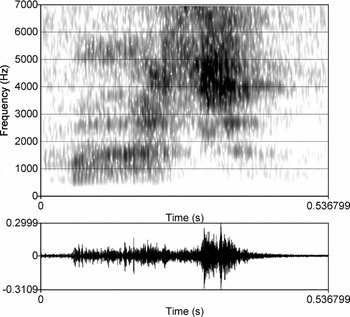
Nonfricated realisations of /p/ and /k/ tended, as in Dublin, to be preaspirated plosives. Realisations of /t/ varied, with preaspirated plosives most common for the females, and ‘glottalised’ or [ʔ] variants found for the male subjects. Subject MbM4 had fully fricated forms in mat in all tokens (see figure).
Wideband spectrogram (top) and waveform (bottom) of fully fricated token of mat (token 2) for Middlesbrough subject MbM4

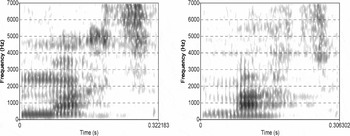
This categorical frication of /t/ for MbM4 contrasted with the patterns observed for the other subjects, almost all of whose fricated /t/ realisations were judged to be intermediate in some respect. The intermediate pattern (see figure 4 below) consisted of a period of pre-affrication as the articulators approximated with a high volume-velocity of airflow for preaspiration. There followed a brief period in which amplitude fell across a broad range of frequencies, often giving the appearance of complete articulatory closure. However, closure is unlikely to have been complete, as there was no transient at ‘release’ to mark the onset of the gradual increase in the amplitude of broad bandwidth frication, though direct indications of closure from articulatory or aerodynamic measures are of course lacking in this acoustic study.
‘Intermediate’ tokens of /t/ for two male speakers of Middlesbrough English (MbM2, token 1; and MbM3 token 3) showing incomplete frication

The lower amplitude ‘closure’ period of intermediate forms may involve a continuing tongue movement which falls short of closure but directs airflow away from the incisors, as suggested by Jones & Llamas (Reference Jones and Llamas2003), or one involving a narrow groove in which the velocity of airflow falls below that required to generate frication. Instead of an abrupt transient ‘release’, apparent transients were often visible part-way through the frication. As these apparent transients were also seen occasionally in the /s/ realisations for some subjects in experiment 2, they may be indicative of brief incomplete occlusion of part of the narrow constriction due to saliva, rather than any more significant articulatory closure.
The frication associated with word-final intervocalic /t/ for subject MbM4 does occasionally show some indications of a variable amplitude pattern, which might suggest a residual closure gesture. However, an inspection of intensity curves across subjects showed that similar intensity patterns were not uncommon with the phonological fricatives /s/ and /ʃ/, and temporal variation in the noise amplitude of fricatives has been observed more widely (see Stevens Reference Stevens1998: 389). As phonological fricatives also show a reduction in amplitude in some realisations, the amplitude reduction in fricated tokens of /t/ cannot straightforwardly be associated with a residual closure gesture for a plosive articulation. Whether the low amplitude ‘closure’ period of the intermediate forms is sufficient to cue the percept of a stop closure and release remains to be demonstrated.
5 Experiment 2: acoustic analysis and comparison of fricated /t/ and phonological fricatives
5.1 Method
The data for analysis were those tokens of word-final intervocalic /t/ which were regarded as fully fricated in the dataset elicited for experiment 1, as described in section 4.1.1 above. The data come from one male Middlesbrough subject, MbM4, and three female Dublin subjects, DbF4, DbF5 and DbF6. Realisations of fricated /t/ are compared with word-final intervocalic realisations of the phonological fricatives /s, ʃ, f/ for each subject (and for MbM4 also /ɵ/) in the words mass, mash, laugh and bath. Dublin English, like other varieties of Irish English, usually realises /ɵ/ as [t̪ʰ] (Ó hÚrdail Reference Ó hÚrdail1997). The Dublin English subjects in the sample tended overwhelmingly to exhibit this realisation, except for three possibly weak fricative realisations for the oldest female subject DbF6. These weak fricative realisations of /ɵ/ are not analysed here.
The acoustic analysis of fricatives presents problems in that it is unclear which measures best characterise articulatory and perceptually relevant acoustic structure (Ladefoged & Maddieson Reference Ladefoged and Maddieson1996: 139). Recent studies of fricatives produced in English and in other languages have increasingly employed a range of measures (e.g. Gordon, Barthmaier & Sands Reference Gordon, Barthmaier and Sands2002; Jongman, Wayland & Wong Reference Jongman, Wayland and Wong2000; van Dommelen Reference van Dommelen2003), in addition to more traditional considerations of peak location (e.g. Hughes & Halle Reference Hughes and Halle1956) and amplitude (Behrens & Blumstein Reference Behrens and Blumstein1988). The fricatives under investigation here will be characterised in terms of the following parameters:
1. Relative duration
2. Relative amplitude
3. Statistical characterisation of the spectrum in terms of Centre of Gravity (COG)
4. Frequency and amplitude of major spectral peak
5. Frequency range of frication located within 12 dB of the major spectral peak.
Duration was measured from the onset to the offset of relatively high amplitude aperiodic noise in the spectrogram window. Due to the acoustic effects of vocal fold abduction (comparable to preaspiration; see Ní Chasaide & Gobl Reference Ní Chasaide, Gobl, Hardcastle and Hewlett1999) preceding the formation of the oral constriction, frication offset was generally easier to identify than frication onset. However, it is generally possible to distinguish the onset of oral frication from adjacent glottal frication in terms of amplitude and frequency characteristics (Stevens Reference Stevens1998: 457–64). Duration measures were normalised relative to the duration of a section of the carrier phrase ‘Say [test word] ag-’. The final syllable of again was not included in its entirety for duration normalisation as nasalisation of the vowel and a reduction in overall amplitude often meant that consonant offset was frequently unclear. The ag- syllable was measured to the onset of higher formants following the /ɡ/, as closure was often incomplete.
Relative amplitude was measured by obtaining an automatic intensity measure in decibels (dB) for a 50 ms window of the fricative midpoint, and subtracting this measure from an intensity measure for a 50 ms window of modally voiced vowel following the /m/ offset. A section of modally voiced vowel following /m/ offset in the preceding vowel was chosen for amplitude normalisation in preference to the immediately preceding ‘preaspirated’ portion of the vowel because of temporal variability in voicing offset in the ‘preaspiration’ and the effect this has on vowel amplitude. This is a problem not encountered in studies of prevocalic fricatives (e.g. Jongman et al. Reference Jongman, Wayland and Wong2000). On those few occasions when the modally voiced vowel was less than 50 ms in duration, a 50 ms window was placed so as to include all the modally voiced vowel and however much following ‘preaspiration’ filled the remainder of the window. Care was taken to exclude modal voicing due to the /m/. In one token of /f/ for DbF5 the fricative was less than 50 ms in duration, and here the entire duration of frication was used to calculate the intensity.
The Centre of Gravity (COG) is a statistical measure of the spectrum shape involving an amplitude-weighted mean of frequency components, also called the first spectral moment or the centroid (e.g. Jassem Reference Jassem and Jassem1968; Jongman et al. Reference Jongman, Wayland and Wong2000). The COG of each fricative was calculated automatically in Praat (power = 2) based on the same 50 ms window which had served for the amplitude measurements. Other statistical measures of each fricative were automatically calculated at the same time (dispersion, skewness, kurtosis), but these are not reported here as the results are highly variable both within and between subjects, making it hard to draw any firm conclusions about patterns.
The frequency and amplitude of the major spectral peak was identified from an FFT spectrum computed over a 50 ms window centred on the fricative midpoint (or the entire duration of frication, as for one token from DbF5 above). The peak was identified visually and the cursor placed at the tip of the peak to obtain a frequency measure in Hertz (Hz) and an amplitude measure in decibels (dB). The range of frequencies falling within 12 dB of that peak was measured manually from the same FFT spectrum (van Dommelen Reference van Dommelen2003; see also Jassem Reference Jassem and Jassem1968: 192, 202). The range was measured by locating the lower and upper points in the spectrum between which most frequencies were above the cut-off of peak amplitude minus 12 dB. Some subjectivity is involved in this measure as there were occasional narrow troughs below the cut-off amplitude, with broadband peaks extending considerably above it, just as there were occasionally isolated narrowband peaks just above the cut-off amplitude. The approach adopted was to include within the range any relatively broadband peaks which extended well above the cut-off and were separated from other peaks by relatively narrow troughs. Although this is not entirely satisfactory, it must be remembered that linear Hertz spectra are not accurate representations of speech auditorily (and therefore also perceptually). Any more objective solution would presumably have to consider possible auditory effects on the spectrum, and is therefore beyond the scope of the present investigation.
5.2 Relative duration results
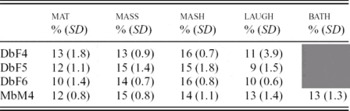
The individual means and standard deviations for relative duration for each fricative for all subjects are presented in table 1. The results show that fricated /t/ is generally shorter than the phonological fricatives /s/ and /ʃ/ at both localities, except for subject DbF4 who has identical average durations of fricated /t/ and /s/. The relationship between the average duration of fricated /t/ and the nonsibilant /f/ (and Middlesbrough /ɵ/) differs. In Dublin, which only has /f/ data, the duration of fricated /t/ is longer than /f/ on average for two subjects, and equal in duration to /f/ for DbF6. For the male Middlesbrough subject, fricated /t/ is slightly shorter in duration than the nonsibilants /f/ and /ɵ/ on average.
Individual subject means (and standard deviations in parentheses) for the normalised duration of each fricative as a % of utterance portion ‘Say [test word] ag-’

Standard deviations show that fricated /t/ is more variable in duration than /s/ and /ʃ/ for two Dublin subjects, but less variable for the other (DbF5). The Middlesbrough subject has equal variability in fricated /t/ and /s/. The nonsibilant /f/ (and /ɵ/) is more variable than /s/, /ʃ/, and fricated /t/ for all subjects except DbF6.
5.3 Relative amplitude results
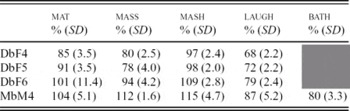
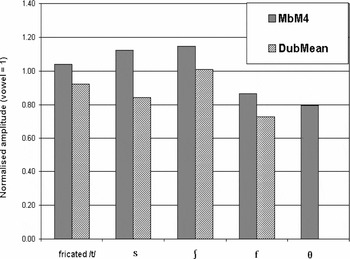
The individual subject means for relative amplitude are presented in table 2 and figure 5 below and show that the Middlesbrough male has the expected pattern of high amplitude for the sibilants /s/ and /ʃ/, with lower amplitude for the nonsibilants /f/ and /ɵ/. Fricated /t/ has an intermediate amplitude for MbM4. The female Dublin fricatives are generally lower in amplitude than the data for the Middlesbrough male subject. While /ʃ/ has the expected relatively high amplitude and /f/ the expected low amplitude, /s/ has a low amplitude, lower even than that of fricated /t/ which compares well with that of /ʃ/.
Individual subject means for the normalised amplitude of each fricative as a % of preceding modal vowel amplitude (standard deviations in parentheses)

Average normalised amplitude values (vowel = 1) for fricated /t/, /s/, /ʃ/, /f/ and for MbM4 also /ɵ/. Fricated /t/ has an amplitude higher than that of /f/ but lower than that of /ʃ/ for all subjects. Surprisingly, Dublin English /s/ is lower in amplitude than Dublin English fricated /t/

The standard deviations show greater variation in the amplitude of fricated /t/ for DbF4 and DbF6 than for the other fricatives. Amplitude variation for Dublin /s/ also seems to be high relative to the other fricatives, but variation for /s/ is lowest of all the fricatives for MbM4. Amplitude variation for fricated /t/ for MbM4 is similar to that for /f/, and not so different from that seen for /ʃ/.
5.4 Centre of gravity (COG) results
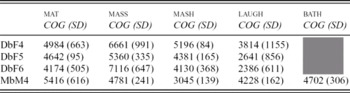
Individual averages for COG are presented in table 3 above. Across the Dublin English subjects, the highest average COG is seen for /s/, the lowest for /f/, and /ʃ/ has an intermediate COG. Fricated /t/ has an average COG which is relatively close to that of /ʃ/. For the Middlesbrough male a different picture emerges. His highest COG is for fricated /t/, followed by /s/, and then the nonsibilants /ɵ/ and /f/. The lowest average COG seen in his data is that of /ʃ/. The COG values for the Middlesbrough male are, as expected given differences in average vocal tract size between males and females, lower than the Dublin values for /s/ and /ʃ/, but the relative orderings are phonetically significant. Two discrepancies between the data sets arise: the COG of /f/, and the COG of fricated /t/.
Individual subject means for the centre of gravity (COG) of each fricative in Hertz (Hz) with standard deviations in parentheses

The relatively low COG for /f/ for the (female) Dublin English subjects runs counter to expectations and is unlikely to be due to sex-based vocal tract differences. The range of frequencies within 12 dB of the major spectral peak for two subjects (DbF5 and DbF6) is very narrow (see figure 6 below, and accompanying discussion), and this is bound to have an effect on COG, but must itself have an explanation. The lower than expected COG for Dublin English /f/ may indicate a slight articulatory difference in the formation of the labiodental constriction compared with that in other languages. The fricated /t/ COGs also differ in relative positions. In the Dublin data, the COG for fricated /t/ is similar to that for /ʃ/, whereas the COG for fricated /t/ for the Middlesbrough subject is more similar to (but higher than) that of Middlesbrough English /s/. In the Dublin data, fricated /t/ is less variable in terms of average COG than /s/. In the Middlesbrough data fricated /t/ has a much more variable COG than the other fricatives.
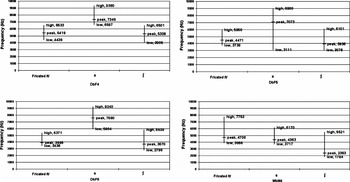
Average range (high–low) and peak values (Hz) for fricated /t/, /s/, and /ʃ/ for subjects DbF4, DbF5, DbF6 and MbM4

5.5 Peak frequency results
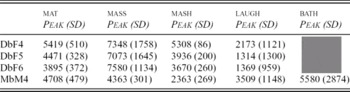
The individual average values for the frequency of the major spectral peak for each fricative are presented in table 4. The locations of the peaks within the range are illustrated in figures 6 and 7.
Individual subject means for the peak frequency for each fricative in Hertz (Hz) with standard deviations in parentheses

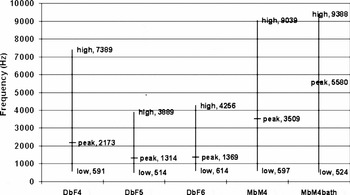
Average range and peak values (Hz) for /f/ (all subjects) and /ɵ/ (MbM4)

The individual averages for the frequency of the major spectral peak for the Dublin subjects show that the peak for the fricated /t/ is similar to that of /ʃ/ for each subject, but higher in frequency, between 111 Hz and 535 Hz higher. The peak for /s/ is much higher than that of fricated /t/, located at over 7000 Hz. The average peak values for /f/ are clearly very different from the other fricatives, with a much lower peak (1314 Hz – 2173 Hz).
The results for MbM4 show a pattern in which the peak for fricated /t/ at 4708 Hz is similar to but higher than that for /s/ at 4363 Hz, and very different from the low frequency peak at 2363 Hz for /ʃ/. The peak for /f/ is between those of /s/ and /ʃ/ at 3509 Hz, and the highest peak is seen for /ɵ/ at 5580 Hz.
The standard deviation data for peak frequency once again show that in the Middlesbrough data the fricated /t/ is very variable, more so than the other sibilants, but not as variable as the nonsibilants. In the Dublin English data, the location of the major spectral peak is slightly more variable for fricated /t/ than it is for /ʃ/, but much less variable than it is for /s/, which is even more variable in peak location than /f/.
5.6 Range results
The average range of frequencies falling within 12 dB of the major spectral peak and the location of the peak itself are presented in figure 6 for fricated /t/, /s/, and /ʃ/, and in figure 7 for /f/ and (MbM4 only) /ɵ/.
Figure 6 shows that the range and peak values for /s/ and /ʃ/ are similarly located relative to one another at both localities. The maximum frequency of the range for /s/ is located at a higher frequency than that of /ʃ/ for all subjects. At the lower end of the range, there is some considerable overlap for /s/ and /ʃ/ for DbF5 and MbM4, but clear differences in the location of the peak remain. The higher frequency range of /s/ is expected given previous analyses of /s/ in various languages (see e.g. Gordon et al. Reference Gordon, Barthmaier and Sands2002; Jongman et al. Reference Jongman, Wayland and Wong2000). Fricated /t/ for the Dublin subjects looks very similar in terms of range and frequency location to /ʃ/, with most energy between 3000 and 6000 Hz. For MbM4, on the other hand, fricated /t/ has a range and peak frequency which looks more similar to that seen for /s/. These findings support the results of Jones & Llamas (Reference Jones and Llamas2003): Dublin English fricated /t/ is more like /ʃ/, Middlesbrough English fricated /t/ is more like /s/.
Turning to /f/, and for MbM4 also /ɵ/, figure 7 shows that two patterns emerge. For DbF4 and MbM4, /f/ has a range with a very wide bandwidth. For MbM4, this pattern looks similar to that exhibited by /ɵ/, as expected given the widely reported acoustic similarities of these consonants. For DbF5 and DbF6, however, the range for /f/ is quite narrow, and located in the low-frequency region below 4000 Hz. For all three female Dublin subjects, the peak location is low within the range, and it is undoubtedly this which accounts acoustically for the low COG for Dublin /f/ in this study.
6 Discussion
This study has used instrumental methods applied to controlled speech to address some questions about the frication of /t/ in two varieties of English, Dublin English and Middlesbrough English. Controlled speech was used not only in order to allow a detailed acoustic analysis of the properties of the surface fricatives, but also because frication of plosives seems to be a common crosslinguistic effect in casual speech, and may be affected by subtle effects on, for example, intra-oral pressure. Consequently, the incidence (or nonincidence) of fricated plosives in casual speech cannot reliably demonstrate whether frication is phonological or phonetic, or would be present systematically in more formal styles.
The results of experiment 1 on the frication rates of /p/, /t/ and /k/ show that /t/ is not the only plosive with fricative realisations in word-final intervocalic positions at either locality. However, frication of /t/ does seem to have some characteristics indicative of a more rule-governed phenomenon. Most tellingly, frication of /t/ occurs categorically (i.e. without gradience in individual tokens) and nonvariably or nonsporadically (i.e. in all tokens in the sample) for some subjects at both localities. Indications of phonetic gradience are lacking for Irish English slit-/t/, and there seems to be little support in this study for Hickey's claim that ‘in formal styles, such as reading a text aloud, Irish English speakers only have a stop realization of /t/. . .’ (Hickey Reference Hickey1984: 237). Irish English fricated /t/ occurs in this controlled data set in read speech and does not appear to be the result of an online casual or fast speech process, such as fricated realisations of /t/ in more standard varieties of English spoken in southern England (Brown Reference Brown1977; Shockey & Gibbon Reference Shockey and Gibbon1993; Simpson Reference Simpson2001) or Greek (Nicolaidis Reference Nicolaidis2001). Non-neutralisation of production contrasts with other fricatives indicates that the locus of the pattern is in a postlexical language-specific phonetic component (see Keating Reference Keating1990). There may be systemic or historical reasons for the absence of regular frication of /p/ and /k/. Irish has a contrast between /x/ and /k/ (Ní Chasaide Reference Ní Chasaide1999), and /x/ may be a marginal consonant in Irish English (Wells Reference Wells1982: 433). As discussed in more detail below, the possible realisation of /f/ as [ɸ] for some speakers may preclude the frication of /p/ which would be expected to have a phonetically identical outcome (cf. systemic patterns in Lavoie Reference Lavoie2002; Ortega-Llebaria Reference Ortega-Llebaria and Face2004).
In the Middlesbrough English data, fricated /t/ occurs in a categorical nonvariable way for one male subject, and appears in more gradient fashion like a language-specific casual speech process for others, undoubtedly promoted by the high airflow rates of preaspirated plosives. The data suggest that MbM4, who produces categorical nongradient frication, may have a separate representation of the process from that for the other subjects. Nonidentity of the fricated /t/ form and other fricatives is suggestive of the process being located in the postlexical phonetic component for this subject. The gradience in /t/ frication for other subjects results in so-called ‘intermediate’ forms, which show varying amounts of frication. The actual articulatory time-course of the intermediate forms is unclear, as the loss of frication cannot straightforwardly be equated with complete closure of the vocal tract, due to the absence of any release bursts at the resumption of frication. Loss of frication may occur as the constriction becomes so small in cross-sectional area that airflow rates fall below the threshold value for the production of audibly turbulent airflow, or the jet of air is deflected away from any downstream obstacles (see Shadle Reference Shadle, Hardcastle and Marchal1990, Reference Shadle, Hardcastle and Laver1997; Stevens Reference Stevens1998). Stevens & Hajek (Reference Stevens and Hajek2005) present acoustic data on a class of ‘semi-fricatives’ in Sienese Italian, which they explain in terms of variable glottal width during a preceding preaspiration phase. Superficially, there are considerable similarities between the Sienese Italian ‘semi-fricatives’ and the Middlesbrough intermediate fricated /t/ tokens. Acoustically similar patterns have also been noted for Tyneside English in work by Docherty & Foulkes (Reference Docherty, Foulkes, McCormack and Russell1996, Reference Docherty and Foulkes1999), in particular their ‘archway’ subcategory (Docherty & Foulkes Reference Docherty, Foulkes, McCormack and Russell1996: 158–9). However, underlying fricatives in various languages can show a rise–fall–rise amplitude pattern (see section 4.3 above), so that the pattern of acoustic gradience seen with fricated /t/ is not necessarily evidence for a residual closure gesture. Relating patterns like these to similar patterns in crosslinguistic data is essential in order to understand the significance of the variation and its proper theoretical context.
Place of articulation effects require further investigation. The Middlesbrough results suggest that /t/ frication may be part of a more general phonetic effect which also affects /k/, and possibly /p/. Some subjects do produce all realisations of /k/ with categorical frication and no intermediate forms, such as are seen for /t/. This might suggest a similar rule-based frication of /k/ for those subjects. On the other hand, the frication of /k/ may produce a nonobstacle fricative with sufficient frication generated at the relatively long constriction itself (Shadle Reference Shadle, Hardcastle and Marchal1990, Reference Shadle, Hardcastle and Laver1997), making ‘intermediate’ forms less likely. Sorianello (Reference Sorianello2003: 3082) notes that /t/ is most often produced as a fricative in the acoustic analysis of a corpus of informal conversational Florentine Italian speech produced by two male and one female subjects. Fricative realisations of /p/ and /k/ do also occur, but approximant realisations are more common. Loakes and McDougall (Reference Loakes, McDougall, Cassidy, Cox, Mannell and Palethorpe2004: 174) reported a higher incidence of fricated /k/ (17.2%) than of fricated /p/ (11.6%) in a corpus of spontaneous Australian English speech. They did not look at /t/. The speaker consistency in frication rates observed by Loakes & McDougall (Reference Loakes, McDougall, Cassidy, Cox, Mannell and Palethorpe2004: 176) is not present in this controlled sample.
As the occurrence of categorically fricated realisations of /t/ across all subjects initially recorded was so variable (in qualitatively different ways) at both localities, only a few subjects in the sample provided data which were suitable for the detailed acoustic analysis: one out of ten for Middlesbrough; three out of ten for Dublin. However, the results of the acoustic analysis provide the first acoustic data on other fricative realisations at both localities and confirm the basic results of Jones & Llamas (Reference Jones and Llamas2003) for new subjects using several of the same (peak frequency, amplitude, duration) and several new (range, COG) measures. Dublin English fricated /t/ has many more similarities to Dublin English /ʃ/ than to Dublin English /s/: the COG and the location of the major spectral peak are very similar, and the ranges are largely overlapping. Middlesbrough English fricated /t/ has many more similarities to Middlesbrough English /s/ than to Middlesbrough English /ʃ/ in terms of COG and peak location. Although data from a single male Middlesbrough subject were analysed here, the pattern of relative acoustic similarity of Middlesbrough fricated /t/ to /s/ is found for three female subjects in Jones & Llamas (Reference Jones and Llamas2003). The sex difference between the male Middlesbrough subject and the female Dublin subjects does not account for the locality-specific differences in the acoustics of fricated /t/, and despite the small number of subjects in this study, confidence in the results is bolstered by the parallels in Jones & Llamas (Reference Jones and Llamas2003). The Jones & Llamas (Reference Jones and Llamas2003) results on peak frequency are presented in table 5 (as Mdb1, Mdb2, Mdb3 and Dub1) together with the data reported here.
Peak frequency (Hz) data (Mdb1–3 and Dub1) from Jones & Llamas (Reference Jones and Llamas2003: 657) together with the Middlesbrough (MdbM4) and Dublin (DbF4–6) data on peak frequency reported here

Table 5 clearly shows that the frequencies for /s/ and /ʃ/ are similar across female subjects at both localities, with the single male subject (MdbM4) having the biologically expected lower frequencies. The frequency of the peak for fricated /t/ is similar to that of their own /s/ for all Middlesbrough subjects, regardless of sex, but in the Dublin data the peak of fricated /t/ is similar to that of /ʃ/.
However, there are differences between fricated /t/ and /s/ and /ʃ/ at both localities, mainly in terms of amplitude and duration. In line with the results for Pandeli et al. (Reference Pandeli, Eska, Ball and Rahilly1997), Irish English fricated /t/ is shorter in duration than the phonological fricatives /s/ and /ʃ/, and the same is true for Middlesbrough English. In amplitude terms, fricated /t/ falls between the sibilants and nonsibilants in Middlesbrough, but has a higher amplitude than /s/ in Dublin English. Dublin English /s/ has a low amplitude which makes it appear more /ɵ/-like than /s/-like. Possibly the absence of a final /ɵ/ has had a systemic impact on the realisations of /s/ in Dublin, allowing a modification in the direction of /ɵ/, perhaps in order to maintain acoustic distinctiveness between /s/ and /ʃ/. There is no indication of merger of fricated /t/ with any other fricative in production. The extent to which amplitude and durational differences are used perceptually to distinguish between fricated /t/ and /s/ or /ʃ/, and, on the other hand, the question of whether spectral similarities are sufficient to cue perceptual misidentification of fricated /t/ remains to be investigated.
The most unexpected results from this current study concern Dublin English /f/ and /s/. Dublin English /f/ has a very low COG, a low peak frequency, and a relatively narrow range of frequencies within 12 dB of the peak for two of the three subjects whose data were analysed here. Data on American English /f/ in Jongman et al. (Reference Jongman, Wayland and Wong2000) have a much higher average COG at 5108 Hz than both sets of English data reported here. Measures of COG for /f/ more similar to that of the Middlesbrough data can be found for a range of languages in Gordon et al. (Reference Gordon, Barthmaier and Sands2002): Chickasaw, 4562 Hz; Scottish Gaelic, 4415 Hz; and especially Toda, 4268 Hz. Dublin English realisations of /f/ analysed here could be phonetically [ɸ], i.e. voiceless bilabial fricatives (see Ladefoged & Maddieson Reference Ladefoged and Maddieson1996: 141–3; Strevens Reference Strevens1960: 44; Utman & Blumstein Reference Utman and Blumstein1994). The use of [ɸ] for /f/ in Irish English would not be completely unexpected (see Wells Reference Wells1982: 434), and certainly accords with auditory impressions of the recordings. Utman & Blumstein (Reference Utman and Blumstein1994) and Ladefoged & Maddieson (Reference Ladefoged and Maddieson1996: 141–3) show that the /f/ ∼ /ɸ/ contrast in the West African language Ewe is characterised by greater energy at lower frequencies for /ɸ/ than for /f/ (below 6 kHz; Utman & Blumstein Reference Utman and Blumstein1994: 226), implying a lower COG for /ɸ/ in that language, and Strevens (Reference Strevens1960: 44) reports a concentration of energy at lower frequencies for [ɸ]. Consequently, two speakers of Dublin English analysed here may have a [ɸ] realisation of /f/. Further acoustic data and direct articulatory confirmation of this analysis are required.
The variation in usage of the terms ‘sibilance’ and ‘strident’ has already been raised above (e.g. Utman & Blumstein Reference Utman and Blumstein1994). The present study contains no articulatory data, but given the spectral data on similarities with /s/ or /ʃ/, it seems likely that fricated /t/ at both localities is an obstacle fricative (Ladefoged & Maddieson Reference Ladefoged and Maddieson1996; Shadle Reference Shadle, Hardcastle and Marchal1990, Reference Shadle, Hardcastle and Laver1997), and could therefore be ‘sibilant’ in line with Ó Baoill (Reference Ó Baoill1997: 82). The amplitude differences between fricated /t/ and /ʃ/ at both localities suggest that fricated /t/ could be nonstrident. However, the nonstrident nature of fricated /t/ is not so clear-cut, as fricated /t/ falls between the amplitude of the sibilants and nonsibilants for the single Middlesbrough subject, but is greater in amplitude than /s/ for all three Dublin subjects. Using amplitude as the sole measure of stridency, if Dublin English fricated /t/ is nonstrident, Dublin English /s/ is also nonstrident.
Kirchner (Reference Kirchner, Hayes, Kirchner and Steriade2004: 326–7) defines sibilants in terms of duration, and on this count fricated /t/ would be nonsibilant, being shorter than /s/ and /ʃ/ at both localities. Fricated /t/ is also longer than nonsibilant /f/ for most subjects at both localities. Standard deviations for average peak frequencies suggest that the nonsibilant /f/ (and MbM4's /ɵ/) have very variable peak locations, whereas sibilant /ʃ/ has a much less variable peak frequency. If variability of peak frequency is used as some kind of indicator of the articulatory precision required for sibilants, fricated /t/ falls between the sibilants and nonsibilants at both localities, but for Dublin English, the low amplitude /s/ is also highly variable. This variability could be due to amplitude itself, and therefore an indirect indication of low amplitude frication, rather than a separate factor. More research on the nature and perceptual and crosslinguistic validity of criteria for sibilance/stridency is required. However, these results indicate that acoustic data from a particular language, not assumptions based on descriptions of ‘the same’ fricatives in other languages, are essential for determining whether or not the outcome of a frication process could be sibilant/strident.
The finding that the acoustic characteristics of fricated /t/ differ between the two localities speaks against a common origin for Dublin and Middlesbrough English fricated /t/ in terms of a transfer effect due to contact with Irish English. Based on the results presented here and the earlier findings of Jones & Llamas (Reference Jones and Llamas2003), it seems likely that Middlesbrough English fricated /t/ is due to crosslinguistically common phonetic processes involving the incomplete occlusion of plosives in certain environments. Proponents of an Irish English transfer account for Middlesbrough English fricated /t/ would have to explain how it is that the transfer from Irish English has resulted in a phonetically distinct realisation.
Irish English fricated /t/ is said to derive historically from a phonological transfer effect based on the morphophonological ‘lenition’ of initial consonants in Irish, or the transfer of an assumed greater tendency to fricate all plosives in Irish, with a subsequent restriction to /t/ (Hickey Reference Hickey1986; Wells Reference Wells1982: 429–30; but see Hickey Reference Hickey1984 for problems). An alternative account would see Irish English fricated /t/ being due to a transfer effect from Irish involving the mapping of Irish palatal alveolar /ṯj/ to English /t/, and the mapping of Irish nonpalatalised dental /t̪ɣ/ to English /ɵ/, in the formation of Irish English (Ó Baoill Reference Ó Baoill, Edmondson, Feagin and Mühlhäusler1990: 159–60; Reference Ó Baoill1997: 80–1; also Ó hÚrdail Reference Ó hÚrdail1997: 146). Instrumental work has established that even experienced non-native speakers of a second language fail to attain native-like proficiency of sounds which have an ‘equivalent’ in their native language, and that inexperienced non-native speakers may continue to use almost native-like realisations of the ‘equivalent’ sound (e.g. Flege Reference Flege1987). The use of plosive realisations of /ɵ/ in Irish English has been referred to above. Irish palatalised /ṯj/ presented a range of realisations historically: lamino-dental, alveolo-palatal, lamino-alveolar, or apico-alveolar (Ó Baoill Reference Ó Baoill1997: 81), and furthermore it is often (af)fricated (Ní Chasaide Reference Ní Chasaide1999: 113). Evidence for a palatal realisation of /t/ in Irish English also comes from realisations of /s/ as [ʃ] before /t/ in, for example, cost, fist (Ó Baoill Reference Ó Baoill1997: 81). The palatal pronunciation of /k, g/ and /l/ in Irish English (Ó Baoill Reference Ó Baoill, Edmondson, Feagin and Mühlhäusler1990, Reference Ó Baoill1997) suggests that the non-native pronunciation of English consonants may have been generally influenced more by the native Irish palatalised series than by the native Irish velarised series, regardless of (or in addition to) any segment-specific equivalence mapping.
7 Conclusions
The frication of /t/ in two varieties of English results in spectrally different fricatives, suggesting that the two phenomena are not directly related in terms of historical dialect contact, and indicating that perceptual confusion between fricated /t/ and other voiceless fricatives is unlikely but could occur if amplitude and durational differences are not attended to. The available data confirm the earlier results of Jones & Llamas (Reference Jones and Llamas2003), and represent a first detailed study of the acoustics of surface fricative realisations, including fricated realisations of /t/, at both localities. Future works will address sociolinguistic patterning and the maintenance of perceptual contrasts in more detail.