Soil and adjacent leaf-litter environments support a diverse decomposer fauna. This has led to what is known as ‘the enigma of the soil fauna’, or the question of how it is possible for such large numbers of species to coexist without obvious biotic mechanisms, such as competitive exclusion, limiting coexistence (Anderson Reference ANDERSON and Vanek1975). Dietary specialization or effective partitioning of food resources could be a mechanism to avoid niche overlap among sympatric soil/litter species (Chahartaghi et al. Reference CHAHARTAGHI, LANGEL, SCHEU and RUESS2005, Jennings & Barkham Reference JENNINGS and BARKHAM1975). However, unravelling the complexities of trophic relationships can be difficult, especially in soil/leaf-litter habitats where both consumers and prey are small, diverse and often unidentifiable (Scheu & Falca Reference SCHEU and FALCA2000). As such, the trophic relationships among species in these habitats typically remain unresolved.
Stable isotope ratios, particularly 15N/14N and 13C/12C ratios (expressed as δ15N and δ13C), are increasingly used to identify trophic relationships among organisms in soil and leaf-litter habitats (Chahartaghi et al. Reference CHAHARTAGHI, LANGEL, SCHEU and RUESS2005, Ponsard & Arditi Reference PONSARD and ARDITI2000, Scheu & Falca Reference SCHEU and FALCA2000, Schmidt et al. Reference SCHMIDT, CURRY, DYCKMANS, ROTA and SCRIMGEOUR2004). Nitrogen ratios (δ15N) are used to estimate trophic positions of organisms because stepwise enrichment of 15N (3.4‰ ± 1.1‰) is usually observed with each trophic transfer (Post Reference POST2002). Carbon ratios (δ13C) are used to determine the dietary source because carbon ratios typically vary among primary producers but change little with trophic transfers (0.4‰ ± 1.4‰) (Ostrom et al. Reference OSTROM, COLUNGA-GARCIA and GAGE1997). Together δ15N and δ13C can identify subtle differences in trophic position among litter invertebrates (Schmidt et al. Reference SCHMIDT, CURRY, DYCKMANS, ROTA and SCRIMGEOUR2004).
Our goal was to use δ15N and δ13C to investigate the trophic relationships among terrestrial mollusc species (native and non-native) in the leaf-litter of a Hawaiian rain forest. We focus on terrestrial molluscs because they are major components of Hawaiian terrestrial biodiversity (Cowie et al. Reference COWIE, EVENHUIS and CHRISTENSEN1995). We evaluated two hypotheses: (1) mollusc species partition food resources and occupy distinct trophic niches and (2) δ15N increases during the decomposition process. While differences in δ13C are used to determine dietary source, differences in δ15N between the leaf-litter and fresh plant material may allow identification of contributions of the above-ground and below-ground food webs to the various molluscs.
Molluscs, other soil invertebrates and plants were collected from a 20 × 20-m area in the Upper Waiakea Forest Reserve (19.33479°N, 155.15023°W) on the eastern (windward) side of the island of Hawaii. The site is a young (the last lava flow to cover the area was ~ 2100 y ago) wet forest with dense canopy cover that typically receives an annual rainfall of 2500 to >5000 mm (Meyer & Cowie Reference MEYER and COWIE2010a). The plant community is characterized by the dominant native tree, Metrosideros polymorpha Gaudich., mid-canopy tree ferns, Cibotium spp., and understorey plants such as Broussaisia arguta Gaudich. The only common native mollusc in the litter is Succinea cepulla Gould. Other Succinea species occur in the area but are typically found on plants and rarely seen in the litter (Meyer Reference MEYER2009). Common invasive molluscs in the study area are the slugs Arion intermedius Normand, Limax maximus Linnaeus and Deroceras laeve Müller, and the predatory snail Oxychilus alliarius Miller, all of which are widely distributed within the Hawaiian Islands (Meyer & Cowie Reference MEYER and COWIE2010a).
To identify the isotopic baseline, leaf-litter (leaves collected after abscission) were allowed to decompose for 0, 6 and 12 mo at the site, and leaves (pre-abscised) were collected from the three most common plant species as determined by numbers of individuals. Leaf-litter consisted of leaves collected just after abscission between June 2007 and December 2007. Leaves from all plant species at the study site were collected and mixed thoroughly to ensure a random mixture of species. To evaluate if isotopic ratios change as litter decomposes, leaf-litter was placed in bags that were deployed in the field. Each bag consisted of a 10 × 10 × 8-cm plastic-mesh food carton (to provide a three-dimensional framework) covered with plastic screen (2.0-mm mesh). Each bag contained 4.0 g (mean air-dry mass) of leaf-litter and had two holes (2.5 cm diameter) cut in the mesh on opposite sides of the bags to allow macro-invertebrates access. The leaf-litter decomposition experiment ran from 20 January 2008 to 9 January 2009. In total, 20 bags were released at the site and six and eight litter bags were recovered after 6 and 12 mo, respectively. Ten 4.0-g leaf-litter samples were not placed in the field and were used to assess the isotopic signatures of fresh litter. Fresh leaves of the three most common plant taxa (Metrosideros polymorpha, Cibotium spp., Broussaisia arguta) were collected from six individual plants within the study area in August 2008 to evaluate differences among plant species and between pre-abscised and abscised leaves.
Molluscs and non-molluscan invertebrates were collected in July 2008. Molluscs were collected by hand. Non-molluscan invertebrates were extracted from the leaf-litter that had been allowed to decompose for 6 mo. The litter bags were collected in the field and their contents immediately transferred into Berlese funnels for 48 h to extract invertebrates (temperatures of litter in the funnels did not exceed 30 °C). All invertebrates collected were preserved in 95% ethanol. Non-molluscan invertebrates included one oligochaete species (earthworm) and the dominant arthropod groups: Acari (mites), Aranaeae (spiders), Collembola (springtails), Diplopoda (millipedes) and Isopoda (isopods). We used one-way ANOVAs and Tukey's multiple comparison tests to determine differences in N and C isotopic signatures among terrestrial molluscs and potential food sources (three plant species and three leaf-litter treatments). Nitrogen isotopic ratios of non-mollusc invertebrates were used to help confirm placement of terrestrial molluscs into feeding guilds. Isopod, millipede, springtail and earthworm samples were used to identify primary decomposers, those probably feeding on litter/detritus with adhering lichens, algal mats, fungi and bacteria. The mite sample, which included both predatory and detritivorous mites, was used to identify secondary consumers, a group feeding either on a mixture of litter and other invertebrates, or microbes that can be enriched in 15N (Högberg et al. Reference HÖGBERG, HÖGBERG, QUIST, ECKBLAD and NÄSHOLM1999). Spiders were used to identify predators/scavengers or those species feeding on either live or dead invertebrates.
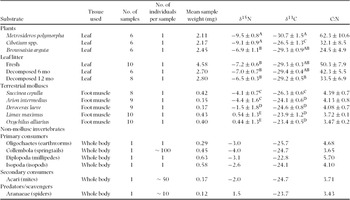
Most efforts to elucidate diets of terrestrial molluscs typically involve direct observations of feeding behaviour, gut analysis or food choice experiments, and conclude that most molluscs are general grazers, feeding indiscriminately on leaf-litter and associated microbes (Barrada et al. Reference BARRADA, IGLESIAS and CASTILLEJO2004, Cook & Radford Reference COOK and RADFORD1988, Jennings & Barkham Reference JENNINGS and BARKHAM1975). In contrast, our study provides evidence of food partitioning and indicates that mollusc species occupy distinct trophic niches and multiple trophic levels (Table 1), suggesting that dietary specialization or effective partitioning of food resources may help explain their coexistence.
Sample description and isotopic values (δ15N and δ13C) for all treatments. Values denoted with the same superscript letter do not differ significantly.

Assuming an enrichment of δ15N of ~ 3.4‰ per trophic level (Post Reference POST2002), a δ15N range of 4.94‰ (−9.5‰–1.5‰) indicates the presence of at least two trophic levels. Comparing mollusc isotopic ratios to the ratios of non-mollusc invertebrates for which we had a priori assumptions of their trophic guild, we assigned terrestrial molluscs to three feeding guilds: (1) primary consumers/decomposers, (2) omnivores/secondary consumers or (3) predators/scavengers. The native snail S. cepulla and the introduced slug A. intermedius were assigned as primary consumers because individuals were enriched in δ15N ~ 3.4% above the leaf-litter, suggesting these species feed on litter/detritus with adhering fungi and bacteria (Table 1). The δ15N values for Cibotium spp. and M. polymorpha, the two most abundant plant species at our study site, are ~ 5% lower than any mollusc species indicating that S. cepulla and A. intermedius probably feed primarily on leaf-litter, not fresh plant material. However, using isotopes to distinguish between above-ground and below-ground food webs is complicated in our system because live tissue from B. arguta had a similar δ15N to that of the leaf-litter (Table 1). However, it is unlikely that these species consume live plants because they were always found in the litter (pers. obs.). Increased degree of decomposition of food sources can result in δ15N enrichment of soil animals (Schmidt et al. Reference SCHMIDT, CURRY, DYCKMANS, ROTA and SCRIMGEOUR2004). However, we only observed a slight, non-significant, trend for δ15N to increase (0.7%) during the decomposition process (Table 1). As such, larger differences in δ15N values between litter and live plant tissue are most likely the result of differences in proportions of 14N and 15N reabsorbed before abscission, because fresh litter (composed primarily of Cibotium spp. and M. polymorpha leaves) had significantly higher δ15N values than tissues collected from living Cibotium spp. and M. polymorpha (pre-abscission).
The invasive molluscs, D. laeve, L. maximus and O. alliarius, feed higher in the food web (Table 1). Deroceras laeve was classified as an omnivore or secondary consumer because δ15N values were intermediate between those of primary decomposers and predators/scavengers. Deciphering the diet of D. laeve at a finer scale is difficult using stable isotopes alone. For instance, intermediate δ15N values may indicate omnivory (feeding on both animal and plant resources) which is prevalent in soil food webs (Eggers & Jones Reference EGGERS and JONES2000), or may indicate that D. laeve is selectively feeding on microbes in the litter, which can in some ecosystems be enriched in δ15N compared with the surrounding environment (Högberg et al. Reference HÖGBERG, HÖGBERG, QUIST, ECKBLAD and NÄSHOLM1999). Analysis of the diet of a congeneric species, Deroceras reticulatum, indicated that a small proportion of its diet consisted of animal material (Barrada et al. Reference BARRADA, IGLESIAS and CASTILLEJO2004). Limax maximus and O. alliarius were classified as predators/scavengers, because individuals enriched in δ15N ~ 3.4% above primary decomposers. Oxychilus alliarius preys on snails (Meyer & Cowie Reference MEYER and COWIE2010b) and δ15N was therefore expected to be more enriched than the other molluscs. However, we were surprised by the high δ15N values associated with L. maximus, which indicates that plant material does not form a significant proportion of its diet. This contradicts Cook & Radford (Reference COOK and RADFORD1988) who, examining faecal pellets, found the diet of L. maximus in Northern Ireland consists primarily of vascular plant material. Explanations for this discrepancy include: (1) novel feeding behaviours by L. maximus in its non-native range or (2) that L. maximus does ingest a large portion of plant material, but may only assimilate material from the invertebrates and microbes on that plant material. Limax maximus has been observed consuming a variety of food items other than plants including dung, dog food, dead/crushed molluscs and rat bait in Hawaii (pers. obs.).
Values of δ13C are typically expected to change little with each trophic transfer (0.4% ± 1.4%) (Ostrom et al. Reference OSTROM, COLUNGA-GARCIA and GAGE1997). However, in our study, all invertebrates were enriched in δ13C compared to plant and litter food resources (Table 1). Enrichment between invertebrates and plant material was less for Cibotium spp. (0.2%–3.7%) than for B. arguta (3.0%-6.5%), leaf-litter (3.0%–6.5%), and the dominant tree species M. polymorpha (4.4%–7.9%). Using the convention that δ13C is expected to change little with trophic transfers (0.4% ± 1.4%), we would conclude that Cibotium spp. contribute to the leaf-litter food web but that the other two plants contribute little. However, it seems inconceivable that the dominant tree species, M. polymorpha, would not contribute to the leaf-litter food web in Hawaii. Primary consumers in our system may be elevated in δ13C relative to primary producers for a variety of reasons. Litter invertebrates may be feeding primarily on fungi and bacteria for which isotopic values are often not determined here but can have higher δ13C values than the detritus (Gregorich et al. Reference GREGORICH, LIANG, DRURY, MACKENZIE and McGILL2000) or litter invertebrates may only be able to assimilate certain fractions of the litter (Martin et al. Reference MARTIN, BALESDENT and MARIOTTI1992). Elevated δ13C values may have also resulted from the preservation technique used (invertebrates preserved with 95% ethanol) which can increase δ13C values (Kaehler & Pakhomov Reference KAEHLER and PAKHOMOV2001). Regardless of reasoning, δ13C values currently cannot reliably provide an estimate for the contributions of different food sources in our leaf-litter food web because δ13C enrichment differs considerably from what is expected for the first trophic transfer.
Although, dual analysis of δ13C and δ15N can identify subtle feeding differences among species (Schmidt et al. Reference SCHMIDT, CURRY, DYCKMANS, ROTA and SCRIMGEOUR2004), we suggest that differences in δ13C among molluscs should be interpreted as hypotheses that still require further testing. Significant differences in δ13C between the primary decomposers A. intermedius and S. cepulla suggest these species use different food resources (Table 1). Succinea cepulla, the only native snail examined, differs from all the invasive molluscs in δ13C suggesting little dietary overlap. However, evidence for competition has been observed between the primary consumers A. intermedius, S. cepulla and millipedes at our study site, but not between millipedes and other molluscs that feed higher in the food web (W.M. Meyer unpubl. data), suggesting that species at similar trophic levels, as defined here by δ15N, may compete for food resources despite differences in δ13C values.
In our study, we demonstrate that stable isotopes, particularly nitrogen, can be used to define trophic relationships among molluscs and examine the roles of resource partitioning and competition in structuring soil/litter mollusc communities. Isotopic ratios provide evidence of food partitioning among mollusc species and indicate that these species occupy distinct trophic niches, suggesting that partitioning of food resources may help explain coexistence. In addition, our study underscores that classification of terrestrial molluscs as general grazers is not appropriate as they occupy a wide trophic breadth that ranges from primary to secondary consumers to predators/scavengers. Since many of the same non-native species examined here have also become established on other Hawaiian and Pacific islands (Cowie Reference COWIE2001, Cowie et al. Reference COWIE, HAYES, TRAN and MEYER2008), determining the trophic relationships of these species can have wide-ranging implications for understanding resource utilization and competition among mollusc species and other soil invertebrates throughout the Pacific.
ACKNOWLEDGEMENTS
We thank Jodie Schulten, Barbara Rowe and Rebecca Ostertag for help with field collections, and Aaron Shiels, Robert Cowie and Sheldon Plentovich for reviews of draft manuscripts. Financial support was provided by the National Science Foundation (DEB0710435 to R. H. Cowie and W. M. Meyer), the Ecology, Evolution and Conservation Biology programme of the University of Hawaii (DGE05–38550 to K. Y. Kaneshiro), the Jessie Kay fellowship and Conchologists of America.