

1. Introduction
This study reports on a quantitative variationist investigation of the competing forms used to express futurity in the French Caribbean territory of Martinique. To this effect, I investigate the overall distribution of future verb forms in spoken Martinique French and explore whether the constraint systems reported for other varieties of French also hold in a Caribbean context. In the course of this analysis, competing statistical methods (fixed versus mixed-effects models) will be tested in order to assess the extent to which random effects, such as individual speaker and lexical verb, affect the variance in the French future temporal reference system (cf. also Roberts Reference Roberts2012). Such an approach is of particular importance when examining variation in Martinique since high levels of interspeaker variability have previously been reported in the speech of individuals living in small island communities, such as on Tristan da Cunha in the South Atlantic Ocean (Schreier Reference Schreier2006). It will also enable us to build a more comprehensive picture of the variable grammar in this regional French variety.
In all contemporary varieties of French, future temporal reference is realized predominantly via three different constructions: the inflected future (IF)Footnote 1, given in (1a), the periphrastic future (PF), in (1b), and the futurate present (FP), in (1c). This article focuses exclusively on the alternation between inflected and periphrastic future verb forms. The third variant, the futurate present, has been excluded from my investigation. This decision was motivated by two main reasons: (i) it occurs infrequently in spoken French and almost categorically co-occurs with future time adverbials; (ii) the vast majority of previous studies did not submit this marginal variant to variationist analysis.Footnote 2
- (1)
a. Je prendrai à peu près une année sabbatique. [MAJ]Footnote 3
‘I will take about a year off.’
b. Je ne pense pas qu'ils vont voter pour lui. [NOR]
‘I don't think they are going to vote for him.’
c. L'année prochaine je pars en métropole. [DOT]
‘Next year I leave for the mainland.’
2. Previous studies
In both prescriptive and pedagogical grammars, the two main linguistic factors governing variant choice are claimed to be (a) the temporal distance between speech time and the future eventuality and (b) the degree of certainty expressed by the speaker that the future event will in fact take place (Grevisse and Goosse Reference Grevisse and Goosse1993, Hawkins and Towell Reference Hawkins and Towell2001). The periphrastic future, for instance, has been claimed to mark “souvent un futur proche, parfois aussi un futur relativement lointain mais considéré comme inéluctable” (Grevisse and Goosse Reference Grevisse and Goosse1993: 1230).Footnote 4 Variationist linguistic studies have tested these claims quantitatively based on Laurentian (Deshaies and Laforge Reference Deshaies and Laforge1981, Emirkanian and Sankoff Reference Emirkanian, Sankoff, Lemieux and Cedergren1985, Zimmer Reference Zimmer1994, Poplack and Turpin Reference Poplack and Turpin1999, Blondeau Reference Blondeau2006, Poplack and Dion Reference Poplack and Dion2009, Grimm Reference Grimm2010, Grimm and Nadasdi Reference Grimm and Nadasdi2011, Wagner and G. Sankoff Reference Wagner and Sankoff2011, Sankoff et al. Reference Sankoff, Tagliamonte and Smith2012) and Acadian (Chevalier Reference Chevalier, Boudreau and Dubois1996, King and Nadasdi Reference King and Nadasdi2003, Comeau Reference Comeau2011) varieties of Canadian French, as well as European French (Söll Reference Söll and Hausmann1983, Roberts Reference Roberts2012).Footnote 5
These studies have demonstrated that the constraint systems operating on the variable are much more complex than the prescriptive literature suggests (see sections 4.2 and 4.3). Furthermore, they have shown that, in speech, there exists a general tendency for speakers toprefer periphrastic verbs forms. In Laurentian French, the frequency of inflected forms is reported to range from only 11 % (N = 135) in Ontarian French (Grimm and Nadasdi Reference Grimm and Nadasdi2011: 181) to 22 % (N = 725) in Ottawa-Hull (Poplack and Turpin Reference Poplack and Turpin1999: 148).Footnote 6 In contrast, there is a greater prevalence of the IF (41 %, N = 179) in European French (Roberts Reference Roberts2012: 101) and in the more conservative Acadian varieties: IF usage rates vary from 38 % (N = 257) in Baie-Sainte Marie, Nova Scotia (Comeau 2011: 226) to 53 % (N = 362) in Prince Edward Island and Newfoundland (King and Nadasdi Reference King and Nadasdi2003: 332). For written French, we find a reversal of this trend. Lesage and Gagnon (Reference Lesage and Gagnon1993) and Wales (Reference Wales2002) report that the incidence of IF forms far exceed that of the periphrastic future in their journalistic corpora: 97 % in Québec and 90 % in Ouest-France regional newspapers.
3. The Data
With a population of nearly 400,000 people (IEDOM 2010: 24), the volcanic island of Martinique is the third largest island in the Lesser Antillean archipelago. More specifically, it is located to the south of Dominica and to the north of Saint Lucia. It is bordered by the Caribbean Sea to the west and the Atlantic Ocean to the east. Martinique has been incorporated into the institutional, political, and legal framework of the French state since 1946 (see Hintjens Reference Hintjens, Burton and Reno1995, Reno Reference Reno, Burton and Reno1995).Footnote 7 Nowadays, Martinique forms an integral part of the French Republic as a département et région d'outre-mer ‘overseas mono-departmental region’ (DROM).Footnote 8 The native islanders of Martinique (les Martiniquais) are thus full French citizens. Even though the island is located approximately 7000 km from Paris, Martinique nevertheless constitutes part of France just like any other French région or département,Footnote 9 as the quotation below from Burton (Reference Burton, Burton and Reno1995: 2) confirms:
The Frenchness of [Martinique] is undeniable. It is not just the Monoprix and Unimags [supermarkets, NSR] […], not just the administrative and political superstructures, the French-style educational and social security systems, the autoroutes chock-a-block with Peugeots, Citroëns and Renaults […], not just the baguettes, the day-old copies of Le Monde and Libération, the mulâtresses in the latest Paris fashion. Far deeper than such surface manifestations, the Frenchness of Martinique […] involves a mentality produced by more than 350 years of near-continuous occupation by France.
The data discussed in this article are derived from a corpus of spoken Martinique French (see Roberts Reference Roberts2014). The corpus comprises approximately 16 hours of semi-directed interviews which I conducted between December 2010 and February 2011. The analysis is based on a socially-balanced judgement sample of 32 informants, all of whom originate from the Saint-Pierre arrondissement ‘administrative district’ in the northwest of the island. Other than for schooling, they have remained in this area for their entire lives.Footnote 10 The data were gathered using a semi-directed sociolinguistic interview protocol. The main aim of the sociolinguistic interview is to elicit the informants’ vernacular style. Labov (Reference Labov1972: 208) defines the vernacular as “the style in which the minimum attention is given to the monitoring of speech”. More recent definitions have affirmed that the vernacular is “everyday speech” (Sankoff Reference Sankoff1980: 54), “real language in use” (Milroy Reference Milroy1992: 66) or “the language of locally based communities” (Eckert Reference Eckert2000: 17), among others. To reduce the formality of the conversation, I conducted the recordings at a location of the informants’ choosing: they took place in a classroom, in the schoolyard, in a private work office, at home, on the beach or in a quiet café. The questions I asked my participants were based on the modules, or topic areas, found in a traditional sociolinguistic interview (Labov Reference Labov1972) but they were adapted to community-specific issues and traditions (Meyerhoff and Walker Reference Meyerhoff and Walker2007).Footnote 11
Given Martinique's DROM status, French constitutes the official language of the native islanders. The inhabitants of Martinique also speak a French-lexifier Creole, known as créole martiniquais (see Pinalie and Bernabé Reference Pinalie and Bernabé2000, Bernabé Reference Bernabé2003 inter alia). The sociolinguistic situation in Martinique is often characterized as diglossic (Ferguson Reference Ferguson1959). Traditionally, the use of Creole is reserved for informal conversation among friends and family, whereas Standard French is taught in schools and is used in more formal, public situations. Recent empirical research on present-day language use in Guadeloupe, the other French DROM located in the Lesser Antilles, reveals that the use of the local Creole variety has become highly restricted. In a recent study of Guadeloupe French, Pustka (Reference Pustka2007a: 261) notes that, nowadays, the vast majority of Guadeloupéens acquire the local variety of French as their L1 rather than a supralocal variety. This is also the case in Martinique, which has traditionally been viewed as more assimilated to mainland France, both linguistically and culturally, than its sister island (Pustka Reference Pustka2007b: 60).
All of my participants spoke the regional variety of French and the local French-lexifier Creole to varying degrees of competency. I chose to control for my informants’ level of bilingualism by using a modified version of Mougeon and Beniak's (Reference Mougeon and Beniak1991: 72) language-restriction index. Essentially, the index provides a quantitative measure of informants’ use of French in interpersonal communication. The language-restriction index has been extensively utilized in research on bilingual communities in Ontario, Canada (see Mougeon and Nadasdi Reference Mougeon and Nadasdi1998 and Nadasdi Reference Nadasdi, Valdman, Auger and Piston-Hatlen2005 inter alia) and has produced consistent findings concerning the effect it exerts on speakers' choice of variant forms. For instance, more restricted speakers display a tendency to prefer morphologically simple forms: In their study of irregular 3pl verbs (e.g., ils comprennent ‘they understand’), Mougeon and Beniak (Reference Mougeon and Beniak1991: 101–103) demonstrate that speakers with greater levels of restriction prefer to simplify the verbal paradigm so that 3sg and 3pl verb forms are homophonous (e.g., il(s) comprend ‘he/they understand’). Moreover, research has illustrated that speakers in the restricted cohort tend to limit their use of informal variants. They display lower rates of schwa deletion (Mougeon et al. Reference Mougeon, Nadasdi, Rehner and Uritescu2002), /l/ deletion (Tennant Reference Tennant1995), subject doubling (Nadasdi Reference Nadasdi2000), ne-use (Burdine and Mougeon Reference Burdine and Mougeon1999), ça fait que as an expression of consequence (Mougeon and Beniak Reference Mougeon and Beniak1991), and the restrictive construction rien que (Rehner and Mougeon Reference Rehner and Mougeon1998).
On the basis of their different life experiences, I created two separate surveys for my younger speakers and older participants, respectively. The questions focused on language use in a variety of communicative settings (e.g., home, classroom, playground, church) as well as with a range of interlocutors (e.g., mother, father, friend, spouse, boss, teacher). They also assessed the direction of the exchange (informant to interlocutor or interlocutor to informant). In each case, speakers were asked to rate how often they communicate in French and créole martiniquais on a four-point scale, ranging from ‘always in French’ to ‘always in Creole’.
I subsequently scored each response from zero to three depending on whether the participants spoke, or were spoken to, always in Creole (0), mostly in Creole (1), mostly in French (2), always in French (3). Each question was equally weighted, regardless of the setting, interlocutor(s), or directionality. A mean index score was then calculated for each subject ranging from zero (i.e., they always communicate in Creole) to one (i.e., they only spoke French). Traditionally, Mougeon and collaborators have classified speakers into one of three groupings on the basis of their language restriction score: ‘restricted’ speakers are those who use French infrequently (<0.45); ‘semi-restricted’ speakers have mid-to high levels of restriction (0.45–0.79) and communicate in both languages in relatively equal proportions; ‘unrestricted’ speakers are the most frequent users of French (>0.79).
The restriction scores of my Martinique informants range from 0.52 to 0.91. There are no restricted speakers, 17 semi-restricted speakers, and 15 unrestricted speakers. This distribution appears to corroborate Pustka's (Reference Pustka2007a, Reference Pustka2007b) observation that the islanders in France's Caribbean territories are indeed predominantly L1 French speakers. Note further that, although previous research on Ontario French has treated this social factor group as a discrete variable, I include each speaker's individual language-restriction score in the quantitative analyses reported in subsequent sections.
4. Methodology
This section has two principal aims: firstly, to define the envelope of variation, with those tokens falling outside the variable context identified and excluded from quantitative analysis, and secondly, to present and explain the salient linguistic and social constraints hypothesised to constrain variant selection in the Martinique future temporal reference sector, along with the coding protocol adopted in the present study.
4.1 Excluded tokens
The variationist linguistic enterprise seeks to correlate the use of sociolinguistic variants with linguistic and social conditioning factors. According to Labov's (Reference Labov1972: 72) ‘principle of accountability’, it is first necessary to identify the contexts in which a variant did occur, as well as those cases in which it could have occurred but did not. This practice, known as “clos[ing] the set that defines the variable” (Labov Reference Labov1996: 78), aims to create a homogenous dataset that is not contaminated by semantically and pragmatically non-equivalent cases. Only once these instances have been identified and removed from the data pool will the remaining tokens respond well to quantitative analysis (Coveney Reference Coveney2007: 103). As a result, every verb form that featured IF tense morphology and every aller periphrasis was first extracted from the Martinique corpus using the AntConc concordance program (Anthony 2011). However, since the present study analyses variability in the French future temporal reference sector and not merely those verbal forms featuring future morphology, I excluded a number of tokens in line with the protocol for delimiting the variable context which was first outlined in Poplack and Turpin (Reference Poplack and Turpin1999: 143–145) and refined in more recent work (cf. Grimm and Nadasdi Reference Grimm and Nadasdi2011: 174–175, Wagner and Sankoff Reference Wagner and Sankoff2011: 279–284).
Following this procedure, I discarded all ‘false futures’, that is those tokens that exhibit future morphology but do not actually reference a future eventuality. As such, all habituals (2a), hypotheticals (2b), instances of aller ‘to go’ used to indicate spatial movement (2c), and imperatives/pseudo-imperatives (2d) were excluded from the dataset and not considered in my quantitative analysis. It was also necessary to remove those tokens that have a future temporal reference but do not have full variability: for example, tokens occurring in the protases of conditional si-clauses (2e) were discarded as such contexts prohibit IF.
- (2)
a. Des fois on va rigoler avec le professeur. [NOR]
‘Sometimes we'll have a laugh with the teacher.’
b. Si par exemple tu sors avec la fille tu vas pas lui parler créole. [AUB]
‘If for example you are going out with a girl you are not going to
speak to her in Creole.’
c. Oui moi je vais voir si elle est là. [MAC]
‘Yes I am going to see if she is here.’
d. Va pas lui remplir la tête avec des bêtises. [JOU]
‘Don't go filling his head with rubbish.’
e. Si je vais les gronder je vais parler en créole. [VAV]
‘If I'm going to tell them off I'm going to speak Creole.’
Finally, tokens were excluded if they had been primed by the interviewer, occurred in fixed expressions, reported speech or metalinguistic commentary, were interrupted, repeated, or reformulated.
In total, 513 tokens that made unambiguous reference to future time were retained for quantitative analysis. Each instance of the variable was coded for a number of internal and external constraints. In order to facilitate cross-dialectal comparison, I oriented to the coding protocols developed in previous research on French future temporal reference (Poplack and Turpin Reference Poplack and Turpin1999, King and Nadasdi Reference King and Nadasdi2003, Grimm and Nadasdi Reference Grimm and Nadasdi2011). Sections 4.2 and 4.3 illustrate the coding scheme adopted for the present study.
4.2 Linguistic conditioning factors
The data were coded for a total of seven linguistic factor groups: temporal distance, adverbial specification, sentential polarity, certainty, grammatical person, the influence of si ‘if’, and the presence or absence of quand ‘when’. I will discuss each factor group in turn.
4.2.1 Temporal distance
The principal linguistic factor claimed by traditional grammars of French to condition variant selection is the temporal distance between the speech act and the future event (Grevisse and Goosse Reference Grevisse and Goosse1993). In this literature, PF refers to proximal events and states, in contrast to IF, which is preferred for distal time contexts. Variationist studies of Laurentian French, however, report that this factor group exerts a small effect on variant choice (Poplack and Turpin Reference Poplack and Turpin1999, Poplack and Dion Reference Poplack and Dion2009), whereas it is identified as the most influential linguistic constraint in Acadian communities (King and Nadasdi Reference King and Nadasdi2003, Comeau Reference Comeau2011). In order to capture any distinction between the two variants on the basis of temporal distance, I coded for a fine degree of possible outcomes on the continuum of future reference: whether the verbal action was set to occur within the day (3a), the week (3b), the year (3c), or a period longer than a year (3d), as well as those token with a continuous (3e) or an indeterminate future reference (3f).
- (3)
a. Alors ça c'est une question difficile. Je répondrai en nuançant. [ALB]
‘Well that's a difficult question. I will qualify my answer.’
b. Elle sera encore là samedi. [MAE]
‘She will still be there on Saturday.’
c. Au mois de juin j'aurai 19 ans. [TEM]
‘In June I will be 19 years old.’
d. Il ne sera pas réélu en 2012. [NOR]
‘He will not be re-elected in 2012.’
e. On sera là pour une semaine encore. [MYR]
‘We will still be here for another week.’
f. Un jour ça va peut-être commencer à secouer. [IRL]
‘One day it is going to perhaps start to shake.’
4.2.2 Adverbial specification
The literature reports a link in Laurentian French between variant choice and the type of adverbial modification. Poplack and Turpin's (Reference Poplack and Turpin1999: 151–152) ternary conceptualization suggests that the futurate present is preferred in the presence of a specific time adverbial, such as demain ‘tomorrow’. In contrast, the inflected future is associated with non-specific adverbials, such as plus tard ‘later’, while the periphrastic variant is favoured in contexts with no adverbial modification (see also Emirkanian and Sankoff Reference Emirkanian, Sankoff, Lemieux and Cedergren1985). To capture the potential effect of this factor group, I coded for the type of adverbial specification, distinguishing specific (4a) and non-specific adverbials (4b) from the absence of any modification (4c).
- (4)
a. Après en septembre il y aura les sénatoriales. [MAN]
‘Afterwards in September there will be the Senate elections.’
b. Et puis après je pense que je vais partir. [KAG]
‘And afterwards I think I'm going to leave.’
c. On sait pas ce qui va nous arriver. [ORT]
‘We don't know what is going to happen to us.’
4.2.3 Sentential polarity
The effect of sentential polarity has been largely ignored by prescriptive grammars (Poplack and Dion Reference Poplack and Dion2009). Indeed, it is not operative in Acadian French (King and Nadasdi Reference King and Nadasdi2003, Comeau Reference Comeau2011) and in other Romance languages, such as Brazilian Portuguese (Poplack and Malvar Reference Poplack and Malvar2007) and varieties of Spanish (Orozco Reference Orozco and Eddington2005, Reference Orozco, Potowski and Cameron2007; Blas Arroyo Reference Blas Arroyo2008; Osborne Reference Osborne2008). However, all Laurentian studies have identified the polarity of the future eventuality as the most influential linguistic constraint. It has been operative since at least the nineteenth century (Poplack and Dion Reference Poplack and Dion2009) and has a strong effect on variant choice: affirmative contexts massively favour PF while negative environments near-categorically licence IF selection (Poplack and Turpin Reference Poplack and Turpin1999, Blondeau Reference Blondeau2006). Indeed, Wagner and Sankoff (2011: 285) report that, in all 588 negative constructions identified in their combined 1971 and 1984 Montréal dataset, only two were realized as the periphrastic variant and both of these involved false starts, hesitations, and reformulations. Given the influence of this constraint, I coded all tokens as either affirmative (5a) or negative (5b).
- (5)
a. En France je serai seule. [NOR]
‘In France I will be alone.’
b. Même s'il veut partir je ne le suivrai pas. [MIP]
‘Even if he wants to leave I will not follow him.’
Moreover, in Roberts (Reference Roberts2012), I deconstructed the negative polarity category and identified a link between the type of negation and variant choice. In Hexagonal French, IF-use increases from 38 % (N = 149) in affirmative contexts to 61.5 % (N = 16) in utterances with the negative particle ne omitted and then to 71.4 % (N = 15) in utterances with full bipartite negation (Roberts Reference Roberts2012: 102). I therefore decided to operationalize polarity as a four-way constraint: affirmative sentences (see 5a), negative utterances with only post-verbal negation (6a), negative utterances with full bipartite negation (6b), and those contexts in which it is not possible to identify if the negative morpheme ne has been realized, such as in liaison contexts where on ‘one’ is followed by a vowel (6c).
- (6)
a. Ça va rien changer. [TEM]
‘That is going to change nothing.’
b. Ça ne va plus se reproduire. [MAN]
‘That is not going to happen again.’
c. On (n’) aura pas de glissement de terrains. [ALB]
‘We won't have any landslides.’
4.2.4 Certainty
The literature indicates that the certainty of the outcome of the future eventuality may also impact upon variant choice: PF is preferred when the state or event is deemed certain to occur, while the IF is linked to doubtful outcomes (Franckel Reference Franckel1984). Coding for the degree of certainty is extremely difficult and highly subjective and there is thus no one perfect approach for operationalizing this factor group. This is because subtle semantic or pragmatic distinctions in the message the speaker wishes to convey cannot be easily identified in the absence of overt contextual cues. Nevertheless, the presence of adverbials, such as bien sûr ‘of course’ or peut-être ‘maybe’, do facilitate the decision-making process as they clearly indicate whether a token is deemed by the speaker to be certain or not. Consequently, I have adopted King and Nadasdi's (Reference King and Nadasdi2003: 330) protocol, which was developed with the aim of coding each token using criteria that were as objective as possible. In essence, if adding sans aucun doute ‘without any doubt’ to the variable token rendered the future event more certain to occur, it was coded as uncertain (7a). If this was not the case, however, the token was deemed to be certain (7b). If the certainty of the future eventuality could not be ascertained, the token was coded as unknown (7c).
- (7)
a. Je vais peut-être continuer ou je vais directement changer de filière. [VAV]
‘I am perhaps going to carry on or I am going to completely change my course of study.’
b. On va gagner en efficacité certainement. [MAN]
‘We are certainly going to gain in efficiency.’
c. Moi je pense qu'il va rester. [JUF]
‘I think that he is going to stay.’
4.2.5 Grammatical person
Various subject types have been shown to influence variant selection. For instance, Poplack and Turpin (Reference Poplack and Turpin1999: 154) establish a relationship between the use of formal vous to a singular addressee (also known as vouvoiement) and the inflected future (see also Wagner and Sankoff Reference Wagner and Sankoff2011, Roberts Reference Roberts2012). Furthermore, claims that the PF is more subjective and therefore more likely to occur with first person subjects is substantiated by data from Hawkesbury, Ontario (Grimm Reference Grimm2010) and France (Söll Reference Söll and Hausmann1983). In light of these findings, tokens of the variable were coded for all grammatical persons, both singular and plural, some examples of which are given in (8a–c). For analytic purposes, these were collapsed in various ways as detailed in section 5.1.
- (8)
a. Tu vas pas revenir là? [CLU]
‘Are you not going to come back here?’
b. Il y aura bien sûr une bibliothèque. [JOB]
‘There will of course be a library.’
c. Même les tortues vont disparaître. [GEM]
‘Even tortoises are going to disappear.’
4.2.6 The Influence of si ‘if’
Previous Laurentian studies have shown that speakers display a tendency to prefer inflected future forms when the future event is dependent on the outcome of another (Poplack and Turpin Reference Poplack and Turpin1999, Blondeau Reference Blondeau2006, Wagner and Sankoff Reference Wagner and Sankoff2011). In most cases, contingency is indicated by a conditional si ‘if’ + present + future sequence. In order to test this hypothesis, tokens were coded according to whether they occurred in the apodosis of a si-clause (9a) or not (9b).
- (9)
a. Si on va pas au Maroc on va faire un séjour en Angleterre. [MIP]
‘If we don't go to Morocco we are going to have a holiday in England.’
b. b. Le Morne des Cadets on va surtout te le montrer. [MYR]
‘Le Morne des Cadets we are definitely going to show you.’
4.2.7 The presence or absence of quand ‘when’
Finally, the favouring effect of quand ‘when’ for IF selection has been illustrated with data from both Acadian (King and Nadasdi Reference King and Nadasdi2003) and Laurentian French (Wagner and Sankoff Reference Wagner and Sankoff2011). Consequently, occurrences of the variable were coded for the presence (10a) or absence (10b) of quand ‘when’.
- (10)
a. Quand je serai grande je mangerai beaucoup de bonbons. [ORT]
‘When I'm older I will eat lots of sweets.’
b. Elle va comprendre ce que vous lui dites. [MAC]
‘She is going to understand what you say to her.’
4.3 Social conditioning factors
Tokens were also coded for four social factors: age, sex, educational level, and language restriction.
4.3.1 Age
The results from both apparent-time research (Comeau Reference Comeau2011, Roberts Reference Roberts2012) and a trend study on Montréal (Sankoff et al. Reference Sankoff, Tagliamonte and Smith2012) indicate that the two main future variants are relatively stable across time and are not undergoing any major change. However, research on Laurentian French suggests that the periphrastic future is participating in a change in progress at the expense of the IF in apparent time (Emirkanian and Sankoff Reference Emirkanian, Sankoff, Lemieux and Cedergren1985, Zimmer Reference Zimmer1994, Poplack and Turpin Reference Poplack and Turpin1999). Younger speakers favour the use of PF and, in turn, the older informants prefer IF. Poplack and Dion's (Reference Poplack and Dion2009) real-time work on Québec and Ottawa-Hull French has corroborated this finding. Their results indicate that an increase in the frequency of the periphrastic variant is linked to a concomitant decline of the inflected future (Poplack and Dion Reference Poplack and Dion2009: 572). In contrast, Blondeau's (Reference Blondeau2006) and Wagner and Sankoff's (Reference Wagner and Sankoff2011) Montréal panel studies demonstrate that speakers actually increase their use of IF over the course of their life span. In light of these conflicting findings, I decided to test whether age influences variant use in Martinique.
4.3.2 Sex
While a number of studies have shown that sex is not operative on the selection of IF or PF verb forms (Poplack and Turpin Reference Poplack and Turpin1999, Roberts Reference Roberts2012), research on some Canadian varieties has demonstrated that females are more likely to use PF, while males employ the inflected variant comparatively more (Comeau Reference Comeau2011, Grimm and Nadasdi Reference Grimm and Nadasdi2011). I therefore coded all tokens for the sex of the speaker.
4.3.3 Educational level
Previous Laurentian studies have shown a linear correlation between variant choice and social class, with upper and middle-class speakers producing more IF tokens than working class informants (Emirkanian and Sankoff Reference Emirkanian, Sankoff, Lemieux and Cedergren1985, Grimm and Nadasdi Reference Grimm and Nadasdi2011, Wagner and Sankoff Reference Wagner and Sankoff2011). Relatedly, research using informants’ educational attainments as a marker of their socioeconomic standing suggests that increased use of the inflected future positively correlates with higher levels of education (Roberts Reference Roberts2012). The present study also focuses on educational level. Speakers were categorized depending on whether they had no formal qualifications, a baccalauréat, or a university degree.
4.3.4 Language restriction
Finally, I chose to examine the effect of language restriction on variant selection. Recall that this constraint measures how often speakers use either French or créole martiniquais in interpersonal communication (see section 4). Although this factor group has received little attention in previous research on future temporal reference (cf. Grimm Reference Grimm2010, Grimm and Nadasdi Reference Grimm and Nadasdi2011), work on other grammatical variables in Ontarian French frequently reports significant results for this particular social factor (cf. Mougeon and Beniak Reference Mougeon and Beniak1991). Consequently, I decided to investigate whether variable levels of restriction in the daily use of French played a role in variant choice in my Caribbean data.
4.4 Data analysis
The first stage of quantitative data analysis involves computing the frequency of each variant in my Martinique corpus. I calculate the relative frequency of individual variants in proportion to the total number of potential occurrences. In practice, variant frequency is calculated by dividing the raw token count of a variant by the total number of potential occurrences, that is, the overall frequency of the variable. To ensure maximal comparability with previous and future research, I follow standard variationist methodology and report both the raw empirical data as well as the normalised results (Macaulay Reference Macaulay, Chambers, Trudgill and Schilling-Estes2002: 299, Tagliamonte Reference Tagliamonte2006).
To determine which linguistic and social constraints significantly contribute to variant choice and to uncover the variable grammar that underpins the choice of variant forms, the data are submitted to statistical analyses. Variationist research has long-demonstrated that multiple contextual factors condition variation in a language at the same time (the ‘principle of multiple causes’, Young and Bayley Reference Young, Bayley, Bayley and Preston1996: 253). Mainstream variationist methodology therefore advocates examining all factor groups simultaneously, instead of carrying out a factor-by-factor analysis and treating individual constraints in isolation (Bayley Reference Bayley, Chambers, Trudgill and Schilling-Estes2002, Paolillo Reference Paolillo2002, Tagliamonte Reference Tagliamonte2006).
To this end, I use the standard statistical tool in variationist research, namely fixed-effects multiple logistic regression. While this analysis has traditionally been performed using the Varbrul software programs, for example GoldVarb Lion (Sankoff, Tagliamonte and Smith Reference Sankoff, Tagliamonte and Smith2012), the present article relies on the increasingly prevalent Rbrul package, which has become very popular in recent years (Johnson Reference Johnson2009). The main functions of Rbrul are the same as GoldVarb: the software uses a stepwise multiple logistic regression procedure to assess the contribution of the predictor (independent) variables on the choice of the binary response (dependent) variable. However, the Rbrul program offers a number of advantages for data analysis (Johnson Reference Johnson2009: 360–365). For instance, unlike GoldVarb, it can handle continuous variables. As such, the language restriction predictor variable in the present study does not have to be packaged into discrete groupings.Footnote 12 Also, Rbrul can better deal with KnockOuts (Tagliamonte Reference Tagliamonte2006: 152–153) and interaction effects can be tested in a very straightforward manner.
Another benefit of using Rbrul for quantitative analysis is that the software incorporates mixed-effects modelling (see Baayen Reference Baayen2008). Traditional fixed-effects models cannot account for speaker-level and word-level variation. In other words, they assume that there is no variation above the level of the token. This assumption is not warranted as linguistic data “are naturally grouped according to the individual speakers who produced them” (Johnson Reference Johnson2009: 363). Mixed models, on the other hand, are capable of taking random effects, such as individual speaker and word-level variation into account.Footnote 13 They are therefore “able to account for the fact that individual speakers may contribute different amounts of data, and that they may favour or disfavour individual variants as well as particular factor levels to a greater or lesser degree than a fixed model would predict” (Pichler Reference Pichler2013: 33). This approach to data analysis is of particular relevance to the present study as high levels of interspeaker variability have previously been reported in the speech of individuals living in island communities (Schreier Reference Schreier2006). A mixed-effects model thus reduces the risk that outliers might skew the results since the program only selects factors as statistically significant “when they are strong enough to rise above the inter-speaker variation” (Johnson Reference Johnson2009: 365).Footnote 14
Importantly, I assess the effect of linguistic and social factors in separate multivariate analyses. This analytical step reduces the possibility of Type II errors, that is Rbrul failing to identify an effect that does exist (Johnson Reference Johnson2009: 365; Tagliamonte Reference Tagliamonte2012: 130–131, 141). It is also in keeping with the French variationist tradition.
Each table presents the total number of tokens per cell (see Tokens in multivariate tables), the number of tokens of the application value, that is the non-standard variant, for each factor level (N) and the relative proportion of the application value ( %). In all of the multivariate tables, I also detail the deviance, the degrees of freedom (df), the intercept, and the grand mean. The deviance is a quantitative measure of how well the model fits the data. In other words, it assesses the extent to which the actual data deviate from the predictions of the model: the smaller the deviance, the better the fit. The degrees of freedom relate to the number of observations that are free to vary (see Field, Miles and Field Reference Field, Miles and Field2012: 38). The intercept acts as the baseline for the model and can be combined with log-odds to calculate a specific prediction that the model would make (Johnson Reference Johnson2009: 361–362). The grand mean indicates the overall frequency of that response variable in the data. Finally, I give the Nagelkerke R 2 value for the fixed-effects models, which is used to gauge the proportion of the variation in the data that is explained by the model.
The impact of a particular factor on the application value is presented as a regression coefficient. In Rbrul, these are expressed as both a log-odd and a centred weighted probability (or factor weight).Footnote 15 Log-odds range from positive to negative infinity: In general, a positive log-odd indicates a favouring effect, a negative log-odd is a disfavouring effect and a value of 0 indicates a neutralizing effect. In contrast, weight probabilities are measured on a scale from 0 to 1: a factor weight greater than 0.5 denotes a favouring effect, less than 0.5 signals that the application value is disfavoured and a factor weight of 0.5 is neutral.Footnote 16 Since the vast majority of sociolinguistic research presents results as factor weights, I have chosen to report both types of regression coefficient for nominal factor groups. However, I report only the log-odd value for language restriction. In this case, the predictor variable is not a factor group and therefore cannot be assigned a corresponding factor weight.
To build a more complete picture of the variable grammar in the variety of French under investigation, multivariate analyses provide us with ‘three lines of evidence’ (Poplack and Tagliamonte Reference Poplack and Tagliamonte2001: 93–94; Tagliamonte Reference Tagliamonte, Chambers, Trudgill and Schilling-Estes2002, Reference Tagliamonte2013: 122–124). These are: (a) statistical significance, (b) the range, and (c) the constraint hierarchy. Concerning statistical significance, the factor groups displayed in the logistic regression models, have all attained significance at the p < 0.05 level and thus influence speakers’ choice of variant in speech. The range, also known as the magnitude of effect, is the value which indicates the relative strength of a factor group and situates it with respect to the other predictor variables: the greater the range, the greater the effect of the factor group on variant choice. Finally, the constraint hierarchy is the ordering of the factors in a factor group from the most to the least favouring context. These three results will be used to establish and explain the constraint systems underpinning the variability in the morphosyntax of Martinique French speakers. They will allow us to triangulate the use of variants in Martinique with previously studied French speech communities located in Canada and Europe.
5. Results and analysis
Table 1 reveals that there is a marked preference for the PF in the spoken French of Martinique: it is selected in 72.3 % (N = 371) of all potential occurrences.
Distribution of IF and PF future variants in Martinique French

All inflected and periphrastic future tokens were subsequently submitted to multiple logistic regression analyses using the program Rbrul (Johnson Reference Johnson2009) with the PF set as the application value. The models generated by this software identify which linguistic and social constraints, outlined in sections 4.2 and 4.3, contribute to variant choice at a statistically significant level. In the following sections, I will discuss the results of the multivariate analyses.
5.1 Linguistic factors
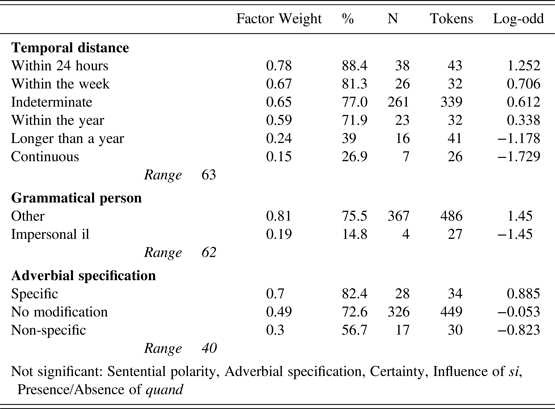
The outcome of the fixed-effect regression analysis is shown in Table 2.Footnote 17 In total three linguistic factor groups were retained by the model as statistically significant: temporal distance, grammatical person, and adverbial specification. Let us now investigate the effect of these constraints in more detail.
Fixed-effect regression analysis of linguistic factors contributing to PF selection

Deviance = 505.181; df = 9; Intercept = −0.592; Mean = 0.723; Nagelkerke R2 = 0.256
Temporal distance is selected as the most influential linguistic constraint with a range of 63. This finding is in line with both Acadian studies (King and Nadasdi Reference King and Nadasdi2003, Comeau Reference Comeau2011), which report that this factor group is the strongest predictor of variant choice. Note that the hypothesis that PF is more frequent in cases where the future event is proximal to the speech act is substantiated by the present study. Crucially, the probability that speakers will select the periphrastic future declines with increasing temporal distance from 0.78 when the action is set to occur within the day, to 0.67 for within the week, and to 0.59 for within the year. The variant then becomes disfavoured when reference is being made to something expected to occur over a year following speech time (FW = 0.24), as well as in continuous contexts (FW = 0.15). Hence, in Martinique, there appears to be a linear correlation between the choice of future variants and temporal distance.
Not only is the Martinique data the first to report a straightforward linear association between future variants and the degree of temporal distance in French, the proximate/distal cut-off point in the Martinique system differs notably from what we find in Acadian varieties. King and Nadasdi (Reference King and Nadasdi2003: 333) report that, for Newfoundland and Prince Edward Island, only those events expected to occur up to a week following speech time favour PF. In Baie Sainte-Marie, Comeau (Reference Comeau2011: 227–228) notes that speakers only select the periphrastic variant for events set to occur within an hour of utterance time. Both Acadian studies report that the factor weights remain relatively stable at the 0.5 level after a week post-speech time. This result indicates that the effect of temporal distance in these varieties is neutralized in the more distal time contexts. In Martinique, however, the probability that speakers will select the periphrastic future gradually declines and PF becomes disfavoured only after 12 months.
When investigating temporal distance, the question of how to deal with tokens to which it was not possible to ascribe a precise future reference came to the fore. A full 66 % (N = 339) of tokens in my data were ambiguous in this regard. These indeterminate tokens generally favour the periphrastic construction (FW = 0.65). Since Rbrul does not allow the exclusion of tokens from a specific factor group while retaining them in all others, I decided to rerun the model using GoldVarb Lion (Sankoff et al. Reference Sankoff, Evans Wagner and Jensen2012), which is similarly based on the same statistical principle, namely multiple logistic regression. I was thus able to remove those tokens with an indeterminate temporal reference and analyze only those tokens associated with a clear-cut temporal reference. The outcome of the multivariate run on the GoldVarb platform (not displayed) reveals that the ranges for temporal distance and adverbial specification remain stable at 63 and 40 respectively, although the range for grammatical person decreases from 62 to 48. Thus, in essence, the ranking of constraints remains the same. This effectively means that these tokens with indeterminate future reference do not seem to have a large impact on the overall model.
The literature contains a number of claims concerning the role of grammatical person (see section 4.2.5). Crucially, in Martinique French, no relationship was detected between vouvoiement and the IF. Also, claims that the periphrastic future is more subjective and therefore more likely to occur with first person subjects were not substantiated by my data. The only significant conditioning effect exerted by a personal pronominal form was that of impersonal il constructions, an example of which is provided in (4a). Table 2 reveals that the impersonal il subject strongly favours the selection of the inflected future (FW = 0.19), yet the periphrastic construction is preferred with other subject pronouns (FW = 0.81).
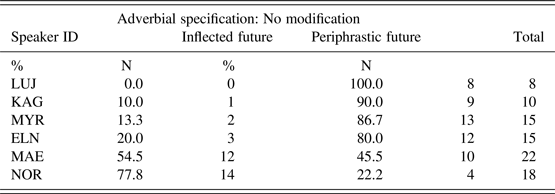
The results in Table 2 also indicate that non-specific adverbials favour the inflected future (FW = 0.30). This result echoes Poplack and Turpin's (Reference Poplack and Turpin1999: 151–152) findings for Ottawa-Hull. Specific adverbials, on the other hand, are shown to have a favouring effect on the periphrastic construction (FW = 0.70), whereas the absence of adverbial modification has a neutralizing effect (FW = 0.49). This last finding is somewhat unexpected, since it is the PF that is traditionally preferred in unmodified contexts (Poplack and Dion Reference Poplack and Dion2009: 573, Comeau Reference Comeau2011: 228–229). Moreover, note that this factor group is not identified as significant in an isolated chi-square calculation (χ2 = 5.400, df = 2, p = 0.670). When I deconstructed the ‘no modification’ category for each speaker (see Table 3), I noticed that a number of informants display higher-than-expected rates of the periphrastic future (e.g., LUJ: 100 %, N = 8 and KAG: 90 %, N = 9). Likewise, some speakers use the inflected future comparatively more (e.g., NOR: 77.8 %, N = 14 and MAE: 54.5 %, N = 12).
Cross-tabulation of future variants unmodified adverbially by speaker

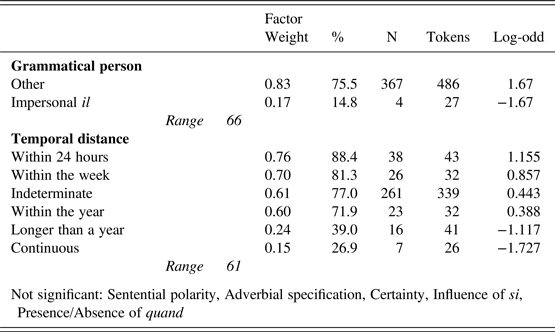
Importantly, the fixed-effect model in Table 2, while accounting for between-group effects, assumes that there is no variation above the level of the token and thus “individual-speaker and individual-word variation do not exist” (Johnson Reference Johnson2010: 7). As Table 3 illustrates, this assumption is not warranted. Mixed-effect regression models, on the other hand, are capable of taking random effects, such as speaker variability, into consideration. Mixed models only identify a factor group as statistically significant when it is “strong enough to rise above the inter-speaker variation” (Johnson Reference Johnson2009: 365). I therefore decided to return to Rbrul to run a mixed model with individual speaker as a random effect. Table 4 reveals that, unsurprisingly given the results in Table 3, once we consider the effect of speaker on variant choice, adverbial specification is discarded from the model.
Mixed-effect regression analysis of linguistic factors contributing to PF selection with speaker as a random effect

Deviance = 497.154; df = 8; Intercept = −0.441; Mean = 0.723; Speaker Random Std Dev = 0.779
Additionally, while the ranking of individual factors within the factor groups has remained constant, the overall hierarchy of the constraint system has changed: grammatical person is now identified as the strongest predictor of variant choice with a range of 66, whereas the range for temporal distance remains stable at 61.
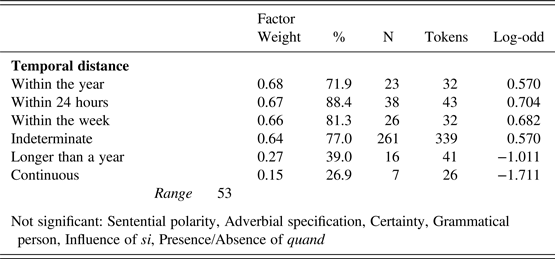
Johnson (Reference Johnson2010: 11) has also illustrated that similar pitfalls in data analysis may be encountered if the effect of individual word-level variation is ignored. Indeed, while the role of lexical verb has been acknowledged in the future temporal reference research literature (Poplack and Turpin Reference Poplack and Turpin1999, Wagner and Sankoff Reference Wagner and Sankoff2011), its overall effect has been comparatively under-researched from a quantitative perspective (cf. Roberts Reference Roberts2012). Crucially, I noticed that a number of verbs in impersonal il constructions appear to occur very frequently, if not categorically, with the inflected future (e.g., il y aura ‘there will be’: 90 %, N = 18; il faudra ‘it will be necessary’: 100 %, N = 5).Footnote 18 It might thus be the case that the previously unattested result for grammatical person is masking a purely lexical effect. I decided to control for such an epiphenomenon by including individual verb as a random effect. The results of a mixed model that includes both speaker and lexical verb as random effects are displayed in Table 5.
Mixed-effect regression analysis of linguistic factors contributing to PF selection with speaker and lexical verb as random effects

Deviance = 381.722; df = 8; Intercept = −0.587; Mean = 0.723; Speaker Random Std Dev = 0.727; Lexical Verb Random Std Dev = 2.033
Now, grammatical person is not selected as significant, which suggests that the significant effect in Table 2 was indeed epiphenomenal. The only linguistic factor that remains in the model is temporal distance. Also, the regression coefficients have altered considerably from the initial fixed-effects analysis. The linear relationship between the decreasing weighted probabilities and the increasing temporal distance has been lost completely. Those events set to occur up to a year following speech time all favour the periphrastic future to the same degree (FW = 0.66–0.68). There is a clear temporal divide, with actions occurring in the most distal time context strongly disfavouring this variant (FW = 0.27). This result is in stark contrast to what is reported for Acadian varieties, in which the PF acts as a marker of proximity and the temporal distinction becomes neutralized in the more distal time contexts.Footnote 19 In Martinique French, PF is the default option in the majority of cases and it is the inflected variant that functions as an indicator of distal outcomes.
5.2 Social factors
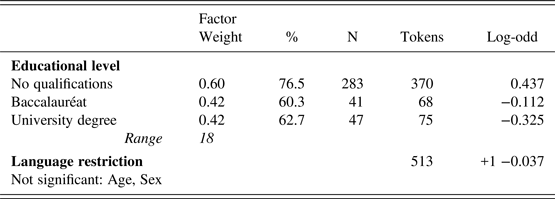
In order to assess the overall effect of the social constraints, I conducted another fixed-effect analysis in Rbrul. Table 6 reveals that both educational level and language restriction emerge as statistically significant in the logistic regression model.
Fixed-effect regression analysis (Rbrul) of social factors contributing to PF selection

Deviance = 588.726; df = 4; Intercept = 3.589; Mean = 0.723; Nagelkerke R2 = 0.046
Poplack and Dion (Reference Poplack and Dion2009: 581) first hypothesized that educational attainment could be a good predictor for variant choice. They posit that schools and higher educational institutions might be successful in transmitting the “prescriptively sanctioned” form. In other words, exposure to formal instruction might positively correlate with the inflected future. Their results for Laurentian French, however, indicate that this is not the case and that the distribution of the future variants is the same, regardless of informants' educational level. The results from Martinique, however, do appear to substantiate Poplack and Dion's initial postulate. In my dataset, an increase in educational level has a disfavouring effect on PF usage. Whereas those informants without any formal qualifications favour the use of the periphrastic future (FW = 0.60), it is those speakers with either a baccalauréat (FW = 0.42) or a university degree (FW = 0.42) who prefer the inflected variant. In recent research, I have reported a very similar effect for European French (Roberts Reference Roberts2012: 103). The crucial difference between the two studies, however, is that the effect of education in mainland Europe is only noticeable for those informants who have studied at university level. In Martinique, on the other hand, as the findings in Table 6 indicate, successful graduation from the secondary school system seems to be conducive to increased use of the inflected future.
Let us now consider the role that language restriction plays on variant choice. To date, research on Franco-Ontarian communities has categorized speakers into one of three groups depending on their language restriction score (Mougeon and Beniak Reference Mougeon and Beniak1991). ‘Restricted’ speakers are those who use French infrequently (<0.50), ‘semi-restricted’ informants have mid-to-high levels of restriction (0.50–0.79) and thus communicate in both languages in relatively equal proportions, while ‘unrestricted’ speakers use French as their main language (>0.79). However, since the Rbrul package used in this study can handle continuous variables, I ran an analysis that considers each speaker's individual language-restriction score.
Grimm and Nadasdi (Reference Grimm and Nadasdi2011: 184–185) postulate that speakers with higher levels of restriction in the use of French may demonstrate a tendency to prefer morphologically analytic forms. Resultantly, given the morphological complexity of the French inflected future, we might expect reduced IF rates amongst these informants. Grimm and Nadasdi's (Reference Grimm and Nadasdi2011: 183) own research on future temporal reference reveals that there is no significant difference between this factor group and the choice of variants in Ontarian French.
In my Martinique French data, on the other hand, this factor group is operative in speech. The log-odd coefficient for language restriction (+1, −0.037) indicates that the periphrastic future becomes disfavoured as we move further up the language restriction scale.Footnote 20 In other words, the more speakers use French on a daily basis, the greater the likelihood that they will select the inflected variant. This general trend is confirmed by the graph in Figure 1.
Profile of individual speaker's language restriction scores and their use of PF (higher index score = less restriction in the use of French).

Note, however, that the scatterplot in Figure 1 identifies a number of informants who display somewhat unexpected behaviour. Certain semi-restricted speakers employ the inflected variant much more frequently than their unrestricted counterparts (e.g., MAN: 52.38 %, N = 11; DOT: 46.67 %, N = 7; MIP 38.89 %, N = 7). Likewise, a number of unrestricted speakers use the PF more often than we would expect from their restriction score (e.g., KAG: 91.67 %, N = 11; LUJ: 90 %, N = 9; ORT: 83.33 %, N = 10). Moreover, concerning educational level, some speakers with no qualifications (e.g., NOR: 82.60 %, N = 19; DOT: 46.67 %, N = 7) exhibit unexpectedly high rates of the inflected future, while others who hold a baccalauréat (e.g., ELN: 77.77 %; N = 14) or a university degree (JOU: 85.71 %, N = 6) select PF comparatively more often.
As was the case with the linguistic constraints, a fixed-effect run for social factors cannot account for the fact that “some individuals might favour a linguistic outcome […], over and above […] what their age, gender, social class, etc. would predict” (Johnson Reference Johnson2009: 365). I therefore decided to once again run a regression analysis on the data and included speaker as a random effect. Notably, once we consider the effect of speaker on variant choice, none of the social factors are retained as significant: both educational level and language restriction are discarded from the mixed model.
6. Conclusion
In conclusion, this article examined the variable nature of future temporal reference in Martinique French. Results revealed grammatical differences between Caribbean and Hexagonal varieties. In Martinique French, speakers prefer to encode future time by employing the periphrastic future; usage rates of this variant are comparable to Laurentian French communities in Canada. Fixed- and mixed-effects models furthermore highlighted the idiosyncratic constraint system operating in this locality. Temporal distance, and not sentential polarity as in Laurentian and European French, topped the constraint system: while the periphrastic future acts as the default marker of futurity, the inflected future functions as a marker of distal time. The variable grammar of futurity in Martinique French therefore patterns like the highly conservative enclave Acadian varieties.
How can we conceptualize the fact that two varieties of French share the same constraint system, even though they are situated approximately 2200 miles (3500 km) apart? Geographically isolated communities, like Martinique and the Atlantic Provinces in Canada, are often viewed as linguistically conservative and do not partake in language change as much as urban mainland communities do (Andersen Reference Andersen and Fisiak1988). The constraint systems in both varieties may therefore be lagging behind those found in contemporary Hexagonal and Laurentian French (see also Trudgill Reference Trudgill1999: 27), in which the robust effect of polarity has been well documented. If temporal distance was indeed once operative in European varieties pre-colonization, it may therefore have been transplanted to Martinique and the Atlantic Provinces in Canada by the input varieties spoken by the first settlers. Such an explanation, however, implies that the temporal distinction in European and Laurentian varieties (that we still see in Martinique) has been lost in favour of the polarity constraint. At the moment, we are not in the position to answer this question with certainty because diachronic investigations into the historical development of the variable grammar that governs the future temporal reference system in French are notably lacking.
While Varbrul software packages have traditionally been utilized in variationist research to perform multivariate analyses, the present article relied on the Rbrul package, which has become an increasingly prevalent analytic tool in recent years. One of the main benefits of using Rbrul is that it incorporates mixed-effects modelling, which allowed me to test for the effect exerted by variation ‘above the level of the token’. I was thus able to explain more of the variation by evaluating the effect that individuals may have on the data.
Speaker and lexical verb effects were shown to considerably alter the constraint systems governing the choice of future forms. In fixed models, a range of constraints was shown to be operative in Martinique: temporal distance, grammatical person, adverbial specification, educational level, and language restriction all constrain the expression of futurity. However, once random effects were accounted for, results indicate that only one factor group, namely temporal distance, actually influences the variable expression of futurity in Martinique French. Poplack and Malvar (Reference Poplack and Malvar2007: 137) note that “the lion's share of [future] variant choice is ascribed to subtle semantic or pragmatic distinctions in the message the speaker wishes to convey” (see also, for example, Fleischman Reference Fleischman1982). What this effectively means is that the differences between the two main future variants are highly subjective and contingent on psychological notions, such as intention, certainty, doubt, and proximity (see Poplack and Turpin Reference Poplack and Turpin1999, Poplack and Malvar Reference Poplack and Malvar2007, Poplack and Dion Reference Poplack and Dion2009). It is exactly this non-overt/grammatically-encoded, rather than overt-contextualised, information in the discourse which may lead to high levels of speaker variability. This contrasts with subject doubling and ne-omission in Martinique French (Roberts Reference Roberts2014). Both of these variables are predominantly governed by structural constraints, such as the type of subject or the presence/absence on intervening clitics. As these constraining factors do not rely on access to speaker motivations regarding epistemicity or modality, they are more accessible than the temporal distinction governing the expression of futurity. The different types of factors influencing variation selection might therefore offer an insight into why the strong effect of speaker-level variation is detectable with the future cross-dialectally in both Martinique and Hexagonal French varieties (see also Roberts Reference Roberts2012: 103–105). They might also, as in Buchstaller and D'Arcy's (Reference Buchstaller and D'Arcy2009) research, offer an insight as to why the future in Martinique, but not ne and subject doubling, patterns so differently to non-isolated varieties of French.
In summation, this article has identified the linguistic and social correlates of further temporal reference variation in a hitherto under-researched variety of French. On-going comparative work on varieties of English has revealed very important insights into the localised use of supralocal features. This comparatively new avenue of research in French sociolinguistics will ultimately further our knowledge of the complex set of constraints that unite and divide la francophonie.