Introduction
Organic agriculture (OA) is a production system that sustains the health of agro-ecosystems and people1. Organic operation can contribute to a sustainable food production systemReference Azadi, Schoonbeek, Mahmoudi, Derudder, De Maeyer and Witlox2, improve employment opportunities, especially for womenReference Farnworth and Hutchings3, improve household food securityReference El-Hage Scialabba4, enhance biodiversityReference Mahmoudi, Sharghi, Vossoughi and Salamat5 and contribute to agricultural developmentReference Darnhofer, Schermer and Schneeberger6.
Many countries promote OA to avoid facing larger problems with unsafe food supplies, health problems, unsustainable agri-rural development and environmental degradation, among othersReference Partap, Partap and Saeed7. In Iran, the advantages of organic farming are widely appreciated by different stakeholders, including policy makers, extension workers and researchersReference Malek-Saeidi, Rezaei-Moghaddam and Ajili8. However, despite the rapid growth of OA in much of the developed worldReference Darnhofer, Schermer and Schneeberger6, Reference Willer and Kilcher9, Reference Sadati, Shabanali-Fami, Kalantari, Mohamadi and Asakere10, the expansion of OA in developing countries, including Iran, has been much slower than in the developed worldReference Partap, Partap and Saeed7. Only one-third of the world's organic agricultural lands—12.5 million hectares (ha)—are located in these countriesReference Willer and Kilcher11. In such countries, certified organic food production is generally limitedReference Vossenaar and Jha12. Similarly in Iran, OA lands comprised 7256 ha in 2010. The key organic products in Iran consisted of pistachio (1382 ha), wheat (1156 ha), rose (900 ha), fig (780 ha), raisin (700 ha) and date (595 ha). In 2011, more than 95% of organic products in Iran were exported to European countriesReference Kledal, Mahmoudi, Mahdavi Damghani, Willer and Kilcher13.
The first Iranian national plan to promote sustainable agriculture was initiated in 1995, entitled Optimal Utilization of Fertilizers and Pesticides. The plan was a ten-year program aimed mainly at decreasing poisonous residuals in agricultural products. The plan could not achieve its goals after 10 years, largely because of the low participation of farmersReference Sharifi-Moghaddam14. The process of OA promotion is still in its early stages in Iran. Integrated Pest Management/Farmers Field School (IPM/FFS) are recognized as extension approaches for promoting OA. High-level IPM (i.e., preventive practices to control pests) is considered a first step in promoting organic farming systems. The majority of farmers who are involved in the IPM/FFS projects in Iran are increasingly shifting to OAReference Etehadi, Rusta and Gholi-Nia15, Reference Razzaghi-Borkhani, Rezvanfar and Shabanali Fami16. Consequently, the IPM/FFS sites have been established in pilot farms throughout the country in search for more participatory approaches for the dissemination of OAReference Etehadi, Rusta and Mashhadi Bandani17.
Despite the important impact of the IPM/FFS initiatives, the results of case studiesReference Etehadi, Rusta and Mashhadi Bandani17–Reference Karimi20 show that farmers have not adopted sustainable and organic farming practices entirely. What makes it difficult for policy makers and practitioners to promote OA in Iran is that Iranian farmers' motives and challenges toward adopting OA are still unclear. Because the issue has only recently come to the researchers’ attention, there are few qualified research studiesReference Rezvanfar, Eraktan and Olhan19. In addition, these studies have mostly considered experts’ attitudes toward the dissemination of OA, not those of farmers. Finally, the case studies on farmers' attitudes, reported from different areas, lack methodological consistency.
The purpose of this review was to identify and summarize previous studies on Iranian farmers' attitudes toward OA, with the aim of drawing a comprehensive picture of the issue. Furthermore, this paper aims to identify mechanisms that may stimulate the adoption of organic practices among farmers.
Methodology
Case studies were reviewed to identify factors that influence farmers' decisions to adopt OA practices (e.g., biological pest and weed control, composting, cover cropping, green manuring and green leaf manuring, intercropping, living fences, microbial bio-fertilizers, multi-cropping and multipurpose trees). The main keywords used to obtain the documents were ‘organic agriculture’ and ‘organic farming’ followed by a combination of ‘farmers’ attitude’, ‘farmers’ adoption’, ‘farmers' challenges’ and ‘IPM/organic’. IPM was included, because, as mentioned previously, IPM/FFS have been the main mechanisms to foster OA through participatory tools in Iran. Among the articles, quantitative studies were selected, which used questionnaires to determine farmers' barriers to and motives for adopting IPM and organic practices. Some inclusion and exclusion criteriaReference Azadi, Ho, Hafni, Zarafshani and Witlox21 were used to conduct a more focused search. Inclusion criteria included studies that contained information about the adoption of OA practices, and assessed farmers' points of view. Abstracts or unpublished studies were excluded from the review. The date of released documents, which were either in English or Persian, was limited to 5 years (2007–2012). The data were obtained from four possible databases: scholarly journals in Persian (n=13), scholarly journals in English (n=6), Iranian conferences in Persian (n=12), and international conferences in English (n=3). The key findings of each study considered were those statistically significant factors affecting farmers' attitudes. Most articles used case study or survey methodology.
Results
Among the 34 reviewed studies, some discussed the farmers' barriers of adoption, some addressed their motives for adoption and others investigated both. The following presents our findings about the farmers' barriers to and their motives for the adoption of OA.
Farmers’ barriers
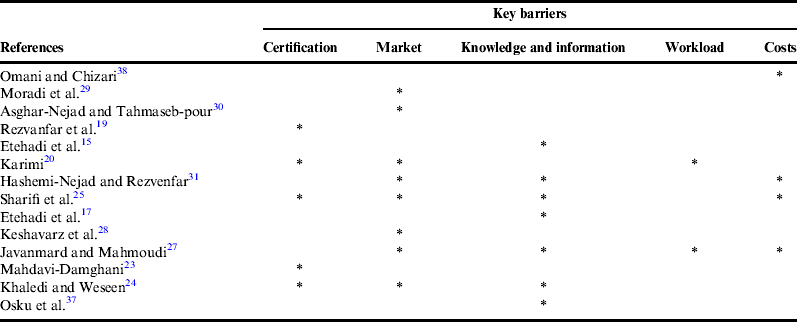
Table 1 describes the most important barriers of Iranian farmers to the adoption of organic farming.
Farmers' barriers to adopting OA in Iran.
Certification
Some studies on the barriers of adopting OA in Iran found that certification is one of the main challenges for farmersReference Rezvanfar, Eraktan and Olhan19, Reference Khaledi, Gray, Weseen and Sawyer22–Reference Sharifi, Sadati, Rostami Ghobadi, Sadati, Mohamadi and Tolou Del25. This has been mentioned as a critical challenge for farmers in many other developing countries as wellReference Bello26. According to the international rules, each farmer has to be inspected annually. In Iran, there are no national certification bodies that may verify organic products officiallyReference Sharifi, Sadati, Rostami Ghobadi, Sadati, Mohamadi and Tolou Del25 and farmers have to utilize international certification bodies. In Iran, where 80% of farmers are smallholders, such a certification system is extremely expensiveReference Bello26. Some authors proposed establishing a national institute for the certification of organic productsReference Sharifi, Sadati, Rostami Ghobadi, Sadati, Mohamadi and Tolou Del25, Reference Javanmard and Mahmoudi27. Mahdavi–DamghaniReference Mahdavi-Damghani23 proposes a group certification system as an alternative way, in which farmers' groups consisting of a hundred to several thousand small-scale producers will be co-certified as a unit. Despite the differences amongst experts, there is consensus that certification is a barrier for the adoption of OA among Iranian farmers.
Market
Despite the global expansion of the market for organic products, it is still expanding very slowly in IranReference Sharifi, Sadati, Rostami Ghobadi, Sadati, Mohamadi and Tolou Del25, Reference Javanmard and Mahmoudi27–Reference Hashemi-Nejad and Rezvanfar31, as in many developing countries. This is partly because organic products are more expensive than other productsReference Sari, Asadi, Akbari, Fakharzadeh and Sukhtanloo32 and the majority of Iranian people cannot afford organic productsReference Sharifi, Sadati, Rostami Ghobadi, Sadati, Mohamadi and Tolou Del25, Reference Akbari, Sari, Fakharzadeh, Iravani and Namdar33. Therefore, farmers are not sure whether they can sell their products in the national marketReference Keshavarz, Allahyari, Azarmi Sesari and Khayati28. Sari et al.Reference Sari, Asadi, Akbari, Fakharzadeh and Sukhtanloo32 suggest that to overcome this challenge, the government should establish specific sites for selling organic products. This will decrease the costs of marketing for producers and therefore, the price of organic products. Furthermore, sufficient information about the benefits and standards of organic products is not available to both producers and customersReference Nemati and Azami34. Lastly, certification systems are considered by some authors as the root of many challenges for marketing organic productsReference Mahdavi-Damghani23, Reference Khaledi and Weseen24.
Knowledge and information
Lack of knowledge and information is reported by many researchers as a barrier to the adoption of OA in IranReference Etehadi, Rusta and Gholi-Nia15, Reference Etehadi, Rusta and Mashhadi Bandani17, Reference Khaledi and Weseen24, Reference Sharifi, Sadati, Rostami Ghobadi, Sadati, Mohamadi and Tolou Del25, Reference Javanmard and Mahmoudi27, Reference Hashemi-Nejad and Rezvanfar31, Reference Shah-Morad and Hayati35. Knowledge and information barriers relate specifically to marketReference Sharifi, Sadati, Rostami Ghobadi, Sadati, Mohamadi and Tolou Del25, and technical and financial issuesReference Karimi20. BelloReference Bello26 believes that farmers in many developing countries lack technical information about farming practices, production and marketing methods, such as choosing products to grow, identifying different markets and distribution channels, competition strategies and market access.
Workload and costs
Previous studies have shown that organic farmers have greater labor needs compared with conventional farmsReference Karimi20, Reference Javanmard and Mahmoudi27. Since many activities, such as weeding, are done manually in OA, there is a need to recruit more workersReference Karimi20. Additionally, OA can require more facilities for transport and storage, which are quite costly for farmersReference Sharifi, Sadati, Rostami Ghobadi, Sadati, Mohamadi and Tolou Del25. Moreover, the transition period to OA might be costly. Wossink and KuminoffReference Wossink and Kuminoff36 consider that a farm in transition from conventional to organic needs to keep rigorous records for 3 years before being fully certified—an additional cost for farmers.
Influences on farmers' adoption of OA
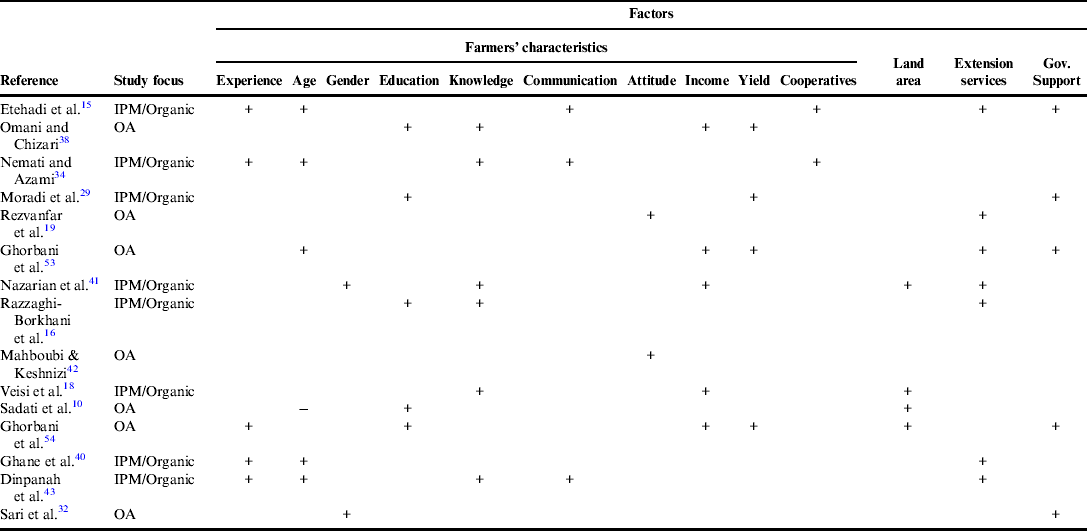
Despite the barriers, there are factors that influence the adoption of OA practices by Iranian farmers. Findings are summarized in Table 2.
Main factors influencing farmers' adoption of OA in Iran.

+, Positive influence on adoption; −, negative influence on adoption.
Experience
Some studies show that more experienced farmers with a higher level of informal knowledge are keener to learn about sustainable farming practicesReference Etehadi, Rusta and Gholi-Nia15, Reference Veisi, Mahmoudi and Sharifi-Moghaddam18, Reference Foruzani and Shahvali39, Reference Ghane, Namdar and Chizari40. The traditional agriculture of Iran is a great deal like OA in many waysReference Malek-Saeidi, Rezaei-Moghaddam and Ajili8. Mahmoudi et al.Reference Mahmoudi, Sharghi, Vossoughi and Salamat5 believe that almost all practices and processes in the traditional agro-ecosystems of Iran are compatible with organic agricultureReference Mahmoudi, Sharghi, Vossoughi and Salamat5. Therefore, years of experience in traditional agriculture can support farmers to appreciate and more easily adopt OA practices. Moreover, such an experience provides them with increased knowledge about the environment in which decisions for adopting OA must be madeReference Genius, Pantzios and Tzouvelekas44. This seems to be a rather unique finding among developing countries.
Age
Age is positively correlated with experience in some studiesReference Genius, Pantzios and Tzouvelekas44. Evidence shows that in Iran, older and more experienced farmers have a more positive attitude toward OA and IPMReference Veisi, Mahmoudi and Sharifi-Moghaddam18, Reference Ghane, Namdar and Chizari40, Reference Dinpanah, Mirdamadi, Chizari and Slack43. Although a few studies show that younger farmers are less risk adverse and may adopt organic practices soonerReference Sadati, Shabanali-Fami, Kalantari, Mohamadi and Asakere10, some research has found that both groups of experienced and younger farmers who participate in extension programs (especially IPM/FSS) are more likely to adopt organic practicesReference Razzaghi-Borkhani, Rezvanfar and Shabanali Fami16, Reference Ghane, Namdar and Chizari40, Reference Dinpanah, Mirdamadi, Chizari and Slack43.
Gender
The term ‘feminization of agriculture’ is becoming a cliché that refers to the significant role that women play in the agricultural sectorReference Kunihira45. Some studies show that women are generally more willing to adopt organic practicesReference Foruzani and Shahvali39, Reference Nazarian, Ajili and Rezaee-Moghaddam41. OA supports gender equality because it creates meaningful work, offers economic opportunities for women, encourages biodiversity and traditional knowledge, and ensures equitable work standards46. According to KangReference Kang47, women are the major stakeholders in OA because, over decades, the socio-economic and health statuses of women in farming communities have been adversely affected by conventional farming technologies and policies.
Education and knowledge
Both scientific and indigenous knowledge influences farmers' attitudes toward organic adoption. The positive impact of farmers' education on adoption was found by Omani and ChizariReference Omani and Chizari38, Razzaghi-Borkhani et al.Reference Razzaghi-Borkhani, Rezvanfar and Shabanali Fami16, and Sadati et al.Reference Sadati, Shabanali-Fami, Kalantari, Mohamadi and Asakere10. Generally, educated farmers can acquire technical information more easilyReference Genius, Pantzios and Tzouvelekas44. Farmers’ education is identified as an influencing factor on organic adoption in other developing countries as wellReference Kassie, Zikhali, Manjur and Edwards48. Behrad-Far and FarzanianReference Behrad-Far and Farzanian49 believe that in OA, modern knowledge is not in contradiction with traditional knowledge, but is complementary to it. Sofia et al.Reference Sofia, Prasad and Vijay50 explain that organic farming has been practiced since ancient times. As such, the values and principles of OA, including the principles of health, ecology, fairness and care51 are in line with the traditional beliefs and values of farmers.
Income, yield and land area
Organic farmers can experience an increase in production costs because of the introduction of labor-intensive technologies. In addition, farmers face new costs related to certification and transportation52. Therefore, higher incomes might facilitate the adoption of OA by farmers. According to Kassie et al.Reference Kassie, Zikhali, Manjur and Edwards48, wealth affects adoption decisions, since wealthier farmers have greater access to resources and may be better able to take risks. Similarly in Iran, some studiesReference Sadati, Shabanali-Fami, Kalantari, Mohamadi and Asakere10, Reference Omani and Chizari38, Reference Nazarian, Ajili and Rezaee-Moghaddam41, Reference Ghorbani, Liaghati and Nemati53, Reference Ghorbani, Koocheki and Mahmoudi54 show that farmers with higher incomes and larger farms are more likely to adopt OA. Yield is associated with income and land area in many small farms, and influences the adoption of OAReference Moradi, Heydari, Azizi and Yaqubi29, Reference Omani and Chizari38. These factors seem to be common around the world in regard to the adoption of OA52, Reference Pornpratansombat, Bauer and Boland55 and other innovationsReference Baumüller56.
Extension services and communication
Many studiesReference Etehadi, Rusta and Gholi-Nia15, Reference Razzaghi-Borkhani, Rezvanfar and Shabanali Fami16, Reference Rezvanfar, Eraktan and Olhan19, Reference Nemati and Azami34, Reference Nazarian, Ajili and Rezaee-Moghaddam41, Reference Ghorbani, Liaghati and Nemati53 show that Iranian farmers' participation in extension programs will enhance their tendency to adopt organic farming practices. However, Behrad-Far and FarzanianReference Behrad-Far and Farzanian49 found that extension workers in Iran are generally not sufficiently capable of providing assistance with organic methods. To overcome this deficiency, FFS programs have recently been launched and are considered as the best training methods for farmers interested in organic agricultureReference Pornpratansombat, Bauer and Boland55.
Some studiesReference Sadati, Shabanali-Fami, Kalantari, Mohamadi and Asakere10, Reference Etehadi, Rusta and Gholi-Nia15, Reference Dinpanah, Mirdamadi, Chizari and Slack43 show that by increasing farmers' access to information and communication technologies, they are more likely to adopt organic practices. Organic farmers should develop their communication skills to increase their access to the information about the latest achievements in agriculture. Furthermore, technical assistance should take into account farmers' communication needs in IranReference Etehadi, Rusta and Gholi-Nia15, Reference Dinpanah, Mirdamadi, Chizari and Slack43.
Farmers' membership in cooperatives
A few studiesReference Etehadi, Rusta and Gholi-Nia15, Reference Khatoonabadi57 show that farmers' membership or relationship with cooperatives increases their likelihood to adopt organic practices because they have better access to resources such as credit and extension servicesReference Azadi, Hosseininia, Zarafshani, Heydari and Witlox58, Reference Kalogeras, Kalaitzis, Van Dijk, Mattas and Tsakiridou59. Moreover, when a cooperative adopts OA, it attempts to generate information that allows contracting, production and marketing planning, communication, and monitoring, in order to keep organic production costs at a low levelReference Karamidehkordi and Hashemi60. This is in line with findings from EthiopiaReference Kassie, Zikhali, Manjur and Edwards48 where the household's membership in farmers' organizations increased the likelihood of practicing organic techniques.
Government support
StudiesReference Etehadi, Rusta and Gholi-Nia15, Reference Moradi, Heydari, Azizi and Yaqubi29, Reference Hashemi-Nejad and Rezvanfar31, Reference Sari, Asadi, Akbari, Fakharzadeh and Sukhtanloo32, Reference Ghorbani, Liaghati and Nemati53, Reference Ghorbani, Koocheki and Mahmoudi54, Reference Nieberg and Kuhnert61 also show that governmental support can be very critical in generating positive attitudes in farmers to adopt organic practices. According to Mahmoudi et al.Reference Mahmoudi, Mahdavi Damghani and Liaghati62, it remains the responsibility of governments to change the attitude of farmers toward OA and encourage them to produce organic products. Such support can be provided in five areas, including organic food production at the farm level, processing and marketing organic foods, out-of-home consumption, consumer information and cross-cutting measures such as research and developmentReference Mahboubi and Keshnizi42. The situation is the same in many developing Asian countries. According to PartapReference Partap, Partap and Saeed7, the governments in these countries are not providing minimum incentives to farmers, NGOs, small and medium-sized enterprises involved in OA. In Ethiopia, Kassie et al.Reference Kassie, Zikhali, Manjur and Edwards48 found that poverty limits OA adoption. This means those policies which aim at alleviating poverty can positively affect adoption decisions.
Farmers' attitude
Some studiesReference Rezvanfar, Eraktan and Olhan19, Reference Bagheri and Shahpasand63 confirm that farmers' attitudes toward organic farming influence their decision to adopt it. Iranian organic farmers strongly believe that organic production is harmless and healthier for both the environment and humansReference Ghane, Namdar and Chizari40, Reference Mahmoudi, Mahdavi Damghani and Liaghati62, Reference Karthikeyan, Veeraragavathatha, Karpagam and Ayisha Firdouse64. Moreover, the long-standing values and beliefs of farmers are in line with the values of sustainable practices of organic farmingReference Foruzani and Shahvali39, Reference Bagheri and Shahpasand63. However, traditional beliefs that are in line with OA practices are declining. It appears that Iranian farmers now have a mix of traditional and modern values that drive them to adopt some organic practices, and reject those which are not productive or diminish their income. For example, a study by Bagheri and ShahpasandReference Bagheri and Shahpasand63 on potato farmers' attitude toward sustainable and organic agricultural practices shows that some farmers had a negative attitude toward using fewer fertilizers and pesticides, while their attitude toward some methods of securing sustainability, such as soil and water conservation and crop rotation, for instance, were positive. These same attitudes can be found in other developing countriesReference Iliopoulou, Douma, Giourga, Migliorini, Minotou, Lusic, Hashem and Martinis65.
Discussion and Conclusion
There is growing evidence that increased adoption of organic farming can offer numerous environmental, social and financial benefits, and lead to an alternative way to sustainability in agricultureReference Azadi, Schoonbeek, Mahmoudi, Derudder, De Maeyer and Witlox2, Reference Schoonbeek, Azadi, Mahmoudi, Derudder, De Maeyer and Witlox66, Reference Scialabba67. The results of this study show that for Iranian farmers, there are some main challenges that slow down the process of adopting OA. These barriers include challenges in certification, market, access to knowledge and information, labor and costs. These barriers exist in many developing countriesReference Taylor68. Among them, certification seems to be the most serious problem in Iran, in comparison to other developing countries, due to Iran's limited international communications and lack of national certification bodies.
In spite of these barriers, there are some factors that influence Iranian farmers' decision to adopt OA practices. Experience is one factor that influences farmers to adopt OA. Since most Iranian farmers are older and experiencedReference Etehadi, Rusta and Gholi-Nia15, Reference Khatoonabadi57, such attributes can be regarded as an opportunity for the promotion of OA. Gender can also influence OA adoption, and studies found that women are better adopters of OAReference Sari, Asadi, Akbari, Fakharzadeh and Sukhtanloo32, Reference Nazarian, Ajili and Rezaee-Moghaddam41. Knowledge from both types of formal (education) and informal (indigenous) sources also has a positive effect on the adoption of OA. Income, land area and productivity have positive impacts on farmers' adoption as well. Extension services are important in the promotion of OA, especially IPM/FFS programs that apply participatory methods for disseminating OA. Findings show that those Iranian farmers more likely to adopt OA are those who have a more positive attitude toward OA; have access to communication technologies; are members of cooperatives; and are farmers supported by the government. Similar findings are reported in other developing countriesReference Bello26, Reference Kassie, Zikhali, Manjur and Edwards48, Reference Pornpratansombat, Bauer and Boland69, Reference Azadi and Filson70.
Implications for current practices on OA adoption
Taking the findings of the discussed case studies into consideration, we make four recommendations to increase the adoption of OA in Iran: (a) appreciating the Iranian farmers' role in the process of adoption, (b) rethinking extension programs, (c) realization of the facilitation role of women; and (d) appropriate governmental support.
(a) Appreciating the Iranian farmers' role in the process of adoption
Most factors that drive farmers to adopt OA are directly related to personal attributes of farmers (e.g., experience, age, gender, education, knowledge and attitude). However, the development of organic farming is led by the Iranian government through top-down processesReference Etehadi, Rusta and Gholi-Nia15 that often disregard farmers' concerns and their characteristics. The critical issue is that in many extension programs at the rural levelReference Wossink and Kuminoff36, wealthy farmers are the focus of the programs, whereas poor and small-scale farmers are often ignored.
(b) Rethinking extension programs
Providing extension services to increase organic farmers' yield and supply natural inputs are necessaryReference Ghorbani, Koocheki and Mahmoudi54. Among other extension initiatives, FFS programs have been reported as the most successful in facilitating the adoption of IPM technologies in IranReference Osku, Chizari and Rasuli37. However, some studies show the unsatisfactory impacts of FFS programs, maintaining that they have been mainly successful in changing farmers' attitudes and not their behavior. Other studies show that they could not improve the farmers' collaboration over the long term. For example, a study by Etehadi et al.Reference Etehadi, Rusta and Gholi-Nia15 shows that, from farmers' point of view, FFS has been very effective in providing relevant information, but not linking farmers, researchers and extension agents to each other over the long term, because the farmers' collaboration and linkages with research and extension are limited to the project duration, and collapse once the project ends Reference Sharifi-Moghaddam14.
(c) Realization of rural women's facilitation role
It is important to understand that women are not merely the adopters of OA, but can also be important facilitators and promoters of organic practices among farmers, processors of agricultural products and their family. According to PartapReference Partap, Partap and Saeed7, all over Asia, women are taking a leading role in OA development—as farmers, as consumers, or as the organizers of the organic sector. For instance, in Thailand and Malaysia, many of the pioneer traders of organic products are women. In India, the organic movement receives much support and leadership from women self-help groups, NGOs and individual entrepreneurs. Similarly in Iran, rural women are generally more willing to adopt organic practices and are the main customers of organic productsReference Sari, Asadi, Akbari, Fakharzadeh and Sukhtanloo32. However, support and extension services for rural women are very limited. The study of Etehadi et al.Reference Etehadi, Rusta and Gholi-Nia15 on the effectiveness of IPM/FFS sites showed that only 11% of the participants were rural women. Men were also more satisfied by the IPM/FFS sites, which were originally planned for them. The main conclusion is that rural women's access to information and credit for organic production should be enhanced and an awareness of the importance of organic foods among rural women needs to be emphasized.
(d) Appropriate governmental support
In the past, OA has been adopted without the support of governments and agricultural extension agencies in Iran. Especially in the early stages, farmers applied organic practices without any professional backup or infrastructureReference Kummer, Aigelsperger, Milestad, Chowdhury and Vogl71. Today, the situation is different. Modern agriculture has resulted in the increased use of chemical inputs, causing adverse impacts on human health and the environmentReference Etehadi, Rusta and Gholi-Nia15. Therefore, a critical role of the government is envisaged. According to PartapReference Partap, Partap and Saeed7, governments should consider providing direct incentives, rather than subsidies, to organic farmers. Moreover, there is a need to allocate resources and expertise to establish private institutions/agencies that can facilitate the adoption of OA. Such institutions can be managed by pioneer organic growers. EsmaieliReference Esmaieli72 proposes that organic farmers should receive specific insurance services as a support from the government. Such insurance should cover the first 3 years of the transitional period, yield losses as a result of diseases, and market failure, among others.
AbdollahiReference Abdollahi73 believes that government supports should include subsidies, long-term loans, the establishment of organic farmers' organizations and facilitating farmers' access to information about technical issues of OA and marketing. Additionally, Yaghubi and NaseriReference Yaghubi and Naseri74 suggest that the government can ease the access of organic farmers to information through holding workshops and exhibitions on OA. The government can also support organic farmers in the domestic market by purchasing their products in advance before harvest. The policies for developing organic farming should be formulated in a way that allows a bottom-up approachReference Vairo, Haring, Dabbert and Zanoli75.
Implications for future research
The recommendations proposed in this paper are expected to improve the rate of the OA adoption. Further research is needed to address how best to bring these mechanisms into practice. For instance, there is a need to assess the governmental supports for organic farming at the farm level. Moreover, the role of rural women, and their challenges and opportunities in adopting and promoting organic farming, should be studied. The effectiveness of existing extension methods for fostering OA should be assessed on the bases of ‘region-case’ and ‘crop-case’. Finally, future studies could address the weight of the different applied criteria in this study to come up with further insights into the decision making process—why farmers decide for or against the adoption of organic agriculture.
Acknowledgements
The authors wish to thank Mr. Nji Tizi Clauvis Taning for his kind help to improve the English of the paper. The corresponding author is a beneficiary of a mobility grant from the Belgian Federal Science Policy Office co-funded by the Marie Curie Actions from the European Commission.