Implications
Milk fatty acids (FAs) output (impacting milk quality for consumers) and lipogenic gene expression from mammary tissue and milk cells were evaluated in lactating dairy cows supplemented with rumen-stable fractionated palm fat or a combination of plant oils (linseed or sunflower oils) plus docosahexaenoic acid (DHA)-rich algae for 10 weeks. Plant oils plus DHA-algae in the diet decreased milk fat yield and de novo FA secretion, responses that occurred together with decreases in the mRNA levels of two lipogenic enzymes and a transcription factor in mammary tissue. These data contribute to decipher the molecular mechanisms underlying nutritional regulation of mammary lipogenesis in ruminants.
Introduction
Ruminant-derived foods (meat and milk) are the main source of conjugated linoleic acid (CLA) in the human diet (Lawson et al., Reference Lawson, Moss and Givens2001), with evidence from animal models that the predominant isomer, cis-9,trans-11, exhibits anticarcinogenic and antiatherogenic properties (Wahle et al., Reference Wahle, Heys and Rotondo2004). In milk, cis-9,trans-11-CLA is derived from the ruminal metabolism of 18:2n-6 and from endogenous synthesis via the action of Δ-9 desaturase on trans-11-18:1 (vaccenic acid, VA), an intermediate of linoleic (18:2n-6) and linolenic (18:3n-3) acid metabolism in the rumen (Bauman and Griinari, Reference Bauman and Griinari2001). In addition, saturated fatty acids (SFA; mainly 14:0, 16:0), when consumed in excess, exert negative effects on human health (Parodi, Reference Parodi2005). Thus, there is considerable interest in developing nutritional strategies to increase the cis-9,trans-11-CLA content and decrease SFA in milk fat.
In bovines, a lot of studies have examined the effects of different nutritional strategies on the milk concentrations of cis-9,trans-11 and trans-11-18:1, mainly by supplementing the diet with plant or fish oil (FO; Bauman and Griinari, Reference Bauman and Griinari2001). FO is more effective than plant oils in elevating milk fat cis-9,trans-11-CLA content (Offer et al., Reference Offer, Marsden, Dixon, Speake and Thacker1999) because of the inhibitory effect of docosahexaenoic acid (DHA) in FO on VA reduction to stearic acid in the rumen (Boeckaert et al., Reference Boeckaert, Vlaeminck, Dijkstra, Issa-Zacharia, Van Nespen, Van Straalen and Fievez2008). These increases in milk cis-9,trans-11-CLA and trans-11-18:1 can be further enhanced when FO is provided in combination with plant oils or oilseeds rich in 18:2n-6 (Whitlock et al., Reference Whitlock, Schingoethe, Hippen, Kalscheur, Baer, Ramaswamy and Kasperson2002; AbuGhazaleh et al., Reference AbuGhazaleh, Schingoethe, Hippen and Kalscheur2004). The combined use of FO to modify ruminal biohydrogenation and plant oils as a substrate for ruminal trans-11-18:1 formation is an established strategy for increasing milk fat cis-9,trans-11-CLA content. However, most of the studies reporting increased concentrations of cis-9,trans-11-CLA have been carried out with n-6-rich lipids and FO and during short-term periods (14 to 28 days; Whitlock et al., Reference Whitlock, Schingoethe, Hippen, Kalscheur, Baer, Ramaswamy and Kasperson2002; AbuGhazaleh et al., Reference AbuGhazaleh, Schingoethe, Hippen and Kalscheur2004; Shingfield et al., Reference Shingfield, Reynolds, Hervas, Griinari, Grandison and Beever2006). A considerable variation in the response of cis-9,trans-11-CLA was observed and was probably due to differences in the nature and composition of the plant oils as well as the duration of the treatment. Additionally, in bovines, the molecular mechanisms underlying the nutritional regulation of mammary lipogenesis are still poorly understood. To address these issues, the first aim of the present study was to evaluate the effects of sunflower oil (rich in n-6) and linseed oil (rich in n-3) combined with DHA-rich algae compared to rumen-stable fractionated palm fat (rich in C16:0) over a 70-day period in lactating Holstein cows on milk fat and fatty acid (FA) outputs and on the mammary lipogenic gene expression.
Most of the studies on the effect of nutrition on mammary lipid metabolism have been carried out using mammary tissue collected at the time of slaughtering or by biopsy, while only a few studies have been reported using milk cells from ruminants as a non-invasive method (Boutinaud et al., Reference Boutinaud, Rulquin, Keisler, Djiane and Jammes2002 and Reference Boutinaud, Ben Chedly, Delamaire and Guinard-Flament2008; Murrieta et al., Reference Murrieta, Hess, Scholljegerdes, Engle, Hossner, Moss and Rule2006, Feng et al., Reference Feng, Salter, Parr and Garnsworthy2007). The second aim of the present study was to investigate the effect of lipid-supplemented diets on the amount of milk purified mammary epithelial cells (MEC) and on the gene expression of lipogenic enzymes from MEC.
A reduction in milk fat yield due to sunflower oil (rich in n-6) and linseed oil (rich in n-3) combined with DHA-rich algae diets compared to rumen-stable fractionated palm fat (rich in C16:0) was expected. We hypothesised that reduction in milk fat yield would be due to an increase in rumen biohydrogenation intermediates and/or long-chain polyunsaturated fatty acids (PUFA) of lipid supplements that would down-regulate lipogenic gene expression, and would be associated with the transcription factor SREBF-1.
Materials and methods
Animals and diets
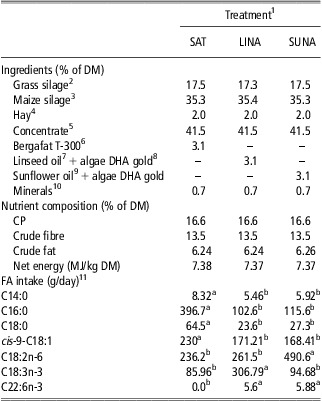
All experimental procedures were approved by the Animal Care Committee of the Leibniz Institute for Farm Animal Biology FBN in accordance with the Use of Vertebrates for Scientific Purposes Act of 1985. Eighteen primiparous German Holstein dairy cows in mid-lactation (days in milk, DIM = 91.6; standard error of the mean, s.e. = 7.8) were offered one of three experimental diets (SAT, LINA and SUNA) for 10 weeks, in three groups of six cows. The SAT diet included grass silage, maize silage, hay, a mineral feed mixture (Salvana 9522, Salvana, Sparrieshoop, Germany) and a concentrate mixture (MF 2000, Vollkraft, Güstrow, Germany) supplemented with rumen-stable fractionated palm fat, which is mostly saturated fat (SAT; Bergafat T-300, Dr. Pieper Technologie, Wuthenow, Germany) (3.1% of the basal diet dry matter, DM). The LINA diet included a combination of linseed oil (Dörnthaler Öhlmühle, Dörnthal, Germany) (2.7% of the basal diet DM) and DHA-rich marine algae (DHA Gold, Novus Europe, Brussels) (0.4% of the basal diet DM), whereas the SUNA diet included a combination of sunflower oil (Teutoburger Ölmühle, Ibbenbüren, Germany) (2.7% of the basal diet DM) and DHA-rich marine algae (DHA Gold, Novus Europe, Brussels) (0.4% of the basal diet DM). The diets were distributed as total mixed ration (TMR). The inclusion of dietary oils as 3.1% of DM was determined according to Cruz-Hernandez et al. (Reference Cruz-Hernandez, Kramer, Kennelly, Glimm, Sorensen, Okine, Goonewardene and and Weselake2007), who demonstrated that the level of rumenic acid could be retained when the level of oil in the diet is moderate (about 3% of the DM content). The ingredients and composition of the experimental treatments are shown in Table 1.
Ingredients and composition of experimental treatments offered in the mixed ration

DM = dry matter; DHA = docosahexaenoic acid; FAs = fatty acids.
Different letters indicate significant differences between treatments at P ⩽ 0.05.
1Refers to diets supplemented with rumen-stable fractionated palm fat (SAT), or a combination of linseed oil and algae (LINA), or a combination of sunflower and algae (SUNA).
2Maize silage composition (g/kg DM unless otherwise stated) was DM (g/kg fresh weight), 352; CP, 87; net energy of lactation (MJ/kg DM), 7; fibre, 169; crude fat, 33; starch, 346; simple carbohydrates (sugars), 5; ashes, 34.
3Grass silage composition (g/kg DM, unless otherwise stated) was DM, 424 (g/kg fresh weight); CP, 191.3; net energy of lactation, 6; fibre, 242; crude fat, 35; sugars, 67; ashes, 106.
4Hay composition (g/kg DM, unless otherwise stated) was DM, 832 (g/kg of fresh weight); CP, 125; net energy of lactation, 5; fibre, 337; crude fat, 15; sugar, 60; ashes, 61.
5Concentrate: 33% soybean, 20% corn, 17% wheat gluten feed, 13% wheat, 8% rapeseed meal, 5% molasses, 2% NaHCO3, 1.3% CaCO3, 0.2% NaCl, 0.5% vitamins and minerals.
6Bergafat T-300 – rumen-stable fractionated palm fat (TG) contained (g/100 g of FAs) C14:0 (1.4), C16:0 (71.2), C18:0 (11.0), cis-9-C18:1 (12.8) and C18:2n-6 (3.2).
7Linseed oil contained (g/100 g of FAs) C14:0 (0.05), C16:0 (5.3), C18:0 (3.0), cis-9-C18:1(18.0), C18:2n-6 (16.0) and C18:3n-3 (55.6).
8DHA-rich algae contained (g/100 g of FAs) C14:0 (12.0), C16:0 (27.7), C18:0 (0.6), C18:1cis-9 (0.1), C18:2n-6 (0.04), C20:5n-3 (1.4), C22:5n-3 (0.3) and C22:6n-3 (53.1).
9Sunflower-seed oil contained (g/100 g of FAs) C14:0 (0.07), C16:0 (6.0), C18:0 (1.8), C18:1cis-9 (25.2), C18:2n-6 (64.1) and C18:3n-3 (0.09).
10Mineral feed mixture (Salvana 9522 declared as containing 92% ashes, 20% calcium, 5% phosphorous, 8% sodium, 6% magnesium).
11FA intake was estimated based upon TMR FA composition and dry matter intake.
Animals of same parities, similar milk yields and similar DIM were selected for this study and the treatments were randomly assigned to these pre-selected animals.
The diets were isoenergetically and isonitrogenously calculated and were offered ad libitum as two equal meals at 0700 and 1700 h. The cows had free access to water throughout the experiment and were milked twice a day. The animals were slaughtered at the end of the experimental period.
Measurements and sampling
Samples of milk were collected from the morning milking on the last day of the experimental period for analysis of FA composition, according to the method described by Duske et al. (Reference Duske, Hammon, Langhof, Bellmann and Losand2009). Briefly, the lipid fraction of milk was extracted with n-hexane/isopropanol (v/v = 3/2). FA methyl esters were prepared and subjected to GC-FID analysis. The temperature programme started with an initial oven temperature of 45°C held for 4 min; this temperature was increased to 150°C at a rate of 13°C/min, was held for 47 min, and then was increased to 215°C at 4°C/min and held for 35 min to identify the trans-C18:1 isomers. The individual isomers of CLA methyl esters were prepared from cis-9,trans-11 CLA, trans-9,trans-11 CLA, trans-10,cis-12 CLA, cis-9,cis-11 CLA and cis-11,trans-13 CLA purchased as free FA from Matreya (Pleasnet Gap, PA, USA). Identification and quantification analysis of the CLA isomers was performed by Ag+-HPLC using an HPLC system (LC 10A, Shimadzu, Japan) equipped with a pump (LC-10AD VP), an autosampler (SIL-10AF), a 50 μl injection loop, a photodiode array detector (SPD-M 10Avp, Shimadzu, Japan), and the Shimadzu CLASS-VP software system (Version 6.12 SP4). Four ChromSpher 5 Lipids analytical silver ion-impregnated columns (4.6 mm i.d. × 250 mm stainless steel; 5 μm particle size; Chrompack-Varian, Walnut Creek, CA, USA) were used in series. The mobile phase (0.1% acetonitrile in n-hexane) was prepared fresh daily and pumped at a flow rate of 1.0 ml/min. The detector was operated at 233 nm to identify CLA isomers based on the measurement of integrated area under the 233 nm peaks attributed to conjugated dienes. The identification of CLA isomers was made by the retention time of individual CLA methyl esters (cis-9,trans-11 CLA, trans-9,trans-11 CLA, trans-10,cis-12 CLA, cis-9,trans-11 CLA, cis-9,cis-11 CLA and cis-11,trans-13 CLA). The external calibration plots of the standard solutions were adapted to different concentration levels of individual CLA isomers in the lipid extracts, as described by Shen et al. (Reference Shen, Dannenberger, Nuernberg, Nuernberg and Zhao2011).
Milk yield was recorded daily. Milk aliquots were collected once weekly during morning milking for the analysis of fat, protein, lactose contents (Landeskontrollverband für Leistungs- und Qualitätsprüfung Mecklenburg-Vorpommern e.V., Güstrow, Germany). Milk fat yield and milk FA yield (Glasser et al., Reference Glasser, Doreau, Ferlay and Chilliard2007) were calculated from milk data of the last experimental week. A representative sample of hay, maize silage, and concentrate was taken and stored at −20°C. The chemical composition of the feed ingredients was determined using standard procedures (Association of Official Analytical Chemists (AOAC), 1997). FA intake was calculated as dry matter intake (DMI) during the last experimental week multiplied by the estimated FA composition of the diet (TMR).
Mammary tissue
At the end of the experimental period (day 70), the cows were slaughtered by captive bolt stunning followed by exsanguinations in the abattoir of the Leibniz Institute for Farm Animal Biology in Dummerstorf (Germany). Immediately before slaughter, the animals were milked to remove most of the milk from the mammary glands. Immediately after slaughter, the skin of the udder was removed, and a slice of mammary tissue from the upper middle of the right rear quarter was collected. Approximately 100 g of mammary tissue was collected under sterile conditions in the secretory area. The samples were immediately frozen in liquid nitrogen and stored at −80°C until RNA extraction.
Milk cells
Milk sampling was carried out at day 70 of the experimental period. The methodology described by Boutinaud et al. (Reference Boutinaud, Ben Chedly, Delamaire and Guinard-Flament2008) was used to extract the milk cells. Two litres of fresh milk per cow (n = 18) from the morning milking were collected and skimmed by 15 min of centrifugation at 1500 × g at 4°C in 175 ml tubes (Capitol Scientific Inc., Austin, TX, Germany). The skim milk was removed, and the remaining total cell pellet was re-suspended in 225 ml of phosphate buffered saline (PBS; Gibco, Invitrogen, Karlsruhe, Germany). The cell suspension was washed twice in PBS and filtered through a 200-μm nylon membrane. After a final centrifugation (1000 × g, 10 min at 4°C), the cell pellet was re-suspended in 2 ml of PBS containing 1% bovine serum albumin (BSA; Sigma-Aldrich Logistik, Schelldorf, Germany). The cell suspension was used for purification of MECs using an immunomagnetic separation technique according to the method first described by Alcorn et al. (Reference Alcorn, Lu, Moscow and McNamara2002), with some modifications. Briefly, dynabeads (Pan Mouse IgG, Dynal Biotech, Invitrogen, Karlsruhe, Germany) were first coated with a primary mouse monoclonal antibody directed against cytokeratin (clone 34 beta E12, DakoCytomation, Hamburg, Germany) by a 30-min incubation on a rotary mixer at 4°C, as described previously (Boutinaud et al., Reference Boutinaud, Ben Chedly, Delamaire and Guinard-Flament2008). The antibody-bead complex and milk cell suspension were incubated for 1 h on a rotary mixer at 4°C. Specifically bound cells were collected by placing the sample vials in a magnetic particle concentrator (1 min) after aspiration of the supernatant. Cells binding to the dynabeads were washed with 1 ml of 1% BSA-PBS and re-suspended in 1 ml of 1% BSA-PBS. A 10-μl aliquot was collected to be quantified by microscopy using a Kova Glasstic Slide 10 with grids (Hycor Biomedical, Kassel, Germany). The milk purified MECs were pelleted by a 5000 × g centrifugation at 4°C for 5 min. The cell pellets were re-suspended in 1 ml Trizol and stored at −80°C until RNA extraction.
RNA isolation and quantitative real-time reverse transcription-PCR
Total RNA was isolated from milk purified MECs using the RNeasy Mini Kit, according to the manufacturer's recommendations (Qiagen Inc., Courtaboeuf, France), which included a DNase treatment step to eliminate contaminating genomic DNA. Total RNA was isolated from ∼80 mg of mammary tissue using TRIZOL reagent (Invitrogen Life Technologies, Cergy Pontoise, France) and further purified using the Invitrogen Total RNA Isolation system (Invitrogen Life Technologies, Cergy Pontoise, France), which included a DNase treatment step to eliminate contaminating genomic DNA. The total RNA concentration and purity were determined using a spectrophotometer (NanoDrop® ND-1000 UV-Vis) at 260 and 280 nm and a Bioanalyser 2100 system (Agilent Technologies, Massy, France).
The total RNA integrity was assessed by the RNA Integrity Number (RIN) generated by Agilent 2100 Expert software, version B.02 (Agilent Technologies, Massy, France).
Reverse transcription (RT) was performed using 4 μg of purified total RNA obtained from the mammary gland, 10 pmol of oligonucleotides (dT) and 200 U of Superscript II RNase H-reverse transcriptase (Invitrogen, Life Technologies, Cergy Pontoise, France) in a final volume of 20 μl. The reaction mix was then diluted with 30 μl of sterile water as previously described by Bernard et al. (Reference Bernard, Bonnet, Leroux, Shingfield and Chilliard2009a). cDNA was generated from the total RNA from the milk purified MECs in a Bio-Rad thermal cycler using a first-strand cDNA synthesis kit (Roche Diagnostics, Meylan, France). Five microlitres of RNA extracted from the milk purified MECs at a concentration of 40 ng/μl was incubated with 5 μl of the RT mix for 1 h at 42°C, according to the manufacturer's instructions. Reverse transcript products were stored at –80°C until use.
From samples of mammary tissues and milk cells, the mRNA levels of the following genes were measured due to their implication in the major metabolic pathways of lipogenesis (Ahnadi et al., Reference Ahnadi, Beswick, Delbecchi, Kennelly and Lacasse2002; Baumgard et al., Reference Baumgard, Matitashvili, Corl, Dwyer and Bauman2002; Harvatine and Bauman, Reference Harvatine and Bauman2006): lipoprotein lipase (LPL), involved in the uptake of FAs from circulating triglycerides; fatty acid synthase (FASN), involved in de novo lipogenesis; stearoyl-CoA desaturase (SCD1), involved in the delta-9 desaturation of FA; glycerol-3-phosphate acyltransferase 1, mitochondrial (GPAM), whose transcribed protein catalyses the first step in the esterification of FAs to glycerol; and sterol regulatory element binding transcription factor 1 (SREBF1), involved in the regulation of lipogenic genes expression.
The mRNA abundances of the targeted genes (SCD1, LPL, FASN, GPAM, SREBF1) was determined by Real-time quantitative PCR (qPCR) using a StepOne™ Real-Time PCR system (Applied Biosystem, Foster City, CA, USA). The results are expressed as the mRNA copy number of each gene of interest (three repetitions/sample) relative to the geometric mean of three housekeeping genes (peptidyl-prolyl cis-trans isomerase A or cyclophilin A (PPIA), eukaryotic translation initiation factor 3 subunit K (EIF3 K), and ubiquitously expressed transcript (UXT1)) determined using GeNorm software (Vandesompele et al., Reference Vandesompele, De Preter, Pattyn, Poppe, Van Roy, De Paepe and Speleman2002), to account for variations in RNA integrity, RNA quantification and cDNA synthesis. These genes were previously described by Bonnet M., et al. (unpublished data) and Kadegowda et al. (Reference Kadegowda, Bionaz, Piperova, Erdman and Loor2009) and were identified as suitable internal controls among several tested (Bonnet M., et al., unpublished data).
The mRNA abundances of SCD1, LPL, FASN, and PPIA were quantified in triplicate using specific fluorescent Taqman probes (Applied Biosystem, Foster City, CA, USA) and specific primers (Supplemental Table) as previously described (Bernard et al., Reference Bernard, Rouel, Leroux, Ferlay, Faulconnier, Legrand and Chilliard2005a), with the quantification determined from a calibration curve prepared by amplifying different copy numbers of a recombinant plasmid (Bernard et al., Reference Bernard, Rouel, Leroux, Ferlay, Faulconnier, Legrand and Chilliard2005a). The abundances of SREBF1, GPAM, UXT1 and EIF3 K mRNA were quantified in triplicate using a Power SYBR® Green PCR Master Mix Kit (Applied Biosystems, Foster City, CA, USA) and specific primers (Supplemental Table) according to the manufacturer's instructions. The cDNA quantification was performed from calibration curves generated from 5-point serial dilutions using bovine mammary cDNA. The development of the qPCR technology allow after the run of amplification to check the specificity of primer pairs using fusion curves of the nucleotide sequence using Sybergreen methodology, and recently systems were developed using this methodology (Bernard et al., Reference Bernard, Leroux, Rouel, Bonnet and Chilliard2011).
For the eight genes, the calibration curves demonstrated similar amplification efficiencies calculated as E = 10(−1/slope) whatever the methodology (Taqman or Sybergreen), varying from 1.85 to 1.95. A non-template negative control was incorporated into all PCR runs.
Statistical analyses
All of the data were analysed by the least-squares mean method using the GLM procedures in SAS(R)2009. Treatment means were compared using the least-squares mean procedure (SAS Institute) with the significance set at P ⩽ 0.05. Values of P between 0.05 and 0.10 were considered to be tendencies. Relationships between different parameters were assessed after calculation of Pearson correlation coefficients. The following model for the analysis of variance with the fixed factor diet (D) was used:
 $${{Y}_{ij}}\,{\rm{ = }}\,\mu \,{\rm{ + }}\,{{D}_i}\,{\rm{ + }}\,{{E}_{ij}}$$
where μ is the overall mean, Di is the diet effect (i = 3) and Eij is the residual error.
Results
Intake
By design, 18:2n-6 was the major FA supplied by the SUNA diet (236, 262 and 491 g/d for SAT, LINA and SUNA, respectively), and 18:3n-3 was the major FA supplied by the LINA diet (86, 307 and 95 g/d for SAT, LINA and SUNA, respectively). Animals fed with the SUNA or LINA diet ingested a higher amount of DHA compared to animals that were fed the SAT diet without DHA (0.0, 5.6 and 5.9 g/d for SAT, LINA and SUNA, respectively). Experimental diets allowed for a higher intake of total C18:0 FAs (564, 773 and 858 g/d, for SAT, LINA and SUNA, respectively).
Animal performance
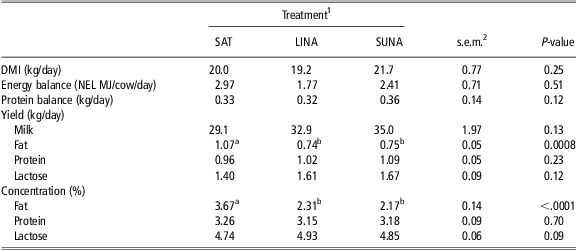
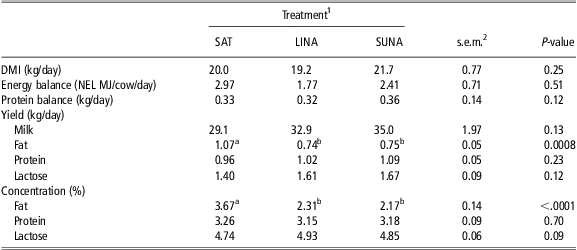
Treatments with plant oils and algae had no effect on the DMI, energy and protein intake (Table 2). Relative to the SAT diet, the LINA and SUNA treatments decreased the milk fat yield (−33 and −34 g/d, respectively; P < 0.0001) and fat concentration (−1.4 and −1.5 percentage unit, respectively; P < 0.0001). The LINA diet increased the milk lactose percentage (P = 0.016), and the SUNA diet had a tendency to increase it (P = 0.10; Table 2).
Effect of experimental treatments on DMI, milk yield and composition and energy and protein balance in cows (average last week)
DMI = dry matter intake; NEL = net energy of lactation
Different letters indicate significant differences between treatments at P ⩽ 0.05.
1Refers to diets supplemented with rumen-stable fractionated palm fat (SAT), or a combination of linseed oil and algae (LINA), or a combination of sunflower oil and algae (SUNA).
2Standard error of the mean for n = 18.
Milk FA secretions
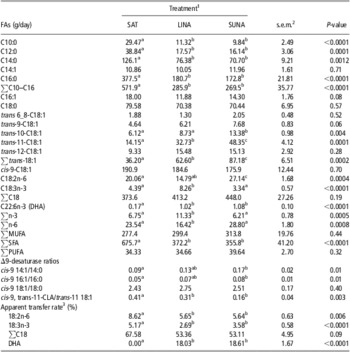
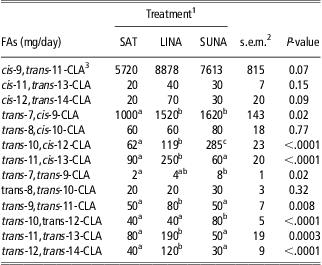
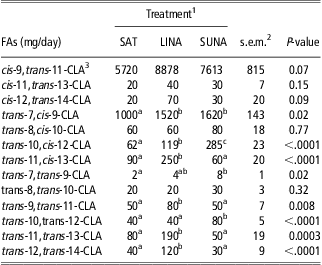
Data on milk FA and CLA secretion (g/d and mg/d, respectively) are shown in Tables 3 and 4. Plant oils plus algae decreased (P < 0.0001) milk secretion of SFA from C10:0 to C16:0 and the total secretion of SFA and increased milk secretion of DHA (P < .0001), trans-7,cis-9-CLA (P = 0.02) and the total secretion of trans-C18:1 isomers (P = 0.0002). Milk secretions of trans-11-18:1 and trans-10,cis-12-CLA increased with the LINA and SUNA diets compared to the SAT diet and were higher for the SUNA diet compared to the LINA diet. The output of C18:3n-3, the total amount of n-3 FA, trans-12,trans-14-CLA, trans-11,trans-13-CLA, trans-11,cis-13-CLA and trans-9,trans-11-CLA increased (P ⩽ 0.05) with the LINA diet only. The output of C18:2n-6, trans-10-C18:1, trans-10,trans-12-CLA and trans-7,trans-9-CLA increased (P ⩽ 0.05) with the SUNA diet only (Tables 3 and 4).
Effect of experimental treatment on the secretion of the major FAs in milk, including specific trans isomers of C18:1, milk fat Δ-9 desaturase ratios, and apparent transfer rate of C18 FAs and DHA in cows

FA = fatty acids; DHA = docosahexaenoic acid; MUFA = monounsaturated fatty acids; SFA = saturated fatty acids; PUFA = polyunsaturated fatty acids; CLA = conjugated linoleic acid.
∑C10–C16 = C10:0 + C12:0 + C14:0 + C16:0.∑SFA = C10:0 + C11:0 + C12:0 + C13:0 + C14:0 + C15:0 + C16:0 + C17:0 + C18:0 + C20:0 + C21:0 + C22:0 + C23:0 + C24:0.
∑MUFA = C14:1 + C15:1 + C16:1 + C17:1 + trans-9-C18:1 + trans-10-C18:1 + trans-11-C18:1 + cis-9-C18:1 + cis-11-C18:1 + C22:1 + C24:1.
∑n-3 FA = C20:3n-3 + C22:6n-3 + C22:5n-3 + C20:5n-3 + C18:4n-3 + C18:3n-3.
∑n-6 FA = C22:2n-6 + C20:2n-6 + C18:3n-6 + C22:4n-6 + C20:3n-6 + C18:2n-6 + C20:4n-6.
Different letters indicate significant differences between treatments at P ⩽ 0.05.
1Refers to diets supplemented with rumen-stable fractionated palm fat (SAT), or a combination of linseed oil and algae (LINA), or a combination of sunflower oil and algae (SUNA).
2Standard error of the mean for n = 18.
3Apparent transfer rate calculated as the ratio between the milk FA secretion and its level provided by the diet.
Effect of experimental treatment on the secretion of CLA isomers in milk in cows
CLA = conjugated linoleic acid; FAs = fatty acids.
Different letters indicate significant differences between treatments at P ⩽ 0.05.
1Refers to diets supplemented with rumen-stable fractionated palm fat (SAT), or a combination of linseed oil and algae (LINA), or a combination of sunflower oil and algae (SUNA).
2Standard error of the mean for n = 18.
3Coelutes with trans-9,cis-11-CLA.
The SUNA diet resulted in higher cis-9-14:1/14:0 and cis-9-16:1/16:0 ratios compared to the SAT diet (P = 0.01). The cis-9,trans-11-CLA/trans-11-18:1 ratio was significantly lower for the LINA and SUNA diets compared to the SAT diet (P < 0.001). The C18:2n-6 and C18:3n-3, from the diet were apparently transferred into milk with lower efficiencies for the LINA and SUNA diets compared to the SAT diet, whereas the converse was observed for DHA (Table 3).
Quantification of purified MECs and mRNA quality
The different diets did not have statistical effects on the concentration of milk purified MECs or the number of MECs exfoliated per day (P = 0.18). The total amount of RNA collected from milk purified MECs was similar between the diet groups (P = 0.35), averaging 2.3 μg (s.e. 0.3) (data not shown). The diet has no effect on total RNA quality even though a tendency was observed for a lower RIN with SUNA (P = 0.08) compared to SAT (Table 5).
Effect of experimental treatment on milk purified MEC number and on the RNA quality of MEC and mammary tissue indicated by RIN

MEC = mammary epithelial cells; RIN = RNA integrity number; MG = mammary gland.
1Refers to diets supplemented with rumen-stable fractionated palm fat (SAT), or a combination of linseed oil and algae (LINA), or a combination of sunflower oil and algae (SUNA).
2Standard error of the mean for n = 18.
3RIN generated by Agilent 2100 Expert software, version B.02 (Agilent Technologies, Massy, France).
Gene expression in mammary tissue and milk purified MECs
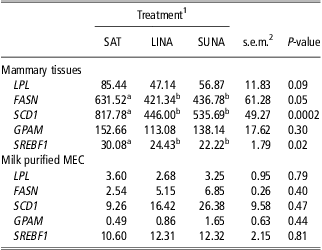
The addition of plant oils and algae to the diet decreased (P ⩽ 0.05) the abundance of SCD1, FASN, and SREBF1 mRNAs in mammary tissue. Furthermore, plant oils and algae had no effect (P = 0.3) on the abundance of the GPAM and LPL mRNAs in mammary tissue, except for a tendency (P = 0.09) of decreased LPL levels with the LINA diet compared to the SAT diet (Table 6).
Effect of experimental treatment on mRNA abundance of LPL, FASN, SCD1, GPAM, SREBF1 genes in mammary tissues and milk purified MEC of cows
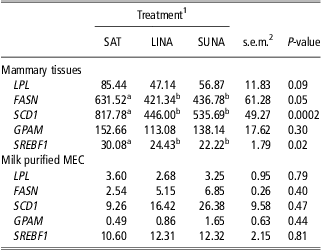
LPL = lipoprotein lipase; FASN = fatty acid synthase; SCD1 = stearoyl-CoA desaturase; GPAM = glycerol-3-phosphate acyltransferase 1, mitochondrial; SREBF1 = sterol regulatory element binding transcription factor 1; MEC = mammary epithelial cells.
Levels of mRNA expressed in arbitrary units determined as abundance relative to the geometric mean of three reference genes (PPIA, EIF3 K and UXT).
Different letters indicate significant differences between treatments at P ⩽ 0.05.
1Refers to diets supplemented with rumen-stable fractionated palm fat (SAT), or a combination of linseed oil and algae (LINA), or a combination of sunflower oil and algae (SUNA).
2Standard error of the mean for n = 18.
In milk purified MECs, the treatments had no effect (P > 0.10) on the abundance of the SCD1, FASN, SREBF1, and GPAM mRNAs (Table 6).
Discussion
The present study investigated the effects of plant oils rich in either C18:3n-3 or C18:2n-6 plus DHA compared to a mostly saturated fat source from rumen-stable fractionated palm fat on milk fat composition and milk yield, particularly with respect to the expression of genes involved in the major pathways of lipogenesis in mammary tissue. These data are discussed in relation with other studies on the effect of nutrition on mammary gene expression all carried out using mammary tissue as source of mRNA. In addition, gene expression was also determined from milk purified MECs to evaluate this source of mRNA in lipid-supplemented animals for which so far only one study is available in ruminant (Murrieta et al., Reference Murrieta, Hess, Scholljegerdes, Engle, Hossner, Moss and Rule2006). The observations made in the present study (milk fat composition and gene expression) are related to the endpoint of a long-term adaptation period to the treatments (10 weeks) even though it is likely that a short-term adaptation occurred earlier.
Milk production and composition
Supplementing with a combination of linseed or sunflower oil with algae compared to saturated fat for 10 weeks did not affect the DMI. Similar results were found by Abughazaleh et al. (Reference AbuGhazaleh, Schingoethe, Hippen and Kalscheur2004), in a study where lactating cows were supplemented with fish meal and extruded soybean (0.5% and 2% of FO and soybean oil, respectively) for 10 weeks. In contrast, Shingfield et al. (Reference Shingfield, Reynolds, Lupoli, Toivonen, Yurawecz, Delmonte, Griinari, Grandison and Beever2005) found a significant decrease of DMI in cows fed a corn silage-based diet (forage : concentrate, 60 : 40, DM basis) supplemented with a mixture of FO (1.5% of DM) and sunflower oil (3.0% of DM) for 28 days compared to a control diet (without lipid supplement). Supplementing diets with oils rich in unprotected PUFA often results in a reduction in DMI, with the mechanisms of this hypophagic effect being attributed to effects on ruminal fermentation and gut motility, the palatability of diets containing added fat, the release of gut hormones and the oxidation of fat in the liver (Allen, Reference Allen2000). The maintained DMI observed in the present study compared to other studies could be due to the nature of the control diet (rumen-stable fractionated palm fat), which presented the same amount of fat as SUNA and LINA diet, a possible difference in the effect of algae compared to FO on the diet palatability, the different level of algae compared to FO in the diets and/or the duration of the dietary treatment (10 weeks in the present study and in Abughazaleh et al., Reference AbuGhazaleh, Schingoethe, Hippen and Kalscheur2004v. 28 days in Shingfield et al., Reference Shingfield, Reynolds, Lupoli, Toivonen, Yurawecz, Delmonte, Griinari, Grandison and Beever2005).
The decreases in milk fat yield (−30% and −31% for LINA and SUNA compared to SAT, respectively) and concentration (−38% and −41% for LINA and SUNA compared to SAT, respectively) are consistent with previous studies using FO in bovines (Whitlock et al., Reference Whitlock, Schingoethe, Hippen, Kalscheur, Baer, Ramaswamy and Kasperson2002; AbuGhazaleh et al., Reference AbuGhazaleh, Schingoethe, Hippen and Kalscheur2004). This effect is known as milk fat depression (MFD) and often occurs in dairy cows that are fed unprotected PUFAs (Shingfield et al., Reference Shingfield, Reynolds, Hervas, Griinari, Grandison and Beever2006). MFD has been related to an alteration of ruminal biohydrogenation resulting from the production of different ruminal intermediates that have a negative effect on the gene expression of lipogenic enzymes (Bauman and Griinari, Reference Bauman and Griinari2001). DHA-micro-algae alone have been used as a viable alternative to FO in cow's diets to modify rumen biohydrogenation (AbuGhazaleh et al., Reference AbuGhazaleh, Potu and Ibrahim2009). Boeckaert et al. (Reference Boeckaert, Vlaeminck, Dijkstra, Issa-Zacharia, Van Nespen, Van Straalen and Fievez2008) found that supplementing dairy cows with algae inhibited the total biohydrogenation of C18:2n-6 and C18:3n-3, resulting in increased concentrations of biohydrogenation intermediates in rumen, in particular the 18:1-cis and -trans isomers, whereas C18:0 decreased due to a decrease of the capacity of the butyrivibrio community to hydrogenate trans-C18:1 FAs. In the present experiment, both PUFA diets decreased the apparent transfer rate of C18:2n-6 and C18:3n-3 and increased the output of different trans-C18:1 isomers, particularly trans-11 compared to SAT. An estimation of the degree of ruminal trans-C18:1 reduction from the ratio of trans-C18:1/(C18:0 + cis-9-C18:1 + trans-11-C18:1; Palmquist and Griinari, Reference Palmquist and Griinari2006) in milk (i.e. 0.05, 0.11 and 0.17, for SAT, LINA and SUNA, respectively) is in line with FO acting as an inhibitor of the conversion of trans-18:1 to stearic acid in the rumen (Chilliard et al., Reference Chilliard, Ferlay and Doreau2001).
Milk FA secretion and lipogenic enzyme gene expression from mammary tissue
In the present study, after 10 weeks feeding the diets supplemented with PUFAs, the decreased output of milk medium-chain FAs (C10–C16, −50% with LINA and −53% with SUNA) was related to a significant decrease in FASN mRNA levels (−33% with LINA and −31% with SUNA). These results are consistent with studies evaluating the nutritional regulation of lipogenic enzyme gene expression in lactating cows with high-concentrate diets (Peterson et al., Reference Peterson, Matitashvili and Bauman2004), with rations containing soybean oil (Piperova et al., Reference Piperova, Teter, Bruckental, Sampugna, Mills, Yurawecz, Fritsche, Ku and Erdman2000), FO (Ahnadi et al., Reference Ahnadi, Beswick, Delbecchi, Kennelly and Lacasse2002), FO and soybean oil (Harvatine and Bauman, Reference Harvatine and Bauman2006) that induce MFD. Under these conditions, substantial reductions in milk FAs related to de novo synthesis (from 30% to 59% decreases in C10–C16:0) have been associated with a decrease in mammary FASN mRNA levels and/or activity. These effects were attributed to the synthesis of specific rumen biohydrogenation intermediates associated with the ruminal trans-10 pathway that exerts antilipogenic effects in bovines (Shingfield et al., Reference Shingfield, Bernard, Leroux and Chilliard2010). In particular, abomasal infusion of supraphysiological amounts of trans-10,cis-12-CLA has been shown to inhibit milk fat synthesis in ruminants (Baumgard et al., Reference Baumgard, Matitashvili, Corl, Dwyer and Bauman2002). Consistent with these findings, in the present study, the PUFA-rich SUNA and LINA diets led to a significant increase in milk trans-10,cis-12-CLA that may explain the observed decreases of both FASN gene expression and milk medium-chain FA secretion. However, these observations contrast with data from Invernizzi et al. (Reference Invernizzi, Thering, McGuire, Savoini and Loor2010) obtained on dairy cows fed with a mixture of fish and soybean oils that lead to a decrease in milk de novo FA synthesis that was not associated neither to increase in milk trans-10,cis-12-CLA nor to significant effect on FASN mRNA abundance. These data, together with others combining plant oils with FO (Whitlock et al., Reference Whitlock, Schingoethe, Hippen, Kalscheur, Baer, Ramaswamy and Kasperson2002; AbuGhazaleh et al., Reference AbuGhazaleh, Schingoethe, Hippen and Kalscheur2004) underlined that MFD may occur with moderate increase (Whitlock et al., Reference Whitlock, Schingoethe, Hippen, Kalscheur, Baer, Ramaswamy and Kasperson2002; AbuGhazaleh et al., Reference AbuGhazaleh, Schingoethe, Hippen and Kalscheur2004) or without increasing (Invernizzi et al., Reference Invernizzi, Thering, McGuire, Savoini and Loor2010) milk trans-10,cis-12-CLA. Thus, the implication of other biohydrogenation intermediates have been involved, such as trans-18:1 isomers and specifically the trans-10 18:1 isomer, which may exert potentially antilipogenic effects and contribute to the reduction in milk fat synthesis during diet-induced MFD in the lactating cow (Shingfield et al., Reference Shingfield, Sæbø, Saeb, Toivonen and Griinari2009). In addition, the trans-9,cis-11-CLA and the cis-10,trans-12-CLA isomers, have been also identified as inhibitors of milk fat synthesis (Shingfield et al., Reference Shingfield, Bernard, Leroux and Chilliard2010), but their outputs were very low in the present experiment. It cannot be ruled out that other isomers, such as trans-7,cis-9-CLA, which increased in milk for the LINA and SUNA diets, may exert an antilipogenic effect, as recently suggested by studies in lactating mice (Kadegowda et al., Reference Kadegowda, Connor, Teter, Sampugna, Delmonte, Piperova and Erdman2010). In addition other mechanisms may be involved in the MFD (Loor and Herbein, Reference Loor and Herbein2003) such as an alteration in the melting point of fat, although not measured in our study, due to the large increase in the sum of trans-18:1 isomers without increase in cis-9-C18:1 (Table 3).
The total secretion of C18, representing the major part of the milk long-chain FAs, was maintained in response to the addition for 10 weeks of PUFAs to the diet, whereas the secretion of DHA was increased (Table 3). These small variations in the milk long-chain FA were not related to variations in mammary LPL mRNA levels measured after 10 weeks feeding period, even though a tendency for a decrease with the LINA compared to the SAT treatment was observed. This result concurs with studies in cows showing that mammary LPL mRNA levels were not significantly affected during MFD with high-concentrate diets (Peterson et al., Reference Peterson, Matitashvili and Bauman2004) or in response to intravenous infusions of trans-10,cis-12-CLA as free FA (Gervais et al., Reference Gervais, McFadden, Lengi, Corl and Chouniard2009); these treatments decreased the total secretion of C18. Conversely, other studies in cows have shown that the abundance of LPL mRNA in mammary tissue is decreased during MFD with diets containing FO (Ahnadi et al., Reference Ahnadi, Beswick, Delbecchi, Kennelly and Lacasse2002) or a combination of FO and soybean oil (source of n-6 FA; Harvatine and Bauman, Reference Harvatine and Bauman2006) or in response to intravenous (Harvatine and Bauman, Reference Harvatine and Bauman2006) or abomasal infusion (Baumgard et al., Reference Baumgard, Matitashvili, Corl, Dwyer and Bauman2002) of supraphysiological doses of trans-10,cis-12-CLA; these treatments had either no effect or decreased secretion of long-chain FAs in milk. Altogether, these results showing variable effects of diet on the mammary secretion of long-chain FA and LPL expression suggest that factors such as substrate availability are important in the regulation of mammary long-chain FA metabolism in the bovine in line with previous studies in ruminant (Bernard et al., Reference Bernard, Leroux and Chilliard2008).
The decrease in SCD1 mRNA levels in mammary tissue following the inclusion of plant oils and algae in the diet for 10 weeks is in line with previous studies with FO (Ahnadi et al., Reference Ahnadi, Beswick, Delbecchi, Kennelly and Lacasse2002) or soybean oil (Jacobs et al., Reference Jacobs, Van Baal, Smits, Taweel, Hendriks, Van Vuuren and Dijkstra2011) in cows and formaldehyde-treated linseeds in goats (Bernard et al., Reference Bernard, Rouel, Leroux, Ferlay, Faulconnier, Legrand and Chilliard2005a). Conversely, other studies in cows have shown that feeding them high-concentrate diets (Peterson et al., Reference Peterson, Matitashvili and Bauman2004) or FO and soybean oil (Harvatine and Bauman, Reference Harvatine and Bauman2006, Invernizzi et al., Reference Invernizzi, Thering, McGuire, Savoini and Loor2010) causing MFD are mostly not associated with altered SCD1 mRNA levels or associated with an increase in SCD1 mRNA (Invernizzi et al., Reference Invernizzi, Thering, McGuire, Savoini and Loor2010). In these studies, both the absence of variation or the increase of SCD1 mRNA expression were attributed to the role of SCD1 in regulating the synthesis of milk triglycerides and maintaining milk fat fluidity via the endogenous synthesis of cis-9-C18:1 from C18:0 in the mammary gland (Loor and Herbein, Reference Loor and Herbein2003). The discrepancy between our results on SCD expression and those of Invernizzi et al. (Reference Invernizzi, Thering, McGuire, Savoini and Loor2010) could be due to differences in the origin (algae v. FO) and doses (0.4% v. 1% DM) of oils used as well as to differences in the adaptation period to the treatments (10 v. 3 weeks). In the present experiment, the down-regulation of SCD1 gene expression by the LINA and SUNA diets could be related to the observed increase of trans-10,cis-12-CLA in milk. Indeed, in vivo (Baumgard et al., Reference Baumgard, Matitashvili, Corl, Dwyer and Bauman2002; Gervais et al., Reference Gervais, McFadden, Lengi, Corl and Chouniard2009) and in vitro (Peterson et al., Reference Peterson, Matitashvili and Bauman2004; Kadegowda et al., Reference Kadegowda, Bionaz, Piperova, Erdman and Loor2009) studies have demonstrated that trans-10,cis-12-CLA decreases SCD1 transcription in the bovine although in most of them supraphysiological doses of this CLA isomer were used. The LINA and SUNA treatments also increased DHA levels, which as a member of the n-3 FAs, could be involved in the down-regulation of SCD1 gene regulation in mammary (Ahnadi et al., Reference Ahnadi, Beswick, Delbecchi, Kennelly and Lacasse2002; Bernard et al., Reference Bernard, Rouel, Leroux, Ferlay, Faulconnier, Legrand and Chilliard2005a), muscle (Waters et al., Reference Waters, Kelly, O'Boyle, Moloney and Kenny2009) and adipose (Daniel et al., Reference Daniel, Wynn, Salter and Buttery2004) tissues in ruminants. In addition, the combination of sources of n-3 (linseed oil) or n-6 (sunflower oil) FAs with a source of DHA (algae) altered rumen biohydrogenation, causing the production of specific intermediates that may affect SCD1 expression. Thus, post-ruminal infusion studies in cows using trans-10,trans-12-CLA (Sæbø et al., Reference Sæbø, Sabo, Griinari and Shingfield2005) or trans-9,trans-11-CLA (Perfield et al., Reference Perfield, Lock, Griinari, Sæbø, Delmonte, Dwyer and Bauman2007) reduced milk fat delta-9 desaturase ratios, and therefore, these biohydrogenation intermediates would be expected to be potential down-regulators of SCD1 gene expression and/or activity. In the present study, trans-10,trans-12-CLA and trans-9,trans-11-CLA yields were increased in milk for the SUNA and LINA treatments, respectively. Thus, the increase of these CLA intermediates in addition to trans-10,cis-12-CLA and DHA may contribute to mediate the down-regulation of SCD1 gene expression from the LINA and SUNA treatments.
Additionally, the observed decrease in the SCD1 mRNA level could be related to the decrease in the milk delta9-desaturase ratio of cis-9,trans-11-CLA (Table 3). Indeed, the strong increase of trans-11-18:1 with the LINA (by 131%) and SUNA (by 242%) diets compared to the SAT diet was not related to a significant increase in cis-9,trans-11-CLA, which may indicate a lower level of SCD activity for these treatments. However, variable effects were observed on the other milk delta9-desaturase ratios, with either no effect of the dietary treatment or an increase only for the SUNA compared to the SAT treatment for the C14 and C16 milk delta9-desaturase ratios. These data are in line with others in cows (Bionaz and Loor, Reference Bionaz and Loor2008; Gervais et al., Reference Gervais, McFadden, Lengi, Corl and Chouniard2009; Invernizzi et al., Reference Invernizzi, Thering, McGuire, Savoini and Loor2010) supporting a doubt in the accuracy of desaturase indexes to infer activity and/or expression of SCD. Such discrepancies could be due to differences in other factors that may regulate milk fat desaturase ratios, such as differential uptake, turnover and utilisation of the pairs of FA in these ratios in mammary tissue in addition to variation in the accuracy of cis-9 containing FA determinations in milk. In addition, differences between mammary SCD1 mRNA levels and the calculated milk desaturase ratios could be due to effects of the treatments at the protein level of SCD as described in goats fed with supplements rich in rich in 18:1n-9, 18:2n-6 and 18:3n-3 (Bernard et al., Reference Bernard, Leroux, Bonnet, Rouel, Martin and Chilliard2005b and Reference Bernard, Leroux, Faulconnier, Durand, Shingfield and Chilliard2009b) in addition to effects at the transcription step.
This study is the first to characterise in cows fed a combination of plant and algae lipids the mammary expression of genes involved in different pathways of lipogenesis: the uptake of circulating FAs (LPL), de novo FA synthesis (FASN), delta9-desaturation of FAs (SCD1) and triglycerides synthesis (GPAM) and of a transcription factor (SREBF1) expressed in mammary tissue and reported to control the transcription of lipogenic genes in the bovine (Harvatine and Bauman, Reference Harvatine and Bauman2006; Bionaz and Loor, Reference Bionaz and Loor2008). The results of the study also demonstrated significant positive associations between the expression of the following pairs of genes: LPL and SCD1 (r = +0.64, P = 0.01; Y = 0.1025X + 1.6585), FASN and SCD1 (r = +0.64, P = 0.01; Y = 0.5527X + 165.05) and GPAM and SCD1 (r = +0.66, P = 0.01; Y = 0.1454X + 47.444) suggesting similar regulation for these pair genes. A joint decrease in the mammary expression of SREBF1, FASN and SCD1 was observed for the LINA and SUNA treatments that could be related to MFD. These results are in line with others (Harvatine and Bauman, Reference Harvatine and Bauman2006) demonstrating a joint decrease in the mammary expression of SREBF1 and lipogenic gene expression together with MFD in lactating cows that were fed a low-forage/high-oil diet or one infused with trans-10,cis-12-CLA.
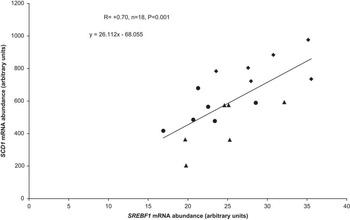
A positive inter-individual relationship between SCD1 and one of its putative transcription factors, SREBF1 (r = +0.70, P = 0.01; Figure 1), was observed and suggests that, in our dietary conditions, either the regulation of these two genes may be similar or that SREBF1 is transcriptionally regulated and in turn regulates SCD1 gene expression. In line with the first hypothesis, it was recently reported that the bovine SREBF1 gene contains in its promoter responsive elements for both SREBF1 (SRE) that could allow for its positive feedback regulation, and for liver X receptor (LXR-RE; Lengi and Corl, Reference Lengi and Corl2010). These two responsive elements (SRE, LXR-RE) have been also characterised in SCD1 gene promoter in human, mouse or chicken (Mauvoisin and Mounier, Reference Mauvoisin and Mounier2011) and are conserved between species suggesting that they may be present in bovine SCD1 gene promoter.
Relationship between mRNA abundances of stearoyl-CoA desaturase (SCD1) and sterol regulatory element binding transcription factor 1 (SREBF1) in mammary tissue of cows fed diets supplemented with rumen-stable fractionated palm fat (SAT, ▪), or a combination of linseed oil and algae (LINA, ▴), or a combination of sunflower oil and algae (SUNA, •). The mRNA abundances are expressed in arbitrary units (AU) determined as abundance relative to the geometric mean of 3 reference genes (PPIA, EIF3K and UXT).

Elsewhere, a similar positive relationship between SCD1 and SREBF1 gene expression was observed in the muscle tissue of beef cattle supplemented with dietary n-3 PUFAs (Waters et al., Reference Waters, Kelly, O'Boyle, Moloney and Kenny2009). We suggest that in the bovine mammary gland, as observed in muscle, the negative effect of dietary PUFAs on SCD1 mRNA expression could be mediated at least in part by reduced SREBF1 gene expression. In addition, we hypothesise that the SREBF1 down-regulation observed in the LINA and SUNA treatments is mediated by the observed increase in milk trans-10,cis-12-CLA and long-chain FA of the n-3 family. Because the SREBF1 protein is regulated at both the levels of transcription and protein maturation (Eberlé et al., Reference Eberlé, Hegarty, Bossard, Ferre and Foufelle2004), different effects of PUFAs and their rumen intermediates on SREBF1 gene transcription or on the proteolytic activation process of the SREBF1 protein may be observed (Peterson et al., Reference Peterson, Matitashvili and Bauman2004; Harvatine and Bauman, Reference Harvatine and Bauman2006).
In addition to SREBF1, other proteins such as sterol regulatory element-binding protein cleavage-activating protein (SCAP) or transcription factors such as peroxisome proliferative activated receptor, gamma (PPRG, as proposed by Bionaz and Loor, Reference Bionaz and Loor2008), and LXR (as discussed above), which are also expressed in mammary tissues (Sundvold et al., Reference Sundvold, Brzozowska and Lein1997; Kadegowda et al., Reference Kadegowda, Bionaz, Piperova, Erdman and Loor2009; Invernizzi et al., Reference Invernizzi, Thering, McGuire, Savoini and Loor2010; McFadden and Corl., Reference McFadden and Corl2010), may contribute to the observed regulation of lipogenic gene expression.
Concordance between mRNAs from milk purified MEC and mammary tissue
There was a lack of an effect of polyunsaturated lipid supplementation on the mRNA levels of lipogenic enzymes using milk purified MECs. In addition, our study did not uncover any relationship between the response to the dietary treatments of the mRNA levels of lipogenic enzymes from mammary tissue and from milk purified MECs, whereas previous studies demonstrated that gene expression in milk cells reflects what occurs in the mammary gland (Boutinaud et al., Reference Boutinaud, Rulquin, Keisler, Djiane and Jammes2002; Murrieta et al., Reference Murrieta, Hess, Scholljegerdes, Engle, Hossner, Moss and Rule2006). From these results it is tempting to conclude that milk purified MECs are not a valuable source of mRNA for the analysis of lipogenic gene expression in response to lipid supplements. In our study, supplementation with PUFAs and DHA resulted in a tendency for reducing RNA quality in milk cells compared to rumen-stable fractionated palm fat. According to Fleige and Pfaffl (Reference Fleige and Pfaffl2006), qRT-PCR performance is affected by the RNA integrity. Thus, we believe that the type of lipid supplementation used in our study impact the milk purified MEC RNA quality that may be responsible for the discrepancy between gene expression results in mammary tissue v. milk epithelial cells. Additionally, the number of obtained milk purified MECs per millilitre had high variability in all treatments (CV = 20–48%), and the numbers in some samples were very low resulting in very low extracted RNA. The high variation of the milk purified MEC population and its RNA quality could also partly explain the absence of concordance between gene expression in the mammary tissue and in milk purified MECs. Moreover, we hypothesise that milk purified MEC population is modified by the nature of the lipid supplements, as suggested by a study showing that linseed oil decreases mammary cell proliferation and increases apoptosis in breast cancer (Saggar et al., Reference Saggar, Chen, Corey and Thompson2010). In order to test this hypothesis we analysed the gene expression of a pro apoptotic gene Bax. However, we did not observe any modification of Bax mRNA abundance neither in milk purified MEC nor in mammary tissue (data not shown). A better indicator of changes in cell proliferation and apoptosis would have been immunohistochemical analyses (Boutinaud et al., Reference Boutinaud, Lollivier, Finot, Bruckmaier and Lacasse2012), but mammary tissue sections could not be prepared in the current study. In our study, linseed oil plus algae increased the loss of MEC in the milk, but the differences were not significant (49% higher than SAT and 48% higher than SUNA). Thus, we suggest that it is important to consider the population of epithelial cells recovered from milk and its RNA quality before using these cells as a source of mammary transcripts. Further studies should be carried out to improve the collection conditions and the preparation of cell extracts for the use of these cells as a non-invasive tool under all treatment conditions.
Conclusions
This study showed that the addition of plant oils and algae for 10 weeks to the diet of lactating cows induced a MFD related to a joint down-regulation in the mammary gland of lipogenic gene expression (SCD1, FASN) and of the SREBF1 transcription factor expression. In addition, a positive relationship between the expression of SCD1 and SREBF1 was observed, suggesting a possible similarity in the regulation of these two genes. We propose that the effect of dietary PUFAs on SCD1 mRNA expression could be mediated at least in part by the reduction of SREBF1 gene expression, with the hypothesis that SREBF1 down-regulation is mediated by trans-10,cis-12-CLA and long-chain FA of the n-3 family. In addition to the early adaptation of the transcriptome reported in response to lipid supplements (Invernizzi et al., Reference Invernizzi, Thering, McGuire, Savoini and Loor2010), our results demonstrate a long-term regulation of lipogenic gene expression and milk fat synthesis in the bovine mammary gland supporting the implication of SREBF1. The observed effects of dietary PUFAs on milk FA secretion and mammary lipogenic gene expression were associated to milk trans-10,cis-12-CLA and DHA. In addition, probably that other mechanisms or biohydrogenation intermediates could be involved as well, such as C18:1-trans-FA or trans-7,cis-9-CLA, but further experiments will be required. Moreover, this study provides information supporting the type of lipid supplements that may affect the milk purified MEC population and RNA quality, which are important factors to consider in the future for the analysis of gene expression using milk cells.
Acknowledgements
This study was supported by Colciencias (Colombia, project 111545221319), by Antioquia University Medellin Colombia (Professorial status-Superior Agreement 083 1996 and CODI), by the EU (EU project FOOD-CT-2006-36241) and by the INRA (France). This study represents a subset of the findings from an ongoing large experiment at the Leibniz Institute for Farm Biology. The authors thank B. Jentz, H. Rooch and M. Dahm of the Research Unit Muscle Biology and Growth, S. Marion from the INRA UMRPL for her technical help, J. Domagalsky of the INRA UR1213 for laboratory support and Mr. R. Gaeth for accurate feed preparations.