A medical/individual perspective has been prevalent in quality of life research in the field of disability. Within this rubric, individuals’ quality of life with a disability has been placed in the field of pathology and deficit. Based on the assumption that the absence of a medical condition constitutes in itself a better quality of life (Cummings, 2001; Huppert & Whittington, Reference Huppert and Whittington2003) and that there is a dichotomy between health and illness, disability fails to fulfill the criteria for ‘normality’ (De Mayer, Vanderplasschen, & Broekaert, Reference De Mayer, Vanderplasschen and Broekaert2009; Pfeiffer, Reference Pfeiffer2000).
Moreover, the concept of ‘health-related quality of life’ has been widely used in disability research. This concept is assessed by evaluating the ‘normality’ of an individual’s mental and physical health and their influence on the individual’s functioning (e.g. Cummins, Reference Cummins2000; Farquhar, Reference Farquhar1995; Ware, Kosinski, & Keller, Reference Ware, Kosinski and Keller2002; The World Health Organization (WHO), 2001). This assessment has often been executed using the Short Form Health Survey–36 (SF-36) and the Short Form Health Survey–12 (SF-12) (Garratt, Schmidt, Mackintosh, & Fitzpatrick, Reference Garratt, Schmidt, Mackintosh and Fitzpatrick2002; Ware, Kosinski, & Keller, Reference Ware, Kosinski and Keller1996 ). With these instruments, the ‘abnormality’ of the disabled individuals’ physical condition is tested (Hays, Hahn, & Marshall, Reference Hays, Hahn and Marshall2002; Tate, Kalpakjian, & Forchheimer, Reference Tate, Kalpakjian and Forchheimer2002) based on their ability to accomplish two feats: move a table or climb stairs (Huppert & Whittington, Reference Huppert and Whittington2003).
This emphasis on the ‘normality’ of physical and mental functionality neglects the possibility of an individual’s well-being in the presence of his/her impairment. Similarly, the medicalization of disability and the consequent authority granted to health professionals has been a disabling factor in peoples’ lives (Pfeiffer, Reference Pfeiffer2000). Empirical evidence reinforces this finding: accounts of disabled people suggest that, according to others, a life with a disability is not worth living (McCarthy, Reference McCarthy2003). Furthermore, empirical data reflect a gap in the way that disabled individuals’ quality of life is perceived by themselves and by the general population (Ubel, Loewenstein, & Jepson, Reference Ubel, Loewenstein and Jepson2003). This underestimation of disabled individuals’ quality of life as a result of medicalization influences political decisions, which are largely based on economic factors and medical decisions. Health professionals and patients thus interpret health situations or physical conditions through the filter of the medical model of disability (Ubel et al., Reference Ubel, Loewenstein and Jepson2003).
However, this model of medical assessment, which has produced academic research that attributes a sense of inferiority to disabled individuals’ quality of life, has been strongly opposed by various models that emerged some decades ago. The disability movement has given rise to other models of disability that have supported broader opportunities for disabled people to participate in society (Wehmeyer & Schalock, Reference Wehmeyer and Schalock2001; Wehmeyer & Schwartz, Reference Wehmeyer and Schwartz1998). Sociopolitical, rights and environmental models interpret disability in the interaction between the individual (impairment) and the context. Moreover, these models aim to attain a similar level of the quality of life for disabled and non-disabled citizens (Keith & Schalock, Reference Keith and Schalock2000).
Within a sociopolitical paradigm, the assessment of individuals’ quality of life takes into account the respondents’ priorities instead of one relying on normative comparisons (Joyce, McGee, & O’Boyle, Reference Joyce, McGee and O’Boyle1999). One’s personal, familial; community and societal well-being go well beyond the technological, scientific and medical developments conveyed by the medical model. Furthermore, the empowerment model replaces the normalizing movement when it advocates for person-centered planning and self-determination (Verdugo, Prieto, Caballo, & Peláez, Reference Verdugo, Prieto, Caballo and Peláez2005).
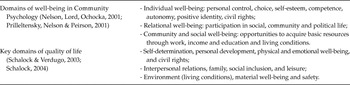
Within this paradigm, Schalock and Verdugo (Reference Schalock and Verdugo2003) and Schalock (Reference Schalock2004) have arrived at a consensus concerning the key domains of an individual’s quality of life. Interestingly, these key domains are consonant with the well-being domains proposed by Community Psychology. Well-being is considered at an individual, relational, community and social level (Nelson, Lord, & Ochocka, Reference Nelson, Lord and Ochocka2001; Prillentensky, Nelson, & Peirson, Reference Prilleltensky, Nelson and Peirson2001). We can identify corresponding key domains for individuals’ quality of life as identified by Schalock and Verdugo (Reference Schalock and Verdugo2003) and Schalock (Reference Schalock2004) in several studies Footnote 1 . As shown in Table 1, the domains of quality of life, such as self-determination, personal development, physical and emotional well-being and civil rights, correspond to domains of individual well-being; interpersonal relationships, family, social inclusion and leisure are related to one’s relational well-being; and environmental circumstances (living conditions), material well-being and safety represent the dimension of community and social well-being.
Quality of life’s key domains and the well-being domains of Community Psychology

Of the many definitions of quality of life in the literature, one of the most commonly used is the WHO definition. WHO defines Quality of Life as individuals’ perception of their position in life in the context of the culture and value systems in which they live and in relation to their goals, expectations, standards and concerns (The World Health Organization Quality of Life Group (WHOQOL), 1998). In contrast to the bio-psychosocial perspective defended by WHO, Schalock and Verdugo (Reference Schalock and Verdugo2003) define quality of life as the promotion of equal opportunities between people, regardless of their physical condition, thus espousing a sociopolitical perspective. Schalock’s model of quality of life (1996) used in this empirical research considers this construct to be multidimensional, comprising the following aspects: emotional well-being, interpersonal relationships, material well-being, personal development, physical well-being, self-determination, social inclusion and rights.
In Portugal, there is one study of the quality of life of disabled people that was conducted by Sousa et al., Reference Sousa, Casanova, Pedroso, Moita, Gomes, Seiceira and Alves2007 (CRPG/ISCTE), comprising a sample of 15.005 disabled people. The results of this study revealed the importance of a sociopolitical dimension of a person’s quality of life with a disability. The findings indicate that Portuguese disabled people have negative levels of quality of life in self-determination, personal development, physical and material well-being, rights and social inclusion. Moreover, the findings suggest that the social inequalities that disabled individuals experience in their access to training, work and income reveal discrimination and prejudice in the Portuguese society. However, this discrimination is not felt as such by disabled people, suggesting that there is a sense of conformity toward their situation and a diminished social consciousness because they do not regard disability as a social condition (Sousa et al., Reference Sousa, Casanova, Pedroso, Moita, Gomes, Seiceira and Alves2007).
This empirical study assesses the quality of life of disabled people according to a sociopolitical perspective. It proposes the following aims:
-
- to evaluate the validation of the Schalock’s multidimensional model of quality of life (1996) in the Portuguese context through confirmatory factor analysis;
-
- to assess the adequacy of two new subscales—the equality of rights and positive discrimination from the Minorities’ rights support scale (Nata & Menezes, Reference Nata and Menezes2007)—for the quality of life scale through confirmatory factor analysis;
-
- to examine levels of quality of life in their various dimensions (satisfaction, competence, empowerment, equality of rights and positive discrimination) and their correlations; and
-
- to assess the impact of discrimination on people’s lives by probing the values concerning the existence, motives and contexts of discriminatory experiences and the level of discomfort felt, as well as the relationship between discrimination and quality of life.
Method
Participants
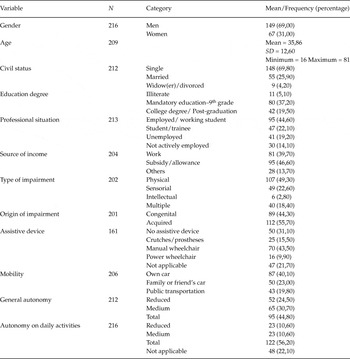
As described in table 2, the sample was composed of 217 participants: 149 men (69,00%) and 67 women (31,00%) between the ages of 16 and 81 (M = 35,86; SD = 12,60). Single participants account for 148 (69,80%), 55 (25,90%) are married and 9 (4,20%) are widow(er)s or divorced. Participants’ sources of income include work (N=81; 39,70%), pensions/allowances and subsidies (N = 95; 46,60%) or other sources (N = 28; 13,70%). Regarding education, 11 (5,10%) cannot read or write, 80 (37, 20%) had completed the 9th grade, 82 (38,10%) had completed high school or a technical course and 42 (19,50%) had completed a degree or post-graduate studies. As to their professional situation, 95 (44,60%) are employed or working students, 41 (19,20%) are unemployed, 30 (14,10%) are not actively employed and 47 (22,10%) are students or trainees.
Characteristics related to socio-demographics and to impairment, mobility and autonomy

With reference to the type of impairment, 107 (49, 30%) have a physical impairment, 6 (2,80%) have an intellectual impairment, 49 (22,60%) have a sensory impairment and 40 (18,40%) have multiple impairments. As to the origin of impairment, 89 (44,30%) of the participants noted a congenital cause and 112 (55,70%) noted an acquired cause.
Most of the participants use assistive devices: 25 (15,50%) use crutches or prostheses, 70 (43,50%) use a manual wheelchair and 16 (9,90%) use a power wheelchair. With respect to autonomy in daily life activities (eating, getting dressed, bathing), 122 (56,20%) have total autonomy in their daily life activities, 23 (10,60%) have a medium level of autonomy and 23 (10,60%) have reduced autonomy.
Assessment Instruments
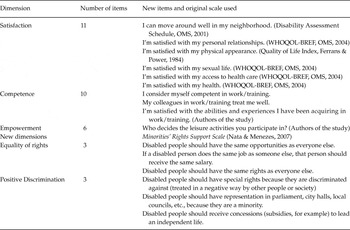
Questionário de Qualidade de Vida (Questionnaire of Quality of Life) (QQV). The QQV is an adapted version of four scales. Most of the items are adapted from the Quality of Life Questionnaire (QoL.Q) (Schalock & Keith, Reference Schalock and Keith1993). Other items have been adapted from the scales WHOQOL–BREF (WHO, 2004) and the Disability Assessment Schedule (WHO, 2001), which have been added to three original dimensions of the QoL.Q (satisfaction, competence, empowerment) (see Table 3). Two additional dimensions have been added to the QQV—equality of rights and positive discrimination—which were adapted from the Minorities’ Rights Support Scale (Nata & Menezes, Reference Nata and Menezes2007) (see Table 3).
Dimensions, number of items and new items for the QQV

In his literature review, Cummins (Reference Cummins1997) has found that the QoL.Q is the most frequently used scale in quality of life research. This scale was originally developed for people with intellectual disabilities and has primarily been used with that population (e.g., Lachapelle et al., Reference Lachapelle, Wehmeyer, Haelewyck, Courbois, Schalock, Verdugo and Walsh2005); however, it has also been used with visually impaired people (Verdugo, Schalock, Keith, & Stancliffe, Reference Verdugo, Prieto, Caballo and Peláez2005). The original QoL.Q uses an ordinal scale with three categories.
The Portuguese version was adapted by the authors and includes 33 items using a five-point Likert scale (1 for ‘totally disagree’ and 5 for ‘totally agree’; for some items, 1 for ‘decided totally alone’ and 5 for ‘someone totally decided for me’). The questionnaire includes the following dimensions: satisfaction (11 items, α = .79) (ex.: Generally speaking, my life is as I want it to be), competence/productivity (10 items, α = .86) (ex.: My work or what I carry out daily is important for me and for others), empowerment/independence (6 items, α = .687) (ex.: I can leave the house or get in whenever I want), equality of rights (3 items, α = .74) (ex.: Disabled people should have the same opportunities as everyone else) and positive discrimination (3 items, mean inter-item correlation = .231) (ex.: Disabled people should have special rights because they are discriminated against).
Escala da experiência de discriminação (Discriminatory Experiences Scale); EED. The EED is a version of ‘The experience of discrimination scale’ (Thompson, Noel, & Campbell, 1996, cited in Thompson, Noel & Campbell, Reference Thompson, Noel and Campbell2004) adapted by the authors. It includes four items referring to the existence of an experience of discrimination (‘Have you ever felt discriminated against?’), the motive for the discrimination (impairment, race, gender, age, socioeconomic status, religion, sexual orientation or others—with an option to be more specific), the contexts where the discrimination occurred (school, work or other—with an option to be more specific) and the degree of discomfort felt due to the experience, using a scale ranging from 1–5 (1 for ‘none at all’ and 5 for ‘much’).
Escala de Autonomia (Autonomy Scale) (EA). The EA is a version of the questionnaires Disability Assessment Schedule (WHO, 2001) and Participation Objective, Participation Subjective (Brown, Reference Brown2006) by the authors. It includes 7 items, 3 of which refer to daily activities (eating, getting dressed and bathing) and 4 to other activities, such as domestic activities, purchasing groceries, preparing/cooking meals and being on one´s own for several days. For each item, the question is whether the participants can carry out the task on their own or if they require assistance (and, in that case, if the assistance is total or partial and whether it is available).
Design and Procedure
The snowball sampling method was used (Maroco, Reference Maroco2007) due to the difficulties in accessing this socially excluded population. Disability organizations were contacted, as well as personal contacts (one of the researchers is part of the disability community); they were encouraged to respond to the questionnaire and to spread the word about the study. Before administering the questionnaire, a discussion was carried out with four persons with physical disabilities who had different socio-demographic features. These individuals provided suggestions on how to improve the items’ comprehensiveness.
The criterion for including participants in the study was the existence of impairment; in the case of an acquired impairment, it needed to have occurred at least one year prior. Participants were required to be at least 16 years old.
The questionnaire was administered both on-line and on paper Footnote 2 and it guaranteed anonymity. Information regarding the time required to fill out the questionnaire, its aim, its target population and the contact information of the research team was available. The administration of the questionnaire took place from August 2008 to February 2009.
Statistical analyses
Confirmatory factorial analysis using the EQS 1.6 program was conducted for validation purposes. First, an analysis of local fit for each of the quality of life dimensions (satisfaction, competence, empowerment, social integration, equality of rights and positive discrimination) was carried out. Second, a first- and second-order Confirmatory Factor Analysis global model fit was tested to determine which model revealed a better goodness-of-fit. Furthermore, Cronbach’s alpha coefficient and mean inter-item correlation analyses were executed to test the instrument’s internal consistency.
Descriptive and correlational analyses were carried out using the program SPSS 19. Analyses of means and standard deviations for the four quality of life dimensions were conducted. The Kolmogorov-Sminorv Test was used to test the normal distribution of the sample, which revealed an abnormal distribution for all dimensions aside from the dimension of satisfaction. With this type of distribution, Spearman’s Rank Order Correlation was chosen to analyze correlations between the quality of life dimensions. The impact of discrimination on participants’ lives was examined with descriptive analyses, including frequencies and percentages related to discrimination (experience, motive, context, and degree of discomfort). Spearman’s Rank Order Correlation was conducted to study the relationship between discrimination and quality of life.
Results
Confirmatory factor analysis (CFA)
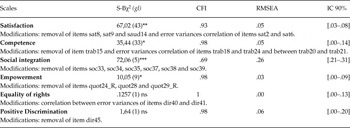
The original version of the QoL.Q (Shalock & Keith, Reference Schalock and Keith1993) includes 40 items and has four dimensions: satisfaction, competence/productivity, empowerment/independence and social integration. Confirmatory Factor Analysis revealed good local fit indices for each of the dimensions except for social integration, which was removed from the scale due to its inadequate fit indices, (χ Footnote 2 (5) = 72.06, p < .001; CFI = .69; RMSEA = .26), (see Table 4). Of the six items that comprised this dimension, only three remained after depuration proceedings, and they were related to participation in associations/recreational activities.
Results from CFA: fit indices and descriptions of modifications

* p < .05; ** p < .01; *** p < .001; ns (not significant)
It was thus necessary to carry out depuration proceedings, i.e., to remove items from all sub- scales. This removal was based on the factor loading of each item, redundancy and/or ambiguity. The criteria for removal were a low factor loading (under 0.35) and a consequent improvement of fit indexes once removed. Correlations between error variances of some items were performed using the criterion of semantic similarity between those items (Byrne, Reference Byrne2006). The robust version (Byrne, Reference Byrne2006) was chosen for all dimensions, as it was found to be more suitable due to the abnormality of distribution.
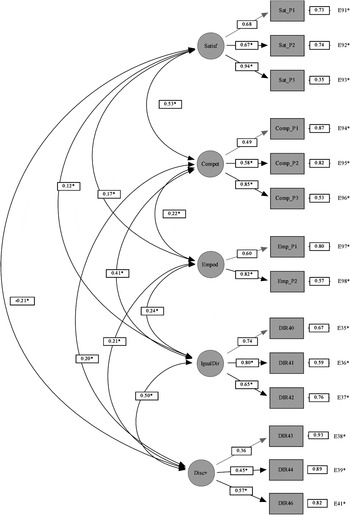
Afterwards, the first-order (global) model’s fit was tested, and in some dimensions, items were randomly parceled (in 2 or 3 parcels, according to the number of items) to achieve a parsimonious and justified model (for further details on the advantages of using parceling, see Little, Cunningham, Shahar, & Widaman, Reference Little, Cunningham, Shahar and Widaman2002). The test of first-order global fit with factor analysis shows good fit indices (χ2(17) = 14.62 ns; CFI = .93; RMSEA = .00) (see Table 5). This finding reveals that the model is multidimensional. The diagram regarding the first-order global fit is displayed in figure 1.
Results from CFA: first- and second-order model fit; fit indices and AIC scores

**p < .01; ns (not significant)
First-order global model–5-dimension-structure and factor loadings. Satisf = Satisfaction; Compet = Competence; Empod = Empowerment; IgualDir = Equality of rights; Disc+ = Positive discrimination.

The goodness-of-fit of the second-order (global) model was also tested (see Table 5), and the AIC values (Akaike’s Information Criterion) of both models were compared to determine which presented the lowest value, thus revealing the best-fitted model (Hu & Bentler, Reference Hu, Bentler and Hoyle1995). The value for the second-order global model (−40.26) is higher than the value of the first-order model (−10.84), which confirms the multidimensionality of the model.
Reliability analysis
The sub-scales of quality of life have good internal consistency with Cronbach’s alpha coefficients reported between .859 and .687 (cf. Table 6). Moreover, positive discrimination has a good internal consistency with the mean inter-item correlation reported to be .231 (in the range of .2–.4) (Briggs & Cheek, Reference Briggs and Cheek1986) (see Table 6). We chose to use the mean inter-item correlation for positive discrimination because the Cronbach’s alpha coefficient is more sensitive to the number of scale items; using the mean inter-item is therefore more adequate (Pallant, Reference Pallant2001).
Values of internal consistency (Cronbach’s alpha coefficient) and mean inter-item correlation, means and standard deviations of the dimensions

Dimensions of quality of life
As displayed in Table 6, equality of rights (M = 4.67, SD = .67) and empowerment (M = 4.20, SD = .75) are the dimensions with the highest means, followed by positive discrimination (M = 3.96, SD = .88), competence (M = 3.89, SD = .83) and satisfaction (M = 3.49, SD = .66).
The relationships between dimensions of quality of life were investigated using Spearman’s Rank Order Correlation. There is a moderate positive correlation (r = .447, p < .001) (Bryman & Cramer, Reference Bryman and Cramer2003) between satisfaction and competence in work/training, and this correlation has the highest value (see Table 7), with high levels of satisfaction in life associated with high levels of competence in work/training. Additionally, there is a positive correlation (r = .183, p < .001) between competence in work/training with equality of rights (see Table 7).
Spearman’s correlations between dimensions

Note:
* p < .05; ** p < .01; *** p < .001
Empowerment is significantly and positively correlated with satisfaction (r = .152, p < .01) and with equality of rights (r = .277, p < .001), with high levels of empowerment associated with high levels of satisfaction in life and equality of rights. Finally, equality of rights is correlated with positive discrimination (both are dimensions of rights), with high levels of equality of rights associated with high levels of positive discrimination (r = .159, p < .01) (see Table 7). This finding implies that the more people advocate equal rights, the more they also advocate positive discrimination. Except for the correlation between satisfaction and competence in work/training, all other correlations reveal low scores (Bryman & Cramer, Reference Bryman and Cramer2003).
Impact of discrimination
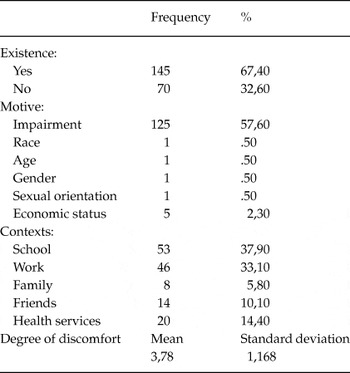
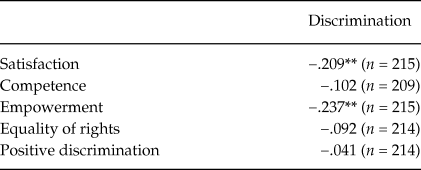
The impact of discrimination was analyzed with the use of descriptive statistics regarding the existence, motive, contexts and discomfort level experienced (see Table 8). The relationship between the dimensions of quality of life and discrimination was investigated using Spearman’s Rank Order Correlation (see Table 9).
Frequencies and percentages of responses related to the existence, motive and contexts of discrimination; mean and standard deviation of the degree of discomfort with discrimination

Spearman’s correlations between discrimination with dimensions of quality of life

*p < .05; ** p < .01; *** p < .001
As displayed in table 8, 67.40% (n = 145) of the participants have been discriminated against by people or society. Impairment is the primary underlying motive for discrimination (57.80%, n = 125), as other motives have low levels of expression (n < 5). School (37.90%, n = 53) and work (33.10%, n = 46) are the main contexts of discrimination, followed by health services (14.40%, n = 20). Discrimination experienced in personal relationship with friends (10.10%, n = 14) and family (5.89, n = 8) is less frequent than the contexts mentioned above. The mean score of discomfort level is 3.78 (SD = 1.168).
Spearman’s correlation analysis between the quality of life dimensions and discrimination reveal a negative correlation with satisfaction (r = −.209, p < .005) and empowerment (r = −.237, p < .05), with high levels of discrimination associated with low levels of satisfaction and empowerment (see Table 9).
Discussion
This empirical research aimed to evaluate the validation of Schalock’s multidimensional quality of life model in the Portuguese context. It also intended to analyze the quality of life of disabled people from a sociopolitical perspective, along with the impact of discrimination.
As to the first aim of the study, CFA analyses revealed adequate fit indices; therefore, the validation procedures of the QoL.Q for the Portuguese sample were satisfactory. The goodness-of-fit statistics obtained through the CFA procedure, as well as the internal consistency scores, indicate that the final model structure is stable and valid. Removing the sub-scale of social integration is a relevant aspect of this procedure worthy of further analysis.
Verdugo, Schalock et al. (Reference Verdugo, Prieto, Caballo and Peláez2005), in their study of a sample of blind Spaniards, conducted CFA and found that the four original dimension model lacked goodness-of-fit; additionally, the exploratory factor analysis revealed a three-dimensional model in which ‘social integration’ was excluded. This dimension was also removed in our study. Only the items related to participating in associations/leisure activities obtained acceptable factor loadings. However, we chose to remove this dimension because these items did not seem to accurately reflect social integration when considering the habits of the Portuguese population. Indeed, a comparative study of 23 EU countries concerning attitudes toward life (Nata & Menezes, Reference Nata, Menezes, Pais and Ferreira2010) concluded that Portugal is the country with the highest level of sociability; however, Portugal obtained a negative mean score in community involvement, a concept defined by participation in charity or volunteer organizations or in organized activities in the area of residence. As in Spain, Portugal has no established tradition of participation in civic organizations or associations, which may be related to its late democratic transition (Nata & Menezes, Reference Nata, Menezes, Pais and Ferreira2010). Therefore, due to cultural differences, the dimension of social integration revealed poor fit with respect to a Portuguese sample, whereas the remaining dimensions demonstrated an adequate local fit.
Two important conclusions can be stated concerning the validation of the instrument. The first is related to its multi-dimensional nature; the tested model, which includes 5 factors, has proven to be multi-dimensional, given the fact that when conducting a comparison of scores of AIC, the fit of the first-order global model displayed more adequate fit indices than the second-order global model (Byrne, Reference Byrne2006). The second conclusion relates to the fact that the dimensions of equality of rights and positive discrimination—as proposed by the authors—can be included in this model. Thus, a multi-dimensional model of quality of life composed of five dimensions—satisfaction, competence, empowerment, equality of rights and positive discrimination—fits the Portuguese population, demonstrating the importance of using two sub-scales of rights when measuring individuals’ quality of life with a disability.
The second aim of this research was to analyze the quality of life of disabled people from a sociopolitical perspective, accounting for the impact of discrimination. A starting point for this analysis pertains to the dimensions related to participants’ satisfaction in life. First, the correlation between satisfaction in life with competence in work/training proved to be the strongest and seems to reflect the importance of positive perceptions about competence in a professional domain. Work is one of the factors with a major impact on the social and material well-being of disabled people (Barnes, Mercer, & Shakespeare, Reference Barnes, Mercer and Shakespeare2005). Additionally, work presents a systematic advantage associated with a substantial reduction in expenses with subsidies/allowances and other services provided by the state (O’Brien & Dempsey, Reference O’Brien and Dempsey2004). Understandably, disabled individuals’ perception of competence in work/training is highly related to their satisfaction in life. This finding is similar to what Verdugo, Schalock et al. (Reference Verdugo, Prieto, Caballo and Peláez2005) found with Spaniards with visual impairment, which led these authors to suggest that services for disabled people should focus on interventions promoting the perception of competence in the professional/training area. However, there are numerous obstacles to employment for disabled people, namely physical barriers in buildings, lack of knowledge and the existence of prejudice (Instituto de Emprego e Formação Profissional, 2004). In this study, the results reveal a significant positive correlation between equality of rights with the sense of competence in work/training and a high frequency of discriminatory experiences in the employment context. These findings suggest that an individual focus on promoting employability or perception of competence is insufficient; instead, a broad intervention is required to change the attitudes and practices of employers and the society as a whole. Moreover, employment and training services for disabled people should focus on the promotion and assurance of equality of rights in the workplace (Wagner, Armstrong, Frase, Vandergoot, & Thomas, Reference Wagner, Armstrong, Frase, Vandergoot, Thomas, Hagglund and Heinemann2006).
In addition to its correlation with competence in work/training, empowerment is also associated with satisfaction in life. The correlation between self-determination (including 5 items of the original sub-scale of empowerment) with satisfaction found by Verdugo, Schalock et al. (Reference Verdugo, Prieto, Caballo and Peláez2005) has also been proven to exist in our study. In addition, one might theorize about the influence that the type of impairment has upon the concepts that reflect the individual’s reality. For example, in the study by Verdugo, Schalock et al. (Reference Verdugo, Prieto, Caballo and Peláez2005) with a sample of blind Spaniards, the concept of self-determination was chosen instead of the construct of empowerment. In the present study, the dimension of empowerment is adequate for the sample and is associated with equal rights, which in turn are correlated with positive discrimination. These results suggest that power and being in control of one’s life is associated with a political dimension, which, while referenced in Schalock’s model (1996), had no concrete expression in the QoL.Q.
To fully address the impact of discrimination on the quality of life of disabled people, we must examine some findings more closely. First, the significant negative correlation between empowerment and discrimination prompts us to consider the relevance of a rights’ dimension in promoting and assessing the empowerment of disabled people (due to the correlation mentioned above). In addition, a high frequency level of discrimination based on disability has been experienced by more than half of the sample in such important contexts as school and work while participants reveal a high mean score for empowerment. This finding might signify that the quality of life of Portuguese disabled people is determined by individual empowerment rather than by their access to and use of empowering social structures and social attitudes.
In fact, discrimination occurs so often in disabled people’s everyday life (e.g., Gilson & De Poy, Reference Gilson and DePoy2002; McCarthy, Reference McCarthy2003) that it is regarded as a profound structural violence; it has a marked negative impact on the well-being of disabled people, their families and communities (Stancliffe, Reference Stancliffe2001). This research reveals both a significant negative correlation between discrimination and satisfaction as well as a high score mean in the discomfort felt in discriminating experiences. This finding seems to demonstrate the severe impact that discrimination has on people’s lives. Considering this discriminatory framework, the high level of consensus concerning the importance of equality of rights is easily understandable and clearly addresses the need felt by disabled people to be recognized as equal to all other citizens.
In conclusion, this empirical study reveals that disabled individuals’ quality of life is marked by the relationship between their satisfaction in life and their perception of competence in their work/training and their degree of empowerment. The results regarding empowerment suggest that disabled people only have an individual level of empowerment, as more than half of the participants report high levels of discrimination in contexts that are fundamental for social inclusion and that cause a significant psychological impact. The participants’ high level of consensus on the subject of equal rights, as well as the association between this political dimension and empowerment, should cause us to reflect on the urgent need to promote a critical political consciousness on disabled individuals’ quality of life and the discrimination to which they are exposed.
It is therefore critical to take into account the relevance of rights and empowerment in promoting disabled individuals’ quality of life instead of focusing on personal tragedy (Oliver, Reference Oliver1990) and biological determinism (Barnes et al, Reference Barnes, Mercer and Shakespeare2005), which ‘blam[e] the victim’ (Nelson & Prillentensky, Reference Nelson and Prilleltensky2005) and perpetuate the oppression of disabled people through sociopolitical means (Meekosha, Reference Meekosha2004). Power and being in control of one’s life—which are important to every human being—should not be understood as imposing on someone else. Instead, power is a matter of mutual responsiveness that should exist in the various contexts of a person’s life (Herrmann, Reference Herrmann2005).
We thus question whether the medical model is able to promote the quality of life of disabled people (van Campen & Iedema, Reference van Campen and Iedema2007; Vash, Reference Vash2004). By reassessing the medicalization of disability (Barton, Reference Barton1993), this model engenders policies that build barriers by assuming that personal and misfortunate circumstances create obstacles (Barnes et al, Reference Barnes, Mercer and Shakespeare2005). Studies on disabled individuals’ quality of life should take into account the barriers and discrimination that disabled people face throughout their lives. These studies should also include a political dimension to unveil the dimensions that influence satisfaction in life and not just the perceptions thereof.
Some limitations of the present study will now be discussed. First, the fact that we used an instrument that was originally developed for subjects with intellectual disabilities on a group of participants with various types of impairments (mainly physical) should be taken into consideration. Although the instrument has proven to be adequate, it is possible that the type of impairment plays an important role in an individual’s quality of life. Therefore, future research focusing on physical disabilities is important for better understanding the quality of life of this population.
A limitation of this study may be the abnormal distribution of the sample and the bias it might reflect; it may not be representative of the disabled Portuguese population. This distribution was to be expected, as it reflects the social conditioning that disabled people face. Our sample was the one we managed to gain access to, thus representing a part of the disabled population that has achieved some degree of social inclusion. We tried to overcome one of the conditioning factors that society imposes on disabled people, such as physical inaccessibility, with an on-line questionnaire. Nevertheless, the fact remains that we have not reached a significant number of disabled people who are not integrated in society and who do not have access to it. Future studies should attempt to overcome this limitation.
Finally, this study reveals that disabled individuals’ quality of life should be understood in a sociopolitical context, promoting equality (Schalock & Verdugo, Reference Schalock and Verdugo2003) and conceptualizing disability as resulting from the interaction between an individual and the society. This understanding implies that it is everyone’s responsibility to promote a good quality of life and respect for the civil rights of disabled people.