Introduction
Emotion remains stubbornly underinvestigated in archaeology. Whilst all manner of other aspects of life (such as personhood, gender, identity, memory and religious thought) have become widely discussed and debated within the literature, emotion seems to remain close to the top of a Hawkesian ladder of inference. Doubted and mistrusted by many archaeologists either because it is not ‘recoverable’ from archaeological material, because it is inherently ‘subjective’ or even ‘speculative’, or because it is potentially essentializing, emotion has remained largely absent from archaeological narratives. Yet since the late 1990s this lack has been identified and negotiated by a number of scholars (Gosden 2004; 2005; Meskell 1998; Nilsson Stutz 2003; Tarlow 1999; 2000; Whittle 2005). Within this paper our principal objective is to further the study of emotion in archaeology by moving beyond the understanding of emotions as internal, immaterial phenomena towards an appreciation of how the encounter with the material world is inherently affective. Failure to incorporate understandings of emotion means that our attempts to understand how human beings and material things are co-constitutive fall short. If we are to understand how people and things bring their worlds into being we are required to engage with emotion.
In order to accomplish this we suggest that a central difficulty needs to be overcome: how do we begin to interpret emotion in the past in the absence of text or living informants? These sources of evidence form the two staples of emotion research both inside and outside archaeology. In order to answer this challenge we proceed by developing a vocabulary that will help archaeologists to analyse and investigate emotion in the past by challenging the notion of emotion as something exclusively subjective, individual and immaterial. We will define four terms: emotion, affective fields, attunement and atmosphere, and explore how these emerge in conjunction with the material world. Whilst we acknowledge the dangers of tight definitions constricting and essentializing debate (Tarlow 2000, 714), we feel a new set of terms with which to begin discussions can be profitable in moving the debate forward. We stress here that we define these terms for heuristic and analytical purposes only; we see no absolute differences between them, nor do we suppose them to be phenomenologically distinct.
It is not enough merely to define this new vocabulary, however; we also need to apply it to archaeological materials. To do so we turn to a site where over a period of circa 600 years in the Late Neolithic and the Early Bronze Age a series of complex practices were carried out: the henge monument of Mount Pleasant in Dorset, England. At around 2500 B.C. people dug a huge ditch and raised a massive bank, and created a smaller henge-within-a-henge, which in turn contained an intricate series of posts. They curated and deposited pottery and other materials, and later, around 2000 B.C., raised an enormous palisade of up to 1,600 oak posts which entirely enclosed the centre of the henge, leaving only two small entrances. In turn this palisade was destroyed; parts were burnt down, in other places the posts were left to rot, and elsewhere – perhaps most extraordinarily – some of the posts were dug up and removed.
What motivated these practices? What effect did the architecture, the material culture and the practices have on people? How can we understand why people were motivated to act in certain ways and to move in certain ways? Instead of stressing chiefdoms, secret knowledge or emerging priesthoods, we wish to build on and develop understandings of emotion, and the affective capacities of material culture and performance. It is in order to do so that we develop and employ a new analytic vocabulary.
Approaches to emotion
Over the past decades emotion has become a central topic of debate in numerous disciplines, including anthropology (e.g. Lutz and Abu-Lughod 1990; Overing and Passes 2000; Rosaldo 1984), geography (e.g. Löfgren 2008; Tuan 1974; Davidson, Bondi and Smith 2005), sociology (e.g. Harré 1986; Stets and Turner 2006; Thoits 1989) and cognitive science (e.g. Damasio 1999; Dolan 2002; Panksepp 1998). Many of these have provided important insights, such as the key role emotions play in maintaining sociality, in generating a sense of place and in sustaining ideas of group affiliation. However, in this paper we want to concentrate on archaeological approaches to emotion, in order to develop a focus on material culture.
As noted, the key work introducing emotion into archaeological research emerged in the 1990s. Drawing on long-standing traditions of thought in the anthropological community these perspectives provide us with the basis to make a number of points that we take to be axiomatic: that emotions are embodied and cannot be easily separated into ‘physical’ or ‘mental’ aspects; that they play a crucial role in the lives of all people in all times and places (Kus 1992); and that how emotions are expressed, felt, valued and understood varies both within and between cultural groups (Lutz 1988). We take these points to be relatively uncontroversial, and may refer to several anthropological and psychological approaches that support this point of view (Milton and Svašek 2007; Seremetakis 1991; see references above and also Damasio 1996; Lupton 1998; Ratcliffe 2008). Furthermore, Tarlow (1999; 2000) has shown that we need to include the emotive as an important part of many aspects of archaeology, including by connecting death with bereavement as a supplement to the more traditional archaeological tendency to link death with ritual. She primarily focuses on the cemetery context, demonstrating that the textual and iconographic expressions of love, loss, memory and bereavement have a strong bearing on her own personal state of mind (Tarlow 1999).
Tarlow's work begins with an expression of empathy, which is something she explicitly acknowledges (2000, 740), but also seeks to transcend (1999, 21). Through a shared sense of cultural continuity – the knowledge that death was an event involving sorrow and grief – she uses her own responses to the gravestones to stand as proxy for the emotions of past people. It is this reliance on empathy that has been critiqued by archaeologists concerned with the variability of past human identities, because of the manner in which it can be seen as relying on an idea of a transhistorical humanity (Fowler 2000; Thomas 2002). Similar criticisms have been applied to the work of Lynn Meskell (1998), who draws on written texts to inform herself about the emotions of worker's lives in ancient Egypt.
In our example from Neolithic Britain, however, no texts exist to facilitate interpretation, nor can we claim any sense of cultural continuity. The question thus remains, how do we begin to understand emotion in the prehistoric past? Tarlow's reliance on gravestone inscriptions and Meskell's on written texts mean we must seek alternative guidance if we want to think about the affective capacities of material things. A starting point for this is Gosden's (2004, 39) concise conclusion that ‘emotions are materially constituted and material culture is emotionally constituted’. This argument is supported by the range of work in different disciplines that now emphasizes that human beings and material things recursively shape each other (Gell 1998; Latour 1993; Miller 2005; Webmoor and Witmore 2008). Similarly, emotions are not the product of an internal human mind looking out through their eyes at the external world, but rather are produced through engaging with that world. Gosden has pointed out that objects regularly evoke emotions in people as they embody links to people, places and events (2004, 34). A related point has been made in anthropology by Thomas Maschio (1998) in his analysis of the affective side to exchange. He argues that acts of exchange are both identity-forming and highly emotional events, which embody desires for objects and feelings of indebtedness, gratitude and envy (Maschio 1998; see also Mauss 2002). Fundamentally, emotions are produced through people's material engagement with the world, at the same time as emotions are productive of that engagement; indeed these processes are inseparable from each other.
In the archaeological context this may be a particularly relevant observation, and one we can build on by acknowledging that things have the capacity to work as affective agents. In a study of Yoruba art, anthropologist Robert P. Armstrong (1971) has elucidated the inadequacy of reading material culture as a symbolic container or a vehicle for meaning (see also Meskell 2004). Looking for meaning or symbolism ‘behind’ the art misses and denies, in Armstrong's view, the work's selfhood and affecting presence. Armstrong thereby emphasizes how the work of art ‘stands in the relationship of immediacy, not of mediation’ (1971, 25–26). Hence, he argues that artworks are not to be approached as something more than themselves or as representational. Rather, they work independently of their creator in affecting people (see also Gell 1998). We hold this observation to be pivotal for exploring the relationship between things and emotions.
It is not only art objects that have the potential for affective agency. Michel de Certeau (1988) held that mundane commodities are individuated by consumers in their daily routines in order to appropriate them and move them from residing in a generalized category to achieving personalized properties. Recently, Fiona Parrott (2005) explored the practices of decoration – or rather nondecoration – in a medium-secure mental institution in Britain. In short, she discovered a process contrary to the one that de Certeau describes: the patients in the institution refuse to decorate their rooms as this would bring about connotations of homeliness and permanence, which they sought to avoid, instead emphasizing transience. Such appropriation of things, or the rejection of personalizing places through things, alludes to the fact that everyday objects may have strong affective capacities, and we see no reason to assume that this is a product of 20th-century consumer culture, but hold that this is more likely to belong to an inherent human capacity to identify with and through material culture. Mundane items may thus become charged with emotional value, becoming ‘objects of desire’ (Forty 1995).
Emotional agencies
However, we are still a long way from gaining a sufficient understanding of how to approach these questions archaeologically. As a first step, therefore, we feel it is essential to develop a vocabulary that can both distinguish and delimit the kinds of feelings we might characterize more broadly as emotion. This is not about defining the differences between ‘joy’ and ‘happiness’, for example, which in any case are culturally constituted, but instead about developing terms of analysis of differing scale that allow us to be more analytical about the phenomena we address, in turn creating interpretive transparency. As we show in our case study, a developed archaeological vocabulary of emotion-words demonstrates that even within prehistoric contexts, where we rely solely on the material record, we can still discuss emotions. Furthermore, such a developed understanding of the material character of emotion may have something to offer other disciplines taking part in the much-noted ‘material turn’.
Despite a number of discussions about the exact significance of certain words (Deleuze 1983; Massumi 2002; Ngai 2005, 27; Probyn 2005, 11; Richard and Rudnyckyj 2009, 59; Simonsen 2007, 176) assumptive terminologies are widespread in the debates that surround emotion in the social sciences. Indeed, specifying concepts can be seen as running the danger of creating universals out of contemporary and culturally specific notions (Leavitt 1996, 516; Tarlow 2000, 714). As noted, we do not wish to set up a list of definitions of particular emotions, but instead we wish to address the terminology surrounding the wider range of emotion studies. The terms we develop here – ‘emotion’, ‘affective fields’, ‘attunement’ and ‘atmosphere’ – are to be seen as inclusive and they are not set in a hierarchical relationship. Maybe more importantly, we want to reiterate that these terms are divided for analytical purposes, and we see and use them in this vein and maintain that they are not separated at an experiential, phenomenological level.
Emotion We define ‘emotion’ as the act of being moved, which is always tied to specific situations and the perception of particular bodily states. Of the terms we define below, this is the one that comes closest to a folk understanding of the term ‘emotion’, though we imply no separation between body and mind. Emotion is directional in the sense that it is a movement towards you or away from us; we feel angry about something or love somebody (Ahmed 2004). As such, it is not a generalized and open-ended medium, but the specific outcome of relational engagements. Other studies (e.g. Richard and Rudnyckyj 2009) have declared that using the term ‘emotion’ effectively separates mind and body. Here emotion is a mental occurrence (I feel sad) contrasted with affect, a bodily reaction (I cry). This approach, familiar from the work of William James (1884; 1890) imposes a temporal and causal relationship between emotion and affect, which means that the internal and mental states are driving the external and expressive.
Contrary to this line of thinking, we wish to collapse the discursive awareness of the mental and the bodily, of the felt and the expressed, thus unifying the feeling of being sad and the tears rolling down the cheek. Being sad and being in tears are one movement: the movement of being-moved-to-tears. In using the term ‘emotion’ we neither impose nor imply any dichotomy. Emotion is thus always bodily, and we hold that it is impossible to feel an emotion without the appropriate movement. This is what has led a number of scholars to the contention that we are effectively moved to move (Leder 1990, 136; Massumi 2002, 1; Rosaldo 1984, 138; Sheets-Johnstone 1999, 273; Sheller 2004, 226), meaning that the traditional separation of mental movement and body movement needs to be collapsed into one event or experience (Sørensen 2010). As a consequence we use the term ‘emotion’ to cover the entire range of movements from the mental occurrence to the bodily expressive as we see them in a continuous, recursive and co-constitutive relationship.
We furthermore connect the workings of emotions with human sociality. Emotions can be personal phenomena and may be experienced at the individual level, but need not be seen as exclusively individuated (Tarlow 1999, 34). Instead, emotions can be experienced by social groups and at times by large crowds, sometimes even by an entire people or nation, or by large parts of the world. Michelle Rosaldo (1984, 141) emphasizes how ‘affects . . . are no less cultural and no more private than beliefs’. Nevertheless, emotion has to be viscerally experienced, yet it can be discursively cognized; we do not have to be aware of why we feel a certain emotion, or we might only become aware of it afterwards.
It is clear that these emotions are not separated from the material world. Not only are they embodied, but they are also tied to our engagements with material things. A wedding ring, to give one example, can evoke powerful emotions through the relationship entwined in its physical form and through the bodily act of wearing it. The materiality of the ring, its biography and its history are central to the experience of wearing it, to the emotions that arise when it attracts our focused attention. Of course, most of the time wedding rings do not cause us to feel powerful emotions which require our active attention towards them.
Affective fields Yet a wedding ring does not instantiate just a single person's emotions. Rather it is the product of a relational connection which in itself is generative of emotion. We define the affective field as the relationship between agents, where something or somebody is stimulating an emotional response in a causal set of events. As such, affective fields are dynamic and generative, because they are about the ways in which emotions are produced, triggered or provoked, changing the state of affairs in a given situation. Affective fields are produced between people, places and things, and they may thus vary depending on the relations in which they are enmeshed. To return to the wedding ring again, we can see how the affective field, which the ring is both generative of and inherent to, can vary quite substantially depending on the circumstances. Wearing a wedding ring when your spouse is deceased can be a quite different matter to wearing one when newly wed. Equally, seeing a wedding ring on the finger of a former, but still loved, partner binds a person into an affective field which again may generate quite disparate emotions. Affective fields are thus networks of relations that are produced through, and are themselves productive of, practice; they are dependent on material occurrences in the sense that bodies or things function as the affective constituent.
Affective fields are taken to signify a particular range of emotional relations. Imagine the relationship that exists between a bully and the person s/he is bullying. This relationship, which clearly involves power, or the attempt to express power, also involves emotion. The bullied person might feel fear perhaps, or humiliation. The bully in turn may feel happy, powerful, dominant or whatever. The two emotional responses (and the bodily movements that produce/are produced by them) could not be more different. Yet both are produced through a single field of relations. This is the affective field, the generative dynamic network through which the emotional experiences of bullying and being bullied – in this example – are produced. This does not mean that the affective field is social whilst emotions are individualized. Emotions can be experienced en masse (as a product of the affective field) and the affective field is always generative of emotion. Thus the heuristic contrast we draw serves merely to delineate a reciprocal causal process, rather than a dichotomous contrast. The two are always part of each other.
Attunement Attunement is the phenomenological basis of being-in-the-world. It differs, therefore, from the affective field, which is a relational construct which might spread across a place, landscape or beyond the horizon, binding in material things, people and places both present and absent. Attunement, by contrast, is the embodied process of attending to the world. We take this term from Heidegger's (1962) work on emotion. Heidegger argues that attunement is central to how human beings come to interpret their worlds. Attunement, therefore, is the means through which the world is disclosed to people (Heidegger 1962, 172–74) and recent psychological and philosophical work continues to support Heidegger's perspective (e.g. Ratcliffe 2002).
We also suggest that attunement can refer more specifically to the means by which the moods and emotions of others are also disclosed to people. For us, therefore, attunement is also how people notice, observe, perceive and recognize moods and emotions in themselves and others. This means that attunement can involve an attentive directedness, which at first may be involuntary as one's attention is suddenly focused on another person. This should not be reduced to empathy, as it is not about getting into another person's head. Rather it focuses on the ways in which bodily movement (including the micro-movement of facial expression) discloses emotional states (just as it produces them simultaneously). Like the awareness of one's own mood, which can form ‘an irreducible pre-theoretical background’ (Ratcliffe 2002, 287) to being-in-the-world, so awareness of others’ moods and emotions can prefigure cognitive and discursive engagement. Attunement to others thus forms part of the background against which affective fields and emotions emerge. Furthermore, attunement always involves material things, because it is against the material background of the world that moods and emotions (of both self and other) are disclosed. Most of the time material things guide our attention without our conscious knowledge, what Heidegger would call being ready-to-hand. However, on occasions material things can stand out, demand to be noticed and defy attempts to ignore them; here they are present-at-hand (Heidegger 1962, 102–7).
Within this, particular actions or kinds of display can be designed to explicitly draw attention to themselves. Wearing particular kinds of clothing, for example, can deliberately signal to others the performance of a particular kind of emotion. Material things can draw in and focus attention on themselves as well as on the person employing them. When a mourning widow or widower dresses in black, the performance of crying and weeping is not necessary to show that certain emotions are being experienced. Thus the material things, the clothes, allow emotions to be extended beyond the ability of the body to sustain their active demonstration. It is through attending to these signals, which can be bodily or material but are perhaps usually both, that people become attuned to the emotional worlds around them. This involves all of the senses, not just vision.
Atmosphere Atmospheres are one aspect of emotional worlds that emerge at the intersection of people, places and things, and typically in architectonic settings. We may take our clue here from philosopher Otto Friedrich Bollnow and his understanding of atmosphere, summed up in the phrase ‘tempered space’ (Bollnow 1963, 230), which denotes the recursiveness of personal mood and architecture. This approach to atmosphere again plays on the ways in which people are attuned to or absorb the tension of a place and the people therein. Likewise, philosopher Gernot Böhme (1992, 119) argues that atmospheres exist in an intermediate position between subject and object. He defines atmosphere as ‘spaces insofar as they are “tinctured” through the presence of things, of persons or environmental constellations’ (ibid., 121–22). Thus it is in being attuned to people, places and things that atmospheres emerge.
A related approach comes from architect Peter Zumthor (2006), who argues that atmospheres emerge through the use of certain materials, their properties and their combinations, and the way they change over time. Atmospheres are thus outcomes of situated material agencies, specific spatialities and particular events. As such very dissimilar atmospheres can arise in the same environment, as is evident, for example, in the case of a church, where an atmosphere at a wedding can be significantly different from that of a funeral. Thus the agencies of people and things become blurred in the workings of atmospheres.
Atmospheres thereby become expressions of particular kinds of affective fields that can be induced through particular forms of assembly and architecture, and are not solely dependent on practice. Shopping malls and marketplaces may, for example, instantiate very differing degrees of durability in terms of social and material relations, even though they largely perform the same functions: commerce and exchange. Marketplaces in one sense can be more transitory (stalls change on a daily basis, are removed at night), yet at the same time they can have longer and more established histories than shopping malls. In turn, people relate very differently to the former (a symbol of more localized, specific social engagement) than to the latter (a representative of the broad powers of hypermodern capitalism). Thus despite the overlap in function, their material constructions form incongruent atmospheres. Atmosphere is thus dependent on the particular coexistence of people, places and things. Unlike the broader affective field, which exists regardless of people's awareness of it, atmospheres are only produced and revealed in their apprehension.
Mounting emotions in the Late Neolithic
These four categories of analysis offer us a range of terms with which to approach studying emotion in the past in the absence of text or ethnography. What we aim to do now is to deploy these terms in our case study. It is our contention that these terms can provide the initial sketch of an interpretive strategy which can open up new avenues for understanding the prehistoric past.
Furthermore, we want to go beyond what most studies of emotion in archaeology have focused on – the feelings of bereavement and grief that accompany death (Meskell 1998; Nilsson Stutz 2003, 81–100; Tarlow 1999). In each of these cases, the assumption is that death, burial and emotions are related. This reliance on a cultural recognition of links between certain material categories and emotional regimes is by no means limited to these works, but can be found in numerous studies, including our own (Harris 2006; Sørensen 2009). It is, we stress, not unreasonable at all to presume that funerary practices in any period were deeply emotional events. However, what has furthermore been highlighted is the failure to understand past societies more broadly as emotionally motivated and emotionally affected (Tarlow 1999, 26), especially in the light of the impact that emotions have on mundane social life, let alone on more dramatic events (ibid., 30). In this context we now wish to apply our terms to the site we began this paper with, Mount Pleasant. To summarise, they are:
• emotion: the embodied act of being moved to move;
• affective fields: the networks of people and things through which emotions are generated;
• attunement: the practice of attending to the material world and its emotional qualities;
• atmosphere: the emotional experience engendered by being in a particular place and situation.
Mount Pleasant Mount Pleasant has regularly featured in the discussions of processual and postprocessual archaeologists (Barrett 1994; Brück 2001; Renfrew 1973; Thomas 1996). Constructed in the Late Neolithic, it is one of several large henges in the broader region including Avebury, Durrington Walls, Knowlton and Marden. It is also contemporary with the building of the later phases of Stonehenge. More locally, Mount Pleasant is one of several Late Neolithic monuments in the area. Within two kilometres are the henge Maumbery Rings (Bradley 1975) and the palisade enclosure Greyhound Yard (Woodward, Davies and Graham 1993). The Alington Ridge on which Mount Pleasant sits had a long history of occupation in the Neolithic, furthermore, with a pair of broadly Middle Neolithic monuments in the form of the Flagstones enclosure and the Alington Avenue long barrow postdating Early Neolithic occupation represented by a number of pits (Davies et al. 2002; Harris 2006; Smith et al. 1997; Thomas 1996). Mount Pleasant thus shared broad regional connections to the great henges of Wessex as well as being carefully positioned in a rich historical landscape bearing the traces of over a thousand years of occupation.
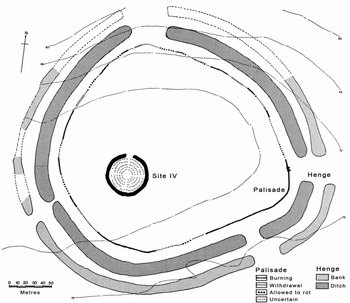
The site itself is a truly enormous henge, 320 metres north–south by 370 metres east–west, enclosing almost five hectares (see figure 1). It dates to the second half of the third millennium cal. B.C. (Wainwright 1979, 4), and was defined by an external bank, which may have stood four metres high and 18 metres wide, and an internal, irregular, ditch, both broken by at least five entrances (Barber 2004, 9; 2005; contra Wainwright 1979, 35). Within the henge a smaller enclosure called Site IV was excavated. This was revealed to be a second henge featuring a ditch 43 metres in diameter and containing a post setting made up of some five rings with an outer diameter of 38 metres, an inner diameter of 12.5 metres (Wainwright 1979, 9) and as many as 176 posts (ibid., 22–23). The rings are divided by four corridors into quadrants leaving access to the centre from the cardinal points (ibid., 11). The southern corridor was blocked, however, by a single post at the northern end. A possible later phase at Site IV was made up of a stone cove and a series of pits (Pollard 1992; Wainwright 1979).
Plan of the henge monument, palisade and Site IV, showing the methods of destruction of the palisade (after Wainwright 1979, figures 20 and 99). This plan does not include recent reanalysis of the aerial photographs by Martyn Barber (2004; 2005) that demonstrates the existence of a fifth entrance at the southern extent of the bank and ditch, and other features including a hollow way approaching the site. The features in this plan, of course, were not all constructed at the same time, and the western entrance is depicted after it was narrowed. Reproduced by kind permission of the Society of Antiquaries of London, © reserved.

As already noted, the site was transformed throughout its history. Although the sequence is not entirely clear due to the paucity of radiocarbon dates, suggestions can be made on the basis of existing evidence and comparison with other sites (Pollard 1992; Thomas 1996). The first construction may well have been the wood setting at Site IV. Alex Gibson (2004) has noted the tendency for the bank and ditch of similar monuments to be constructed after the timber settings inside them, something also recently supported by Julian Thomas (2010). This has previously been suggested at Site IV. Furthermore, Site IV may also generally pre-date the construction of the main henge bank and ditch, as suggested by Davies et al. (2002, 191). Other comparable sites certainly support this suggestion. The recent excavations at Durrington Walls have located houses stratified under the bank at the site and Thomas (2010, 11) suggests that the construction of this monument may well represent the sealing off of an area rich in past events. This sequence may well be roughly comparable with events here, although the broader history of Mount Pleasant suggests that the monument was not finished with when the bank and ditch were constructed, as further acts of transformation continued at the site. The stone setting at Site IV was erected at some point prior to the complete rotting of the timbers (Pollard 1992). Potentially, and highly provisionally, it may be that the cove was orientated towards the southern entrance recently identified by Barber (2004, 10) from aerial photographs. If so, this might suggest, as he indicates, that the date of the Site IV ditch might itself actually postdate the construction of the cove as well as the wooden settings (ibid.). In any case, each of these alterations almost certainly preceded the erection of the palisade. This latter act may also be contemporary with the stone cove's destruction (Pollard 1992), and it is certainly coeval with the narrowing of the western entrance to a width of five metres and perhaps other possible additions to the bank (Barber 2004). The ditches saw the deposition of objects including carved chalk objects, animal bone and flint tools, amongst other things, and notable quantities of pottery, including grooved ware, beakers, food vessels and collared urns. Thomas (1996, chapter 7) has conducted a detailed discussion of the way in which these processes were patterned across the site.
To facilitate our discussion we want to concentrate on three aspects of Mount Pleasant. In each case we will draw on the vocabulary defined above to better understand the sensibilities at play. The three areas follow the broad chronological sequence outlined above. First we consider the use of Site IV and grooved ware pottery. Second we turn to the building of the henge monument itself and finally to the transformation of the henge associated with the erection and destruction of the palisade.
Connecting community: Site IV and grooved ware Let us begin with Site IV. Here 176 posts in concentric rings created a space through which movement appears to have been closely guided (Thomas 1996). People could enter the space, turning perhaps to walk between the rings. As they did so, the centre of the monument and the outside world would move into and out of view. At Site IV movement was inseparable from the wooden posts that guided it, and the materiality of this process is central. The steady decay of these timbers would have meant that the atmosphere was slowly transformed as the monument itself changed through time. This atmosphere emerged through the way people's attention was attuned to the changing materiality and temporality of the rotting wood. This attunement to the space, guided by the wood, was what motivated movement; people were tied into an affective field by attending to the space, to the way the wood smelled, felt and looked, to the decoration that might have been carved on it.
It was this attention to the materiality and temporality that guided movement through Site IV and disclosed to people particular emotional textures of experience. We have already noted the way movement and emotion are deeply connected. Differing kinds of bodily movement, therefore, would have helped to elicit emotions in people. By creating an architecture that engendered potentials for particular forms of movement and foreclosed others, particular kinds of emotion could also be called forth. Thus in moving through Site IV in the right way appropriate emotions could be felt. More broadly, we need to remember that Mount Pleasant was situated in a landscape replete with historical monuments that may further have helped to shape movement. Approaching Mount Pleasant itself may further have been channelled by the possible route identified by Barber (2004). Movement at Mount Pleasant and particularly at Site IV was explicitly directed through a landscape of memory to a site of potent materiality. Linking motion and emotion here allows us to perceive how the creation of a feeling of being-in-place is precisely engendered through the emotional qualities of embodied locomotion.
We can build in other connections. Thomas (2007; 2010) has recently linked the wooden circles and structures at Durrington Walls to the houses discovered there (see Thomas 2007; Parker Pearson 2007; a point also made by Pollard and Robinson 2007). Drawing on their structural similarities he argues that the northern circle at Durrington represented a building in a state of decay (Thomas 2010, 9; see also Bradley 2003, 13). Structures like the southern circle at Durrington Walls, which closely parallels Site IV in layout, are also tied into the schema Thomas suggests, through an architectural link to house perimeters. ‘Entering the circle was like crossing the threshold of the house over and over again’ (Thomas 2010, 9). Although no houses have been discovered at Mount Pleasant, they are known from Cranborne Chase to the north, and it seems likely that a similar architectural referent was at play at Site IV. This was not people building a house, but rather creating, through the temporal materiality of decaying wood, a level of sensuous proximity to an architectural form replete with associations to community and the past. Thomas has written powerfully about the performances such architecture can situate; however, we suggest that our terms allow us to go beyond the general notion of dramatization. To begin with, we can note that potentially the atmosphere Site IV generated could be intensified through the absence of houses around Mount Pleasant, because it thereby represented the only house for the whole community. This, of course, might change if future research discovers Durrington-type houses in the vicinity. The location of several unexcavated ring-ditches close to the site – at least one of which has potentially produced evidence for burning and late Neolithic flint work (Barber 2004, 13) – hints at the potential for houses to be uncovered here too. Regardless, community is a key term for understanding the events at Mount Pleasant, and central for us not least because it is a directly emotional concept (cf. Overing and Passes 2000). It is through generating a particular affective field through practice and work that a sense of community emerges. Because of the way affective fields generate disparate emotions in people we need not think of a single celebration of community, but rather of different people relating to and moving through this architecture, and thus associating with the community in different ways. The circular shape of Site IV is important here as a vehicle for creating an enclosed scene – a theatre in the round, if you will – with very different qualities compared to an elongated piece of architecture, which would have resulted in a more pronounced front–back and near–far relationship between actors at the scene. The round scene at Site IV is creative of a space that draws in its actors, stimulating movement precisely because it does not disclose its entire space visually due to the timber posts.
The quality of drama Thomas discusses hints at both participants and observers. Both of these two sets of people were incorporated within the affective field (one shaped by the post settings), but their emotional engagement with it could vary. The architecture itself thus generates an atmosphere that in turn tinctured the affective field, creating differences in feeling between people on the inside and outside, people moving and people standing still. The specific materials with their architectural referents to the house were required to generate this affective field that in turn engendered a feeling of community. The limited durability of the materials was central to this, a sense of temporality that called people to action that required them to return because things would be different. The atmosphere changed at the site not only through people's actions but through processes they could witness and monitor over generations. By attuning themselves to the material transformation of this communal house people were called back to the site; they felt they needed to return.
When we factor in some of the materials that were caught up in these processes another level of analysis emerges. In particular grooved ware, of which 657 sherds were found at Mount Pleasant (Longworth 1979, 84), plays an important role. Grooved ware, which is flat-based and often quite large in comparison to other styles of pottery (Thomas 1999, 113–14) seems to be associated with group consumption both in daily life and in more specialized contexts like Mount Pleasant (Jones 2002). Furthermore, its decoration, including grooves, lozenges, cordons and fingernail impressions, amongst other things (Cleal 1999), has long been noted to be similar to art that occurs in some Irish passage graves. Thomas (2010, 7) suggests that this drew attention to the pottery, embellishing and adding to processes of consumption in both domestic and more ritualized contexts. At Mount Pleasant we can note the specific associations between certain places and grooved ware with particular forms of decoration (Thomas 1996, 200–2). In the east terminal of the ditch by the northern entrance the grooved ware was dominated by many undecorated or simply decorated vessels. In comparison, Site IV has a much higher percentage of pots with herringbone and diagonal incisions and more complex motifs. These patterns, crucially, are maintained over time, showing that deliberate decisions were being made about what kind of grooved ware decoration was suitable for deposition in any one place (Thomas 1996, 202). These particular decorations not only embellished the pots, therefore, and contributed to the drama of consumption, they also linked particular designs to certain places at Mount Pleasant.
In the broader world away from the site, grooved ware would have played a central role in how communities sustained themselves through shared consumption (Jones 2002, 166–67). Additionally, because of the way material things can refer to other times and places (Jones 2007), the act of encountering, holding and using grooved ware would have allowed people to attune to the affective field constituted at henge monuments. Grooved ware in this sense may have become ‘sticky’ with the emotional and memorable textures of this broader scale of community (Ahmed 2004). The particular decorations, furthermore, could act to make these associations far more specific by linking acts of consumption in the wider world to particular parts of Mount Pleasant, reaching beyond a generalized feeling of community to the memories and emotions generated by precise relations of consumption and practice within the affective field.
Building the henge The act of building the main bank and ditch reveals that the practices at Site IV had produced a place of central communal importance. This act of construction would have required many different groups to come together, bridging potential conflicts and disagreements to work at and to support the construction of the site. Architecturally, the first point to note is the separation between the world on the inside of the ditch and bank and the world outside it. Writing about Durrington Walls, Thomas (2010, 11) has suggested that the ditch and bank may separate off the histories contained inside the monument. This suggestion is useful in our example as well. Mount Pleasant was a site located in a landscape replete with history from Early Neolithic occupation through Middle Neolithic monuments to Late Neolithic enclosures, of which this site was just one. It seems, then, that the atmosphere generated through the construction of the henge was not one of a generic past, but rather one that spoke to the specific practices that had taken place there. The different scales of community coming together to help build the monument were united through their associations with this place, so the space within the monument may have been the space of this broader community. It was here, in this architecture, that this community could exist, within an atmosphere engendered by the emotional memory of joint community enterprise. The potency of this architecture and atmosphere could have generated similar emotions in people across different subgroups, helping to sustain a feeling of community at the larger scale.
This atmosphere varied, of course, depending on the numbers of people who gathered there at any one time. It would have been very different being there in a small group or in mass communal gatherings. The architecture also suggests, as Joanna Brück (2001) has noted, the possibility for multiple ad hoc practices, rather than simply mass-monitored performance. Standing in the ditch would have hidden people from widespread observation and may suggest that the acts of deposition that took place here were more private than public, in contrast, perhaps, to the acts of feasting we can trace in the cattle and pigs consumed at the site. However, as we have already seen with grooved ware, patterns of deposition are maintained in places through time, so these were not random acts, even if they took place in an atmosphere quite different to that surrounding broader moments of engagement, including the building of the henge itself. Just as different communities must have temporarily united to build the monument before dispersing again, so the monument itself suggests different scales of atmosphere. Hidden and private moments of deposition contrast with public feasts; the architecture which goes high above and deep below the surface also suggests that different kinds of arenas of practice were available.
That the past was a crucial resource in creating an affective field that engendered a feeling of community is indicated by the fact that many of the objects at the site were curated and cared for and thus invested with history and the emotions that this could evoke. The evidence of beaker-sherd curation at Mount Pleasant has been demonstrated by detailed analysis by Anne Woodward (2002). She concentrates on the beakers found in segment XIII, layer 5 of the Site IV ditch, which contained not only the major assemblage of beaker sherds from Site IV but also a mixture of many different styles including All Over Cord (AOC), European, Wessex/Middle Rhine, Northern/North Rhine and Southern (Woodward 2002, 1042). Whilst the general sequence of beaker pottery design has been questioned following the dates published by Kinnes et al. (1991; cf. Case 1993), it can still be argued that AOC and European beaker styles are earlier than other types in Britain (Needham 2005; Woodward 2002). On this basis Woodward (2002, 1043) compares the size of sherds from segment XIII and argues that later beaker styles tend to occur as large portions, whilst the older styles tend to be found as sherds (see also Bradley 2000). From this she concludes,
The overall impression is that large chunks of Beaker vessels were circulating or were temporarily deposited for many years, if not generations. Thus they may have functioned as heirlooms or relics before they eventually came to be deposited within the ditch around the focal timber and stone monument (Woodward 2002, 1043).
Beakers may have been extremely important artefacts, then, in terms of the ways in which they could embody particular biographies through their histories of use and exchange. These histories created an affective field through which people and things interacted, bringing each other into being (Battaglia 1990, 56). Thus Mount Pleasant's association with the past went beyond the histories of practice at Site IV. It was contained in the very materials people handled and deposited. There was a physical association linking past and present, and these curated materials allowed people to attune to these links. Indeed, this need not only apply to beakers. Some of the material, including animal bone, recovered from the much later palisade ditch was contemporary with the building of the henge, so a wide range of material was being curated and engaged with over time at Mount Pleasant (Wainwright 1979, 58). Using the concept of affective fields we can see how people, place and things were emotionally bound up. In the tensions that must have been present in building the henge, in gathering there together, it was the shared history that the site and the material things disclosed that allowed a larger-scale community to coexist. This does not mean that we see this as an idealized or idyllic community, rather we stress the active emotional practices that were required to make this work.
Transforming the henge Around 2000 B.C., some centuries after the initial acts of building, Mount Pleasant was transformed. The west entrance was narrowed, and then swiftly blocked by the enormous construction of the palisade. This ran inside the ditch for 800 metres around the whole length of the monument and had only two entrances. The palisade was made of up to 1,600 oak posts, each perhaps nine metres in length and half a metre wide. These were inserted into a continuous trench and would have stood an imposing six metres above the ground. Potentially, at about the same time, the stone cove that had been erected within Site IV was destroyed (Pollard 1992) and remarkable acts of deposition took place.
This was clearly a dramatic change in the architecture of the site, whether we choose to view this as elaboration of the existing monument (Thomas 1996, 214) or as a more radical reworking of its design. Here we see the large-scale community stressed over and above ongoing ad hoc practices at the site. It would have taken people from a wide area to construct the palisade, both in terms of the number of people and for sufficient wood to have been gathered, especially as the landscape around Mount Pleasant was largely open at this time. The acts of deposition tell us more about this moment of transformation. One example is the deposit mentioned above in segment XIII of Site IV, where sherds from 28 beaker vessels were deposited (Wainwright 1979). This is half the total number for the whole of Site IV, which potentially saw deposition over the preceding 400 or 500 years. Although people already associated the ditch at Site IV with beakers, deposition at this scale was unprecedented. We have already noted how beakers were curated and carried specific biographies with them. As a result, interacting with them may have allowed associations, emotions and memories to return unbidden (Harris 2009; Pollard 2001). Depositing these pots, then, represented a clear transformation, a moment in which they were taken away from potential physical interaction and placed into the ditch. The material deposited with these Beakers included over 3,000 flint artefacts and considerable quantities of sarsen, perhaps relating, as Pollard (1992) proposes, to the destruction of the stone cove at Site IV. This indicates that the area around Site IV was transformed through the deposition of potent materials and the destruction of the cove.
The construction of the palisade and of these transformative deposits represents a moment of real change at the monument, we suggest, not only a renewal of communal engagement. The palisade did not just help to generate a new atmosphere at the site, nor did it merely create new ways of moving into and out of the site. Rather it seems as if this moment of transformation attempted to generate a new kind of affective field, a new range of emotional engagements. This was not just about making people experience the site differently, but rather about making them relate to it in new ways. Just as an urban environment might be transformed through a council initiative in an attempt to encourage people to care about it and feel more involved, so altering the site at Mount Pleasant, building the palisade and undertaking new forms of deposition helped to make this a place where people related to each other and the world differently. However, unlike the urban example, we do not posit the existence of a preconceived plan or single hand behind these transformations.
This transformation was not by any means permanent, however. At some point after the palisade was constructed it was actively destroyed. Here was an event that interceded in the temporality of the monument. Whereas the wood, like that at Site IV, could all have been allowed to rot down at its own pace, much of it was instead worked upon and transformed. The place was taken apart, in three particular ways. The first saw the rapid destruction of parts of the palisade through burning, particularly on the monument's south side. This burning was by no means accidental, demonstrated by the extent and intensity of burning, which was sufficient to burn some of the posts right down to their bases, as in cutting XVI (Wainwright 1979, 60). People here attended to the fire, they attuned to it and worked at it, drawing on the latent potential of this materiality, the flammability of the wood. That a spectacular atmosphere would be generated by this seems likely – the intense heat, the roaring flames, the smell and the sights would have burned themselves into people's memories (Noble 2006; Thomas 2000).
The second form of transformation involved some of the posts being dug up and removed. The effort required to do this is quite remarkable when you consider that the posts were inserted up to three metres into the ground. These posts would have been associated with Mount Pleasant, with the palisade, with the atmosphere and practices of the site, and people may have wanted to relocate these relations (see Pitts 2001 for similar suggestions regarding the Late Neolithic site of the Sanctuary in Wiltshire). It seems unlikely that people pulled the posts up merely to throw them away, and it is noticeable that they were not merely cut off but actively extracted, suggesting that they were required whole. Material things both tincture and become tinctured through their presence within affective fields, adding to the properties these (decorated?) posts would possess. These tinctured textures of experience could be actively relocated by moving the wood from one place to another and it seems that some people felt this was appropriate (cf. Pitts 2001).
The final form of transformation is more familiar from Mount Pleasant as the remaining posts were allowed to rot down. A very different form of temporality of memory was associated here, one more reminiscent of Site IV than the spectacular acts of burning or transformation through relocation. The steady decline of the posts could have reminded people of the temporal gap between themselves and the palisade's existence and of the transformative potential of building and destruction. In a way, these posts would be reminders for the burnt and removed timbers; they made present their absence (Bille, Hastrup and Sørensen 2010) and ensured that people recalled the events of their destruction.
It seems, then, that the destruction of the palisade took place within a new relationship to the affective field that had bound people together despite differing interests. Instead of a united front, we may argue that the three different strategies in, or attitudes to, the dissolution of the palisade – destruction (by fire), disintegration (by pulling the palisade down) and abandonment (leaving the timber to rot) – suggest that a contestation was taking place at this time, building on conflicting emotional understandings of Mount Pleasant. Based on the appreciation of the building of the henge ditch in segments suggesting the presence of separate social groups (cf. Pryor 1998), and the massive scale of the palisade, it seems very likely that Mount Pleasant was built by communities coming together and negotiating differences. Similarly, the dissolution of the place through varying strategies could thus occur along the lines of disparate affective relations with the site; some groups might desire to dispose of the palisade in the instant of an event, while others could have appreciated the historicity of the timber for reuse elsewhere, and others in turn would see the gradual deterioration and organic decay of the wood fit for the dissolution of the place as a whole. In this light, contestation may be about issues other than power relations, social differentiation and claims of right (Bender and Winer 2001), but also relate to the unevenness of emotional relations to places and dissolving matter.
Emotion and material culture at Mount Pleasant Although we have touched on only some of the processes and practices that took place at Mount Pleasant, we suggest that understanding of the site can benefit from an appreciation of its emotional qualities. If we want to understand why a site like Mount Pleasant was repeatedly worked on and transformed, why these events took place here and not elsewhere in the landscape, we need to consider the site's emotional history. We have been able to show that people felt required to return because of the potent histories revealed in the site's architecture and materiality, a potency engendered through the textures generated by the people's emotional engagements and feelings of community.
Reaching this conclusion has been possible by drawing on the suggested vocabulary. The role of emotions has been illustrated to play a crucial way in which the site was textured. The investment of activities at the site testifies to an emotional sense of belonging, one that would have been re-experienced in the act of moving to and through the site. The use of the notion of affective fields, in contrast, has allowed us to explore the way the constitution of community at a greater-than-normal scale at Mount Pleasant could be both emotionally sustained and differentially experienced. Attunement allows us to consider the way in which people attend to the detail of the material world, and thus to the emotive textures these materials bear witness to, for example the way in which the decaying wood revealed the ongoing historicity of the communities engaging with the place. Finally the role of atmosphere may in turn be suggested to tincture or temper the experience of Mount Pleasant as a place through the wood, the pottery, the tools, the bodies, and their changing qualities through time. The powerful burning of parts of the palisade can be understood not merely as the product of tensions and disagreements, though it may well have been these, but also as a moment which produced a powerful, perhaps compelling, atmosphere, a heated, emotional, burning quality that transformed both the site and how people felt about it.
Conclusion: things in (e)motion
In this paper we have proposed and defined a set of terms that we believe will prove useful to archaeologists seeking to understand the ways in which people engaged with material things, places and each other in the past. We believe that such a move is important if we are to develop analytical strategies for identifying the role of emotion in past societies where we are denied access to written texts and ethnographic informants. As we have seen, the movement of bodies and things in relation to one another and in relation to the world around them creates and changes sensuous engagements with the tactile world. It may never be possible to specify exact emotions occurring in a person during an event like the burning of the palisade. What it is possible to do, we suggest, is to recognize how the movement of things and the movement of people caught up in this event generated an affective field which bound together the atmosphere of Mount Pleasant's architecture and the wider mood of people whilst they were attuned to this moment. The binding affective field would in turn have generated a range of potentially disparate emotions within people, and it makes no sense to ignore this point when we consider broader archaeological questions. Why did people carry out acts of deposition? Why did people move huge oak posts to this site? Why were some of them burnt down? What such questions address is the scrutiny of the emotional template of motivation behind certain actions and activities, or ‘emotives’ (cf. Reddy 2001).
More than this, archaeology may add a new perspective to broader debates around the role of things in people's lives, and explore the intersection of material culture and emotions in both the past and the present. This process has only begun, however, and our approach here is only one step on the way. In the spirit of this project of investigation we wish to conclude this article by suggesting two routes forward that might be beneficial. First, we suggest that further critique of our terms developed here will be necessary; can we be more specific about how they interrelate? Second, it has been beyond the scope of this article to develop a fine-grained methodology for the study of emotions through material culture (but see Sørensen 2010). We believe that such a methodology can be developed on the basis of the proposed vocabulary, offering avenues for practical analysis within the field of emotion studies, interpolating the role of emotion in the spatial setting of, for example, power manifestation or contestation, or in the negotiation of memory, forgetting and innovation. These potentials remain to be developed, and what we offer here is neither the first step towards engaging with emotion in prehistory (others began this journey long ago) nor an end point, merely the next part of the discussion.
Acknowledgements
This paper was written during our stays in Cambridge as a postdoctoral researcher (OJTH) and a visiting Ph.D. student (TFS). We would like to thank the Leverhulme Trust, the Danish Ministry of Science, Technology & Innovation and the University of Aarhus for funding our respective research. We are also grateful to the department of archaeology and especially Marie Louise Stig Sørensen and John Robb for making Cambridge such a stimulating environment. This paper has benefited enormously from the critical yet supportive comments of the editorial board of Archaeological dialogues and two anonymous reviewers. The usual disclaimers apply to their advice.