


Introduction
While cognitive behaviour therapy (CBT) has been demonstrated as an efficacious treatment for mild to moderate depression in a large number of studies (e.g. Butler et al. Reference Butler, Chapman, Forman and Beck2006), the empirical foundation of the supposed mechanisms of change in CBT is less solid (Clark et al. Reference Clark, Beck and Alford1999; Roth & Fonagy, Reference Roth and Fonagy2005; Wampold, Reference Wampold2010). A central assumption of CBT is that since people respond to cognitive representations of the environment rather than to the environment itself, cognitive distortions are central to the understanding of the aetiology and maintenance of depression. Due to the activation of dysfunctional schemas, depressive clients hold a distorted view of themselves, others and the world and are prone to systematic errors in thinking, which affect emotions and behaviour. According to this theory, change through therapy will primarily occur through a modification of the maladaptive cognitions maintained by the depressive client (Clark et al. Reference Clark, Beck and Alford1999). However, while there is general support for a convergent pattern between changes in cognitive variables and changes in depression it is unclear whether cognitive change is actually the specific mechanism underpinning symptom improvement. In fact, a number of studies designed to investigate whether it is indeed modification of cognitive variables, such as negative automatic thoughts, that leads to change, have failed to convincingly demonstrate this relationship (Longmore & Worrell, Reference Longmore and Worrell2007).
Metacognitive therapy (MCT; Wells, Reference Wells2009) is an alternative approach to the treatment of depression. According to the metacognitive Self-Regulatory Executive Function model, depression is developed and maintained through a dysfunctional syndrome designated Cognitive Attentional Syndrome (CAS). The syndrome is characterized by negative self-focused information processing in the form of inner awareness, awareness of threats and persistent negative thinking in terms of worry and rumination (Wells, Reference Wells2000, Reference Wells2005). The activation of CAS is an inappropriate coping strategy, which maintains and extends the emotional experience as a self-reinforcing pattern (Wells, Reference Wells2009). CAS is developed and maintained through positive and negative metacognitive assumptions. Positive metacognitive assumptions concern the need to ruminate to overcome depressive feelings and find answers to problems. Negative metacognitive assumptions are assumptions such as ‘I have no control over thinking’ or ‘thoughts are dangerous’ (Wells, Reference Wells2009). As in CBT, the MCT model presupposes that negative thoughts influence emotions and behaviour. In MCT, however, it is assumed that it is the attention to the negative thoughts rather than the meaning of the thoughts that causes depression. The central mechanism of change is therefore thought to be changing the client's relationship to the thought (Papageorgiou, Reference Papageorgiou and Simos2009; Wells, Reference Wells2009).
Since MCT is a relatively new therapy, there is limited evidence for the efficacy of therapy as well as for its mechanisms of change. Single case studies of attention training (ATT), a central component of MCT, show that ATT itself has an effect in reducing depressive symptoms, but more research is obviously needed (Papageorgiou & Wells, Reference Papageorgiou and Wells2004).
Qualitative research constitutes an alternative approach to a deeper understanding of the mechanisms of change in psychotherapy by providing nuanced descriptions of what exactly clients find effective in therapy and why. However, while a relatively large body of qualitative studies of experiential and psychodynamic psychotherapy exist, there have been fewer qualitative studies of CBT, and, to the best of our knowledge, none of MCT. The general finding from existing qualitative studies that do not focus specifically on cognitive behavioural therapies is that common, non-therapy specific factors are typically mentioned as most important by the client (Elliott & James, Reference Elliott and James1989; Levitt et al. Reference Levitt, Butler and Hill2006; Hodgetts & Wright, Reference Hodgetts and Wright2007; Elliott, Reference Elliott2008). Although there are some differences in the weight given to the various factors, a number of aspects of therapy are found important across qualitative studies focusing on clients’ perspective of change in therapy. Thus, clients typically mention the therapeutic relationship as a key factor in therapy, where the experience of feeling understood and being listened to is emphasized. More specifically, clients often explain that it provides an emotional relief in itself to talk with the therapist and that a safe therapeutic relationship with a therapist who is non-judgemental is seen as helpful. Another helpful factor is a personal relationship between client and therapist. Clients seem to appreciate that the therapist sees them as whole persons rather than simply diagnoses and that the therapeutic cooperation takes place between two equal persons. Clients also report that the development of personal strength and confidence through the therapy has been helpful. Among the more specific helpful factors, gaining new insights, i.e. identifying patterns and obtaining new perspectives on problems as well as achieving greater self-awareness or self-reflection is mentioned in virtually all studies. Furthermore, the exploration and verbalizing of feelings is often mentioned as a helpful aspect of therapy (Paulson et al. Reference Paulson, Trutscott and Stuart1999; Fitzpatrick et al. Reference Fitzpatrick, Janzen, Chamodraka and Park2006; Levitt et al. Reference Levitt, Butler and Hill2006; Hodgetts & Wright, Reference Hodgetts and Wright2007; Timulak, Reference Timulak2007; Poulsen et al. Reference Poulsen, Lunn and Sandros2010).
The fact that non-specific relational factors rather than specific factors are mentioned as helpful in therapy is consistent with a comprehensive review of clients’ experience in psychotherapy (Elliott & James, Reference Elliott and James1989), which finds that relational and contextual factors are generally considered more important by the clients than tasks and problem-solving aspects. This observation has been mentioned as support for the so-called common factors paradigm stating that elements common to all brands of therapy, such as various relationship variables, may be more important that technical factors (Lambert, Reference Lambert, Norcross, Vandenbos and Freedheim2011). However, results from an increasing number of qualitative studies focusing specifically on CBT indicate that while clients in CBT also emphasize the importance of the therapeutic relationship, the particular qualities of this relationship are described differently in CBT. Furthermore, factors related to the specific techniques of CBT are mentioned more frequently. Thus, in most studies of clients’ experience of CBT, elements described as helpful are being understood by the therapist and being in an equal partnership with the therapist where the client views himself as an active part of the change process. Some studies point out that clients describe CBT as a learning process in which the therapist is seen as a teacher or an expert. Clients also find the socialization to a cognitive model helpful. Through the model they become aware of the connection between thoughts, behaviours and emotions, and obtain a better understanding of why they may end up repeating certain negative patterns. Clients in CBT typically report that they have learned to think in a more positive and balanced manner. Finally, several studies point out that clients mention specific exercises or techniques, such as exposure, thought diaries and case formulation, as important (Messari & Hallam, Reference Messari and Hallam2003; Clarke et al. Reference Clarke, Rees and Hardy2004; McGowan et al. Reference McGowan, Lavender and Garety2005; Nilsson et al. Reference Nilsson, Svensson, Sandell and Clinton2007; Berg et al. Reference Berg, Raminani, Greer, Harwood and Safren2008; Westra et al. Reference Westra, Aviram, Barnes and Angus2010; Crowe et al. Reference Crowe, Whitehead, Carlyle, McIntosh, Jordan, Joyce and Carter2012). Even a recent study focusing primarily on the difficulties related to being in CBT (Barnes et al. Reference Barnes, Sherlock, Thomas, Kessler, Kuyken, Owen-Smith, Lewis, Wiles and Turner2013) reported that clients found that learning to challenge their negative thought patterns had been helpful.
The aim of the present study is to explore clients’ experiences of the mechanisms of change in CBT and MCT for depression. A particular focus of the study is whether the mechanisms of change in the two therapies are typically described as factors common to the two therapies or rather as distinctly different between the therapies.
Method
Participants
Clients
The study is based on qualitative interviews with six clients aged between 20 and 35 years (mean 25.5 years). The clients all participated in a randomized controlled trial (N = 120) comparing the outcome of CBT and MCT and conducted in a clinical psychology practice (Callesen, Reference Callesen2010). The participants of the outcome study were clients diagnosed with major depressive disorder typically referred by their general practitioner. They were recruited to the trial by offering a shorter waiting time before starting therapy if they agreed to participate in the study. The main inclusion criteria of the outcome study were meeting DSM-IV-TR (APA, 2000) criteria for major depressive disorder diagnosed through the Structured Clinical Interview for DSM-IV Axis I Disorders (SCID-I; First et al. Reference First, Spitzer, Gibbon and Williams2002) and signing informed consent. Main exclusion criteria were co-morbid psychosis or bipolar disorder, substance and alcohol abuse, borderline personality disorder screened by the Structured Clinical Interview for DSM-IV Axis II Personality Disorders (SCID-II; First et al. Reference First, Gibbon, Spitzer, Williams and Benjamin1997), clients with organic brain syndrome or learning disabilities, pregnancy, and failure to respond favourably to an earlier adequate trial of either CBT or MCT. The trial was approved by the Research Ethics Committee for the Capital Region of Denmark.
The clients participating in this study were the first six of the 120 participants in the outcome study to begin therapy. Three clients (two women and one man) received CBT while the other three (two women and one man) received MCT. All six participants gave written consent regarding the use of material from their interviews in this article. Any information that might reveal the identity of the participants has been omitted from the excerpts of the interviews. The qualitative study was approved by Institutional Ethical Review Board, University of Copenhagen, Department of Psychology.
Therapist
All therapies were conducted by the same female therapist. The therapist was a clinical psychologist, who is certified as a specialist in psychotherapy and has completed 2 years of additional specialized education in both CBT and MCT. She has 9 years of therapeutic experience with CBT compared to 2 years with MCT.
Researchers
The first author was a psychology student when the interviews were conducted and the research was part of her master's thesis, which aimed to explore the clients’ view of change factors in CBT and MCT. The second author was the supervisor of the research project. He has a background as a psychodynamic psychotherapist and has conducted research focusing on clients’ experience of dynamic psychotherapy (Poulsen, Reference Poulsen2004; Poulsen et al. Reference Poulsen, Lunn and Sandros2010).
Measures
The interview guide includes questions concerning five themes: the general experience of therapy, experiences of change outside the therapy, factors promoting change, expectations for the therapy, and the therapeutic relationship. The themes were chosen to cover important aspects of what works in therapy. The interview was semi-structured in order to help clients express their experiences as freely as possible. Thus, the interviewer was allowed to change the order of the questions; however, in each interview all themes in the interview guide had to be covered. All interviews were conducted as face-to-face interviews by the first author at the clinic where the therapy took place. The duration of the interviews was between 24 and 42 min.
Treatments
All clients were offered up to 24 sessions of 50 min duration. The treatment ended when a client's score on the Beck Depression Inventory – II (BDI-II; Beck et al. Reference Beck, Steer and Brown1996) was below 13.
CBT
The treatment was based on Melanie Fennell's protocol for depression (Fennell, Reference Fennell, Hawton, Salkovskis, Kirk and Clark1989). According to the protocol, the therapy starts by identifying the client's problem through a case formulation. The formulation contains information about background, schemas, dysfunctional assumptions and negative automatic thoughts as well as critical situations in the client's daily life. In the initial sessions, the focus is primarily on behavioural change and on identifying and modifying automatic negative thoughts. As symptoms are reduced, the therapy starts challenging the more rigid underlying dysfunctional assumptions and schemas. Modification and change of automatic negative thoughts and dysfunctional assumptions and schemas occur primarily through cognitive restructuring and behavioural experiments, where evidence for and against an assumption is examined with the client. The client is given specific home assignments relevant to the phase of therapy.
MCT
The treatment was based on Adrian Wells’ protocol for depression (Wells, Reference Wells2009). In the initial sessions of MCT, a case formulation is constructed through which the client is socialized to become aware of how rumination itself feeds depression. Positive and negative assumptions about rumination are challenged. Detached Mindfulness and Attention Training is introduced to experience and reinforce the executive control over CAS (Wells & Papageorgiou, Reference Wells, Papageorgiou, Papageorgiou and Wells2004). As in CBT, home assignments are an important part of the therapy.
Data analysis
The interviews were analysed using the qualitative method, Interpretative Phenomenological Analysis (IPA; Smith et al. Reference Smith, Flowers and Larkin2009). The method focuses on the life-world of the individual and is based on phenomenological philosophy, originally developed by Edmund Husserl, which deals with the essence of the complex phenomena that are part of the human experience (Willig, Reference Willig2004; Langdridge, Reference Langdridge2007). The phenomenological method is complemented by an interpretative approach in order to access the informant's insider perspective on the topic of the study (Willig, Reference Willig2004; Smith et al. Reference Smith, Flowers and Larkin2009). Thus, the IPA coding process follows the hermeneutic circle: to find the individual themes it is necessary to both look at the totality of the interview text and delve into specific parts in order to achieve a full understanding (Smith et al. Reference Smith, Flowers and Larkin2009).
The coding of the interviews in the study was divided into four stages following IPA guidelines (Smith et al. Reference Smith, Flowers and Larkin2009). During the first stage, the transcripts were read several times to get as close as possible to the life-world of the clients. In the second stage, comments were added to capture the meaning of the interview. Three different types of comments were applied, namely descriptive, linguistic and interpretive comments (Smith et al. Reference Smith, Flowers and Larkin2009). In the third stage, the themes of the interview were identified and described, paying close attention to avoid any interpretative bias. In stage four, the themes from the interviews were divided into superordinate and minor themes. The final themes were combined into a master table (Smith et al. Reference Smith, Flowers and Larkin2009). All coding was done by the first author.
Results
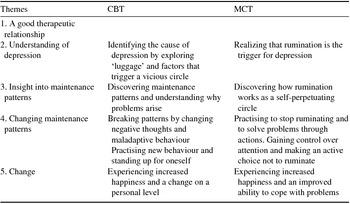
The coding of the six interviews identifies five superordinate themes, which cover the experiences of both the MCT and CBT clients. However, within each theme (except theme 1), there are distinct differences with regard to what clients from the respective groups have found helpful. In Table 1, the five identified themes are presented. For each theme, the table presents the main differences between the MCT and CBT clients.
Helpful elements in CBT and MCT

In the following section each of the five superordinate themes are presented using the subheadings of the original master table. The three clients in CBT have been given the names of Anna, Bob and Carol, while the three clients in MCT have been named David, Emily, and Felicia.
A good therapeutic relationship
Five out of the six clients express that they have had a good relationship with their therapist. Several of the clients attribute this to the therapist's relaxed manner. Among the clients in CBT, Carol explains how the therapist's ‘down-to-earth’ personality gave her a relaxed feeling in therapy. Anna suggests that this is the reason why she was capable of opening up during therapy:
She is a really nice person to be around – and a little absent-minded. It's actually quite funny. Everything is loosened up a bit, when she doesn't know where the computer is or something like that. [. . .] It's also cool that she can make mistakes. It was really cool to see that she was just a human. This helped me to open myself to her.
Among the clients in MCT, David explains how his previous therapist used technical terms that he did not understand, and that he appreciated that he and the therapist in the study ‘talked the same language’. Felicia, who was generally very critical towards the therapy and who was the only one of the six clients who did not achieve a notable improvement in her BDI score, says that despite everything the relationship was good, and that the therapist had a nice and relaxed personality.
Thus, regardless of therapy type, five out of the six clients have relatively identical and positive descriptions of the therapist as a person as well as their relationship with her. Apparently, the feeling that the therapist was down-to-earth and promoted an equal relationship was seen as particularly helpful. While it is uncertain whether a good relationship is seen as an effective factor in itself, the interviews indicate that it can be helpful by increasing the likelihood that a client feels able to open up (Anna), feel relaxed (Carol), or feel understood (David). The last client, Bob, however, stated that although he liked the therapy, he would have preferred a warmer and more caring therapeutic relationship.
Understanding of depression
Clients in CBT as well as in MCT mentioned that therapy has given them a better understanding of why they became depressed, but the reasons found in the two therapies differ distinctly.
Understanding of depression in CBT
According to Anna, achieving insight into the cause of her problems has been essential:
[The therapist] really understood how to find out what the real problem was by kinda just listening to what was getting to me. She really understood a lot [. . .] and then found the reason why it made me sad.
Thus, Anna states that understanding the cause of the problem is important, and that the path to this insight goes through the therapist's understanding. Both Anna and Carol describe the process through which this understanding is achieved as ‘digging’.
When asked how the therapist identified the cause, Anna also points to a specific factor:
She did it by drawing [. . .] She drew a fire and a pair of glasses, and what is the last one?
[Interviewer:] A backpack or luggage?
Anna is referring to an alternative phrasing of the cognitive case formulation, where upbringing and previous experiences are termed ‘luggage’, ‘glasses’ stand for schemata and personal rules, and ‘fire’ is equivalent to automatic thoughts in critical situations. When Anna talks about the importance of understanding the cause of her depression, she refers to how schemata and rules from her upbringing influence her present problems. She explains why this has been helpful:
It is obvious that if I couldn't find the reason, I would probably just get sick again [. . .] because this luggage, it would just pop up again and again and again. It is important to find the roots of all these things I avoid, in order for me to be able to let it go. Or at least unpack it and see what it is that is happening here.
While Anna mentions the importance of previous experience, Carol points to the examination of the factors, which trigger the vicious circle. Thus, while the two clients focus on different aspects, they both explain how the therapy has increased their understanding of why they have been feeling bad.
Understanding of depression in MCT
While the clients in MCT also mention the importance of finding the cause of their problems, the cause is understood very differently. Two clients from the MCT group, David and Emily, describe how they found out through therapy that rumination is their main problem. David relates that he and his therapist found out that rumination was the primary issue through questions regarding the meaning of rumination and by the use of an advantage-disadvantage list:
We used a piece of paper and she made some weird shapes [. . .] and just kept putting a lot of words on it. What were the advantages of rumination? What were the bad things about it, etc. She made me realize that it was actually a bad thing to sit and brood over things all the time, and that it backfired in the end.
That David seems to have adopted the metacognitive understanding is apparent, when he was asked whether he and his therapist have looked at the past in order to understand his problems:
I will certainly do my best to stay clear from thinking too much about all the negative things that have happened in the past.
Thus, two of the clients in MCT state that by talking about the advantages and disadvantages of rumination they came to realize that rumination was the cause of their problems. However, for Felicia, the third client in the MCT group, the fact that the therapy did not allow for her to talk about the cause of the problems was a primary reason for her dissatisfaction with the therapy:
You know, there was a reason why I started ruminating in December, and it was this reason we should have focused on instead, I think. Because it shouldn't get to the point where the rumination begins.
According to Felicia, rumination was not her only issue. She believed that there was something, which was the cause of her rumination and she had hoped that the therapy would have focused on this primary cause instead.
Insight into maintenance patterns
All six clients mentioned that insight into maintenance patterns has been an effective mechanism of change. This is consistent with both CBT and MCT. However, the cognitive understanding of maintenance patterns is different from the metacognitive. This difference is reflected in the interviews with the two groups.
Insight into maintenance patterns in CBT
Anna describes how the understanding of luggage and glasses made her understand why certain fires might start. Bob says that therapy has given him some tools to understand why he ends up in problematic patterns. One of these tools is the cognitive diamond, which gave him an overview of the problem. Anna also mentions the cognitive diamond as a way to understand the pattern of maintenance and how to stop it by nipping it in the bud. The clients also express the importance of discovering that it is themselves who maintain their problems and that the responsibility to get rid of the problems is therefore on their own shoulders. Carol puts it this way:
That I could suddenly see that it was the things you did yourself that actually damaged you. So this also motivated you to want to change many things.
Insight into maintenance patterns in MCT
Emily explains that the most important part of therapy has been the insight that it is herself and her tendency to ruminate that maintain and amplify her problems. She describes how the therapist's questions helped her discover a self-perpetuating spiral, subsequently stating that it is this new insight, which is essential:
She [. . .] asked me: ‘[. . .]When you’re feeling bad, what happens inside of you?’ ‘Well, I do this and this’. ‘Does that make you feel better?’ ‘No, it actually doesn’t’. And I hadn't thought of that. I actually hadn't realized that I was building up this spiral myself. [. . .] So it was just about getting that right question: ‘Does what you’re doing now actually help you?’
David also expresses how the negative thoughts get him caught up in a vicious circle and explains that it was a train metaphor, showing him that he can choose whether or not to ruminate, that helped him:
Mmm the one with the trains . . . You shouldn't jump on all the negative thoughts running around in your head. [. . .] The thoughts can be there, you just don't need to jump on and follow them into a vicious circle.
Evidently, all clients who had received CBT and two of the three clients in MCT describe, how the awareness of the maintenance pattern and the client's own part in it has been effective (Felicia, the third client in MCT, did not improve). However, while clients from the CBT group explain that the vicious circle is triggered by their actions or aspects of their personality, for clients in the MCT group it is the attention to the negative thoughts that has a self-reinforcing and self-sustaining power. Thus, despite individual variations, the similarities and differences between the two groups’ experiences reflect the theoretical similarities and differences inherent in the two approaches.
Changing maintenance patterns
Clients from both groups mention that stopping the vicious circle is an important aspect.
Changing maintenance patterns in CBT
Breaking patterns by changing cognitions
Both Anna and Carol state that an effective way to break the negative patterns has been to turn negative thoughts and situations into something positive by using a cognitive restructuring scheme. Thus, Carol states that she has learned how to automatically change negative thoughts into more positive ones, while Anna has found it useful to find rebuttals to the negative thoughts by the use of a self-esteem diary.
Breaking patterns by changing behaviour
All three clients in CBT explain that changing behaviour is one of the ways they have changed the vicious circle. Thus, Anna stresses that she has ended her relationship with her boyfriend, Carol expresses that she has spoken with her father and cleared things up, and Bob has written a letter to his wife, where he takes up a sensitive subject, which might lead to a major conflict.
Standing up for yourself
Another change in behaviour, which is mentioned as having a positive effect, is that clients have learned to stand up for themselves rather than adapting to other people. Anna says she has stopped playing tennis because it was something she only did for her father's sake. She has learned that it's OK to be herself, ‘even though everyone else might not think that this is how you have to be’. And Carol (like Anna) explains how she listens more to herself and speaks her mind more freely.
Changing maintenance patterns in MCT
Solving problems through actions
None of the clients in MCT mention that they have learned to say ‘no’ to other people, but David explains how other actions have been important:
It has obviously been exercises. But exercises can't make you social as such. So you have to do something. And get out and feel social with other people.
Emily also states that action has been an important factor: ‘So stop ruminating, and then solve the problem’. She says that she has been acting her way out of troubles by sorting her tasks and duties and by postponing certain tasks.
Choosing whether you want to jump on the carousel
All three clients in MCT describe that they have learned to choose whether or not they should enter into a train of thought (Emily, David) or a conflict (Felicia). To make this decision, Emily explains, one has to take a step back or ‘stand outside oneself’. This sounds like the theoretical description of meta-awareness. Emily puts it this way:
Whether you kind of jumped on the carousel, or if I stepped back and kind of observed what was going on and like said to myself, ‘Well no, this carousel – I don't need to jump on it right now. Let's wait a little and see if it might resolve itself.
For David, it is the train metaphor that helps him stop and choose not to be absorbed by his thoughts: ‘So we just think about the trains, and this way we let it go’. The way David puts it indicates that this action has become quite automatic and uncomplicated. Likewise, Felicia says that when she stops to take a deep breath, she can stop a conflict and regulate her emotions.
Getting control over attention
While this theme is not mentioned by any of the clients in CBT, all of the clients from the MCT group say that an important part of therapy has been to control attention and to shift the focus away from negative thoughts or emotions. David says that this is what has helped him the most:
Well, it's mostly about being able not to focus so much on the negative thoughts. To kind of try to stay away from them [. . .] That is what has helped me the most.
David adds that controlling his thoughts has given him the side-effect of being present in the moment, because he is not distracted by his negative thoughts and therefore can ‘enjoy the moment with other people’.
ATT is an intervention in the MCT manual intending to improve control over attention. The statements from the clients regarding this theme are, however, rather complex. Thus, Emily, on the one hand, says that the training did not work because it was too ‘artificial’ and too far from real-life issues. For her, it was the awareness that you have a choice whether to jump on or off a train of thought that has helped. On the other hand, she says that she needed practice to stop worrying, which indicates that, besides the awareness of a choice, there has also been some form of training or exercises. Felicia mentions that by shifting her attention away from her emotions, she has learned to gain control of them. It is, however, unclear whether it is the ATT per se or a more general understanding of the importance of attention that has been helpful. Finally, David says that the helpful part was the way he and his therapist talked in therapy, and does not mention ATT at all.
Summing up, all three clients state that shifting attention away from thoughts or emotions has been a helpful part of the therapy. Emily and David focus on their increased control of thoughts and ruminations, while Felicia stresses her ability to control her emotions. Nevertheless, common to all three is that therapy has helped them gain increased control over attention. The clients do not, however, specify whether it is ATT, which has given them this ability.
Change
What works in therapy seems to be linked to the type of change experienced by the clients.
Change through CBT
Anna and Carol describe a change in personality or in their perception of themselves, where they have gained increased personal strength and confidence. In addition to a reduction in symptoms, they have changed on a more personal level. Anna expresses it this way: ‘Well, for example, I have gained self-confidence, which is something I’ve never had before’. Because of her personal strength, she has now become ‘a completely different person’ and this, she explains, changes her everyday life. Likewise, Carol says: ‘It's probably the fact that I’ve started to be more like: “Here I come”, instead of just being the quiet one’.
Bob describes his change as a personal change as well: ‘I can't go back to my old alcohol use. Because that is not something I should take with me in this change or process of self-development’. In addition to the reduction of his alcohol consumption, the process of self-development among other things includes that he bases his friendships on new values.
Change through MCT
Clients in the MCT group seem to undergo a different kind of change. According to Emily, it is not a personal change or a change into something new. The same problems still occur, but her ability to cope with them has improved, and the problems do not have the same negative effect on her mood.
There have been some situations since I ended therapy, where my heart started racing again and I got those stress symptoms [. . .]. As I described it to my husband, it's as if I can now stop it at the physical level. It doesn't upset me. I manage not to go into that psychological dimension.
Similarly, Felicia says that the problems still occur, but that her ways of coping with them has changed:
I’ve gotten some tools to deal with it, when [. . .] I get depressed or something. But I haven't stopped falling down into a black hole every once in a while. That still happens.
For Felicia, being able to cope with her problems is not sufficient in terms of change. Conversely, Emily and David are very happy with their increased control over the way problems affect their lives. Of particular interest is the fact that they describe this as a change, which affects their entire way of dealing with problems in their life.
David for example explains how the train metaphor has taught him not to pay attention to negative thoughts and says in this regard: ‘I think I can use this for all sorts of different things in my life’. Apparently, he describes a new way of relating to his thoughts, which has been digested and thus can be transferred to other situations:
I have learned it now. Now it is just there in one's mind, that I shouldn't think about all the negative things.
Although the change is described as a better way of coping with problems through control over attention, for David this leads to a more global change in his interpersonal relations: ‘It is just something I do now. I just sit and talk and socialize without actually thinking about all the negative thoughts’.
Emily says that her coping with stress has improved, and that this has an impact on a lot of situations:
Well, I guess I can use it in my entire life, both privately and professionally. The problem was all the way around, you see. So it is the whole environment around me.
Overall, the CBT clients’ experience of change seems to be personality-oriented in the sense that they have gained more personal power and are experiencing self-development. On the other hand, clients in MCT describe the change as an improved ability to cope with problems in general, by having learned a new way of relating to thoughts. All clients, except Felicia, say they have become happier (which is in accordance with the fact that all these clients showed significant improvements in their BDI scores).
Discussion
The study shows that what the clients consider to be the effective elements in CBT and MCT, respectively, and the similarities and differences between clients’ experiences of change in the two approaches are largely consistent with the applied therapeutic model. Thus, addressing negative thinking is central in both therapies. However, according to the clients in this study, CBT works through the modification of the negative thoughts, while it is the client's relationship to the thoughts that changes in MCT.
Helpful factors in CBT
Considering the lack of empirical support for the hypothesis that change in CBT occurs through the modification of dysfunctional cognitions, it is noteworthy that the CBT clients in this study seem to find changes in cognitions essential. Two of the clients state that they have learned to adjust their way of thinking by turning negative thoughts into positive or more balanced thoughts; especially the cognitive restructuring scheme has been helpful in this regard. These modifications of cognitive distortions support the fact that changing cognition is important (Table 1, theme 4). Likewise, two of the CBT clients state that it has been effective to identify the cause of the depression. In particular, they mention the exploration of early maladaptive schemas, or ‘luggage’, and the insight into how these influence current problems and create dysfunctional maintenance patterns (Table 1, themes 2 and 3). This is also in line with the cognitive model, where insight into schemas and assumptions is central. What does not correspond with CBT theory, however, is that none of the clients mention behavioural experiments even though these are considered to be an essential element in the change of negative thinking patterns. This might of course be due to a lack of behavioural experiments in the treatment. However, since the therapy is conducted in the context of a randomized controlled trial and thus should be in accordance with the manual this does not seem to be a likely explanation.
The CBT clients mention the importance of different specific factors such as the self-esteem diary, the restructuring scheme, the cognitive diamond, homework assignments, and case formulations. Among the more non-specific elements of therapy, like clients in previous qualitative studies of CBT, they find the equality in the therapeutic collaboration important. One of the clients, however, even though he obtained a marked symptomatic improvement, would have preferred ‘a warmer and more caring relationship’. Overall, the statements reflect that while a good relationship is experienced as essential, the clients in the present study seem to place greater emphasis on specific therapeutic factors.
Helpful factors in MCT
In the metacognitive model, intervention involves three elements: (1) challenging dysfunctional metacognitive beliefs, (2) training executive control of attention and rumination (CAS) and (3) the development of a metacognitive mode through detached mindfulness. According to the three MCT clients, the first and third elements have been helpful, while the second element is either not mentioned or not considered effective. According to two of the clients, the most helpful part of therapy was the discovery of how their depression is maintained through attention to negative thoughts (element 1). In addition, it appears essential for the clients to discover that it is their own choice whether to engage in the negative thoughts or not. The clients explain that the ability to make this choice requires a moment where they take a step outside of themselves and decide, whether to jump on a train of thoughts or not. This appears to be a description of a metacognitive mode. According to the metacognitive model, there are several detached mindfulness techniques with the aim of developing a metacognitive mode, such as free association and mind wandering. However, none of the clients mention these techniques. Instead, it is mostly metaphors as well as considerations about pros and cons, which has given them insight into a maintenance pattern and the choice to step out of it. Furthermore, it is noteworthy that none of the clients specifically mention ATT as helpful, even though this is an essential part of the metacognitive model. Emily explains that she found this type of training too ‘artificial’ and too detached from her actual problems. This seems to challenge existing research done on ATT, showing that ATT alone may lead to a reduction in symptoms of depression. It is, however, possible that ATT may indeed have been effective, even if the clients did not consciously experience it as such.
While ATT per se does not figure as helpful in the interviews with the clients in MCT, their experiences of what has been effective seem close to the metacognitive model. Clients in MCT talk less about non-specific factors, e.g. ‘the feeling of being listened to and understood’ compared to clients in CBT and other therapies. This reflects the metacognitive model, which differs from most psychotherapies by not making way for client's stories about past experiences or reflections on the causes of depression.
Helpful factors in CBT and MCT
There are similarities between the mechanisms of change reported by CBT and MCT clients. Clients in both groups have obtained an understanding of which factors trigger and maintain depression and how to prevent a self-reinforcing circle. Likewise, clients from both therapies report that change occurs by changing behaviour, i.e. taking action with their problems rather than brooding over them. Beneath these common factors there are, however, significant differences. CBT clients understand the cause of depression as previous experiences or aspects of one's personality. Maintenance of the depression is described through the cognitive diamond, which gives an understanding of how emotions, behaviour, thoughts and body sensations are related. Change in CBT occurs primarily through the alteration of maintenance behaviour and through modification of cognitions, where negative thoughts are turned into more balanced thoughts. For the MCT clients, the cause of depression is not considered to be a problem in their personality or from their past, instead rumination in itself is the problem. Change happens at a meta-level by changing the solution strategy rather than the problem. The maintaining factor is the importance given to the negative thoughts, rather than the negative thoughts themselves. It is thus the insight that rumination causes depression, which is considered crucial. The changing of the vicious circle is therefore not about modification of thoughts or behaviour, but about choosing not to go into a thought and thereby reducing the importance of the thought.
Specific and non-specific factors
Based on the interviews with the six clients in this study, both non-specific factors related to the therapeutic relationship and specific, technical factors operate in CBT and MCT. However, the strongest emphasis seems to be placed on the specific factors, especially for the clients in MCT. According to the six clients, the mechanisms of change are quite consistent with the respective theoretical models of the two therapies. This finding runs counter to a substantial number of previous qualitative studies conducted with clients from various therapeutic approaches, where non-specific factors were assessed to be the most effective factors in therapy. The results are, however, in line with results from other qualitative client studies of CBT, where clients tend to stress therapy-specific factors as helpful. In CBT and MCT it is primarily the satisfied clients who mention therapy-specific factors, which is consistent with studies showing that it is the integration of the cognitive model with one's own thinking and language that provides opportunities for change (Crowe et al. Reference Crowe, Whitehead, Carlyle, McIntosh, Jordan, Joyce and Carter2012), and which improves the outcome (McGowan et al. Reference McGowan, Lavender and Garety2005).
It is noteworthy that specific factors figure more prominently in clients’ reports of cognitive behavioural therapies than in reports of other therapeutic approaches. It is tempting to see this as evidence of the particular importance of specific factors in cognitive behavioural therapies compared to for instance dynamic or humanistic therapy. However, an alternative explanation of the findings might be that they are simply a result of the clients reproducing the explanation of the mechanisms of change in the therapy they have been given by the therapist. If this is indeed the case, common therapeutic factors may have played a more prominent role in therapy than explicitly stated by the clients, even though the clients have only acknowledged and formulated the impact of these factors to a limited degree. This explanation would be consistent with the fact that it has proven notoriously difficult to demonstrate the specific effect of techniques in systematic empirical research. Thus, while previous studies of clients’ experiences of CBT as well as the detailed descriptions of change processes given by the clients in the present study indicate that specific factors seem to be important, more research is clearly needed to illuminate this question. Furthermore, even though the study indicates that the clients see the specific therapeutic techniques as efficacious, the individual clients differ clearly with regard to which techniques are experienced as particularly helpful. This implies that when conducting the therapy, the therapist should be responsive to the preferences and wishes of the individual client and adapt the therapy accordingly.
Limitations
While the present study provides an impression of the clients’ experience of CBT and MCT, the study is obviously limited by its small sample size, which may have restricted the variation within the sample as perhaps indicated by the relatively narrow age range of the participants. Furthermore, the interviews were rather brief for qualitative research and the therapist was the same for all six clients. Taken together these limitations make it unlikely that the data fully represent the range of possible experiences of clients in the two treatments. No generalizations are possible and the results of the study should be considered as material for hypotheses to be tested further in larger scale research.
Another limitation of the study is that the interview guide focused primarily on helpful aspects of therapy rather than negative experiences in therapy. Thus, the study provides relatively little information about possible problematic clients’ experiences in therapy, even though these must be expected and have been documented in other studies (e.g. Barnes et al. Reference Barnes, Sherlock, Thomas, Kessler, Kuyken, Owen-Smith, Lewis, Wiles and Turner2013). Furthermore, while IPA is designed as a phenomenological and hermeneutic approach, the emphasis of the present study is on the phenomenological effort to understand and represent the view of the participants rather than on the hermeneutic endeavour to interpret and explain the participants’ perspective. While this may be seen as a limitation, we would argue that by providing the clients’ own views about their therapies the present study has the potential to contribute to the further development of the treatment approaches. Finally, the coding process was conducted solely by the first author. While the steps of the IPA analysis have been followed meticulously and precaution has been taken to avoid the analysis being unduly influenced by the author's preconceptions, it would have improved the trustworthiness of the analysis if more researchers had been involved in the verification of the results. Still, we believe that as an explorative study comparing two central approaches to the psychotherapeutic treatment of depression, the results of the present study puts previous studies of clients’ experiences into perspective and provides important information about clients’ experience of cognitive behavioural therapies.
Conclusion
While clients in both CBT and MCT state that a focus on negative thinking patterns was essential, the specific therapy processes considered helpful by the clients differed in the two approaches. In CBT, clients feel that learning to modify negative thoughts has been helpful, whereas clients in MCT stress that the discovery that they can choose not to engage in negative thinking has been crucial. Thus, while not all specific techniques used in CBT and MCT are mentioned by the clients, the study largely supports the therapeutic rationale inherent in the two approaches. This runs counter to the finding that across various therapeutic approaches clients typically emphasize common therapeutic factors related to the therapeutic relationship as most helpful. It is, however, consistent with a growing body of studies reporting clients’ experiences of cognitive behavioural therapies.
The study indicates that whereas the experience of change in CBT seems to be described as a change in personality, clients in MCT may experience a more circumscribed gain, i.e. an improved ability to cope with problems. This could indicate that CBT would appeal more to clients aspiring to achieve a more wide-ranging personal change, whereas MCT might be particularly helpful to clients mainly wanting to cope with their problems in a more suitable way.
Acknowledgements
The authors thank the clients interviewed for this study for contributing to the understanding of client experience of psychotherapy and for consenting to the publication of this article.
Declaration of Interest
None.
-
(1) To identify aspects of therapy experienced as helpful by clients in CBT and MCT.
-
(2) To compare the experiences reported by clients in CBT and MCT to clients’ experiences of other types of psychotherapy.
-
(3) To investigate possible differences between clients’ experiences of helpful aspects of therapy in CBT and MCT, respectively.



Comments
No Comments have been published for this article.