Introduction
Chronic diseases, such as type 2 diabetes mellitus (DM) and chronic obstructive pulmonary disease (COPD), are increasingly common and place a large burden on patients. Many patients face permanent limitations that disrupt their normal life. The chronically ill patients are confronted with various changes in life-style, physical functioning, and future perspectives (Marks et al., Reference Marks, Allegrante and Lorig2005). The physical problems, such as reduced mobility, pain, and shortness of breath, can limit patients in their daily functioning. Such limitations can easily provoke negative thoughts about the logistics of social participation which in turn can negatively influence their daily functioning. Not surprisingly, many patients with chronic diseases develop symptoms of depression. Depression, in turn, is related to reduced quality of life (Spitzer et al., Reference Spitzer1995), and to increased morbidity and physical disability (Penninx et al., Reference Penninx, Guralnik, Ferrucci, Simonsick, Deeg and Wallace1998). It may also impair a patient's ability to adhere to medical regimens (e.g. to take medication as instructed, to diet, to exercise, and/or toquit smoking), potentially worsening the course of the chronic illness. Therefore, patients with depression run the risk of sliding into a downward spiral, since depression and disability are mutually reinforcing (Penninx et al., Reference Penninx, Guralnik, Ferrucci, Simonsick, Deeg and Wallace1998; DiMatteo et al., Reference DiMatteo, Lepper and Croghan2000). This indicates a maladaptive reaction to their taxing circumstances. Depressive symptoms are especially common in elderly patients (Djernes, Reference Djernes2006).
A minimal psychological intervention (MPI) has been developed that aims to reduce symptoms of depression, anxiety, and related thoughts and behaviors in chronically ill elderly patients by breaking through this negative spiral (van Eijk et al., Reference van Eijk, Diederiks, Kempen, Honig, van der Meer and Brenninkmeijer2004). In the Depression in Elderly with Long-Term Afflictions (DELTA) study, the MPI was tested in a primary care setting, using primary care nurses. The MPI is based on principles of self-management and cognitive behavioral therapy (CBT). Links between negative beliefs and thoughts about the ability to function in daily life and the related behaviors are explored. Then, these negative beliefs, thoughts and behaviors are transformed into positive ones by applying reattribution techniques and action planning. Reattribution refers to the technique in which the patient is encouraged to consider possible alternate causes for their depressive symptoms. The patient reattributes the symptoms, and relates them to psychosocial problems. Patients are further stimulated to think about wishful behaviors and to describe their experiences when wishful behavior is carried out. Action planning is then applied in which the patient is encouraged to identify objectives to achieve the wishful behavior. These objectives must be feasible and measurable. By applying these techniques we aim at behavioral change and changing beliefs about self-efficacy. In this way, chronically ill patients can learn – independently and autonomously – to explore solutions to their problems in daily life and become active self-managers.
Previously, we demonstrated that the MPI has a moderate effect on depressive symptoms in chronically ill elderly people with co-morbid depression (Lamers et al., Reference Lamers2010). Here, we report on the effectiveness of the MPI regarding improvement in self-management beliefs and behaviors. Self-efficacy is related to self-confidence (Bandura, Reference Bandura1977). A self-confident self-manager is likely to become less guided by feelings of anxiety. These factors are preconditions for the exploration of positive and wishful behaviors. Improvements in daily functioning and participation reflect the intended behavioral change. By improving daily functioning and social participation, the positive behavior provokes positive feelings and thoughts which falsify negative beliefs. We hypothesized that the MPI, directly or indirectly, improves self-efficacy, anxiety, daily functioning, and social participation. Problems with coping with a chronic disease (or its consequences) are similar across patients with different chronic diseases, as they face similar changes in their lives (Lorig and Holman, Reference Lorig and Holman2003). In our study, we included patients with DM and COPD and we expected our intervention to be generic across chronic diseases. Therefore, we also examined whether the type of chronic disease modifies the effects of the MPI.
Methods
Design
The DELTA study is a two-armed randomized controlled trial with measurements at baseline (before randomization) and at one week, three months, and nine months after the intervention period (trial registration: ISRCTN92331982; www.controlled-trials.com/ISRCTN92331982). Time between baseline and the first-follow-up measurement depended upon the time it took to complete the tailor-made intervention and differed between patients. In the control group, the first follow-up measurement was set at six weeks after baseline, which was estimated beforehand to be the mean duration of the intervention in the intervention group. A block randomization scheme was used stratifying for chronic disease and general practice. The block size was two, to enable equal distribution over groups per practice. Patients were randomized by an external agency, using a computerized random number generator. The intervention was carried out by specially trained research nurses. All data were collected through self-administered questionnaires. Data entry was performed by researchers blinded to the allocation. Approval for conducting the DELTA study was granted by the Medical Ethics Committee of Maastricht University/Academic Hospital Maastricht. A detailed description of the design of the DELTA study has been published elsewhere (Lamers et al., Reference Lamers, Jonkers, Bosma, Diederiks and van Eijk2006).
Study population
Between October 2003 and May 2005, participants were recruited in 89 primary care practices in the south of the Netherlands. All patients from those practices with an established diagnosis of DM or COPD, based on the International Classification of Primary Care (ICPC) codes, who were aged 60 years and over were selected. Patients who were community-dwelling and did not meet exclusion criteria were sent the Patient Health Questionnaire (PHQ-9) by the DELTA research team (Spitzer et al., Reference Spitzer, Kroenke and Williams1999). The exclusion criteria were: treatment with antidepressants for depression, major psychiatric problems(bipolar disorder, schizophrenia, alcohol or substance abuse), current psychosocial/psychiatric treatment (to prevent contamination from other treatments), serious cognitive problems, on a waiting list for a nursing home, bedridden, loss of spouse within the previous three months, and not fluent in Dutch. Patients who reported having at least two symptoms of depression present for more than half of the days, one of them being loss of interest or depressed mood, were invited to take part in a structured diagnostic interview for DSM-IV axis I disorders, the Mini International Neuropsychiatric Interview (MINI) (Sheehan et al., Reference Sheehan1998). In addition, the Hamilton Depression Rating Scale (HDRS) (Hamilton, Reference Hamilton1960) was used to determine the severity of the depression.
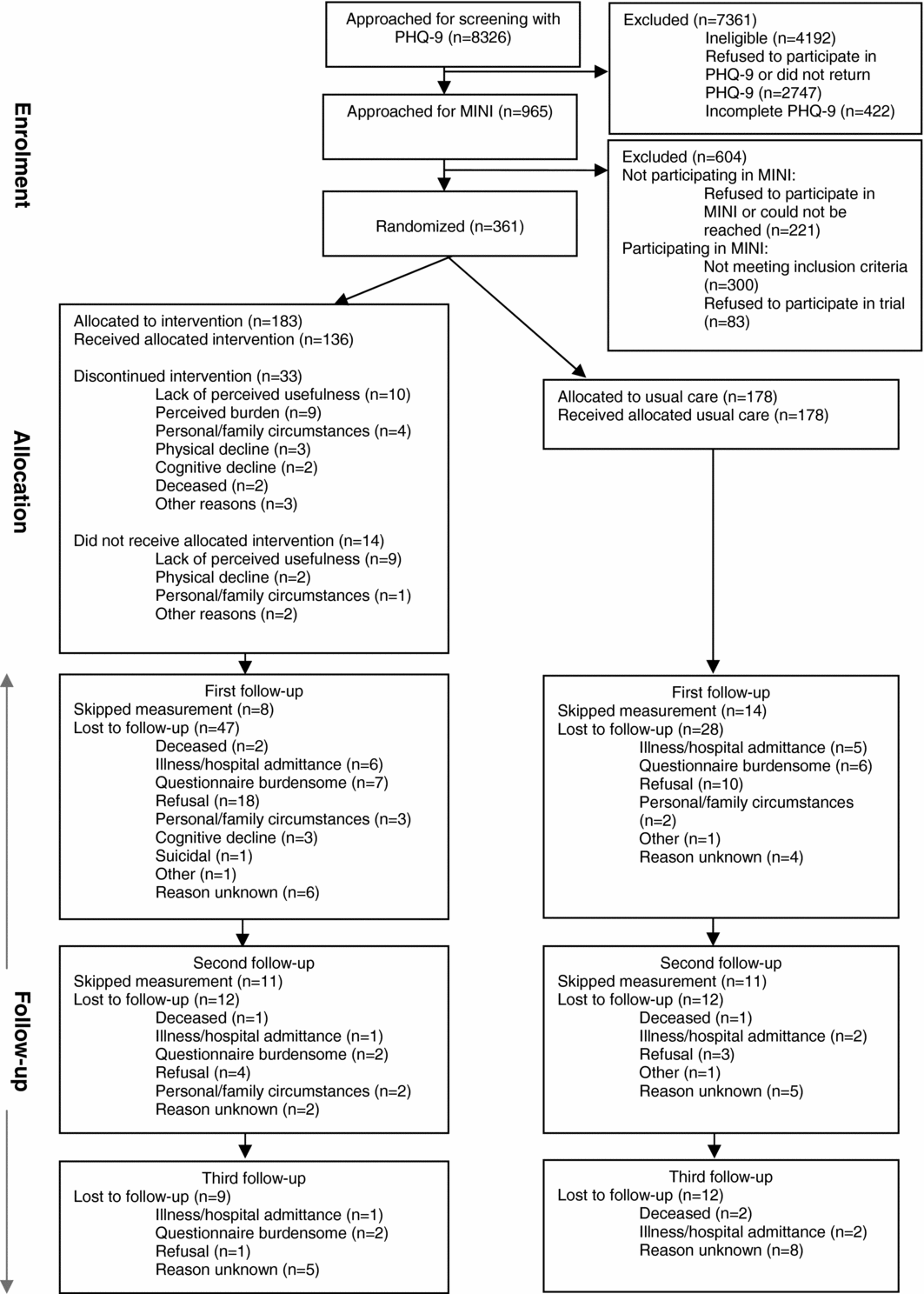
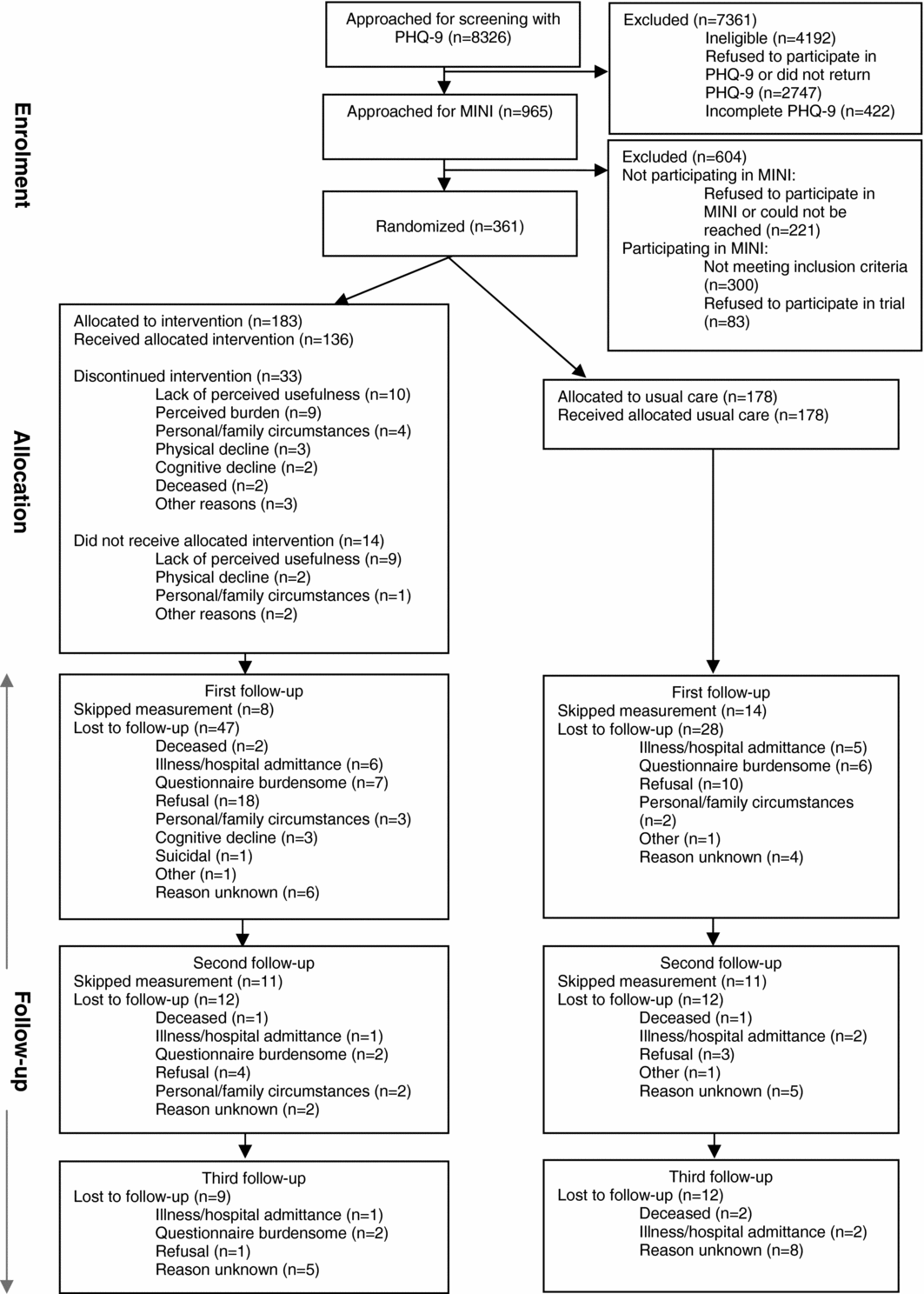
The MINI and HDRS were administered at the patients’ home by trained research nurses. Patients with minor depression, mild to moderate major depression, or dysthymia were invited to participate in the trial. Patients with suicidal risk and patients with severe major depression (HDRS>18) were excluded and referred to their general practitioner. This was done because more intensive treatments than a minimal psychological treatment are more appropriate for these patients. After signing an informed consent form and completing a baseline questionnaire, 361 patients (185 DM patients, of whom seven had comorbid COPD, and 176 COPD patients, of whom 14 had comorbid DM) were randomly allocated to the MPI or usual care (see Figure 1).
. Patient flow and follow-up in the DELTA study
The first follow-up was at one week after the intervention, the second was at three months after the intervention and the third at nine months after the intervention.
Intervention
Patients allocated to the intervention group received the MPI in addition to usual care. The duration of the intervention was limited to a maximum of ten visits over a period of no more than three months, making this a minimal intervention. The intervention was delivered at the patient's home by research nurses, who were trained in the DELTA intervention. Patients received the MPI from a nurse who had not also performed the MINI. The intervention is based on principles of CBT and self-management and consists of five phases, which have been described in more detail elsewhere (van Eijk et al., Reference van Eijk, Diederiks, Kempen, Honig, van der Meer and Brenninkmeijer2004; Lamers et al., Reference Lamers, Jonkers, Bosma, Diederiks and van Eijk2006). Briefly, in phase one, the nurse explores the patients’ feelings, cognition, and behaviors. The goal is that the patient shares his/her feelings with the nurse and the nurse gains an understanding of the origin of the symptoms and the daily routine of the patient. During phase two, patients keep a diary, in which they record symptoms, complaints, thoughts, worries, and related feelings and behaviors. In phase three, patients are challenged to link their mood and thinking to the consequent behavior, using information from the diary. A distinction is made between complaints related to the chronic illness itself, and those related to the emotional and behavioral consequences of the illness. For example, a DM patient wanting to improve her life-style may try to reduce her visits to the local coffee shop for a cup of coffee and a slice of pie. However, in doing so, she finds she misses the small talk and contact with the other customers in the coffee shop. She is challenged to describe what she feels when she visits the coffee shop. In this way, the patient experiences that her negative feelings or feelings of distress are connected to her behavior (not going to the coffee shop) instead of the diabetes itself. The self-management approach is introduced in phase four, where patients explore possibilities to alter their behavior and where they draw up an action plan. In this plan the patient addresses how he or she wants to solve the perceived problems and he or she sets specific goals to be reached before the next visit from the nurse. The patient from the example above decided to return to the coffee shop and order healthier choices to replace the coffee and pie. Phase five consists of an evaluation of the degree to which goals from the action plan have been achieved. The intervention is tailor-made and a home visit could address one or more phases, depending on the progress. To ensure that the nurses adhered to the protocol during the study, they were asked to keep checklists, covering all essential intervention steps, for each patient. If all the steps in a phase had been addressed, the nurses could decide to move to the next phase. Examination of the checklists showed that nurses had adhered closely to the guidelines in the protocol, although no objective measure was available (Jonkers et al., Reference Jonkers, Lamers, Bosma, Metsemakers, Kempen and van Eijk2007). During the study, patients received two to ten visits over a period of at most three months. The mean number of visits was four, with a mean duration of 61 minutes (Jonkers et al., Reference Jonkers, Lamers, Bosma, Metsemakers, Kempen and van Eijk2007). Patients assigned to the control group received the usual care for their chronic disease, according to the guidelines of the Dutch College of General Practitioners.
Measures
Information on demographic factors (age, gender, education) was collected during the PHQ-9 screening. Self-efficacy was defined as the belief of a person in his or her ability to organize and execute certain behaviors that may lead to desired outcomes such as improved health. It was assessed using the 12-item Self-Efficacy scale (Bosscher et al., Reference Bosscher and Smit1998). Examples of items include: “When I make plans, I am certain I can make them work”, “I give up easily“, and “I am a self-reliant person“. Scores range from 12 to 60, where patients with higher scores have higher levels of self-efficacy. The internal consistency (Cronbach's α) for this scale is 0.69. Anxiety was assessed using the anxiety subscale from the Symptom Checklist (SCL-90) (Arrindel and Ettema, Reference Arrindel and Ettema1986). Questions addressed in this subscale include “feeling afraid” and “feeling tense”. This subscale ranges from 10 to 50, where patients with higher scores have more anxiety. Cronbach's α is in the range 0.76–0.88, across different research populations. Daily functioning was assessed with the Activities of Daily Living scale (ADL) from the Groningen Activity Restriction Scale (GARS) (Kempen et al., Reference Kempen, Sullivan, van Sonderen and Ormel1999). Examples of GARS items are “Can you, fully independently, dress yourself?” “Can you, fully independently, stand up from a chair?”, and “Can you, fully independently, go up and down the stairs?”. This scale ranges from 11 to 44 and higher scores represent poorer daily functioning. Cronbach's α for this subscale is in the range 0.77–0.93, across different research populations. Social participation was assessed using the questions from the domain “Autonomy Outdoors” taken from the Impact on Participation and Autonomy questionnaire (IPA) (Cardol et al., Reference Cardol, de Haan, van den Bos, de Jong and de Groot1999). Questions include “My chances of visiting relatives and friends when I want to are. . .” and “My chances of using leisure time the way I want to are. . .” The Autonomy Outdoors domain has five questions about the ability to attend social activities in a desired frequency and manner. Scores of this domain range from 5 to 25 and higher scores represent less social participation. Cronbach's α of the Autonomy Outdoor subscale of the IPA is 0.81.
Missing items on the Self-Efficacy scale and GARS were imputed using the individual mean score of items that were not missing in patients for whom at least 50% of items were available. Missing items of the SCL-90 Anxiety scale and the Autonomy Outdoors scale were imputed according to their manual requiring an availability of items of 75%. The number of imputations across measurements (T0-T1-T2-T4) was 13-6-4-7 for the Self-Efficacy scale, 8-3-7-6 for the SCL-90 Anxiety scale, 5-6-5-4 for the GARS, and 30-13-13-7 for the Autonomy Outdoors scale.
Statistical analysis
The power calculation for the DELTA study was based on depression scores measured with the Beck Depression Inventory, which was the primary outcome, and has been described elsewhere (Lamers et al., Reference Lamers2010).
Analyses were based on the intention-to-treat principle. To check the comparability of groups, t-tests and χ2 tests were used for demographic and outcome variables. We used a mixed-model, repeated-measures ANCOVA to test for differences between groups at different points in time. In addition, these models give insight into differences in trend over time between groups (group×time interaction). We included eight fixed effects in our model (age, sex, education level, chronic disease, baseline value of outcome, treatment group, time, and the interaction term between treatment group and time). Several random effects and covariance matrices were then tested, using -2 log likelihood tests to decide which model had the best fit. Lastly, two-way and three-way interaction terms for group, time, and disease (DM or COPD) were used to test for effect modification by disease. We decided to set α at 0.10 to denote statistical significance for the interaction term. In this way, we were able to detect all possible differences between the chronic diseases and were better able to address our hypothesis of a generic intervention. Furthermore, effect sizes (d) were calculated by dividing the difference in mean group scores by the pooled standard deviation. A check for outliers was conducted for all four outcomes, but no serious outlier influence was established.
Results
Figure 1 describes the patient flow in the study. In total, 8326 patients with DM or COPD received the screening questionnaire, of whom 965 patients proved eligible for the diagnostic interview (17.3%). Of these patients, 221 (23%) refused to participate in the MINI, or could not be reached. A comparison of participants (n = 744) and non-participants (n = 221) revealed no differences between these groups regarding gender, age, educational level, or PHQ-9 sum score. The 83 patients who were eligible according to the MINI, but who refused to participate in the trial, were more often female, older and were significantly lower educated. In total, 361 patients were randomized: 183 to the intervention and 178 to usual care.
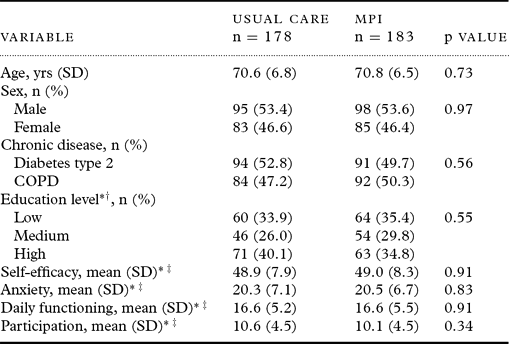
The percentage of dropout throughout the follow-up was higher in the intervention group, but not significantly different (38% vs. 30%, p = 0.11). Dropout was only associated with a higher age (p<0.000); they were on average 2.8 years older than patients who remained in the study. As shown in Table 1, the intervention and control groups were comparable in terms of baseline characteristics and the baseline measures of the outcomes.
Comparability of intervention and control groups in terms of sociodemographic variables and baseline values of outcomes
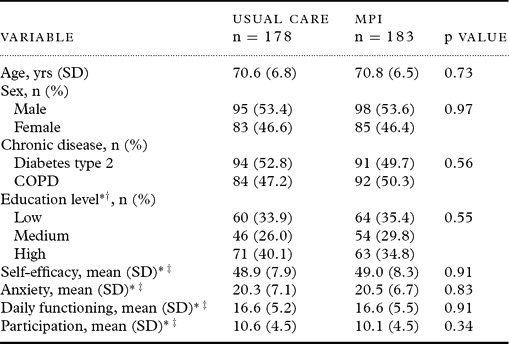
SD = standard deviation; MPI = Minimal Psychological Intervention.
* Missing data: education n = 3; self-efficacy n = 6; anxiety n = 14; daily functioning n = 2; participation n = 4.
† Low refers to primary school only, medium refers to lower vocational training or lower general education, high refers to higher vocational training, secondary school, higher professional education and university training.
‡ Self-efficacy range 12–60, higher scores = more self-efficacy skills; Anxiety range 10–50, higher scores = more anxiety; Daily functioning range 11–44, higher scores = poorer daily functioning; Participation range 5–25, higher scores = less participation.
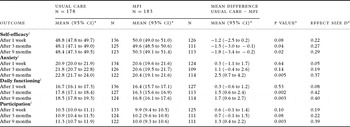
Results from the mixed-model ANCOVA analyses (Table 2) show that patients in the control group scored worse on all outcomes than patients in the intervention group. Significant differences were predominantly observed at the third follow-up. Differences in self-efficacy between the intervention and control groups were found at second (p = 0.04) and third (p = 0.02) follow-up, where the intervention group had more self-efficacy skills than its counterpart. The effect sizes were 0.27 and 0.29 respectively. For anxiety, the analysis revealed that the control group seemed to deteriorate, while the intervention group remained stable. The difference between intervention and control group reached significance at the last follow-up, with an effect size of 0.37. Tests revealed that the observed difference in trend, indicated by the interaction term between treatment group and time, was statistically significant (p = 0.03; not tabulated). Daily functioning was poorer for patients in the control group compared to the intervention group. This finding was consistent across all follow-up measurements and reached significance at the second (p = 0.002) and third (p = 0.003) follow-up measurement. Effect sizes were 0.42 for the second follow-up and 0.40 for the last. Again, we found a significant trend (p = 0.05; not tabulated). For social participation, the control group experienced significantly less participation than the intervention group at the last follow-up (p = 0.003). The effect size was 0.39.
Outcomes on self-efficacy, anxiety, daily functioning, and participation at follow-up

CI = confidence interval; MPI = Minimal Psychological Intervention.
* Adjusted for age, sex, level of education, chronic disease, and baseline value of the outcome measure.
† Self-efficacy range 12–60, higher scores indicate more self-efficacy skills; Anxiety range 10–50, higher scores indicate more anxiety; Daily functioning range 11–44, higher scores indicate poorer daily functioning; Participation range 5–25, higher scores indicate less participation.
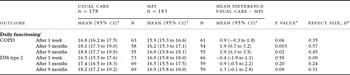
No significant three-way product terms of disease with group and time were found, although we did find significant (p < 0.10) two-way interaction terms between disease and group for daily functioning (p = 0.07). This indicated a different effect of the intervention in DM patients than in COPD patients. Therefore, stratified analyses by disease were performed for daily functioning (Table 3). The stratified analyses revealed that for COPD patients the effect of the MPI on daily functioning was more profound than for DM patients. However, patterns were the same for both diseases and showed that differences between intervention and control group were mainly due to a deterioration of daily functioning in the control group.
Outcomes on daily functioning at follow-up, stratified for type of chronic disease

CI = confidence interval; MPI = Minimal Psychological Intervention; COPD = chronic obstructive pulmonary disease; DM = Diabetes mellitis.
* Adjusted for age, sex, level of education, and baseline value of the outcome measure.
† Daily functioning range 11–44, higher scores indicate poorer daily functioning.
Discussion
In our group of chronically ill elderly patients with minor or mild to moderate major depression, the nurse-led intervention was associated with less anxiety and better self-efficacy skills, better daily functioning, and more social participation in intervention patients compared to the control group, due to a deterioration in the control group compared to a stabilization in the intervention group. Significant differences between the intervention and control group were mainly observed at three and nine months after the intervention. The effect sizes were small to medium. Furthermore, we found a difference in trend between the intervention and control group for anxiety and daily functioning.
Several aspects should be taken into account when interpreting the results of our study. First, as expected, the overall dropout rate in our study was 33% and did not significantly differ between the intervention and control group. Furthermore, attrition rates up to 30% are not uncommon in elderly populations with chronic diseases (Chatfield et al., Reference Chatfield, Brayne and Matthews2005; Gardette et al., Reference Gardette, Coley, Toulza and Andrieu2007). Still, as reasons for attrition might differ, attrition is a major limitation in our study which potentially influenced our findings. Second, the study was only performed on a selected subsample of patients (those who did not meet exclusion criteria and were willing to participate). Furthermore, we have only selected patients from one geographical region. These factors may reduce the external validity of our findings. Third, blinding of patients was not possible as we compared the intervention with usual care. Fourth, the choice of general self-efficacy as an outcome for improved self-management and behaviors has its disadvantages. Although general self-efficacy is regarded by some as a valid measure to study whether patients are fit for a task, others argue that self-management is task specific and should be measured with specific instruments (Chen et al., Reference Chen, Gully and Eden2001; Blazer, Reference Blazer2002). Lastly, the observed differences between groups were relatively small, especially considering the range of the measurement scales. Therefore, we calculated effect sizes, which appeared to be small to medium. This indicates that it is debatable whether our findings are of actual clinical relevance.
In this study, we aimed to improve self-management beliefs and behaviors. The factors we studied were self-efficacy, anxiety, daily functioning and social participation. Here, we discuss our findings on these factors in the context of previous research. The patients who received the MPI reported greater confidence in their ability to organize and execute health-related behaviors (self-efficacy) than the control group. This is in line with long-term findings from a collaborative care treatment for depressed elderly patients in primary care (Hunkeler et al., Reference Hunkeler2006). Other trials have found that self-efficacy enhancing interventions reduce depressive symptoms, although none of these trials specifically included depressive patients (Piette et al., Reference Piette, Weinberger and McPhee2000; Pariser and O'Hanlon, Reference Pariser and O'Hanlon2005; Brody et al., Reference Brody, Roch-Levecq, Kaplan, Moutier and Brown2006). Moreover, self-efficacy has previously been found to act as a mediator and moderator in the relation between chronic illness and depression (Marks et al., Reference Marks, Allegrante and Lorig2005; Jerant et al., Reference Jerant, Kravitz, Moore-Hill and Franks2008). Both CBT and self-management approaches focus on the self-efficacy construct as the key mediating factor in improving health-related behaviors (Marks et al., Reference Marks, Allegrante and Lorig2005). Still, future studies are needed that shed further light on the complex interplay between cognitive emotional factors, self-efficacy, and behaviors related to managing a chronic disease.
In the DELTA study, we found effects on both depression (Lamers et al., Reference Lamers2010) and anxiety. The comorbidity of anxiety and depression in the elderly population is high and the concepts are closely related. Therefore, interventions that aim to reduce depression are likely to have an effect on symptoms of anxiety as well. In our study, we used depression as a selection criterion for inclusion, but the intervention might be applicable to all patients with emotional problems in relation to their chronic disease, not only depression.
In terms of daily functioning, we found larger effects for COPD patients than for DM patients. This was mainly due to a more serious deterioration in the COPD control group. In general, DM can be seen as a gradual progressive illness, where the illness becomes slowly worse, whereas COPD is a more gradual relapsing condition (Rolland, Reference Rolland1987), with more sudden and irreversible deteriorations. Therefore, it is not surprising that COPD patients tend to show a more vigorous worsening in daily functioning than DM patients. However, patterns were similar for both diseases, which supports our view of a generic approach to address emotional problems across chronic diseases.
In our study, patients in the control group reported a decline in social participation over time whereas the social participation in patients in the intervention group remained stable. Previous studies have found that social participation is associated with functioning, well-being, quality of life, and survival (Dahan-Oliel et al., Reference Dahan-Oliel, Gelinas and Mazer2008). Furthermore, social participation seems to be related to behavioral coping (Demers et al., Reference Demers, Robichaud, Gelinas, Noreau and Desrosiers2009). Researchers suggest that social participation should be integrated in the care for elderly persons, in order to help bring about behavioral changes (Dahan-Oliel et al., Reference Dahan-Oliel, Gelinas and Mazer2008; Demers et al., Reference Demers, Robichaud, Gelinas, Noreau and Desrosiers2009). This is in line with our intervention that was aimed at both cognitive and behavioral changes.
In sum, the aging of Western society challenges us to find solutions to the pressures that are increasingly being placed on our healthcare systems. Minimal interventions, such as the MPI described here, may help improve patients’ skills and effectively allow them to manage their chronic disease and accompanying depressive symptoms, which in turn might reduce the burden on the healthcare system. In general, detection and monitoring of mental health problems in chronically ill and elderly patients is increasingly recognized as being important. Our process evaluation showed that patients and nurses were positive about the MPI (Jonkers et al., Reference Jonkers, Lamers, Bosma, Metsemakers, Kempen and van Eijk2007) and we observed modest improvements in depression (Lamers et al., Reference Lamers2010) and in self management beliefs and behaviors. Therefore, we feel our study provides enough evidence to warrant further research to improve the effectiveness of the MPI. In addition, we plan to adapt the MPI so that it places more emphasis on detection of mental health problems through watchful waiting by primary care nurses and integration in regular care. We argue that the detection and awareness of depressive symptoms, cognition and behaviors should become an integral part of the treatment of chronic diseases and should be embedded in the regular tasks of the practice nurse who periodically monitors a patient's chronic disease.
Conflict of interest
None.
Description of authors' roles
JvE and HB developed the study concept. All authors contributed to the design of the study. CJ, FL, HB, and JvE contributed to the acquisition of the subjects and data, and performed the data analysis. All authors contributed to the interpretation of data, and the preparation of the paper.
Acknowledgments
This study was funded by the Netherlands Organization for Health Research and Development (ZonMw), Health Care Efficiency Research Program, grant number 945-03-047.
We thank Kitty Daemen, Henny Geelen, Francine Hendriks, and Mieke Witte for administering the intervention with dedication and enthusiasm, as well as MEMIC (Centre for Data and Information Management, Maastricht University) for providing us with a data management system.