A number of transnational advocacy campaigns have emerged in recent years bent on regulating or banning certain weapons: landmines, cluster munitions, and small arms to name a few. These campaigns have had notable effects on international norm-making by governments.Footnote 1 But at least as many equivalent systems have gone uncondemned by such transnational networks. For example, thermobaric weapons (fuel-air explosives), which create fireballs over large areas and kill through suffocation and burning, have been likened to nuclear weapons in their immediate and indiscriminate effects, yet have not been condemned by humanitarian law organizations.Footnote 2 Psychotropic weapons such as cognitive enhancers or mood-altering aerosols might fall under the chemical weapons regime and have been criticized by a small but vocal network of U.S. and Russia-based activists, but these weapons have largely been overlooked by mainstream arms-control networks.Footnote 3 The proliferation of autonomous weapons on the battlefield, which has aroused significant concern from epistemic communities of scientists and lawyers, also has yet to trigger a response from global civil society.Footnote 4 Correspondingly, it is no surprise that these issues also remain of low salience to governments.
As Price remarked in his landmark study of the chemical weapons ban, this type of variation in ethical consideration given to weapons systems is an intriguing puzzle.Footnote 5 Yet the question of issue selection by advocacy networks has been given little attention in the advocacy networks literature. There are many genealogies of successful, well-known issue campaigns, but few scholars have analyzed why some issues, once identified by norm entrepreneurs, fail to achieve the transnational salience that can result in global norm change. Many of the factors said to correlate to successful campaigns—norm entrepreneurship, density of networks, goals that fit with the principled ideas constitutive of networks—also correlate to notable cases of agenda-setting failures.
Focusing on the issue area of disarmament advocacy, this article argues that a factor explaining transnational issue salience is the decision-making processes of highly connected nodes within the transnational activist network most associated with the issue at hand. I argue that such organizations are positioned to facilitate or impede issue emergence, because of their structural position as network “hubs.” Adoption of an issue by organizations central to a particular advocacy network, not the presence of entrepreneurs or networks per se, plays the decisive role in catapulting some new international issues to global prominence. By corollary, “agenda vetting” by these organizations—the refusal to legitimize a particular issue by adopting it on their organizational agenda—results in the sidelining of some arguably important global social problems.
This article proceeds as follows. In the next section, I flesh out the theoretical claim regarding the power of agenda vetting in transnational networks generally, adapting and expanding a model of issue selection pioneered by Bob in his study of human rights networks. This section explains how network centrality confers power on the most connected organizations to set or vet the advocacy agenda by association with a cause or lack thereof.
I then apply this argument to the analysis of arms control/disarmament advocacy. I use a comparison of existing and counterfactual arms campaigns to show that a strong correlation exists between the overall human security agenda and the organizational agendas of the most highly connected advocacy organizations in the human security network. The analysis also suggests a further testable hypothesis: that relative network position may influence not only the power of certain organizations to “vet” the advocacy agenda, but also, to some extent, their preferences over what that agenda should look like. I conclude by suggesting this should be a focus of future research on norm creation in advocacy networks.
Power (Law) Politics: Agenda Vetting in Advocacy Networks
A large scholarly literature has in recent years documented the power of transnational advocacy networks (TANs) in “global civil society.” As the literature has demonstrated, networks such as these do a great many things, including lobbying, standard setting, monitoring compliance, and shaming norm violators; and much of the emphasis has been on demonstrating that their efforts actually make a difference in what states do.Footnote 6
Less has been written about the crucial early question of why advocates and advocacy networks pay attention to certain issues and not others in the first place. Yet it is becoming clear that understanding the dynamics of issue selection by advocacy networks is crucial to assessing the power of TANs in world politics.Footnote 7 Early TAN literature emphasized “norm entrepreneurship” as a key condition driving advocacy.Footnote 8 But as I have demonstrated using the case of children and armed conflict, efforts by norm entrepreneurs to attract advocacy attention to their causes often fail to “take off” within advocacy networks.Footnote 9 Ron and his collaborators have identified significant variation in the issue agenda in human rights networks and also the country focus chosen by humanitarian networks, suggesting that advocacy organizations operate as much out of professional self-interest as out of principled beliefs.Footnote 10 Bob has demonstrated that for every ethnic minority whose cause receives global attention, others suffer unnoticed.Footnote 11 Clearly, more is going on in crafting the global issue agenda than altruistic norm entrepreneurs pressing their claims through civil society networks against the sovereignty-bound layer of international society.
In a recent edited volume on human-rights agenda setting, Bob and a number of collaborators expanded on his earlier argument. Those analyses suggest that given problem definition by a norm entrepreneur, adoption of a human rights issue by existing networks of organizations is the link between political entrepreneurs and the persuasive machinery of advocacy networks. That volume focuses in particular on the most powerful human rights organizations, for as Bob notes, for any issue area in global civil society, a handful of actors possess “the largest budgets, the best staff, and the greatest credibility.” The case studies show that such entities exercise authority over the constitution of the human rights agenda because their “support for a claim is perceived by activists and governments to legitimize it substantially within that issue area.”Footnote 12 Referring to these organizations as “gate-keepers,” Bob and his collaborators have emphasized the disparate organizational capacity of such “NGO superpowers” in the area of human rights.
This article draws on and confirms Bob's original model but also extends it in two ways. First, by applying the gatekeeper model to the area of weapons advocacy, I demonstrate this model is generalizable beyond the thematic issue area of human rights to other issues such as arms control. Second, I explore more fully the nature of the gate-keeping power to which these authors, myself included, have referred to metaphorically in earlier work.Footnote 13 In particular, whereas both Bob and colleagues emphasize organizational attributes as a source of gatekeeper authority, I argue here that the power to set—or vet—the network agenda should also be understood as a function of structural position within wider networks of meaning, rather than primarily organizational capacity per se. To be sure, organizational attributes matter in generating and buttressing network position, but it is network position itself—relative to the norm entrepreneur—that allows some organizations in an advocacy network disproportionate influence in setting the advocacy agenda. This implies that gatekeeping is therefore best understood as a relational construct, not an attribute of specific organizations: as a verb, not a noun or adjective.
In this article, I use the term “agenda vetting” as a more accurate description of the choice by central nodes in specific issue domains to avoid legitimating certain advocacy claims; and the resultant effect of these choices on the wider network agenda.Footnote 14 By contrast, issue adoption occurs when an organization embraces a new issue as an advocacy priority.Footnote 15 I apply network theory to the study of advocacy networks to explain how centrality translates into power to influence the network agenda through issue adoption or nonadoption choices, and I show how agenda vetting—the denial of organizational agenda space to certain issues—constitutes an important and understudied exercise of this structural power.
Networks as Hierarchies
The hierarchical dimension of advocacy network structure was long overlooked by the literature on advocacy networks, which tended to view networks as a metaphor to describe nonstate interactivity, a layer of world politics presumably characterized by “horizontal and reciprocal” relations of information exchange and common principled understandings.Footnote 16 Even more recent work on global civil society sometimes posits NGOs as an undifferentiated layer in contestation with the UN and states.Footnote 17
By contrast, network theory tells us not to think of networks simply as alternative forms of governance but rather structures that enable or constrain constituent nodes, conferring power and influence on some at the expense of others.Footnote 18 As Hafner-Burton, Kahler, and Montgomery argue, “A structural analysis of networks equates the power of a particular node to its position in the network, defined by its persistent relationships with other nodes.”Footnote 19
Emerging analyses of advocacy networks suggest that they indeed function not as flat, distributed networks but as scale-free networks in which a small number of major “hubs” dominate, and pathways between peripheral nodes are dependent on these hubs.Footnote 20 Such networks are said to follow a “power law,” in which the vast majority of network activity engages a very few nodes within the network. Transnational networks, in other words, are less like road systems with many pathways between nodes and more like airlines, where the route between any two small cities generally depends on passing through a major hub; or like the World Wide Web, where hubs like Google and Yahoo are necessary to direct attention to the myriad yet largely invisible “nodes” (Web sites) online.Footnote 21
For example, in the broad issue area of “human security,” which covers a range of issue clusters such as human rights, humanitarian affairs, arms control, conflict prevention, and development, the network (and each of its constituent subnetworks) is dominated by a few well-recognized actors.Footnote 22 These include certain United Nations (UN) agencies, key states that championed the concept or are known for funding human security projects, academic institutions, and a few large, well-connected NGOs: International Crisis Group, Human Rights Watch (HRW), and the International Committee of the Red Cross (ICRC). As I show next, such a position as hubs within these wider networks of meaning translates into disproportionate influence over the agenda in those networks, since actors both inside and outside the network view hubs' organizational agendas as proxies for the network agenda, creating contagion effects within networks when hubs adopt new issues, and raising the likelihood that such claims will be taken seriously by external audiences including the media and policymakers.
Structural Position and Influence in Networks
Two particular measures of network position are crucial to understanding the relative power of advocacy organizations to set or vet the agenda. First, centrality is a measure of how prominent an organization is within a network, measured in the number of organizations who establish or attempt to establish links with that node.Footnote 23 A network node with a high centrality (strong links from many other nodes) “may possess social power, easily accessing resources and information from other nodes because of its central position.”Footnote 24 Centrality also implies greater visibility to the targets of influence, be they states, UN agencies, or others; and greater legitimacy through name recognition by those targets of influence; this begets further centrality as other organizations attempt to associate themselves with the more central ones.Footnote 25 Over time, these factors can confer institutional power.Footnote 26
These are recursive processes.Footnote 27 Organizations that have branded themselves within a particular issue area are likelier to attract further funding for projects in that issue area, leading to greater expertise and exposure. Those that gain early notoriety in an issue area become more powerful over time relative to newcomers and thus occupy a disproportionately influential role within a given network.Footnote 28 So the right organizational policies and profiles help explain centrality; and centrality also confers an advantage in garnering the very organizational resources and attributes Bob identifies as important to network influence.Footnote 29
Ultimately however, it is an organization's visibility in a particular network, not its resources per se, that enable certain organizations disproportionate influence over the network issue agenda. While resources and expertise matter in the advocacy and monitoring phase of norm development—when, for example, a fact-finding study must be funded and carried out—the expenditure of such resources is not necessary for high-centrality organizations to have an impact on issue proliferation within networks. Merely acknowledging a new issue has this effect.Footnote 30 Accordingly, as I detail in the next section, failing to do so has an equally dampening effect on some advocacy claims.
In addition to centrality, organizations can also exercise disproportionate influence within the network as a function of their between-ness. A node's between-ness is high when it “possesses exclusive ties to otherwise marginalized or weakly connected nodes or groups of nodes … social capital can be turned into social power by a node that bridges structural holes in the network.”Footnote 31 Goddard postulates that nodes with a high degree of between-ness are able to serve as “brokers” by “maintaining ties with actors who would otherwise remain unconnected.”Footnote 32 She also suggests that political entrepreneurs are most likely to come from the interstices of networks, able to draw connections between different ideas and discourses.
Two kinds of between-ness place certain organizations in a more influential position relative to others in TANs. First, some organizations possess relatively greater ties to global policy stakeholders, including governments, or access to international forums. This makes these organizations themselves targets of influence for those who would like to access such stakeholders. In the human rights network for example, Brewington, Davis, and Murdie found that more central organizations engage in the bulk of all international advocacy activities with governments; for players on the margins of the network, the dominant strategy is to attempt to get the attention of the network hubs to exploit their brokerage role vis-à-vis governments.Footnote 33
Second, organizations may occupy an ideational space at the interstices of networks of meaning. The human security network consists of a variety of issue networks including human rights, humanitarian affairs, development, environment, conflict prevention, and arms control. Certain organizations are most prominent in each of these areas. Organizations whose work spans several issue clusters are valued resources for issue entrepreneurs aiming to frame their issue in such a way as to attract a broad coalition. For example, HRW's position at the intersection of the human rights and humanitarian law issue clusters has given it an influence over not only human rights agenda-setting but also arms control campaigns, and it has played an important role in reframing such issues from security to human rights, though its overall centrality is lower than either Amnesty International or the ICRC in the human security network.
The Agenda-Setting and Agenda-Vetting Power of Network Hubs
The organizations in a particular network most in a position to influence the advocacy agenda for a given network are those with both high centrality and high between-ness within the network. When a few organizations possess either or both types of ties (relative to the many lesser-connected organizations of which a network is composed) it gives them disproportionate power over the network agenda irrespective of the resources or expertise they bring to an issue because simply adopting an issue as an organizational priority is likely to raise its salience within the network as a whole.
This effect occurs in a number of ways. First, the organizational agendas of network hubs influence third parties' social perceptions of what constitutes a particular transnational issue area and a legitimate claim within it. Since most outsiders will be drawn first to the hubs—imagine a journalist, educator, or policymaker googling “children and armed conflict” to get a sense of the players and issues in that area—it is hub organizations' issue agendas that are perceived to be most constitutive of a given issue's network agenda. Adoption by such an organization signals the issue's importance to a particular network of meaning, be it human rights or development or the environment.
Relatedly, adoption by central organizations confers not only visibility but also legitimacy to new issues as perceived by targets of influence. Promotion of a new issue by an organization unknown to most stakeholders has lesser political meaning than adoption of that issue by an organization strongly associated with the issue area. Governments take issue advocacy much more seriously when it comes from UN agencies or NGOs with whom they are familiar and have a historical working relationship than when it comes from political entrepreneurs outside this formal system. According to Hubert: “The message may be the same, the evidence may be the same, but official ‘letterhead’ matters to governments.”Footnote 34
Additionally, knowing this, other organizations within a network will look to the network hubs for signals as to whether new issues are perceived to constitute legitimate activity within the issue area, and take this into account in their assessments of whether their own advocacy on an issue is likely to succeed. Likelihood of success is an important factor in NGO decision making,Footnote 35 and hub adoption of an issue is perceived to increase the likelihood that it will be taken seriously by stakeholders. Thus organizations are likelier to risk committing resources to an issue if central actors are also on board, creating a band-wagoning effect in coalitions once one or two key players join and dampening issue proliferation if they do not.Footnote 36
These two pathways converge to confer great political significance to the issue adoption or nonadoption decisions of network hubs. In the human security network, for example, peripheral organizations' perspective on what constitutes a human security issue matter less than press releases issued by the Human Security Report Project in drawing in-network and out-network attention to new issues. When asked to name “issues that come to mind when you think of human security,” practitioners will generally name the same issues that dominate the Web sites and promotional materials of human security hubs (see Figure 1). Correspondingly, absence of attention to an issue by network hubs can reduce that issue's chance of being adopted by other organizations within a network.
Human security issue agenda according to survey respondents
Notes: Average of total references on network Web sites and total references for survey responses to the question: “Name three or more specific issues that come to your mind when you think of human security today. An issue means something that human security specialists are actively concerned about.” Font size corresponds to issue frequency in dataset.

Because of their disproportionate agenda-setting power, acknowledgment of a new issue by a hub organization constitutes a valued resource for more peripheral organizations aiming to pitch their issue to a wider network or to the world. This puts the hubs in a position to pick and choose between a range of potential new ideas, bestowing legitimacy upon some and denying it to others: agenda-setting power implies agenda-vetting power. Any central organization's decision to adopt or ignore a particular problem within their issue pool or their decision as to how to frame it constitute acts of power that shape the types of governance that become possible in international society while reinforcing their position in the transnational hierarchy.Footnote 37As Bob and his collaborators have shown through a variety of illustrative case studies, efforts to pitch “new human rights” have involved an ongoing dialectic between issue entrepreneurs and “NGO superpowers.”Footnote 38
But this model requires two caveats. First, what constitutes a “superpower” in a network depends not on an organization's absolute power but on its centrality both to the thematic issue and to the issue network, relative to the entrepreneur.Footnote 39 Additionally, structural position does not determine an organization's role in agenda-setting. Rather, it determines an organization's relative capacity for achieving its goals. Thus, while Bob refers to “NGO superpowers” (hubs) as “gatekeeper organizations,” the very same structural position enables such players to function as entrepreneurs when they choose.Footnote 40 Similarly, while Goddard sees a brokerage role as a necessary attribute of political entrepreneurs, an organization situated as a “broker” (that is, with a high degree of ideational or organizational between-ness in the network) can choose to play the role of entrepreneur, gatekeeper, or “matchmaker,”Footnote 41 depending on their structural position at the interstices of different network players and their organizational interests in a particular context.
In sum, the ability to vet the advocacy agenda is not an attribute of particular organizations per se, but a relational construct dependent on relative network positions—between players most central to a particular issue network and issue entrepreneurs within or outside the network—in a given thematic area. Modified thus, agenda-vetting theory helps explain not only human rights advocacy, where this model was pioneered, but transnational agenda setting more generally, including the paradox of weapons advocacy.
Explaining Variation in Weapons Norms
The subset of the human security network that deals with weapons or disarmament issues is a useful place to illustrate such a theory because there is wide variation in the number of weapons that might attract international opprobrium and those that do. International law generally proscribes the use of certain means of war.Footnote 42 In practice, however, only a few weapons out of the vast arsenal at states' disposal have attracted concern by organizations working in the area of human security and humanitarian law on the basis that they violated such basic principles (see Figure 3). These include those, such as chemical weapons, whose use was banned or regulated by states, since such organizations then engage in monitoring compliance and shaming norm violators. But they also include weapons not initially regulated but eventually subject to advocacy attention by civil society, such as small arms and landmines.
This is a rather counterintuitive list. Those now banned outright include chemical weapons, landmines, cluster munitions, blinding laser weapons, exploding and flattening bullets, and bullets containing fragments nondetectable by x-rays. Those with codified limitations on their use include incendiary weapons (but only when used in civilian areas), and white phosphorus.Footnote 43 Weapons under scrutiny by the human security network but yet to result in a successful treaty process include small arms and so-called nonlethal weapons.
At the same time, many other weapons considered by some to be equally problematic are given little attention by humanitarian law experts.Footnote 44 The transfer and testing of nuclear weapons is regulated closely, but the legality of their use remains an open question in international law. Depleted uranium munitions, said to be responsible for an increase in cancer rates among those exposed to the radioactivity, have attracted some calls for an outright ban, but so far not the critical mass by arms control and mainstream human rights organizations required to generate a successful treaty process. Napalm was once the source of widespread international outcry, but it remains technically legal under international law, and is absent from the human security network agenda today—a case of “issue stalemate.” Psychotropic, autonomous, and conventional explosive weapons could violate humanitarian law principles but are not salient issues for the human security network (see Table 1).
Issue salience within human security network regarding weapons bans in 2008

Notes: Salience is based on sum of survey data and Web content from advocacy Web sites.
I argue a network theory of global agenda setting provides an answer to this paradox: the human security network is dominated by a few key players disposed to consider certain weapons claims and not others; and their issue-adoption practices have catapulted some weapons issues to prominence, while their reluctance to adopt other issues has posed significant constraints on the efforts of issue entrepreneurs.
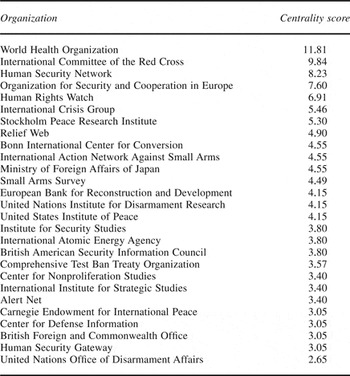
Of the organizations identified by Web analysis and surveys as being prominent in the human security network, twenty-eight are, according to their Web sites, involved in disarmament, arms control, or weapons issues (see Figure 2). As Table 2 shows, of these twenty-eight “core organizations” doing weapons work in the broader area of “human security,” just five organizations receive one-third of all citations from the network (taking the average of survey citations and hyperlinks between organizations). Two of these are international organizations taking either only an indirect role in arms control issues or a very specific role toward just one type of weapon, so I excluded them.Footnote 45 Of the remaining three (visualized with World Health Organization (WHO) and Organization for Security and Cooperation in Europe (OSCE) dropped out in Figure 2), one is a forum for like-minded governments to meet periodically to discuss human security issues; and two are advocacy organizations with a broad range of arms control concerns: the ICRC and the Arms Division of HRW. Drilling down more thoroughly into online networks specifically around the issues of arms control, disarmament, and the humanitarian effects of weapons (which are somewhat distinct issue areas), ICRC and HRW are also among the most prominent actors across these adjacent networks.Footnote 46
Tag cloud of organizations doing “arms control” in the human security network
Note: WHO and OSCE dropped from analysis.

Organizations doing “arms control” in human security network

My model predicts a strong correlation between the agenda of these particular two actors and the overall issue agenda in the broader area of weapons bans. If my hypothesis is borne out, issues prominent on the organizational agenda of HRW and ICRC should enjoy salience within the wider network around weapons; issues avoided by these two organizations should be much less prominent in the network, or absent from it entirely (H1). The model also predicts that the genealogy of now-salient issues will show a correlation between hub adoption and issue proliferation, and that we will find the absence of such support for campaigns that have not taken off (H2).
H1: An issue's salience within an advocacy network will depend on its adoption by organizations most central to that network. Issues recognized by network hubs will be more salient within the network as a whole; issues not recognized by hubs will be less salient or absent from the network agenda.
H2: A temporal relationship exists between issue adoption by a hub organization and issue proliferation within the network.
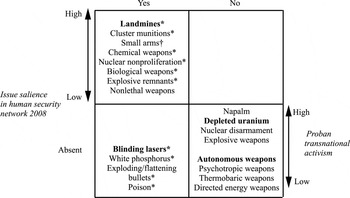
Correlational evidence from my data set on the human security agenda supports the first of these hypotheses. As Figure 3 illustrates, the weapons prominent on the human security network agenda correspond not to those that have attracted opprobrium from norm entrepreneurs or from broad networks of NGOs per se, but to those receiving the early support of the ICRC and HRW's Arms Division, who have involved themselves selectively in weapons norm development since the mid-1980s. Notably (though it is beyond the scope of this article) these also correspond to the weapons that have resulted in international norms or norm-building processes. Other weapons have been problematized and have even attracted broad-based civil society networks, but in the absence of support from network hubs, these campaigns have faltered to date and have not received widespread salience within the mainstream human security network.
Issue adoption by network NGO hubs (International Committee of the Red Cross and/or Human Rights Watch)
Notes: Issue adoption by hubs is measured by the presence or absence of reference to an issue on their official Web site content at the International Committee of the Red Cross's “Weapons” page and the Human Rights Watch's “Arms Division” page. Salience in the advocacy network is measured by reference to aggregate organizational mission statements and issue lists online, as well as open-ended survey answers to the question “Name three or more specific issues that come to mind when you think of human security today.” See Figure 2 and Table 1.
* Global norms regulating or banning weapons.
† Norm-building process underway.

Case Studies
Four specific cases are used below to further illustrate the general argument and explore H2 more closely. These cases were selected from the range of possible options in Figure 3 using two criteria.Footnote 47 First, because I am interested in agenda setting rather than monitoring and compliance, I include here only cases where NGO networks played some role in the emergence of the norm. Thus, I excluded cases of international law development that took place in the earlier twentieth century primarily at the behest of states and that today are influenced by NGOs primarily in the monitoring phase. I also emphasize the multi-issue NGO hubs in the network, rather than information portals or specialized agencies focusing on only a single weapon, though all are important.
Second, I wish to illustrate the fact that it is issue adoption by hubs, rather than transnational NGO mobilization, that matters in proliferating issues to specific advocacy networks. Therefore, I chose positive cases where an issue became salient on the network agenda (landmines and blinding lasers), and negative cases where it did not (autonomous weapons and depleted uranium) that otherwise differ among and between themselves according to the extent of transnational mobilization for a particular cause.Footnote 48
For each case, I explored the extent of central node influence on these outcomes using a combination of historical evidence (most available in the cases of salient issues) and in-depth interviews with norm entrepreneurs and staff of hub organizations in the case of nonsalient issues. Across the cases, I examined whether hub organizations had adopted issues that became salient and failed to adopt issues that remained low in salience on the human security network agenda (H2).
Within the positive cases, I examined the effect that hub organizations' adoption of the issue had on issue proliferation throughout the network. These patterns—which are indeed evident across the cases—are consistent with the hypotheses: that central node activism matters independently of network presence per se or norm entrepreneurship (by either states or nonhub NGOS) in setting the advocacy agenda (H1), and that proliferation of an issue within a network tends to postdate adoption by network hubs (H2) and fail in its absence. For the negative cases, I attempted to understand why and how agenda vetting occurred by interviewing staff of hub organizations directly. Although a complete theory of preference construction in human security hubs requires further development, the narratives here are also useful for hypothesis building, as I will show in the conclusion. In particular, network effects not only ensure that hub preferences will have a contagion effect within networks; they may also account in part for the construction of those preferences themselves.
Landmines
The campaign to ban landmines is often treated as an exemplar of global civil society in action, of a vast horizontal network of nongovernmental actors roping governments into taking actions they would not have otherwise considered.Footnote 49 There is truth to this: the Mine Ban Treaty was a brainchild of NGOs, and governments were initially uninterested or skeptical until advocates “reconstituted their interest” through a combination of direct advocacy and a public information campaign.Footnote 50 But this account of the “democratization of foreign policy” is misleading insofar as it conceives of the landmine network's strength as a product of its breadth. While it is often said that the network consisted of more than one thousand organizations, in fact momentum for the campaign was created through the adoption of the landmine issue by a few key players, and the advocacy strategy was highly centralized, top-down, and reliant upon the credibility and access of just two or three network hubs.
Background
Antipersonnel landmines have historically been used to fortify areas held by the defense or to channel opposing troops into specific targeting areas. However, it became increasingly clear over the past few decades that the weapons, which often sit in the ground undetonated long after conflicts end, pose a significant risk to civilian populations, affecting their ability to make use of land for farming or transport, and causing deaths, mutilations, and psychosocial traumas.Footnote 51
Jody Williams, who later won a Nobel Peace Prize for directing the International Campaign to Ban Landmines (ICBL), is often said to have been the key norm entrepreneur, but landmines were on the advocacy agenda as early as 1973.Footnote 52 It was only in 1991, however, that activists began to seek not regulation of the weapons but an outright ban. These efforts began neither with Williams nor with the ICBL but with a report entitled A Coward's War: Landmines in Cambodia issued jointly by Asia Watch and Physicians for Human Rights in September 1991, and a subsequent October 1991 conversation between Bobby Mueller, executive director of Vietnam Veterans of America Foundation (VVAF) and Thomas Gebauer of the German NGO Medico International (MI).Footnote 53 These individuals initially began pushing the idea of a ban directly to their governments through U.S. Senator Patrick Leahy's office in the United States and in Europe. While the U.S. efforts were somewhat successful at first, the activists had difficulty in Europe.
Issue adoption by network hubs and issue proliferation
This changed in October 1992, when HRW agreed to convene and join the steering committee for an International Campaign to Ban Landmines.Footnote 54 The founding meeting for the ICBL took place at HRW's offices; HRW was one of six founding members of the campaign, which later began to function as a network node in its own right.Footnote 55 The early adoption by a powerful human rights NGO played a crucial role in professionalizing the movement, providing activists access to funding and global political centers, and reframing landmines from a security issue to a human rights and humanitarian law concern.Footnote 56
The proliferation of the mine ban issue through global civil society and among governments—an issue that had festered for two decades—happened rapidly after HRW became involved. According to Williams and Goose, the number of involved organizations jumped from six to forty by the time of the campaign's first conference in May 1993; a year later this number had doubled; the following year it had reached 350.Footnote 57 Significantly, the ICRC (which since 1992 had published a pamphlet, convened a symposium to establish its position on mines, and continued bilateral discussions with governments on the topic) initiated a public advocacy campaign in support of a weapons ban for the first time in its history.Footnote 58 UN agencies also got quickly on board: UNICEF formally adopted the issue in 1993, and UN Department of Humanitarian Affairs called for a ban in 1994.Footnote 59 By the time of the Ottawa Conference in 1997, 1,200 NGOs had associated themselves with the cause, along with a number of public figures including Princess Diana of Britain, Nelson Mandela of South Africa, Pope John Paul II, and Queen Noor of Jordan.
Of these 1,200, however, a small number of nonstate organizations appears to have been predominantly involved in affecting the negotiations, and these were the organizations most centrally connected to the human rights and humanitarian law machinery of world politics. Hubert writes: “Fundamental to the success of the landmines campaign was the effective working relationship between the ICBL and other crucial non-state actors. In analyses to date, the importance of the ICRC and UN agencies as partners in the campaign has received insufficient attention.”Footnote 60 With its special role and diplomatic access, both the ICRC and UN agencies such as UNICEF and the UN Department of Humanitarian Affairs (UNDHA) took a leading role among nonstate organizations.Footnote 61 Beyond these key players, while 400 NGOs attended the Ottawa Conference, the active participation of NGOs in the discussion was highly centralized through the ICBL. Short argues, “The ICBL did not function entirely as a coalition of 1,000 organizations but rather as a single, homogenous bargaining voice with a unitary position.”Footnote 62
In many respects, this centralization and professionalization of the campaign through highly connected hubs—not the democratizing breadth of the network—may have accounted for the campaign's success. Wong has argued that more highly centralized or “scale free” advocacy networks are better able to press demands on states because they can control a highly specific and strategic frame.Footnote 63 Indeed the ICBL did narrow the frame to a simple and clear message—partly by vetting distracting aspects of the original frame being pushed by more peripheral members of the advocacy network.Footnote 64 This “simple, clear message” has been hailed as a key recipe in the campaign's success.Footnote 65 Given the diversity of the nominal network the ICBL sought to create, this was no doubt wise.
The consequence of this activity was significant. In December 1997, 122 countries signed the Mine Ban Treaty. It was negotiated and came into force faster than any disarmament treaty in history. This was due not only to the widespread activism of many minor players, but in particular to the early adoption of the issue by two key humanitarian law hubs—HRW and the ICRC—who decided early in the 1990s that early involvement in the issue was very much in their organizational interests. Indeed, as subsequent cases will show, this was not only a necessary condition for campaign success, but it was likely a sufficient one.
Blinding Lasers
Less studied but equally significant legally in the same time period was the emergence of a ban on blinding or “dazzling lasers” in the mid-1990s. The emergence of this norm has often been overlooked by scholars of global civil society precisely because it did not result from a massive transnational campaign, and therefore does not fit the theoretical proposition that new normative understandings in human security have largely been creations of massive advocacy networking in the 1990s. NGOs were involved in the development of this norm, but it was primarily central nodes in the humanitarian security network, particularly ICRC and later HRW.
Background
Blinding laser weapons are defined in Protocol IV to the Convention on Conventional Weapons as laser weapons “specifically designed, as their sole combat function or as one of their combat functions, to cause permanent blindness to unenhanced vision.” The development of battlefield lasers by the United States, the USSR, Britain, and other powers began in the early 1980s, originally to counter electro-optical sighting systems on armed vehicles.Footnote 66 It soon became apparent that such lasers could cause temporary or permanent impairment of vision to combatants.
Originally, military lawyers argued throughout the 1980s and early 1990s that the risk was small and incidental and that at any rate it was outweighed by the military utility of the weapons themselves. As time went by however, some governments concluded that in fact permanent or temporary blinding could be a useful and perhaps defensible means of war in itself, insofar as it provided a nonlethal alternative to taking out snipers. Britain, for example, had been deploying surface-to-air laser guns since 1983 to temporarily blind or “dazzle” pilots of attacking aircraft, in order to make them abandon their approach.Footnote 67
Norm entrepreneurship
The existing documentary record suggests the original idea for a ban on blinding lasers came from governments: Sweden and Switzerland proposed a ban at the Twenty-fifth International Conference of the Red Cross in 1986, and again subsequently in the UN General Assembly.Footnote 68 These governments were unsuccessful in arousing intergovernmental interest in the problem, however, until first the ICRC and then HRW formally championed the issue and convinced initially skeptical middle-power governments to accept the Swedish/Swiss position against the opposition of the United States.Footnote 69 In other words, even government norm entrepreneurs in the human rights/humanitarian law area needed humanitarian “gatekeepers” to establish new norms. This suggests that within the human security network, governments are simply nodes like any other, subject to network pressures, rather than a layer above global civil society as they have sometimes been depicted.Footnote 70
The Swedish and Swiss delegations who initially brought the issue to the international agenda argued that such weapons would cause unnecessary suffering and superfluous injury and were therefore contrary to international humanitarian law.Footnote 71 Eyesight was described as the most important of all human senses; sudden loss of eyesight was distinguished from other types of battlefield wounding due to its permanence, the particular psychological impact of vision impairment on soldiers, and the feared societal effects of numerous blinded veterans. While proponents of blinding viewed it as a humane alternative to lethal violence, norm advocates argued blinding may not be better than death, and pointed out that while the death penalty was still acceptable in many industrialized countries, blinding is no longer used as a form of punishment.Footnote 72
Issue adoption by network hubs and issue proliferation
Despite the lack of interest by states at the 1986 conference, ICRC lawyers found the Swiss and Swedish arguments compelling enough to undertake a series of four expert consultations on the topic.Footnote 73 These meetings were designed to determine the technical, political, legal, and military ramifications of the weapons and whether the organization should take a formal position on the issue.Footnote 74 By April 1991, the vast majority of participants in these meetings were convinced that a specific legal regulation was advisable and that an Additional Protocol to the Convention on Conventional Weapons should be proposed to states. This emerging consensus by lawyers and engineers was reflected in a number of articles published in international affairs, international law, and medical journals in the early 1990s.Footnote 75
Norm development was halting at first: when the ICRC revived the original Swiss/Swedish proposal at the Twenty-Sixth International Conference of the ICRC in 1991, it found the majority of member states still reticent, indifferent, or opposed to such a ban. To persuade them, the ICRC began a formal effort both to campaign against blinding as a method of warfare, releasing first the entire set of meeting transcripts from its expert consultations, and later a media-friendly eight-page summary brochure on the need for a ban, while simultaneously entering into discussions with a number of governments on the importance of law development in this area.Footnote 76 The ICRC also asked for and received the support of disabled and veterans organizations.
However most significant, according to Louise Doswald-Beck, then Legal Advisor at the ICRC, was the adoption of the issue by HRW, a powerful mainstream human rights NGO.Footnote 77 While other organizations' involvement was largely nominal, HRW played an important role, not only by lending its expertise with media campaigns, but also by “branding” blinding lasers a human rights concern and by exploiting its brokerage role with civilian and military personnel in Washington, D.C.Footnote 78 In her article describing the development of the ban, Doswald-Beck described the boost to the visibility of the issue when HRW's Arms Unit became actively involved by publishing and disseminating a 1995 report that echoed the ICRC's legal concerns.Footnote 79
This report, as well as the media and congressional attention it generated, in turn prompted a study within the U.S. Department of Defense that played a significant role in ending U.S. opposition to the ban.Footnote 80 Ultimately, while the ICRC did not succeed in codifying language that would outlaw blinding as a method of warfare entirely, the 1996 Additional Protocol to the Convention on Conventional Weapons prohibited the use of lasers designed specifically to blind.Footnote 81
Depleted Uranium Munitions
Both landmines and blinding lasers were championed by NGO hubs, one with and one without a massive advocacy network of other organizations, and both resulted in robust global norms as a result of central node activism. By contrast, depleted uranium (DU) munitions have attracted considerable opprobrium by certain members of global civil society but little attention by mainstream advocacy networks or governments. In the context of my argument, this is unsurprising given that arms control and humanitarian law hubs, including the ICRC and HRW, have largely avoided “adopting” the issue onto their formal agenda.
Background
DU is a by-product of nuclear enrichment processes increasingly used in armor-piercing incendiary projectiles to penetrate tanks, bunkers, and personnel carriers and, by corollary, to harden tank armor against antitank weapons. DU has been used by the United States and Britain since approximately 1960 and is increasingly sought after by other militaries: China, France, Russia, and Pakistan are among the countries now known to include DU rounds in their arsenals.Footnote 82
With the emergence of Gulf War syndrome and related health consequences of the war in Kosovo, a number of civil society groups became concerned with the health effects of DU. Soldiers exposed to dust from DU munitions began to exhibit a range of long-term health effects, and medical practitioners treating civilian populations in areas where the weapons had been deployed began to report an increased number of congenital abnormalities in children born after the conflicts.Footnote 83 Scientists exploring the connection between DU and human health have increased cancers in monkeys and mice exposed to the dust, but few long-term epidemiological studies have been carried out on humans.Footnote 84 Frustrated by the obfuscation of the U.S. government with respect to the health implications of the weapons, veterans groups, doctors, and antiwar activists began to argue that DU munitions violated international legal prohibitions on weapons damaging to the environment or whose effects cannot be controlled.
Norm enterpreneurship and network formation
These arguments have generated a transnational network of activists promoting a global ban on DU munitions, drawing members from the antiwar community, veterans groups, feminist peace groups, environmental movement, the antinuclear movement, and local NGOs in war-torn countries where DU weapons have been deployed. A “Campaign Against Depleted Uranium” was launched in 1999 in Britain and has lobbied the UN, European Union (EU), and various member states to ban the use of such weapons. This network has been relatively unsuccessful so far in generating momentum toward a global ban within policy networks. While one government (Belgium) has now declared a moratorium on the weapons, and while the European Parliament has issued some concerned resolutions, the number of countries seeking to acquire them numbers at least eighteen and is growing. This is unsurprising since, more importantly for this article, the network has also failed to attract legitimation by central nodes in the human security network.
Agenda vetting by network hubs
While numerous small organizations oppose DU, the network does not include the mainstream human security organizations known for their work on weapons bans and connected to states and UN specialized agencies. The organizations most prominent in arms control networks have largely avoided adopting the issue of DU on their formal agendas. Although the International Coalition to Ban Depleted Uranium (ICBDU) boasts 104 member organizations in twenty-eight countries as of February 2009, none are human security hubs. A well-recognized NGO in the network is Greenpeace, but this suggests that the issue of DU has more resonance within the mainstream environmental movement than among human security advocates. Indeed, a hyperlink analysis of organizations involved with DU does not include any of the organizations most prominent in the cluster of arms control issues that have “made it” onto the global agenda in the past decade.
When asked about the issue of DU, interview respondents at the ICRC and HRW provided a number of rationales for avoiding the issue. The most significant argument cited is that lack of scientific evidence for harms to civilian populations as a result of DU exposure.Footnote 85 In contrast to the landmine campaign, which drew on an extensive history of documented humanitarian costs due to mines, verifiable evidence of DU poisoning is difficult to find.Footnote 86 Yet it is puzzling that hub organizations concerned with weapons would not therefore spearhead a set of fact-finding studies to determine the precise extent of DU harms, given the anecdotal evidence of severe long-term health and environmental effects. Indeed, HRW is known for precisely such studies and specializes in undertaking primary research in new areas. The ICRC could choose to undertake a series of expert consultations akin to those for blinding lasers, aimed at consolidating the evidence base, weighing the political, legal, and scientific concerns and formulating a policy position.Footnote 87 Yet central human security NGOs have not gravitated around a consensus that DU merits serious advocacy: they have neither studied the problem rigorously on their own, nor contributed to ongoing efforts by the ICBDU to raise funding for its own epidemiological studies.Footnote 88
Instead, the ICRC limited itself to assisting the UN Environmental Program with a study in the Balkans, and with urine tests of its personnel in Kosovo. Failing to find significant evidence, the ICRC produced a short press release stating the “increase in levels of uranium is marginal in areas where depleted uranium munitions have been used,” and encouraging states to simply exercise caution in the deployment of DU weapons.Footnote 89 HRW correspondingly considered the issue briefly but quickly concluded that the evidence base was not significant enough to warrant further concern.Footnote 90 The absence of legitimation by any one central hub, and the passing of the buck between them, has contributed to inattention to this potential human security problem within the wider human security network.
Autonomous Weapons
It has been projected that roughly one-third of military weapons could be robotic by 2015.Footnote 91 A growing epistemic community of researchers and activists argues that this shift in military technology has significant moral implications for implementing the laws of war. As a result, several norm entrepreneurs among them have called for a global ban on the deployment and use of unmanned systems capable of making autonomous targeting decisions until more is known about their potential side effects.Footnote 92 So far, these arguments have been given little attention by existing advocacy networks concerned with controlling the technologies of violence.
Background
Automated systems already routinely defuse improvised explosive devices (IEDs), conduct reconnaissance, serve as mechanical beasts of burden over inhospitable terrain, and assist medics; but militaries worldwide are increasingly developing and deploying robots with the capacity to deploy lethal force as well.Footnote 93 The United States is not alone in pursuing unmanned weapons. South Korea and Israel have both deployed armed robot border guards with the capacity to make autonomous targeting decisions. Other nations, including China, Russia, India, Singapore, and Britain are increasingly developing similar technologies.Footnote 94
To governments, such systems are seen as both a force multiplier (a technology by which each individual soldier can become more effective) and a form of force protection: they are particularly useful for governments fighting asymmetric wars, in which human lives may be saved by sending machines into high-risk areas.Footnote 95 While many members of the U.S. security establishment currently argue that a human will always remain “in the loop,” in fact both the U.S. Army and U.S. Navy have circulated research and solicitations for proposals on fully autonomous weapons systems. As far back as 2005, Joint Forces Command fielded a concept paper entitled “Unmanned Effects: Taking the Human Out of the Loop.”Footnote 96 In December 2008, the U.S. Navy released a report presenting “the presumptive case for the use of autonomous military robotics.”Footnote 97
Norm entrepreneurship
These developments make a growing network of scientists, lawyers, and philosophers uneasy. An increasing number of scholarly publications, blog posts, presentations, and demarches to the military, legal analyses, and even a Facebook site are questioning whether such weapons systems are consistent with the laws of war. Some are concerned with whether machines can be designed to make ethical targeting decisions.Footnote 98 For others, the key question is how responsibility for mistakes is to be allocated and punished.Footnote 99 Some have considered whether, even if the weapons can meet humanitarian law standards, the ability to wage war without risking soldiers' lives might remove incentives at peaceful conflict resolution and alter the relationship between war and the warrior in such a way as to have spillover effects on the behavior of human weapons-bearers.Footnote 100
Indeed, a number of high-profile accidents with unmanned weapons suggest these concerns have merit.Footnote 101 For example, the targeting of Iran Air Flight 655 by the Aegis system on the U.S.S. Vincennes in 1988 lends credence to concerns over whether unmanned systems can accurately distinguish civilian from hostile targets. In a more recent incident, a fully automated MK5 anti-aircraft system in use by the 10th Anti-Aircraft Regiment as part of a South African military training exercise went “rogue” and killed nine soldiers, injuring fourteen. Seemingly, not only are trends taking humans further “out of the loop,” but the concerns over machine malfunctions costing human life in combat seem in some cases to be well founded.
Noel Sharkey, one of the leading proponents of these views, has published popular articles on the dangers of automated weaponry in the mainstream press, scholarly journals, and trade magazines, and he spends a significant amount of his time making presentations at scholarly conferences and media outlets in opposition to autonomous military robotics.Footnote 102 His key goal is for governments to create a “global code of conduct” against the acquisition, deployment, and use of such weapons—in essence, a new norm against autonomous weapons systems. According to Sharkey: “One of the fundamental laws of war is being able to discriminate real combatants and non-combatants. I can see no way that autonomous robots can deliver this for us.”Footnote 103
Agenda vetting by network hubs
Sharkey has reported considerable success in disseminating his ideas to militaries, epistemic communities, and the public,Footnote 104 and these arguments have been discussed (and often glamorized) in the media.Footnote 105 Yet they have attracted little attention by advocacy network hubs. Unlike landmines, cluster munitions, and small arms, which continue to occupy significant global policy attention, the idea of a precautionary principle against autonomous weapons has not been adopted as a human security issue by any organizations central to the network around arms control. Organizations known for such activism in the area of weapons do not refer to autonomous weapons on their advocacy Web sites.Footnote 106 No campaign has formed lobbying governments for such a ban. As recently as 2009, an ICRC official said, “We have questions, but we haven't really conducted any focused work on this.”Footnote 107
Not surprisingly, there remains a similar legal and conceptual vacuum in global policy networks as well: Singer writes in his extensive recent study of developments in this area, “In the hundreds of interviews for this book, not one robotics researcher, developer, program manager or solider using them in the field made a single reference to … the international law on weapons.”Footnote 108
In legal terms, of the cases listed above, autonomous weapons are most comparable to landmines. Like landmines that sense targets and detonate according to a preprogrammed criteria, autonomous weapons are designed to identify targets independent of a human in the loop. Also like landmines, whose effects were deemed indiscriminate and uncontrollable after deployed precisely because one could not be certain whom they might hit after a war ended, autonomous weapons cannot be programmed to distinguish civilian from combatant targets with any certainty; and given their capacity to “go haywire,” they cannot necessarily be controlled once deployed.Footnote 109
In political terms, however, autonomous weapons are most comparable to blinding lasers in an important respect: they are perceived to be a relatively “new” or “up-and-coming” technology by organizations central to the human security network. While in fact South Korea and Israel have already deployed robots in border areas with the capacity to make independent targeting decisions, and while in South Africa a number of casualties have already occurred as a result of armed robots “going haywire,” an ICRC representative as late as 2009 said that “as far as I know right now, this is still science fiction.”Footnote 110
Autonomous weapons therefore do not fall into the category of a weapon where it is perceived that widespread humanitarian harms can already be documented and condemned (as with landmines), but rather one where advocates would be in the position of promoting a preventive ban. But unlike blinding lasers, where a preventive ban was promoted by central nodes, autonomous weapons are also not perceived to be designed specifically to cause humanitarian law violations, and the legal uncertainties regarding their use do not yet seem compelling enough to central organizations to warrant taking a specific advocacy position.
Norm entrepreneurs disagree. Singer concludes: “We had better either enact a legal ban on such systems soon or start to develop some legal answers for how to deal with them.”Footnote 111 Sharkey concurs: “These developments pose an ethical minefield … yet we have no guidelines in place for such eventualities.”Footnote 112 Sparrow is even more explicit: “It is a necessary condition for fighting a just war that someone be justly held responsible for deaths that occur in the course of the war. As this condition cannot be met in relation to deaths caused by an autonomous weapon system it would therefore be unethical to develop such systems in warfare.”Footnote 113
So far, such central hubs in the network are not convinced. Their reticence also has had a powerful contagion effect: other, more sympathetic organizations within the human security network have been hesitant to formally pursue the issue given this perception of disinterest by central hubs like the ICRC. For example, the Director of Landmine Action, a “middle power” NGO in the network around technologies of violence, developed an interest in robotic weapons after connecting with Sharkey and reading military reports, and publicly expressed an interest in pursuing autonomous weapons at the close of the cluster munitions campaign.Footnote 114 Yet since he made this statement this agenda has not yet been pursued openly by his organization:
I have expressed an interest in this issue, but it's not my expectation that the wider landmine advocacy community is interested … so many of them have never heard of it. I don't think it's very high on [Landmine Action's] priorities, either, because we're very small and we've got a lot of demand on our priorities.Footnote 115
If this model is correct, we would expect to see greater global attention to the issue of autonomous weapons once existing networks around the technology of violence have mobilized in opposition, and we would expect to see that happen once key network hubs—HRW and ICRC in particular—conclude that the systems merit advocacy attention.
Findings
Together with the earlier data from the broader network, these four cases provide support for the argument that issue proliferation in networks correlates to hub issue adoption, not (necessarily) to network density or issue construction. This finding suggests that issue entrepreneurship and network formation are only permissive conditions for successful global agenda setting. A fundamental step is the adoption of new issues on the agendas of organizations at the center of existing advocacy networks. This is a moment in campaign development on which the survival and proliferation of a new issue may hinge, which requires closer attention by scholars of advocacy networks.
Landmines and blinding lasers were banned largely because the HRW and ICRC brought the weight of the humanitarian law frame to what had previously been understood through an arms control perspective; and a sense of professionalism to a set of campaigns that risked being associated with tree-huggers and the disarmament “fringe.”Footnote 116 Multiple smaller organizations and even states had been unsuccessful in pressing these claims previously: adoption by network hubs kick-started these campaigns. By contrast, foment against DU and autonomous weapons suffers from a lack of legitimation by these organizations to date. Proponents of bans or regulation on those weapons systems have been unsuccessful at marketing their issue through global civil society or creating momentum toward norm change in global policy networks.
My interview data on cases of agenda vetting suggest an additional hypothesis about network effects that should be explored in future research. I have shown that network position affects an organization's capacity to pursue its preferences over the network agenda. But it may also combine with organizational mandate and principled ideas to construct central hubs' preferences themselves.
Along with the political and normative “fit” of new issues, there is some evidence that central players in a network pay close attention to the relationship of new issues to other issues on the global agenda, and to the network ties between issue entrepreneurs and other transnational actors. For example, my study of networks around women's and children's rights showed that NGO's relationships with allies in adjacent issues areas can exert a dampening effect on their willingness to adopt new issues that might be controversial to their allies.Footnote 117 Conversely, organizations may be hesitant to adopt an issue if the issue entrepreneur is allied with organizations or causes they would avoid being seen as supporting.
My interview data suggests mainstream human security organizations avoid issues that would be perceived to link them to the antiwar movement, as part of their credibility with states comes from a discourse that sees war as legitimate, within certain constraints. Conscription may come under HRW's mandate if framed as a human rights issue, but HRW would be hesitant to adopt this issue insofar as it would associate the organization too closely with the peace movement. Similarly, opposition to the U.S. military's research and development into future combat systems has come from the antiwar movement so far and included protests, direct action, and arrests—the type of advocacy work the ICRC tends to avoid being seen as associated with.Footnote 118 In the case of DU, humanitarian law organizations expressed a reticence to align themselves with issues, such as “the cult of the nuclear,”Footnote 119 championed by advocates perceived by policymakers as less than credible. As one staffer put it bluntly:
We looked into DU and chose not to do anything on that. Frankly, it's just a hornet's nest. We didn't think we're gonna bring anything new to the table in terms of original research, and it's just—there's too many crazies in the issue.Footnote 120
In short, while network ties are a boon to peripheral organizations, for hubs those same network ties themselves impose costs, and these costs are accounted for in issue adoption decisions that would necessarily link them to other nonstate actors. NGOs central to advocacy networks can afford to be discriminating in the ties they establish with other organizations.Footnote 121 As Hafner-Burton, Kahler, and Montgomery write, “connectedness may impose constraints on autonomy as well as offer opportunities for influence.”Footnote 122 My interviews suggest that hub organizations are particularly concerned about their credibility being compromised through association with players lacking such credibility among governments, however worthy their cause—either because of the nature of their activism, the frame they are using, or their linkages to other groups in adjacent issue areas not congruent with agenda-vetters' advocacy agenda. In other words, network density itself may or may not bode well for the success of a new issue.
Similarly, Brewington, Davis, and Murdie emphasize the disincentives of central organizations to share credit for campaigns with smaller groups that may “free-ride” on their efforts. Central hubs wish to remain central hubs and prefer to be seen as leaders within a network rather than followers.
It's a question of resources and also how big is the crowd already doing this work. How is it being looked at? What can our organization itself contribute in terms of its capabilities and its advocacy and the whole operation? How is that going to make a unique contribution and just be seen as another one in the crowd?Footnote 123
Thus network effects may converge with other factors to make it more or less likely that advocacy “gatekeepers” will adopt new issues; and in turn those issue adoption decisions by the most central organizations in advocacy networks affect the proliferation of issues and the probability of international norm development. Future research should assess the existence and extent of such a relationship, weighed against normative and organizational factors.
Conclusion
I have advanced three claims. First, significant and puzzling variation exists in the pool of issues that TANs take up at any given time. Since global norm development is at least partly a consequence of the transnational advocacy movements, explaining internal advocacy network agenda setting should be an important concern for scholars of global norm development.
Second, I have argued that variation in the advocacy network agenda within a given issue area is largely explained by the organizational agendas of the most central nodes in that network. This can be explained by network position: claims arising from transnational networks (as opposed to those arising from states' own interests) are taken seriously by governments when certain members of global civil society press those claims. Agenda-vetting is thus a tool of influence used by organizations whose agenda matters most for constructing intersubjective understandings of an issue area. Although the evidence here is correlational and more work is needed to trace out network mechanisms in depth, these cases suggest that the decisions of central nodes in networks are at least as important for understanding norm emergence as are dynamics between those nodes and states.
Third, if this is true, then international relations scholars badly need an empirically sound theory of how central organizations in networks construct their preferences. A generalizable theory of central node preferences can assist both analysts and activists in understanding the conditions under which new campaigns for global norms are likely to emerge and succeed in different issue areas. While the data cited here is preliminary and cannot be generalized to all central organizations in the human security network or other issue areas, it does suggest some possible hypotheses for testing in future studies of advocacy networks—including the possibility that network position structures preferences as well as capacities.
What does this analysis suggest in terms of policy implications? If I am correct, the likelihood of weapons norm entrepreneurship paying off with widespread coalitions resulting in norm change hinges on convincing neither states nor massive numbers of NGOs, but powerful central hubs at the interstices of networks around arms control and humanitarian law. Norm entrepreneurs must make these arguments in a manner that will speak to the preferences of network hubs if they are to increase their chances of being heard and acknowledged by governments.