INTRODUCTION
Neutral detergent fibre (NDF) contains mainly β-polysaccharides (cellulose and hemicelluloses) and lignin, as well as nitrogenous compounds and ash. These nitrogenous compounds may be cell-wall constituents such as lignin-nitrogen (N) or cell-wall proteins and also insoluble proteins not directly associated with the cell wall. These insoluble proteins may represent a large contamination of the NDF, especially after thermal treatments of high moisture feeds (Van Soest Reference Van Soest1994; Pereira et al. Reference Pereira, Carro, González, Alvir and Rodríguez1998). Sodium sulphite is used in an optional way to reduce this contamination because it cleaves disulphide bonds and thus dissolves many cross-linked proteins (Van Soest et al. Reference Van Soest, Robertson and Lewis1991). However, Van Soest et al. (Reference Van Soest, Robertson and Lewis1991) discouraged its use, especially when the NDF residues are used to determine insoluble N (NDIN), because the sulphite reaction is non-biological. In addition, sulphite also attacks lignin and as a consequence it should not be used in sequential analyses (Van Soest et al. Reference Van Soest, Robertson and Lewis1991) as it is usual in forages.
Arroyo & González (Reference Arroyo and González2013b ) have shown that the analytical procedures to isolate NDF and acid detergent fibre (ADF) do not promote the total detachment of ruminal micro-organisms adhered to feed particles. Microbial contamination varies considerably between feeds, increasing with their fibre contents (Michalet-Doreau & Ould-Bah Reference Michalet-Doreau, Ould-Bah and Jarrige1989; Rodríguez & González Reference Rodríguez and González2006). This fact, along with the high N content of micro-organisms, means that microbial contamination may lead to overestimations of NDIN and the N content of ADF (ADIN). Consequently, contamination with both non-cell-wall protein or ruminal microbes may affect ruminal effective degradability (ED) estimates of fibre fractions, especially for NDIN and ADIN. The aims of the present study were to examine in different feed types the effects of the residual microbial contamination (determined by 15N infusion methods) on the ruminal degradability of NDF and ADF and their associated N-fractions as well as the effect of including sodium sulphite in the NDF solution in the degradability estimates of NDF and NDIN.
MATERIALS AND METHODS
Tested feeds and assays
The tested feed set included cereal grains: maize (MG), rye (RG) and wheat (WG); cereal co-products: maize gluten feed (MGF), distilled dried grains with solubles from barley (DDGB) or wheat (DDGW) and wheat bran (WB); protein concentrates: rapeseed meal (RSM) and expeller palm kernel meal (EPK); dehydrated sugar beet pulp (DBP) and grass hays from oat (OH) and ryegrass (RGH). The effects of using sodium sulphite on the ED of both NDIN and NDF were studied in DDGW, WB, RSM, EPK, DBP, OH and RGH. This selection was determined by the residual availability of ruminal incubated residues after their use for other priority measures. Residues of NDF obtained without sodium sulphite corresponding to this last study were also examined for possible contamination with ruminal micro-organisms and the effects of this contamination on ED of NDF and NDIN. These studies were also performed for ADF and ADIN in grass hays. Feeds were ground to pass a 2 mm screen for in situ studies and then through a 1 mm screen for chemical composition analysis.
Effective degradability estimates
In situ studies were carried out on three Manchega wethers (body weight (BW)±sd=59±4·36 kg), provided with rumen cannulae and ‘T’-type duodenal cannulae. Animals were housed in individual pens and handled according to the animal care principles as published in the Spanish Royal Decree 32/2007 (BOE 2007). Wethers were fed with a 2 : 1 (fresh weight basis) chopped OH: commercial concentrate diet, containing (per kg dry matter (DM)) 136 g of crude protein (CP), 402 g of NDF and 172 g of ADF. The diet was supplied from 10 days before the start of ruminal incubations, at 40 g/kg BW0·75 in six equal meals (every 4 h), starting at 09.00 h.
In situ studies were performed labelling ruminal micro-organisms through a continuous intra-rumen infusion of a solution of 15N enriched (0·98 atoms, i.e. 98 of 100 atoms correspond to 15N isotope) ammonium sulphate (at a daily dose of 25 mg 15N/wether) from 5 days before the start of ruminal incubations to their end. Before suppressing this infusion, representative samples of ruminal contents were obtained for solid adherent bacteria (SAB) isolation, as described by Rodríguez et al. (Reference Rodríguez, González, Alvir, Repetto, Centeno and Lamrani2000).
Nylon bags (110×70 mm inner dimensions) with a pore size of 46 μm were filled with c. 3 g (air-dry basis) of the feed samples. Hays were incubated in the rumen for periods of 3, 6, 12, 24, 48, 72 and 96 h. Concentrates and co-products were incubated for periods of 2, 4, 8, 16, 24 and 48 h. Since a lag time in EPK was presumed, an additional period of 120 h was also included to assure an accurate fitting of degradation kinetics. Two series of incubations were performed for each feed and animal. In each series, all bags were simultaneously placed in the rumen, just before the wethers were offered their first meal in the morning. After removal from the rumen, bags were washed with tap water and stored at −20 °C. Bags were then thawed and washed three times for 5 min in a turbine washing machine. The same procedure was applied to two series of two bags to obtain the water-insoluble fraction (0 h value). Afterwards, bags were stored at −20 °C, freeze-dried, and weighed to determine DM disappearance. Disappearance data of DM in the two series of incubations were fitted together for each animal with the exponential model of Ørskov & McDonald (Reference Ørskov and Mcdonald1979), modified in EPK by incorporating a lag time (t 0) as proposed by McDonald (Reference McDonald1981). Estimates of ED were derived from these kinetics and the rates of ruminal comminution and mixing (k c) and outflow (k p) of particles, which were determined in accordance with Guevara-González et al. (Reference Guevara-González, González, Arroyo, Moya and Piquer2013) for OH and the dietary concentrate labelled with europium (Eu) and yterbium (Yb), respectively. Transit rates from concentrate were applied to concentrates and co-products and those from OH in both tested hays. To determine the particle transit, a pulse dose (40 g) of each labelled feed was supplied simultaneously to each animal before the first morning meal (i.e. at 09.00 h), which was totally consumed in 20 min. Then a total of 21 samples were obtained from the duodenal cannula, the first sample before supplying the labelled feeds and the remainder between 1 and 96 h afterwards. These samples were oven-dried at 60 °C, milled (through 1 mm screen), and analysed for Eu and Yb. The pattern of each marker in duodenal digesta over time was described for each animal using the model of Dhanoa et al. (Reference Dhanoa, Siddons, France and Gale1985). In agreement with Ellis et al. (Reference Ellis, Matis and Lascano1979), primary and secondary rate constants of this model were assumed as k p and k c rates, respectively. Estimates of ED were determined by the method proposed by Arroyo & González (Reference Arroyo and González2013a ) based on generating composite samples representative of the total rumen outflow of undegraded feed. These samples were analysed for NDF, ADF, NDIN, ADIN and 15N/total N. Values of ED were determined from the contents of the tested fraction in composite samples (Y) and whole feed samples (X) and the ED of DM as: 1–[Y×(1–ED of DM)/X]. Microbial proportions of N and DM in composite samples and their fractions were determined as indicated by Rodríguez & González (Reference Rodríguez and González2006) using SAB as reference.
Chemical analyses
Tested feeds were analysed in triplicate for DM (procedure 934·01), ash (procedure 967·05), ether extract (procedure 920·39) and CP (Dumas N×6·25; procedure 968·06) by the methods of the AOAC (2000). Feed samples were also analysed for NDF using α-amylase and without sodium sulphite (Van Soest et al. Reference Van Soest, Robertson and Lewis1991), or with this compound and ADF and acid detergent lignin (Robertson & Van Soest Reference Robertson, Van Soest, James and Theander1981). Analyses of ADF were performed sequentially in forages and directly in concentrates and co-products. Values of NDF and ADF were expressed including residual ash. The insoluble nitrogen in neutral detergent (NDIN) and in acid detergent (ADIN) solutions was determined by N analysis of the respective residues. Fibre parameters were analysed in triplicate. Therefore, three (concentrates and co-products) or nine (hays) replicates of NDF and six of ADF analyses (all feeds) were performed. Variations with the use of sodium sulphite on the content of NDIN (g/kg of total N) and NDF as well as the contribution of NDIN×6·25 to NDF were determined in all these feeds. Analyses of NDF, NDIN, ADF and ADIN in incubated residues were carried out by the same procedures. Ratios of 15N/total-N were analysed in duplicate by mass spectrometry (VG Prism II isotope ratio mass spectrometry (IRMS), Isogas Ltd., Middlewich, UK, linked in series to a Dumas-style N analyser EA 1108, Carlo Erba, Milan, Italy). Samples of duodenal content collected for transit studies were analysed in duplicate for Eu and Yb by inductively coupled plasma emission spectroscopy (ICP 5000, Perkin Elmer, Waltham, MA, USA).
Statistical analyses
Results of ED with or without sodium sulphite, or with or without microbial contamination correction, and the results of the particle transit study were compared by variance analysis considering each wether as a block. These analyses as well as the simple correlations among the different chemical characteristics evaluated with or without sodium sulphite in NDF fractions were performed using the SAS software (SAS Institute 1990). Effects were declared significant at P<0·05.
RESULTS
Feed chemical composition and particle transit
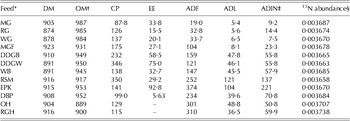
The chemical composition of tested feeds for fractions other than NDIN and NDF is shown in Table 1 together with the 15N abundance, which was near to the natural atmospheric abundance (0·003663 atoms) in all feed samples. Mean values of SAB were 468 g CP/kg of DM and 0·004670 atoms of 15N abundance.
Chemical composition (g/kg of DM) of tested feeds

* MG, maize grain; RG, rye grain; WG, wheat grain; MGF, maize gluten feed; DDGB, distilled dried grains from barley; DDGW, distilled dried grains from wheat; WB, wheat bran; RSM, rapeseed meal; EPK, expeller palm kernel; DBP, dehydrated sugar beet pulp; OH, oat hay; RGH, ryegrass hay.
† ADF, acid detergent fibre; ADIN, acid detergent insoluble nitrogen; ADL, acid detergent lignin; CP, crude protein; EE, ether extract; OM, organic matter.
‡ g/kg of N.
§ proportion of atoms.
Particles from concentrate showed a faster k c rate than those from OH (0·734 v. 0·224; residual standard deviation (r.s.d.)=0·0246; degrees of freedom (d.f.)=2; P=0·001), whereas no effect was shown for k p (0·0447 v. 0·0425).
Sodium sulphite use
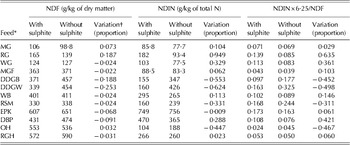
The variation in the NDF content using sulphite was variable in sign and magnitude, although it was low or moderate, except in RG, DDGB and DDGW (Table 2). These variations showed a higher correlation coefficient with those of NDIN (r=0·729; P<0·01) than with those of the ratio NDIN×6·25/NDF (r=0·582; P<0·05). The variations of the NDIN content using sodium sulphite were also variable in sign and magnitude (Table 2). Thus, reductions were apparent in DDGB, DDGW, RSM, EPK and OH, whereas increases were apparent in the remaining feeds, although these variations were low (<0·05) in EPK and RGH. All these changes were associated with variations of the same sign in the contribution of NDIN×6·25 to NDF, except in EPK which showed very low values for these variations (Table 2). Thus, a close correlation was shown between the variations in NDIN and the ratio NDIN×6·25/NDF (r=0·971; P<0·001). The NDIN content (g/kg N) determined without sulphite showed large variation between feeds (Table 2). Thus, this content was low (<100) in all tested grains and MGF, intermediate (<300) in WB, RSM and hays, large (<500) in DDGB, DDGW and DBP and very large in EPK (756). The contribution of NDIN×6·25 to NDF was also high in DDGW (0·325), RSM (0·244), DDGB (0·177) and EPK (0·163) and lower than 0·1 in the remaining feeds.
Variations using sodium sulphite of NDF, NDIN and NDIN×6·25/NDF estimates in different feeds (analyses were made in quadruplicate)

* MG, maize grain; RG, rye grain; WG, wheat grain; MGF, maize gluten feed; DDGB, distilled dried grains from barley; DDGW, distilled dried grains from wheat; WB, wheat bran; RSM, rapeseed meal; EPK, expeller palm kernel; DBP, dehydrated sugar beet pulp; OH, oat hay; RGH, ryegrass hay.
† Variation using sodium sulphite in relation to values obtained without its use.
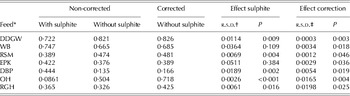
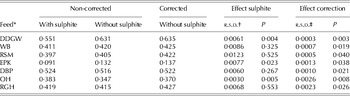
The ED of NDIN varied widely among feeds (Table 3): from 0·135 (DBP) to 0·821 (DDGW) when sulphite was not used. The use of sulphite led to consistent variations of ED of NDIN in some feeds, which in general showed a similar behaviour to the variations of the feed-NDIN proportion. Thus, reductions were shown in DDGW (P<0·01), RSM (P<0·01) and OH (P<0·001) and increases were recorded in DBP (P<0·001) and RGH (P=0·016), although no effects on the NDIN content were shown in this last feed. A numerical increase (12·3%) was also recorded in WB (P=0·109). The use of sulphite was also associated with variations of ED of NDF (Table 4): decreases in DDGW (12·7%; P<0·01) and EPK (30·7%; P<0·05) and increases in OH (10·4%; P<0·01).
Effects of the use of sodium sulphite and of microbial contamination correction on ruminal ED of NDIN of some feeds

* DDGW, distilled dried grains from wheat; WB, wheat bran; RSM, rapeseed meal; EPK, expeller palm kernel; DBP, dehydrated sugar beet pulp; OH, oat hay; RGH, ryegrass hay.
† Between microbial non-corrected values. r.s.d., residual standard deviation; degrees of freedom (d.f.) =2.
‡ Between values without sulphite. d.f.=2.
Effects of the use of sodium sulphite and microbial contamination correction on ruminal ED of NDF of some feeds

* DDGW, distilled dried grains from wheat; WB, wheat bran; RSM, rapeseed meal; EPK, expeller palm kernel; DBP, dehydrated sugar beet pulp; OH, oat hay; RGH, ryegrass hay.
† Between microbial non-corrected values. r.s.d., residual standard deviation; degrees of freedom (d.f.) =2.
‡ Between values without sulphite. d.f.=2.
Microbial contamination of fibres
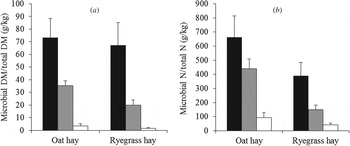
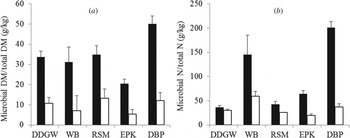
The mean contribution of ruminal micro-organisms to NDF, ADF, NDIN and ADIN of composite samples of tested hays is shown in Fig. 1, together with the microbial contribution to particles. The content of microbial N in ruminal undegraded NDIN was large but very variable between both hays (441 and 150 g microbial N/kg NDIN, as mean in OH and RGH, respectively), while for NDF this content has some importance (35·3 and 20·0 g microbial DM/kg NDF, in OH and RGH, respectively). The proportion of microbial N in ruminal undegraded ADIN was moderate (94·5 and 41·2 g microbial N/kg ADIN, in OH and RGH, respectively). Microbial contamination in ADF represented only 3·6 (OH) and 1·7 (RGH) g microbial DM/kg ADF. The microbial contamination of ruminal undegraded NDF in concentrates and by-products (Fig. 2) varied from 5·4 (EPK) to 13·3 (RSM) g/kg NDF. The associated mean contents of microbial N in NDIN were<30 g microbial N/kg NDIN, except in DBP (37·3) and WB (59·3).
Microbial contribution to particles (■) and neutral ( ) and acid (□) detergent residues (a) and their associated N fractions (b) in ruminal incubated composite samples representing the chemical composition of the by-pass fraction of oat and ryegrass hays. Bars are standard errors (s.e.).

Microbial contribution to particles (■) and neutral (□) detergent residues (a) and their associated N fractions (b) in ruminal incubated composite samples representing the chemical composition of the by-pass fraction of different industrial by-products (DDGW, distilled dried grains from wheat; WB, wheat bran; RSM, rapeseed meal; EPK, expeller palm kernel; DBP, dehydrated sugar beet pulp). Bars are standard errors (s.e.).

Omitting the correction for microbial contamination led to consistent undervaluations of ED of NDIN and NDF in all tested feeds (Tables 3 and 4). For NDIN these undervaluations were large in hays (29·8% in OH and 23·3% in RGH) and DBP (18·6%) and low in the remaining co-products (from 0·6 to 3·3%). The under-valuations for NDF were moderate or low in all tested feeds (from 0·6 to 6·2%). Undervaluations for ADIN and ADF in hays by omitting microbial correction (Table 5) were only shown as a tendency in RGH (P=0·063). These errors were moderate in ADIN (4·6%) and low in ADF (1·0%).
Effects of the microbial contamination on ruminal ED of ADF and ADIN

* OH, oat hay; RGH, ryegrass hay.
† NC, microbial non-corrected values; C, microbial corrected values.
‡ r.s.d., residual standard deviation; degrees of freedom (d.f.) =2.
DISCUSSION
Particle transit
The present results agree with the proposition of Ellis et al. (Reference Ellis, Matis and Lascano1979) that the smallest rate constant represents the outflow of fine particles accumulated in the reticulum, whereas the highest rate should be ascribed to an intra-ruminal compartment associated with the comminution of particles and their mixing with rumen contents. Particles from concentrate have initial values of density and size higher and lower, respectively, than the hay particles, justifying their higher k c rate. As a consequence of this difference, accumulation of particles in the reticulum is faster for concentrates than for forages, which may be manifested in small differences in k p rates between these two kinds of particles. As in previous works carried out with duodenal sampling (González et al. Reference González, Ouarti, Rodríguez and Alvir2006; Arroyo & González Reference Arroyo and González2013a ), the proportion of total residence time in the rumen-reticulum associated with k c was higher in hay (0·159) than in concentrate (0·057) particles, showing that k c should be considered in addition to k p to improve accuracy of in situ estimates, as in the present results.
Sodium sulphite use
The NDIN fraction is composed of N from lignin, cell-wall proteins and other insoluble proteins not directly associated with the cell wall. In addition, thermal treatments, especially of humid feeds, may lead to large increases of the last cited fraction and, therefore, of the NDIN content (Vanhatalo et al. Reference Vanhatalo, Aronen and Varvikko1995, Pereira et al. Reference Pereira, Carro, González, Alvir and Rodríguez1998). Differences in the nitrogenous compounds included in NDIN together with their contribution to the total feed N may explain the large variation shown among feeds. Thus, the low NDIN contents in cereals, especially in naked grains, or the low NDIN×6·25/NDF ratio in WB, MGF and grass hays seem to indicate that NDIN is mainly composed of cell-wall N. On the other hand, the high values of NDIN and NDIN×6·25/NDF in distilled dried grains, RSM and EPK seem to indicate that insoluble linked-proteins resulting from the heat applied in the manufacturing process represent a large proportion of NDIN in these types of processed feeds.
The present results show that including sodium sulphite in the NDF solution can reduce protein contamination of NDF in some feeds, especially in heat-treated co-products in humid conditions, by removing proteins altered by heating. However, in feeds with protein-rich fibres such as EPK this protein removal seems small. In contrast, in other feeds, sodium sulphite may have the opposite result to that intended, presumably due to a reduction of the solubility of proteins associated with its use. It is interesting to note that the highest absolute increases of NDIN were observed in feeds rich in soluble fibre, such as DBP and RG, suggesting that proteins associated with these fibrous compounds may be mainly affected by this reduction in solubility. Caution should be taken when considering the precision of these variations, associated with a possible lack of accuracy in the combined proximal analyses of NDF and N, especially in feeds with low NDF and/or NDIN contents due to the expression as a percentage of these variations. The higher correlation of the variations of NDF with NDIN than with the NDIN×6·25/NDF ratio suggests that sulphite also affects compounds other than proteins. Also, variations in NDIN and NDIN×6·25/NDF with the use of sodium sulphite were not always consistent with the associated changes in NDF. The reduction of lignin recovery with the use of sodium sulphite (Van Soest et al. Reference Van Soest, Robertson and Lewis1991) may justify most of these inconsistencies. For instance, this fact may contribute towards explaining the higher decrease in NDF than that justified by the elimination of its contamination with insoluble protein in distilled dried grains. All these discrepancies may suggest other possible actions of sulphite that are variable between feeds, which should be addressed in future research. Therefore, caution should be applied in the interpretation of results obtained using sodium sulphite.
The associated variations due to sulphite-use of the NDIN contents and their ED may be explained considering that NDF-insoluble proteins not integrated in the cell wall could be more degradable than cell-wall-structural nitrogenous compounds. In addition, the present results support the above observation that using sodium sulphite may lead to variable changes (not altering, reducing or increasing) on contamination of NDF with insoluble proteins. The results also show that ED of NDF estimates may also be affected using sulphite. The combined changes with its use on non-cell-wall insoluble proteins and lignin recovery together with the magnitude of both of these fractions in each feed may affect the resultant effects. Thus, the effects of sulphite-use on ED of NDF seem to be conditioned largely by feed.
Close negative correlations between NDIN contents (on total N) estimated without sodium sulphite and ED of CP have been shown in previous works (Haj-Ayed et al. Reference Haj-Ayed, González, Caballero and Alvir2000; Repetto et al. Reference Repetto, González, Cajarville, Alvir and Rodríguez2003; Pereira & González Reference Pereira and González2004). These relationships seem to be a consequence of (i) the lower ED of cell-wall N than total N (Arroyo & González Reference Arroyo and González2013b ) and (ii) the reductions of both solubility and degradation rate of proteins derived from the condensation reactions between protein and carbohydrates. Based on the variable effects among feeds with sulphite use, it can be supposed that these relationships would be more uncertain using NDIN values obtained with sulphite. As a consequence of all the limitations observed, its use seems to be only recommended in treated feeds with a large fraction of proteins whose solubility has been reduced by heating.
Microbial contamination of fibre fractions
The present results support those of Arroyo & González (Reference Arroyo and González2013b ), that the NDF procedure failed in micro-organism extraction whereas errors for sequential ADF had little practical importance. The higher microbial detachment in sequential ADF has already been shown by Mason (Reference Mason1969) in samples of sheep faeces, measuring microbial contamination using diaminopimelic acid. Mason (Reference Mason1969) also concluded that resultant errors have no practical importance in ADF but that NDF solution fails on the microbial extraction.
Differences in decontamination with fibre procedures between both tested hays show that microbial detachment efficiency seems to be affected by the feed, especially for NDF. Thus, assuming a similar microbial colonization in fibrous materials and in feed particles, the proportion of residual micro-organisms after fibre analyses represented 0·491 and 0·298 in NDF and 0·046 and 0·025 in ADF for OH and RGH, respectively. These same values in Italian ryegrass hay (Arroyo & González Reference Arroyo and González2013b ) were 0·296 (NDF) and 0·044 (ADF). Results in concentrates and co-products also support the feed influence on the microbial detachment efficiency. Residual micro-organisms in NDF represented 0·39, 0·32, 0·26, 0·24 and 0·24 in relation to the content in particles in RSM, DDGW, EPK, DBP and WB, respectively. Therefore, the present results illustrate that the failure of the NDF technique for microbial extraction seems to be large in vegetable feeds. Large undervaluations of ED of NDIN and ADIN caused by omitting microbial contamination correction may be expected in rich fibrous feeds, such as forages or DBP (Arroyo & González Reference Arroyo and González2013b ), in which this correction should be made to obtain accurate values. However, the inaccuracies incurred by ignoring this contamination were not large for NDF or ADF in these same feeds or for any fibre compound examined in the concentrates tested.
Ruminal degradation of fibre fractions
Factors such as the nature of cell-wall proteins, contribution to NDIN of non-cell-wall insoluble proteins, degradation resistance of both of these protein fractions or their accessibility to microbial enzymes allowed by the cell-wall lignification may explain the large variation among feeds recorded in corrected ED of NDIN (from 0·166 to 0·826). However, it should also be considered that ruminal microbial hydrolyses may disrupt di-sulphur bonds, simplifying protein structure and increasing the solubility of proteins in NDF solution, which will lead to overestimation of ED because proteins extracted with the NDF solution would be considered as degraded using the in situ technique. This fact may contribute to the high ED estimates found in some feeds rich in NDIN, such as DDGW. Therefore, further studies on the extraction of proteins with both neutral and acid detergent solutions should be performed to assure the accuracy of ED estimates for measuring the ruminal degradation of cell-wall N.
The present results showed a considerable degradation of ADIN in forages, which may be even greater than that of NDIN, as shown in RGH. Arroyo & González (Reference Arroyo and González2013b ) also showed a high ED of ADIN close to that of NDIN in Italian ryegrass hay. High apparent in situ degradations have been shown previously in lucerne stems (Sanderson & Wedin Reference Sanderson and Wedin1990). Also, apparent in situ results for lucerne of Aufrère et al. (Reference Aufrère, Boulberhane, Graviou and Demarquilly1994) showed a large degradation of ADIN as well as in one of its main constituents, extensin, a glycoprotein of the primary cell wall.
Diverse factors such as fibre structure and content and distribution of lignin may be considered responsible for differences in fibre ED among the tested feeds. Thus, the lower corrected ED of NDF or ADF in OH compared to RGH agrees with the higher fibre lignification degree of OH. In addition, the higher ED of NDIN or ADIN in OH compared to RGH agrees with the higher ED of CP and amino acids shown in OH (Guevara-González et al. Reference Guevara-González, González, Arroyo, Moya and Piquer2013). Also, it is interesting to note the scarce digestibility of fibre carbohydrates in EPK, since c. 0·47 of the corrected value of degraded NDF was due to the disappearance of protein by rumen degradation or by extraction in NDF solution. This can also explain the higher value in DDGW than in WB despite the similar nature of their fibres and lignification values. The contribution to NDF degradation of rumen-degraded NDF-associated proteins represents 0·42 in DDGW and only 0·14 in WB; therefore, excluding nitrogenous compounds, the ED of NDF in both of these feeds was 0·367 and 0·364, respectively.
CONCLUSIONS
Caution is required in the interpretation of NDF contents obtained using sodium sulphite because it may increase or decrease the solubility of proteins, reducing or increasing protein contamination. Its use seems mainly of interest in highly treated feeds, where it removes proteins altered by heating. These changes affect NDIN and NDF estimates as well as the ED of both of these fractions. Neutral and acid detergent solutions do not promote a complete extraction of ruminal micro-organisms adhered to particles; this residual contamination is feed-dependent. The associated errors are, however, moderate for NDF in all feed types tested and low for ADF. On the other hand, these errors are large for NDIN and ADIN in forages and for NDIN in some fibrous by-products. The associated under-valuations of the rumen-ED only reach importance for NDIN in forages and DBP.
This work has been supported by the CICYT-funded Project AGL 2006-08300. Analyses of 15N isotope ratios were performed at the Servicio Interdepartamental de Investigación, Universidad Autónoma de Madrid, Spain.