The severe acute respiratory syndrome coronavirus 2 (SARS-CoV-2) pandemic has had a profound global impact, causing 256,966,237 confirmed cases of coronavirus disease (COVID-19) and 5,151,643 deaths as of November 22, 2021. 1 The availability of COVID-19 vaccines is crucial to the reduction of morbidity and mortality from COVID-19. Early reports on vaccine hesitancy suggested that only 54%–58% of Americans intend to get one of the currently available SARS-CoV-2 vaccines, which decreased from earlier estimates of 67%–71%. Reference Daly and Robinson2–Reference Reiter, Pennell and Katz6 This level of hesitancy was particularly alarming considering expert recommendation that as low as 40% but as high as 90% of the population must get vaccinated to see reductions in incidence, hospitalizations, and deaths. Reference Moghadas, Vilches and Zhang7,Reference Anderson, Vegvari, Truscott and Collyer8 Healthcare workers (HCWs) were given priority status to be one of the first groups vaccinated. This strategy enabled vaccine access to a large portion of the US population (∼18,000,000 of America’s 330,063,047 people are HCWs). 9,10 Given HCWs’ synergistic occupational and community risks for SARS-CoV-2 infection, Reference Wilkins, Hirschhorn and Gray11,Reference Wilkins, Gray and Wallia12 their public influence as exemplars of best practice, and their proximity to infected or vulnerable populations, vaccine hesitancy in this group is particularly worrisome. In addition, the landscape continues to rapidly change related to vaccines. The Federal Drug Administration (FDA) recently approved a full authorization of the first COVID-19 vaccine for those aged 16 years and older. 13 In addition, vaccine mandates are being supported and emerging in healthcare systems across the country. 14 Continuing to understand vaccine intentions will also be important in improving vaccine uptake, particularly now that booster doses have been authorized. Thus, the goal of this analysis was to assess (1) HCW vaccine intentions at the beginning of the US vaccine rollout, (2) associations between vaccine hesitancy and level of exposure risk, and (3) change in vaccine uptake over time.
Methods
Study design and setting
This prospective cohort study of HCWs was conducted in a large, tertiary-care academic health care system. Reference Wilkins, Gray and Wallia12 Participants were HCWs from 10 hospitals (the largest in downtown Chicago, with others in the west, northwest, and north suburbs of Chicago), 18 immediate care centers, and 325 outpatient practices in the Chicago area and surrounding Illinois suburbs. The Northwestern University Institutional Review Board approved this study, and all participants gave written informed consent.
Study population and measures
Details of the study and recruitment techniques have been reported previously. Reference Wilkins, Hirschhorn and Gray11,Reference Wilkins, Gray and Wallia12 Briefly, HCWs were recruited in May and June 2020 to participate in a cohort study assessing prevalence and incidence of SARS-CoV-2 IgG antibodies and COVID-19, with serology testing (via the semiquantitative Abbott Immunoassay System to measure antinucleocapsid IgG) between May 26 and July 10, 2020, and follow-up testing between November 9, 2020, and January 8, 2021. Participants were administered a baseline survey that assessed the following: COVID-19 diagnosis and symptoms, demographic characteristics, occupational group, participation in specific occupational tasks (caring for COVID-19 patients or being involved in procedures such as hemodialysis, nebulizer therapy, colonoscopies, etc), and community exposure to COVID-19. Participants were sent monthly surveys to assess new exposures, diagnoses, symptoms, or testing for COVID-19. The question on vaccine intention, ‘Are you willing to get a vaccine in the next 6 months?’ was asked in the 6-monthly surveys, which occurred between November 25, 2020, and January 9, 2021. This survey was conducted between 3 weeks before and 4 weeks after the first COVID-19 vaccine emergency use authorization (EUA; Pfizer on December 11, 2020, and Moderna on December 18). Vaccination of HCWs in this healthcare system began December 14, 2020. A follow-up survey was conducted from April 24, 2021, to July 12, 2021, with the same question on vaccination to determine change in intention. Participant outcomes in the electronic medical record were also assessed to identify incident COVID-19 (based on PCR testing and physician diagnosis) from March 1, 2020, to January 8, 2021.
Statistical analysis
Demographics, exposure characteristics and serostatus for SARS-CoV-2 IgG, incident COVID-19, and COVID-19 vaccine intentions (yes, no, or unsure) were assessed by participant self-report. Occupations were categorized into 4 groups (ie, physician, registered nurse, administrative, other) based on a priori risk for COVID-19 and for stability of model estimates. Reference Wilkins, Gray and Wallia12 Race and ethnicity were included due to known associations with COVID-19, with smaller groups categorized together due to sample size. Respondents to the vaccine intention survey and nonrespondents were also compared to determine whether there were any significant differences in demographics and exposures. We used χ2 analyses to describe unadjusted associations. Sensitivity analyses were conducted to determine intentions before and after the EUA because the survey was administered over the span of the determination of the EUAs for both Pfizer and Moderna vaccines. Multivariable logistic regression was used to identify independent associations between demographic and exposure characteristics and vaccine intention (includes both “unsure” and “no” groups). Adjusted odds ratios (ORs) and 95% confidence intervals (CIs) are presented. Notably, multinomial logistic regression using 3 categories of intention (yes, unsure, or no) was also conducted, but the results were similar; thus, logistic regression models are presented. Statistical significance was considered based on the 95% CI (not significant if CI included 1) or P < .05.
Results
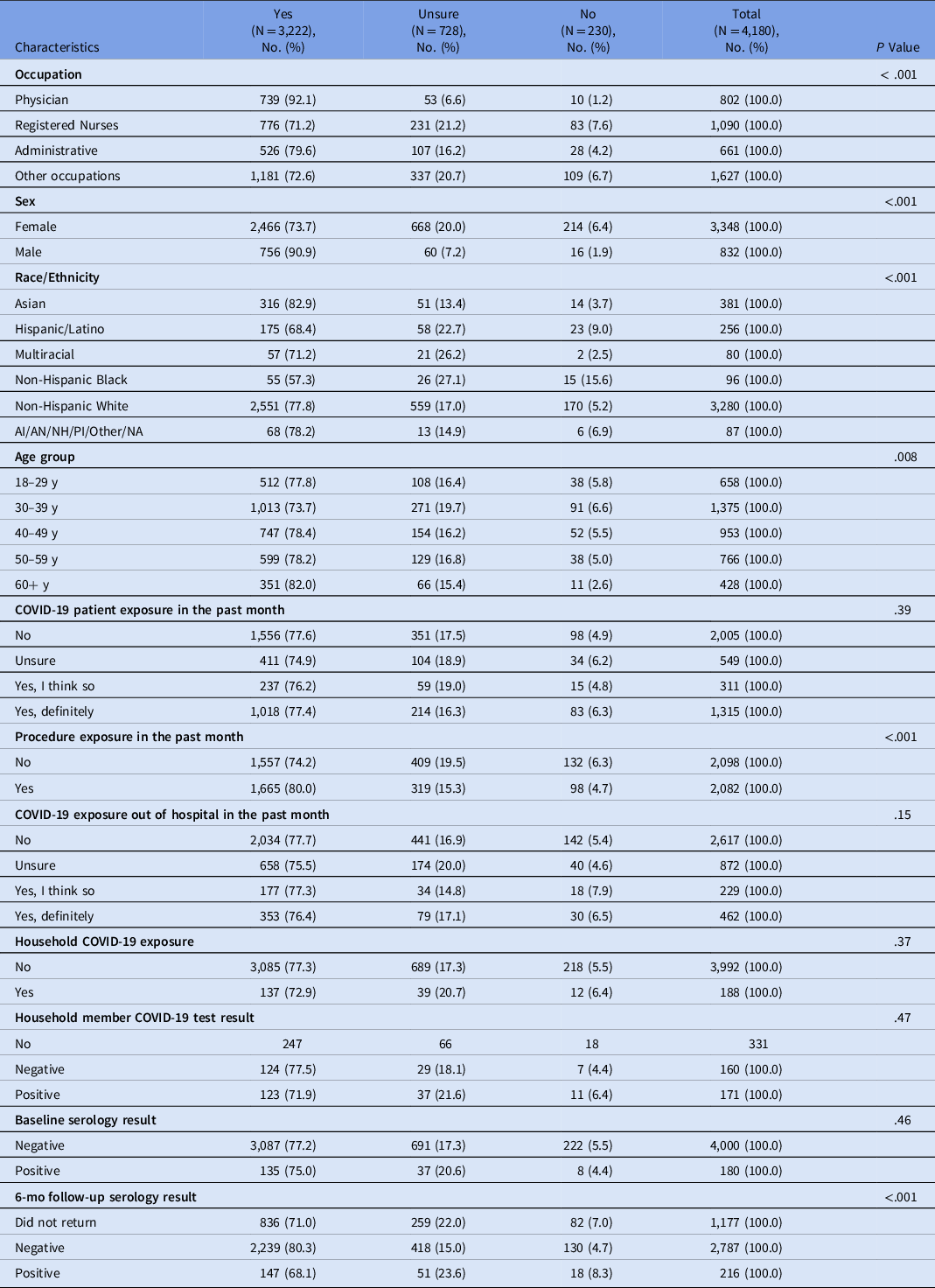
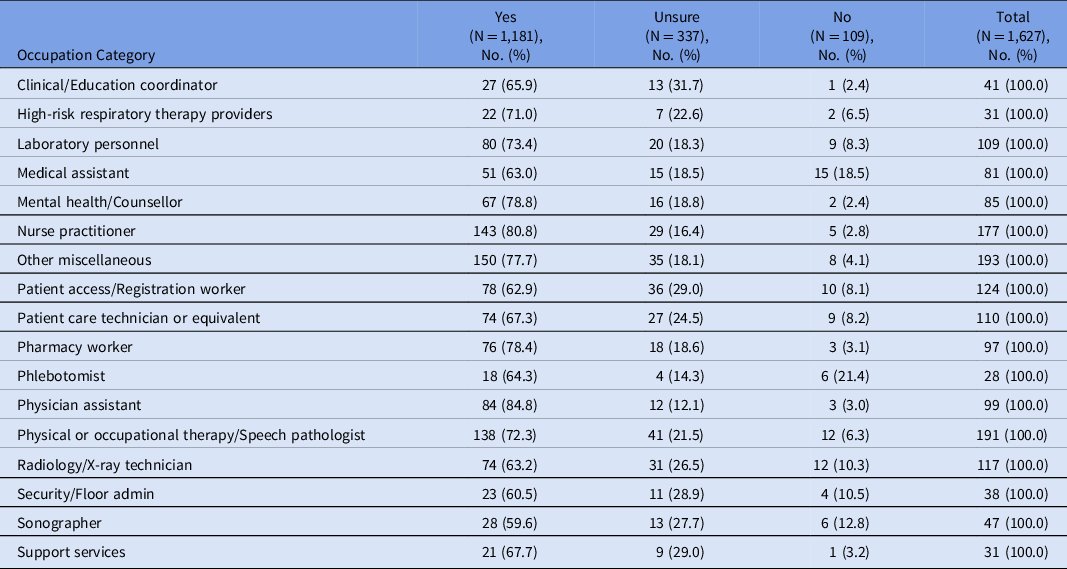
The initial survey (conducted November 25, 2020, through January 9, 2021) with the vaccine intention question was completed by 4,180 HCWs (64.2%) of the 6,510 enrolled in the study. Respondents significantly differed from nonrespondents in occupation, race or ethnicity, age, and seropositivity for SARS-CoV-2 at baseline. A higher proportion of respondents were in administrative roles (15.8% vs 10.4%) and a lower proportion were in nursing roles (26.1% vs 30.2%) compared to nonrespondents (P < .001). Also, there was a higher proportion of non-Hispanic White participants (78.4% vs 68.6%; P < .001) and participants aged ≥50 years (28.6% vs 18.6%; P < .001) in the respondent group versus nonrespondents. Respondents also had a lower prevalence of IgG seropositivity at baseline than nonrespondents (4.3% vs 5.8%; P = .006). Of those who responded, 77.1% indicated that they intended to get the vaccine or had already received the vaccine (23.2%); 17.4% were not sure if they would get the vaccine; and 5.5% reported that they would not get the vaccine. There were significant differences in intention to get vaccinated by occupation, sex, race or ethnicity, age, hospital and community COVID-19 exposures, and participant serology results (Table 1). Table 2 shows the vaccine intentions for the ‘other’ HCW group further categorized by occupation group. Physicians had the highest vaccine intentions (92.1%) whereas nurses (71.2%) and ‘other’ occupation groups (72.6%) had the lowest (P < .001). Women reported lower vaccine intentions than men (73.7% vs 90.9%; P < .001) (Table 1). Asian HCWs had the highest vaccine intentions (82.9%) whereas non-Hispanic Blacks had the lowest (57.3%) (P < .001). Respondents aged 30–39 years had the highest hesitancy, with higher proportions of this age group reporting being unsure or no to intending to get the vaccine (P < .008). Participants reporting being involved in patient care procedures (ie, hemodialysis) reported higher intention to get vaccinated than those who were not involved in these procedures (80.0% vs 74.2%; P < .001).
Healthcare Worker Demographics and Characteristics by Intention to get the COVID-19 Vaccine

Note. AI/AN/NH/PI/Other/NA represents American Indian/Alaska Native/Native Hawaiian/Other Pacific Islander/Other/Did not answer.
Other Occupations by Intention to Get the COVID-19 Vaccine

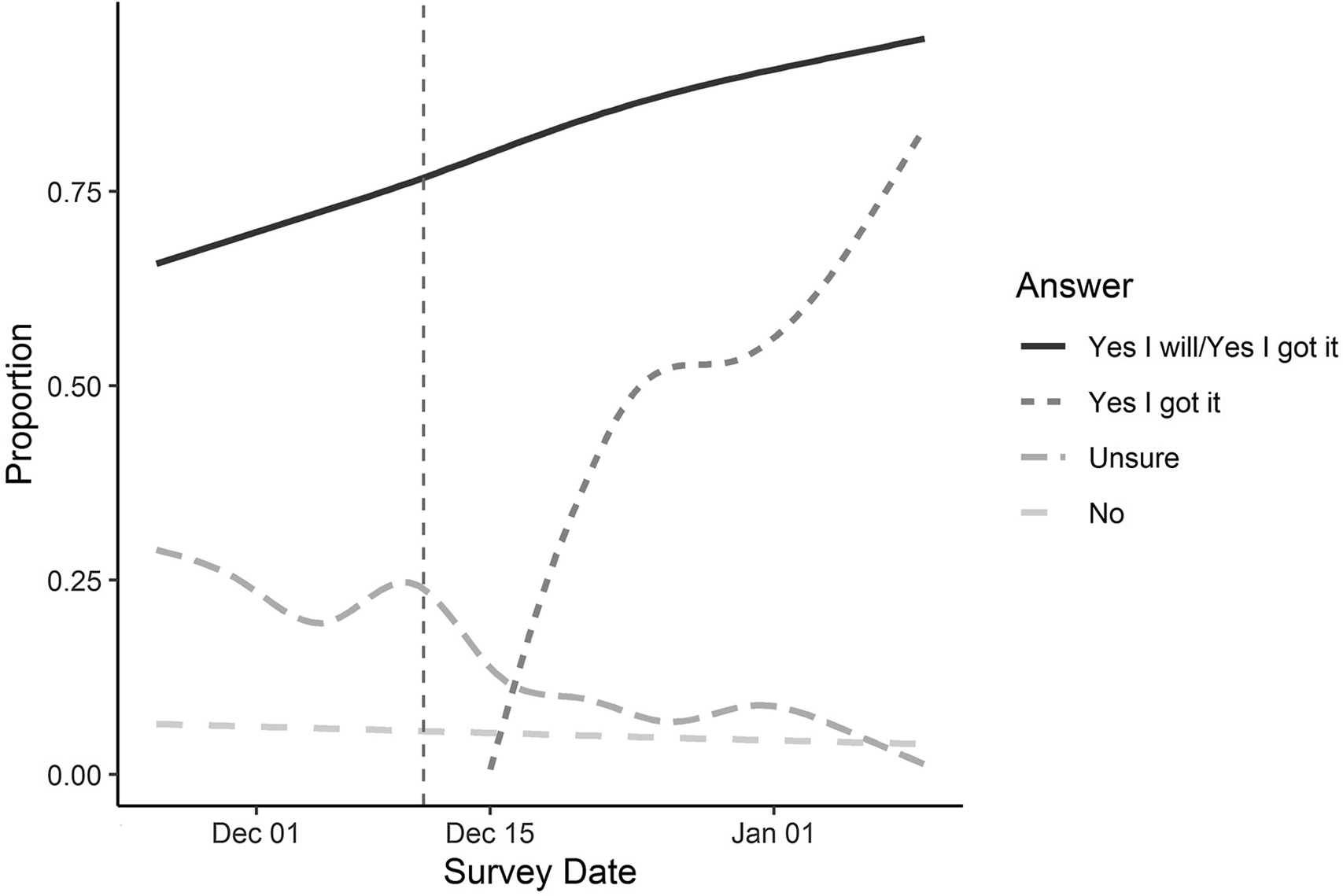
Vaccine intention was higher in HCW participants who completed the survey after the Pfizer and Moderna EUAs than before these EUAs (85.8% vs 70.4%). Before the EUAs, 23.4% of HCWs were unsure about getting the vaccine and 6.2% reported that they would not get the vaccine; after the EUAs, only 9.6% were unsure and 4.6% reported that they would not get the vaccine (Fig. 1).
Participants response to willingness to get vaccinated over time and by timing of first COVID-19 vaccine Emergency Use Authorization (dotted line). 1

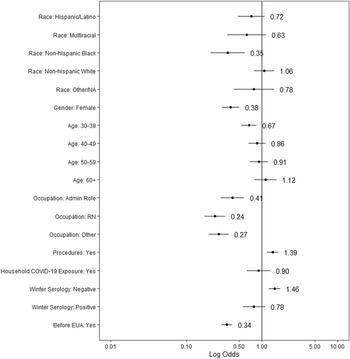
Multivariable logistic regression results are shown in Figure 2. Compared to physicians, several occupations were associated with a lower odds of intending to get the vaccine: nurse (OR, 0.24; 95% CI, 0.17–0.33), administrator (OR, 0.41; 95% CI, 0.28–0.58), or other occupational group (OR, 0.27; 95% CI, 0.20–0.36). Non-Hispanic Black HCWs had lower odds of intending to get the vaccine (vs Asians: OR, 0.35; 95% CI, 0.21–0.59), and women had lower odds of intending to get the vaccine (vs men: OR, 0.38, 95% CI, 0.30–0.50). Participants aged 30–39 years also had lower odds of getting vaccinated (vs <30 years: OR, 0.67; 95% CI, 0.53–0.85). Being exposed to patient procedures (OR, 1.39; 95% CI, 1.16–1.65) or having a negative serology test for SARS-CoV-2 at follow-up (vs no follow-up test: OR, 1.46; 95% CI, 1.24–1.73) increased the odds of vaccination intention. Those participants who completed the survey before the EUAs for vaccines had lower intentions to get vaccinated (OR, 0.34; 95% CI, 0.29–0.41).
Multivariable logistic regression model of the association between willingness to get a COVID-19 vaccine and healthcare worker characteristics, adjusted odds ratios and 95% confidence intervals. Reference groups are race (Asian), sex (male), age (<30 years), occupation (physician), procedures (no exposure), household COVID-19 exposure (no exposure), winter serology (no test), before EUA (no).

At the follow-up survey 4–6 months after vaccination began, of those who completed the survey (n = 3,162), 95.6% had received the vaccine, and there were no significant differences in their characteristics. Most HCWs (90.6%) who had previously been unsure were vaccinated, and 59.7% of those who previously reported no intention of getting vaccinated, also were vaccinated at a later time. Of those who were initially unsure or reported no intention to get vaccinated, there were no significant differences in characteristics between those who eventually were vaccinated by the follow-up survey and those who were not.
Discussion
In this cohort, after COVID-19 vaccines were made available, vaccine intentions were higher among HCWs (77.1%) than estimates from the general US population, which had reached 49% by February 2021 according to the Centers for Disease Control and Prevention (CDC). Reference Razzaghi15 More recently by June 2021, 96% of ‘practicing physicians’ Reference Li, Luo and Watson16 had been fully vaccinated for COVID-19. 17 However, there were considerable differences in intentions across HCW occupational and demographic groups, even after adjustment in multivariable models. Higher vaccine hesitancy rates were observed in groups at higher risk for COVID-19. Most notably, nurses had the lowest intentions of receiving the vaccine even after controlling for demographic and exposure characteristics. These findings are consistent with previous research showing that nurses have lower influenza vaccination rates than physicians, Reference Martinello, Jones and Topal18–Reference Toronto and Mullaney20 as well as recent research showing similarly lower COVID-19 vaccine acceptance among nurses. Reference Dror, Eisenbach and Taiber21 This finding is particularly troublesome because nurses have the highest rates of SARS-CoV-2 infection among HCW groups. Reference Wilkins, Gray and Wallia12 Not only could low vaccine uptake put front line nurses at risk for severe COVID-19 or postinfectious sequelae, but prolonged occupational contact with patients and other HCWs also increases the possibility of spread within healthcare settings. Reference Kwok, Li, Wei, Tang, Wong and Lee22 Further research into the perceptions and beliefs that determine vaccine decision making in nurses is urgently needed. Specific concerns of women and those aged 30–39 years may need to be studied further, as their relative higher hesitancy may be related to age or sex-specific reasons such as reproductive concerns. However, the CDC has recommended COVID-19 vaccination for pregnant women and those planning to get pregnant in 2021. Reference Clark, Cowan and Wortley19,23
Black participants reported 65% lower odds of intention to get vaccinated than Asian participants. This is consistent with other studies examining COVID-19 vaccine intentions and perceptions in Black non-HCW populations early in the vaccine rollout. Reference Reinhart4,Reference Reiter, Pennell and Katz6,Reference Guidry, Laestadius and Vraga24 Higher reporting of being unsure or not being willing to be vaccinated by Black participants, even after controlling for other factors, is concerning due to the disproportionate burden of COVID-19 and severe COVID-19 complications observed in Black people. This study did not assess reasons for vaccine hesitancy or deliberation. Others have found that the fundamental issue of mistrust between the Black community and the broader health system likely undermines vaccine uptake even among HCWs. 23,25 Approaches that address barriers to COVID-19 vaccination in Black and other marginalized communities should be applied. Reference Abdul-Mutakabbir, Casey and Jews26,Reference Ferdinand27
Women also had a lower intention to get vaccinated than men. Other studies have found a similar trend. Reference Reinhart4–Reference Reiter, Pennell and Katz6,Reference Guidry, Laestadius and Vraga24,Reference Fisher, Bloomstone, Walder, Crawford, Fouayzi and Mazor28 Concerns with safety of the vaccine may be of key importance for women, especially for those in their reproductive years. Reference Goncu Ayhan, Oluklu and Atalay29 The CDC now recommends COVID-19 vaccine for pregnant women, Reference Clark, Cowan and Wortley19,30 and although the COVID-19 vaccination trials did not specifically enroll pregnant women, the risk of severe illness and death is elevated for pregnant versus age- and morbidity-matched controls.
Older age was associated with higher intentions to get vaccinated. This trend has been found in some other studies. Reference Reinhart4–Reference Reiter, Pennell and Katz6,Reference Guidry, Laestadius and Vraga24,Reference Fisher, Bloomstone, Walder, Crawford, Fouayzi and Mazor28 People aged ≥65 years are at significant risk for COVID-19 hospitalization and death, and this increased interest in vaccination may reflect recognition by HCWs in this age group of their elevated risk.
Individuals who had negative serology results at follow-up also had higher likelihood of intending to get vaccinated compared to those who had not been tested at follow-up or who were seropositive at follow-up. Those who had positive serology at follow-up did not differ significantly in intention to those who had not been tested at follow-up. These findings suggest differences in perceptions and misperceptions of immunity following natural infection with SARS-CoV-2. Although previous infection provides some short-term and modest immunity, reinfection is a significant risk Reference Lumley, O’Donnell and Stoesser31 and CDC recommends vaccination, regardless of previous SARS-CoV-2 infection.
Previous studies have shown that people were concerned with EUAs for COVID-19 vaccines and in fact, intentions to get vaccinated were lower with an EUA being associated with the vaccine versus a full approval from the FDA. Reference Guidry, Laestadius and Vraga24,Reference Kreps, Prasad and Brownstein32 In this study, completing the survey after the EUA was provided for both the Pfizer and Moderna vaccines was associated with higher intentions to be vaccinated. Several factors may explain the findings of this study that, in many places, COVID-19 rates were increasing during this period due to a ‘Thanksgiving surge.’ In addition, the widely reported high vaccine effectiveness associated with the Pfizer and Moderna vaccines introduced a level of excitement reflecting the published study results and the growing recognition that this measure was more effective than behavioral prevention measures (mask, social distancing) for reducing risk at work and home and ending the pandemic. Finally, while not as persuasive as full approval, the EUA may have encouraged some HCWs who had previously been hesitant.
Efforts to get HCWs vaccinated in this healthcare system included a tiered system of getting those deemed at most risk (ie, occupational groups working in COVID-19 units) vaccinated first, using e-mail outreach and education fliers across the system, and vaccine availability at all work sites. These findings may have supported the increased vaccine uptake over time, with 90% of HCWs eventually getting vaccinated, including most of those who were initially unsure about getting vaccinated. Tush, minds can be moved to increase uptake. This change over time is particularly important to inform ongoing work, considering that the uptake of vaccine has slowed in the United States and certain communities have shown decreased uptake.
Our study had some limitations. We did not assess reasons for vaccine hesitancy, and despite the HCW sample’s diversity, those who participated differed from our larger enrolled cohort. However, our cohort was comparable to the overall US healthcare workforce in age and sex but had a smaller proportion of Black and Hispanic HCWs. 33 Also, the sample was large and represented HCWs located across a large metropolitan and suburban area whom we followed longitudinally as the vaccines were introduced and evidence in effectiveness and safety continued to emerge.
Despite the risk of exposure and the significant health impact of COVID-19, some hesitancy remained at the start of vaccination availability after the EUA. However, with access and time, vaccination increased. These findings strongly support the public health importance of consistent, accurate messaging about the efficacy and safety of the vaccine, which are tailored to the targeted populations. Although women, those aged 30–39 years, and Black participants had lower intentions of getting vaccinated early in the vaccine rollout, progress (increasing vaccination intention prevalence) was seen in these groups over time. Understanding how messaging and other factors including mistrust of the healthcare system and inclusion in research can affect perception and uptake in these groups is important to develop effective interventions now and in the future. To achieve this goal, participatory research is needed with HCWs to understand how more effective messaging can be developed and how to address underlying mistrust of the healthcare system generally and vaccines specifically.
Acknowledgments
The opinions, results and conclusions reported are those of the authors. No endorsement by Northwestern Medicine or any of its funders or partners is intended or should be inferred.
Financial support
This work was supported by the Northwestern University Clinical and Translational Sciences Institute and the Northwestern Memorial Foundation.
Conflicts of interest
All authors report no conflicts of interest relevant to this article. Research funding support was received from Novo Nordisk, Eli Lily, United Healthcare Group (A.W.); consulting fees were received from BioK+ (C.T.E.).