Introduction
Follicular development is mainly regulated by FSH, LH and ovarian steroid hormones (LaVoie, Reference LaVoie2017), resulting at ovulation in the release of oocytes competent to be fertilized and potentially capable of supporting embryo development. Members of the transforming growth factor β (TGFβ) superfamily, which are secreted by follicular cells and oocytes, play relevant roles in the folliculogenesis of mammals (Juengel and McNatty, Reference Juengel and McNatty2005; Gilchrist et al., Reference Gilchrist, Lane and Thompson2008). Among them, the bone morphogenetic protein 15 (BMP15), the growth and differentiation factor 9 (GDF9) and their receptors are involved in key events, such as proliferation and differentiation of follicular cells, steroidogenesis, ovulation and luteinization (Su et al., Reference Su, Sugiura, Wigglesworth, O’Brien, Affourtit, Pangas, Matzuk and Eppig2008; Orisaka et al., Reference Orisaka, Jiang, Orisaka, Kotsuji and Tsang2009; Peng et al., Reference Peng, Yang, Wang, Tong and Guo2010). Moreover, BMP15 is involved in regulating the apoptosis of cumulus oophorous cells (Zhai et al., Reference Zhai, Liu, Li, Dai, Gao, Li, Zhang, Ding, Yu and Zhang2013).
In sheep, increased ovulation rates occurred after a short period of immunization against BMP15 and GDF9, but there were no effects on oocyte fecundation, embryo development and pregnancy rates (Juengel et al., Reference Juengel, Hudson, Whiting and McNatty2004). In contrast, prolonged immunization against the same proteins impaired follicular development (McNatty et al., Reference McNatty, Hudson, Whiting, Reader, Lun, Western, Heath, Smith, Moore and Juengel2007). Conversely, in swine, expression of bone morphogenetic protein receptor type 1B (BMPR1B) was positively correlated with plasma oestradiol levels (Paradis et al., Reference Paradis, Novak, Murdoch, Dyck, Dixon and Foxcroft2009), contradicting data for cattle (Gasperin et al., Reference Gasperin, Ferreira, Rovani, Bordignon, Duggavathi, Buratini, Oliveira and Gonçalves2014). Therefore, in addition to known species-specific differences, the regulation and function of local oocyte factors during folliculogenesis in multi-ovulatory species still needs to be further investigated.
Among the enzymes involved in the synthesis of steroid hormones during folliculogenesis, the cytochrome P450 family 11 subfamily A member 1 (CYP11A1) converts cholesterol to pregnenolone (Hanukoglu, Reference Hanukoglu1992). The cytochrome P450 family 19 subfamily A member 1 (CYP19A1) is responsible for synthesizing oestrogen from androgens in granulosa cells (Tosca et al., Reference Tosca, Crochet, Ferré, Foufelle, Tesseraud and Dupont2006; Kandiel et al., Reference Kandiel, Watanabe and Taya2010). At ovarian level, both such enzymes act during follicular atresia and luteogenesis in different species (Albrecht and Daels, Reference Albrecht and Daels1997; Bao and Garverick, Reference Bao and Garverick1998; Pan et al., Reference Pan, Zhang, Lin, Ma, Wang and Liu2012): CYP19A1 regulates oestrogen production and decreases during early atresia; whereas CYP11A1 increases progesterone levels. After the preovulatory LH surge, expression of CYP11A1 rises quickly, while expression of CYP19A1 declines drastically (Wissing et al., Reference Wissing, Kristensen, Andersen, Mikkelsen, Høst, Borup and Grøndahl2014), resulting in decreased oestrogen circulating levels and accelerated synthesis of progesterone (Lydon et al., Reference Lydon, DeMayo, Funk, Mani, Hughes, Montgomery, Shyamala, Connelly and O’Malley1995).
Female swine would be a suitable experimental model to study folliculogenesis in multi-ovulatory species, as they release dozens of oocytes during ovulation, allowing the evaluation of many oocyte factors. To our knowledge, there has been only one study evaluating the regulation of members of the TGF superfamily during follicular development in weaned primiparous sows, which received no previous gonadotrophin treatment (Paradis et al., Reference Paradis, Novak, Murdoch, Dyck, Dixon and Foxcroft2009). Furthermore, BMP receptor (BMPR-1A, BMPR-1B and BMPR-2) proteins were immunohistochemically detected in granulosa cells from primordial to antral follicles in ovaries from fetal, prepubertal gilts and cyclic females (Quinn et al., Reference Quinn, Shuttleworth and Hunter2004). However, the regulation of BMPRs has not yet been evaluated in prepubertal swine females. Therefore, we hypothesized that steroidogenic enzymes, members of the TGFβ superfamily and their receptors were regulated differentially after gonadotrophin treatment in prepubertal gilts, according to changes in the endocrine environment. The objective of this study was to evaluate the effect of exogenous gonadotrophin treatments (eCG or eCG + hCG, to simulate the endocrine profiles observed during the final follicular growth and ovulation, respectively) on the expression of steroidogenic enzymes and of TGFβ superfamily members in prepubertal gilts.
Materials and methods
Samples were obtained from 24 prepubertal gilts from a commercial farm, that were housed in finishing barns and destined to slaughter. Those gilts were randomly assigned to three treatments (n = 8 each). As the control group was designed to be representative of the physiological prepubertal endocrine profile, gilts in such group received no treatment. In the eCG group, gilts were treated with 1200 IU eCG (Folligon®, MSD Animal Health), injected intramuscularly (I.M.), 3 days prior to the scheduled date of slaughter (D −3). In the eCG + hCG group, gilts received I.M. injections of 1200 IU eCG (Folligon), 6 days before slaughter (D −6) and of 500 IU hCG (Chorulon®, MSD Animal Health) at D −3, that is 60 h before slaughter (D0). The eCG and hCG doses were determined based on previous studies using prepubertal gilts (Ziecik et al., Reference Ziecik, Biallowicz, Kaczmarek, Demianowicz, Rioperez, Wasielak and Bogacki2005; Bordignon et al., Reference Bordignon, El-Beirouthi, Gasperin, Albornoz, Martinez-Diaz, Schneider, Laurin, Zadworny and Agellon2013, Małysz-Cymborska et al., Reference Małysz-Cymborska, Ziecik, Waclawik and Andronowska2013). At the time of slaughter, gilts were 130 days old and weighed 100 kg, on average.
At slaughter (D0), a blood sample and both ovaries were collected from each gilt and transported to the laboratory within a maximum of 2 h, in a thermal box at 5°C. Blood samples were centrifuged at 3000 g for 10 min. The serum was split into two aliquots and stored at −20°C. Duplicate serum samples were sent to a commercial laboratory to determine oestradiol and progesterone concentrations, through electrochemiluminescence. Oestradiol levels were quantified using the Elecsys Estradiol III Cobas Assay (Roche Diagnostics, Mannheim, Germany; REF 06656021). Progesterone levels were quantified using the Elecsys Progesterone III Cobas Assay (Roche Diagnostics, Mannheim, Germany; REF 07092539). Although both kits were for human serum, they were validated for multispecies, with intra- and inter-assay coefficient of variability lower than 10%. To validate the achievement of the desired endocrine profile, one gilt from the control group and two gilts from the eCG group were removed from the experiment because they presented progesterone levels above 3.0 ng/ml, which are likely to indicate the occurrence of previous ovulations.
From the ovaries, follicular cells from follicles greater than 4 mm diameter were aspirated with a 19G needle attached to a vacuum pump (theca and granulosa cells were not separated). After sedimentation, the aspirates were placed in Petri dishes for collection of cumulus–oocyte complexes (COCs) in a binocular stereomicroscope (Meiji Techno®). The content was centrifuged at 8000 g for 6 min, to separate follicular cells from the fluid. Samples of follicular cells and COCs were stored at −196°C.
The total RNA was extracted from follicular cells with TRIzol® (Invitrogen), according to the manufacturer’s guidelines. The extracted RNA was quantified using a NanoDrop® spectrophotometer (Thermo Scientific) with 260 nm wavelength. The purity of the extracted RNA was evaluated by the absorption rate of the OD260/OD280 ratio, standardized to values equal or greater than 1.8. Residues of contaminant DNA were digested by treating the total RNA with DNase (Promega) at 37°C for 5 min. After inactivating the DNase at 65°C for 10 min, the reverse transcription reaction was conducted using the iScriptc® DNA synthesis kit (Bio-Rad), following the manufacturer’s recommendations. Relative gene expression was evaluated through real-time PCR (CFF 384®, Bio-Rad) for steroidogenic enzymes (CYP19A1, CYP11A1), gonadotrophin receptors (FSHR and LHCGR) and members of the TGFβ superfamily (GDF9, BMP15, TGFβR1, BMPR2, BMPR1A and BMPR1B). The variability in the amount of mRNA was corrected by amplification of the reference genes GAPDH and Cyclophilin. All evaluated genes and respective primer sequences are shown in Table 1.
Genes and sequence of initiators

For statistical analyses, all response variables of interest were checked for normality using the Shapiro–Wilk test. Due to lack of normality, the serum P4 levels and the mRNA relative abundance for BMPR1B were transformed to the logarithmic scale. Responses were compared among treatments through analyses of variance, with comparisons of means using the Tukey test (Statistix®, 2013).
Results
As expected, progesterone serum levels in the eCG + hCG group were two-fold greater (P < 0.01) compared with the control and with the eCG group (Fig. 1). However, oestradiol serum levels did not differ among treatments (P > 0.05).
Serum levels of progesterone (A) and oestrogen (B) in prepubertal gilts with distinct endocrine profiles controlled by treatment with gonadotrophins. Control (n = 7): no treatment; eCG (n = 6): 1200 IU eCG at D −3; eCG + hCG (n = 8): 1200 IU eCG at D −6 + 500 IU hCG at D −3 (60 h before slaughter). a,bMeans ± standard error of the mean (SEM) with distinct superscripts differ by at least P < 0.01.

Gilts from the eCG group presented greater relative expression of CYP19A1 in follicular cells (P < 0.05) than gilts from the other groups. The relative expression of CYP19A1 did not differ for gilts in the control and in the eCG + hCG groups (P > 0.05). The mean expression of CYP11A1 mRNA was numerically greater in eCG-treated gilts than in control gilts and bordered significance (P = 0.08) (Fig. 2), but no additional differences were observed among groups (P > 0.05).
Relative abundance of mRNA for CYP19A1 (A) and CYP11A1 (B) in follicular cells of prepubertal gilts with distinct endocrine profiles controlled by treatment with gonadotrophins. Control (n = 7): no treatment; eCG (n = 6): 1200 IU eCG at D −3; eCG + hCG (n = 8): 1200 IU eCG at D −6 + 500 UI hCG at D −3 (60 h before slaughter). a,bMeans ± standard error of the mean (SEM) with distinct superscripts differ by at least P < 0.05. x,yMeans ± SEM with distinct superscripts differ by P = 0.08.

In the control, the relative expression of BMPR1B in follicular cells was greater (P < 0.05) than that observed in the eCG + hCG group (Fig. 3). The expression of BMPR1B in the eCG group did not differ from that observed in the other groups (P > 0.05).
Relative abundance of mRNA for BMPR1B in follicular cells of prepubertal gilts with distinct endocrine profiles controlled by treatments with gonadotrophins. Control (n = 7): no treatment; eCG (n = 6):1200 IU eCG at D −3; eCG + hCG (n = 8): 1200 IU eCG at D −6 + 500 UI hCG at D −3 (60 h before slaughter). a,bMeans ± standard error of the mean (SEM) with distinct superscripts differ by at least P < 0.05.

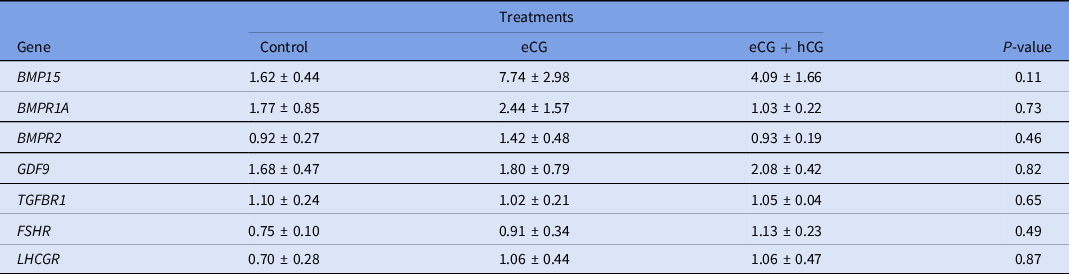
No differences in the expression of BMP15, BMPR1A, BMPR2, FSHR, LHCGR, GDF9 and TGFBR1 (P > 0.05) were observed across groups (Table 2).
Relative abundance of mRNA of genes related to members of the TGFβ superfamily and gonadotrophin receptors in follicular cells of prepubertal gilts with distinct endocrine profiles controlled by treatments with gonadotrophins a

a Control (n = 7): no treatment; eCG (n = 6): 1200 IU eCG at D −3; eCG + hCG (n = 8): 1200 IU eCG at D −6 + 500 UI hCG at D −3 (60 h before slaughter).
Discussion
The expression of CYP19A1 in follicular cells was greater for gilts treated with eCG than for those either treated with the eCG + hCG combination or untreated. CYP19A1 is more abundant in preovulatory follicles, as a marker of terminal differentiation of granulosa cells (Estienne et al., Reference Estienne, Pierre, di Clemente, Picard, Jarrier, Mansanet, Monniaux and Fabre2015). As the aromatase activity in granulosa cells during steroidogenesis is positively influenced using FSH (Słomczyńska et al., Reference Słomczyńska, Szołtys, Duda, Sikora and Tabarowski2003), the expression of CYP19A1 may decrease with declined FSH concentration (Wang et al., Reference Wang, Chen, Li, Wang, Zhang, He, Wang, Zhao, Zhang and Xu2011; Grzesiak et al., Reference Grzesiak, Knapczyk-Stwora, Duda and Słomczyńska2012), as indicated by our findings. Increased relative expression of CYP19A1 was also observed in granulosa cells of mice treated with eCG (Samardzija et al., Reference Samardzija, Pogrmic-Majkic, Fa, Glisic, Stanic and Andric2016). Conversely, initial antral follicles of swine present low (although detectable) levels of mRNA of CYP19A1 (Słomczyńska and Tabarowski, Reference Słomczyńska and Tabarowski2001), indicating a limited capacity of oestrogen production. Additionally, after treatment with eCG in the present study, gilts presented increased expression of CYP11A1, which processes cholesterol into pregnenolone, a precursor of all steroid hormones (Mast et al., Reference Mast, Annalora, Lodowski, Palczewski, Stout and Pikuleva2011) that is commonly increased as follicles mature (Gillio-Meina et al., Reference Gillio-Meina, Hui and LaVoie2005). Nonetheless, the increased expression of CYP11A1 observed in the present study, although substantial, was only marginally significant, and is likely to be due to sample size limitations. In contrast with our results, eCG treatment in rats was followed by reduced expression of CYP11A1 in granulosa cells (Samardzija et al., Reference Samardzija, Pogrmic-Majkic, Fa, Glisic, Stanic and Andric2016). However, in this study, hCG was administered 40–48 h after eCG treatment and samples were collected at various subsequent periods, which may account for such a discrepancy. The fact that the hCG treatment downregulated CYP19A1 in the eCG + hCG group, compared with the eCG treatment, was expected because this enzyme is downregulated by the GnRH/LH surge or by hCG during the luteinization process in cattle (Ndiaye et al., Reference Ndiaye, Fayad, Silversides, Sirois and Lussier2005) and gilts (Sriperumbudur et al., Reference Sriperumbudur, Zorrilla and Gadsby2010). Furthermore, in cattle, both CYP19A1 and CYP11A1 are downregulated in preovulatory follicles after hCG-induced ovulation (Ndiaye et al., Reference Ndiaye, Fayad, Silversides, Sirois and Lussier2005). Therefore, our data suggested that eCG alone upregulated, whereas hCG downregulated, the eCG-induced expression of both enzymes during the ovulation/luteinization process. That could explain why an intermediate expression of CYP11A1 was observed in the eCG + hCG group.
Ovulation is influenced by endocrine and paracrine processes involving local growth factors secreted by granulosa cells and growing oocytes (Manabe et al., Reference Manabe, Goto, Matsuda-Minehata, Inoue, Maeda, Sakamaki and Miyano2004). In the TGFβ superfamily, BMPs are involved in several actions related to apoptosis and steroidogenesis (Zhao et al., Reference Zhao, Li, Wang, Chen, Yu, Wang and Xu2014) and linked to the TGFβR1 receptor, which is potentially related to the selection and maintenance of the preovulatory oocyte population in swine ovaries (Foxcroft et al., Reference Foxcroft, Silva and Paradis2016). Although, gonadotrophin treatment used in the present study did not alter the relative expression of some TGFβ members across distinct endocrine profiles, this may have occurred because both BMP15 and GDF9 are expressed at all stages of the oestrous cycle (Su et al., Reference Su, Sugiura, Wigglesworth, O’Brien, Affourtit, Pangas, Matzuk and Eppig2008; Orisaka et al., Reference Orisaka, Jiang, Orisaka, Kotsuji and Tsang2009; Peng et al., Reference Peng, Yang, Wang, Tong and Guo2010). Our results corroborated reports of lack of effect of GDF9 regulation in the growth of cattle follicles (Haas et al., Reference Haas, Rovani, Oliveira, Vieira, Bordignon, Gonçalves, Ferreira and Gasperin2016), although BMP15 may be more relevant during the periovulatory period than at other stages of the oestrous cycle in swine (Paradis et al., Reference Paradis, Novak, Murdoch, Dyck, Dixon and Foxcroft2009). Data for cattle indicated that granulosa cells of small follicles (3–6 mm) may be more sensitive to the effects of GDF9 on their proliferation and on steroidogenesis (Spicer et al., Reference Spicer, Aad, Allen, Mazerbourg, Payne and Hsueh2008). Nevertheless, although the abundance of mRNA for TGβR1 is positively correlated with follicular size (Paradis et al., Reference Paradis, Novak, Murdoch, Dyck, Dixon and Foxcroft2009), no effect was observed after gonadotrophin treatment in the present study.
In the present study, expression of BMPR1B was greater in control gilts than in those treated with eCG + hCG. This result contradicts a study that reported greater expression of BMPR1B in large porcine follicles (more common as follicular development advances) than in intermediate and small follicles (Zhao et al., Reference Zhao, Li, Wang, Chen, Yu, Wang and Xu2014). However, in this study, ovaries were collected at slaughterhouses from females with unknown endocrine profiles. However, the findings of the present study agreed with reports of greater expression of BMPR1B in granulosa cells of atretic cattle follicles than in healthy dominant follicles (Gasperin et al., Reference Gasperin, Ferreira, Rovani, Bordignon, Duggavathi, Buratini, Oliveira and Gonçalves2014). BMPR1B is a type-I receptor present in granulosa cells of ewes (Wilson et al., Reference Wilson, Wu, Juengel, Ross, Lumsden, Lord, Dodds, Walling, McEwan, O’Connell, McNatty and Montgomery2001) and sows (Wilson et al., Reference Wilson, Wu, Juengel, Ross, Lumsden, Lord, Dodds, Walling, McEwan, O’Connell, McNatty and Montgomery2001; Quinn et al., Reference Quinn, Shuttleworth and Hunter2004), that plays a relevant role in the signalling of some transforming growth factors (TGFs) (Lavery et al., Reference Lavery, Swain, Falb and Alaoui-Ismaili2008), in proliferation and differentiation of granulosa cells (Edson et al., Reference Edson, Nalam, Clementi, Franco, Demayo, Lyons, Pangas and Matzuk2010) and in follicular development (Reader et al., Reference Reader, Haydon, Littlejohn, Juengel and McNatty2012). These findings suggested that decreased regulation of BMPR1B is likely to be necessary for ovulation, although understanding its regulation in distinct stages of folliculogenesis in pigs still requires further research.
The presence of receptors for FSH and LH in follicular cells at different stages of the oestrous cycle suggests that these follicles are sensitive to gonadotrophins. FSHR may be detected in granulosa cells of small follicles during the oestrous cycle (Liu et al., Reference Liu, Aronow, Witte, Pope and La Barbera1998), and is likely to aid follicular development and steroidogenesis (Bramble et al., Reference Bramble, Goldstein, Lipson, Ngun, Eskin, Gosschalk, Roach, Vashist, Barseghyan, Lee, Arboleda, Vaiman, Yuksel, Fellous and Vilain2016). Antral follicles can also contain detectable mRNA for LHCGR in the theca (Yuan and Lucy, Reference Yuan and Lucy1996). Although the LHCGR is confined to the external thecal layer and to mural granulosa cells, LH initiates a cascade of events that also affects cumulus oophorous cells and oocytes (Park et al., Reference Park, Su, Ariga, Law, Jin and Conti2004; Hsieh et al., Reference Hsieh, Lee, Panigone, Horner, Chen, Theologis, Lee, Threadgill and Conti2007). After the LH surge, the abundance of LHCGR mRNA declines in preovulatory follicles, concurrently with a decrease in oestradiol levels as luteinization starts after ovulation (Agca et al., Reference Agca, Ries, Kolath, Kim, Forrester, Antoniou, Whitworth, Mathialagan, Springer, Prather and Lucy2006). In cattle, expression of LHCGR mRNA was not observed in follicular cells of heifers, but was detected in similar cells of adult cows, only in large follicles with diameter of at least 8 mm (Simões et al., Reference Simões, Satrapa, Rosa, Piagentini, Castilho, Ereno, Trinca, Nogueira, Buratini and Barros2012). In the present study, the distinct endocrine profiles induced by gonadotrophin treatment did not affect the expression of both FSHR and LHCGR. This may be because these genes are more regulated in ovaries of adult females than in those of prepubertal females, which may present neither large follicles nor evidence of corpora lutea (Du et al., Reference Du, Zhang, Li, Pan, Liu and Li2016). It is also important to consider that the evaluation of mRNA expression of gonadotrophin receptors may have limited value because it does not necessarily reflect the amount of synthesized protein or the functionality of receptors, especially for LHCGR, which has several splice variants (Nogueira et al., Reference Nogueira, Buratini, Price, Castilho, Pinto and Barros2007).
The only detectable change in the serum levels of steroid hormones occurred for progesterone, which was increased for gilts from the eCG + hCG group. This could be expected, as progesterone levels normally increase after the LH surge (Parvizi et al., Reference Parvizi, Elsaesser, Smidt and Ellendorff1976), suggesting that some gilts are either ovulated or present luteinized follicles at the time of slaughter. These findings validate the model used in the present study, as gilts in other groups retained basal progesterone levels, consistent with both the prepubertal and the proestrus endocrine profiles. Although low serum oestradiol levels would be expected in prepubertal females (Esbenshade et al., Reference Esbenshade, Paterson, Cantley and Day1982), these levels did not differ among gilts in the three evaluated endocrine profiles and may reflect the fact that these gilts did not express oestrus behaviour prior to their slaughter.
In conclusion, the relative expression of steroidogenic enzymes CYP19A1 and CYP11A1 increased in prepubertal gilts following treatment with eCG. A decline in the expression of BMPR1B may precede ovulation, as it occurred in gilts after treatment with eCG and hCG, along with raised serum progesterone levels.
Financial support
FAPERGS: Grant #16/2551-0000494-3 – Pronex 12/2014. CNPq: Grant #309138/2017-5 to B.G. Gasperin; Grant #303559/2015-2 to T. Lucia Jr. The authors thank Microvet, Microbiologia Veterinária especially for the financial support for V. Hoyos-Marulanda.
Conflict of interest
The authors declare no conflict of interest.
Ethical standards
All procedures were approved by the Ethics in Animal Experimentation Committee of the Universidade Federal de Pelotas (process #39970).