Introduction
The National Institute for Health and Clinical Excellence (NICE) was set up in 1999 to enhance the use of evidence and social values in health care policy and practice across the English and Welsh National Health Service (NHS).Footnote 1 Over the years, NICE's remit has grown to include public health (Littlejohns and Kelly, Reference Littlejohns and Kelly2005) and, more recently, quality standards in health and social care to help drive payers’ and providers’ performance, ensure accountability and guide monetary incentives and penalties.Footnote 2 However, NICE's Health Technology Appraisals continues to be the most controversial of its programmes, deciding which technologies (mostly new drugs) merit reimbursement within the NHS and which do not represent good value for money and should therefore not be covered (Steinbrook, Reference Steinbrook2008). And while NICE tends to say ‘yes’ almost 90% of the time, a lot more often than equivalent agencies in Australia and Canada (Clement et al., Reference Clement, Harris, Li, Yong, Lee and Manns2009), it is the few negative or restrictive decisions that generate heated debate in the national and international press, among professionals and patient organisations and, occasionally, in the country's parliament.
This article discusses how the United Kingdom has tried to handle the pressure of paying for expensive cancer drugs for patients with incurable diseases [also referred to here as end-of-life (EOL) drugs], through its resource-constrained tax-funded system without undermining the NHS's core principles of equity and efficiency. NICE's role has been central in managing this tension, though, it may be that, in the future, the arrangements for pricing and accessing medicines may change, as set out in the government's proposals for Value-Based Pricing.Footnote 3 Either way, the battle to balance equity and efficiency with access and, oftentimes, industrial policy, is far from over.
Social values and opportunity costs
We are not trying to be unkind or cruel. We are trying to look after everybody.
Sir Michael Rawlins, chairman, NICE, quoted in Steinbrook (Reference Steinbrook2008)
Since its early days, NICE has been conscious of the importance of eliciting and incorporating society's values on health and treatment, in its decision-making process: “underlying all [NICE's] decisions is one fundamental social value judgement: that advice from NICE to the NHS should embody values that are generally held by the population that the NHS serves” (Rawlins and Culyer, Reference Rawlins and Culyer2004). As NICE's operations and decisions became increasingly public, setting up a mechanism for eliciting these principles and then incorporating them into the decision-making process, was seen as a priority. As a result, NICE set up its Citizens’ Council to debate societal views on broad questions including several directly or indirectly linked to EOL care, such as its very first report on how NICE ought to define clinical need (2002), whether the Institute should adopt a ‘rule of rescue’ as a criterion in its deliberations (2006), the role of disease severity in making decisions (2008) and, most recently, the criteria which ought to justify deviating from NICE's cost-effectiveness threshold range (2009)Footnote 4 (Rawlins, Reference Rawlins2005). Drawing on the Council's deliberations, NICE has developed a Social Value Judgements Guideline for its decision-making committees; this is a list of principles all committee members joining NICE have to read and ensure they incorporate, when making their recommendations. In this document, the importance of a population level perspective comes across strongly: “NICE recognises that when it is making its decisions it should consider the needs of present and future patients of the NHS who are anonymous and who do not necessarily have people to argue their case on their behalf”.Footnote 5 It is perhaps because of this strong commitment to ‘looking after everybody’, a principle consistent with the core NHS value of solidarity, that NICE has avoided adopting a ‘rule of rescue’ and has insisted on the principle of a “QALY is a QALY is a QALY” in the Reference Case for economic evaluation.Footnote 6
At the same time, however, even if not through a mathematical formula carrying differential weights, which can be methodologically and informationally challenging, NICE's committees regularly depart from this principle. NICE's decision makers seek to incorporate in their decisions values reflected in the United Kingdom and EU legislation, in the views of the Citizens’ Council's and in the feedback from expert patients and professionals that regularly engage in the guidance development process. It is for this reason NICE recommended, despite its poor value for money, pemetrexed for mesothelioma, a cancer of the lungs affecting those exposed to asbestos while working in the mines and shipyards in the 1960s and 1970s before the toxic substance was banned in the United Kingdom. Similarly, NICE recommended that the NHS pays for imatinib for the blast phase of chronic myeloid leukaemia for any patients not having been offered this drug before their disease progressed. While at a cost per quality-adjusted life year (QALY) of about £40 k, almost twice NICE's threshold (the cost per QALY below which the agency considers a technology to be good value for money), the committee felt that patients reaching this advanced stage without having had the chance to try imatinib before, ought to be given this opportunity, despite the low chance of the drug being beneficial at this late stage of the disease (hence its high cost per QALY). These cases suggest that NICE's decision-making committees can consider both the severity of a condition (mesothelioma and chronic myeloid leukaemia (CML)) and also how patients reach a terminal illness (occupational hazard and possible omission in care, respectively) in their deliberations, in order to justify deviations from NICE's conventional cost-effectiveness acceptability range of £20–30,000 per QALY (Rawlins and Culyer, Reference Rawlins and Culyer2004).
But these were decisions left to the committee's discretion, the idea being a case law would gradually develop to guide future committee decisions and ensure the consistency of the process and its outcomes. Indeed, there are no official NICE analyses of such deviations from the threshold range and the underpinning rationale, other than a few publications analysing select cases (Rawlins et al., Reference Rawlins, Barnett and Stevens2010; Shah et al., Reference Shah, Cookson, Culyer and Littlejohns2011). Instead, the Institute relies on the collective experience of its Committee members, the case studies of its individual decisions and deliberations, all available on its website, as well as on the consultation process and on appeals all contributing to a NICE case law. Compared with explicit decision rules or mathematical formulas, such a casuistical approach does not pretend to be scientific and may be harder to manipulate by stakeholder groups, at least when coupled with a strong conflict of interest code for committee members and NICE staff.Footnote 7 Case law allows the values of the committee members themselves to be debated and inform the final decision rather than reducing the whole process to a mathematical modelling exercise. Without the methodology nor the empirical data to build the perfect, discretion-free decision-making model, case law and deliberation based on independent, transparent, consultative and contestable processes, emerged as NICE's preferred method for reaching realistic and implementable recommendations (Pearson and Rawlins, Reference Pearson and Rawlins2005).
Top-ups and the EOL drugs debate
[Mr Alan Johnson, Secretary of State for Health] declined to disclose specifics of how the new top-up payments scheme would work – saying only that he had opened a “Pandora's box”.
Alan Johnson, Secretary of State for Health (Winnett, Reference Winnett2008)
As the NHS turned 60, in the summer of 2008, the so-called ‘top-up’ debate was at its peak. Faced with decisions by NICE and Primary Care Trusts (PCTs) to restrict access to some expensive drugs for advanced cancer on the grounds that they failed the cost-effectiveness test, some patients argued they should be allowed to supplement the costs of their own care by paying for these drugs out-of-pocket, while continuing to receive all other care associated with their treatment free from the NHS. Government strongly opposed the possibility of such topping-up practices, arguing that they would be in “direct contravention with the principles and values of the NHS” (Lawrance, Reference Lawrance2008). Not everybody agreed: individual patients and their families started challenging their local PCTs and an alliance of UK physicians, generally unhappy with the tax-funded publicly provided British health care model, started raising money for a judicial review of the government's decision to ‘outlaw’ top-ups (Faden et al., Reference Faden, Chalkidou, Appleby, Waters and Leider2009). Under mounting pressures the Department of Health appointed the National Clinical Director for Cancer, Professor Mike Richards, to review the existing policy.
According to the Richards report, the solution to the problem of expensive cancer drugs was not going to be a radical change in the NHS's topping-up policy. The existing policy of separating public from private care was in fact made clearer and further reinforced. Instead, the report recommended that NICE says ‘yes’ more and faster using flexible value-based pricing and patient access schemes and, most importantly, that NICE demonstrates ‘greater flexibility’ when evaluating high cost treatments for terminally ill patients: “The Department of Health should work with NICE to assess urgently what affordable measures could be taken to make available drugs used near the end of life that do not meet the cost-effectiveness criteria currently applied to all drugs” (Richards, Reference Richards2008). If successfully implemented, the proposals would mean that only a ‘very small minority’ would wish to buy drugs not provided on the NHS (Robins, Reference Robins2008; Rose, Reference Rose2008). Consequently, the underlying NHS principles of equity and solidarity are preserved and access to expensive and cost-ineffective (mostly cancer) drugs near the EOL is broadened.
A less publicised recommendation in the Richards report called for patient education and for training programmes for clinicians so the latter are able to “…communicate complex information effectively and in a balanced way” and help “…patients to make informed assessments about the balance of risk, cost and benefit involved in any potential treatment” (Richards, Reference Richards2008). Improving patient awareness of the value of expensive EOL drugs paid from out-of-pocket seemed even more important following the publication of a national enquiry on the toxicity of these drugs, published almost at the same time as the Richards report. The National Confidential Enquiry into Patient Outcome and Death revealed lapses in the quality of therapeutic and palliative care offered to terminally ill patients, including with regard to information offered to patients and their families, as well as a general reluctance by consultant oncologists to collaborate and share their hospital's data with the auditors (National Confidential Enquiry into Patient Outcome and Death, 2008). According to the report, “in 27% (115/429) of cases the advisors believed that the [chemotherapy] had caused death or hastened death”.
Government accepted Richards's recommendations and:
• reinforced the need for NICE to speed up its processes;
• started working towards reforming the country's pricing arrangements with flexible pricing and patient access schemes eventually introduced as part of the Pharmaceutical Price Regulation Scheme (PPRS) reforms of 2009;Footnote 8
• confirmed the importance of the NHS Constitution which, a year later, would make drugs approved by NICE an entitlement for all NHS patients;Footnote 9 and
• called on NICE to review its decision rules when assessing EOL treatments (almost exclusively pharmaceuticals and almost exclusively for advanced end stage cancer).
In the efforts to broaden access to cancer drugs, the NCEPOD findings got little attention from the press, as did Richards call for protecting consumers through:
• better patient information possibly in the form of a ‘Which’ guide to drugs, setting out their risks and benefits, linked to evidence-informed guidelines and potentially developed by NICE in collaboration with patients and professionals;
• government-sponsored specialist clinician training for health care professionals in communicating risks and benefits of pharmaceuticals; and
• inclusion of communication skills assessments in Royal College recertification processes.
The Richards recommendations on improving professionals’ knowledge base and communication skills and patients’ access to comprehensible information on the risk/benefit ratio of cancer drugs, were the least prioritised ones from within his report and have yet to be implemented. At the same time, NICE continues to provide lay versions of all its guidance, including appraisals of pharmaceuticals, as it has done since the early days of its operation.
When discretion is not enough: formalising the exceptions
Given that fewer than 6,000 people per year in England and Wales are diagnosed with kidney cancer, “Why put ourselves through so much heartache for very little money? The answer is that if we don't apply the same criteria even to small groups of patients, there's little value to what we do at all”.
NICE's Chief Executive, quoted in Harris (Reference Harris2008)
Shortly after the Richards review, in late 2008, and in accordance to its core principles of inclusiveness and transparency, NICE publicly consulted on: “…[amending] the advice it gives to its Appraisal Committees to ask them to consider recommending the use of medicines, with an incremental cost effectiveness ratio in excess of £30,000, where all the following criteria are met:
• The medicine is indicated, in its licence, for a patient population normally not exceeding 7000 new patients per annum, and;
• The medicine is indicated for the treatment of patients with a diagnosis of a terminal illness and who are not, on average, expected to live for more than 24 months, and;
• There is sufficient evidence to indicate that the medicine offers a substantial extension to life, compared to current NHS treatment”.Footnote 10
Initial EOL guidance also included the lack of available “alternative treatment with comparable benefits” in the NHS.
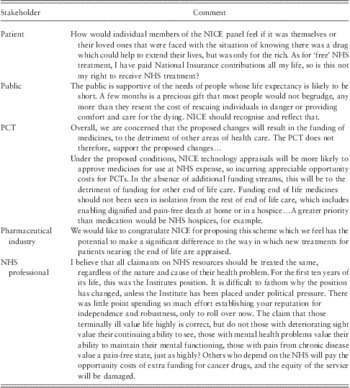
Hundreds of comments were submitted from patients and their families, the general public, the pharmaceutical industry, frontline professionals from across the NHS and those responsible for commissioning care in PCTs and SHAs. Table 1 lists some of these (anonymised) comments.
Comments received by NICE in response to its end-of-life drugs consultation

NICE = National Institute for Health and Clinical Excellence; NHS = National Health Service; PCT = Primary Care Trust.
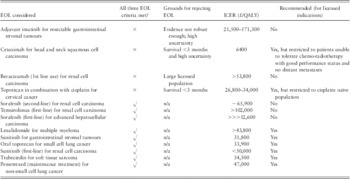
Following the end of the consultation, NICE published its final list of criteria that a drug ought to meet for the EOL guidance to apply.Footnote 11 These are listed in Table 2.
Final NICE criteria for end-of-life treatments

NICE = National Institute for Health and Clinical Excellence; NHS = National Health Service.
The final version of NICE's EOL drug policy included a number of changes, many in response to the numerous comments received, some criticising the perceived arbitrary nature of figures such as 7000 patients or 24-month life extension and some arguing for more specificity (and, therefore, possibly, more arbitrariness) in relation to terms such as ‘substantial extension to life’.
Consequently, the 7000 patient threshold was replaced with ‘small patient populations’. The definition and rationale of ‘small’ were discussed and further refined in subsequent appeals, the main point being that the smaller the patient population (across all indications) the fewer the incentives for commercial R&D due to the limited size of the market – hence the criterion of population size is meant to encourage investment in diseases affecting small numbers of people.Footnote 12
In addition, the requirement for the treatment in question to be the sole available treatment option for the guidance to apply was dropped (though used in the very first case of EOL on renal cancer treatments) following consultees voicing concerns as to the definition of ‘alternative treatments’ (i.e. routine vs NICE-endorsed vs available care).
Furthermore, the final version makes optional the requirement for prospective monitoring and evaluation of the real life impact of these drugs in terms of survival and side effects. Instead, it requires that the evidence presented to the Committee at the time of the submission along with the accompanying assumptions, are ‘plausible, objective and robust’. Other than this expectation on behalf of the Committee, there is no link between EOL decisions and prospective evidence generation, collection or analysis. However, the pre-consultation draft policy did place significant weight on generating the necessary evidence of safety and comparative effectiveness and value: “…medicines recommended for use, will normally be subject to an appropriately designed programme of evidence development to ensure that the anticipated survival gains are evident when it is used in routine practice…The design of the studies will be determined by the Institute and will need to be funded centrally. NICE will be responsible for managing the data collection exercise and assessing and reporting the outcome. Manufacturers will be given access to anonymised data and a summary of the results published”.Footnote 13 But in its final version, perhaps reflecting concerns about the logistical burden of real time prospective evidence generation, the potential ‘crowding out’ of more readily fundable and publishable clinical research projects by policy-relevant questions and the methodological challenges of establishing comparative effectiveness in the absence of control groups as a technology diffuses in the real world, NICE simply reserves the option of recommending “…to the Department of Health that it should give consideration to a data collection exercise for treatments recommended for use” through the research recommendations section of the guidance. And though NICE has no power to implement research recommendations, the fact it has given its Committees the leeway to reject submissions if the evidence is not considered scientifically robust, may be seen as an incentive for manufacturers to improve the quality of the data they submit in support of their products.
Finally, the post-consultation policy asks of NICE committees to assume that: “…the extended survival period [whilst on the drug] is experienced at the full quality of life anticipated for a healthy individual of the same age”,Footnote 14 which is at odds with the findings of the 2008 national audit of care of terminally ill cancer patients on chemotherapy. According to the audit, over 90% of patients experienced side effects and toxicity (directly, probably or possibly) linked to the chemotherapeutic drugs (see Table 6.12 in National Confidential Enquiry into Patient Outcome and Death, 2008). At the same time, loosening the requirement for prospective monitoring of patients to ascertain the true impact of the medication means the actual change caused on the quality of life is unlikely to be tested in a real world setting.
The new EOL policy was criticised by the UK's multiparty parliamentary committee on health: “We believe that the decision by NICE to raise its cost per QALY threshold for end-of-life drugs is both inequitable and an inefficient use of resources. By spending more on end-of-life treatments for limited health gain, the NHS will spend less on other more cost-effective treatments” (Health Select Committee, 2009).
However, NICE's new approach towards EOL drugs was broadly consistent with the views expressed over the years by the Citizens’ Council, a lay group of UK taxpayers and users of the NHS, representative (socio-demographically) of the general public in England and Wales (Rawlins, Reference Rawlins2005). The Citizens’ Council has in the past voted in favour of the NHS paying extra for drugs to treat rare (orphan) diseases (2005), or for circumstances where the ‘rule of rescue’ may apply (2006) and, most recently, for taking account of disease severity (2008) and of stretching NICE's threshold in a number of circumstances including lack of alternative treatments, NHS negligence or life-saving interventions (2009).Footnote 15 The 2009 report on conditions that would justify departing from NICE's threshold range concludes: “…the great majority of us do not think that a view based solely on formulaic considerations of health economics is a satisfactory basis on which to make recommendations about the use of drug or other interventions by the NHS. Judgements also need to take account of other factors”. Indeed, NICE's Committees have showed such flexibility (albeit not in the context of an explicit policy such as EOL) since the Institute's early days (Shah et al., Reference Shah, Cookson, Culyer and Littlejohns2011).
Building a case law
Between January 2009 (when NICE's EOL policy was implemented) and September 2011, there have been 13 technology/indication pairs where EOL was considered. Table 3 offers the rationale for the four pharmaceuticals not qualifying for the EOL guidance based on NICE's EOL criteria (post-consultation). It also lists the final decision by the NICE Committee for both EOL-eligible and non-eligible medications. Out of the 13 cases, NICE's Committees agreed that all three EOL criteria were met for nine technology pairs and recommended the use of the technologies in the NHS for six out of the nine. Frequently, the EOL policy was combined with a patient access scheme effectively reducing the transaction price of the drug, though such schemes are not without their critics (Raftery, Reference Raftery2010; Williamson, Reference Williamson2010). Three of the EOL-eligible drugs were rejected by the Committee.
NICE technology appraisals and EOL policy

NICE = National Institute for Health and Clinical Excellence; EOL = end of life; ICER = incremental cost-effectiveness ratio; QALY = quality-adjusted life year.
The rationale for rejecting EOL-eligible medications may relate to lack of clinical or cost-effectiveness (both considered sequentially for each one of their licensed indications), as may be the case for non-EOL drugs.Footnote 16 For example, sorafenib as second-line for renal cancer patients who have failed on sunitinib, was rejected because of lack of clinical effectiveness evidence. Similarly, temsirolimus was rejected as it had not been shown to be a clinically effective first-line treatment for people with advanced renal cancer who were unsuitable for immunotherapy. And while the Committee “…considered temsirolimus to be an improvement in treatment for advanced and/or metastatic renal cell carcinoma”, it also felt: “…that the additional weight that would need to be assigned to the original QALY benefits in this patient group for the cost-effectiveness of temsirolimus to fall within the current threshold range would be too great”.Footnote 17 For a more detailed discussion of the cost-effectiveness considerations in the case of the renal cancer drugs, see Raftery (Reference Raftery2009). In the case of azacitidine for myelodysplastic syndromes, which qualified for EOL rules, the manufacturers appealed against NICE's negative decision arguing that a multiplier of 2.1, required to bring the incremental cost-effectiveness ratio (ICER) to the top end of NICE's acceptable range (£30 k) was warranted given the magnitude of effect/extension of life. At the appeal hearing: “The Appeals Panel agreed that the Committee had not been unreasonable in concluding that a multiplier of 2.1 was too high to recommend” and dismissed the appeal on this point.Footnote 18
So, how is the weight calculated by NICE's Committees and is there a new threshold or QALY weighting for EOL drugs and can it be quantified?
On the first question, early Technology Appraisal reports (e.g. TA178), appeals and early reports to NICE's Board (e.g. July 2009), suggest different approaches were tried with regard to how the additional weeks or months conferred by EOL drugs ought to be weighed. These documents reveal discussions as to whether full utility of one should be used or an age-matched (lower) utility and whether the weight ought to be applied for the whole of the extra survival or only the progression-free part of the weeks of life added. Increasingly, it seems that NICE's Committees have adopted a simpler and more straight forward approach: they now tend to look at the QALY multiplier required to make the technology cost-effective, given its cost, at the upper (£30,000) limit of NICE's threshold range (personal communication with NICE Committee Chairs). At the same time, NICE is commissioning research into a more formalised approach to deriving and applying weights, which is also consistent with government's thinking on value-based pricing.
On the second question, NICE's Board intentionally gave its Committees no specific guidance on the level of QALY weighting (multiplier) to be applied for technologies eligible for EOL rule. Arguably, gradually, and with the case law accumulating, (the upper end of) such a multiplier may be revealed based on past Committee decisions.Footnote 19, Footnote 20 Indeed, a single multiplier figure, elicited from the publicly available NICE reports, may be misleading for two reasons:
(a) the technology's ICER put in the public domain may be higher than the real ratio following a confidential discount for the NHS in the context of a Patient Access Scheme;
(b) the Committee may have taken other factors into account, not captured by or reflected in the cost-effectiveness ratios, and usually hard to quantify even if described in the ‘Considerations’ section of a NICE report. Such factors may include equity or feasibility issues (Rawlins et al., Reference Rawlins, Barnett and Stevens2010).
Whether the EOL and Patient Access Schemes policies have enhanced access and how they have affected overall spending are questions that at some point NICE and its governmental sponsors may have to address with the help of the academic and clinical communities in the United Kingdom. However, as it is still early days and governmental policies on access to pharmaceuticals are constantly changing, these questions are, for now, hard to address. What the cases above show is that, far from ‘neutralising’ decision makers’ discretion, the EOL guidance encourages NICE's Committees to continue to make judgements as to the appropriateness of making new treatments available in the NHS, based on their comparative clinical and cost-effectiveness.
All diseases are equal but cancer is more equal than others
Every third technology appraised by NICE is a cancer drug.
NICE database of decisions, June 2010
All of the requests for the EOL policy have so far been for cancer drugs. While the criteria do not restrict the policy to cancer drugs, the fact that they refer to a terminal disease affecting small numbers of people where the technology offers a small extension in survival at a high price, points to new expensive anti-cancer agents.
Cancer has always held a special place in UK national health policy and, consequently in NICE's work programme, which has always been skewed towards cancer rather than other major diseases such as mental health and cardiovascular conditions (Chalkidou et al., Reference Chalkidou, Culyer, Littlejohns, Doyle and Hoy2008). It was inadequate access to cancer drugs that triggered the debate about ‘top-ups’ and Richards’ review leading to the formulation of the EOL guidance. The post 2010 election announcement of a £50 million Cancer Drugs Fund to pay, by April 2011, for cancer drugs deemed not to be cost-effective by NICE giving, as reported in The Guardian: “…thousands of people an extra few months at the end of their lives”, reinforces this. That the extra money allegedly came from scrapping the previous government's plan to give “free personal care for the 280,000 elderly people with the greatest need” (Ramesh, Reference Ramesh2010) perhaps reveals the preferential position drugs hold compared with the less tangible notion of ‘personal care’ or indeed other chronic debilitating conditions and led to the Lancet branding the Fund “already intellectually bankrupt” shortly after it was announced (Editorial, 2010).
Making cancer, and, specifically, pharmacological treatments for cancer, a top policy priority may be justifiable to the extent it reflects society's own priorities. However, such evidence is scarce, according to the Department of Health's own impact assessment of the Cancer Drugs Fund: “The evidence reviewed has referred to public preferences in respect of disease severity. No robust evidence has been found to indicate additional, specific biases towards cancer against other severe diseases, or towards the treatment of severe diseases with drugs against other clinical approaches”.Footnote 21
According to government, however, the Cancer Drugs Fund is just the first step in a move to change the way all pharmaceuticals are paid for, through a new Value Based Pricing approach. And even though the new Value-Based Pricing approach is currently being discussedFootnote 22 (Faden and Chalkidou, Reference Faden and Chalkidou2011), early reactions by major stakeholders seem to have resulted in a government rethink (Jack, Reference Jack2011; Judd, Reference Judd2011; MacDonald, Reference MacDonald2011).
Earlier on, responses to the government's consultation on the Cancer Drugs Fund from industry and patients indicated their concern over the Fund leading to a more generalised by-passing of NICE in evaluating pharmaceuticals: “In order for drugs to be prescribed safely and in the interests of the patient, it is essential that pharmaceutical companies continue to cooperate with NICE despite the existence of the Fund” (Cancer Research UK) and the “ABPI recommends the Fund is not used to fund treatments where…a company has unreasonably not cooperated with the NICE appraisal process” (Association of the British Pharmaceutical Industry).Footnote 23
It seems, the English aversion to variation overwhelms the US aversion to central, government-related decision-making. This may be one of the most defining cultural differences between the United Kingdom and the United States, underpinning their diverging health care policy journeys, especially with regard to decisions about access to and reimbursement of new technologies and health care interventions.
The legitimacy of changing the rules: who decides?
Compromising the principle that the NHS must always be free at the point of use would be a small price to pay if it meant that people received life-saving treatment that would otherwise be denied them.
Lord Tebbit, former chairman of the Conservative Party blogging in the Daily TelegraphFootnote 24
NICE has over the years adopted an incremental approach in adapting and responding to government priorities: making public health a core component of its work; introducing a ‘fast-track’ appraisal based mostly on industry submissions; opening its decision-making committee meetings to the public, experimenting with risk sharing (or patient access) schemes for new drugs, and, most recently, designing, consulting on and implementing its EOL policy are examples of its responsiveness and willingness to adapt to a changing environment. Maybe this is one of the reasons it has survived and grown despite the controversial nature of many of its decisions. And rightly so: it is not for NICE to decide on the society's priorities but, instead, to try and elicit those and then incorporate them, to the best of its abilities, in its decision-making functions. This process may be NICE's (and indeed other decision makers’) greatest challenge. In the meantime, ‘changing the rules’, as long as it is done in a transparent (albeit often uncomfortably public), consultative, and scientific way, is not only acceptable but also necessary. In the case of NICE maybe ‘the medium is the message’.
Although Lord Tebbit's is an extreme view, transforming the very nature of the NHS as it currently stands, free at the point of delivery for those who need it, irrespective of their ability to pay, may be one of the last rules to be changed to accommodate society's evolving values and priorities. However dramatic future changes may be, the question is whether NICE, in the context of the new pricing and reimbursement environment to be introduced with Value-Based Pricing, is able to continue its adaptive evolution while maintaining its scientific objectivity, its independence from external pressures and its ability to engage in a balanced and responsive fashion with all those affected by its decisions. In the case of cancer drugs for patients at the end of their lives, it may be too early to tell.
Acknowledgements
I would like to thank Corinna Sorenson, John Appleby, Ruth Faden and Amanda Adler for commenting on the draft, Claud Regnard for explaining to me how end-of-life care works in the United Kingdom and Rebecca Trowman and Meindert Boysen for helping me access and interpret the data on NICE's decisions. I would also like to thank the colleagues who participated in the LSE workshop on end-of-life care held in London in December 2010. Disclaimer: The views expressed here are mine and do not represent NICE, or the people acknowledged above.