Introduction
Sri Lanka is a culturally diverse country comprising multiple ethnic groups. The three main ethnicities are Sinhalese (74.9%), Sri Lankan Tamils (11.2%) and Sri Lankan Moors (9.2%) (Ministry of Health, Sri Lanka, 2016). Sri Lankans practise four main religions: Buddhism, Hinduism, Islam and Christianity. In addition, there is a caste system practised among Sinhalese and Tamils to variable extents. Although caste plays only a minor role in modern Sri Lankan daily life, its influence becomes more apparent at the time of a typical Sri Lankan marriage (UK Essays, 2018).
In about 500 BC settlers arrived from north-east India and the Sinhala population is thought to be descended from these migrants. Over the centuries, Tamils from southern India have migrated to Sri Lanka regularly due to the close proximity of the land masses of India and Sri Lanka. With maritime shipping routes passing through Sri Lankan harbours, traders of Moor descent settled in various parts of the country (Geiger & Bode, Reference Geiger and Bode1912). Most Sinhalese practise Buddhism, while Tamils mostly practise Hinduism and Moors are almost exclusively followers of Islam. There is a minority from both Sinhala and Tamil communities who are Christian (Ministry of Health, Sri Lanka, 2016).
While inter-communal tensions between the three main communities have existed at a low level perhaps for centuries, major ethnic strife erupted between the majority Sinhalese and minority Tamils in the late 1970s. This evolved into a full-scale civil war which raged for almost 30 years, mostly in the north and east of the country. The war ended in 2009 and resulted in heavy casualties on both sides of the ethnic divide (The Commonwealth, n.d).
Marriage is considered an important, if not the most important, milestone in human life. Its significance is particularly vital in South Asian countries such as Sri Lanka, where separation and divorce are not widely acceptable culturally, even in the 21st century. The patterns of marriage in a society reflect its social structure and have important effects on the health of that nation, specifically related to the transmission of genetic diseases (Bittles & Black, Reference Bittles and Black2010; Fareed & Afzal, Reference Fareed and Afzal2017).
In common with the rest of South Asia, in Sri Lanka marriages are mainly categorized as ‘arranged’ or ‘love’ marriages. An ‘arranged’ marriage is a union where individuals other than the couple themselves select the bride and groom – mainly family members such as the parents. A ‘love’ marriage is a union where the individuals express their love for each other and get married with or without the consent of their parents (Jones & Yeung, Reference Jones and Yeung2014).
Previous analyses of marriage patterns in Sri Lanka have shown that, unlike in other South Asian countries, arranged marriages are becoming less common and the age at marriage of the groom and the bride is rising (Gamage, Reference Gamage1982; De Silva, Reference De Silva1990; Caldwell, Reference Caldwell1996). The age gap between the groom and the bride is narrowing, becoming similar to marriages in the Western world and in contrast to that of neighbouring South Asian countries (Gamage, Reference Gamage1982; De Silva, Reference De Silva1990; Caldwell, Reference Caldwell1996).
Consanguineous marriage is common in many Asian communities. Consanguinity increases the risk of autosomal recessively inherited diseases, including β-thalassaemia, among offspring (Merten, Reference Merten2019). The extent to which consanguinity contributes to the prevalence of β-thalassaemia, the most common monogenic disease in Sri Lanka, has not previously been studied. Earlier studies have, however, investigated the contribution of malaria-driven natural selection and the importance of migration in the establishment of β-thalassaemia in Sri Lanka (Premawardhena et al., Reference Premawardhena, Allen, Piel, Fisher, Perera and Rodrigo2017). At present, it is widely accepted that the reason for the marked variation in the prevalence of haemoglobinopathies in adjoining regions of the country is the historical exposure to malaria in these regions (Premawardhena et al., Reference Premawardhena, Allen, Piel, Fisher, Perera and Rodrigo2017).
Although there is a substantial body of research on changing trends of Sri Lankan marriages there is a paucity of data on the prevalence and patterns of consanguinity. Only one previous study has referred to this issue, based on an analysis of consanguineous marriages among members of the Govigama caste in rural Kandy, Sri Lanka, in 1973, which showed that 30% of this community were consanguineous (Reid, Reference Reid1976).
The objectives of the present study were to describe the patterns of marriages and determine the consanguinity rates in modern Sri Lankan marriages, and to identify the socio-demographic associations of consanguineous marriages. Consanguinity rates among the parents of patients with β-thalassaemia were also determined, to understand the role of consanguinity in the transmission of this disorder in Sri Lanka.
Methods
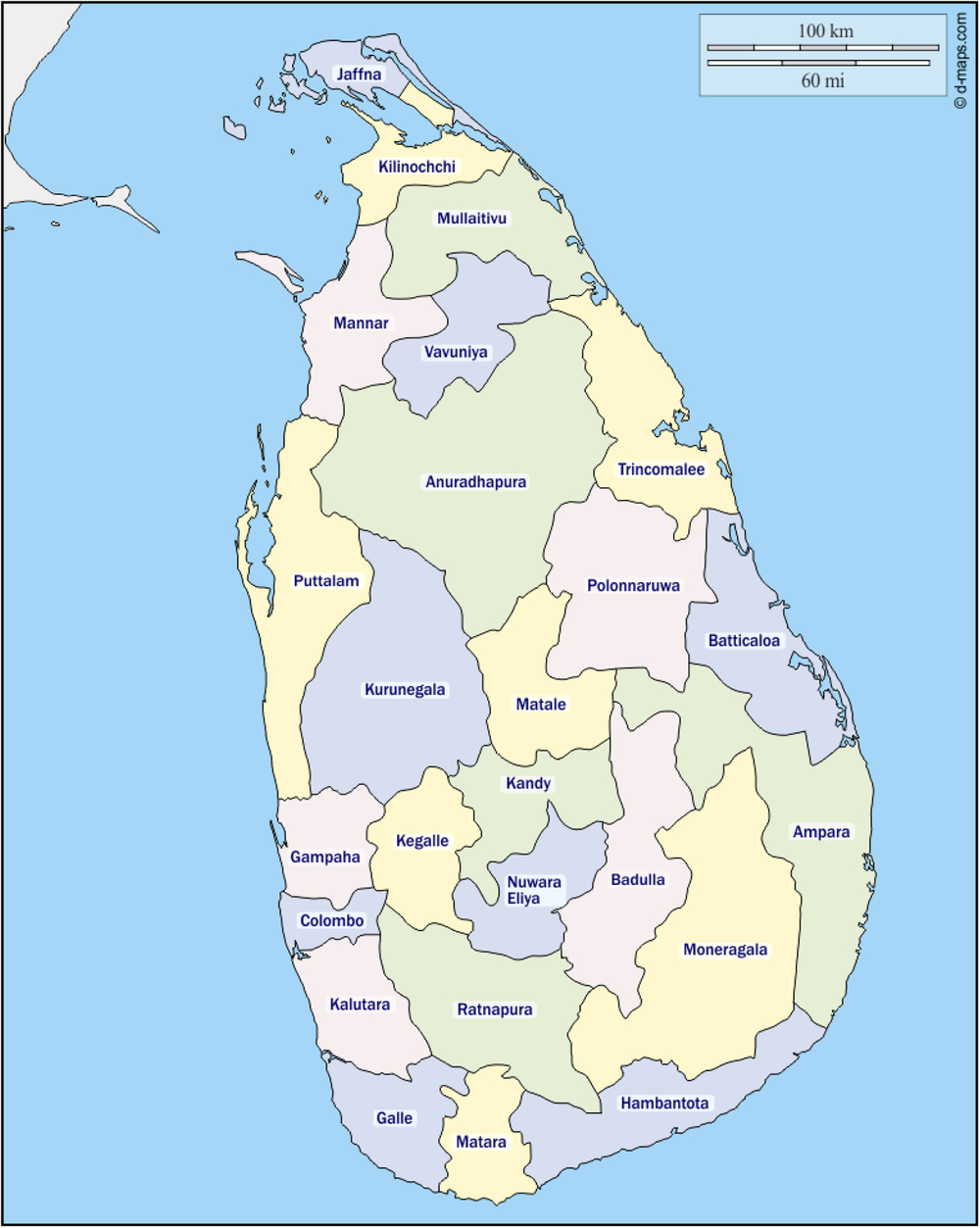
This island-wide descriptive study was conducted in all 25 districts of Sri Lanka (Fig. 1) over a 6-month period from 1st July to 31st December 2009. Three marriage registrars from each district were randomly selected to prospectively collect data on all couples who were registering their marriage during that period. All participating marriage registrars were briefed prior to the commencement of the study on the sensitivity of the information and the method of data collection. Data on age, ethnicity, education level, type of marriage and consanguinity were collected using a data collection form, from all couples registering their marriage. Informed written consent was obtained from all couples before collecting data.
Map of Sri Lanka showing districts. Accessed free of charge from https://d-maps.com/carte.php?num_car=109502&lang=en (accessed 26th September 2019).

Marriages were categorized as ‘love’ marriages if the union followed a friendship or relationship between the spouses or ‘arranged’ marriages if the marriage was pre-arranged by parents, marriage brokers or a third party. Consanguineous marriages were defined as marriages between a ‘blood relative’ or two persons descended from the same ancestor. For the purposes of the study, consanguinity was defined as a union between a couple related as second cousins or closer, equivalent to a coefficient of inbreeding (F) of ≥0.0156 (Bittles, Reference Bittles2001).
The second part of study was conducted among patients with β-thalassaemia who were registered for treatment at the three largest thalassaemia centres in Sri Lanka. All patients or their parents were interviewed via telephone. In families with more than one patient with β-thalassaemia, a single progeny was included, and the other siblings were excluded from the study. The interviews were conducted by a trained medical officer, who collected demographic details and information on the prenatal relationship of the parents.
Data were analysed using IBM SPSS Statistic 22.0. Descriptive statistics were presented as means and standard deviations or proportions. Socio-demographic associations of consanguinity were determined by calculating odds ratios and 95% confidence intervals between the odds of consanguinity among individuals with and without a specific characteristic.
Results
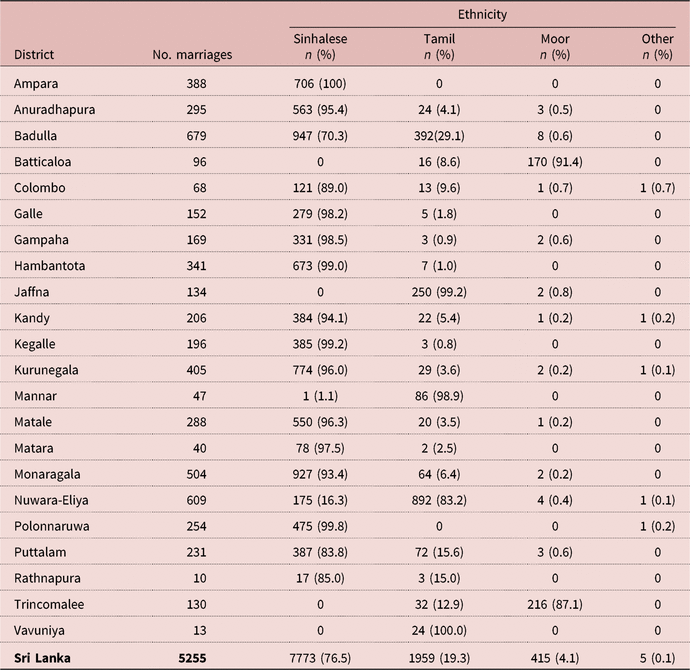
Fifty-nine marriage registrars from 22 districts recorded information on 5255 marriages. No records were returned from Kilinochchi, Mullaitivu or Kalutara districts. Kilinochchi and Mullaitivu areas were just returning to government administrative control after a protracted civil war, which made it difficult to obtain data. Data were not available from Kalutara district for administrative reasons, i.e. due to a lack of co-operation from the marriage registrars. Varying numbers of subjects failed to provide data on certain parts of the questionnaire, as noted in Tables 1–3, e.g. on ethnicity and religion.
Distribution of studied marriages and marriage partner (respondent) ethnicitya by district

a Note that ethnicity data were missing from 358 individuals.
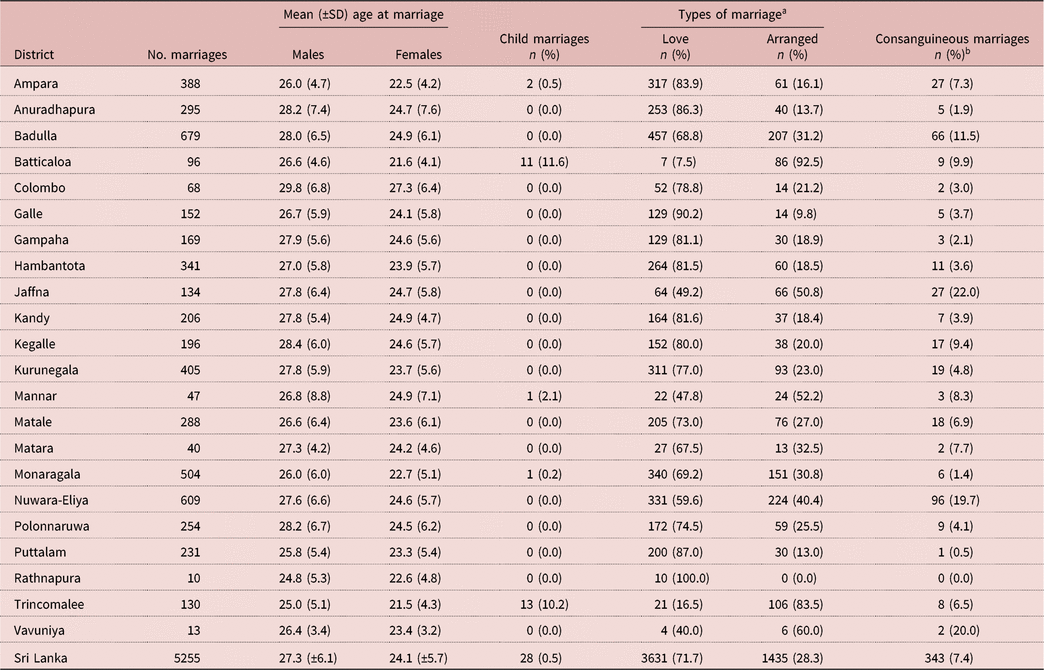
Marriage type, age at marriage, rate of child marriage and rate of consanguineous marriages by district

a Data missing from 189 marriages.
b Data missing from 619 marriages.
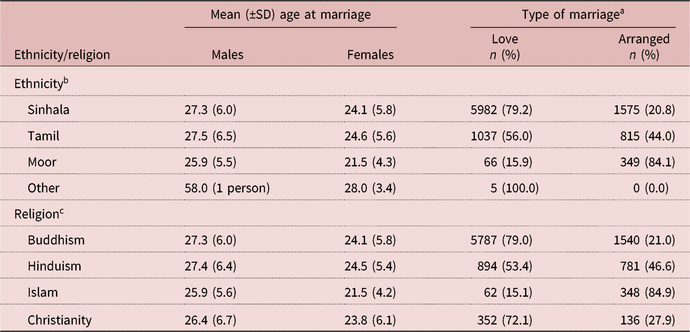
Marriage type and age at marriage by religion and ethnicity

a Data missing for 358 couples.
b Data missing for 285 couples.
c Data missing for 323 individuals.
The number of marriages from each district ranged from 10 in Ratnapura to 679 in Badulla. Over 100 marriages each were recorded from sixteen districts (Table 1).
Ethnic and religious distribution of respondents
The ethnic distribution of the respondents (married partners) was evaluated and found to closely represent the ethnic distribution of the country. Over three-quarters (76.5%) were Sinhalese, 19.0% were Tamils and 4.0% were Moors (Table 1). A large majority (97%) of marriages were between individuals of the same ethnicity, while 152 (3%) marriages were inter-ethnic.
The religious distribution of the married partners was: Buddhist 73.7%, Hindu 17.4%, Islam 4.0% and Christian 4.9%. As with ethnicity, most (94.3%) marriages were between partners of the same religion. The highest prevalence (200/500, 40%) of inter-religious marriages was seen among Christians. The caste details of both partners were available for only 1179 (22.4%) marriages, 90.2% of which were same-caste.
Age at marriage
The average age at the time of marriage was 27.3 (±6.1, range 18–73) years for males and 24.1 (±5.7, range 16–64) years for females (Table 2). The highest average age at marriage was in the Colombo district for both sexes: males 29.8 (±6.8) years and females 27.3 (±6.4) years. Overall, relatively rural districts, i.e. Ampara, Batticaloa, Moneragala, Puttalam and Trincomalee, reported lower ages at marriage compared with more urbanized districts, i.e. Colombo, Gampaha and Kandy.
A small number (n = 28, 0.5%) of child marriages, where the bride was less than 18 years old, was reported, particularly from Batticaloa and Trincomalee districts. Mean age at marriage was lower in Moors (males, 25.9; females, 21.5 years) compared with Sinhalese (males, 27.3; females, 24.1 years) and Tamils (males, 27.5; females, 24.6 years) (Table 3).
‘Love’ marriages and ‘arranged’ marriages
Of the total 5255 marriages, 5066 (96.4%) had data on whether they were ‘love’ or ‘arranged’ marriages. The majority (71.7%) were ‘love’ marriages, and 28.3% ‘arranged’. The marriage type showed regional variation, with less-urbanized Batticaloa (92.5%) and Trincomalee (83.5%) having the higher rates of ‘arranged’ marriages, and the more urbanized Galle (90.2%) having the highest rate of ‘love’ marriages (Table 2).
When analysed by ethnicity, the Sinhalese had the highest percentage of ‘love’ marriages (79.2%), whereas Moors had the highest percentage of ‘arranged’ marriages (84.1%) (Table 3). Inter-ethnic marriages were mainly ‘love’ marriages [139/152 (92.1%)]. Buddhists (79.0%) and Christians (72.1%) had the highest percentages of love marriages, whilst followers of Islam (84.9%) had the highest percentage of arranged marriages.
Consanguineous marriages
Of the 5255 marriages, data on consanguinity were available for 4636 (88.2%) couples, of which 343 marriages were between blood relatives, giving a consanguinity rate of 7.4% in the study population. Of the consanguineous marriages, 272 (79.3%) were between first cousins (F = 0.0625), 63 (18.4%) were between second cousins (F = 0.0156) while eight (2.3%) were non-cousin-related marriages (F < 0.0156), equivalent to a mean coefficient of inbreeding (α) of 0.0039. Consanguinity rates varied between districts, with the highest rates reported in Jaffna (22.0%), Vavuniya (20.0%) and Nuwara Eliya (19.7%) districts with Tamil majorities (Tables 1 and 2).
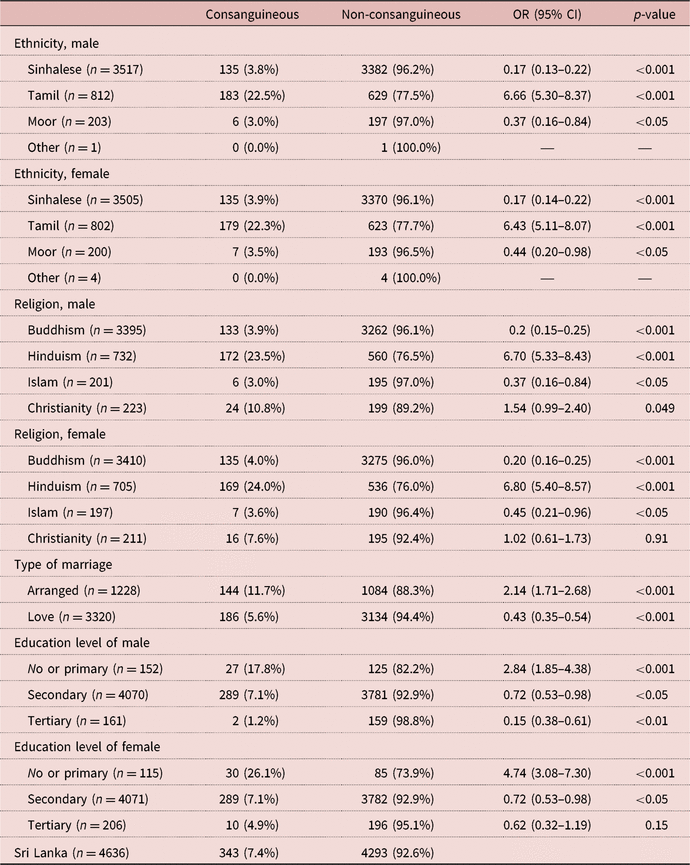
The socio-demographic associations of consanguineous marriages were evaluated next (Table 4). The highest parental consanguinity rates were reported among Tamils (males, 22.5%; females, 22.3%) whereas Sinhalese (males, 3.8%; females, 3.9%) and Moors (males, 3.0%; females, 3.5%) reported significantly lower consanguinity rates. Followers of Hinduism had significantly higher consanguineous rates (males, 23.5%; female, 24.0%) compared with other religions. ‘Arranged’ marriages were significantly more associated with consanguinity compared with ‘love’ marriages (p < 0.001). Partners with a low education level (defined as having no or primary education only) were significantly more likely to be in consanguineous marriages (males, 17.8%; females, 26.1%) compared with better-educated individuals.
Consanguineous and non-consanguineous marriages by socio-demographic characteristics

Newly married couples were also asked about the consanguinity between their parents. The overall prevalence of consanguinity among parents was 5.3% (536/10,059). The parents of partners in consanguineous marriages were more likely to have had consanguineous marriages themselves: 107/343 (31.2%) parents of husbands of consanguineous marriages were themselves consanguineous, while only 128/4293 (3.0%) parents of husbands in non-consanguineous marriages were in a consanguineous union (OR = 14.7; 95% CI 11.0–19.6, p < 0.001). Similarly, a significantly higher proportion of the parents of wives in consanguineous marriages were consanguineous [115/343 (33.5%)] compared with the parents of wives in non-consanguineous marriages [126/4293 (2.9%)] (OR = 16.6; 95% CI 12.5–22.2, p < 0.001).
Awareness of β-thalassaemia
Knowledge about β-thalassaemia and its spread was evaluated in the married partners. The response rate for this part of the study was 89%. Only 33.6% of males and 30.5% of females were aware of β-thalassaemia. The highest levels of awareness were seen in Kegalle (74.5%) and Kurunegala (73.0%) districts, while the lowest awareness levels were in Trincomalee (0%) and Batticaloa (2.3%) districts. A significantly lower percentage of males who were aware of β-thalassaemia (5.9%) were in consanguineous marriages, compared with those who were unaware of β-thalassaemia (8.1%) (OR = 0.72; 95% CI 0.55–0.93, p < 0.05). Likewise, females with knowledge of β-thalassaemia were less likely to be in a consanguineous marriage (5.6%), compared with those who did not know about the disease (8.1%) (OR = 0.67; 95% CI 0.51–0.88, p < 0.01).
Consanguinity among the parents of patients with β-thalassaemia
Finally, the prevalence of consanguinity among patients with β-thalassaemia was evaluated. A total of 386 patients with β-thalassaemia were enrolled into the study. Fifty-six patients were born to consanguineous parents, giving a consanguinity rate of 14.5% in this population; 39 parents were first cousins and 17 were second cousins, equivalent to a mean coefficient of inbreeding (α) of 0.0070. Tamil patients with β-thalassaemia were most likely to have consanguineous parents [44.4% (4/9)]. Consanguinity was lowest in Sinhalese patients [12.6% (43/342)], while Moors had a rate of 25.7% (9/35). At district level, reported consanguinity rates varied from a low of 5.4% (3/56) in Gampaha to a high of 100% in Ratnapura (1/1) and Mannar (1/1), with no cases of β-thalassaemia reported from Hambantota, Kalutara, Polonnaruwa or Vavuniya.
Discussion
This study is possibly the largest recent nation-wide study to evaluate the prevalence of consanguinity in married couples and its effect on β-thalassaemia, in an area where the disease is highly prevalent. The study identified several social characteristics and practices relating to marriage in the Sri Lankan population.
The average ages at marriage for Sri Lankan males and females were 27.3 and 24.1 years respectively. These values are similar to those of the most recent National Census data, where mean age at marriage was reported as 27.2 years for males and 23.4 years for females (Demographic and Health Survey Report, 2006). The average age at marriage for females in Sri Lanka was 18.1 years in 1901, 20.7 in 1946, 20.9 in 1953, 22.1 in 1963 and 23.5 years in 1971 (Fernando, Reference Fernando1975). It reached the highest level of 25.5 years in 1993 and declined thereafter to 23.6 years, as reported by the 2006–2007 Demographic and Health Survey (De Silva, Reference De Silva2014). The average age at marriage for males in Sri Lanka was 24.6 in 1901 and 27 years in 1946; this rose very slightly thereafter to 27.2, 27.9 and 28.0 years in 1953, 1963 and 1971 respectively (Fernando, Reference Fernando1975).
Sri Lankan statistics regarding age at marriage for females has more in common with East Asian countries, rather than its South Asian neighbours (Caldwell, Reference Caldwell2005). The relatively high age at marriage and larger number of females who remain unmarried until an older age has earned Sri Lanka the name ‘Ireland of Asia’ in relation to its marriage practices (De Silva, Reference De Silva1997). The higher literacy and education levels attained by Sri Lankan females may be related to the delayed age at marriage compared with neighbouring countries (Ogawa, Reference Ogawa1981). This factor is believed to be more important than any other socioeconomic factor such as ethnicity, religion, place of residence in childhood and premarital work experience, in determining age at marriage (Ogawa, Reference Ogawa1981). The highest average age at marriage for both genders was reported in the urbanized Colombo district, while the lowest average age at marriage was in the less-urbanized Trincomalee district.
‘Love’ marriages were found to be the most prevalent type of marital union in Sri Lanka. This is a consequence of the recent modernization of society where a shift from family-arranged to self-selected marriages has become apparent (Caldwell, Reference Caldwell1996). However, ‘arranged’ marriages were still prevalent (89%) in the Moor community, where traditions and customs are observed in a much stricter manner.
Information on caste was volunteered by only 22% of the subjects, whereas information on education and consanguinity was disclosed without reservation by all participants. This highlights the sensitive nature of this topic. Although in many aspects caste is less significant and less visible in Sri Lanka compared with India, about 90% of the Sri Lankan population nevertheless recognizes it, at least for some purposes (UK Essays, 2018). The poor availability of data is likely to make generalizations about caste not quite accurate, especially as information about caste was only available for the Sinhalese. Based on the available information, there appears to be a high tendency for same-caste marriages (92%) as opposed to marriages between different castes (7.7%), suggesting the importance attached to caste, at least at the point of marriage, and the potential impact of caste endogamy in determining the profile of β-thalassaemia in the Sri Lankan population.
Literacy rates were very high in the study population, with participants having no schooling limited to only 0.4% of the sample. This is in keeping with the high literacy rate of 92% for the country as a whole (Ogawa, Reference Ogawa1981; Ministry of Health, Sri Lanka, 2016). A majority (93%) of the participants had secondary or higher level of education, which is a likely contributory factor to the later age at marriage in females. This reflects the equality of educational opportunities available to females in Sri Lanka, in contrast to other countries in the region, other than in the Maldives (Sheikh & Loney, Reference Sheikh and Loney2018).
It has been conservatively estimated that 10.4% of the 6.7 billion global population are related to each other, as second cousins or closer (Bittles & Black, Reference Bittles and Black2010). In general, high consanguinity rates have been reported from South Asian countries, depending on the communities tested. In Pakistan, almost all surveys have identified consanguinity rates over 50% in all the communities sampled (Shami et al., Reference Shami, Schmitt and Bittles1989; Hussain & Bittles, Reference Hussain and Bittles1998; Shami & Iqbal, Reference Shami and Iqbal1983). In Nepal, a survey among Moors identified a consanguinity prevalence of 32.5% (Bhatta & Haque, Reference Bhatta and Haque2015). In India, the prevalence of consanguineous marriage is variable depending on the community tested and ranges from 1.1% in a Christian community in Mangalore to 55.1% in Pondicherry (Verma et al., Reference Verma, Prema and Puri1992; Bhagya et al., Reference Bhagya, Sucharitha and Avadhani2013). In Bangladesh, a 1976 survey identified a prevalence of 17.6% (Khan et al., Reference Khan, Wojtyniak and Saha1997), with a similar level recently being reported by Mobarak et al. (Reference Mobarak, Chaudhry, Brown, Zlenska, Nizam Khan and Chaudry2019). As mentioned previously, data on consanguinity in Sri Lanka are limited to a single study conducted in 1973 in a single community (Reid, Reference Reid1976).
Awareness of β-thalassaemia was only indicated by 31% of the young population studied. Most distressing was the zero awareness in the sample tested (n = 254) in Trincomalee. The higher awareness among the population of Kurunegala and Kegalle districts is likely to be because these districts report the highest number of cases of β-thalassaemia in the country and have undertaken ongoing awareness programmes for over 10 years (Ministry of Health, Sri Lanka, 2016).
The high average age, literacy rate and educational level of the partners at marriage is of great relevance when planning β-thalassaemia prevention campaigns in Sri Lanka. In 2017 the non-communicable disease division of the Ministry of Health launched a revamped β-thalassaemia screening programme. The main strategy of the campaign was to screen school children from the ages of 16 to 19 years, in addition to opportunistic screening of adults who are employed in factories and/or studying in higher educational institutes (Mudiyanse, Reference Mudiyanse2015).
A higher age of marriage would make screening school children for genetic diseases less desirable, as the time from screening to marriage could be at least another 8–10 years, during which period they would probably forget the genetic information imparted to them. A good education programme targeting older females before marriage would probably be more successful as they are likely to better understand the significance of the genetic message.
With the exception of the Moor community, most marriages in Sri Lanka are ‘love’ unions. This is also significant since the decision on partner selection is likely to be made by the young people themselves, with attempts by parents to impose a partner choice very likely to be futile. The disappointingly low level of awareness of β-thalassaemia at the present time is largely a reflection of the degree of effort expended by health authorities in spreading the requisite information, rather than the understanding of the disease by the general population.
The consanguinity rate among the parents of patients with β-thalassaemia was 14.5% (α = 0.0070), compared with the general population rate of 7.4% (α = 0.0039), and probably plays an important role in the transmission of the disease in the population. Consanguinity rates are especially high in the Tamil community, where marriage between relatives has been practised for centuries. However, severe β-thalassaemia is much less common among the Tamil population than among the Sinhalese and Moor communities, as the caseloads are substantially lower. This is a paradox that is hard to explain but may reflect community-specific founder mutations and marital endogamy along traditional ethnic and religious lines (Sinha et al., Reference Sinha, Black, Agarwal, Colah, Das and Ryan2009; Black et al., Reference Black, Sinha, Agarwal, Colah, Das, Bellgard and Bittles2010).
It is quite clear that consanguinity plays an important, though probably not the central, role in the propagation of β-thalassaemia in Sri Lanka. Malaria-related geographical variation and random mating are likely to be far more important. However, the role of consanguinity in the propagation of β-thalassaemia should not be ignored, especially when educating and counselling high-risk populations.
In conclusion, information on marriage patterns in Sri Lanka can be utilized to develop β-thalassaemia screening programmes. Screening should target young people (i.e. above 20 years) rather than school children. Although overall consanguinity rates are low in Sri Lanka (at 7.4%), the higher rate found in β-thalassaemia patients (14.5%) and the high consanguinity rate in the Tamil community (22.5%) should be borne in mind when developing screening and counselling campaigns.
Acknowledgments
The authors gratefully acknowledge the contribution made by the following in collecting data: Mr Lakshman Perera, Dr Gayan Goonathilake and Dr Ramees Leebe. We are greatly saddened by the passing of our senior author Sir David Weatherall. This paper is dedicated to his memory.
Funding
This research received no specific grant from any funding agency, commercial entity or not-for-profit organization.
Conflicts of Interest
The authors have no conflicts of interest to declare.
Ethical Approval
The authors assert that all procedures contributing to this work comply with the ethical standards of the relevant national and institutional committees on human experimentation and with the Helsinki Declaration of 1975, as revised in 2008.