Individuals with high neuroticism and impulsivity are predisposed to psychiatric disorders (Congdon & Canli, Reference Congdon and Canli2008; Lönnquist, Verkasalo, Mäkinen, & Henriksson, Reference Lönnqvist, Verkasalo, Mäkinen and Henriksson2009; ten Have, Oldehinkel, Vollerbergh, & Ormel, Reference ten Have, Oldehinkel, Vollebergh and Ormel2005). Expression of these traits is moderated by environmental and genetic factors. The impact of genetic variation and environmental effects is known to converge at the level of regulation of neurochemical transmission. For example, emotional behavior and/or personality traits are related to serotonergic (Kriegebaum, Gutknecht, Schmitt, Lesch, & Reif, Reference Kriegebaum, Gutknecht, Schmitt, Lesch and Reif2010; Oreland, Nordquist, Hallmann, Harro, & Nilsson, Reference Oreland, Nordquist, Hallman, Harro and Nilsson2010) and dopaminergic systems (Kestler, Malhotra, Finch, Adler, & Breier, Reference Kestler, Malhotra, Finch, Adler and Breier2000; Reiner & Spangler, Reference Reiner and Spangler2011; Smillie, Cooper, Proitsi, Powell, & Pickering, Reference Smillie, Cooper, Proitsi, Powell and Pickering2010). Both systems are regulated by nitric oxide (NO), a gaseous messenger molecule. NO is produced from the amino acid arginine catalyzed by the enzyme NO synthase (NOS). One form of this enzyme is the neuronal form NOS1 (Kiss & Vici, Reference Kiss and Vizi2001). Recently, a dinucleotide variable number tandem repeat (VNTR) polymorphism in the promoter region of the alternative first exon 1f (ex1f) of the human neuronal nitric oxide synthase (NOS1 ex1f-VNTR) has been found to affect impulsivity and related psychopathology in different populations (Laas et al., Reference Laas, Reif, Herterich, Eensoo, Lesch and Harro2010; Reif et al., Reference Reif, Jacob, Rujescu, Herterich, Lang and Gutknech2009, Reference Reif, Kiive, Kurrikoff, Paaver, Herterich and Konstabel2011). The human NOS1 gene comprises 28 coding exons, as well as at least 9 different and alternative first exons (exons 1a–1j), which are spliced to the same second exon. Each of the first exons is driven by its own promoter; however, none of them is translated into protein. Exons 1c and 1f are most abundant in the brain. NOS1 ex1f-VNTR is highly polymorphic and thus has been dichotomized into long and short alleles. Dichotomization originally was done according to a median split of the repeat number (Reif et al., Reference Reif, Herterich, Strobel, Ehlis, Saur and Jacob2006), with up to 19 repeats being designated as “short.” Using a luciferase reporter assay, it was demonstrated that the long variant of NOS1 ex1f-VNTR results in significantly increased reporter gene activity as compared with intermediate and short variants (Reif et al., Reference Reif, Jacob, Rujescu, Herterich, Lang and Gutknech2009; Rife et al., Reference Rife, Rasoul, Pullen, Mitchell, Grathwol and Kurth2009). In healthy controls, 21% of subjects are homozygous for short alleles whereas 28% are homozygous for long alleles (n = 8,719 subjects; Reif et al., unpublished data). There is no significant difference between samples of different origin, as far as they have been tested (samples from Germany, Italy, Sweden, Estonia, Austria, Norway, and The Netherlands).
Studies in mice have revealed that knocking out the Nos1 results in behavioral changes involving the anxiolytic-like phenotype (Zhang et al., Reference Zhang, Huang, Ye, Luo, Wu and Hu2010) and increased aggressiveness (Nelson, Trainor, Chiavegatto, & Demas, Reference Nelson, Trainor, Chiavegatto and Demas2006; Trainor, Workman, Jessen, & Nelson, Reference Trainor, Workman, Jessen and Nelson2007). The low-expression NOS1 ex1f-VNTR short/short (s/s) genotype parellels this behavior: it is found more frequently among adults with impulsive behavior and impulsivity-related disorders, for example, attention-deficit/hyperactivity disorder and Cluster B personality disorder (Reif et al., Reference Reif, Jacob, Rujescu, Herterich, Lang and Gutknech2009). In the general population, participants with the s/s genotype missed significantly more hits on the Stop signal task (ηp2 = 0.02; Reif et al., Reference Reif, Kiive, Kurrikoff, Paaver, Herterich and Konstabel2011), which reflects deficits in vigilance (Malloy-Diniz, Fuentes, Borges Leite, Correa, & Bechara, Reference Malloy-Diniz, Fuentes, Borges Leite, Correa and Bechara2007), and had higher maladaptive impulsivity if they had experienced inferior family relationships (ηp2 = 0.02–0.04; Reif et al., Reference Reif, Kiive, Kurrikoff, Paaver, Herterich and Konstabel2011). In conclusion, neuronal NOS function is pertinent to impulsivity, and the people with the lower expressing NOS1 s/s genotype may be more vulnerable to impulsivity-related psychiatric disorders.
Impulsivity is considered to be a heterogeneous construct (Evenden, Reference Evenden1999). While there are quite a number of classifications of and approaches to impulsivity, few can be used to explain why such an apparently inferior trait is so prevalent. One attempt to explain the benefits of impulsivity is to divide it into functional impulsivity, which incorporates willingness to take risks in situations where this behavior is appropriate, and dysfunctional impulsivity, described as a tendency to act with less forethought, when this tendency is a source of difficulty (Dickman, Reference Dickman1990). Dysfunctional impulsivity is associated with increased neuroticism (Zadravec, Bucik, & Sočan, Reference Zadravec, Bucik and Sočan2005), while functional impulsivity and sensation seeking rather correlate with extraversion (Aluja, García, & García, Reference Aluja, García and García2003; Smillie & Jackson, Reference Smillie and Jackson2006; Zadravec, Bucik, & Sočan, Reference Zadravec, Bucik and Sočan2005). Both high neuroticism and low extraversion predict anxiety and depressive symptoms (Chioqueta & Stiles, Reference Chioqueta and Stiles2005; Kerscher, Rapee, & Schniering, Reference Kerscher, Rapee and Schniering2009; Muris et al., Reference Muris, Bos, Mayer, Verkade, Thewissen and Dell'Avvento2009). Neuronal NOS has been associated with anxiety and depression in both animals and humans (Reif et al., Reference Reif, Herterich, Strobel, Ehlis, Saur and Jacob2006; Workman, Trainor, Finly, & Nelson, Reference Workman, Trainor, Finly and Nelson2008; Wultsch et al., Reference Wultsch, Chourbaji, Fritzen, Kittel, Grünblatt and Gerlach2007; Zhang et al., Reference Zhang, Huang, Ye, Luo, Wu and Hu2010). Hence, investigation of the NOS1 genotype effect on basic personality traits, anxiety, and depressiveness is a rational consequence. Although neuroticism and depression share to a large extent their genetic underpinnings (Kendler, Gatz, Gardner, & Pedersen, Reference Kendler, Gatz, Gardner and Pedersen2006), extraversion does not have a similar association with depression. Nevertheless, high extraversion is associated with fewer symptoms of depression and lower anxiety (Jylhä & Isometsa, Reference Jylhä and Isometsä2006). Because extraversion has been considered as a proxy measure for positive affect (Lucas, Le, & Dyrenforth, Reference Lucas, Le and Dyrenforth2008), and positive affect has an independent, protective role in the pathogenesis of depression (Geschwind et al., Reference Geschwind, Nicolson, Peeters, van Os, Barge-Schaapveld and Wichers2011), the association between NOS1 and negative emotionality needs to be considered in the context of extraversion. Because there are gender differences in personality and depressiveness (Schmitt, Realo, Voracek, & Allik, Reference Schmitt, Realo, Voracek and Allik2008; Van de Velde, Bracke, & Levecque, Reference Van de Velde, Bracke and Levecque2010), gender was included in the analysis.
Starting from adolescence, measures of extraversion increase and measures of neuroticism decrease (Roberts, Walton, & Viechtbauer, Reference Roberts, Walton and Viechtbauer2006). Both of these personality traits are associated with the development of the prefrontal cortex: extraversion has been found positively related to orbitofrontal volume (Cremers et al., Reference Cremers, van Tol, Roelofs, Aleman, Zitman and van Buchem2011; DeYoung et al., Reference DeYoung, Hirsh, Shane, Papademetris, Rajeevan and Gray2010) and neuroticism negatively associated with the volume of the right dorsomedial prefrontal cortex (DeYoung et al., Reference DeYoung, Hirsh, Shane, Papademetris, Rajeevan and Gray2010). The prefrontal cortex is still developing in adolescent years (Insel, Reference Insel2010), and prefrontal functioning is suggested to be impaired in NOS1 ex1f-VNTR short allele carriers in a gene–dose dependent fashion (Reif et al., Reference Reif, Jacob, Rujescu, Herterich, Lang and Gutknech2009). The development of the prefrontal cortex is associated also with environment (McLaughlin, Fox, Zeanah, & Nelson, Reference McLaughlin, Fox, Zeanah and Nelson2011), and environmental conditions have been found to play an important role in gene–phenotype association studies (Uher & McGuffin, Reference Uher and McGuffin2010).
Therefore, to clarify the potential impact of the NOS1 ex1f-VNTR on personality development and its possible interaction with environment, we performed a longitudinal analysis of a database on a population-representative sample of adolescents to examine the effect of NOS1 ex1f-VNTR on basic personality traits, anxiety, and depressiveness dependent on environmental conditions.
Materials and Methods
Participants
The sample of the present study was based on the younger cohort of the population-representative European Youth Heart Study, originally conducted in Estonia in 1998–1999, which was incorporated into the longitudinal Estonian Children Personality, Behaviour, and Health Study. The rationale and procedure of sample formation have been described elsewhere (Harro et al., Reference Harro, Eensoo, Kiive, Merenäkk, Alep and Oreland2001, Reference Harro, Merenäkk, Nordquist, Konstabel, Comasco and Oreland2009). In brief, all schools of Tartu County, Estonia, that agreed to participate (54 of the total of 56) were included in the sampling, using the probability proportional to the number of students of the respective age groups in the school, and 25 schools were selected. In 1998–1999, all children from Grades 3 and 9 were invited to participate, and written informed consent was received from 79% of the invited subjects and their parents. The total number of subjects in this sampling was 1,176, including 593 in the younger cohort. The data for the present study were collected during the follow-ups of the younger cohorts in 2004 and 2007, where we were able to recruit, respectively, 83% (n = 483; 222 males, 261 females) and 78% (n = 453; 201 males, 252 females) of the original sample. The mean age of the participants studied in 2004 and 2007 was 15.3 ± 0.3 and 18.0 ± 0.3 years, respectively. All participants were Caucasians. Adolescents and their parents gave their informed consent in all study waves, and the study procedure was approved by the Committee of Ethics of the University of Tartu, Estonia.
Measures
Measures of personality
The five-factor personality (neuroticism, extraversion, openness to experience, agreeableness, and conscientiousness) assessment was carried out at age 15 with a 240-item questionnaire Estonian Personality Item Pool NEO (Mõttus, Pullmann, & Allik, Reference Mõttus, Pullmann and Allik2006) and at age 18 with a 60-item inventory “short five.” Both questionnaires measure the five-factor construct with adequate reliability and are highly intercorrelated (Konstabel, Lönnqvist, Walkowitz, Konstabel, & Verkasalo, Reference Konstabel, Lönnqvist, Walkowitz, Konstabel and Verkasalo2012). On the basis of median value and both genders separately, the participants were divided to form the groups of less or more extrovert for NOS1 × Environment × Extraversion interaction analysis. Data about personality at ages 15 and 18 were available for 468 and 452 participants, respectively.
Measures of impulsivity
We have previously reported on the effect of the NOS1 ex1f-VNTR genotype on impulsivity in this sample (Reif et al., Reference Reif, Kiive, Kurrikoff, Paaver, Herterich and Konstabel2011). In the current analysis, impulsivity measures were therefore used as covariates. Self-reported adaptive and maladaptive impulsivity scales (see, e.g., Laas et al., Reference Laas, Reif, Herterich, Eensoo, Lesch and Harro2010) at ages 15 and 18 were used. Data were available for 481 and 445 participants at ages 15 and 18, respectively.
Measurement of anxiety
The Spielberger State Anxiety Inventory (Spielberger, Reference Spielberger1983) was used at ages 15 and 18, and the Spielberger Trait Anxiety Inventory at age 18. Data were available for 450, 447, and 441 participants, respectively.
Measurement of depressive symptoms
Depressiveness was measured by the Montgomery–Åsberg Depression Rating Scale self-assessment version (Montgomery & Åsberg, Reference Montgomery and Åsberg1979). Data were available for 440 participants.
Measures of family relations
Relationships in the family were measured using the Tartu Family Relationships Scale (Paaver, Kurrikoff, Nordquist, Oreland, & Harro, Reference Paaver, Kurrikoff, Nordquist, Oreland and Harro2008). It has four subscales: closeness, support, misprize, and abuse. Based on the similarity in results in the presented analyses, the subscales of closeness and support were added together under a common name, warmth in the family, and the subscales of abuse and misprize were added together under a common name, maltreatment. On the basis of the median value of the warmth or maltreatment score, the participants were divided to form the groups with less and more maltreatment or warmth. Data were available for 388 and 411 participants, respectively.
Stressful life events
The history of stressful life events was self-reported at age 18. The list of stressful life events consisted of 15 adverse experiences, including parental death and divorce/separation, unemployed parent, parental alcoholism, poverty, poor living conditions, poor health, accidents and traumas, physical abuse, emotional abuse, severe burden/serious concerns, suicidal attempts, leaving home for several days without telling anyone, depression of a close relative, and committed suicide or suicide attempt of a close relative. Data on stressful life events were available for 452 adolescents. The events were recorded as dichotomous variables (present or not present) and were then counted to form the number of experienced adverse life events. On the basis of the median value (1), the participants were divided to form the groups with less (0–1; 57% of participants) or more stressful life events (2–12; 43% of participants).
Genotyping
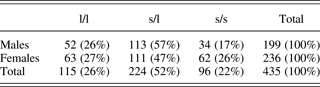
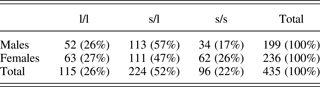
NOS1 ex1f-VNTR has been analyzed as published previously (Reif et al., Reference Reif, Jacob, Rujescu, Herterich, Lang and Gutknech2009). One of the primers was labeled with a fluorescent dye (cy-5; TIB MolBiol, Berlin) enabling detection of the polymerase chain reaction product. Electrophoretic separation of the polymerase chain reaction products was performed using a CEQ8000 DNA sequencer (Beckman–Coulter, Krefeld, Germany). NOS1 ex1f-VNTR alleles were grouped as short (180–196 repeats) and long (198–210 repeats). For the mixed-effect analysis of variance, which incorporated data from two follow-up studies, 2004 and 2007, data of the NOS1 ex1f-VNTR genotype were available for 524 participants. In interaction analysis, data from the 2007 follow-up were used: data of the NOS1 ex1f-VNTR genotype were available for 435 participants (Table 1). Quality control comprises genotyping two constant external controls every 90 samples, as well as genotyping 2% of all samples (randomly) twice. Concordance rates were 100%. The sample has been genotyped in one batch, and the call rate was 91%. Dropouts were due to missing amplicons, and repetition of genotyping dropouts did not result in recovery of genotypes, so we assume that the dropout most likely is due to DNA degradation. Genotypes were in Hardy–Weinberg equilibrium.
Number of nitric oxide synthase 1 exon lf variable number tandem repeat genotypes in the study participants in the 2007 follow-up
Note: l, long allele; s, short allele.
Statistical analysis
Participants were divided into groups with long/long (l/l), l/s, and s/s genotypes. A mixed-effects analysis of variance was used for testing NOS1 genotype, gender, and age effects on personality traits and anxiety. Contrasts were computed for statistically significant effects, using reduced models where nonsignificant independent variables were omitted (with the exception of lower-order terms included in significant interactions). Personality measures were standardized into z scores, indicating how far and in what direction the group deviates from the whole sample's mean expressed in units of its distribution's standard deviation, according to the formula ZX = X − MX/SDX, where ZX accounts for the z score, X for the raw score, M for the sample's mean, and SD for the standard deviation of the mean.
For detecting Gene × Environment (G × E) interaction effects, participants were divided into two groups according to their median score on the family relations subscales. The median score was included in the groups with less aversive family relations and with less stressful life events. To detect the impact of extraversion on the G × E interaction, the participants were split into groups with high versus low extraversion using the median score. Multiple analysis of variance was carried out on data from the 18-year-olds to detect two-way or three-way interaction effects between genotype–family relations and among genotype–family relations–gender on personality, anxiety, and depressiveness. Fisher post hocs are given for a comparison of the groups. The raw scores of personality measures were used in the multiple analysis of variance. An analysis of covariance was used for taking into consideration the effect of impulsivity. The ηp2 values are reported as estimates of effect size.
Results
The effect of NOS1 genotype on neuroticism and extraversion
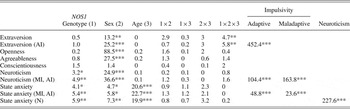
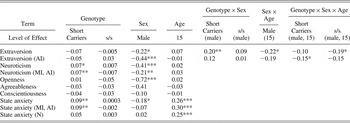
The F statistics for mixed models, including NOS1 genotype, gender, and age as independent variables and personality traits as dependent variables, are presented in Table 2. Contrasts computed for gender, age, and genotype group comparisons are presented in Table 3.
Nitric oxide synthase 1 (NOS1) exon lf variable number tandem repeat genotype effects on aspects of personality and state–anxiety

Note: Because of missing data, the error degrees of freedom vary across analyses: 330–346 for age and interactions involving age and 463–475 for other effects. The F statistics are for terms in the mixed effects models. AI, adaptive impulsivity; MI, maladaptive impulsivity; N, neuroticism. Extraversion (AI), Neuroticism (MI, AI), State anxiety (MI, AI), and State anxiety (N) are F statistics if AI, MI, and N are controlled for in the respective aspects or states.
*p < .05. **p < .01. ***p < .0001.
Nitric oxide synthase 1 exon lf variable number tandem repeat genotype effects on aspects of personality and state–anxiety

Note: Contrasts are in the mixed effects models. The numbers refer to regression coefficients for the respective contrasts. s, short allele; Short Carriers, contrasts s/s + s/long (1) with l/l; s/s, s/s homozygocity contrasts s/s with s/l + l/l. Extraversion (AI), Neuroticism (MI, AI), State anxiety (MI, AI), and State anxiety (N) are contrasts if AI, MI, and N are controlled for in the respective aspects or states. Contrasts for nonsignificant interactions were not computed.
*p < .05. **p < .01. ***p < .0001.
Age had no independent effect on any personality trait. Females scored significantly higher on neuroticism, F (1, 472) = 25.10, p < .0001, ηp2 = 0.096, and extraversion, F (1, 471) = 13.22, p = .0003, ηp2 = 0.053, than males.
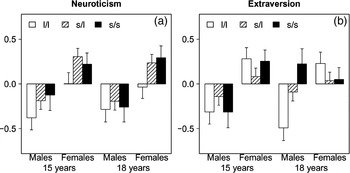
The analysis revealed a significant main effect of the NOS1 genotype on neuroticism, F (2, 472) = 3.26, p = .04, ηp2 = 0.014, indicating that short allele carriers scored higher on neuroticism than adolescents with the l/l genotype (p = .02; Figure 1a). The genotype effect (effect of being an short allele carrier) for neuroticism was independent of adaptive and maladaptive impulsivity, F (2, 464) = 4.89, p = .008, ηp2 = 0.021.
The standardized scores of (a) neuroticism and (b) extraversion in adolescents with nitric oxide synthase 1 long/long (l/l), short (s)/l, and s/s genotypes. The limit bars above and below the symbols indicate 95% confidence intervals.

A three-way interaction effect of NOS1 genotype, gender, and age on the score of extraversion was detected, F (2, 345) = 4.75, p = .009, ηp2 = 0.027. Males carrying a NOS1 short allele had significantly higher scores than males with the l/l genotype (p = .009), while this effect was not observed among females (Figure 1b). At age 15, males with the s/s genotype had lower extraversion than the 15-year-old males with the long allele (p < .03), whereas this effect was not significant among 18-year-old boys. We found that the genotype effect on extraversion in males was partly due to the association between extraversion and adaptive impulsivity: when controlling for adaptive impulsivity, the two-way interaction between genotype and gender did not exist (p = .50); however, the three-way interaction remained statistically significant (p = .004). In females, extraversion did not depend upon genotype.
Because we had recorded personality with scales based on the five-factor model, data were available for other personality traits such as agreeableness, openness to experience, and conscientiousness. Nevertheless, the NOS1 genotype had no effect on these other personality traits of the five-factor model, thus suggesting more specific associations with neuroticism and extraversion.
The effect of NOS1 genotype on anxiety and depressiveness
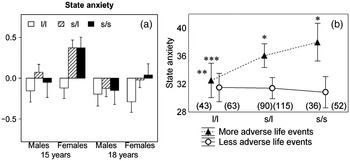
Females had higher scores of state anxiety than males, F (1, 465) = 4.69, p = .03, ηp2 = 0.010. The score of anxiety declined with age, F (1, 335) = 20.70, p < .0001, ηp2 = 0.058. A significant main effect of the NOS1 genotype on state anxiety was found, F (2, 465) = 4.10, p = .02, ηp2 = 0.017, indicating that short allele carriers had higher state anxiety than adolescents with the l/l genotype (p = .007; Figure 2a). The genotype effect (effect of being a short carrier) on state anxiety was independent of maladaptive and adaptive impulsivity, F (2, 455) = 5.38, p = .005, ηp2 = 0.023, and neuroticism, F (2, 460) = 5.86, p = .003, ηp2 = 0.025. No main effect of the genotype on trait anxiety or depressiveness was found.
The nitric oxide synthase 1 genotype and state anxiety. (a) The standardized scores of state anxiety in adolescents with long/long (l/l), short (s)/l, and s/s genotypes. The limit bars above and below the symbols indicate 95% confidence intervals. (b) Gene × Environment interaction effects on state anxiety. *p < .001, different from adolescents with the same genotype and less adverse life events; **p < .05, different from adolescents with the same level of adverse life events and s/l genotype; ***p < .01, different from adolescents with the same level of adverse life events and s/s genotype. The numbers in parentheses are the number of participants in each group. The limit bars above and below the symbols indicate 95% confidence intervals.

NOS1 × Environment interactions on personality, anxiety, and depression
The NOS1 genotype had no interaction effect with family relationships or stressful life events on personality, trait anxiety, and depressiveness. However, stressful life events and the NOS1 genotype interacted in shaping state anxiety. The highest levels of state anxiety were observed in short allele carriers who had experienced more adverse life events, interaction effect F (2, 393) = 3.38, p = .04, ηp2 = 0.017 (Figure 2b). The interaction effect of the NOS1 genotype and the number of stressful life events on state anxiety remained significant when the score of neuroticism, trait anxiety, maladaptive impulsivity, or adaptive impulsivity was added to the analysis as a covariate, F (2, 392) = 3.94, p = .02, ηp2 = 0.020; F (2, 385) = 3.77, p = .02, ηp2 = 0.019; F (2, 375) = 2.99, p = .052, ηp2 = 0.016; or F (2, 373) = 3.75, p = .02, ηp2 = 0.020, respectively.
NOS1 × Environment × Gender interactions in personality, anxiety, and depressiveness
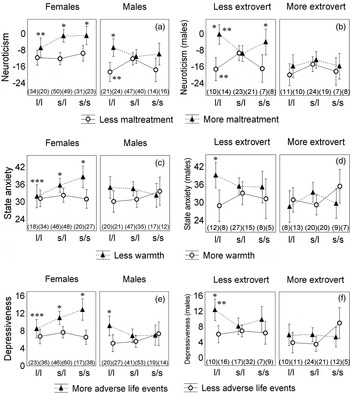
We found a significant three-way interaction effect on neuroticism, dependent on maltreatment in the family, F (2, 357) = 5.06, p = .007, ηp2 = 0.028. There was also a significant three-way interaction effect on state anxiety, dependent on warmth in the family, F (2, 335) = 3.00, p = .05, ηp2 = 0.018, which remained significant after adding the scores of neuroticism, trait anxiety, maladaptive impulsivity, or adaptive impulsivity as a covariate, F (2, 334) = 6.00, p = .003, ηp2 = 0.035; F (2, 328) = 6.99, p = .001, ηp2 =0.041; F (2, 318) = 3.37, p = .04, ηp2 = 0.021; or F (2, 317) = 2.96, p = .05, ηp2 = 0.018, respectively. There were no three-way interaction effects on extraversion or trait anxiety.
NOS1 and gender had a significant interaction effect on depressiveness, dependent on adverse life events, F (2, 382) = 4.08, p = .02; ηp2 = 0.021. The interaction remained significant when each score of neuroticism, state anxiety, maladaptive impulsivity, or adaptive impulsivity was added as a covariate, F (2, 381) = 3.54, p = .03, ηp2 = 0.018; F (2, 378) = 4.48, p = .01, ηp2 = 0.023; F (2, 365) = 3.15, p = .04, ηp2 = 0.017; or F (2, 363) = 2.96, p = .05, ηp2 = 0.016, respectively. When trait anxiety was added as a covariate, the interaction effect remained almost significant, F (2, 374) = 2.91, p = .056, ηp2 = 0.015.
Males
Males with the l/l genotype and higher exposure to environmental adversity had higher neuroticism and depressiveness than men with the same genotype from an advantageous environment. Higher neuroticism was found in l/l males who had experienced more maltreatment in family, and higher depressiveness was found in males with the l/l genotype who had had more adverse life events (Figure 3a, c, e).
Gene × Environment interaction effects on (a, b) neuroticism, (c, d) anxiety, and (e, f) depressiveness. The numbers in parentheses are the number of participants in each group. The limit bars above and below the symbols indicate 95% confidence intervals. (a, c, e) The effect of genotype and environment on males and females. (b, d, f) The effect of genotype and environment dependent upon the level of extroversion. *p < .05, different from adolescents with the same genotype, same sex, and better environmental conditions; **p < .05, different from adolescents with similar environmental conditions, same sex, and short/long (s/l) genotype; ***p < .05, different from adolescents with similar environmental conditions, same sex, and s/s genotype.

Females
Female short allele carriers had higher neuroticism, state anxiety, and depressiveness in cases of adverse environment. Female short allele carriers had higher scores of neuroticism with higher experience of maltreatment, higher scores of state anxiety if having experienced less warmth in family, and higher scores of depressiveness in cases of more adverse life events (Figure 3a, c, e).
NOS1 × Environment × Gender interactions on psychological and somatic symptoms of depressiveness
Based on factor analysis (data not shown), items of the Montgomery–Åsberg Depression Rating Scale were divided into two groups: psychological symptoms of depression (reported sadness, inner tension, lassitude, inability to feel, pessimistic thoughts, suicidal thoughts) and somatic symptoms of depression (reduced sleep, reduced appetite, concentration difficulties).
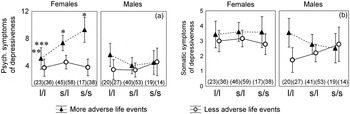
We found a significant three-way interaction effect on psychological symptoms of depressiveness, dependent on adverse life events, F (2, 378) = 3.78, p = .02, ηp2 = 0.020. Females with one or two short alleles and more adverse life events had significantly more psychological symptoms of depressiveness than other female groups. No similar effect was found in males (Figure 4a).
Genotype, adverse life events, and symptoms of depressiveness. (a) Psychological symptoms and (b) somatic symptoms. The limit bars above and below the symbols indicate 95% confidence intervals. *p < .001, different from adolescents with the same genotype, same sex, and fewer adverse life events; **p < .01, different from adolescents with similar environmental conditions, same sex, and short/long (s/l) genotype; ***p < .001, different from adolescents with similar environmental conditions, same sex, and s/s genotype.

There was no significant three-way interaction effect on somatic symptoms of depressiveness, F (2, 381) = 1.75, p = .18, ηp2 = 0.009 (Figure 4b), but when analyzing males separately and comparing short allele carriers with the l/l genotype, there appeared an interaction effect, F (1, 170) = 3.94, p = .05, ηp2 = 0.023: Males with the l/l genotype and more adverse life events had more somatic symptoms of depression than male l/l participants who had fewer adverse life events (p < 0.05). Females showed no significant NOS1 × Adverse Life Events interaction on somatic symptoms of depression.
NOS1 × Environment × Extraversion interactions on neuroticism, anxiety, and depressiveness
NOS1 and extraversion had a significant interaction effect on neuroticism, dependent on maltreatment, F (2, 150) = 3.06, p = .05, ηp2 = 0.039, a significant interaction effect on state anxiety dependent on warmth, F (2, 140) = 3.57, p = .03, ηp2 = 0.048, and a significant interaction effect on depressiveness, dependent on adverse life events, F (2, 162) = 3.04, p = .05, ηp2 = 0.036, in males.
Less extroverted males with the l/l genotype who had lived in a more adverse environment had higher neuroticism, state anxiety, and depressiveness scores than less extroverted males who had lived in a favorable environment. There was no difference between males with different NOS1 genotypes and different environmental conditions among more extroverted males (Figure 3b, d, f).
NOS1, extraversion, and environment had a significant interaction effect on female depressiveness, F (2, 208) = 3.48, p = .03, ηp2 = 0.032. In contrast to what was found in males, females with low extraversion had significantly higher scores of depressiveness if they had been experiencing more adverse life events recently and had the s/s genotype (data not shown).
Discussion
The results of the present study indicate that the functional NOS1 ex1f-VNTR polymorphism is associated not only with impulsivity (Laas et al., Reference Laas, Reif, Herterich, Eensoo, Lesch and Harro2010; Reif et al., Reference Reif, Kiive, Kurrikoff, Paaver, Herterich and Konstabel2011) but also with basic personality traits and state anxiety in the general population. While the effect of the genotype on neuroticism and state anxiety was independent of gender, the effect on extraversion was present only in males. NOS1 genotype interaction with life events appears to be gender specific.
Among psychiatric patients, subjects with the s/s genotype present a more severe course of the disorder, higher depression ratings, and lower scores in global assessment of functioning (Reif et al., Reference Reif, Herterich, Strobel, Ehlis, Saur and Jacob2006). In the general population, male s/s homozygotes have higher adaptive impulsivity (Laas et al., Reference Laas, Reif, Herterich, Eensoo, Lesch and Harro2010; Reif et al., Reference Reif, Kiive, Kurrikoff, Paaver, Herterich and Konstabel2011). In the present analysis, we have found that adolescents carrying the short allele have higher neuroticism and state anxiety than participants with the l/l genotype. Although aspects of impulsivity are included in neuroticism in the five-factor model of personality, impulsivity did not explain the genotype effect on neuroticism. It appears that the environment-independent effects of the NOS1 ex1f-VNTR genotype on neuroticism and the adaptive side of impulsivity are at least in part separate.
Higher neuroticism and state anxiety leads to higher sensitivity toward life events (Homberg & Lesch, Reference Homberg and Lesch2011). Therefore, people with NOS1 short alleles should be more sensitive to adversities in the environment. Accordingly, participants with the s/s genotype were found to describe themselves as more thoughtless and disinhibited persons, if having unfavorable relations in their family (Reif et al., Reference Reif, Kiive, Kurrikoff, Paaver, Herterich and Konstabel2011). The result of the short allele carriers being more vulnerable to adverse environment was found again in the present analysis, as adolescents carrying the short allele had high state anxiety if having been subjected to an adverse environment. In addition, female participants with the short allele and experience of adverse environment had higher neuroticism and depressiveness. This supports the notion that adverse life events interact with the risk allele to increase impulsivity in males and neuroticism/depressiveness in females, that is, the preponderant sex-specific sequelae of life adversity: While males may be imprisoned, females seek treatment. Thus, adverse environment leads to different psychological outcomes in males and females dependent on the NOS1 genotype. More difficult to explain, however, is the finding that in males this association was reversed in a way that, after experiencing an adverse environment, males with the l/l genotype had higher neuroticism and depressiveness. One can only speculate how such a balanced selection effect might make sense: Under positive conditions, male short allele carriers feature the advantageous genotype in that they display increased adaptive impulsivity (Reif et al., Reference Reif, Kiive, Kurrikoff, Paaver, Herterich and Konstabel2011) and extraversion. In the presence of life adversity, s/s carriers have to pay the price in featuring higher maladaptive impulsivity and an accordingly increased risk for related psychopathology. On the contrary, male l/l participants have lower impulsivity and extraversion, and could be led by an adverse environment to anxiety and affective disorders. If that is true, we would expect a G × E interaction in a way that male short allele carriers compared to the l/l participants are less prone to clinical depression, especially in the absence of an adverse life event, which is a hypothesis that seems worthy of testing in further studies.
Thus, our results support the notion that “vulnerability genes” or “risk alleles” could sometimes be more appropriately conceptualized as “plasticity genes” because they seem to make individuals more susceptible to environmental influences for better and for worse (Belsky et al., Reference Belsky, Jonassaint, Pluess, Stanton, Brummett and Williams2009). Genetically driven deficits would not have been maintained throughout evolution if they only exerted negative effects without conveying any gain of function. This plasticity gene effect on functional outcomes has been described for other genes. For example, most of serotonin transporter linked polymorphic region gene studies associate short allele carriers with maladaptive phenotypes like anxiety-related traits and increased risk for depression in interaction with psychosocial adversity across the life span. However, humans and nonhuman primates carrying the short variant of the serotonin transporter linked polymorphic region gene outperform subjects carrying the long allele in an array of cognitive tasks and show increased social conformity (Homberg & Lesch, 2010). In addition, children with the s/s genotype were more likely to respond to cognitive behavior therapy than those carrying a long allele (Eley et al., Reference Eley, Hudson, Creswell, Tropeano, Lester and Cooper2012) and on average their higher neuroticism wanes during the transition from childhood to adolescence and adulthood, suggestive of a complex adaptive capacity (Harro et al., Reference Harro, Merenäkk, Nordquist, Konstabel, Comasco and Oreland2009). Thus, depending on environment and task, short allele carriers who appear to be characterized by general hypervigilance may react in either a less adaptive manner, with increased negative emotionality, or with more successful adaptation, based on cognitive regulation (Homberg & Lesch, 2010). The plasticity gene effect has also been described for the monoamine oxidase A gene (MAOA). Individuals with the less active version of the MAOA gene usually display higher levels of antisocial and risky behavior when they have experienced maltreatment in childhood, but they score lowest in antisocial behavior if they have not been exposed to child maltreatment (Belsky et al., Reference Belsky, Jonassaint, Pluess, Stanton, Brummett and Williams2009). In an experimental gambling task, participants with the low MAOA activity genotype engaged in more risky behavior only when it was advantageous to do so (Frydman, Camerer, Bossaerts, & Rangel, Reference Frydman, Camerer, Bossaerts and Rangel2011).
Thus, subjects carrying the gene variants that can make them more vulnerable may not only passively benefit from the more advantageous environments but also might acquire active successful strategies to prevent devastating effects from their inherited vulnerability and turn vulnerability into success (Harro, Reference Harro2010).
We found that the NOS1 ex1f-VNTR genotype affects extraversion in males. Male short allele carriers also have higher adaptive impulsivity (Reif et al., Reference Reif, Kiive, Kurrikoff, Paaver, Herterich and Konstabel2011). These two constructs are not dissimilar: Both include components that reflect dominance or even overt aggressiveness, such as activity and assertiveness. Analysis of covariance suggested that association of the NOS1 genotype with extraversion is related to its effect on adaptive impulsivity. Comparable results have been found in mouse studies: male mice lacking the Nos1 gene display more aggression-like behavior, which includes high locomotor activity, similar to extraversion and impulsivity in humans, whereas there was no such difference among female mice (Nelson, Trainor, Chiavegatto & Demas, Reference Nelson, Trainor, Chiavegatto and Demas2006). Furthermore, in male mice, administration of a nNOS inhibitor prevented the chronic mild stress-induced behavioral despair (Zhou et al., Reference Zhou, Hu, Hua, Hu, Luo and Han2007). Extraversion is negatively associated with depressiveness (Chioqueta & Stiles, Reference Chioqueta and Stiles2005), and, therefore, the short allele leading males toward being more active and extroverted may prevent them from being increasingly depressed in adversity. That might also be an explanation as to why adverse environmental conditions affected males with the l/l genotype. Sensitivity to stressful conditions appeared only in males with the l/l genotype if they also had low extraversion (Figure 3f).
Males with the l/l genotype had more somatic symptoms of depression after experiencing multiple stressful life events, but there was no significant difference in psychological symptoms of depression. In contrast, women carrying the short allele had more psychological symptoms of depressiveness. Although the vast majority of people make initially exclusively somatic presentations to physicians in cases of depression (Kirmayer, Robbins, Dworkind, & Yaffe, Reference Kirmayer, Robbins, Dworkind and Yaffe1993), women might be more prone to psychologization of their distress, which is the tendency to express distress in cognitive or affective terms.
Personality scores did not differ between 15- and 18-year-old participants, but state anxiety was lower in 18-year-old participants. While emotional stability starts to increase already from adolescence (Roberts, Walton, & Viechtbauer, Reference Roberts, Walton and Viechtbauer2006), this might be a result of maturing revealed in changes at state and not at trait level. Although we did not find age (15 to 18 years) being associated with personality traits, we found that extraversion was lower in 15-year-old males with the s/s genotype but higher in short allele carriers in males. This difference appeared mainly due to the increasing score of extraversion in s/s homozygotic males during the 3 years. As the prefrontal cortex is still developing in adolescents (Insel, Reference Insel2010) and its functioning is most impaired in the short allele homozygotes (Reif et al., Reference Reif, Jacob, Rujescu, Herterich, Lang and Gutknech2009), we might hypothesize that development of the prefrontal cortex and functions associated with it might in adolescent years be most detectable in male short allele homozygotes.
Conclusion
In addition to impulsivity as previously demonstrated, NOS1 ex1f-VNTR associates with neuroticism, extraversion, anxiety, and depressiveness in the general population. These associations are dependent on environmental adversity and are gender dependent. Clearly, because of the exploratory nature of some of the analyses, issues of multiple testing have to be considered in the interpretation of the data. However, the true number of independent tests is difficult to estimate, owing to high correlations between neuroticism, state anxiety, and depressivity. A possibility exists that discovered interaction effects are found by chance and replications in independent data sets are awaited with further studies. However, although in three-way interaction analysis the groups have remained quite small, the effect sizes in our study that on average explain 1% of the variance can be considered large for G × E studies and power adequate (Duncan & Keller, Reference Duncan and Keller2011). Further studies that also incorporate functional imaging data are warranted to disentangle the effect of the NOS1 and other putative plasticity genes on personality and psychopathology.