

Today, many school-aged students in Australia experience excessive anxiety in complex and varied ways. Anxiety disorders are the most prevalent mental health problem experienced by adolescents, with 7% of young people aged from 12 to 17 years old experiencing clinically significant levels of anxiety (Lawrence et al., Reference Lawrence, Hafekost, Johnson, Saw, Buckingham, Sawyer and Zubrick2016). While the presence of excessive anxiety later in life is often first experienced in childhood, anxiety is generally found to be more severe in adolescence (Costello, He, Sampson, Kessler, & Merikangas, Reference Costello, He, Sampson, Kessler and Merikangas2014). Often, anxious adolescents have other psychiatric disorders (Essau, Reference Essau2003), including eating disorders (Kaye et al., Reference Kaye, Bulik, Thornton, Barbarich and Masters2004) and depression (Mathew, Pettit, Lewinsohn, Seeley, & Roberts, Reference Mathew, Pettit, Lewinsohn, Seeley and Roberts2011). Adolescents with severe anxiety symptoms have been found to withdraw from social interactions, isolate themselves from peers and spend less time with close friends (Biggs, Vernberg, & Wu, Reference Biggs, Vernberg and Wu2012), and may have difficulty developing and maintaining long-term friendships (van Ameringen, Mancini, & Farvolden, Reference Van Ameringen, Mancini and Farvolden2003).
In school, adolescents with excessive anxiety may experience less success with academic achievement as severe anxiety often impedes performance by impacting concentration and, in turn, the ability to effectively complete assignments and exams (Kim, Thayne, & Wei, Reference Kim, Thayne and Wei2017; van Ameringenet et al., 2003). These consequences may influence an adolescent’s self-esteem and school enjoyment, making school attendance a difficult task, often leading to greater occurrences of absenteeism, suspensions and expulsions (Skedgell, & Kearney, Reference Skedgell and Kearney2016). In addition, an anxiety disorder developed in adolescence is a strong predictor for continuing anxiety issues or development of other psychological disorders in adulthood (Beidas et al., Reference Beidas, Mychailyszyn, Edmunds, Khanna, Downey and Kendall2012; Headley & Campbell, Reference Headley and Campbell2013; Reardon et al., Reference Reardon, Spence, Hesse, Shakir and Creswell2018).
Despite high prevalence rates and available intervention options, adolescents struggling with excessive anxiety are often under-identified and under-referred (Allison, Nativio, Mitchell, Ren, & Yuhasz, Reference Allison, Nativio, Mitchell, Ren and Yuhasz2014). Studies suggest that adolescents are reluctant to seek professional help of their own accord and rely on adults to help them to access mental health services (Costello et al., Reference Costello, He, Sampson, Kessler and Merikangas2014). Parents are generally the first point of contact for many young people suffering with excessive anxiety. However, even though parents may be aware of their child’s difficulties with anxiety, their perception of what constitutes excessive anxiety determines the likelihood that they will initiate the help-seeking process (Sayal, Reference Sayal2006). Studies suggest that compared to other children, adolescents with an anxiety disorder are more likely to have a parent with anxiety difficulties (Hettema, Neale, & Kendler, Reference Hettema, Neale and Kendler2001). When parents experience anxiety themselves, they may perceive excessive anxiety displayed by their children as ‘normal’ behaviour. Furthermore, even when parents understand that there is a problem, they may view mental health treatment as irrelevant or unhelpful (Girio-Herrera, Owens, & Langberg Reference Girio-Herrera, Owens and Langberg2013; Teagle, Reference Teagle2002).
Consequently, it is important that other avenues of receiving help are explored to ensure that when or if adolescents report anxiety difficulties, they are referred accordingly. Young people spend a large amount of their time at school, which marks education settings as a practical place for them to receive help (Rickwood, Deane, Wilson, & Ciarrochi, Reference Rickwood, Deane, Wilson and Ciarrochi2005; Shiffrin et al., Reference Shiffrin, Brockveld, McLellan, Crawford, Kagan, Hudson, Kendall, Thielking and Terjesen2017). Thus, teachers may be better equipped to help identify and refer adolescents with excessive anxiety to in-school support services.
Primary School Teachers’ Recognition and Referral of Anxiety
Primary school teachers have been shown to be able to accurately identify students with elevated levels of anxiety; however, they are more likely to refer children with externalising anxiety symptomology such as social difficulties, as opposed to behaviours that are internalising in nature, such as perfectionism (Headley & Campbell, Reference Headley and Campbell2011; Molins & Clopton, Reference Molins and Clopton2002; Pearcy, Clopton, & Pope, Reference Pearcy, Clopton and Pope1993). Anxiety is internalising in nature, which suggests that these emotional difficulties are directed towards the individual rather than being ‘acted out’ in the environment (Cunningham & Suldo, Reference Cunningham and Suldo2014). Thus, support services such as school counsellors generally receive more referrals from primary school teachers concerning behavioural problems such as attention deficit hyperactive disorder (ADHD) or aggression rather than anxious children whose mental health is ‘less disruptive’ in the classroom (Dwyer, Nicholson, & Battistutta, Reference Dwyer, Nicholson and Battistutta2006).
Role of Secondary School Teachers
Teachers play an important role in the lives of their students. They are able to observe adolescents daily in various settings such as lunch time (interactions with peers), camps, class work and assessment time, giving them insight into an adolescent’s world that no one else can provide (Auger, Reference Auger2004). These are situations in which anxiety is often identifiable. However, many teachers have received little to no training in mental health as part of their qualifications, and have reported feeling ill equipped to identify and manage students’ mental health needs (Gowers, Thomas, & Deeley Reference Gowers, Thomas and Deeley2004; Rothi, Leavey, & Best, Reference Rothi, Leavey and Best2008).
Trudgen and Lawn (Reference Trudgen and Lawn2011) interviewed 20 teachers from secondary colleges in regional Australia to explore their understanding of mental health issues in young people. Most teachers involved in the study struggled to recognise adolescents with excessive anxiety and generally relied on their own instinct when deciding whether to act on their concerns. These results are consistent with Papandrea and Winefield’s (Reference Papandrea and Winefield2011) study, which found that secondary school teachers in Australia felt pressured in their attempts to refer students with anxiety, yet did not feel adequately equipped to do so. Furthermore, the authors suggested that over 85% of teachers reported they would be more likely to refer students who disrupt classroom learning (i.e., externalising behaviours), compared to students with internalising problems (i.e., perfectionism and shyness). Teachers have also identified lack of confidence in correct identification, lack of resources, and time restrictions as barriers to recognition and referral of children with excessive anxiety (Reardon et al., Reference Reardon, Spence, Hesse, Shakir and Creswell2018).
Identification Factors in Teachers’ Ability to Identify and Refer Excessively Anxious Adolescents
Teachers’ age, gender, background, university training, subject they predominantly teach and professional development are all factors that may influence their ability to identify and refer students with severe anxiety symptoms. For example, a secondary teacher’s position in a school (i.e., year-level coordinator) was found to be associated with a better understanding of anxiety in students when compared to teachers of subject areas (Trudgen & Lawn, Reference Trudgen and Lawn2011). Perhaps English and Mathematics teachers are more likely to observe symptoms of elevated anxiety in students due to the high-stakes nature of these subjects. Alternatively, the status of English and Mathematics as core units of learning may mean that these teachers have higher contact time with students, leading to greater understanding of each student’s needs and therefore higher referral rates.
Teacher gender may also influence referral, with female primary teachers being more inclined to refer anxious students to school support services than male teachers (Headley & Campbell, Reference Headley and Campbell2011). The influence of teacher gender on referral rates has received little research, with none exploring this factor in secondary schools. It has been hypothesised that cultures around mental health problems and gender may influence teachers’ decisions about referral (Headley & Campbell, Reference Headley and Campbell2011). The higher social acceptance for females to express anxiety compared with males (McLean & Hope, Reference McLean and Hope2010; Stevenson-Hinde & Shouldice, Reference Stevenson-Hinde, Shouldice, Rubin and Asendorpf1993) may also lead female teachers to refer more often.
Teachers may also be reluctant to refer their concerns on due to time pressures, and many have had little to no training in mental health as part of their qualifications (Papandrea & Winefield, Reference Papandrea and Winefield2011). Similarly, Hinchcliffe and Campbell (Reference Hinchcliffe and Campbell2016) found that teachers often considered whether their school had capacity to support a student before making a decision to refer. These considerations and pressures may lead teachers to refer only the most severe cases of student anxiety, making early intervention difficult.
The Present Study
The negative consequences and high prevalence rates of excessive anxiety in adolescents emphasises the need for better identification and referral of young people. Given the amount of time adolescents spend at school, teachers can play a significant role by referring young people to the school counsellor or other support services such as psychologists and community agencies. There is scant evidence of secondary school teachers’ identification and referral of excessively anxious adolescents. Studies have been conducted regarding primary teachers’ ability to correctly identify and refer anxious students for further support. Secondary teachers’ ability in this area may differ significantly, for two reasons. The first could be differences in teacher training, which is more concerned with curriculum content such as mathematics rather than student development. The second could be the nature of secondary school, where teachers only see students in classes a few times a week and not continuously as in primary school. Therefore, this study investigated how likely secondary school teachers are to appropriately refer adolescents for school counselling or other mental health support, depending on the severity of anxiety symptoms. We hypothesised that secondary school teachers would not be as accurate in identifying anxiety symptoms as primary teachers. Furthermore, the influence of the teachers’ gender was explored to determine how this impacted their ability to recognise and refer students.
Method
Participants
One hundred and twenty secondary school teachers were recruited from seven independent religious schools in an urban Australian city. Seven participants were excluded from the sample due to missing data, leaving 113 participants whose data were included. Almost all age groups (20–59 years) except those over 60 years were equally represented in the sample, with a similar proportion of males (n = 56, 49.5%) and females (n = 57, 50.5%). The three subjects taught most frequently by the sample were English (n = 28, 18.7%), Mathematics (n = 24, 16%) and Science (n = 22, 14.7%). The mean years of teaching were 14.5 years, with a range from 1 year to 41 years.
Measures
The Teachers’ Anxiety Identification and Referral Questionnaire for Adolescents was modified from the TAIRQ for primary students to be suitable for secondary school students (Headley & Campbell, Reference Headley and Campbell2011). It is a self-report questionnaire (see Appendix) that consists of two parts. The first includes demographic information including age, gender, number of years that the participant has been teaching, and subjects most frequently taught. Participants were also asked to indicate whether they had referred a student for any mental health treatment within the past two years; referral options included school guidance counsellor, community agencies or a psychologist. These survey questions required teachers to indicate their responses through ticking a box, as well as identifying the number of students they had referred for mental health support.
The second part of the questionnaire consists of five vignettes that describe adolescents experiencing anxiety of varying severity and a final question that required participants to rank the vignettes according to priority of referral. The vignettes were based on the TAIRQ used in previous research (Headley & Campbell, Reference Headley and Campbell2011; Pearcy et al., Reference Pearcy, Clopton and Pope1993). Headley and Campbell’s vignettes used for primary school teachers were adapted for this study by changing the age of the students in the vignettes to reflect adolescents. The vignettes were then cross-referenced with anxiety symptomologies according to the Diagnostic and Statistical Manual of Mental Disorders (5th ed., DSM-5; American Psychiatric Association, 2013) to ensure that they still accurately reflected anxiety experienced by adolescents, which they did. For example, the vignette describing moderate anxiety symptoms was: ‘Fatima is a shy 14-year old girl who prefers to sit alone during morning tea and lunch. Sometimes, she seems nervous when her peers attempt to engage her in social settings. When group activities are conducted in the classroom she participates, however, she is noticeably uncomfortable. When she is alone she is creative and active.’
For each vignette, teachers were asked whether or not they would refer the student for support. Responses were recorded using a 5-point Likert-type scale, with responses including Definitely would not (1), Possibly would not (2), Neutral/not sure (3), Possibly would (4) and Definitely would (5). The participants were finally asked to prioritise the vignettes according to severity of anxiety symptoms. This involved ranking the vignettes according to who they would Definitely refer (1), Possibly refer (2), Neutral/not sure (3), Possibly not refer, and they would Definitely not refer (5). Measurement of teachers’ ability to identify severity of anxiety symptoms was based on how they ranked the vignettes correctly from very severe anxiety to minimal anxiety.
Procedure
Ethical approval was obtained from a Queensland university. Independent secondary schools in the capital city area were then contacted to request permission for the researcher to attend staff meetings to administer the questionnaire. After explaining the purpose of the project, teachers were invited to participate in the study by completing a paper questionnaire that required approximately 10–15 minutes.
Data Analysis
Prior to conducting statistical analyses, the assumptions of parametric statistics were inspected for continuous variables. The Shapiro-Wilk test was used to check the statistical significance of normal distribution of the continuous variables at alpha = .001. The main multivariate analysis technique used for testing the hypotheses included the one-sample Wilcoxon test to estimate how the sample median compared to the target or reference value (Lehmann, Reference Lehmann2009). Spearman’s rank non-parametric correlation coefficients were used to test for statistically significant associations between the severity of the anxiety described by the teachers and the decision to refer. A .05 level of significance was used as the criteria for statistical significance for all multivariate analysis. Tests of normality indicated that the variables could not be assumed to be from a normally distributed population at alpha = .001; therefore, non-parametric statistics and techniques were used.
Results
The results from the one-sample Wilcoxon tests indicated that the median anxiety ratings given by the sample were equal to the actual anxiety ratings for the respective vignettes. The effect sizes obtained for all the tests indicated small effect and are shown in Table 1.
Teachers Ranking of Vignettes from Most Anxious to Least Anxious Symptoms of Anxiety

Note: n = 113. aBased on need of referral, Likert scale where 1 = Definitely would refer and 5 = Definitely would not refer.
Rankings assigned were all significantly different from actual vignette rankings. The vast majority (n = 83, 72.8%) of teachers indicated that they had referred a student to either the school counsellor, community agencies or psychologist for any mental health treatment for any social, emotional or behavioural problem in the past two years. A majority of the teachers indicated that they had referred the students to the school counsellor (n = 81, 68.6%). The average number of students that teachers referred for any mental health treatment in the past two years was 9.24 (SD = 16.4). However, there was one outlier in the sample who referred 100 students, thus the median number of referrals made by the teachers in the sample was 5 (IQR = 8).
Identifying Students in Need of Referral
Teachers correctly ranked the need for referral for the vignettes involving highest and lowest levels of anxiety symptoms. However, they reported the vignette involving mild anxiety symptoms as in greater need of referral than that involving severe anxiety symptoms. For the vignette in which the student presented with very severe anxiety symptoms, the most popular response was Definitely refer (n = 69, 60.5%). For the vignette in which the student presented with severe anxiety symptoms, the most popular response was Neutral/Not sure (n = 40, 35.1%). For the vignette in which the student presented with moderate anxiety symptoms, the most popular response was Possibly not refer (n = 46, 40.4%). For the student vignette presenting with mild anxiety symptoms, the most popular response was Possibly refer (n = 41, 36%). For the vignette in which the student showed minimal anxiety symptoms, the most popular response was Definitely not refer (n = 95, 83.3%). The responses to this question are summarised in Table 1.
Influence of The Severity of Student Anxiety and Teacher Decision to Refer
A correlation matrix using Spearman’s rank non-parametric correlation coefficients indicated that there were significant negative correlations between the severity of anxiety described by the teachers and the decision to refer for minimal anxiety symptoms (r = -.404), mild anxiety symptoms (r = -.492), moderate anxiety symptoms (r = -.597), severe anxiety symptoms (r = -.674), and very severe anxiety symptoms (r = -.482).
Influence of Teacher Gender
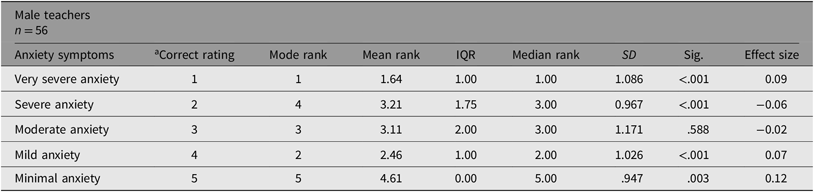
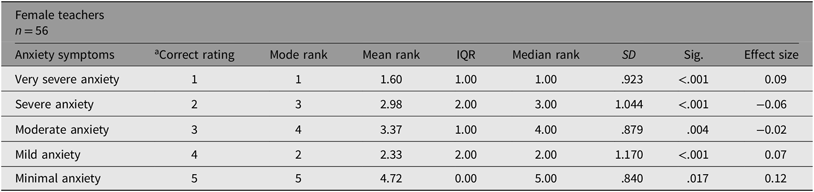
The results from the one-sample Wilcoxon tests by gender are summarised in Tables 2 and 3. There was no significant difference between the identification and referrals between male and female teachers.
Median Rank Assigned According to Teacher Gender — Males
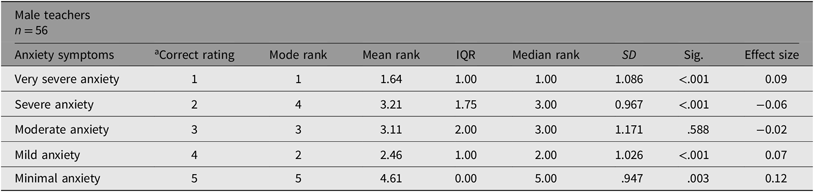
Note: aBased on need of referral, Likert scale where 1 = Definitely would refer and 5 = Definitely would not refer.
Median Rank Assigned According to Teacher Gender — Females

Note: aBased-on need of referral, Likert scale where 1 = Definitely would refer and 5 = Definitely would not refer.
Discussion
This study investigated secondary school teachers’ ability to recognise anxiety symptoms of different severity in adolescents and refer them for in-school counselling or other mental health support. Furthermore, the teachers’ gender was examined to see whether this influenced their decision to recognise and refer students with excessive anxiety. The data indicated that secondary school teachers had limited ability to distinguish between adolescents with mild, moderate and severe anxiety but were able to recognise very severe anxiety disorders in students.
One explanation for this is the characteristics of the symptoms described in the vignettes. Teachers were more likely to refer the student in the vignette describing mild anxiety who presented with external problems, that is, ‘tends to seek excessive attention from her teacher’. Where the vignette described severe anxiety and no behavioural difficulties (i.e., high achieving student, fear of making mistakes always striving for ‘perfect work’) the student was often not considered as being anxious. One teacher wrote, ‘she may be a perfectionist but this can be normal teenage behaviour’.
These results are similar to previous studies that found teachers were more likely to refer students with behaviour difficulties rather than anxious children whose mental health difficulties can be ‘less disruptive’ in the classroom (Dwyer et al., Reference Dwyer, Nicholson and Battistutta2006; Papandrea & Winfield, 2011). Thus, adolescents presenting with excessive anxiety with a concomitant disruptive behaviour are often more likely to be identified as needing support, whereas young people struggling with excessive anxiety who do not disrupt classroom learning — for example, presenting as quieter — lots of absenteeism or disengaged behaviour may not be recognised or referred for the support they need (Papandrea & Winefield, Reference Papandrea and Winefield2011). Similarly, the findings in this study suggest that while teachers are able to recognise very severe or minimal anxiety symptoms, they may have difficulty differentiating between anxiety symptoms that are considered to be problematic or a potential precursor to an anxiety disorder. This lack of recognition may mean that anxious students who could benefit from early intervention are not receiving the support they need.
This is a worrying finding, as early intervention in the course of any anxiety disorder is important to prevent the negative consequences that can disrupt an adolescent’s developmental trajectory. We know that if adolescents are not treated for anxiety disorders their educational attainments can be lower, as well as their anxiety disrupting their peer relationships (Kochel, Ladd, & Rudolph, Reference Kochel, Ladd and Rudolph2012; Patalay, Deighton, Fonagy, & Wolpert, Reference Patalay, Deighton, Fonagy and Wolpert2015). These difficulties can lead not only to school difficulties such as absenteeism, suspensions and expulsions (Skedgell & Kearney, Reference Skedgell and Kearney2016), but also future problems such as substance abuse (Fergusson & Woodward, Reference Fergusson and Woodward2002).
This study also found that teachers’ decision to refer an adolescent with anxiety was influenced only if the anxiety was extremely severe. With little research investigating secondary school teachers’ recognition and referral of students with excessive anxiety, these findings may provide a better understanding of Papandrea and Winefield’s (Reference Papandrea and Winefield2011) and Trudgen and Lawn’s (Reference Trudgen and Lawn2011) studies. Both studies found that teachers felt pressured yet ill equipped to refer students with anxiety. They also indicated that teachers often have no formal mental health training and thus only rely on their intuition to determine whether or not a student requires additional assistance (Papandrea & Winefield, Reference Papandrea and Winefield2011; Trudgen & Lawn, Reference Trudgen and Lawn2011). Similarly, Hinchcliffe and Campbell (Reference Hinchcliffe and Campbell2016) found that while primary teachers do have some ability to recognise and refer children with anxiety, they would consider whether their school could support the student before making a decision to refer. That is, often schools may not have the resources to cater to the number of students teachers think may be struggling with excessive anxiety and therefore decide not to refer them to the counsellor for support.
Surprisingly, given the findings of Headley and Campbell (Reference Headley and Campbell2011), who found that female primary teachers were more likely to refer anxious children to support services than male teachers, in this study there were no significant differences between male and female teachers’ referral ratings of excessively anxious students. One possible explanation could be that there are usually more male teachers in secondary schools than in primary, and often more male counsellors, so modelling of referrals by males could affect male teachers’ decisions. However, because of the scant amount of research on this topic, these results would need to be replicated.
There are some limitations in this study that are important to consider. First, the teachers who participated in the study were all from independent religious schools. These schools might be distinct when examining student wellbeing when compared to public schools as they often highly value pastoral care where teachers are encouraged to look out for students who may be struggling with emotional problems. The lack of diversity among participants may also be a limiting factor for generalisation, as the participating schools were all located in an urban Australian city and therefore would not represent rural population samples. Further, although vignettes are frequently used to examine decision-making processes, teachers’ responses may have differed from how they would respond in real life. Future research could consider examining the type of referrals actually received by a secondary school counsellor to determine whether teachers are referring adolescents with excessive anxiety.
Implications for Practice
We know from previous studies with primary school teachers that they have an understanding of anxiety and appreciate the multidimensional features of anxiety, but have difficulty appreciating that anxiety is on a continuum from adaptive to maladaptive (Headley & Campbell, Reference Headley and Campbell2013). It is not known whether secondary teachers also have a basic understanding of anxiety but see anxiety only as an inability to cope or manage. Preservice and in-service courses on young people’s mental health is needed, which is hopefully being provided by the Australian government’s initiative of Be You (https://beyou.edu.au/). However, knowledge of the signs and symptoms of maladaptive anxiety is not enough, as teachers need to then recognise these in their students. Perhaps screening tools, such as the five-item Screen for Child Anxiety Related Emotional Disorders (SCARED; Birmaher, Brent, Chiappette, Bridge, Monga, & Baugher, Reference Birmaher, Brent, Chiappetta, Bridge, Monga and Baugher1999), could supplement teachers’ observations of students. After the recognition of students in need of treatment, teachers need to refer these young people to the school counsellor or other support services such as psychologists and community agencies. Increasing partnerships with adolescent mental health professionals could strengthen secondary school teachers’ self-efficacy to refer these students. Additionally, we know that some teachers are reluctant to refer to the school counsellor because of their perceptions that the school counsellor is overloaded with assessment cases and does not have time for counselling (Bell & McKenzie, Reference Bell and McKenzie2013). To solve this problem, perhaps a two-day referral process where all students who are of concern to a teacher are discussed (see Campbell, Reference Campbell2003).
Conclusion
The current study found that secondary school teachers are able to identify adolescents struggling with extremely severe anxiety, but may see excessive anxiety behaviours that are less disruptive to the classroom as normal teenage behaviour. This is important to consider, as many adolescents struggling with excessive anxiety may not receive the support they need. However, if teachers are better equipped to identify and refer students struggling with anxiety who are less obvious or disruptive in nature, more young people will be able to access adequate professional mental health support. This could be accomplished by including more mental health education in preservice teacher education programs or by delivering professional in-service development for practising teachers.
Most studies examining the role teachers play in supporting anxious students have focused on primary schools only. The present study specifically asked whether secondary school teachers would refer students to the school counsellor. School counsellors often act as triage in helping adolescents access the help they require when struggling with anxiety; however, the barriers that keep adolescents from self-referring and lack of effective identification by teachers means that many adolescents may not ever receive this support. The findings of this study highlight the need for better training for teachers to provide them with the knowledge needed to recognise students with excessive anxiety and system changes for them to have more resources to which to refer students.
Financial support
This research received no specific grant from any funding agency, commercial, or not-for-profit sectors.
Conflicts of interest
None.
Ethical standards
The authors assert that all procedures contributing to this work comply with the ethical standards of the relevant national and institutional committees on human experimentation and with the Helsinki Declaration of 1975, as revised in 2008.
Appendix Teacher Questionnaire
Please complete the following questions by ticking the relevant box or writing a response.
1. Age: □ 20–29 years
□ 30–39 years
□ 40–49 years
□ 50–59 years
□ 60+
2. Gender: □ Female
□ Male
3. How many years have you been teaching? ____________________ years
4. The subject you most frequently teach: □ English
□ Religious Education
□ Business Studies
□ Creative Arts
□ Health and Physical Ed
□ Languages
□ Learning Support
□ Mathematics
□ Science
□ Social Science
□ Technology
4. In the past two years, have you referred a student for any mental health treatment for any social, emotional or behavioural problems?
□ Yes
□ No
If yes, how many students have you referred? ____________________________
If yes, who did you refer the student/students to?
□ Guidance Counsellor/School Counsellor
□ Community Agency (e.g. Headspace)
□ Psychologist
□ Other (Please specify below)


Please read the following vignettes and answer the corresponding questions:
As you are aware, students are usually prioritised to see the School Counsellor. Therefore, we would like you to rank the vignettes according to children you would definitely refer (1) to students you would definitely not refer (5) (please place a number in the corresponding box):
▪ Aki
▪ Emma
▪ Mark
▪ Fatima
▪ Sarah
PLEASE CHECK THE PAGES CAREFULLY TO ENSURE THAT YOU HAVE NOT MISSED ANY QUESTIONS.