




No CrossRef data available.
Article contents
- Abstract
- The Transition to Adulthood as a Period of Personal and Role Change
- Demographic Influences on the Transition to Adulthood
- Hypothesized Effects of Cluster A PD Symptoms on Adult Role Assumption
- Hypothesized Relationships Between Adult Role Assumption and Persistence in Cluster A Symptoms
- Method
- Results
- Discussion
- References
Adolescent Cluster A personality disorder symptoms, role assumption in the transition to adulthood, and resolution or persistence of symptoms
Published online by Cambridge University Press: 12 May 2005
Article contents
- Abstract
- The Transition to Adulthood as a Period of Personal and Role Change
- Demographic Influences on the Transition to Adulthood
- Hypothesized Effects of Cluster A PD Symptoms on Adult Role Assumption
- Hypothesized Relationships Between Adult Role Assumption and Persistence in Cluster A Symptoms
- Method
- Results
- Discussion
- References
Abstract
Cluster A odd or eccentric personality disorder (PD) symptoms may reflect a schizophrenia spectrum biological vulnerability in at least some persons. Consequently, this symptom pattern may have particularly negative effects on the transition from adolescent to adult roles. A general population sample of 200 young adults was assessed on Cluster A PD at mean ages 17 and 22, and subsequently provided detailed narratives about their monthly experiences and behaviors between these two ages. Adolescent Cluster A PD was related to the developmental trajectories of residential, career, financial, romantic, and family formation roles during this period, and trajectories were related to a change in symptoms over this period. Symptoms were associated with early parenthood and less advanced education, but for other developmental outcomes tended to differ for men and women. These gender differences were attributable, in part, to the differential meaning and consequences of early parenthood for men and women.
This work was funded by NIMH Grant MH-54161 to Patricia Cohen, and by the New York State Office of Mental Health.
Information
- Type
- Research Article
- Information
- Copyright
- © 2005 Cambridge University Press
Persons with schizophrenia are likely to experience a first onset of severe problems in late adolescence or early adulthood (American Psychiatric Association, 1994). These problems severely impair adult role function for many with this disorder. Cluster A schizotypal, schizoid, and paranoid personality disorders (PDs) are also thought to have an onset during this period and may be related disorders. Although the diagnostic criteria for these PDs are mostly distinct, each includes aspects of behavioral eccentricity, extreme social wariness and discomfort, and nonnormative affective responsiveness. This study examined potential impairment in adult role assumption related to Cluster A PD in the years of transition from adolescence to young adulthood.
There is considerable theory and evidence that Cluster A paranoid and schizoid disorders may be in the schizophrenia spectrum (e.g., Kendler, 1985; Kraepelin, 1907; Kretschmer, 1925; Meehl, 1990). Schizotypal PD was defined by characteristics found with elevated frequency in the undiagnosable relatives of persons with schizophrenia (Kendler, Ochs, Gorman, Hewitt, Ross, & Mirsky, 1991; Meehl, 1962; Thaker, Adami, Moran, Lahti, & Cassady, 1993). Theoretically, this spectrum involves organic problems in attention and information processing (Erlenmeyer–Kimling & Cornblatt, 1989), and perhaps in the brain's executive function, the productive synchronization of neurological activity (Meehl, 1990). These problems arise in part from complex genetic and gene–environment origins (Gottesman, 2001), and may also arise from prenatal insult (e.g., Susser, Brown, & Gorman, 1999). Meehl's theory suggests the presence of a series of early indicators of neurological problems may characterize these children; a similar hypothesis is offered by Waddington, O'Callaghan, Youssef, Buckely, Lane, Cotter, and Larkin (1999). These deficits may not be detected or may be compensated for during development in the first decade of life (e.g., Brown, Cohen, Harkavy–Friedman, Babulas, Malaspina, Gorman, & Susser, 2001), but begin to seriously disrupt functioning in later adolescence or in the period of transition to adulthood.
Episodes of severe decompensation characterize schizophrenia. Those with less acute disorders in the schizophrenia spectrum may share biological vulnerabilities leading to similar but milder declines in function. Therefore, some young people with Cluster A disorders may show problems during this transition period. This might particularly characterize young men for whom onset of the more severe form occurs at a younger age than onsets in women. There is little information on individuals with Cluster A problems in the period of transition from adolescence to adulthood, and particularly little on persons with such problems in general population samples not confined to psychiatric patients or to college students. One reason is because those who suffer from these disorders tend to reject treatment (Tyrer, Mitchard, Methuen, & Ranger, 2003). We do, however, know that those with a potential genetic vulnerability to schizophrenia but without a frank disorder may show both cognitive and social deficits in young adulthood (Squires–Wheeler, Friedman, Amminger, Skodol, Looser–Ott, Roberts, Pape, & Erlenmeyer–Kimling, 1997).
Of course, PDs outside of Cluster A may also delay maturation over this period. All PDs involve impairment in interpersonal relationships and other maladaptive behaviors that may stand in the way of the transition from adolescent to adult roles. Much of the research and clinical literature focuses on PDs in the Cluster B group, including antisocial, borderline, histrionic, and narcissistic disorders. There is over a century of empirical literature relating to antisocial behavior, and much on borderline PD, perhaps because of the problems that clinicians have in coping with the self-destructive and threatening behavior of this group who present for treatment relatively often. However, despite the maladaptive quality of the behavior of persons with these disorders, these behaviors do not necessarily preclude the assumption of adult roles, and, in some cases, may even promote early, including premature, role adoption. Premature role adoption, by definition, cannot be taken as an expression of increasing maturity.
Diagnostic criteria for Cluster C disorders in the anxiety spectrum (dependent, avoidant, and obsessive PD) include problems of separation and continued dependency. This suggests that young people with these disorders may also delay assuming some adult roles. However, it also suggests that relationships between adolescent Cluster C symptoms and behavior during the transition to adulthood may reflect simple developmental lag in some cases that may resolve in subsequent years.
It is widely appreciated that there is considerable overlap among the symptoms of the different PDs. Therefore, determination of the prognostic distinctiveness of a particular pattern of problems is hampered by this partial comorbidity. Adolescent Axis I disorders also co-occur with Axis II disorders and are linked to increased risk of adult disorder and to problematic relationships with others, leaving school early, teenage pregnancy, unemployment, poor career development, and poor marital choices and outcomes (Achenbach, Howell, McConaughy, & Stanger, 1995; Fleming, Boyle, & Offord, 1993; Mannuzza, Klein, Bessler, Malloy, & LaPadula, 1993; Rutter, Harrington, Quinton, & Pickles, 1994). Because most studies of Axis I disorders have not also measured Axis II disorders there is little knowledge of the extent to which some of these problems may be attributable to comorbid PD.
The Transition to Adulthood as a Period of Personal and Role Change
The passage from adolescence to adulthood is a distinctive life period characterized by changes in attitudes and behavior, in cognitive functioning, in identity formation, and in the social roles undertaken (Erikson, 1959). Partly because of historical increases in advanced education, this period may now extend well into the third decade of life (Arnett, 1999, 2000). The socially approved goals of this developmental transition include relinquishing childhood dependency by embarking on a career path; establishing residential and financial autonomy; developing an intimate, committed, and long-term romantic relationship; and eventually becoming a parent and caretaker of offspring.
These expected role changes offer many chances for failure. Late adolescence and early adulthood are periods of elevated risk for the onset of many types of mental disorders (Burke, Burke, Rae, & Regier, 1991; Lewinsohn, Hops, Roberts, Seeley, & Andrews, 1993). Rates of alcohol and drug use are at their lifetime highest in this period (Aseltine & Gore, 1993; Bachman, Johnston, O'Malley, & Schulenberg, 1996). Evidence of a link between adolescent PD and adult role dysfunction is beginning to accumulate (Daley, Hammen, Burge, Davila, Paley, Lindberg, & Herzberg, 1999; Kasen, Cohen, Skodol, Johnson, & Brook, 1999; Johnson, Cohen, Skodol, Oldham, Kasen, & Brook, 1999; Levy, Becker, Grilo, Mattanah, Garnet, Quinlan, Edell, & McGlashan, 1999). On the other hand, there also is evidence that certain role changes that occur during this period may exert a positive influence on adjustment and reduce or eliminate prior problem behaviors (Jessor, Donovan, & Costa, 1991; Kohn & Schooler, 1983; Quinton, Pickles, Maughan, & Rutter, 1994), presenting opportunities that, if exploited, can reverse previous adversities and provide a fresh start.
This paper addresses these issues in an empirical examination of how adolescent emotional and behavioral problems reflected in Cluster A PD symptoms affect this transition to young adulthood, and, in turn, how moving from more childlike roles to more adult ones is associated with changes in these symptoms over that transition. There are many reasons to expect developmentally based reduction of symptoms of PD on the average over the adolescent and early adult years, and empirical evidence has supported this expectation (Johnson, Cohen, Kasen, Skodol, & Brook, 2000; Lenzenweger, 1999). One reason is that considerable maturation and consolidation of identity usually takes place over this period (Block & Robins, 1993; Borgen, Amundson, & Tench, 1996; Waterman, 1982; Whitbourne, Zuschlag, Elliot, & Waterman, 1992). In addition, young adults tend to develop a greater appreciation of the larger social world and of the utility of social conventions (Jessor et al., 1991). Other relevant developmental tasks that begin in childhood, such as learning adaptive response scripts for social tasks and situations, and improvements in impulse control and affective regulation, tend to continue throughout the transition to adulthood.
Demographic Influences on the Transition to Adulthood
A recent report shows how the gradual assumption of adult roles with regard to residence, financial self-support, and romantic commitment is influenced by demographic background of the individual (Cohen, Kasen, Chen, Hartmark, & Gordon, 2003). This study examines findings from this community-based longitudinal study regarding the association between adolescent cluster A PD symptoms and movement toward adult roles in the 5 years following the 17th birthday. In addition, the relationship between role assumption and changes in these PD symptoms over this 5-year period are assessed. Assumption or nonassumption of a more adult role in one domain (e.g., career development) is likely to affect roles in other domains (e.g., residential independence). Therefore, analyses assess both the overall effects of adolescent PD on role assumptions and the effects that are mediated by other role transitions occurring over the same period (Goldscheider & Goldscheider, 1999; Marini, 1985, 1988). Other current analyses illuminate some of the means by which problems manifested in adolescence influence the qualitative features of those transitions.
Hypothesized Effects of Cluster A PD Symptoms on Adult Role Assumption
We anticipated that, in general, Cluster A symptoms would impair the movement from adolescent to adult roles. Reported transition behaviors crossed several role domains, including residential status, employment status, financial independence, romantic commitment, and family formation. In addition, each of these domains is impacted by the young person's attendance and performance in after-high school education and training programs. Based on the hypothesis that persons with elevated Cluster A symptoms will include some with subtle neurocognitive deficits, we predicted that, on average, these young people would be less interested in advanced education or training. Those with high Cluster A symptoms may also delay assuming adult residential roles, remaining in the family home to avoid contact with unfamiliar persons. Career development reflected in employment was similarly hypothesized to be impaired by Cluster A symptoms beyond that attributable to educational limits. This hypothesis is founded both on the problems in relationships and on associated neurodeficits that may characterize these young people.
With regard to establishment of a stable romantic commitment, we anticipated delays among those high on Cluster A symptoms, reasoning that their general wariness would tend to preclude such a commitment. Hypotheses regarding the effects of PD symptoms on family formation were difficult to formulate because of the historically changing nature and timing of early pregnancy and parenting (Rindfuss & Parnell, 1989). The investigation reported here is limited to ages 17–22. Children born to adolescents and those in their early twenties in the United States in the 1990s were likely to be unplanned, and adolescent parents often did not commit to a long-term mutual partnership. Thus, such role assumption does not necessarily reflect maturity: such pregnancies are more likely to reflect adolescent problems than more “advanced” adult social involvement (Corcoran, 1998; Kessler, Berglund, Foster, Saunders, Stang, & Walters, 1997; Zoccolillo, Meyers, & Assiter, 1997). However, no data are currently available with regard to associations of early parenthood with PD. Thus, our analysis of the impact of cluster A symptoms on early family formation was primarily exploratory.
Hypothesized Relationships Between Adult Role Assumption and Persistence in Cluster A Symptoms
In general, those who assumed adult roles more readily were expected to show less persistence in Cluster A symptoms. This hypothesis was founded on the expectation that for some young people PD symptoms in adolescence reflect a developmental lag, possibly potentiated by adverse family and social circumstances. For some young people moving “out and on” may lead to a developmental burst, at least partially overcoming earlier problems. This hypothesis is particularly compelling with regard to residential role, and perhaps for assumption of a more mature romantic role as well, although such effects are likely to be contingent on the characteristics of the partner (Quinton et al., 1994). There is prior evidence of problematic partnering for young people with Cluster A symptoms (Daley & Hammen, 2002). No compelling hypothesis about the relationship between assumption of a parental role and persistence in Cluster A symptoms from adolescence to age 22 was made, for the reasons discussed above.
Method
Sample
For this “transition study” 200 young adults were selected for narrative interviews from a larger general population longitudinal cohort.1
See Cohen and Cohen (1996) or nypisys.cpmc.columbia.edu/childcom/methods.htm for a detailed description of the full cohort and sampling and retention data. Retention rates for families in Waves 2–4 were approximately 95%. Given the longer time commitment required for the transition study the participation rate was lower (79%), although still at a conventional level for longitudinal studies.
Measures
Cluster A symptoms
When follow-up of the larger cohort began in 1983, there was no clinical or general instrument devised to assess PDs in adolescents. Time and resource constraints prevented a separate instrument development study on this cohort. Instead, existing instruments for adolescents and adults, especially the Personality Diagnostic Questionnaire (Hyler, Skodol, Kellman, Oldham, & Rosnick, 1990), were used to select and revise items for suitability for PD diagnostic criteria coverage in adolescents. PD items were subsequently added to cover minor modifications in the diagnostic criteria in the DSM-IV (American Psychiatric Association, 1994) with five to nine symptom criteria per disorder. The modal number of criteria met for each disorder in the full cohort was one. This assessment, perhaps uniquely for a general population sample in this age group, includes both self-reports and maternal reports of symptoms; multiple informants have been found to improve prognostic prediction (Klein, 2003). Although this study is still in progress, this instrument based only on self-report showed excellent agreement with assessment by a standard Structured Clinical Interview for Diagnosis—II for DSM-III-R (SCID-II; First, Spitzer, Gibbon, Williams, Davies, Borus, Howes, Kane, Pope, & Rounsaville, 1995) protocol at age 32 (r = .64 for Cluster A symptoms) as well as reasonable stability between the age 22 self-report assessment and the age 32 SCID-II screen (r = .53 for Cluster A). The validity of assessment of PD symptoms in this study has been supported by many theoretically predicted associations with risks (Bernstein, Cohen, Skodol, Bezirganian, & Brook, 1996; Cohen, 1996), correlates (Bernstein, Cohen, Velez, Schwab–Stone, Siever, & Shinsato, 1993; Cohen, 1999), and outcomes (Johnson et al., 1999; Kasen, Cohen, Skodol, Johnson, Smailes, & Brook, 2001).
Because the number of diagnosed Cluster A cases is too small (17 of the 200 participants) to give sufficient statistical power for tests of the impact of PD on the transition variables, a scaled predictor consists of a sum of the number of diagnostic criteria that are met. Scaled measures of PDs are widely advocated and employed for both theoretical (e.g., Widiger, 2001) and practical reasons. This scale (CLA) pools the number of symptoms for the three Cluster A diagnoses. Despite the distinct criteria for these disorders (paranoid, schizoid, and schizotypal PD), the symptom measures are correlated in this sample as well as in clinical populations (Widiger & Trull, 1998). The correlation of the aggregate measure CLA over the 6 years from the adolescent to the young adult assessment was r = .56 in this sample. On the evidence from both adult clinical samples (McGlashan, 1999; Shea et al., 2002; Vaglum, Friis, Karterud, Mehlum, & Vaglum, 1993), and more general samples (e.g., Lenzenweger, 1999; McGue, Bacon, & Lykken, 1993), this level of stability over time is consistent with empirical data from other samples.
Cluster A symptoms are also correlated with symptoms of Clusters B (r = .612) and C (r = .514) PDs quite substantially in this sample. These correlations made it necessary to ensure that any findings were independent of these correlated problems. In addition, a measure of age 17 substance abuse symptoms were included in the final models in order to check for independence of Cluster A effects from these potential effects on role assumption.
Control variables
Based on earlier findings (Cohen et al., 2003), participant gender and socioeconomic status (SES) were employed as control variables in the analyses with potential interactive effects involving Cluster A symptoms. SES was measured when participants were adolescents, and consists of a standardized sum of standardized measures of years of maternal and paternal education, maternal and paternal occupational status, and family income categories. We also included a combined mother–respondent report of high school achievement at age 17 as a covariate.
To check on the independence of Cluster A effects from Axis I psychiatric disorders and from the effects of Cluster B or Cluster C PD symptoms, those variables were included in the models. In no case were the effects of Axis I disorders or of Cluster B symptoms statistically significant independently of Cluster A effects. Statistically significant Cluster C effects are noted.
The narrative interviews
The narrative interviews, typically taking 3–5 hr to complete by telephone, were carried out by intensively trained and supervised interviewers. Interviewers were completely blind to any previously gathered data, including adolescent disorders or other potential risks. Prior to the interview respondents completed a “Life Chart” (Lyketsos, Nestadt, Cwi, Helthoff, & Eaton 1994) covering changes over these years in where they lived, worked, and studied, and dates of graduations, special vacations or trips, engagements, marriage, births, major illness or victimization, special achievement or honors, or any other experiences that help the respondent to reconstruct the period being covered by the interview. The life chart was retained by the respondent, and reviewed with the interviewer. The subsequent narrative interview covered six domains of the person's life: residence, finance, school, employment or career, romance, and family formation. Interviews focused on the concrete facts regarding where and with whom respondents lived, worked, and studied, and by what financial means they were supported between ages 17 and 27 including as many behavioral descriptions as possible. Further details on these interviews are available in previous publications (Cohen, Chen, Hamigami, Gordon, & McArdle, 2000; Cohen, Kasen, et al., 2003) or from the authors. This coding of the structured narratives generated monthly records on the defined variables. To ensure reliability of construct measures, all interviews were recorded and blindly double coded, and the scores averaged across coders. Resulting rater reliabilities of transition level (TL) variables employed here ranged from .98 to .91.
Narrative-based variable reliability and validity
We assessed agreement between ratings of narratives covering short periods (prospective data) and a long period (retrospective data) in a series of four annual interviews of a separate sample of 200 participants (mss. submitted for publication). These narratives used the same research methods and measures, and independent and blind interviewers and reraters as in the current study. The agreement between the prospective and retrospective TL means yielded a median r = .915 across domains. Participant differences in trajectories were almost as consistent when based on prospective (1 year) compared to retrospective (2–5 year) narratives (median r = .786, all p < .001). This high consistency may be viewed as partial evidence of validity as well as reliability. Although the recall interval was necessarily shorter in this methodological study than in the sample used for the analyses in the study reported here, the agreement between prospective and retrospective reports over a short (1 year) and longer 3–5-year interval was not materially or significantly different in the methodological study sample.
Transition measures
The central developmental construct of the transitions study was TL: the extent to which the respondent's behavior was more like that of a child or an adult at a particular point in time. Role behavior was rated on a 100-point scale, where 0 = a fully childlike role and 99 = a fully adult role; thus, scores may be interpreted as percentage points on the scales. These ratings reflected the actual role carried out by the respondent, regardless of who carried out aspects of the role other than the respondent (e.g., a parent, a spouse, a roommate, another caretaker), and also separate from the question of the adequacy or functional maturity with which the role was carried out. Changes in role behavior could be noted at monthly intervals for a 10-year period. TL was assessed in five domains: residence, finance, employment, romance, and family formation.
Residential TL measures the assumption of responsibility for the living situation from 0, indicating having no responsibility in the residential situation (usually in a parental home), to 99, carrying all responsibility of creating and maintaining an independent residence. Financial TL measures the degree of financial responsibility for self and dependents from 0, when fully dependent on others, to 99, which would indicate stable, secure, and adequate self-provision of the financial needs of oneself and dependents. Employment TL measures degree of responsibility and commitment in paid employment, from 0 if not employed, to 99 if carrying substantial responsibility in a job requiring skills and commitment. Romantic TL measures the extent of commitment to a romantic partner, from 0, not even interested in dating, to 99, in a highly committed and lasting relationship, usually married. Family formation TL measures involvement in and commitment to parenting biologic or other children, from 0 if not thinking about becoming a parent in the foreseeable future, to 99 if deeply involved in parenting of offspring or partner offspring with whom one lives. Of course, most participants were consistently above the theoretical scale zero point on most or all TL measures throughout this age range. In each domain the interviewers also used the behavioral descriptions to rate qualitative aspects of the respondent's role behavior, which are not analyzed here. Social support, conflict and life events were also reported, but are not included in these analyses.
Changes in role behavior could be noted in any month for a 10-year period, resulting in a continuous record of role functioning. This allowed the analyses to examine the trajectories of TL for each individual. These trajectories reflect the full complexity of individual lives as they speed up, slow down, level off, and even reverse the direction of change in the assumption of adult responsibilities (TL). In the analyses reported here we examine the TLs over the 60 months from age 17 to age 22, as related to adolescent CLA and change or persistence in CLA from adolescence to age 22.
Data analytic models
The SAS PROC MIXED program was used to estimate random and fixed effects on averages and age changes for each of the TL variables (Littell, Miliken, Stoup, & Wolfinger, 1996; Singer, 1998).
Analysis of educational program participation
In recognition that the timing of all other transitions to adulthood is substantially influenced by the extent of involvement in advanced education or training initial analyses examined age changes in schooling. Attendance was defined as taking more than one academic course or attendance in a training program at least half-time. This dichotomous variable eliminated extreme distributional problems present in scaled fractions of a full-time schedule. Therefore, the analyses carried out on this dependent variable were multilevel logistic regression models. In subsequent investigations of other transition role levels, educational involvement was employed as a time-varying covariate. To separate the direct effects of PD symptoms from those mediated entirely by effects on other transitions, additional time-varying transitions were added to the models, as described below.
Analysis of TL variables
For the remaining analyses SAS PROC MIXED regression was used to estimate random and fixed effects on growth patterns for each of the TL variables. The first step in each analysis (the “basic” or “random” model) examined the between participant differences in mean TL and in the linear and curvilinear (quadratic) trajectories over age, all of which showed substantial random variance (individual differences). Residuals were not independent over adjacent months, and therefore autocorrelation was added to the random model.
This random model was then the basis for examination of the fixed or average effects of all other variables. Because previous analyses (Cohen, Kasen, et al., 2003) have shown an impact of family SES, gender, and race on both the means and the trajectories, these variables were controls in the analyses (effects not reported here). Interactive effects of SES and race with CLA were not statistically significant and were dropped from further consideration.
Inclusion of other time-varying roles as covariates
As noted above, certain roles are likely to have a substantial impact on other roles. In all analyses educational or training program attendance was included as a time-varying covariate. Previous unpublished analyses have also shown that both school attendance and residence have an impact on romantic TL. Therefore, analyses of this TL included these as covariates. These three time-varying covariates were included in the analysis of family formation TL; and these four covariates were included in the analysis of employment TL. Finally, virtually any of the other developmental roles may affect financial TL. These predictors, along with the linear and quadratic effects of age and effects of gender constituted the first set of fixed predictors for each of the TL analyses.
Adding adolescent CLA symptoms
The next model added adolescent CLA to the equation estimating effects both on the mean TL and on its linear change over age, the slope, or trajectory. Quadratic trajectory interactions with fixed predictors were invariably not significant, and were dropped from further consideration. When interactions of CLA with gender were statistically significant, equations were rerun to estimate the simple slopes for men and women (Cohen, Cohen, West, & Aiken, 2003). In addition, we included Cluster B and C symptoms to determine the independence of CLA effects from these correlated variables. Because adolescent substance abuse may also affect the rate of adult role assumption, this variable was also examined for possible mediating effects of Cluster A symptoms.
Adding CLA symptoms at age 22
The “persistence” model added young adult CLA to the fixed predictors of TL and trajectory. Because the model retained adolescent CLA as a predictor, the coefficients for young adult CLA reflect the association of mean TL and TL trajectory with change in PD symptoms from adolescence (pre-17) to adulthood (age 22). A subsequent set of predictors tested whether the relationship between trajectory and change in PD symptoms varied by gender.
Each model was tested for improvement of fit to the data with a chi square. However, the study findings reported here do not include these chi-square values, because they do not add substantively to the significance tests reported for the individual variables.2
These are available from the authors on request. Details on the selection of the optimal models, including estimates of insignificant effects, are also available from the authors, and are omitted here in the interests of substantive clarity and in view of space considerations.
Results
Variable means at age 17 and age 22
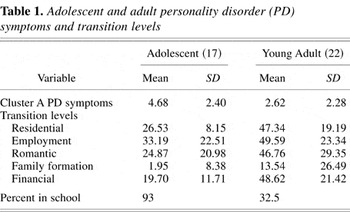
Table 1 presents the mean numbers of symptoms of CLA in the adolescent and young adult assessments. As reported previously for the entire cohort (Johnson et al., 2000), there was a linear decline of CLA with age. Table 1 also presents the mean TL for each of the domains at age 17 and again at age 22. Data show that each domain mean except family formation was between about 20–33% of a fully adult role at age 17 when most participants were still in high school. It also shows the expected increase in each domain, on average, for the group as a whole, except for a decline in the proportion of the sample in school by age 22. On average, by age 22 the respondents had moved about halfway toward a fully adult role in every domain except family formation, where interest and involvement was still very low. As noted previously, this average change is quite consistent with great differences in the level and shape of the trajectories of individual respondents (see Cohen, Kasen, et al., 2003, for illustrative individual trajectories). As diversity in life patterns increased after the high school years, the variance in TLs across participants substantially increased at age 22.
Adolescent and adult personality disorder (PD) symptoms and transition levels

Education
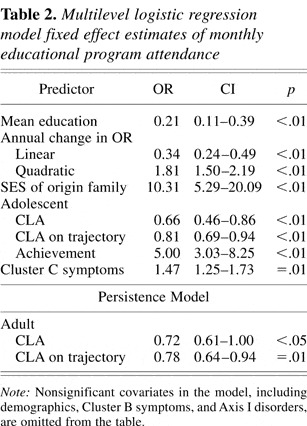
Table 2 provides the estimated effects of the fixed predictors from prediction and change models for educational or training program attendance, based on the multilevel logistic regression analysis. The coefficients presented are the odds ratios associated with unit increases in the predictor, and the associated confidence interval. Odds ratios (ORs) less than 1.0 indicate a decline in the proportion attending educational programs and OR greater than 1.0 indicate an increase in the proportion attending such programs. When confidence intervals include 1.0 the coefficient is not significantly different from 1.0 (p < .05). The OR of <1.0 for the linear age trajectory indicates the expected linear decline in the proportion of the sample attending educational institutions between age 17 and 22, and the OR of >1.0 for the quadratic component of the trajectory indicates that this decline decelerated in the later period, also as expected, given the usual period required for college completion. As anticipated, adolescent CLA showed a dampening effect on average school attendance in this period, and also predicted a more rapid decline in the proportion attending school as this group aged from 17 to 22. All effects were independent of adolescent achievement levels, which were significantly related both to CLA and to further training.
Multilevel logistic regression model fixed effect estimates of monthly educational program attendance

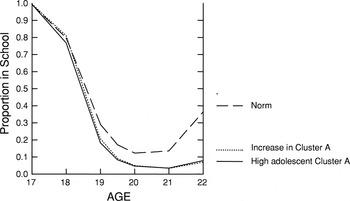
Persistence in CLA from adolescence to young adulthood also was uniquely significantly related to the trajectory of school attendance. Both a lower than average rate of school attendance and a greater attendance decline with age were significantly associated with persistent CLA; symmetrically, a decline in CLA was related to more school attendance and a flatter trajectory of attendance with age. Figure 1 graphs these relationships, converting to model-estimated probabilities of educational attendance associated with 1 SD elevation relative to the age-adjusted CLA average. As can be seen, almost all members of the sample were in high school at age 17, and school attendance dropped off thereafter. Youth with high adolescent CLA were delayed in leaving high school, having a slightly higher attendance until after age 18, after which they were somewhat less likely to be attending educational programs than the norm. The young people whose elevation in CLA persisted from adolescence to age 22 had especially low school attendance after age 19.

Educational trajectories by CLA levels.
Residential TL
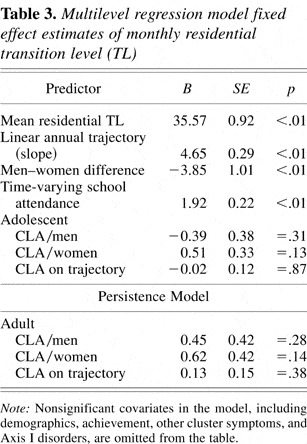
In Table 3 it can be seen that on the average over this period respondents assumed residential TL that was about one-third of the way toward full adult roles (35.6) and the trajectory showed an increase of 4.65% per year. Attending an educational program was associated with nearly 2% higher monthly residential TL on average, reflecting the frequently associated move from parental home to dormitory or shared living arrangements. Adolescent CLA did not show an effect on mean residential TL; however, the gender difference in the symptom effect was statistically significant (B = 0.89, SE = 0.42, p < .05). In a follow-up test of the simple slopes for men and women, neither the estimated negative effect of symptoms on women nor the positive effect on men was significantly different from zero. There were also no further effects associated with the persistence of CLA at age 22.
Multilevel regression model fixed effect estimates of monthly residential transition level (TL)

Romantic TL
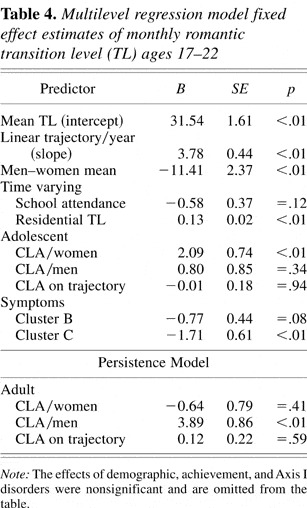
On average, over this 5-year period these young people were about one-third of the way toward a fully adult romantic role, at a TL that is roughly equivalent to “going steady” (see Table 4). Women's average TL was 13.64 points higher then men's, as is normative given the age difference between men and women in the typical young romantic couple. Romantic TL showed an increase of nearly 4% per year (3.84%), reflecting an average change from casual and occasional dating to possible long-term interest in a particular romantic partner over this period. School attendance was not related to romantic commitment; however, residential TL was, and each increase of 1% in residential TL was associated with a 0.12% increase in romantic TL during the same month.
Multilevel regression model fixed effect estimates of monthly romantic transition level (TL) ages 17–22

The model showed a statistically significant gender difference in the effect of adolescent CLA on romantic TL (B = 2.41, SE = 1.00). For men, a positive effect of 0.80 per symptom was not significantly different from 0, whereas for women the positive effect of additional CLA symptoms on romantic commitment of 2.09 was significant (Table 4). Adolescent Cluster C PD symptoms were significantly related to lower levels of romantic TL in both men and women (B = −1.71, SE = 0.61).
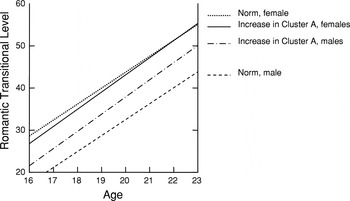
Persistence in CLA from adolescence to age 22 was related to average romantic TL for men only (gender interaction B = 4.53, SE = 1.12). Men whose CLA persisted or increased showed higher than average romantic TL over this period, as had been true for women with high adolescent CLA. In the equation including these age 22 estimates, high adolescent CLA in men showed a trend for low romantic TL (B = −1.54, SE = 0.95, p = .10).
These relationships are plotted in Figure 2. As can be seen, equivalent levels of romantic TL were about 3 years delayed for men compared to women in the normative sample, that is, for example, the TL for men at age 21 is at a level approximately equivalent to the TL for women at age 18. For men who were high on CLA in both adolescence and at age 22, unusually low romantic TL at age 17 was followed by unusually high romantic TL in young adulthood. Symptomatic adolescent women had, on average, more adult romantic roles; however, no relationship of romantic TL to women's CLA at age 22 was apparent.

Romantic transition level trajectories of men and women by CLA levels.
Family formation TL
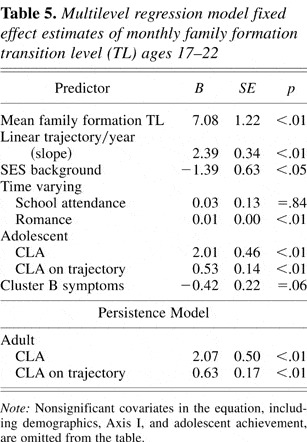
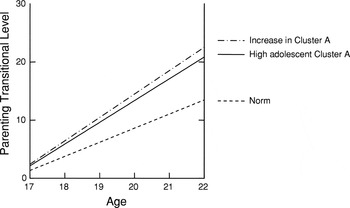
The equation estimates for the transition to a parental role are provided in Table 5. As expected, there was again a (strictly) linear increase with age, but in this case, given the age range covered, the annual increase was quite modest. The age 17 mean near zero (Table 1) indicates that for most respondents there was no interest at all in child bearing or parenting at that age. Adolescent CLA was positively related to early parenting and to an increase in the family formation trajectory over this age period. The association between CLA persistence or increase from adolescence to age 22 and both elevation and increase in the steepness of the trajectory of family TL was also significant. These patterns are seen in Figure 3, where it is clear that the normative level and trajectory were both low between ages 17 and 22. However, high adolescent CLA was related to a much steeper trajectory, and this rapid increase in family formation TL was, in turn, related to high CLA at age 22. Auxiliary analyses showed that 75% of those with offspring by age 20 had higher than average symptom levels in adolescence, and 50% had elevations in symptoms that were more than 0.5 SD above the mean. Again, at age 22, 75% of these parents were above the sample mean, and 25% were more than 1.5 SD above the sample mean on CLA.
Multilevel regression model fixed effect estimates of monthly family formation transition level (TL) ages 17–22


Family formation trajectories by CLA levels.
These unexpected findings on early parenthood for those with elevated adolescent CLA led us to wonder whether family formation accounted for some of the unexpected findings on early assumption of more adult romantic TL. To test this possibility we added to the equation predicting romantic TL both the time-varying family formation TL and the potential difference in its effect on men and women. Both the main effect of family formation TL (B = 0.152, SE = 0.028, p < .001) and the difference between men and women of this effect were statistically significant (B = 0.136, SE = 0.054, p < .05), showing a larger effect of parental TL on romantic TL for men (B = 0.221, SE = 0.048) than for women (B = 0.083, SE = 0.027). In this equation the effect of adolescent CLA no longer even approached statistical significance for either men or women. Thus, the elevated romantic TL for adolescent women with high Cluster A PD was entirely attributable to their early involvement in childbearing and rearing.
The next analyses examined the relationship between symptom change and romantic TL when family formation was added as a time-varying covariate. The relationship between persistence or increase in CLA symptoms in men and greater romantic TL was only modestly smaller (B = 3.07, SE = 0.86, in comparison to B = 3.69) and other effects were essentially equivalent. Thus this association between high romantic TL and high CLA at age 22 in men was not attributable to family formation.
Employment TL
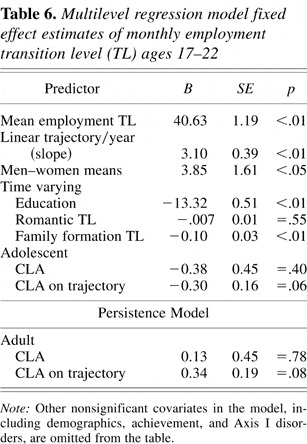
Table 6 presents the associations of adolescent and adult CLA with the average level and trajectory of employment TL. On average, employment TL was about halfway toward a fully adult role, and the trajectory included a 2.42 unit increase with each year from age 17 to age 22. As expected, family formation TL had a dampening effect on careers, although greater romantic commitment did not, perhaps because so few young people without offspring were homemakers at this age. When these time-varying roles were in the model, none of the direct effects of adolescent CLA on either the overall level of “adultness” of employment TL or its age trajectory reached conventional levels of statistical significance. Persistence in CLA was related to the employment TL in the expected direction, but this effect also was not statistically significant.
Multilevel regression model fixed effect estimates of monthly employment transition level (TL) ages 17–22

Financial TL
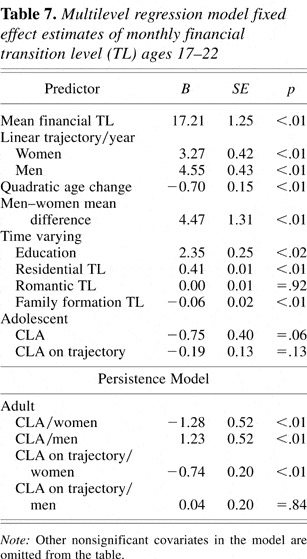
Table 7 presents the fixed equation estimates for financial TL. As anticipated, for the group as a whole there was a substantial increase in financial TL with age, but less over the early years when many members of the cohort were in school or first entering the job market (indicated by the negative quadratic effect of age). There was a trend for a negative effect of adolescent CLA on financial TL (p < .10). This lack of statistical significance was not attributable to the presence of other TL variables in the model, as analyses not shown here but without time-varying covariates showed essentially the same findings.
Multilevel regression model fixed effect estimates of monthly financial transition level (TL) ages 17–22

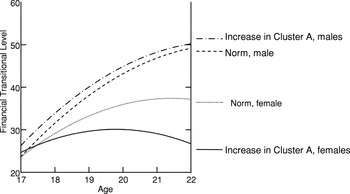
Persistent CLA from age 17 to age 22 was related to financial TL significantly differently for men and women with interaction coefficients of B = 2.54 (SE = 0.66) for average financial TL and B = 0.81 (SE = 0.25) for the trajectory over this period. Follow-up analyses showed persistent or increasing CLA to be related to both lower average financial TL (B = −1.28, SE = 0.52) and to a less positive annual trajectory in financial TL over this period for women (B = −0.73, SE = 0.20). For men, however, these relationships were different: high CLA at age 22 was related to higher average level of financial TL (B = 1.22, SE = 0.52), and not significantly to the trajectory of financial TL over this period (B = 0.04, SE = 0.20). These relationships are shown in Figure 4, where the normative level of financial TL is about 3% higher for men than for women at age 17, increasing to almost 10% difference at age 22. Independently of all other transition domains, persistent CLA was associated with slightly higher financial TL for men, but with distinctly less adult financial TL for women.

Financial transition level trajectories of men and women by CLA levels.
Discussion
Implications of these findings for increased understanding of Cluster A PD
The hypothesis that high Cluster A symptoms would be related to less postsecondary education or training was supported. This Cluster A association was independent of earlier achievement problems shown by these adolescents, suggesting that functional problems tend to increase over the postadolescent period, a pattern that is consistent with the more extreme trajectory of persons with schizophrenia. Of course, given the expected rate of schizophrenia in the population, for one or two of these young adults these symptoms may be prodromal to this more negative prognosis (Thaker et al., 1993). The wariness and low interpersonal connectedness associated with Cluster A may also be reflected in less tolerance of group-oriented settings and the required interactions with unfamiliar others that characterize most educational programs.
Adolescents of both sexes who had elevated Cluster A symptoms were at risk for early parenthood. This was an unexpected finding, with obvious inconsistency between the prediction of developmental lag in this group and a view of parenthood as reflecting greater maturity. It does, however, represent nonnormative timing of family formation, which in itself is an indicator of problems in adaptation (e.g., Thomas & Rickel, 1995). Teenage parenthood, and even parenthood in the very early 20s, tends to be maladaptive for young people in current Western societies. It restricts access to the educational and occupational routes to long-term career and financial stability, and is highly associated with poverty (Maughan & Lindelow, 1997) and parental family dissolution (Vikat, Rimpela, Kosunen, & Rimpela, 2002). Early parenting may be linked to poor social skills and an interference of symptoms with appropriate and timely help-seeking behavior. Yet it is somewhat surprising that these distrustful, disengaged, and often somewhat “loner” adolescents should be at increased risk of early parenting. We investigated the possibility that substance use or abuse might have accounted for this apparent overcoming of interpersonal wariness of those with high Cluster A symptoms, but found no effect of this variable on the Cluster A effects. Previous analyses have shown that sexual abuse as self-reported at the age 22 assessment and official record of physical abuse were related to elevated symptoms of Cluster A assessed in adolescence and at age 22 (Cohen, Brown, & Smailes, 2001). Sexual abuse could have been the cause of early childbearing for some of the high Cluster A women, but it is unlikely to explain early parenthood for high Cluster A men.
Persons with schizophrenia and other psychotic disorders have long been known to have lower than average fertility rates (Kallmann, 1938). This issue has been studied for many years because of the strong evidence of some genetic vulnerability for schizophrenia and the resulting question of why this disorder has not disappeared (Erlenmeyer–Kimling, 1969). One possibility is that relatives of persons with schizophrenia who may share some genetic risk may have higher than average fertility rates. Recent studies have shown elevated fertility in patients' sisters, among whom spectrum symptoms may be present (Bassett, Bury, Hodgkinson, & Honer, 1996; Haukka, Suvisaari, & Lönnqvist, 2003), and also in parents and siblings (Srinivasan & Padmavati, 1997). However, there is very little data on age at first offspring birth of men with disorders, or on those persons with schizophrenia spectrum disorders. A recent Finnish study of a large general practice sample of women with and without psychotic disorders showed an overall fertility rate ratio of 0.68 (p = .06) but an age-specific fertility rate in 789 teen-aged women of 1.41, not statistically significantly different from the comparison sample, but suggestive (Howard, Kumar, Leese, & Thornicroft, 2002). A case–control study of first-episode patients with schizophrenia found significantly more unmarried patients than unmarried controls had offspring, controlling for other demographic differences (Hutchinson, Bhugra, Mallett, Burnett, Corridan, & Leff, 1999). Women with schizophrenia spectrum disorders have also been found to have more unwanted pregnancies (Miller & Finnerty, 1996). Thus, these findings may be consistent with a schizophrenia spectrum interpretation of Cluster A PD symptoms.
Other significant relationships between adolescent Cluster A symptoms and the transition to adult role behavior differed for men and women. Residence roles were less mature for high symptom women than for high symptom men. Higher romantic commitment during this period was associated with more prior Cluster A symptoms in women, an association that was entirely attributable to the higher fertility in these women. This finding is consistent with more early first marriage for persons with clinically significant psychiatric disorders in the National Comorbidity Study (Forthofer, Kessler, Story, & Gotlib, 1996), where low rates of later marriage were also shown.
Findings with regard to the relationship between adult role assumption in this period and persistence in Cluster A symptoms are similarly mixed in their implications. More involvement in advanced education and training was related to a drop in Cluster A symptoms for both men and women. For women, similarly, persistent symptoms were related to lower average financial TL and a less positive trajectory in achieving financial independence. This finding suggests that, at least for some of these adolescents, adolescent Cluster A symptoms may have been elicited by environmental hazards that could be avoided or overcome when they left high school and the parental home, or when they found a niche that permitted more positive adaptation. Among these young people symptoms were less persistent, and adult roles more readily assumed. Possible explanatory effects must exclude simple poverty, low SES, and low achievement, which were controlled in these analyses. For men, however, a drop in symptoms was related to lower average financial TL over this period, as well as lower romantic TL; equivalently, symptomatic persistence or increase was related to more financial independence and romantic commitment. These findings, in the direction opposite to that hypothesized, remain without clear explanation. There is some evidence that marriage may serve to delay onset of more severe symptoms in men with schizophrenia (Jablensky & Cole, 1997). In addition, men with Cluster A PD may be more likely to be selected for romantic relationships by dysphoric women, an effect that may not be beneficial to the symptomatic status of either (Daley & Hammen, 2002). With regard to financial independence, it will be important to determine how this may have been affected by the possibly problematic relationship of these increasingly symptomatic men with their families of origin.
In tests of the relationship of other PD clusters to assumption of these adult roles, Cluster B symptoms were unrelated to these variables. Cluster C symptoms were related to lower levels of romantic commitment over this period as well as more educational program attendance, but had no other significant relationships with adult role assumption. Because school attendance can be seen as a childhood role, these findings may be viewed as consistent with the possibility of developmental delay in these young people. The presence of one or more Axis I mental disorders was also not independently related to adult role assumption in any domain. These disorders may be more related to some of the qualitative aspects of role functions; issues that are addressed in other analyses of the narrative data.
Limitations and additional questions raised by these findings
Although the transition study narrative interviews covered the 120 months between age 17 and age 27, only the first 5 years of this period were included in these analyses because independently assessed Cluster A symptoms were last measured at age 22. Thus evidence of the reliability of these retrospective reports based on an independent study covering only 5 years may not fully generalize to this longer interval. In addition, the assessment of PD symptoms, although showing a great many theoretically coherent associations (Cohen et al., 2001; Johnson et al., 1999; Kasen et al., 1999) were made by lay structured interviews of youth and mothers, and thus may not be comparable to assessments made with the aid of clinical judgment. However, recent reassessments about 5 years after the completion of these narratives and 10 years after the age 22 assessments showed strong continuity between these earlier assessments and PD symptoms and diagnoses assessed by the SCID-II (First et al., 1995). Further, the low rate of specific PD disorders in this general population sample necessitated limiting analyses to overall PD symptoms by cluster. Thus conclusions about more specific relationships by individual disorder cannot be made because of low statistical power for such analyses.
The finding of effects of prospectively assessed adolescent Cluster A symptoms suggest a generally negative impact on the transition to adult roles. However, despite the longitudinal nature of the PD data, these analyses cannot definitively answer the question of whether the transition role experiences had a causal impact on Cluster A symptoms in young adulthood. Symptoms were measured at only two points in time: before and after the transition measures. Other factors may have affected cluster A symptoms early in this period for some or all youth, and these unidentified factors or early symptom change then led to subsequent transition patterns. This is theoretically less likely for those variables for which adolescent symptoms did not predict subsequent transition patterns. With regard to other factors that may influence both transitions and symptoms, we have included demographic factors, adolescent achievement, and other PD symptom clusters and Axis I disorders including substance abuse as covariates, and investigated a number of other earlier potential characteristics of the adolescent or family (Cohen, Kasen, et al., 2003). However, other potential candidates for powerful influence during this transition period include family, peer, and partner support and positive and negative life experiences. These narrative-based variables are currently being investigated.
There is a growing appreciation of the seriousness of PD symptoms per se and also of the impact of co-occuring PD on the prognosis for Axis I disorders such as major depression in clinical populations (e.g., Shea et al., 2002). Understanding the developmental course of PD disorder symptoms and the reciprocal relationships with trajectories of age-appropriate developmental tasks may contribute to treatment planning in clinical settings. Developmental issues are also intrinsically part of the movement toward investigation of etiological contributions to these disorders. As epidemiological, clinical, and biological evidence accumulates, this information may be applied to strategies for preventive interventions designed to lessen the impact of these mental disorders on individuals and populations (Coid, 2003).
References
REFERENCES
Achenbach, T. M.,
Howell, C. T.,
McConaughy, S. H., &
Stanger, C.
(1995).
Six-year predictors of problems in a national sample: III.
Transitions to young adult syndromes.
Journal of the American Academy of Child and Adolescent
Psychiatry
34,
658–669.Google Scholar
American Psychiatric Association.
(1994).
Diagnostic and statistical manual of mental disorders
(4th ed., revised).
Washington, DC:
Author.
Arnett, J. J.
(1999).
Adolescent storm and stress, reconsidered.
American Psychologist
54,
317–326.Google Scholar
Arnett, J. J.
(2000).
Emerging adulthood: A theory of development from the late teens
through the twenties.
American Psychologist
55,
469–480.Google Scholar
Aseltine, R. H., &
Gore, S.
(1993).
Mental health and social adaptation following the transition from
high school.
Journal of Research on Adolescence
3,
247–270.Google Scholar
Bachman, J. G.,
Johnston, L. D.,
O'Malley, P. M., &
Schulenberg, J.
(1996).
Transitions in drug use in late adolescence and young
adulthood. In
J. Graber,
J. Brooks–Gunn, &
A. C. Petersen (Eds.),
Transition through adolescence: Interpersonal domains and
context (pp.
111–140).
Hillsdale, NJ:
Erlbaum.
Bassett, A. S.,
Bury, A.,
Hodgkinson, K. A., &
Honer, W. G.
(1996).
Reproductive fitness in familial schizophrenia.
Schizophrenia Research
21,
151–160.Google Scholar
Bernstein, D. P.,
Cohen, P.,
Skodol, A.,
Bezirganian, S., &
Brook, J. S.
(1996).
Childhood antecedents of adolescent personality disorders.
American Journal of Psychiatry
153,
907–913.Google Scholar
Bernstein, D. P.,
Cohen, P.,
Velez, C. N.,
Schwab–Stone, M.,
Siever, L. J., &
Shinsato, L.
(1993).
Prevalence and stability of the DSM-III-R personality
disorders in a community-based survey of adolescents.
American Journal of Psychiatry
150,
1237–1243.Google Scholar
Block, J., &
Robins, R. W.
(1993).
A longitudinal study of consistency and change in self-esteem from
early adolescence to early adulthood.
Child Development
64,
909–923.Google Scholar
Borgen, W. A.,
Amundson, N. E., &
Tench, E.
(1996).
Psychological well-being throughout the transition from adolescence
to adulthood.
Career Development Quarterly
45,
189–199.Google Scholar
Brown, A. S.,
Cohen, P.,
Harkavy–Friedman, J.,
Babulas, V.,
Malaspina, D.,
Gorman, J., &
Susser, E. S.
(2001).
Prenatal rubella, premorbid abnormalities, and adult
schizophrenia.
Biological Psychiatry
49,
473–486.Google Scholar
Burke, K. C.,
Burke, J. D.,
Rae, D. S., &
Regier, D. A.
(1991).
Comparing age at onset of major depression and other psychiatric
disorders by birth cohorts in five US community populations.
Archives of General Psychiatry
48,
789–795.Google Scholar
Cohen, J.,
Cohen, P.,
West, S. G., &
Aiken, L. S.
(2003).
Multiple regression/correlation for the behavioral
sciences
(3rd ed.).
Mahwah, NJ:
Erlbaum.
Cohen, P.
(1996).
Childhood risks for young adult symptoms of personality disorder:
Method and substance.
Multivariate Behavioral Research
31,
121–148.Google Scholar
Cohen, P.
(1999).
Personality development in childhood: Old and new findings.
In
C. R. Cloninger (Ed.),
Personality and psychopathology (pp.
101–127).
Washington, DC:
American Psychiatric Press.
Cohen, P.,
Brown, J., &
Smailes, E.
(2001).
Child abuse and neglect and the development of mental disorders in
the general population.
Development and Psychopathology
13,
981–999.Google Scholar
Cohen, P.,
Chen, H.,
Hamigami, R.,
Gordon, K., &
McArdle, J. J.
(2000).
Multilevel analyses for predicting sequence effects of financial and
employment problems on the probability of arrest.
Journal of Quantitative Criminology
16,
223–235.Google Scholar
Cohen, P., &
Cohen, J.
(1996).
Life values and adolescent mental health.
Hillsdale, NJ:
Erlbaum.
Cohen, P.,
Kasen, S.,
Chen, H.,
Hartmark, C., &
Gordon, K.
(2003).
Variations in patterns of developmental transitions in the emerging
adulthood period.
Developmental Psychology,
39,
657–669.Google Scholar
Coid, J.
(2003).
Epidemiology, public health and the problem of personality
disorder.
British Journal of Psychiatry,
182(Suppl. 44),
S3–S10.Google Scholar
Corcoran, J.
(1998).
Consequences of adolescent pregnancy/parenting: A review of the
literature.
Social Work in Health Care
27,
49–67.Google Scholar
Daley, S. E., &
Hammen, C.
(2002).
Depressive symptoms and close relationships during the transition to
adulthood: Perspectives from dysphoric women, their best friends, and
their romantic partners.
Journal of Consulting and Clinical Psychology
70,
129–141.Google Scholar
Daley, S. E.,
Hammen, C.,
Burge, D.,
Davila, J.,
Paley, B.,
Lindberg, N., &
Herzberg, D. S.
(1999).
Depression and Axis II symptomatology in an adolescent community
sample: Concurrent and longitudinal associations.
Journal of Personality Disorders
13,
47–59.Google Scholar
Erikson, E. H.
(1959).
Identity and the life cycle.
New York:
International Universities Press.
Erlenmeyer–Kimling, L.
(1969).
Changes in fertility rates of schizophrenic patients in New York
State.
American Journal of Psychiatry
125,
916–927.Google Scholar
Erlenmeyer–Kimling, L., &
Cornblatt, B.
(1989).
High-risk research in schizophrenia: A summary of what has been
learned.
Journal of Psychiatric Research
21,
401–411.Google Scholar
First, M. B.,
Spitzer, R. L.,
Gibbon, M.,
Williams, J. B. W.,
Davies, M.,
Borus, J.,
Howes, M. J.,
Kane, J.,
Pope, H. G., &
Rounsaville, B.
(1995).
The Structured Clinical Interview for DSM-III-R Personality
Disorders (SCID-II), Part II: Multi-site test–retest reliability
study.
Journal of Personality Disorders,
9,
92–104.Google Scholar
Flanagan, C.,
Schulenberg, J., &
Fuligni, A.
(1993).
Residential setting and parent–adolescent relationships during
the college years.
Journal of Youth and Adolescence
7,
225–241.Google Scholar
Fleming, J. E.,
Boyle, M. H., &
Offord, D. R.
(1993).
The outcome of adolescent depression in the Ontariao Child Health
Study follow-up.
Journal of the American Academy of Child & Adolescent
Psychiatry
32,
28–33.Google Scholar
Forthofer, M. S.,
Kessler, R. C.,
Story, A. L., &
Gotlib, I. H.
(1996).
The effects of psychiatric disorders on the probability and timing
of first marriage.
Journal of Health and Social Behavior
37,
121–132.Google Scholar
Goldscheider, F., &
Goldscheider, C.
(1999).
The changing transition to adulthood: Leaving and returning
home.
Thousand Oaks, CA:
Sage.
Gottesman, I.
(2001).
Psychopathology through a life span-genetic prism.
American Psychologist
56,
867–878.Google Scholar
Hamigami, F.,
McArdle, J. J., &
Cohen, P.
(2000).
A new approach to modeling bivariate dynamic relationships applied
to evaluation of personality disorder symptoms. In
V. J. Molfese &
D. L. Molfese (Eds.),
Temperament and personality development across the life span
(pp.
253–280).
Mahwah, NJ:
Erlbaum.
Haukka, J.,
Suvisaari, J., &
Lönnqvist, J.
(2003).
Fertility of patients with schizophrenia, their siblings, and the
general population: A cohort study from 1950 to 1959 in Finland.
American Journal of Psychiatry
160,
460–463.Google Scholar
Howard, L. M.,
Kumar, C.,
Leese, M., &
Thornicroft, G.
(2002).
The general fertility rate in women with psychotic disorders.
American Journal of Psychiatry
159,
991–997.Google Scholar
Hutchinson, G.,
Bhugra, D.,
Mallett, R.,
Burnett, R.,
Corridan, B., &
Leff, J.
(1999).
Fertility and marital rates in first-onset schizophrenia.
Social Psychiatry and Psychiatric Epidemiology
34,
617–621.Google Scholar
Hyler, S. E.,
Skodol, A. E.,
Kellman, H. D.,
Oldham, J. M., &
Rosnick, L.
(1990).
Validity of the Personality Diagnostic Questionnaire—Revised:
Comparison with two structured interviews.
American Journal of Psychiatry
47,
1043–1048.Google Scholar
Jablensky, A., &
Cole, S. W.
(1997).
Is the earlier age at onset of schizophrenia in males a confounded
finding? Results from a cross cultural investigation.
British Journal of Psychiatry
170,
234–240.Google Scholar
Jessor, R.,
Donovan, J. E., &
Costa, F. M.
(1991).
Beyond adolescence: Problem behavior and young adult
development.
Cambridge:
Cambridge University Press.
Johnson, J. G.,
Cohen, P.,
Kasen, S.,
Skodol, A., &
Brook, J.
(2000).
Age-related change in personality disorder trait levels between
early adolescence and adulthood: A community-based longitudinal
investigation.
Acta Psychiatrica Scandinavia
102,
265–275.Google Scholar
Johnson, J. G.,
Cohen, P.,
Skodol, A.,
Oldham, J. M.,
Kasen, S., &
Brook, J.
(1999).
Personality disorders in adolescence and risk of major mental
disorders and suicidality during adulthood.
Archives of General Psychiatry
56,
805–811.Google Scholar
Kallmann, F. J.
(1938).
The genetics of schizophrenia.
New York:
Augustin.
Kasen, S.,
Cohen, P.,
Skodol, A. E.,
Johnson, J. G., &
Brook, J. S.
(1999).
Influence of child and adolescent psychiatric disorders on young
adult personality disorder.
The American Journal of Psychiatry
156,
1529–1535.Google Scholar
Kasen, S.,
Cohen, P.,
Skodol, A. E.,
Johnson, J. G.,
Smailes, E., &
Brook, J. S.
(2001).
Childhood depression and adult personality disorder: Alternative
pathways of continuity.
Archives of General Psychiatry
58,
231–236.Google Scholar
Kendler, K. S.
(1985).
Diagnostic approaches to schizotypal personality disorder: A
historical perspective.
Schizophrenia Bulletin
11,
538–553.Google Scholar
Kendler, K. S.,
Ochs, A. L.,
Gorman, A. M.,
Hewitt, J. K.,
Ross, D. E., &
Mirsky, A. F.
(1991).
The structure of schizotypy: A pilot multitrait twin study.
Psychiatry Research
36,
19–36.Google Scholar
Kessler, R. C.,
Berglund, P. A.,
Foster, C. L.,
Saunders, W. B.,
Stang, P. E., &
Walters, E. E.
(1997).
Social consequences of psychiatric disorders, II: Teenage
parenthood.
American Journal of Psychiatry
154,
1405–1411.Google Scholar
Klein, D.
(2003).
Patients' versus informants' reports of personality
disorders in predicting 7-year outcome in outpatients with depressive
disorders.
Psychological Assessment
15,
216–222.Google Scholar
Kohn, M. L., &
Schooler, C.
(1983).
Work and personality: An inquiry into the impact of social
stratification.
Norwood, NJ:
Ablex.
Kraepelin, E.
(1907).
Clinical psychiatry
(A. R. Dienfendorf, Trans.).
New York:
Macmillan.
Kretschmer, E.
(1925).
Physique and character.
New York:
Harcourt Brace.
Lenzenweger, M. F.
(1999).
Stability and change in personality disorder features.
Archives of General Psychiatry
56,
1009–1015.Google Scholar
Levy, K. N.,
Becker, D. F.,
Grilo, C. M.,
Mattanah, J. J. F.,
Garnet, K E.,
Quinlan, D. M.,
Edell, W. S., &
McGlashan, T. H.
(1999).
Concurrent and predictive validity of the personality disorder
diagnosis in adolescent inpatients.
American Journal of Psychiatry
156,
1522–1528.Google Scholar
Lewinsohn, P. M.,
Hops, H.,
Roberts, R. E.,
Seeley, J. R., &
Andrews, J. A.
(1993).
Adolescent psychopathology: I. Prevalence and incidence of
depression and other DSM-III-R disorders in high school
students.
Journal of Abnormal Psychology
102,
133–144.Google Scholar
Littell, R. C.,
Miliken, G. A.,
Stoup, W. W., &
Wolfinger, R. D.
(1996).
SAS system for mixed models.
Cary, NC:
SAS Institute.
Lyketsos, C. G.,
Nestadt, G.,
Cwi, J.,
Helthoff, K., &
Eaton, W. W.
(1994).
The Life Chart Interview: A standardized method to describe the
course of psychopathology.
International Journal of Methods in Psychiatric Research
4,
143–155.Google Scholar
Mannuzza, S.,
Klein, R. G.,
Bessler, A.,
Malloy, P., &
LaPadula, M.
(1993).
Adult outcome of hyperactive boys: Educational achievement,
occupational rank, and psychiatric status.
Archives of General Psychiatry
50,
565–576.Google Scholar
Marini, M. M.
(1985).
The order of events in the transition to adulthood.
Sociology of Education
57,
63–84.Google Scholar
Marini, M. M.
(1988).
Measuring the process of role change during the transition to
adulthood.
Social Science Research
16,
1–38.Google Scholar
Maughan, B., &
Lindelow, M.
(1997).
Secular change in psychosocial risks: The case of teenage
motherhood.
Psychological Medicine
27,
1129–1144.Google Scholar
McGlashan, T. H.
(1999).
Duration of untreated psychosis in first-episode schizophrenia:
Marker or determinant of course?
Biological Psychiatry
46,
899–907.Google Scholar
McGue, M.,
Bacon, S., &
Lykken, D. T.
(1993).
Personality stability and change in early adulthood: A behavioral
genetic analysis.
Developmental Psychology
29,
96–109.Google Scholar
Meehl, P.
(1962).
Schizotaxia, schizotypy, schizophrenia.
American Psychologist
17,
827–838.Google Scholar
Meehl, P. E.
(1990).
Toward and integrated theory of schizotaxia, schizotypy, and
schizophrenia.
Journal of Personality Disorders
4,
1–99.Google Scholar
Miller, L. J., &
Finnerty, M.
(1996).
Sexuality, pregnancy, and childrearing among women with
schizophrenia–spectrum disorders.
Psychiatric Services
47,
502–506.Google Scholar
Quinton, D.,
Pickles, A.,
Maughan, B., &
Rutter, M.
(1994).
Partners, peers, and pathways: Assortative pairing and continuities
in conduct disorder.
Development amd Psychopathology
5,
763–783.Google Scholar
Rindfuss, R. R., &
Parnell, A. M.
(1989).
The varying connection between marital status and childbearing in
the United States.
Population and Development Review
15,
447–470.Google Scholar
Rutter, M.,
Harrington, R.,
Quinton, D., &
Pickles, A.
(1994).
Adult outcome of conduct disorder in childhood: Implications for
concepts and definitions of patterns of psychopathology. In
R. D. Keterlinus &
M. E. Lamb (Eds.),
Adolescent problem behaviors: Issues and research (pp.
57–80).
Mahwah, NJ:
Erlbaum.
Shea, M. T.,
Stout, R.,
Gunderson, J.,
Morey L. C., Grilo,
C. M., McGlashan,
T., Skodol,
A. E., Dolan–Sewell,
R., Dyck,
I., Zanarini,
M. C., Keller,
M. B.
(2002).
Short-term diagnostic stability of schizotypal, borderline,
avoidant, and obsessive–compulsive personality disorders.
American Journal of Psychiatry
159,
2036–2041.Google Scholar
Singer, J. D.
(1998).
Using SAS PROC MIXED to fit multilevel models, hierarchical models,
and individual growth models.
Journal of Educational and Behavioral Statistics
24,
323–355.Google Scholar
Squires–Wheeler, E.,
Friedman, D.,
Amminger, G. P.,
Skodol, A.,
Looser–Ott, S.,
Roberts, S.,
Pape, S., &
Erlenmeyer–Kimling, L.
(1997).
Negative and positive dimensions of schizotypal personality
disorder.
Journal of Personality Disorders
11,
285–300.Google Scholar
Srinivasan, T. N., &
Padmavati, R.
(1997).
Fertility and schizophrenia: Evidence for increased fertility in the
relatives of schizophrenic patients.
Acta Psychiatrica Scandinavia
96,
260–264.Google Scholar
Susser, E. S.,
Brown, A. S., &
Gorman, J. M. (Eds.).
(1999).
Prenatal exposure in schizophrenia.
Washington, DC:
American Psychiatric Press.
Thaker, G. K.,
Adami, H.,
Moran, M.,
Lahti, A., &
Cassady, S.
(1993).
Psychiatric illnesses in families of subjects with
schizophrenia–spectrum personality disorders: High morbidity risks
for unspecified functional psychoses and schizophrenia.
American Journal of Psychiatry
150,
66–71.Google Scholar
Thomas, E. A., &
Rickel, A. U.
(1995).
Teen pregnancy and maladjustment: A study of base rates.
Journal of Community Psychology
23,
200–215.Google Scholar
Tyrer, P.,
Mitchard, S.,
Methuen, C., &
Ranger, M.
(2003).
Treatment rejecting and treatment seeking personality disorders:
Type R and Type S.
Journal of Personality Disorders
17,
263–267.Google Scholar
Vaglum, P.,
Friis, S.,
Karterud, S.,
Mehlum, L., &
Vaglum, S.
(1993).
Stability of the severe personality disorder diagnoses: A 2- to
5-year prospective study.
Journal of Personality Disorders
7,
348–353.Google Scholar
Vikat, A.,
Rimpela, A.,
Kosunen, E., &
Rimpela, M.
(2002).
Sociodemographic differences in the occurrence of teenage
pregnancies in Finland in 1987–1998: A follow up study.
Journal of Epidemiology and Community Health
56,
659–670.Google Scholar
Waddington, J. L.,
O'Callaghan, E.,
Youssef, H. A.,
Buckely, P.,
Lane, A.,
Cotter, D., &
Larkin, C.
(1999).
Schizophrenia: Evidence for a “cascade” process with
neurodevelopmental origins. In
E. S. Susser,
A. S. Brown, &
J. M. Gorman (Eds.),
Prenatal exposure in schizophrenia (pp.
3–34).
Washington, DC:
American Psychiatric Press.
Waterman, A. S.
(1982).
Identity development from adolescence to adulthood: An extension of
theory and a review of research.
Developmental Psychology,
18,
341–358.Google Scholar
Whitbourne, S. K.,
Zuschlag, M. K.,
Elliot, L. B., &
Waterman, A. S.
(1992).
Psychosocial development in adulthood: A 22-year sequential
study.
Journal of Personality and Social Psychology
63,
260–271.Google Scholar
Widiger, T. A.
(2001).
Official classification systems. In
J. W. Livesley (Ed.),
Handbook of personality disorders: Theory, research, and
treatment (pp.
60–83).
New York:
Guilford Press.
Widiger, T. A., &
Trull, T. J.
(1998).
Performance characteristics of the DSM-III-R personality
disorder criteria sets. In
T. A. Widiger,
A. J. Frances, &
H. A. Pincus (Eds.),
DSM-IV sourcebook
(Vol. 4, pp.
357–373).
Washington, DC:
American Psychiatric Press.
Zoccolillo, M.,
Meyers, J., &
Assiter, S.
(1997).
Conduct disorder, substance dependence, and adolescent
motherhood.
American Journal of Orthopsychiatry
67,
152–157.Google Scholar
Adolescent and adult personality disorder (PD) symptoms and transition levels
Multilevel logistic regression model fixed effect estimates of monthly educational program attendance
Educational trajectories by CLA levels.
Multilevel regression model fixed effect estimates of monthly residential transition level (TL)
Multilevel regression model fixed effect estimates of monthly romantic transition level (TL) ages 17–22
Romantic transition level trajectories of men and women by CLA levels.
Multilevel regression model fixed effect estimates of monthly family formation transition level (TL) ages 17–22
Family formation trajectories by CLA levels.
Multilevel regression model fixed effect estimates of monthly employment transition level (TL) ages 17–22
Multilevel regression model fixed effect estimates of monthly financial transition level (TL) ages 17–22
Financial transition level trajectories of men and women by CLA levels.
 You have
Access
- 21
- Cited by