Introduction
Post-operative hypoparathyroidism is a well-recognised complication of total thyroidectomy. Although this complication may be multifactorial, the most common causes include interference to the parathyroid glands in the form of direct injury, removal or devascularisation. The parathyroid glands share the same blood supply as the thyroid glands. Their vascular supply is tenuous and easily disturbed, and may not function post-operatively even if preserved peri-operatively.
The prevalence of hypoparathyroidism after thyroidectomy ranges from 1.6 to 50 per cent.Reference Karamanakos, Markou, Panagopoulos, Karavias, Vagianos and Scopa1 The onset of hypocalcaemia can be delayed for up to 72 hours.Reference Adams, Andersen, Everts and Cohen2 A number of management strategies are currently in use, including keeping patients in hospital for 3 to 4 days to monitor calcium levels, treating all patients as if hypocalcaemic or simply trusting in luck.
Parathyroid hormone (PTH) is produced by the parathyroid glands and has a half-life of around 2 to 4 minutes. It should fall to its lowest level within 30 minutes, and can predict the behaviour of calcium levels before it is clinically or biochemically apparent.Reference Bieglmayer, Prager and Niederle3
Historically, assessment of PTH levels has been used to predict the outcome of parathyroidectomy operations. However, the potential role of and clinically relevant cut-off scores for PTH level in predicting post-operative hypocalcaemia following total thyroidectomy remain unresolved.
There is a paucity of published research assessing the outcomes of patients with hypocalcaemia. In particular, variables associated with recovery of parathyroid function are poorly defined.
This study had twin aims. The first was to test the possible role of early post-operative PTH levels in predicting subsequent calcium changes. Such knowledge could provide a valuable tool for surgeons seeking to develop a rational and scientific discharge protocol for total thyroidectomy patients. The second study aim was to explore whether early PTH levels could help predict long-term outcomes in those patients who were started on calcium supplementation in the early post-operative period because of actual hypocalcaemia. Such knowledge could simplify post-operative management. These patients could, for instance, be divided into two groups: a low risk group that simply stop hypocalcaemia medication after a short period of time, and a group at higher risk of long-term hypocalcaemia that require more involved management.
Materials and methods
This was a prospective study of a consecutive sample of patients undergoing total thyroidectomy in our unit between January 2010 and December 2011. All patients who had had an early post-operative PTH level recorded (on the day of surgery) and serial corrected calcium measurements (on post-operative days 1–3) were included in the study.
Data collected included patient demographics, pathological diagnosis, procedure (total vs completion thyroidectomy), biochemical results, post-operative complications and treatment given prior to discharge. Patients with incomplete data were excluded from the study. The criteria for hypocalcaemia were a post-operative calcium level of 2.0 mmol/l or less (normal range, 2.05–2.60 mmol/l) at any time point, and symptoms of hypocalcaemia.
Data were retrieved from patient records following their discharge. We also accessed our patient records database to identify the outcomes of those individuals who were given calcium supplementation to treat early post-operative hypocalcaemia. We identified the number of patients in whom treatment was started and later discontinued on returning to a normocalcaemic state, by follow up 12 weeks after surgery.
Descriptive statistics and non-parametric statistical tests were used to analyse the data.
Results
Fifty-nine patients met the inclusion criteria for this study. There were 13 men and 46 women, with a median age of 48 years (range, 23 to 83 years). There were 42 total thyroidectomies and 17 completion hemithyroidectomies. Of the 59 operations, the majority were performed to treat thyroid cancer (n = 37), and 22 were performed to treat benign pathology.
Thirty-two per cent of patients (19 of 59) developed early hypocalcaemia requiring calcium supplementation. Early post-operative PTH levels ranged from 2.8 to 58.5 ng/l (normal range, 12–72 ng/l) (Figure 1). There was a statistically significant difference in the median PTH levels obtained 1 day after total thyroidectomy in patients with and without hypocalcaemia (13.3 vs 34.9 ng/l, respectively; p ≤ 0.001). There was no statistically significant difference between median PTH scores when comparing patients undergoing total versus completion thyroidectomy (24.9 vs 22.4 ng/l, respectively; p = 0.69). Although the median PTH score in those patients who underwent total thyroidectomy for malignant disease was lower than that of patients undergoing surgery for benign thyroid disease, these differences did not reach statistical significance (22.6 vs 25.8 ng/l, respectively; p = 0.19).
Box plot of parathyroid hormone (PTH) levels obtained 1 day after total thyroidectomy in patients with and without hypocalcaemia.

Post-operative hypocalcaemia was developed by a greater proportion of patients undergoing total thyroidectomy (13 of 23; 56.5 per cent), compared with those undergoing surgery for benign pathology (6 of 17; 35.3 per cent); however, this difference was not statistically significant (p = 0.57) (odds ratio, 1.6; 95 per cent confidence interval (CI), 0.51–5.1).
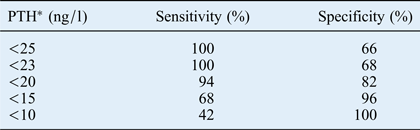
A summary of the sensitivity and specificity of the use of PTH levels to predict hypocalcaemia is highlighted in Table I. Approximately 60 per cent of patients (19 of 32) with an early PTH level of less than 23 ng/l developed early hypocalcaemia. However, no patients with an early PTH level greater than 23 ng/l developed hypocalcaemia. An early PTH level of 23 ng/l or more (on the day of surgery) had a sensitivity of 100 per cent (95 per cent CI, 82–100 per cent), a specificity of 68 per cent (95 per cent CI, 51–81 per cent), a positive predictive value of 59 per cent (95 per cent CI, 41–76 per cent) and a negative predictive value of 100 per cent (95 per cent CI, 87–100 per cent).
Sensitivity and specificity of various PTH thresholds in predicting post-operative normocalcaemia
*Normal range 12–72 ng/l. PTH = parathyroid hormone
Of the 19 patients treated for early hypocalcaemia, follow-up data were available in 16 cases. For the great majority, hypocalcaemia was a transient phenomenon (n = 14). The overall known long-term hypocalcaemia rate was 3 per cent. Only two patients continued to receive calcium supplementation at three months post-operatively. Twelve of the 16 patients (75 per cent) with subnormal serum calcium had PTH levels of 8 ng/l or more; all these patients recovered parathyroid function within 8 weeks of surgery. However, two patients with very low early PTH levels (i.e. <5 ng/l) had a marked improvement in PTH titres and other parameters at four weeks following surgery, and discontinued taking calcium medication.
A suggested algorithm for post-thyroidectomy calcium management is shown in Figure 2.
Algorithm for post-thyroidectomy calcium management. PTH = parathyroid hormone; min = minutes; hr = hours; post-op = post-operative; Ca = calcium; vit = vitamin; appt = appointment
Discussion
In recent years, there has been greater focus on the issue of post-operative care following thyroid surgery, especially given the recent drive towards reducing in-patient hospital stay.
Hypocalcaemia remains one of the important considerations in the care of patients who have undergone thyroidectomy. The risk factors for hypocalcaemia following thyroid surgery are well documented and include total rather than hemi-thyroidectomy, a raised pre-operative thyroxine level, thyroid cancer and retrosternal thyroid extension.Reference Adams, Andersen, Everts and Cohen2, Reference Husein, Hier, Al-Abdulhadi and Black4
Traditionally, serial calcium level measurements have been considered the standard of care for monitoring such patients. Studies have indicated that the magnitude of the slope of declining calcium concentration post-operatively correlates with the development of hypocalcaemia.Reference Karamanakos, Markou, Panagopoulos, Karavias, Vagianos and Scopa1, Reference Adams, Andersen, Everts and Cohen2, Reference Husein, Hier, Al-Abdulhadi and Black4 Unfortunately, the decline in serum calcium levels may be slow, and the nadir may not be reached until 72 hours after surgery.Reference Adams, Andersen, Everts and Cohen2 This lag time can both postpone therapy and delay hospital discharge.
The first aim of the present study was to evaluate the possible role of early post-operative PTH levels in identifying patients who were not in danger of developing hypocalcaemia and therefore did not require further monitoring or treatment. The second aim was to identify which patients considered at risk of hypocalcaemia (i.e. calcium levels ≤2.0 mmol/l) would recover normal parathyroid function within three months post-operatively.
Approximately one-third of our sample developed transient hypocalcaemia after surgery, and this is in keeping with audit data on the outcomes of patients undergoing total thyroidectomy.Reference Lindblom, Westerdahl and Bergenfelz5 Our study confirmed that an early post-operative PTH level provides the surgeon with a very sensitive tool for predicting which patients will develop hypocalcaemia.
Our findings are in keeping with other studies highlighting the role of PTH levels as a predictor of post-operative hypocalcaemia. Payne and colleagues,Reference Payne, Hier, Tamilia, Young, MacNamara and Black6 in a prospective study of 54 consecutive patients who underwent total thyroidectomy, reported that patients reaching critical post-operative levels for both corrected calcium (i.e. >2.1 mmol/l) and PTH (i.e. >28 ng/l) were not at risk of developing hypocalcaemia, and concluded that further blood testing is not warranted after reaching these critical levels.
Graff and colleaguesReference Graff, Miller, Roehm and Prihoda7 reported on a retrospective case series made up of 69 consecutive patients who had undergone total thyroidectomy. In their study, hypocalcaemia was associated with a post-operative PTH level of less than 14 pg/ml (reference range, 10–65 pg/ml) and a negative (post-operative) serum calcium slope. They concluded that early post-operative intact PTH measurement is the most cost-effective screening tool for hypocalcaemia; however, they also found that greater specificity can be achieved by combining PTH findings with serum calcium measurements taken between 6 and 18 hours post-operatively.
Toniato et al.Reference Toniato, Boschin, Piotto, Pelizzo and Sartori8 in a prospective study of 160 total thyroidectomy patients, also highlighted the potential role of early PTH levels in predicting post-thyroidectomy hypocalcaemia. In their study, the maximum sum of the sensitivity and specificity for the correlation of PTH levels and hypocalcaemia occurred at a level of 9.6 pg/ml (normal range, 10–55 pg/ml). The variance in the PTH levels and sensitivity and specificity in our study, when compared with other published studies, is attributable to the different assays and reference ranges used.
Toniato and colleaguesReference Toniato, Boschin, Piotto, Pelizzo and Sartori8 also investigated the optimal time to check PTH levels in order to identify high risk individuals post-thyroidectomy. The authors measured PTH levels before surgery, on the day of surgery and on the first post-operative day, and then correlated these PTH levels with serum calcium levels. Significantly, the authors noted a convincing mean percentage change in PTH values taken at the various stages, and concluded that the PTH level on the first post-operative day was the most reliable predictor of hypoparathyroidism. Reports from other investigators have also suggested that intra-operative PTH levels do not correlate well with post-operative calcium levels.Reference Warren, Andersen, Wax and Cohen9
Some investigators advocate prophylactic oral calcium and vitamin D supplementation to avoid the risk of hypocalcaemia after thyroidectomy.Reference Seybt, Terris, Outpatient and experience in10 The routine use of prophylactic calcium remains somewhat controversial, especially given the risk of hypercalcaemia and the potential deleterious consequences on renal function.Reference Schwartz, Clark, Ituarte and Lo Gerfo11 In one study of 65 patients given routine prophylactic calcium after a total thyroidectomy, 12 per cent of patients developed post-operative hypocalcaemia. Nine per cent had biochemical hypocalcaemia on routine blood testing in the out-patients clinic, whilst 3 per cent were symptomatic and required readmission and treatment with additional calcium and vitamin D supplementation.Reference Sahai, Symes and Jeddy12
One of the limitations of this study was that we did not document and evaluate specific intra-operative factors that may contribute to morbidity after thyroid surgery, such as the number of parathyroid glands identified. Although every effort was made to preserve the parathyroids at the time of surgery, the perceived success rate was not documented because of the reasons mentioned previously.
• Post-operative hypoparathyroidism is a well-recognised complication of total thyroidectomy
• Early parathyroid hormone (PTH) levels can reliably predict patients at risk of hypocalcaemia after thyroid surgery
• Early PTH levels also have a role in predicting recovery from temporary hypocalcaemia after surgery
• In this way, post-thyroidectomy hospitalisation may be considerably reduced
It is well known that simply preserving the parathyroids does not guarantee their function. Others have suggested that the number of parathyroid glands identified and preserved in situ is not an accurate predictor of subsequent progress. For example, Bergamaschi and colleaguesReference Bergamaschi, Becouarn, Ronceray and Arnaud13 reported a case series of 731 patients who underwent total thyroidectomy. These authors found no correlation between the post-operative serum calcium level and the number of parathyroids identified at surgery.
Our study suggests that those hypocalcaemic patients with an early PTH level of 8 ng/l or more would appear to have a good prognosis in terms of recovery of parathyroid function after total thyroidectomy. However, two patients with very low early PTH levels demonstrated recovery of parathyroid function, with a normal serum calcium concentration at four weeks post-thyroidectomy. These findings highlight the fact that early PTH may not entirely accurately predict which patients are likely to have transient versus protracted (permanent) hypoparathyroidism. A delayed PTH measurement may be a better predictor of which patients will fall into each category. In the current study, the overall known long-term hypocalcaemia rate of 3 per cent compares favourably with other studies.Reference Toniato, Boschin, Piotto, Pelizzo and Sartori8, Reference Seybt, Terris, Outpatient and experience in10
Conclusion
This study lends support to the argument that, following total thyroidectomy, PTH levels in the early post-operative period can help differentiate those patients who are at low and high risk of developing hypocalcaemia. We suggest that an early post-operative PTH concentration of 23 ng/l or more represents a safe level, and that further in-patient biochemical monitoring may not be indicated in such patients. An early PTH of 8 ng/l or more would appear to be a good predictor of long-term outcomes in those patients who develop hypocalcaemia.
Although the PTH reference values work in our institution, these values do vary between institutions, and as such, some fine-tuning would probably be required in other centres.
We present an algorithm for post-thyroidectomy calcium management, which allows for a more individualised treatment pathway and a reduction in the length of hospital stay, with associated potential financial implications.