The World Health Organization (WHO), the Centers for Disease Control and Prevention (CDC), and the American College of Surgeons (ACOS) now recommend the discontinuation of surgical antimicrobial prophylaxis (SAP) for clean and clean-contaminated procedures once the incision is closed.Reference Berrios-Torres, Umscheid and Bratzler1–Reference Ban, Minei and Laronga3 With few exceptions, there is no evidence that prolonging SAP after the surgery is completed prevents surgical site infections. Furthermore, extending SAP in uninfected patients is associated with an increased risk of adverse drug events, contributes to the emergence of antimicrobial resistance, and facilitates Clostridioides difficile infection.Reference Branch-Elliman, O’Brien, Strymish, Itani, Wyatt and Gupta4, Reference Asundi, Stanislawski and Mehta5
Despite these guideline recommendations, evidence suggests that SAP remains inappropriately prolonged after a substantial proportion of procedures.Reference Branch-Elliman, O’Brien, Strymish, Itani, Wyatt and Gupta4–Reference Branch-Elliman, Pizer and Dasinger8 To determine whether hospitals have implemented these updated guideline-recommendations on SAP duration, we conducted a survey within the Society for Healthcare Epidemiology of America (SHEA) Research Network.
Methods
A survey was sent via electronic mail to SHEA Research Network members on November 8, 2018. Two reminders were sent to nonrespondents, the last one on December 21, 2018. Responses were requested from the person at the institution who was best qualified to answer questions about antimicrobial use. Only 1 response per institution was possible.
The survey included questions about antimicrobial administration after closing the surgical incision, particularly in clean and clean-contaminated procedures. More detailed questions were asked about SAP for procedures not included in the guidelines where giving postprocedural antimicrobials for >24 hours might be common (ie, cardiovascular implantable electronic devices [CIED], urological procedures, and endoscopic retrograde cholangiopancreatography [ERCP]).Reference Asundi, Stanislawski and Mehta5, Reference Khaw, Oberle and Lund7
Information regarding facility type and bed size were taken from the SHEA Research Network database. Data were captured using Excel software (Microsoft, Redmond, WA) and analyzed using Microsoft SPSS-PC+ version 25.0 software (SPSS, Chicago, IL). This project was classified as not human subjects research by the University of Iowa Institutional Review Board.
Results
Of 112 SHEA Research Network members, 39 completed the survey (response rate, 34.8%). Of 34 respondents who reported their professional activities, 2 (5.9%) were involved in antimicrobial stewardship and 31 (91.2%) were involved in healthcare epidemiology and/or infection prevention activities. Also, 32 respondents (82.1%) were from teaching institutions, 8 (20.5%) belonged to community hospitals, 3 (7.7%) worked in pediatric hospitals, and 18 (46.2%) were from hospitals that had >500 beds. Moreover, 29 hospitals were located within the United States, and 10 were outside the United States. The presence of an antimicrobial stewardship program was reported by 34 hospitals (87.2%).
A policy for stopping SAP once the surgical incision is closed was reported at 10 sites (25.6%) for some procedures and at 12 sites (30.8%) for all clean and clean-contaminated procedures covered by the guidelines. Across these 22 sites, these policies primarily addressed SAP in orthopedic surgeries (18, 81.8%), but policies also addressed general surgeries, gynecological surgeries, or vascular surgeries (17 for each surgery type, 77.3%). Fewer institutions had local guidance for SAP in thoracic (14, 63.6%), otolaryngology (14, 63.6%), or cardiac surgeries (13, 59.1%). Larger hospitals (>500 beds) more frequently had a policy in place compared with middle-sized and small hospitals (≤ 500 beds), but the difference was not statistically significant: 13 of 18 (72.2%) versus 9 of 21 (42.9%) (P = .07).
Of the 22 respondents who worked in an institution that had a policy for guideline-concordant SAP duration, 13 (59.1%) had performed audit-and-feedback to promote compliance, 4 (18.2%) had exclusively audited antimicrobial prescriptions without providing feedback, and 5 (22.7%) had not performed any audit-and-feedback intervention related to SAP.
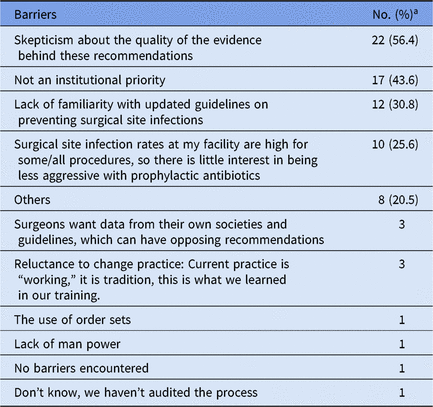
Across all 39 hospitals, primary barriers for implementing the new guideline recommendations on SAP discontinuation were (1) physician skepticism about the evidence behind these recommendations (n = 22, 56.4%); (2) not an institutional priority (n = 17, 43.6%); and (3) the lack of familiarity with updated guidelines on preventing surgical site infections (n = 12, 30.8%) (Table 1).
Barriers Encountered in Stopping Prophylactic Antimicrobials at the Time the Surgical Incision is Closed for Clean and Clean-Contaminated Procedures

a >1 answer per respondent was possible (N=39).
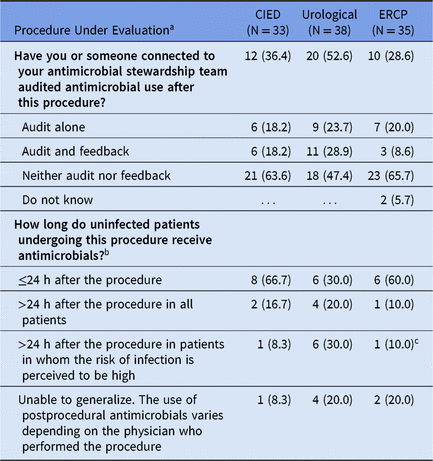
For procedures not covered by the new guidelines, auditing of SAP duration had been performed within the previous 3 years in 20 of 38 institutions performing urological procedures (52.6%), 12 of 33 hospitals placing CIEDs (36.4%), and 10 of 35 centers performing ERCP (28.6%). In hospitals in which postprocedural antimicrobial use had been audited, SAP was usually stopped ≤24 hours after the procedure in 8 of 12 CIED procedures (66.7%), 6 of 10 ERCPs (60.0%), and 6 of 20 urological interventions (30.0%). Specifically, half of the respondents said that patients undergoing urological procedures were more likely to receive >24 hours of postprocedural antimicrobials, either routinely (4 of 20, 20%) or if the risk of infection was perceived to be high (6 of 20, 30%) (Table 2).
Antimicrobial Stewardship Audit-and-Feedback Interventions and Prolonged Post-procedural Antimicrobial Use After Common Clean and Clean-Contaminated Procedures

Note. CIED, cardiovascular implantable electronic devices; ERCP, endoscopic retrograde cholangiopancreatography.
a Only respondents from institutions with the procedure in place were considered.
b This question only applies to respondents who audited antimicrobial use: n = 12 for CIED procedures, n = 20 for urological interventions, and n = 10 for ERCPs.
c Includes incomplete biliary drainage and immunosuppression.
Finally, 29 participants reported that prolonged SAP was commonly prescribed in their institution after other surgeries, such as joint prostheses (n = 15, 51.7%), orthopedic fracture fixation devices (n = 14, 48.3%), vascular grafts (n = 14, 48.3%), ventricular shunts (n = 14, 48.3%), prosthetic heart valves (n = 12, 41.4%), breast implants (n = 11, 37.9%), and others (n = 6, 20.7%).
Discussion
Surgical antimicrobial prophylaxis accounts for a substantial proportion of hospital-based antimicrobial volume, ~14% of all antimicrobials administered to hospitalized patients.Reference Plachouras, Karki and Hansen6 Our survey demonstrates a low adoption of new guideline recommendations for SAP duration and a wide variety of procedures in which prolonged SAP is still prescribed. Promoting guideline-concordant SAP discontinuation in clean and clean-contaminated procedures is a promising target for future stewardship interventions.
Developing facility-specific SAP guidelines can be effective in reducing unnecessary antimicrobial use.Reference Barlam, Cosgrove and Abbo9 Yet, just 30.8% of the sites we surveyed had fully adopted the WHO and CDC recommendations to stop SAP at the time of incision closure. A prior study found that smaller hospitals with resource limitations had greater difficulty translating surgical site infection guidelines into local practice.Reference Branch-Elliman, Pizer and Dasinger8 However, we found that >25% of the largest hospitals (>500 beds) had not yet adopted a shorter duration of SAP in their policies, which suggests that barriers to guideline implementation may extend beyond hospital size and complexity.
Two of the main barriers for SAP discontinuation identified by our survey included physician mistrust of the evidence-base for the guidelines and their lack of awareness of updated guidelines recommendations. Previous research has already identified these challenges as common barriers in antimicrobial guideline implementation.Reference Livorsi, Comer, Matthias, Perencevich and Bair10 Antimicrobial stewardship programs may start with educational interventions and a formal process of audit-and-feedback to acknowledge the problem of prolonged SAP. In our opinion, involving surgeons, anesthetists, and antimicrobial stewardship members in a collaborative way may be crucial in the process of guideline acceptance.
Certain minimally invasive procedures performed outside the operating room were not explicitly addressed by the WHO and CDC guidelines, but these procedures typically have specialty-specific recommendations for SAP duration. Based on our findings, auditing SAP for these procedures would be a good first step in assessing whether opportunities for improved antimicrobial-prescribing exist. Prior studies would suggest that prolonged SAP is common after urological procedures and CIED placements.Reference Asundi, Stanislawski and Mehta5, Reference Khaw, Oberle and Lund7
Our study has several limitations. Survey respondents were members of the SHEA Research Network and may be not representative of all facilities. Additionally, we had a moderate response rate and we do not have information on nonrespondents; they might have been less aware of problems with prolonged postprocedural antimicrobials. As a result, our estimates of prolonged SAP might be biased. However, survey respondents included academic and nonacademic centers and different hospital sizes, making our data generalizable.
In conclusion, our survey identified limited adoption of new guideline recommendations on stopping prophylactic antimicrobials for clean and clean-contaminated procedures once the surgical incision is closed. Prolonged SAP is an important target for future antimicrobial stewardship interventions.
Acknowledgments
The authors thank the SHEA Research Network members for taking part in this survey.
Financial support
No financial support was provided relevant to this article.
Conflicts of interest
All authors report no conflicts of interest relevant to this article.