

Exceptional soft tissue preservation is known from amber (fossil plant resin) and copal (subfossil plant resin) from the Triassic (Schmidt et al. Reference Schmidt, Jancke, Lindquist, Ragazzi, Roghi, Nascimbene, Schmidt, Wappler and Grimaldi2012) to the Recent (Lambert et al. Reference Lambert, Johnson and Poinar1995; Ragazzi et al. Reference Ragazzi, Roghi, Giaretta and Gianolla2003; Wunderlich Reference Wunderlich2004). Amber preservation provides a unique window into ancient ecosystems, as it tends to sample organisms that are otherwise underrepresented in the fossil record: small, soft bodied terrestrial organisms (Penney Reference Penney2002; Labandeira Reference Labandeira2014). Fossils in amber also provide an exceptional record of behaviour, including herbivory, parasitism, pollination, mimicry and mating (Boucot & Poinar Reference Boucot and Poinar2010; Labandeira Reference Labandeira2014; Penney & Jepson Reference Penney and Jepson2014; Peñalver et al. Reference Peñalver, Arillo, Pérez-de la Fuente, Riccio, Delclòs, Barrón and Grimaldi2015; Pérez-de la Fuente et al. Reference Pérez-de la Fuente, Delclòs, Peñalver and Engel2016; Wang et al. Reference Wang, Xia, Engel, Perrichot, Shi, Zhang, Chen, Jarzembowski, Wappler and Rust2016). Along with such records the abundance and diversity of fossils preserved in the best amber fossil sites provides ecological data with which fossil communities can be explored (Penney & Langan Reference Penney and Langan2006; Labandeira Reference Labandeira2014; Penney & Preziosi Reference Penney and Jepson2014; Saint Martin et al. Reference Saint Martin, Saint Martin, Bolte and Néraudeau2014). As such, the data from fossils in amber are a particularly important and unique palaeobiological resource for reconstructing forest ecosystems and predicting consequences of ongoing biotic crises, providing minimum dates for major radiations/extinction events and resolving relationships of modern taxa (Penney Reference Penney, Green and Penney2010, Reference Penney2016).
There is a wide range of variation in the preservation of fossils in amber. Some of the organisms entombed in amber record high fidelity aspects of morphology, such as the internal anatomical features and even parasites (Martínez-Delclòs et al. Reference Martínez-Delclòs, Briggs and Peñalver2004; Rust et al. Reference Rust, Singh, Rana, McCann, Singh, Anderson, Sarkar, Nascimbene, Stebner and Thomas2010; Labandeira Reference Labandeira2014; Mazur et al. Reference Mazur, Nagel, Leppin, Bierbaum and Rust2014). The best preservation known occurs in the Dominican and Baltic ambers, and includes insect flight muscles, air sacs, brain and neural tissues, mitochondria with cristae and endoplasmic reticulum (Henwood Reference Henwood1992; Grimaldi et al. Reference Grimaldi, Bonwich, Delannoy and Doberstein1994), and some biomolecules (Martínez-Delclòs et al. Reference Martínez-Delclòs, Briggs and Peñalver2004). However, it seems unlikely that DNA is preserved in amber, as it was not possible to recover it from fossils in either Baltic or Dominican amber (Austin et al. Reference Austin, Ross, Smith, Fortey and Thomas1997), or even from fossils in the much younger copal precursor (Penney et al. Reference Penney, Wadsworth, Fox, Kennedy, Preziosi and Brown2013). Incredibly life-like insects are only one end-member of a wide spectrum of preservation quality in amber (Martínez-Delclòs et al. Reference Martínez-Delclòs, Briggs and Peñalver2004), as many amber sites only preserve cuticle and the majority have no fossils (Martínez-Delclòs et al. Reference Martínez-Delclòs, Briggs and Peñalver2004). The taphonomic processes that control this vast range in preservation quality are almost completely unknown. To get the most from the amber fossil record, we need to understand the biases and filters that have operated to preserve (or destroy) animals entombed in resin.
Resin chemistry has been implicated as the principal control on the exceptional preservation of fossils in amber (Henwood Reference Henwood1992; Stankiewicz et al. Reference Stankiewicz, Poinar, Briggs, Evershed and Poinar1998; Labandeira Reference Labandeira2014). The intuitive corollary of this is that the extensive chemical variation seen in both modern resin and fossil amber (Lambert et al. Reference Lambert, Johnson and Poinar2008, Reference Lambert, Tsai, Shah, Hurtley and Santiago-Blay2012, Reference Lambert, Santiago-Blay, Wu and Levy2015; Labandeira Reference Labandeira2014) may influence variation in preservation occurrence and quality of entombed organisms. Here, we examine the literature of fossilisation in amber to assess the evidence for and against the hypothesis that resin chemistry influences preservation. The primary purpose of this paper is to statistically compare various amber sites, to determine if there is any significant difference in the fossilisation of entombed organisms between amber of different chemistries. We also qualitatively explore evidence which suggests that resin chemistry cannot account for all the variation in preservation, and remark on other variables that may influence fossilisation in amber. Finally, we discuss what further analyses are needed to more carefully test this hypothesis.
1. Resin chemistry and preservation
The chemical and physical properties of resin (later amber) are thought to prohibit scavengers and decomposition of organisms and result in their exceptional preservation. Resin forms a physical barrier to microbial penetration, dehydrates tissues and contains antimicrobial and antifungal chemicals (Poinar & Hess Reference Poinar and Hess1982, Reference Poinar and Hess1985; Stankiewicz et al. Reference Stankiewicz, Poinar, Briggs, Evershed and Poinar1998; Martínez-Delclòs et al. Reference Martínez-Delclòs, Briggs and Peñalver2004; Labandeira Reference Labandeira2014). Experiments to date have tested this general model of amber preservation and have demonstrated that physical sealing alone is not sufficient to inhibit decay; organisms sealed in wax decayed, in some cases more quickly than in unsealed control experiments (Henwood Reference Henwood1992). However, sealing an organism in maple syrup (which is chemically distinct from wax) inhibited decay compared to organisms placed in unsealed control conditions (Henwood Reference Henwood1992). This experiment demonstrated that the chemistry of a sealing medium influences the decay rate of an entombed organism; under some chemical conditions (i.e., in wax) decay is enhanced, whereas in other chemical conditions (i.e., in maple syrup) decay is inhibited. This strongly suggests that the exceptional preservation of bioinclusions in amber must be due, in some part, to the decay-inhibiting effects of resin chemistry, rather than to physical sealing (Henwood Reference Henwood1992). Analyses of bioinclusions in amber further supports this, indicating that when an organism is entombed in resin, some of the volatile compounds of the resin infiltrate the tissue of the organism and form chemical cross-links that prevent tissue decay (Stankiewicz et al. Reference Stankiewicz, Poinar, Briggs, Evershed and Poinar1998).
Based on these experiments and analyses of fossils in amber, resin chemistry is generally assumed to inhibit decay and promote preservation. However, resin chemistry is highly variable, and the effects of resins of different chemical compositions on decay have never been robustly tested. Neither wax nor maple syrup is chemically analogous to any form of resin, which are composed of terpenoid and phenolic compounds (Labandeira Reference Labandeira2014). Paraffin wax is composed of hydrocarbon alkanes and maple syrup is composed of sugars. Some resins may be more analogous to wax in their effects on decay, in that entombed organisms may decay unusually quickly, which could explain amber sites without fossils. It has also been suggested that certain tissues and biomolecules, particularly DNA, degrade more quickly in resin than in other conditions: DNA could not successfully be extracted from inclusions in Recent copal, even though it could be extracted from pinned museum specimens of a similar age (Penney et al. Reference Penney, Wadsworth, Fox, Kennedy, Preziosi and Brown2013). Other resins may inhibit the decay of entombed organisms, but to different degrees, resulting in fossils of varying preservational quality.
In short, currently it is suspected that resin chemistry may play a significant role in preservation quality, but data to support this are few and no robust analyses across different deposits have been undertaken. To begin to test the hypothesis that variations in resin chemistry can influence the decay of entombed organisms, and thus control preservational quality, we evaluate data surveyed from current literature. We compare resin chemistry of amber sites and fossil occurrence and preservational quality within the sites (e.g., no fossil inclusions, poorly-preserved fossil inclusions, well-preserved fossil inclusions). Using our analyses, we then review published evidence for and against this hypothesis. If the null hypothesis (i.e., that resin chemistry does not influence occurrence and quality of preservation in amber) is rejected, we predict that there will be little variation in fossil preservation between amber sites of similar chemistry, and more variation in fossil preservation between amber sites of different chemistry.
This is important, because if resin chemistry is the principal, or only, control on preservation in amber, it is unlikely to impart any significant biases on preservation occurrence and quality within a specific amber fossil site, assuming that all the amber was sourced from a single tree type and thus had a similar resin chemistry. Any organism entrapped in resin is equally likely to be preserved (although there will still be size and behaviour biases in entrapment), resulting in a preserved assemblage that accurately reflects a known portion of the original life assemblage. Moreover, if resin chemistry does indicate a reliable indicator of preservation quality, it would provide a simple diagnostic test to determine whether new sites should preserve exceptional anatomical and soft tissue details. Conversely, if resin chemistry does not control preservation, or if there are other significant factors at play, then the fossil record of amber may not directly reflect an original life assemblage; more investigation would be needed to determine what processes have filtered the record.
2. Chemical classification of resin and amber
Resin is one of many biological substances secreted by plants (others include gum, wax, sap, latex, oil and mucilage) which polymerises over time into a sub-fossil form and then a fossil form – copal and amber, respectively (Lambert et al. Reference Lambert, Johnson, Poinar and Frye1993, Reference Lambert, Santiago-Blay, Wu and Levy2015). The change from resin to copal to amber is a continuum, and although some authors have attempted to define the three substances based on age, chemistry or physical properties, there is no agreed demarcation between the three groups (Anderson Reference Anderson1996; Vavra Reference Vavra2009; Penney & Green Reference Penney and Penney2010). In general, amber is harder and chemically more inert than either copal or resin, and copal is harder than resin but chemically very similar (Labandeira Reference Labandeira2014).
Resins are distinguished from other plant exudates by their chemistry; they are complex compounds composed primarily of terpenoids and phenolic compounds, supplemented with a number of secondary compounds (Langenheim Reference Langenheim1990; Labandeira Reference Labandeira2014). The chemical composition of any specific resin flow is influenced by several factors, including the botanical source, the time of year, the water and nutrient conditions in the environment, the metabolic processes of the individual tree, and the plant organ producing the resin (e.g., roots vs. trunk) (Langenheim Reference Langenheim and Penney1995; Martínez-Delclòs et al. Reference Martínez-Delclòs, Briggs and Peñalver2004). Despite this, analysis of hundreds of samples of resin and amber suggests that the chemical variation can be roughly encapsulated by a few categories (Labandeira Reference Labandeira2014; Lambert et al. Reference Lambert, Santiago-Blay, Wu and Levy2015). There are primarily two classification schemes, based to some extent on different techniques of analysing the samples, but the resulting categories are basically equivalent, supporting the robustness of amber chemical classification (Lambert et al. Reference Lambert, Santiago-Blay and Anderson2008, Reference Lambert, Santiago-Blay, Wu and Levy2015; Labandeira Reference Labandeira2014).
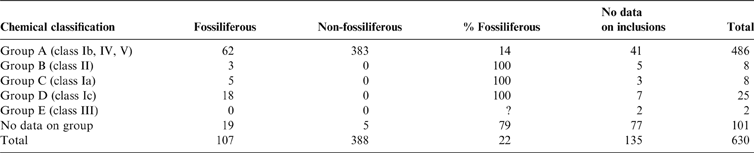
One classification scheme is based on solid state 13C and solution 1H nuclear magnetic resonance (NMR) spectroscopy of fossilised amber, which suggests five major chemical groups (A, B, C, D and E) (Lambert et al. Reference Lambert, Santiago-Blay and Anderson2008, Reference Lambert, Santiago-Blay, Wu and Levy2015; Labandeira Reference Labandeira2014). This classification scheme has also been applied to modern resins (Lambert et al. Reference Lambert, Santiago-Blay and Anderson2008, Reference Lambert, Tsai, Shah, Hurtley and Santiago-Blay2012). Group A is found worldwide, from the Triassic to the Recent, and is by far the most common (Table 1) (Lambert et al. Reference Lambert, Frye and Poinar1990, Reference Lambert, Johnson, Poinar and Frye1993, Reference Lambert, Johnson and Poinar1995, Reference Lambert, Tsai, Shah, Hurtley and Santiago-Blay2012, Reference Lambert, Santiago-Blay, Wu and Levy2015). Although, in general, it is difficult to determine the botanical source of amber (Langenheim Reference Langenheim2003), Group A is most likely produced by a member of the Araucariaceae family. Kauri gum, from the modern Araucaiaceaen tree Agathis australis is the most similar modern resin, but there may be a number of trees that produced comparable resin through time (Lambert et al. Reference Lambert, Johnson, Poinar and Frye1993, Reference Lambert, Santiago-Blay, Wu and Levy2015).
Summary table for the presence and absence of fossils in ambers outcrops, divided into the different chemical groups. (See and for details of each outcrop.)

Group B also has a worldwide distribution and is known from the Carboniferous to the Recent (Bray & Anderson Reference Bray and Anderson2009; Lambert et al. Reference Lambert, Johnson and Poinar1996, Reference Lambert, Levy, Santiago-Blay and Wu2013, Reference Lambert, Santiago-Blay, Wu and Levy2015). Comparisons of Group B amber to the chemical signature of modern resins supports a Dipterocarpaceae source (Lambert et al. Reference Lambert, Levy, Santiago-Blay and Wu2013, Reference Lambert, Santiago-Blay, Wu and Levy2015).
Group C is the Eocene Baltic amber, one of the best known and most fossiliferous sources of amber, which is found in a variety of sites around the Baltic region (Weitschat & Wichard Reference Weitschat, Wichard and Penney2010; Lambert et al. Reference Lambert, Santiago-Blay, Wu and Levy2015). This amber group is chemically very similar to Group A amber, but the two groups can nonetheless be reliably distinguished (Lambert et al. Reference Lambert, Santiago-Blay, Wu and Levy2015). The botanical source of Baltic amber is debated, because all modern resins have notable chemical differences to it (Langenheim Reference Langenheim and Penney1995; Wolfe et al. Reference Wolfe, Tappert, Muehlenbachs, Boudreau, Mckellar, Basinger and Garrett2009); it is generally agreed to be from a coniferous source (Lambert et al. Reference Lambert, Santiago-Blay, Wu and Levy2015).
Group D is Miocene Dominican amber (including other very similar Mexican and South American ambers) (Penney Reference Penney, Green and Penney2010; Lambert et al. Reference Lambert, Santiago-Blay, Wu and Levy2015), which are chemically very similar to the resin produced by the modern (angiosperm) genus Hymenaea, and it is thought to have been produced by the extinct species Hymenaea protera (Poinar Reference Poinar1991; Poinar & Poinar Reference Poinar and Poinar1999; Lambert et al. Reference Lambert, Santiago-Blay, Wu and Levy2015).
Group E is a rare and unusual amber composed of fossil polystyrene and is found from the Cretaceous of New Jersey. Due to the similarities between Group E amber and modern Liquidambar resin, this amber is also thought to be produced by trees in the Hammelimidae family (Lambert et al. Reference Lambert, Santiago-Blay, Wu and Levy2015).
The other classification scheme is based on chemical structural characterisation, often (though not exclusively) through pyrolysis gas chromatography (PY–GC–MS), of modern resins and fossil amber, and suggests seven classes of amber and resin (Ia, Ib, Ic, II, III, IV and V), that overlap almost exactly with the NMR chemical groups (Anderson & Winans Reference Anderson and Winans1991; Anderson Reference Anderson1994; Beck Reference Beck1999; Lambert et al. Reference Lambert, Santiago-Blay and Anderson2008; Labandeira Reference Labandeira2014). Class Ia is Group C, Class Ib is Group A, Class Ic is Group D, Class II is Group D and Class III is Group E (Lambert et al. Reference Lambert, Santiago-Blay and Anderson2008, Reference Lambert, Santiago-Blay, Wu and Levy2015). Classes IV and V are almost unknown in the fossil record, and there are no equivalent groups in the NMR-based classification scheme. The few fossil amber specimens that fall into Class IV or V are considered to be Group A, based on NMR analysis (see ) (Anderson & Botto Reference Anderson and Botto1993; Nel & Prokop Reference Nel and Prokop2005; Colchester et al. Reference Colchester, Webb and Emseis2006; Lambert et al. Reference Lambert, Tsai, Shah, Hurtley and Santiago-Blay2012).
There is a third, somewhat informal, classification scheme that is not based upon chemical analysis, which divides fossiliferous ambers into named types based on similarities of age, geographical location and entombed biota. Examples of categories in this classification scheme include Dominican amber, Baltic amber and Lebanese amber (Penney Reference Penney, Green and Penney2010). There are 13–26 (the numbers vary depending on the author) named types of amber, each of which is a subset of a chemical group (Penney Reference Penney, Green and Penney2010; Lambert et al. Reference Lambert, Santiago-Blay, Wu and Levy2015). The sites within a named type are generally more chemically similar to each other than to other sites in the same chemical group (Lambert et al. Reference Lambert, Tsai, Shah, Hurtley and Santiago-Blay2012).
That resin (and amber) chemistries are grouped based on different schemes, formal and informal, makes it challenging to select categories for statistical analyses of the relationship – if any – between resin chemistry and preservation. For the analyses herein, we use the Group or Class systems (which are equivalent) to categorise amber sites by their chemistry, with a few other analyses based on the informal categories. Although resin chemistries even within groups will vary, we expect the differences between the groups to be larger than the differences within the groups. Moreover, subdividing chemistry-type categories (i.e., within amber groups) would divide the data to an extent that would preclude statistical analysis. Finally, although some of the chemical groups are more similar than others (i.e., groups A and C are more similar to each other than to Group B (Lambert et al. Reference Lambert, Santiago-Blay and Anderson2008, Reference Lambert, Santiago-Blay, Wu and Levy2015)), we employ statistical analyses for categorical data, which makes no assumptions about the degree of similarity of categories. For these types of analyses, it does not matter if some chemical groups are more similar than others.
3. Resin chemistry and preservational quality
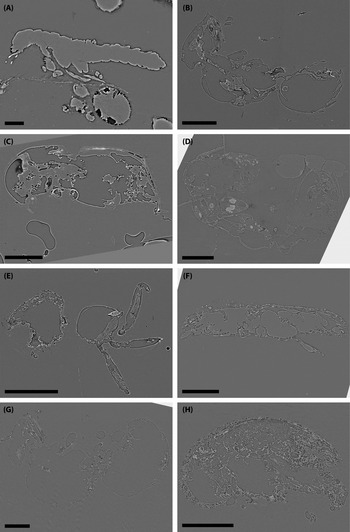
Many bioinclusions in amber, when examined with the naked eye or light microscopy, look perfectly preserved even down to tiny morphological details (Penney Reference Penney, Green and Penney2010; Labandeira Reference Labandeira2014). However, even these apparently perfect specimens vary widely in preservational quality: some are empty voids in the resin, with a thin carbon film providing the appearance of tissue (Fig. 1A–C); some retain external tissues such as cuticle remnants, which themselves range from well-preserved to significantly degraded; others have some remnants of internal soft tissues (Fig. 1D–G); and some contain well-preserved soft tissues (Martínez-Delclòs et al. Reference Martínez-Delclòs, Briggs and Peñalver2004; Labandeira Reference Labandeira2014). Until recently, assessing the preservational quality of bioinclusions in amber was time-consuming and destructive; typically, it required breaking open or dissolving the amber and actually dissecting or chemically analysing the inclusion (Henwood Reference Henwood1992; Grimaldi et al. Reference Grimaldi, Bonwich, Delannoy and Doberstein1994; Stankiewicz et al. Reference Stankiewicz, Poinar, Briggs, Evershed and Poinar1998; Penney & Green Reference Penney, Green and Penney2010; Rust et al. Reference Rust, Singh, Rana, McCann, Singh, Anderson, Sarkar, Nascimbene, Stebner and Thomas2010; Labandeira Reference Labandeira2014). More recently, technology such as CT-scanning and synchrotron tomography has been used to determine the quality of preservation of both internal and external structures in fossils preserved in amber (Dierick et al. Reference Dierick, Cnudde, Masschaele, Vlassenbroeck, Van Hoorebeke and Jacobs2007; Lak et al. Reference Lak, Néraudeau, Nel, Cloetens, Perrichot and Tafforeau2008; Penney & Green Reference Penney, Green and Penney2010; Soriano et al. Reference Soriano, Archer, Azar, Creaser, Delclòs, Godthelp, Hand, Jones, Nel and Néraudeau2010; Labandeira Reference Labandeira2014).
Synchrotron images of fossil in amber showing preservational variation; all images are from the ESRF online paleobiology database, http://paleo.esrf.eu/: (A) Raphidioptera from Charentes amber, showing cast preservation without any internal structures (from Soriano et al. 2010); (B) Hymenoptera from Dominican amber, showing cast preservation without internal structures (unpublished); (C) Coleoptera in Australian amber, showing partially dissolved internal cast preservation (from Soriano et al. 2010); (D) Hymenoptera from Burmese amber, showing partial internal preservation of muscle and head parts, as well as mineral precipitation in the specimen (unpublished); (E) spider from Spanish amber, showing internal muscle preservation in the legs and parts of the abdomen (from Soriano et al. 2010); (F) Coleoptera from Lebanese amber, showing partial internal preservation (from Kirejtshuk et al. 2009); (G) Hymenoptera from Baltic amber, showing internal anatomy preservation including parts of the digestive tract, neural system, and mouthparts (unpublished); (H) Coleoptera from New Jersey amber, showing the white foam of microbubbles coating the specimen (unpublished). Scale bars = 0.5 mm.

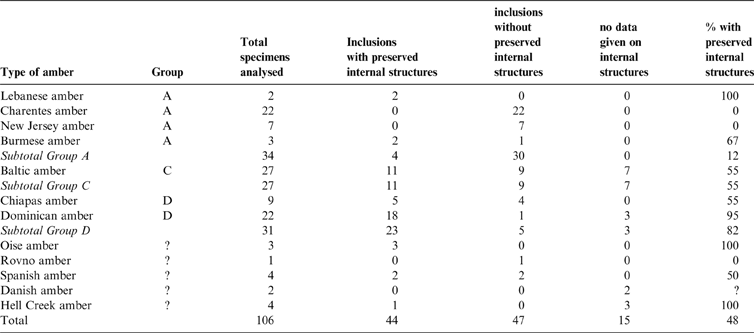
A total of 106 terrestrial arthropod fossils in amber have been investigated using traditional dissecting methods, CT scanning or synchrotron analysis (Table 2; ) and these form the basis of our investigation. A few such studies have also focused on other groups (e.g., flowers, lizards, etc.) (Moreau et al. Reference Moreau, Cloetens, Gomez, Daviero-Gomez, Néraudeau, Lafford and Tafforeau2014; del Rosario Castañeda et al. Reference del Rosario Castañeda, Sherratt and Losos2014; Serano-Sanchez et al. 2015; Sherratt et al. Reference Sherratt, del Rosario Castañeda, Garwood, Mahler, Sanger, Herrel, De Queiroz and Losos2015), but we restrict this analysis to terrestrial arthropods to minimise variation due to the preservation potential of the inclusion. Moreover, we compare site to site rather than inclusion to inclusion, which helps to decrease the effects of inclusion-specific variables on preservation.
Summary of amber specimens that have been analysed with synchrotron tomography, computed tomography (CT scanning) or light microscopy, SEM or TEM after being extracted from the amber. This allows for an assessment of the preservational quality of the cuticle and internal structures. (See and for details of each specimen.) The percentage (%) with preserved internal structures is based only on those specimens with data about internal structure preservation.

Here we consider ‘well-preserved' specimens to be those with preserved internal soft tissue structures (Fig.1D–G), and ‘poorly-preserved' specimens as those that are moulds or preserve cuticular anatomy only (Fig. 1A–C) (Table 2; ). Note that whilst cuticle is nonbiomineralised, it is recalcitrant and more decay resistant than the internal soft tissues. Indeed, it has been shown to survive longer than internal soft tissues in laboratory experiments under all conditions tested (Briggs Reference Briggs2003). Assessing preservational quality based on this dichotomy of the presence or absence of internal soft tissue preservation also matches the level of information provided in most of the published literature; where preservation quality is not described in any great detail, but the presence or absence of internal soft tissue anatomy is usually recorded (but where more detailed descriptions are provided they are noted in ). In some cases where the published description did not mention the presence or absence of internal structures (e.g., Saupe et al. Reference Saupe, Pérez-De La Fuente, Selden, Delclòs, Tafforeau and Soriano2012), we were able to examine the synchrotron images to determine whether or not internal structures were preserved (Table 2).
In our survey, most of the specimens (92 out of the 106) could be assigned to one of the chemical groups A–E, based on previous analyses of amber from the same site (Table 2; ). All the groups except E are represented; however, no fossils are known from Group E amber sites, so that specific type of resin is not relevant for this investigation. Fossils in Group B amber have been dissolved out of the amber and dissected, but no information was given in the paper (Mazur et al. Reference Mazur, Nagel, Leppin, Bierbaum and Rust2014) about the presence or absence of internal structures, so Group B is also effectively not represented in our dataset.
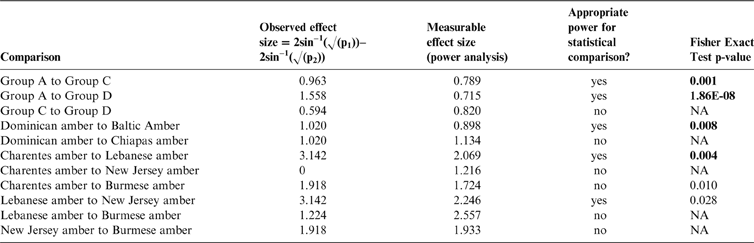
Each of Groups A, C and D include specimens with and without preserved internal soft tissues, suggesting that a range of resin chemistries allows for internal soft tissue preservation of bioinclusions. However, the percentage of fossils that preserve internal soft tissue structures (which relates to the average preservational quality of bioinclusions in that chemical group) varies between the three groups: 12 %, 55 % and 82 % of analysed samples in Groups A, C and D, respectively, preserve internal soft tissue structures. A power analysis, using the program R (R Development Core Team 2014), indicates we can only statistically compare Group A and each of Groups C and D (Table 3).
Statistical comparisons of preservational quality between ambers in different chemical groups. The observed effect size is calculated from the proportions (p1 and p2) of fossils in each group that have preserved internal structures. The measurable effect size is based on a power analysis using the program R, which indicates the effect size that can be accurately measured, given the sample sizes. There is appropriate power for a statistical comparison if the measurable effect size is smaller than the observed effect size. The Fisher Exact tests were also carried out using the program R; significant p-values (p-values < 0.008, due to a Bonferroni correction for multiple tests) are in bold.

Fisher Exact tests reveal that the bioinclusions in Group A amber have significantly lower preservational quality than the bioinclusions in Group C or Group D amber (p=0.001 and 1.86E-08, respectively) (Table 3). This supports the idea that there is a difference in preservational quality in bioinclusions entombed in resins of different chemistry.
However, the data also appear to suggest that there is a difference in preservational quality between amber sites of similar chemistry (i.e., between sites within the same group), although this cannot be tested statistically due to insufficient sample size (Table 3). There are three exceptions, all among Group A amber: Lebanese amber, with 100 % of analysed specimens containing preserved internal structures, can be compared to Charentes amber and New Jersey amber, both of which have 0 % of analysed specimens containing preserved internal structures; and Charentes amber can also be compared to Burmese amber, which has 67 % of analysed specimens containing preserved internal structures. The differences between Lebanese and New Jersey amber and between Charentes and Burmese amber are not statistically significant (Table 3) and so do not reveal anything about preservational variation within Group A amber. In contrast, Charentes amber and Lebanese amber have significantly different proportions of bioinclusions with preserved internal structures (Table 3). Therefore, these results suggest that other variables also influence preservational quality. However, with such small sample sizes, even a few new specimens could change the result of our analyses.
There is also other evidence that variables other than resin chemistry influence preservational quality. Perhaps most compelling is one piece of Chiapas amber (Group D) with eight inclusions, four of which have preserved internal structures and four of which do not. The chemical variation within one piece of amber is likely to be very small, and therefore other variables other than resin chemistry must control internal preservation in this specific instance (Coty et al. Reference Coty, Aria, Garrouste, Wils, Legendre and Nel2014), and potentially across other examples.
These data also offer the opportunity to test the general view that the bioinclusions in Dominican amber are better preserved than those in Baltic amber (Grimaldi et al. Reference Grimaldi, Bonwich, Delannoy and Doberstein1994). A power test demonstrates that we do have a sufficient sample size to statistically test this assertion, and a Fisher Exact test reveals that the percentage of bioinclusions with internal soft tissue structures preserved is significantly higher in Dominican amber than in Baltic amber (Table 3), supporting the consensus view.
4. Resin chemistry and presence/absence of fossils
There are 630 amber sites reported in the literature (Table 1; ) (Martínez-Delclòs et al. Reference Martínez-Delclòs, Briggs and Peñalver2004; Lambert et al. Reference Lambert, Tsai, Shah, Hurtley and Santiago-Blay2012; plus ); of these, 106 are known to have bioinclusions, 388 are known to have none, and for the remaining 136 this information is unrecorded (Table 1, ). If we assume that all sites would have had a living fauna, these data suggest either that at some sites insects were not trapped in resin, or that insects were not preserved in the resin as their remains were lost through decay. There is evidence in some cases that resin forms inside the wood of the tree, and that insect access is therefore limited. However, even in these cases, there can be insect inclusions (Ross & Sheridan Reference Ross and Sheridan2013). Also, studies of modern resin, very young copal and experimental entrapment in other sticky media suggest that resin and other sticky exudates commonly entrap insects (Penney & Preziosi Reference Penney, Preziosi and Penney2010; Solórzano Kraemer et al. Reference Solórzano Kraemer, Kraemer, Stebner, Bickel and Rust2015). In particular, some trees produce resin for the purpose of trapping and neutralising attacking insects (Phillips & Croteau Reference Phillips and Croteau1999; Becerra et al. Reference Becerra, Venable, Evans and Bowers2001; Trapp & Croteau Reference Trapp and Croteau2001; Villagra et al. Reference Villagra, Meza and Urzúa2014). Therefore, although we cannot discount the possibility that some sites did not entomb any organisms, we expect that they are a small part of our data.
In general, about 75 % of amber sites (388 out of 494 with data on inclusions) are non-fossiliferous (Table 1; ) (Martínez-Delclòs et al. Reference Martínez-Delclòs, Briggs and Peñalver2004). However, these non-fossiliferous sites are only found among Group A amber sites (of which only 14 % are fossiliferous). Groups B–D amber sites are all fossiliferous, and there are no data on inclusions in Group E amber. The data we have offer sufficient power (Table 4) to statistically compare Group A amber sites to Group B, C and D amber sites; the results indicate that a significantly smaller percentage of Group A amber sites have fossils than Group B, C or D amber outcrops (Table 4). This supports the hypothesis that resin chemistry can influence whether organisms once entrapped are preserved or lost through decay processes. It is also consistent with the results presented above that preservational quality is inferior in Group A ambers than in other ambers.
Statistical comparisons of fossil presence/absence between ambers in different chemical groups. The observed effect size is calculated from the proportions (p1 and p2) of fossils in each group that have preserved internal structures. The measurable effect size is based on a power analysis using the program R, which indicates the effect size that can be accurately measured, given the sample sizes. There is appropriate power for a statistical comparison if the measurable effect size is smaller than the observed effect size. The Fisher Exact tests were also carried out using the program R; significant p-values are in bold.

However, there is also some evidence of variation in fossil occurrence within resins of very similar chemistry. For example, for Group A ambers, a survey of amber-bearing sites in Spain found that in over 100 outcrops in very close geographic proximity with almost identical chemistry, seven had bioinclusions (Martínez-Delclòs et al. Reference Martínez-Delclòs, Arillo, Peñalver, Barrón, Soriano, Del Valle, Bernárdez, Corral and Ortuño2007). Similarly, of nearly 300 amber-bearing outcrops in Lebanon, only 18 have bioinclusions (Azar et al. Reference Azar, Gèze, Acra and Penney2010). Therefore, although resin chemistry may play a role in determining if entombed organisms are preserved other variables are also likely to be influential.
5. Conclusions: does resin chemistry influence fossilisation?
We have shown that there is statistically significant variation between amber Groups, both in the quality of preservation of fossils, and in whether or not an entombed organism is fossilised. This supports the hypothesis that resin chemistry does influence the preservation of entombed organisms. However, there are many other factors that we could not test that may also account for correlations between amber Group and preservation. Our analyses show that to begin to unravel the chemical properties of resin that promote or inhibit preservation, comparison of the chemistry of Group A amber (the only group without fossils, and those with the lowest preservation quality) to Group C and Group D ambers (all have fossils, with higher preservational quality) would be most fruitful. Groups A, C and D are all formed from polylabanoid diterpenes and are distinguished by the stereochemistry and the presence or absence of succinic acid (Lambert et al. Reference Lambert, Santiago-Blay and Anderson2008), as well as by other secondary chemical variation (see e.g., Lambert et al. Reference Lambert, Santiago-Blay and Anderson2008 for examples of the range of compounds found in the different amber chemical groups). Group A ambers have a regular stereochemical configuration and no succinic acid; Group C ambers have a regular configuration and succinic acid; and Group D ambers have 19β,11α, 20α (non-regular) configuration and no succinic acid. This shows simply that succinic acid and the stereochemistry are unlikely to explain the poor fossilisation in Group A ambers; rather, it may be due to more subtle variation in secondary chemical components. Group D ambers also differ chemically from Group A ambers, but the differences are too extensive and complex to assess here. Variations in preservation within the amber groups may also be explained by chemical variation within the groups, or equally, by the influence of other variables.
There are some instances in which preservational variation cannot be explained by variations in resin chemistry, suggesting that other variables also influence fossilisation in amber. There are a number of other variables that would be interesting to investigate as controls on the preservation of organisms entombed in amber: dehydration of the carcass before being entombed in resin (Henwood Reference Henwood1992; Martínez-Delclòs et al. Reference Martínez-Delclòs, Briggs and Peñalver2004; Ross Reference Ross2010; Coty et al. Reference Coty, Aria, Garrouste, Wils, Legendre and Nel2014); permeability of the resin to water, which degrades tissues and biomolecules (Austin et al. Reference Austin, Ross, Smith, Fortey and Thomas1997; Zschokke Reference Zschokke2003); and variations in the temperature, pressure and other environmental conditions during early diagenesis (Martínez-Delclòs et al. Reference Martínez-Delclòs, Briggs and Peñalver2004). Furthermore, there may be factors that are entirely unrelated to the immediate environment in which the bioinclusion occurs; as with other fossils, those in amber can be significantly modified by later geological events/processes. These include, for example, orogenesis and the temperature/pressure conditions experienced by the amber.
Our initial analyses shows that resin chemistry may, at least in part, influence preservation quality, but what is really required to unravel the role of resin chemistry in preservation is more data – particularly recording data about which sites do not have fossils, which fossils have preserved soft tissue structures, and which fossils show evidence for initial dehydration – this would enable more powerful statistical analyses to test the effect of each of these variables on preservation in amber. Alongside this, the chemical variation of amber between and within sites requires more research. In addition, laboratory experiments to determine how resin chemistry and dehydration affect the process of decay and preservation will greatly enhance current understanding of preservation in amber and the biases in the amber fossil record.
6. Acknowledgements
We thank L. Seyfullah for helpful discussion and ERSF for synchrotron images. This research is supported by a Royal Society Newton Fellowship to VEM. The paper has also been improved by helpful comments from three anonymous reviewers.
7. Supplementary Material
and , (McCoy et al. ; McCoy et al. ) together with an accompanying (McCoy et al. ), are provided as Supplementary Material with the online version of this paper. This is hosted by Cambridge Core and can be viewed at http://journals.cambridge.org/tre.