

As regulatory authority over social and environmental challenges becomes increasingly fragmented, private and public actors need to find novel ways to collectively address these challenges (Bartley, Reference Bartley2007; de Bakker & den Hond, Reference de Bakker and den Hond2008; Ferraro, Etzion, & Gehman, Reference Ferraro, Etzion and Gehman2015; Gilbert, Rasche, & Waddock, Reference Gilbert, Rasche and Waddock2011; Scherer & Palazzo, Reference Scherer and Palazzo2007). Achieving this goal requires a deeper understanding of how stakeholder engagement can productively harness the tension between conflict and consensus to produce effective solutions to these challenges. This speaks to a growing scholarly appreciation of deliberation, a distinctive communicative practice characterized by mutual reason giving and listening (Bächtiger & Parkinson, Reference Bächtiger and Parkinson2019) and originally introduced in the philosophical and political science literatures on deliberative democracy (Dryzek, Reference Dryzek2010; Dryzek et al., Reference Dryzek, Bächtiger, Chambers, Cohen, Druckman, Felicetti, Fishkin, Farrell, Fung, Gutmann, Landemore, Mansbridge, Marien, Neblosimon Niemeyer, Setälä, Slothuus, Suiter, Thompson and Warren2019; Elster, Reference Elster, Elster and Hylland1986; Fung, Reference Fung2007; Habermas, Reference Habermas2018). More recently, the traditional focus of the deliberative democracy literature on seeking rational consensus (Habermas, Reference Habermas1984, Reference Habermas2018) has been criticized by deliberation scholars, who have countered that an exclusive orientation toward consensus may not be appropriate for either corporations or nongovernmental organizations (NGOs). Instead, they have proposed alternative conceptualizations that leave more space for conflict and contestation (Arenas, Albareda, & Goodman, Reference Arenas, Albareda and Goodman2020; Brand, Blok, & Verweij, Reference Brand, Blok and Verweij2020; Schormair & Gilbert, Reference Schormair and Gilbert2020), but this research has not made clear how parties can maintain some measure of productive conflict without hampering deliberation. In other words, how is the tension between conflict and consensus resolved to produce effective deliberation in stakeholder engagement?
We address this question with a study of shareholder engagement with US public companies. Shareholder engagement refers to the comprehensive process whereby shareholders attempt to change environmental, social, and governance (ESG) corporate practices and policies by employing a broad range of tactics, including letter writing, shareholder proposals, and private dialogue (Becht, Franks, Mayer, & Rossi, Reference Becht, Franks, Mayer and Rossi2008; Carleton, Nelson, & Weisbach, Reference Carleton, Nelson and Weisbach1998; Dimson, Karakas, & Li, Reference Dimson, Karakas and Li2015; Eesley, DeCelles, & Lenox, Reference Eesley, DeCelles and Lenox2016; Logsdon & Van Buren, Reference Logsdon and Van Buren2009; Van Buren, Reference Van Buren2007). Since 1970, shareholders have been able to submit proposals on nonfinancial aspects to be voted on at annual company meetings. These proposals typically mark the beginning of a private dialogue between shareholders and the corporation, which is increasingly seen as the core of the engagement process (Becht et al., Reference Becht, Franks, Mayer and Rossi2008; Carleton et al., Reference Carleton, Nelson and Weisbach1998; Logsdon & Van Buren, Reference Logsdon and Van Buren2009). The process typically starts with an adversarial stance given that it is initiated by shareholders with a formal expression of concern in a written letter. Over time, this can translate into a more collaborative stance.
Shareholder engagement is growing exponentially, partially due to the growth of responsible investing, as asset owners and asset managers sign up to the United Nations–supported Principles for Responsible Investment (PRI): more than three thousand signatories with more than US$100 trillion of assets under management (Gibson, Glossner, Krueger, Matos, & Steffen, Reference Gibson, Glossner, Krueger, Matos and Steffen2020). PRI signatories commit to being active owners (principle 2) and thus either start internal stewardship groups (as BlackRock did with a group of more than fifty professionals) or work with specialized asset managers (like the one we studied). Empirical studies of engagement have shown that engagement has positive consequences on the corporate target’s shareholder value (Barko, Cremers, & Renneboog, Reference Barko, Cremers and Renneboog2018; Dimson et al., Reference Dimson, Karakas and Li2015), while the question of what makes for effective engagement—that is, engagement that leads to the implementation of mutually satisfactory solutions to the contested issue—has remained unexplored. Given the opacity of closed-door engagement processes and the resulting lack of publicly available data, our ability to understand the role of deliberation in private dialogue is limited, and so is our understanding of how shareholders and corporate managers can overcome an adversarial stance. There is thus a need to develop an empirical as well as a theoretical account of how private dialogue can make a difference in the engagement process.
In addressing this gap, we build on the interactionist tradition in sociology and organization theory (Barley, Reference Barley1986, Reference Barley, Greenwood, Oliver, Sahlin and Suddaby2008; Collins, Reference Collins2004; Goffman, Reference Goffman1967, Reference Goffman1983; Weick, Reference Weick1995) by adopting the premise that the face-to-face encounters through which private dialogue unfolds matter as much as structural factors. In this regard, though the deliberative democracy literature has identified the structural conditions for deliberation in stakeholder dialogue, it has not specified what forms of interaction are more conducive to it. We conceive shareholder engagement as a three-stage process (establishing dialogue, developing a solution, and implementing the solution) and define engagement progress as the advancement from an earlier to a later stage. We suggest that two key interaction dimensions explain why some dialogues progress while others stall: deliberative interaction and disagreement. We develop hypotheses on how these dimensions affect dialogue at different stages of the process.
We test our hypotheses with a unique proprietary data set of 169 ESG engagements of one asset manager with US public companies over the period 2007–12. As “stakeholder dialogue” can “constitute [an] empowered (and potentially deliberative) space” (Dryzek, Reference Dryzek1999, Reference Dryzek2010), engagements can be characterized by deliberative interactions or a lack thereof. First, we find that although deliberative interaction per se does not significantly increase the likelihood of advancement in shareholder engagement, it mitigates the effect of voicing disagreement in the solution development stage. Second, we find that the expression of disagreement in the solution development stage of dialogue has a negative effect on advancement, and even more so in a deliberative interaction. Thus our results suggest that deliberativeness contributes to making upfront disagreement potentially conducive to solution development, while protracted disagreement erodes the progress already made, hampering dialogue progress and undermining the implementation of mutually agreed solutions and the successful completion of the engagement. Taken together, our findings contribute to the shareholder engagement literature, deliberative theory, and interactionist organization theory by outlining how certain combinations of conflict and collaboration advance deliberation.
DELIBERATION AND DISAGREEMENT IN SHAREHOLDER ENGAGEMENT
To theorize the role of deliberation in shareholder engagement, we turn to the deliberation literature in political science, which has identified numerous criteria for effective deliberation and has debated the relative weight of each (Dryzek, Reference Dryzek2010; Steiner, Bächtiger, Spörndli, & Steenbergen, Reference Steiner, Bächtiger, Spörndli and Steenbergen2005). While there is debate on the ideal conditions for effective deliberation, we adopt the definition of deliberation as a distinctive communicative practice characterized, at its core, by mutual reason giving and listening (Bächtiger & Parkinson, Reference Bächtiger and Parkinson2019).Footnote 1 This definition is consistent with the core of those offered by most deliberative theorists (Boyer, Reference Boyer1995; Mansbridge, Reference Mansbridge, Heller and Rao2015). For instance, as Fung and Wright (Reference Fung and Wright2003: 17) wrote, “in deliberative decision-making participants listen to each other’s positions and generate group choices after due consideration. Participants ought to persuade one another by offering reasons that others can accept” (emphasis added). In sum, an established body of literature has theorized and tested experimentally (Schneiderhan & Khan, Reference Schneiderhan, Khan, Bächtiger, Dryzek, Mansbridge and Warren2018; Sulkin & Simon, Reference Sulkin and Simon2001) how deliberation helps parties overcome their adversarial positions and thus can help us better understand how shareholders and corporations can engage effectively.
Stakeholder engagement has been examined from a deliberative point of view in the political corporate social responsibility (CSR) literature (Ehrnström-Fuentes, Reference Ehrnström-Fuentes2016; Rasche & Esser, Reference Rasche and Esser2006; Roloff, Reference Roloff2008; Sabadoz & Singer, Reference Sabadoz and Singer2017; Unerman & Bennett, Reference Unerman and Bennett2004). A conceptual study of shareholder engagement by Goodman and Arenas (Reference Goodman and Arenas2015) considered the role of deliberation in this activity, warning that shareholder engagement might fall short of the Habermasian ideal of inclusiveness. Others have adopted an agonistic approach that underscores how conflict and contestation play a productive role in deliberative processes (Arenas et al., Reference Arenas, Albareda and Goodman2020; Brand et al., Reference Brand, Blok and Verweij2020). Relatedly, Schormair and Gilbert (Reference Schormair and Gilbert2020) propose an integrative approach based on a discursive value-sharing process that does not consider value consensus as the necessary outcome of engagement processes but suggests that parties adopt an orientation toward “sufficient justification” that opens the door to a balanced mix of consensus and contestation.
Normative theories of deliberation have introduced the idea of meta-consensus as a way to “relax” the expectation that deliberation is always characterized by the achievement of a rational consensus and thus open the door to more contested form of deliberation (Dryzek & Niemeyer, Reference Dryzek and Niemeyer2006). Deliberative theory, indeed, has recognized that deliberation in stakeholder engagement requires confrontation and conflict for the parties to better understand each other and identify solutions for the contested issues, and it refers to this as “agonistic deliberation” (Brand et al., Reference Brand, Blok and Verweij2020). Relatedly, Arenas et al. (Reference Arenas, Albareda and Goodman2020) suggested that in a “contestatory deliberative” approach, parties are likely to disagree on “how” the process should be governed (procedural), “who” should participate (inclusiveness), “what” will be the impact of the agreement reached (epistemic), and what the ultimate “purpose” of the initiative (ultimate goal) is. They argue that each one of these types of contestation can play a role in promoting deliberation and that four related types of meta-consensus are necessary to enable productive contestation in a deliberative process. Yet, their typology does not explain how the meta-consensus “allows the management of contestation and how this combination increases deliberation and democratic quality,” and the authors call for more research on the topic (Arenas et al., Reference Arenas, Albareda and Goodman2020: 191). We propose that the seemingly contradictory effects of contestation can be resolved by attending to the nature of the interaction in the engagement process and to how they unfold at different stages of the process.
Shareholder Dialogue as an Interactional Process
In exploring shareholder dialogue as a process, we take it as a starting point that it is in the interaction between the parties that the tension between collaboration and conflict gets resolved. In doing so, we are drawing on a sociological and organizational tradition that treats social structures and organizations as interaction systems (Barley, Reference Barley, Greenwood, Oliver, Sahlin and Suddaby2008; Strauss, Reference Strauss1978) and the interaction instead of the actors as the basic unit of analysis (Goffman, Reference Goffman1983). We suggest that there might be specific forms of interaction that help parties overcome the tension between collaboration and conflict that is inherent to this process. Effective shareholder dialogue can thus be interpreted as what Schegloff (Reference Schegloff1982) calls an “interactional achievement,” whereby two opposing parties accomplish a “deliberative moment” characterized by intense awareness of the self, the other, and the issue (Sprain & Black, Reference Sprain and Black2018: 336).
In leveraging the interactional dimension of shareholder dialogue, we treat dialogue as a sequence of interactions with several stages. Each stage is a different situation that can be empirically identified and measured, and different stages may call for different forms of interaction. More specifically, we build on Ferraro and Beunza’s (Reference Ferraro and Beunza2018) communicative action model of stakeholder engagement composed of three stages: establishing dialogue, framing, and deliberation. To study the interactional mechanisms that lead to effective deliberation once the dialogue has been established, we unpack their final stage (deliberation) by distinguishing two separate stages of solution development and solution implementation. Similarly, Schormair and Gilbert (Reference Schormair and Gilbert2020) conceive deliberation in stakeholder engagement as a process with five procedural steps. These steps include meeting reciprocity and generality preconditions, assessing stakeholder value conflict while identifying affected stakeholders and their concerns, establishing a reciprocal dialogue with affected stakeholders, engaging stakeholders in a process of mutual learning, and finding solutions that accommodate diverging stakeholder value perspectives. As with Schormair and Gilbert, our stage model presumes that parties will be unable to reach a given stage without completing the previous one. At the same time, while all stages are necessary for deliberation in stakeholder engagement, our model focuses on Schormair and Gilbert’s last two stages—the ones taking place after the dialogue between parties has been established—and adds a third stage of solution implementation as a concrete and measurable indicator of actual effective deliberation. By focusing on the last two stages of both stakeholder engagement models while adding the final stage of solution implementation, we are bracketing some of the earlier stages so that we can focus on the interactional component of deliberation.
In sum, our proposed model theorizes effective dialogue as a process of three empirically identifiable and measurable stages that culminates with the actual implementation of mutually satisfactory solutions emergent from deliberation (Figure 1). In the first stage (establishing dialogue), we include all the steps that enable parties to overcome a purely adversarial stance and start a dialogical process. This includes acknowledgment on the part of the company that the issues raised by the shareholders merit discussion and accepting the other parties as dialogical partners and results in the achievement of a meta-consensus on how the dialogue would unfold (Arenas et al., Reference Arenas, Albareda and Goodman2020) and what the ground rules of the process would be (Schormair & Gilbert, Reference Schormair and Gilbert2020). In the second stage (solution development), the parties search for concrete solutions that satisfy (to a certain degree) all the parties involved. This stage of the process is less focused on developing mutual awareness and more on debating the merits of the different solutions that emerge from the process, as well as converging on a mutually agreed one. Finally, in the third stage of the process (solution implementation), parties aim at implementing the solutions identified, likely arriving at a satisfactory solution to the issue. We define an effective shareholder dialogue as one that completes the final stage, while we define dialogue as ineffective if it stops at earlier stages.
A Three-Stage Process of Shareholder Dialogue

Deliberative Interaction
Deliberative interaction refers to the ability of actors to discursively engage in the exchange of reasoned arguments to resolve disputes. A focus on the interaction is necessary because deliberation is not just any kind of discussion but rather a situational accomplishment for the parties involved; that is, it results from the actions and reactions of the parties when engaged in a face-to-face setting (Goffman, Reference Goffman1983). Indeed, experienced facilitators of deliberative processes can readily identify “good” and “bad” examples of deliberation from video recordings (Mansbridge, Hartz-Karp, Amengual, & Gastil, Reference Mansbridge, Hartz-Karp, Amengual and Gastil2006). In these deliberative moments (Goodin, Reference Goodin2008; Sprain & Black, Reference Sprain and Black2018), parties engage in reason-giving exchanges, listen to the other party, and respect their views.
Given the key role that reason-based disagreement plays in the philosophical origins of deliberative practices (Aristotle, 1984; Dewey, Reference Dewey1922; Habermas, Reference Habermas1984, Reference Habermas2018), it is not surprising that most political scientists agree that “at the core of all theories of deliberative democracy is what may be called a reason-giving requirement” (Thompson, Reference Thompson2008: 498). In interactional terms, this means that not any form of discussion between parties can be treated as a deliberative interaction but only the ones where parties are providing reasons for their arguments. But why would reason giving help advance shareholder engagement? Political theorists argue that the exchange of reasons has both an epistemic and a legitimacy role. From an epistemic point of view, it is only through exchanging reasons that parties can better understand the issues, understand each other, and develop better solutions. From a legitimacy point of view, exchanging reasons will lead to more legitimate solutions.
The idea that mutual listening and respect can lead to more productive social interactions is also well established in sociology and organization theory. For instance, Scheff (Reference Scheff1990) refers to interactions characterized by a deliberative interaction as “attuned” interactions. In an attuned state, people reach a high level of intersubjective understanding and can predict each other’s behavior and intentions (Hurley, Reference Hurley2008). This achievement enables parties to break down adversarial stereotypes, as well as build trust and commitment to the process (Ansell & Gash, Reference Ansell and Gash2008). In the context of shareholder engagement, qualitative studies of the process have suggested the importance of heedful interactions in the process. As Logsdon and Van Buren (Reference Logsdon and Van Buren2008: 361–62) wrote, engagement requires “entering into the perspective of another,” “respectful listening, and a proper tone for criticism.”
In light of these arguments, we expect the following baseline hypothesis to hold at each stage of the shareholder engagement process:
H1: Deliberative interaction between active shareholders and corporate leaders has a positive effect on the engagement’s likelihood of progressing to the next stage.
Deliberative Interaction and Issue Disagreement
Though hypothesis 1 captures the baseline expectation of deliberative democracy theorists, deliberative interaction may not be enough to advance in shareholder dialogue, as parties need to arrive at a degree of agreement on the contested issue. Deliberativeness and disagreement denote distinct social qualities, as the degree to which an interaction is deliberative in any social encounter does not reflect the degree of agreement or disagreement. For instance, two opponents in a labor negotiation could be engaging deliberatively but still disagree on the issues being discussed. Deliberativeness and disagreement, we argue, should not be conflated into one concept, and their joint effect on the engagement will be contingent on the stage of the process. This approach is consistent with the call by Bächtiger and Parkinson (Reference Bächtiger and Parkinson2019) to explore how deliberative practices are contingent on specific contexts and goals.
In disentangling the effects of deliberativeness and disagreement, we first theorize that when the dialogue between investors and corporate leaders is not characterized by a deliberative interaction, disagreements can be interpreted as a threat, or as an expression of mistrust, thereby eroding the parties’ inclination to take the other’s point of view. Thus our baseline expectation in the context of shareholder dialogue is that the independent effect of disagreement on the likelihood of progress in the dialogue would be negative. By contrast, if participants are engaged in a deliberative interaction and strive for mutual understanding, conflict and disagreement can be constructive and yield positive outcomes. Indeed, the attunement literature has made clear that when partners are deliberative, conflict serves the purpose of change and mutual adjustment (Scheff, Reference Scheff1990). For instance, failed interactions can be followed by different sequences of actions, depending on the partners’ willingness to maintain and repair the relationship by reestablishing a deliberative interaction, perhaps even on the fracture itself (Braithwaite, Reference Braithwaite1989; Strang & Braithwaite, Reference Strang, Braithwaite, Strang and Braithwaite2017). Discussing the fracture works as a form of restorative justice in the relationship and has the effect of resynchronizing partners.Footnote 2
Nevertheless, even if expressed within a deliberative interaction, disagreement would have different consequences at different stages of the process. Specifically, in line with the insights from the integrative deliberative perspective (Schormair & Gilbert, Reference Schormair and Gilbert2020), we hypothesize that if disagreement is brought up earlier in the dialogue, it allows both parties to convey their beliefs and constraints and to propose new frames that are acceptable to both, culminating in the joint development of concrete solutions. The ability to successfully resolve disagreement and exhibit flexibility then reinforces the initial sense of trust and propels the engagement forward. We then expect disagreement to have a positive moderating effect on the relationship between deliberative interaction and engagement progress in the solution development stage, that is, before parties have converged toward the identification of mutually satisfactory solutions. In a deliberative setting, disagreements can in fact be addressed through discussion, which is likely to enable progress in the dialogue. Therefore we expect the following hypothesis to hold:
H 2a : Before mutually satisfactory solutions have been identified, disagreement positively moderates the positive effect of deliberative interactions on the engagement’s likelihood of progressing to the next stage of the dialogue.
Once solutions have been developed, however, we expect the aforementioned relationship to reverse. That is, we expect late-stage disagreement to undermine successful completion of the engagement, because in an advanced phase of the relationship, the effects of disagreement may be more disruptive than those in early stages. Disagreements calling into question the progress already made, once the parties have laboriously come to a set of concrete solutions, undermine the trust that a party might have developed with the other one and will be perceived as reneging on the agreement. For instance, in Ferraro and Beunza’s (Reference Ferraro and Beunza2018) analysis of the engagement between ICCR and Ford Motors, after parties had agreed on emissions reduction as a viable solution, the car maker antagonized the shareholder activists by suing the state of California in 2006 for setting overly ambitious emissions standards, thus hampering engagement progress. Continued and protracted disagreement after a solution has been developed may signal a lack of interest on the part of one of the parties to adequately listen to the other. Furthermore, it may suggest that one party strategically silenced its disagreement in the prior conversations so as to create a false atmosphere of cordiality. Finally, late disagreement calls into question the potential exchange of commitments in the previous meetings, pointing to a renegotiation of the truce that emerged and raising the concern that one party is opportunistically exploiting the other. Indeed, the literature on social cognition and emotions made clear that when one of the parties expresses views that are inconsistent with the agreed course of action, the other party attributes such inconsistency to deliberate intent, causing anger, distrust, and negative feelings toward the partner (Healey, Vuori, & Hodgkinson, Reference Healey, Vuori and Hodgkinson2015; Lepine & Van Dyne, Reference Lepine and Van Dyne2001). This eventually undermines coordination and cooperation (Barsade, Ward, Turner, & Sonnenfeld, Reference Barsade, Ward, Turner and Sonnenfeld2000; Healey et al., Reference Healey, Vuori and Hodgkinson2015), rendering the engagement ineffective at producing meaningful policy or practice changes. Therefore we expect the following hypothesis to hold:
H 2b : Once mutually satisfactory solutions have been identified, disagreement negatively moderates the positive effect of deliberative interactions on the engagement’s likelihood of progressing to the final stage of the dialogue.
METHODS
Data
To test our hypotheses, we analyzed data from a large asset management company with more than US$1.2 trillion in assets under advice (US$600 billion in assets under management) at the time of writing. This investor was one of the founding members of PRI and remains one of the most influential active owners when it comes to promoting and developing ESG standards at portfolio firms through active shareholder engagement. In this process, the asset management company engages in dialogue on ESG issues with target companies around the world via letters, emails, telephone conversations, and especially direct, face-to-face dialogue with senior management. In this article, we rely on its extensive proprietary database of its ESG engagements with US public companies for the period 2007–12.
The investor engages companies through a four-step process. After identifying an issue and targeting a specific company, the first milestone is to raise concerns regarding ESG issues identified internally as engagement themes. Companies can react to the investor’s concerns in three different ways: they can deny, delay, or acknowledge the concern. Company acknowledgment occurs when a company agrees that an ESG concern deserves attention and corrective action, thus enabling the engagement relationship to progress to the strategy development phase, which involves closer collaboration to address problems and jointly determine changes to policies and practices. The iterative process involves solidifying a company’s commitment to addressing the issues of concern and creating credible strategies to address them. After strategy implementation, the fourth and last milestone, the investor continues to monitor the company to ensure that the process is properly completed. The final US engagement data set includes fifty-six instances of issue identification, thirty-five instances of raising concerns, thirty-three instances of company acknowledgment, twenty-nine instances of strategy development, and sixteen instances of strategy implementation. Only 17 percent of the engagements led to the development of mutually satisfactory solutions and less than 10 percent to their implementation, suggesting that the transition from the acknowledgment of an issue to the development of a strategy and eventually to its implementation is an important hurdle and therefore ideally suited for our study. Thus, in line with our three-stage process of shareholder dialogue, we focused our attention on the last three milestones and tested our hypotheses on two transitions: from the acknowledgment of the existence of an ESG issue to the development of a strategy to address it, and from this milestone to the implementation of the identified solution.
The engagement database includes milestone dates on each one of the engagements; dates, text, and notes of all incoming and outgoing emails and letters exchanged in the meantime; and extensive notes for all telephone calls, conversations, and meetings with executives. These reports are the key data source we coded to measure deliberative interaction and agreement of the interaction chain. In our data, a milestone marked the end of each stage. The status of a milestone was considered “pending” the day an engagement stage began and “complete” the day it had been achieved, at which point the status of the next milestone was updated to “pending.” Each engagement can last from a few months to three or more years. In our sample, engagements lasted, on average, about 1.5 years; on average, 55 days elapsed between initial contact and the first discussion about ESG issues, an additional 108 days elapsed before companies acknowledged focal issues, a further 239 days elapsed before a credible strategy was developed, and an additional 128 days elapsed before the strategy was implemented. We organized our data in an engagement database by firm and issue. The final sample consists of 169 ESG engagements with 77 US-based publicly traded firms.
Dependent Variable
Our model of deliberative dialogue in shareholder engagement posits a three-stage process, with the second stage culminating with a substantive solution to the issue of concern and the third with the implementation of the solution. To measure shareholder engagement progress, we first mapped the investor’s engagement milestones on our process model (Figure 2) and constructed two dependent variables: the first measuring advancement to milestone 3 in our database (strategy development) and the second measuring advancement to milestone 4 (strategy implementation). We focus solely on these last two milestones, because the first (raising concerns) does not require any action from the corporate side. The company acknowledgment milestone is the earliest milestone that depends on corporate action, but it is limited to the company’s acknowledgment of the issue. Thus, following our model, we assigned solution development a value of 1 when the company has shown a commitment to solving the problem and defined potential solutions (strategy development milestone), and 0 otherwise; similarly, we assigned solution implementation a value of 1 when the company successfully implemented the new ESG practices and policies (strategy implementation milestone), and 0 otherwise.
Mapping the Investor’s Engagement Milestones and Our Theoretical Model

Key Independent Variables
To test our hypotheses, we coded our data in two steps. In the first step, one of the authors independently coded 380 investor notes on meetings and face-to-face conversations (78 percent), phone conversations (17 percent), and emails and letters exchanged (5 percent) with executives, totaling 98,500 words. In the second step, the authors collectively prepared a coding manual (see supplementary materials online), and then a second coauthor and two research assistants not involved in the project independently coded the same 380 notes for deliberative interaction and issue disagreement.
To assess and distinguish between deliberative interaction and disagreement in the engagements, we first coded the interaction—regardless of whether it happened in a meeting, in a telephone call, by email, or by letter exchange, as described in each of the notes—as deliberative, mixed or neutral, or nondeliberative. This approach is consistent with the practice of coding deliberation in parliamentary settings used by political scientists (Bächtiger & Parkinson, Reference Bächtiger and Parkinson2019). In that context, scholars have developed a protocol to evaluate the Discourse Quality Index (Steenbergen, Bächtiger, Spörndli, & Steiner, Reference Steenbergen, Bächtiger, Spörndli and Steiner2003). In the context of shareholder engagement, we coded each one of the investor notes assessing whether the interaction described was deliberative (with a value of 1) when corporate managers appeared to be willing to engage in dialogue, share relevant information, discuss investors’ concerns, and provide reasons for their positions, while both parties appeared willing to listen to the other party, respect their views, use a proper tone for criticism, and change their minds. We coded interactions as mixed (with a value of 0) when partners switched between open and closed attitudes, between listening and reason giving, and between defensive and offensive behaviors. We coded interactions as neutral (also with a value of 0) when it was impossible to determine partners’ attitudes due to a lack of sufficient information about the interaction. Finally, we coded engagement interactions as nondeliberative (with a value of −1) when corporate managers appeared unwilling to engage in dialogue, share relevant information, discuss investors’ concerns, or provide reasons for their positions, while both parties jumped abruptly from one topic to another or challenged each other, appearing unwilling to listen to each other, show respect for the other party’s views, use a proper tone for criticism, and be open to changing their minds. We computed deliberative interaction before a milestone as the sum of deliberative interaction scores that took place before the milestone’s achievement. The final variable, deliberative interaction, is a dummy variable that takes a value of 1 when the total score before a milestone is strictly positive, and 0 otherwise.
To code issue disagreement, we first identified all the issues discussed during each interaction, and then we coded whether investors and managers agreed on each of those issues. We coded issue disagreement as 1, 0, and −1 when the investor was dissatisfied or partially dissatisfied, when it was impossible to determine partners’ attitudes due to a lack of sufficient information about the interaction, and when the investor was partially satisfied or satisfied with the company’s actions or reactions, respectively. We summed the issue values and divided the sum by the total number of issues discussed during an interaction to calculate overall value of disagreement per interaction, and then we summed the interaction values as a first measure of disagreement before a milestone. The final variable, disagreement, is a dummy variable that takes a value of 1 when disagreement before a milestone is strictly positive, and 0 otherwise. Considering only interactions preceding a milestone’s achievement when computing deliberative interaction and disagreement avoids the problem of reverse causality.
To ensure the reliability of our coding, we used the Stata’s kappaetc function to estimate various interrater agreement coefficients, their standard errors, and their confidence intervals, for more than two raters (four, in our case) and more than two rating categories. We weighted disagreement among raters with both linear and quadratic weights to differentially penalize disagreements based on their magnitude. We obtained high levels of interrater reliability on our key independent variables along all the different indices used in previous research (LeBreton & Senter, Reference LeBreton and Senter2008).We observed substantial levels of interrater reliability using linear weights—Gwet’s AC coefficients of 0.765 for deliberative interaction and 0.753 for disagreement—and almost perfect interrater reliability using quadratic weights: Gwet’s AC coefficient of 0.844 for deliberative interaction and 0.903 for disagreement (Gwet, Reference Gwet2008, Reference Gwet2010). These results give us great confidence in the reliability of our coding of deliberative interaction and disagreement.
Control Variables
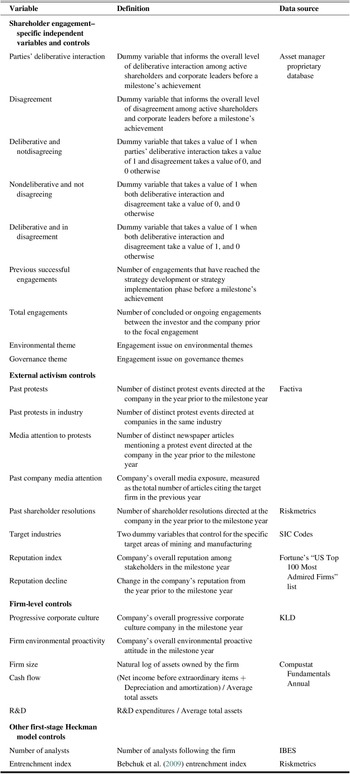
To isolate the effect of interactional dynamics on corporate change, we first controlled for engagement-specific variables that may affect how corporations react to shareholder engagement. We began by setting a baseline to control for the effect of past successful engagements. The variable previous successful engagements is a count of previous engagements between the asset management firm and the company that had reached the strategy development or strategy implementation stage. We then controlled for the breadth of the relationship by considering total engagements, operationalized as the number of concluded or ongoing engagements between the asset management firm and the company that had been initiated prior to the focal engagement. We also controlled for shareholder engagement themes with two dummy variables: environmental theme and governance theme. It is well acknowledged that corporations are more responsive to governance and environmental issues than social ones due to clear and direct links with firm performance and shareholder value (King, Reference King2008; Vasi & King, Reference Vasi and King2012).
We furthermore include control variables to capture societal pressure to increase environmental, social, and governance responsibility. Specifically, we built a database on public protests targeting US corporations during the period 2006–12. We collected data on public protests directed at firms from newspaper data, which is the established source of mobilization data in social movement research (Van Dyke, Soule, & Taylor, Reference Van Dyke, Soule, Taylor, Myers and Cress2004; Earl, Martin, McCarthy, & Soule, Reference Earl, Martin, McCarthy and Soule2004; Earl, Soule, & McCarthy, Reference Earl, Soule and McCarthy2003; McAdam & Su, Reference McAdam and Su2002; King, Reference King2008; Vasi & King, Reference Vasi and King2012). Following King’s (Reference King2008) study on corporate boycotts, we used daily news reports in five different national newspapers: the New York Times, Washington Post, Wall Street Journal, Chicago Tribune, and Los Angeles Times. We selected these specific newspapers to reduce the potential for 1) a description bias arising from biased or partial and incomplete descriptions of mobilizations (Earl et al., Reference Earl, Martin, McCarthy and Soule2004) and 2) a selection bias—such as a regional bias (King, Reference King2008)—based on what is covered by newspapers, because “what is covered by news is not a random sample of all events that took place” (King & Soule, Reference King and Soule2007: 423).
Following standard practice in social movement research studying boycotts and protests (King, Reference King2008; McDonnell, Reference McDonnell2016; McDonnell & King, Reference McDonnell and King2013; McDonnell, King, & Soule, Reference McDonnell, King and Soule2015; Wang & Soule, Reference Wang and Soule2012), a research assistant searched Factiva to identify newspaper articles during the period 2006–12 by using the following search string: <company name> AND <protest*>. A research assistant and one of the authors then independently read each of the 5,896 returned articles to assess whether 1) the article actually referred to a protest event and 2) the protest event actually targeted a corporation in the sample. We counted as protests only events that “involved more than one person” and “happened publicly,” excluding any private events between activists and companies (Wang & Soule, Reference Wang and Soule2012). We also coded the articles to obtain relevant information about each protest, including place, date, number and type of participants, issue(s) of concern, tactics used by protesters, and police presence (McDonnell, Reference McDonnell2016; Wang & Soule, Reference Wang and Soule2012). We used this information to create two measures of protest influence: past protest, that is, the number of unique protest events directed at the company during the year prior to the milestone, and media attention to protests, that is, the number of different newspaper articles mentioning a protest event in the year prior to the milestone (King, Reference King2008). We used the natural logarithm of the article count to stabilize the variables’ skew (Vasi & King, Reference Vasi and King2012).
We also controlled for declines in corporate reputation. According to King (Reference King2008), a decline in reputation experienced by a company prior to being targeted by boycotts makes executives more likely to concede to activists. Therefore, following King, and in line with previous research on company reputation (Fombrun & Shanley, Reference Fombrun and Shanley1990; Roberts & Dowling, Reference Roberts and Dowling2002), we computed the variables reputation index and reputation decline using Fortune magazine’s “US Top 100 Most Admired Companies” list. The variable reputation index takes value 0 if the firm was not ranked among the 100 Most Admired Companies that year; 1 if the company’s raw score on the 100 Most Admired Companies list was between 1 and 5; 2 if the company’s raw score was between 5 and 7; and 3 if the company’s raw score was greater than 7 (King, Reference King2008). The final variable, reputation decline, measures the change in the reputation index’s value from the year before a milestone was achieved. We reverse-coded this variable so that a positive value denotes a decline in reputation and a negative value signifies an increase in reputation. Since the Fortune “US Top 100 Most Admired Companies” list uses data from the previous year to compute the reputation raw scores, we did not lag the reputation index and reputation decline variables in any of the models that used them. Owing to the way the variables are constructed, they are lagged by one year by default.
We further controlled for overall media attention as an additional source of external pressure on a company to concede to shareholders’ requests. Past company media attention measures the number of articles returned by a Factiva search in the Wall Street Journal, New York Times, Los Angeles Times, Washington Post, and Chicago Tribune mentioning the targeted company in the year preceding the milestone (King, Reference King2008; Vasi & King, Reference Vasi and King2012). Besides media attention, we controlled for shareholder activism in the form of shareholder resolutions targeted at the company. To this end, we included the variable past shareholder resolutions, operationalized as the number of shareholder resolutions directed at the company in the year preceding the milestone (Vasi & King, Reference Vasi and King2012). We also included controls for common target industries of shareholder engagement. In particular, we controlled via two separate dummy variables for firms in the mining sector (Allen, Letourneau, & Hebb, Reference Allen, Letourneau and Hebb2012) and firms in the manufacturing sector (Dimson et al., Reference Dimson, Karakas and Li2015).
We also included several firm-level controls as shown in Table 1. First, we included a variable that captures the degree to which a corporation has a progressive corporate culture. Following Vasi and King’s (Reference Vasi and King2012) operationalization of the variable, we used KLD Research and Analytics data and aggregated KLD measures of community, diversity, employee relations, and human rights strengths. The variable progressive corporate culture varies between 0 and 4, and it takes a value of 0 if a company did not score high on any dimension of socially responsible corporate culture and a value of 4 if a company scored high on all dimensions. We further included the variable environmental proactivity, which is operationalized as the sum of all KLD environmental strengths (Vasi & King, Reference Vasi and King2012). We then included a set of other firm-level Compustat data. We measured firm size as the natural log of a firm’s assets, and we used cash flow, calculated as the firm’s operating income plus depreciation value and amortization divided by the firm’s average total assets, to indicate the amount of excess resources a firm could use to eventually accommodate active shareholders’ requests. Finally, we measured R&D intensity as Compustat R&D expenditures divided by average total assets.
Variable Definitions by Source and Model

Main Empirical Specification
Because the sample of companies engaged on ESG issues may not be random, we used a two-stage Heckman model, which is generally used in management literature as a way to account for sample selection bias in results (Leiblein, Reuer, & Dalsace, Reference Leiblein, Reuer and Dalsace2002; Shaver, Reference Shaver1998). In our model of deliberative dialogue in shareholder engagement, the results may be biased because active shareholders tend to select the companies they engage with based on some firm-level characteristics and public pressure dynamics. We therefore used a first-stage probit regression—targeting selection model—to estimate a selection effect coefficient, λ, or inverse Mills ratio, which represents the probability that a corporation will not be targeted for engagement by active shareholders. We then added λ as a control to the second-stage model to account for this selection effect. To run the first-stage probit model and to identify what drives active shareholders’ company selection decisions, we followed previous studies in stakeholder activism (King, Reference King2008; King & McDonnell, Reference King and McDonnell2015; McDonnell, Reference McDonnell2016) and used any constituent of the Fortune 500 largest US companies during the period 2006–12 as sample of control firms. The firms targeted for shareholder engagement by the focal asset management company are, in fact, large and publicly traded US companies.
The final sample comprised 806 unique companies and 5,642 observations. In the model, we included independent variables that measure public pressure on companies and shareholder activism directed at companies in the sample. First, we included the variables past protests and past protests in industry. Grouping firms by industry using four-digit Standard Industrial Classification codes enabled us to operationalize past protests in industry as the number of protests firms in the same industry received in the year preceding the start of the engagement (King, Reference King2008). We then included past shareholder resolutions, reputation index, and reputation decline to control for other characteristics that can make certain companies more likely to be targeted than others. Finally, we included the number of analysts following the firm from I/B/E/S data; the entrenchment index as measured by Bebchuk, Cohen, and Ferrell (Reference Bebchuk, Cohen and Ferrell2009) from RiskMetrics; and firm size from Compustat (see Table 1 for a summary of all variable definitions by data source and model).
The typical second stage of the Heckman (Reference Heckman2013) regression model is an ordinary least squares (OLS) regression with a continuous dependent variable. However, given the operationalization of our dependent variables (i.e., solution development and solution implementation) as variables that only take values of 0 and 1, we used logit regressions. Variations of the original Heckman regression model with dichotomous dependent variables in the second stage rather than OLS regressions have been successfully employed in previous studies of stakeholder activism (e.g., King, Reference King2008). The main models in our study are therefore two different sets of logits, one for each of the two dependent variables of interest. We ran the two sets of models on specific subsamples of the 169 ESG engagements of the focal asset management company with US corporations. In particular, the subsample for model 1, the solution development model, is constituted by engagements that achieved milestones 2 or 3, that is, engagements in which corporations acknowledged an ESG issue and engagements that succeeded further by also developing a credible strategy to address it, respectively. Selecting this subsample enabled us to identify the variables that predict the likelihood that the parties will develop a solution in the shareholder engagement process (i.e., milestone 3), after the corporation acknowledged the issue raised by shareholders (i.e., milestone 2). The final sample consists of sixty-two ESG engagements with thirty-five unique firms during the years 2007–12.
Analogously, the subsample for model 2, the solution implementation model, is constituted by engagements that achieved milestone 3 or 4, that is, engagements that resulted in the development of a credible strategy to address an ESG issue and engagements that continued successfully by implementing the strategy, respectively. This subsample enabled us to identify the variables that predict the likelihood that the engagement process will effectively progress from the solution development stage (i.e., milestone 3) to the implementation of a solution (i.e., milestone 4), the third stage in our three-stage theoretical model. The final sample consists of forty-five ESG engagements with twenty-seven firms during the years 2007–12.
Given our choice to focus on the last two stages of the investors’ four-stage process, we also considered potential selection effects in the earlier engagement stage. Specifically, we ran two sequential selection models to predict the engagements’ likelihood to advance to the next stage. The first selection model includes all active engagements, that is, engagements ranging from milestone 0 to milestone 1, 2, 3, or 4, and returns a second selection effect coefficient, λ2, which represents the probability that the concerns identified by the investors are subsequently raised and acknowledged by the company and that a proper strategy is developed and implemented. We then ran a second selection model on the subsample of engagements that reached milestone 1, 2, 3, or 4, using the λ2 coefficient to obtain a third selection effect coefficient, λ3, which represents the probability that concerns raised by investors are subsequently acknowledged and that a proper strategy to address them is developed and implemented. To ensure simplicity and parsimony in presentation, we do not show these results, but the models are available upon request. Finally, we ran the two second-stage logit models on our main dependent variables—model 1 (solution development model) and model 2 (solution implementation model)—and we included the selection effect coefficient λ3 to control for endogeneity arising from selection bias. In both models 1 and 2, we clustered cases at the firm level to adjust the standard errors.
RESULTS
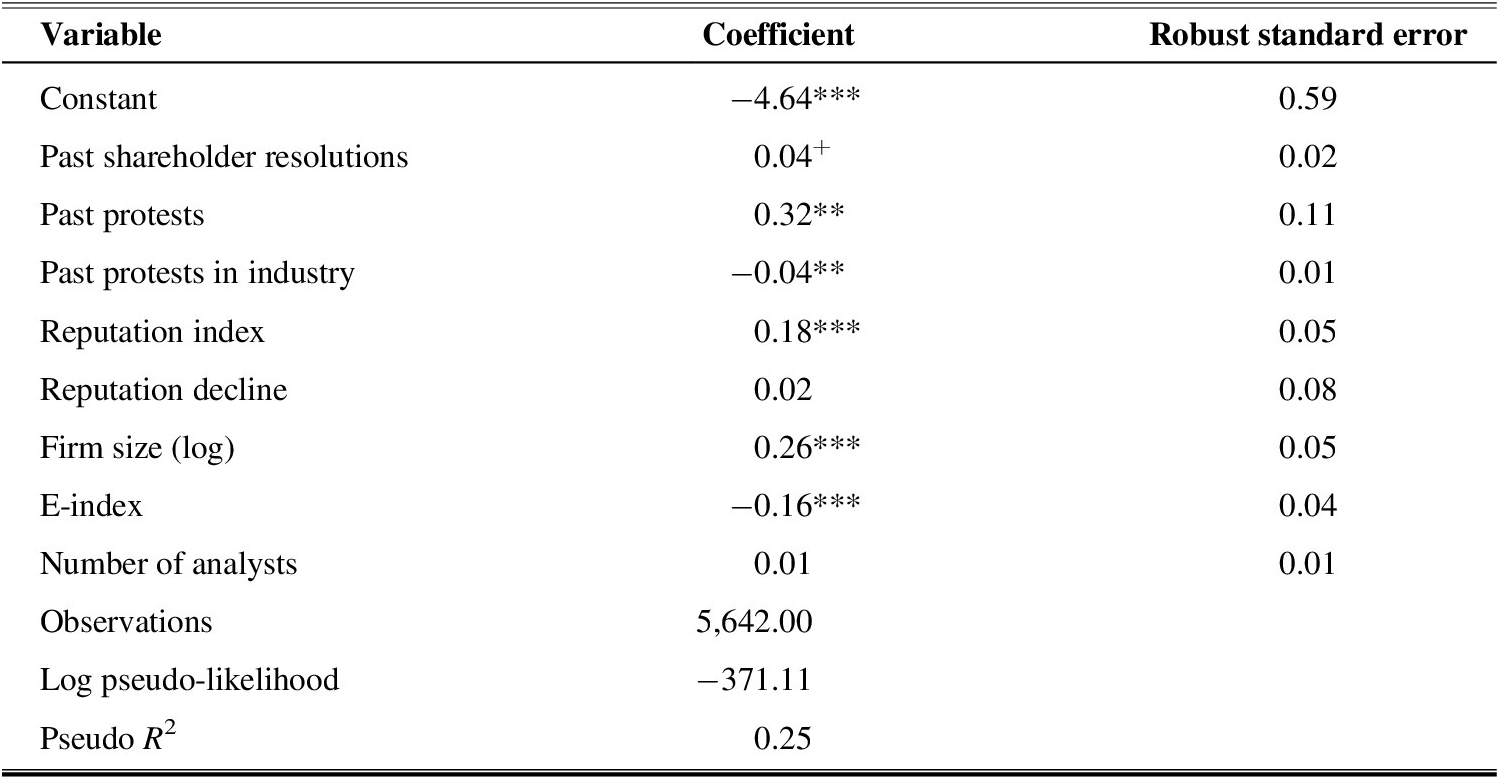
Table 2 shows the results of the first-stage Heckman probit model. In line with previous research, larger firms with stronger reputations and less entrenched management were more likely to be targeted by the focal asset manager company for shareholder engagement, as well as firms previously targeted by public protests (Dimson et al., Reference Dimson, Karakas and Li2015; Gupta & Briscoe, Reference Gupta and Briscoe2020; King, Reference King2008; Vasi & King, Reference Vasi and King2012).
First-Stage Heckman Probit Model on Targeting

Note. The table reports the results of the first-stage probit model, that is, the characteristics of firms that are targeted by shareholder engagement. The dependent variable is a dummy variable that equals 1 if the company is targeted for shareholder engagement by the focal asset manager during the following year, and 0 otherwise. Control firms come from the Fortune 500 list of US companies over the period 2006–12. The final sample is constituted by 806 companies and 5,642 observations. Annual time dummies are included in the model but are not shown in the regression table.
*** p < 0.001. **p < 0.01. *p < 0.05. +p < 0.1.
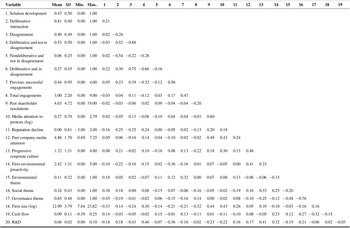
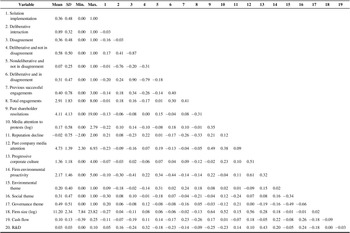
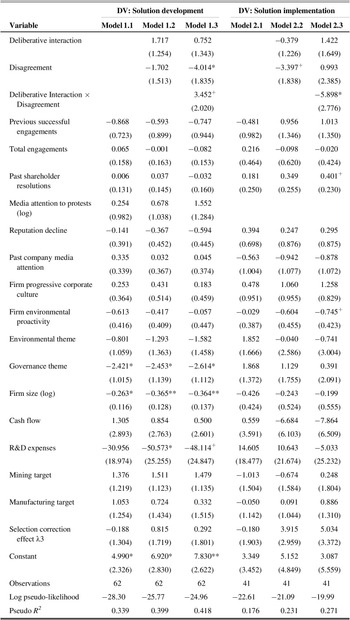
Tables 3a and 3b contain descriptive statistics and correlations for the second-stage Heckman logit regression models. Table 4 shows the results of the regression models for the two dependent variables representing completion of the last two stages of our model of deliberative dialogue in shareholder engagement—solution development and solution implementation. Model 1 tests hypotheses 1 and 2a on the likelihood that parties in the second stage of the engagement process successfully arrive at developing a solution. Specifically, model 1.1 tests the effect of control variables, model 1.2 tests the independent effect of deliberative interaction and disagreement, and model 1.3 adds the interaction effect between deliberative interaction and disagreement. In line with hypothesis 1, deliberativeness has a positive—although not statistically significant—effect on the engagement’s likelihood to advance to the solution development stage.
Means, Standard Deviations, and Correlation Matrices of Independent Variables for Second-Stage Heckman Model on Solution Development

Note. The table reports correlations among variables for model 1’s subsample. The subsample for model 1 is constituted by engagements that achieved at least milestones 2 and 3, that is, engagements which corporations first acknowledged and then to which they responded by developing a credible strategy to address the issue of concerns, respectively. The final sample is constituted by 62 ESG engagements with 35 unique firms during the years 2008–12.
Means, Standard Deviations, and Correlation Matrices of Variables for Second-Stage Heckman Model on Solution Implementation

Note. The table reports correlations among variables for model 2’s subsample. The subsample for model 2 is constituted by engagements that achieved milestones 3 and 4, that is,, engagements to which corporations responded by developing a credible strategy to address the issue of concern and by implementing the strategy, respectively. The final sample is constituted by 41 ESG engagements with 27 unique firms during the years 2008–12.
Second-Stage Heckman Logit Models on Shareholder Engagement Milestones

Note. Robust standard errors are in parentheses.
***p < 0.001. **p < 0.01. *p < 0.05. +p < 0.1.
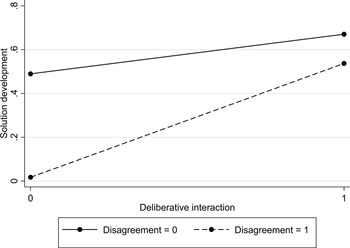
Furthermore, although our results suggest that disagreement negatively affects the likelihood that parties will develop a solution to an ESG issue, model 1.3, in line with hypothesis 2a, shows a positive and significant interaction effect of disagreement and deliberativeness in the engagement relationship, suggesting that deliberativeness significantly mitigates the impact of disagreement. These findings are illustrated in Figure 3, which shows the predicted probability of the engagement advancing toward the development of a solution when deliberative interaction and disagreement range to one standard deviation below or above their means. Engagement relationships in which parties do not experience disagreement have high probabilities of reaching the solution development milestone. Whereas the probability that the parties will reach this milestone is 0.49 for engagement relationships in which partners are not deliberative, the probability rises to 0.67 in the case of deliberative parties. The probability changes greatly when the engagement is characterized by disagreement. In this case, the likelihood of developing a solution when parties experience and voice disagreement is 52 percent higher when parties engage in deliberative interactions (0.54) than when they do not (0.02), resulting in a steep positive slope when disagreement is present.
The Effect of Deliberative Interaction and Disagreement on Solution Development
Note. Predicted probability of the engagement progressing to the solution development milestone when deliberative interaction and disagreement range to one standard deviation below or above their means.

These results show that the likelihood of developing a mutually satisfactory solution is 5 percent higher when parties experience and voice disagreement in deliberative interactions (0.54) than in the absence of disagreements in nondeliberative interactions (0.49). Most importantly, when disagreement is present and voiced in deliberative interactions, the likelihood that the engagement will advance toward the development of a solution (0.54) is only 13 percent lower than in the absence of it (0.67), against the 47 percent drop when disagreement is present and voiced in nondeliberative interactions (from 0.49 to 0.02).
Model 2 in Table 4 tests hypotheses 1 and 2b on the likelihood that the parties will complete the third stage of the engagement and implement the solution. Specifically, model 2.1 tests the effect of control variables, whereas models 2.2 and 2.3 test the hypotheses. Model 2.2 tests the effect of the main independent variable, deliberative interaction, while model 2.3 considers the interaction effect of deliberative interaction and disagreement. The models do not support hypothesis 1. The deliberative interaction between shareholders and corporate leaders does not have a significant independent effect on the likelihood of solution implementation.
On the other hand, model 2.3 does support the predictions of hypothesis 2b, showing a negative and significant interaction effect of disagreement and deliberative interaction in the engagement relationship. Disagreement in a deliberative interaction has a negative effect on the likelihood of the engagement successfully advancing toward solution implementation.
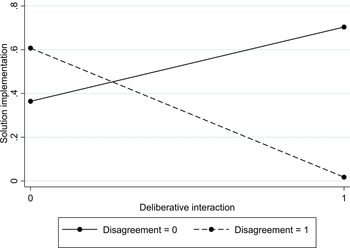
The findings of model 2.3 are illustrated in Figure 4, which shows the predicted probability that the engagement will complete its third stage with the implementation of a solution when deliberative interaction and disagreement range to one standard deviation below or above their means. Engagement interactions without disagreement have a high probability of completing the stage of solution implementation. In engagements without disagreement, the probability of reaching the implementation milestone is 0.36 when partners are not deliberative and rises to 0.70 when partners are deliberative. On the other hand, as predicted by hypothesis 2b, whereas the probability of reaching the implementation milestone is 0.61 for engagements in which parties are not deliberative and experience disagreement, the probability of reaching the milestone drops to 0.02 when shareholders and corporate leaders experience disagreement in a deliberative interaction.
The Effect of Deliberative Interaction and Disagreement on Solution Implementation
Note. Predicted probability of the engagement progressing to the solution implementation milestone when deliberative interaction and disagreement range to one standard deviation below or above their means.

Overall, the support of hypotheses 2a and 2b is evident when we contrast the different effects of disagreement in the two stages, which can be measured by comparing the slope of the dotted regression line across Figures 3 and 4. Whereas the line slopes upward in Figure 3, it is downward sloping in Figure 4. This means that, holding deliberative interaction constant, disagreement increases the probability of advancement from 0.02 to 0.54 in the solution development stage and reduces that probability from 0.61 to 0.02 in the implementation stage.
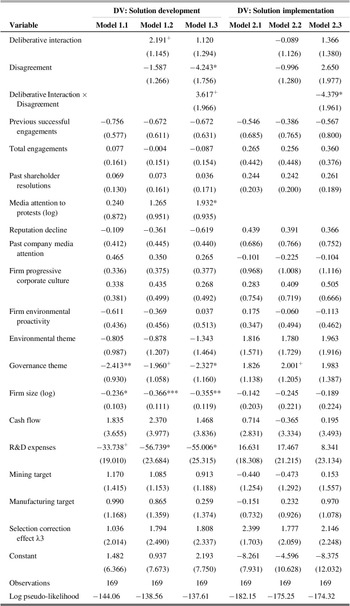
Finally, we ran a number of robustness checks. First, we ran a second-stage logit analysis of our dependent variables on a set of dummy variables we created to test the interaction between deliberative interaction and disagreement: 1) deliberative and not disagreeing, which takes a value of 1 when deliberative interaction takes a value of 1 and disagreement takes a value of 0, and 0 otherwise; 2) nondeliberative and not disagreeing, which takes a value of 1 when both deliberative interaction and disagreement take a value of 0, and 0 otherwise; and 3) deliberative and in disagreement, which takes a value of 1 when both deliberative interaction and disagreement take a value of 1, and 0 otherwise. Second, we ran the four models to move through the sequence of stages using the Stata’s heckprob function and clustering cases at the firm level. Stata’s heckprob function runs simultaneously a first-stage probit selection and a second-stage probit estimation so as to account for the bivariate normal distribution of the errors of the two equations and returns adjusted standard errors and maximum likelihood estimates, which properly account for selection effects. The results—not reported but available upon request—were consistent with the results of the main models. Finally, we ran a sequential logit model specifically formulated for cases in which the final outcome is the result of a sequence of stages of moving from one stage to the next. A sequential logit analysis allows one to test hypotheses across transitions by estimating simultaneously the entire model and to decompose the effect of the explanatory variables on the final outcome of the process into the contributions of each of the transitions (Buis, Reference Buis2010, Reference Buis2011). Table 5 shows the results of the last two of the four stages of the sequential logit model. The results are consistent with our main analyses. Full results are available upon request.
Sequential Logit Model on Shareholder Engagement Milestones

Note. Robust standard errors are in parentheses.
***p < 0.001. **p < 0.01. p < 0.05. +p < 0.1.
DISCUSSION
This article aims at understanding the interactional mechanisms that enable parties in shareholder dialogue to manage the tension between conflict and consensus. To do so, we develop a model of shareholder engagement as a three-stage process that is shaped by two key situational variables: deliberative interaction and the expression of disagreement. This conceptual setup makes it possible to explore the different effect of deliberativeness and disagreement at different stages of the process. We hypothesize that deliberativeness contributes to engagement progress in both the solution development and solution implementation stages and that disagreement has different moderating effects on the impact of deliberativeness: a positive effect before solutions have been identified and a negative effect once solutions have been identified.
Our findings can be summed up as follows. First, we find a positive—although not significant—effect of deliberativeness on engagement progress. Although this result does not support the existence of an independent effect of deliberativeness on engagement progress, it is consistent with an integrative approach to stakeholder engagement shaped by both consensus and conflict (Levy, Reinecke, & Manning, Reference Levy, Reinecke and Manning2016; Schormair & Gilbert, Reference Schormair and Gilbert2020). If deliberative interaction were the sole causal factor behind engagement progress, we would expect to see hypothesis 1 being confirmed, yet this was not the case. Our interpretation of this finding is that, by itself, deliberative interaction is not a sufficient driver of engagement progress because consensus between the engaging parties is not always possible. In the absence of this consensus, continued deliberation runs the risk of producing an infinite loop of argument exchange that stalls rather than advances engagement.
Second, although—contrary to our expectations—we find that disagreement has a negative independent effect on the likelihood that parties will develop a solution to an ESG issue, our results do show a positive and significant interaction effect of disagreement and deliberativeness on engagement progress in the solution development stage (hypothesis 2a) and a negative and significant one in the solution implementation stage (hypothesis 2b). Taken together, these two results imply that the effect of disagreement on engagement progress is negative in both stages. The finding might at first sight appear inconsistent with the recent turn toward a “contestatory deliberative” approach in deliberation theory, which suggests that contestation and conflict are necessary in deliberative processes (Arenas et al., Reference Arenas, Albareda and Goodman2020). Upon closer inspection, however, our findings represent only a moderate deviation from the tenets of contestation, for two reasons. First, our findings are limited to the late stages of the engagement process, while existing stage models of engagement make clear that conflict plays different roles at different stages. Schormair and Gilbert (Reference Schormair and Gilbert2020), for instance, contend that “value conflict” is to be assessed at an early step of the process (second in a five-step scheme), while later steps should be focused on “enabling mutual learning” and “finding solutions.” Our theoretical model and empirical analysis are focused only on the last two steps. A second reason why our findings do not rule out the value of contestation is methodological: because we controlled for social movement activity (protests) in both the selection model and the main regressions, our results are compatible with an important role for contestation and social activism. In sum, our work further specifies the integrative approach to stakeholder engagement by suggesting that conflict is less helpful when expressed outside of a deliberative interaction, when expressed in the late stages of the engagement, and when played out in face-to-face dialogue rather than in the more public and impersonal public arena.
Furthermore, the results from hypotheses 2a and 2b (the interaction effect) indicate that deliberativeness can transform disagreement into a less disruptive form of conflict in the solution development stage of the engagement than in the solution implementation phase. This interpretation is consistent with the interactionist literature on attunement, according to which “conflict will be constructive to the degree that the parties are attuned, and destructive when they are not” (Scheff, Reference Scheff1990: 7). In other words, as the engagement moves toward the implementation of solutions, expressing disagreement in a deliberative interaction might be interpreted as a greater breakdown in the relationship and undermine the fledgling trust created. As a consequence, progress in the engagement might be more severely hindered.
In sum, despite the inevitable limitations due to our data and design, which we discuss subsequently, our findings lead us to reject simplistic explanations of engagement success as mere deliberative interaction or the presence of conflict. Deliberative interaction may indeed be needed for parties to exchange their views, but our results suggest that it is not enough. Furthermore, bringing up disagreement within the engagement dialogue may at some point be necessary, but our results suggest that it is not productive in the last two stages. Finally, although our findings are agnostic as to which combination of deliberation and conflict proves most useful in the early stages of engagement, they remain consistent with the core tenet of the integrative approach to stakeholder engagement, namely, that the nuanced combination of deliberative interaction and conflict facilitates engagement progress.
Contributions
This article contributes to advancing our understanding of deliberation in shareholder engagement, to the development of the contestatory deliberative approach in deliberation theory, and, more broadly, to interactionist perspectives in organization theory.
Shareholder Engagement Effectiveness
Our work speaks to the growing literature on shareholder engagement that has alternatively focused on the effect of shareholder engagement on the target company (Barko et al., Reference Barko, Cremers and Renneboog2018; Becht et al., Reference Becht, Franks, Mayer and Rossi2008; Dimson et al., Reference Dimson, Karakas and Li2015) and on the mechanisms explaining why only some engagement processes succeed through the use of case studies and with qualitative methodologies (Ferraro & Beunza, Reference Ferraro and Beunza2018; Logsdon & Van Buren, Reference Logsdon and Van Buren2009). In terms of the latter, our ability to generalize theoretical insights from case studies or to consider the role of contextual factors is limited, and our article is the first, as far as we know, to establish empirically that the deliberative nature of dialogue matters for shareholder engagement effectiveness, even after controlling for selection effects and other contextual variables. More specifically, our research design allowed us to control for the effect of external activism, media attention, reputational dynamics, and other firm-level and issue-level heterogeneity. Furthermore, we addressed the sample selection bias, a key issue in shareholder engagement, as companies are not randomly targeted, by using a two-stage Heckman logit model, thus mitigating endogeneity concerns arising from selection bias. Our results suggest that at least some of the positive direct effects attributed to engagement by existing case studies might be explained by selection effects. Likewise, by controlling for social activism (protests), we can better isolate the factors that really explain engagement progress. For instance, even carefully conducted empirical studies of engagement effectiveness in finance did not account for the role of social activism and thus might potentially be misspecified (Barko et al., Reference Barko, Cremers and Renneboog2018; Becht et al., Reference Becht, Franks, Mayer and Rossi2008; Dimson et al., Reference Dimson, Karakas and Li2015).
The Contingent Role of Disagreement in Contestatory Deliberation
Our article answers the call in the contestatory deliberative perspective (Bächtiger, Shikano, Pedrini, & Ryser, Reference Bächtiger, Shikano, Pedrini and Ryser2009; Dryzek, Reference Dryzek1999, Reference Dryzek2010; Niemeyer & Dryzek, Reference Niemeyer and Dryzek2007) to explore the contingent ways in which deliberative practices unfold in different contexts. Bächtiger and Parkinson (Reference Bächtiger and Parkinson2019) suggest that deliberative practices should not be studied only as normative ideals but as communicative practices that are more or less appropriate to different contexts, adding that “various forms of deliberation depend on the goals of the engagement … and the institutional, cultural, and issue contexts in which the communication takes place” (153). In line with this contingent approach, and in the context of stakeholder engagement, the “agonistic deliberation” and “contestatory deliberation” approaches concur in claiming a key role for contestation in deliberative processes. Yet, they also call for more research exploring the conditions under which contestation advances deliberation: “While we have argued that contestation is necessary, the question of the appropriate level of contestation that an MSI can tolerate cannot be answered theoretically; but the factors on which this question depends would be worth analyzing with empirical research” (Arenas et al., Reference Arenas, Albareda and Goodman2020: 191).
Our study addresses this question both theoretically and empirically. From a theoretical point of view, we theorize dialogue as a three-stage process, building on prior research, such as Ferraro and Beunza (Reference Ferraro and Beunza2018) and Schormair and Gilbert (Reference Schormair and Gilbert2020), that conceived engagement as a succession of stages. We both relate to and contribute to this literature. Our model indeed only relates to the later stages of Schormair and Gilbert. By doing so, we offer a parsimonious and empirically operationalizable model that is well suited to teasing out mechanisms of deliberation. By renouncing some level of detail for the sake of abstraction and generalizability, we contribute to the development of social theory that has the potential to be robust and empirically generative (Healy, Reference Healy2017). We also suggest that the stage of the engagement is a relevant contingency in the unfolding of the process and that the combination of deliberative interaction and disagreement plays a different role at different stages.
Empirically, the literature’s findings on whether deliberative processes work are, at best, mixed or inconclusive (Baccaro, Bächtiger, & Deville, Reference Baccaro, Bächtiger and Deville2014; Chambers, Reference Chambers1996; Delli Carpini, Cook, & Jacobs, Reference Delli Carpini, Cook and Jacobs2004: 336–37; Janssen & Kies, Reference Janssen and Kies2005; Ryfe, Reference Ryfe2005; Sulkin & Simon, Reference Sulkin and Simon2001: 812) and essentially depend on the context (Bächtiger & Parkinson, Reference Bächtiger and Parkinson2019). Habermas himself acknowledged these mixed results (Habermas, Reference Habermas2006: 420). Unfortunately, much of the empirical research on the topic is ill suited to investigating contextual factors given its research design. Thus one of our study’s main contributions is empirical, as we operationalize the key features of deliberation and study a deliberative process while controlling for numerous contextual factors. Our approach also offers a novel path for researchers studying deliberative processes empirically. Obviously, future research is needed to test our model further, in the context not only of shareholder engagement but also of stakeholder and multistakeholder engagement. The increasing availability of textual data capturing various communicative practices will provide more opportunities to go beyond our coding approach (which was appropriate given the relatively small data set) toward computer-assisted approaches (topic modeling, machine learning), which would work best with much larger data sets.
Advancing Interactionist Approaches in Organization Theory
Finally, this article advances the interactionist research agenda in organization theory by identifying the kinds of deliberative interactions that explain organizational decision-making. In one of the most recent studies in this tradition, Soderstrom and Weber (Reference Soderstrom and Weber2020) explored why some sustainability initiatives succeed and were formally institutionalized in the company’s rules and procedures, identifying specific situational qualities of interactions that effectively translate the fleeting interaction into formal rules. In line with this study, our conceptualization of deliberative interaction and disagreement adds to our understanding of the situational quality of interactions that can lead to organizational decision-making.
In considering dialogue and deliberation from an interactionist perspective, our study brings together the literatures on deliberative democracy and symbolic interactionism. This approach can help scholars move beyond deliberation as a normative ideal and characterize instead the mechanisms and traits that drive real-world success in engagement. By combining deliberation with an analytical focus that takes the interaction as unit of analysis, our study is able to differentiate empirically the effect of disagreement on dialogue at various stages of the engagement process, thus moving beyond structuralist conceptions of engagement that boil down effectiveness to the interests and positions of the actors.
Limitations
Our study on how engagement parties manage the tension between conflict and deliberation is not without limitations. First, given our unique data and an analytical strategy that tried to capture selection effects, we were left with a small sample of engagements and thus with limited statistical power. This may explain why some of our hypotheses received weak empirical support. The growth of the shareholder engagement phenomenon will offer more opportunities to test our hypotheses with larger samples of engagements and to compare the results of these processes across different investors.
A related limitation stems from our coding procedure. Following the work of sociologists studying social interaction in work settings, and instead of applying codes developed for parliamentary discussions (Steiner et al., Reference Steiner, Bächtiger, Spörndli and Steenbergen2005), we decided to develop a specific working definition of dialogue that was able to capture the idiosyncratic nature of relationships between shareholder activists and corporate leaders. Thus our coding is specific to our setting and might not generalize to other contexts. Another limitation of our coding relates to our main independent variable, deliberative interaction: we coded both mixed and neutral interactions with a value of 0, despite the fact that the two types of interactions are substantively different in nature. Furthermore, by coding cases for which it was impossible to determine partners’ attitudes due to a lack of sufficient information about the interaction (neutral interactions) as 0, we might have miscoded interactions that were actually nondeliberative (coded as −1) or deliberative (coded as 1) owing to a lack of information. However, given the operationalization of deliberative interaction as a dummy variable that takes a value of 1 when the sum of deliberative interaction scores that took place before the milestone’s achievement was strictly positive, we are confident that what we capture empirically is a conservative estimate of the overall deliberativeness of the relationship between firm executives and investors.
Another limitation of our study is that our data set is limited to the self-reported perception of the investor, and we do not know if the perception of corporate managers was different. Nevertheless, deliberative interaction is intersubjective in nature, and we are reassured by the psychological evidence that, as such, it involves a reflection on both the self and the other within an interaction (Casciaro & Lobo, Reference Casciaro and Lobo2005; McFarland, Jurafsky, & Rawlings, Reference McFarland, Jurafsky and Rawlings2013: 1608). Similarly, Rivera’s (Reference Rivera2015) study of emotional energy in job interviews relied solely on the perception of the evaluator of the interaction and not on the perceptions of the candidates.
Finally, given the nature of our data, we cannot explore directly the micromechanisms explaining our findings. One potential explanation for the different strength of the effects of disagreement, which we cannot confirm with our data, is that expressions of disagreement during the solution development stage prove less disruptive because they create opportunities for in-depth and multifaceted analyses of the issues at stake, while they do not have that effect during the stage of solution implementation. A different but complementary explanation builds on the observation that deliberative interaction might generate a form of emotional energy as theorized in interaction ritual chains theory (Collins, Reference Collins2004). Agreement, instead, is a purely cognitive process, and thus disagreement might work well in deliberative interaction because the parties benefit from a diversity of perspectives while being shielded from the negative emotional effects of conflict. To explore further the relative role of cognitive and emotional processes, experimental studies could establish the microfoundations of deliberative interaction and disagreement and test our speculation that the former is primarily an emotional process while the latter is a cognitive one, and the consequences of both.
In sum, our study has not exhausted the theoretical and empirical possibilities that open up as we start considering the full complexity of studying dialogue, and future research should aim to capture this process also through other methods.
CONCLUSION
Our study aimed primarily at better understanding whether and how deliberative theory can help explain how corporations engage with stakeholders and thus improve the parties’ ability to collectively address social and environmental challenges. Given the difficulty of empirically capturing deliberative interaction in the wild (as opposed to in an experimental setting) and beyond case studies, it is not surprising that our findings are limited in nature, and future empirical work should test them across a variety of settings. Yet, even with this caveat, our study underscores that the role of deliberativeness and disagreement is contingent on the stages of the shareholder engagement process. Engagement professionals could leverage these findings in their practices, while scholars may be inspired to conduct more in-depth research on deliberative practices.
Supplementary Materials
To view supplementary material for this article, please visit http://doi.org/10.1017/beq.2021.46.
Acknowledgments
The research leading to these results has received funding from the European Research Council under the European Union’s Seventh Framework Programme (FP/2007-2013)/ERC grant agreement 263604. Hoepner acknowledges funding from the European Union’s Horizon 2020 research and innovation program for research on Fintech (grant H2020-ICT-825215) and from Science Foundation Ireland (award 19/FIP/AI/7539). We thank Matteo Prato, Giovanni Valentini, John Almandoz, David Barberá, Shipeng Yan, and the conference participants at the New York IESE conference on Finance and Organization Theory, the first INSEAD conference on Behavioral Perspectives on Corporate Governance, and the ninth annual Alliance for Research on Corporate Sustainability Research Conference and seminar participants at London Business School, City University of Hong Kong, and Ivey Business School. We thank the anonymous asset manager for providing the data. We also acknowledge the excellent research assistantships of Lydia Lafoz, Angela Herrera, Bernat Mallén, Yanan Lin, Alice Mascena, Ludovica Castiglia, Sergio Garcia Vega, and Bárbara Bello. Authors are listed in alphabetical order. The views expressed in this paper are not necessarily shared by the European Commission.
Irene Beccarini is assistant professor at EMLV—Leonard de Vinci Business School. She received her PhD in management from IESE Business School, and her work broadly studies markets as fields emerged from and shaped by the interactions between economic and social actors and forces. Her research focuses on companies and investors as well as on societal actors and social movements, and she studies phenomena like shareholder engagement, impact investing, corporate activism, and social activism targeted at corporations.
Daniel Beunza is associate professor of management at Bayes Business School. Beunza’s research explores the ways in which social relations and technology shape financial value. His award-winning study of a derivatives trading room on a Wall Street bank traced the roots of extraordinary returns to the use of space and internal organization. Beunza obtained his PhD from New York University and has previously taught at Columbia University, the London School of Economics, and Copenhagen Business School.
Fabrizio Ferraro (fferraro@iese.edu, corresponding author) is professor of strategic management at IESE Business School, Barcelona, Spain. His research explores the global rise of ESG and impact investing and the process of shareholder and stakeholder engagement. More broadly, he is interested in understanding how robust action strategies can enable actors to overcome barriers to cooperation and tackle grand challenges, and his article on this topic received the 2017 Roland Calori Prize for the Best Paper Published in Organization Studies.
Andreas G. F. Hoepner, PhD, is a financial data scientist working toward the vision of a conflict-free capitalism. Although the vision is unlikely fully achievable, Andreas’s view is that anyone can strive to make a regular contribution to reducing abusive conflicts of interests and thereby enhancing the fairness of our society’s financial system. Formally, Andreas is full professor of operational risk, banking, and finance at the Michael Smurfit Graduate Business School and the Lochlann Quinn School of Business of University College Dublin (UCD) and serves on the European Commission’s Platform for Sustainable Finance as head of the data subgroup.