I. INTRODUCTION
High-entropy alloys (HEAs) are a newly emerging class of materials with a distinct alloy design strategy.Reference Yeh, Chen, Lin, Gan, Chin, Shun, Tsau and Chang1,Reference Cantor, Chang, Knight and Vincent2 Different from the traditional alloys with one or two major elements, HEAs are characterized by their special compositions consisting of multiprincipal elements in equal or near-equal molar ratios. This concept has led to many successful multicomponent materials with interesting physical, chemical, and structural properties, which has attracted increasing attention from the academic and metallurgic research communities.Reference Zhang, Zuo, Tang, Gao, Dahmen, Liaw and Lu3–Reference Tian14 In previous work, a special crystalline behavior has been discovered, i.e., despite containing multiple components with different crystal structures in their ground states, many HEAs tend to possess a single solid solution phase rather than complex intermetallic structures.Reference Gao, Yeh, Liaw and Zhang15 Generally, HEAs consisting of late 3d transition metals tend to form a face-centered cubic (fcc) phase,Reference Wu, Bei, Otto, Pharr and George16–Reference Wu, Bei, Pharr and George18 those composed of refractory metals often show a body-centered cubic (bcc) phase,Reference Senkov, Wilks, Miracle, Chuang and Liaw19–Reference Yao, Qiao, Hawk, Zhou, Chen and Gao22 while HEAs based on rare-earth metals usually have a hexagonal closed-packed (hcp) phase.Reference Yuan, Wu, Tong, Zhang, Wang, Liu, Ma, Suo and Lu23–Reference Takeuchi, Amiya, Wada, Yubuta and Zhang26 It should be mentioned that there exist multiphase (e.g., duplex fcc/bcc phase) and/or intermetallic phases in the family of HEAs, which depends on the initial chemical compositions, fabrication methods, heat-treatment processes, etc.Reference Tong, Chen, Yeh, Lin, Chen, Shun, Tsau and Chang27–Reference Wang, Wang, Wang, Tsai, Lai and Yeh30 Along with the appearance of large number of different types of HEAs, a great variety of exceptional properties are revealed, such as high hardness,Reference Tong, Chen, Yeh, Lin, Chen, Shun and Chang31 excellent strength and ductility,Reference Gali and George32 outstanding thermal stability,Reference Tsai, Wang, Tsai, Shen, Yeh, Gan and Wu33 good resistances to wear, corrosion, oxidation, and fatigue,Reference Chou, Wang, Yeh and Shih34–Reference Hemphill, Yuan, Wang, Yeh, Tsai, Chuang and Liaw37 and superconductivity.Reference Koželj, Vrtnik, Jelen, Jazbec, Jagličić, Maiti, Feuerbacher, Steurer and Dolinšek38
Extensive efforts in the field of HEAs have been made to investigate the fundamental mechanical properties.Reference Wu, Bei, Pharr and George18,Reference Senkov, Wilks, Miracle, Chuang and Liaw19,Reference Gali and George32,Reference Deng, Tasan, Pradeep, Springer, Kostka and Raabe39–Reference Gludovatz, Hohenwarter, Catoor, Chang, George and Ritchie44 For instance, Senkov et al. found that the partial substitution of Hf with Al in bcc HfNbTaTiZr considerably increases the room-temperature hardness (∼3.8–4.9 GPa) and yield strength (∼930–1841 MPa), and Al0.4Hf0.6NbTaTiZr retains a bcc structure.Reference Senkov, Senkova and Woodward42 Hsu et al. revealed that the hardness varies from Hv 788 at x = 0.5 to Hv 596 at x = 2.0 for AlCoxCrFeMo0.5Ni, and all of them possess higher hardness level than that of Ni-based super-alloys (In 718/In 718H) from room temperature to 1273 K.Reference Hsu, Wang, Tang, Chen and Yeh43 Gludovatz et al. reported that the fcc CrMnFeCoNi shows exceptional damage tolerance with tensile strengths above 1 GPa and fracture toughness values exceeding 200 MPa m1/2, and its mechanical properties improve at cryogenic temperatures.Reference Gludovatz, Hohenwarter, Catoor, Chang, George and Ritchie44 It is emphasized that some of these features are not usually seen in the traditional alloys, making HEAs attractive in many fields.
In general, elasticity is directly related to the mechanical performance of alloys. The elastic parameters govern the stress–strain relation before yielding, and they are sensitive to various internal and external conditions, such as alloying addition, applied force, temperature, fatigue, and ordering. On an atomic scale, macroscopic elastic strain is manifested as subtle changes in the interatomic spacing. The elastic constants are the measure of the resistance to separation or shear of adjacent atoms. The related polycrystalline elastic parameters, e.g., Young’s modulus, Poisson ratio, and Debye temperature, in turn can be used as input data in a series of phenomenological models commonly used in the literature for discussing and predicting the mechanical performance of metals and alloys. For example, the ratio of bulk modulus and shear modulus is often used as an indicator to estimate the ductile–brittle characteristics of metallic materials.Reference Pugh45
Besides the experimental measurement, the elastic parameters can be determined from ab initio calculations based on density functional theory (DFT).Reference Kohn46 Such theoretical data can provide very useful information at the atomic scale. In combination with various solid solution models, several research groups used ab initio methods to study the fundamental properties of HEAs.Reference Huang, Li, Lu, Tian, Shen, Holmström and Vitos47–Reference Feng, Liaw, Gao and Widom52 These studies provided theoretical platforms to study the intrinsic physical properties and mechanisms behind the observed complex behavior in HEAs and revealed alternative opportunities for designing and optimizing the properties of HEA-related materials.
This article reviews the current theoretical understanding of the elasticity of HEAs and is expected to shed light on the fundamental investigations and further applications of the multicomponent systems. The rest of this article is organized as follows: Sec. II briefly introduces the DFT method and the solid solution models for HEAs; Sec. III shows a comparison of different approaches; the elastic properties of several typical HEAs are illustrated in Sec. IV; and the article ends with conclusions. Appendix I provides the computational details for calculating the elastic parameters and Appendix II estimates the impact of exchange-correlation approximations within DFT.
II. THEORETICAL METHODOLOGY
A. DFT
The physical and chemical properties of materials at the atomic scale depend on the interactions of electrons and nuclei, which require a quantum mechanical treatment. DFT is one of the most popular approaches to the theory of electronic structure, in which the electronic density n(r) plays the central role, rather than the many-electron wave function.Reference Hohenberg and Kohn53 According to DFT, the total energy functional E[n(r)], which depends on the electronic density and external potential, has minimum value for the correct density n 0(r) and the minimum value gives the total energy of the interacting system. The energy functional contains two unknown terms: the kinetic energy of the noninteracting electrons T s[n] and the exchange-correlation energy E xc[n], which includes all electron–electron interactions beyond the trivial Hartree term. In practice, the kinetic energy is obtained via the Kohn–Sham (KS) scheme.Reference Kohn and Sham54 Solving the KS equation assumes well-designed numerical methods such as the Exact Muffin-Tin Orbitals (EMTO) method or the Vienna Ab initio Simulation Package (VASP).Reference Vitos55,Reference Kresse and Furthmüller56 Since the exact form of E xc is not known, one needs to resort to various approximations. Nowadays, the local density approximationReference Perdew and Wang57 and the generalized gradient approximation (GGA)Reference Perdew, Burke and Ernzerhof58 are the two most widely applied approximations for the above exchange-correlation term in computational materials science based on DFT. In Appendix II, we briefly discuss two familiar GGA schemes.
B. Solid solution models
Due to the complexity of the problem related to the chemical and magnetic disorder in connection with the multicomponent nature of HEAs, there is a great challenge when one employs conventional ab initio methods. Till now, various techniques have been applied to describe the energetics of the fully or partially disordered system. One way is the effective medium, in which one atomic-unit cell (single-site) is embedded in the medium to model an arbitrary disorder. The most common mean-field methods are the coherent potential approximation (CPA)Reference Soven59–Reference Vitos, Abrikosov and Johansson61 and the virtual crystal approximation (VCA).Reference Nordheim62–Reference Bellaiche and Vanderbilt65 Another way is the supercell approximation, i.e., the periodic boundary condition is artificially imposed on the supercell to investigate the disordered configuration. The key points are trying to mimic the distribution of local environment in random solid solution and to reduce the computational load. Several approaches are used to generate the supercell of HEAs, such as the special quasi-random structures (SQS),Reference Zunger, Wei, Ferreira and Bernard66 the maximum-entropy (MaxEnt) method, the hybrid Monte Carlo/molecular dynamics (MC/MD) simulations, the small set of ordered structures,Reference Jiang and Uberuaga67 or supercell with similar local atomic environment.Reference Song, Tian, Hu, Vitos, Wang, Shen and Chen68 In this section, the CPA and SQS methods are briefly introduced as they are the most widely used in the current theoretical study of HEAs.
1. CPA
The CPA is based on the assumption that the alloy may be replaced by an ordered effective medium, and the parameters of which are determined self-consistently.Reference Soven59–Reference Vitos, Abrikosov and Johansson61 The single-site approximation is applied to the impurity problem, i.e., one single impurity is embedded in an effective medium and no information is provided about the individual potential and charge density beyond the sphere or polyhedron around the impurity.
Basically, two main approximations are invoked within the CPA: (i) assume that the local potentials around a certain type of atom from the alloy are the same, i.e., the effect of local environment is neglected (all atoms belonging to one particular type are the same); (ii) the system is replaced by a monoatomic set-up described by the site independent coherent potential  $\tilde{P}$. In terms of Green functions, one approximates the real Green function g by a coherent Green function
 $\tilde{g}$. A single-site Green function g i is introduced for each alloy component i = A, B, C,… in substitutional alloy AaBbCc…, where a, b, c, … stand for the atomic fractions of the A, B, C,… atoms, respectively. First, the coherent Green function
 $\tilde{g}$ is derived from the coherent potential
 $\tilde{P}$ using an electronic structure method (e.g., EMTO) as
 $\tilde{g} = {\left[ {S - \tilde{P}} \right]^{ - 1}}$, where S denotes the structure constant (slope) matrix corresponding to the underlying lattice. Next, the Green functions of the alloy components, g i, are calculated by substituting the coherent potential of the CPA medium
 $\tilde{P}$ by the real atomic potentials P i, viz.,
 ${g_{\rm{i}}} = \tilde{g} + \tilde{g}\left( {{P_{\rm{i}}} - \tilde{P}} \right){g_{\rm{i}}}$, where the condition is expressed via the real-space Dyson equation. Finally, the average of the individual Green functions should reproduce the coherent Green function
 $\tilde{g} = a{g_{\rm{A}}} + b{g_{\rm{B}}} + c{g_{\rm{C}}} + \cdots$. The three equations above are solved iteratively, and the outputs
 $\tilde{g}$ and g i are used to obtain the electronic structure, charge density, and total energy of the random alloy.Reference Vitos55
2. SQS
The SQS combines the idea of cluster expansion (CE) with the use of supercells.Reference Zunger, Wei, Ferreira and Bernard66 It is guided by the principle of close reproduction of the perfectly random network for the first few shells around a given site, deferring periodicity errors to more distant neighbors. The structure of the random system is characterized by the multisite correlation functions.
The ensemble average of a physical property P over configurations can be described via the CE method,Reference Sanchez, Ducastelle and Gratias69–Reference Laks, Ferreira, Froyen and Zunger71  $\left\langle P \right\rangle = \mathop \sum \limits_{k,m} {D_{k,m}}\left\langle {\mathop {\bar{\Pi }}\limits_{k,m} } \right\rangle {p_{k,m}}$, where
 $\left\langle {\mathop {\bar{\Pi }}\limits_{k,m} } \right\rangle$ are the correlation functions, p k,m are the “interaction parameters” of figures f = (k, m),Reference Wei, Ferreira, Bernard and Zunger72 and D k,m are the degeneracy factors, which indicates the number of symmetrically equivalent figures of type (k, m) per lattice site. For a fully random A 1−xB x structure, the many-body (k ≠ 0) correlation functions can be described as
 ${\left\langle {\mathop {\bar{\Pi }}\limits_{k,m} } \right\rangle _{\rm{R}}} = {\left( {2x - 1} \right)^k}$, where x represents the composition. The core idea of SQS is to design “special” N-atom periodic structures whose distinct correlation functions
 $\mathop {\bar{\Pi }}\limits_{k,m} \left( S \right)$ best match the ensemble averages
 ${\left\langle {\mathop {\bar{\Pi }}\limits_{k,m} } \right\rangle _{\rm{R}}}$ of the random system. The error due to the SQS approximation is represented in terms of a hierarchy of distances, viz.,
 ${\left\langle P \right\rangle _{\rm{R}}} - P\left( S \right) = \sum\limits_{k,m}^\prime {{D_{k,m}}} \left[ {{{\left( {2x - 1} \right)}^k} - \mathop {\bar{\Pi }}\limits_{k,m} \left( S \right)} \right]{p_{k,m}}$, where the prime denotes the omission of k = 0 and 1 terms, which are common to both R and S. It is hence natural to select the occupations by A and B for the special structures S so that the above equation is minimized in a hierarchical manner. One popular algorithm is to perform MC simulations to search for the best SQS, which is implemented in the Alloy Theoretic Automated Toolkit (ATAT).Reference van de Walle, Asta and Ceder73–Reference van de Walle, Tiwary, de Jong, Olmsted, Asta, Dick, Shin, Wang, Chen and Liu75
C. Rule of mixtures
The rule of mixture has often been used to make an initial screening of the selected properties of random solid solutions and may be applied for categorizing the constitutions for design purposes.Reference Tian, Wang, Harris, Irving, Zhao and Vitos76 Vegard’s rule is a well-known example, which is used to estimate the lattice constant of the alloy using data available for the end members. A robust assessment of such a rule in the case of HEAs is shown and compared to the ab initio data. Here, the polycrystalline elastic parameters, e.g., bulk modulus, shear modulus, and Young’s modulus, are characterized by the respective properties of pure elements, i.e.,  $p = \sum {{c_i}{p_i}}$, where c i and p i are the atomic fraction and corresponding elastic modulus of element i, respectively.
III. COMPARISON OF METHODS
The CPA formulated in the framework of the multiple scattering theory using the Green function technique is a mean-field approach for random solid solutions. Since the impurity problem is usually treated within the single-site approximation, no information is provided about the charge redistribution around the impurities. Implemented in the EMTO method, the chemical and magnetic disorder of arbitrary-stoichiometry alloys can be described efficiently.Reference Vitos55
Particularly, the paramagnetic state can be modeled within the disordered local moment (DLM) picture.Reference Győrffy, Pindor, Staunton, Stocks and Winter77 Based on this model, an alloy component M of concentration c is presented by its spin-up (↑) and spin-down (↓) counterparts which are assumed to be distributed randomly on each sublattice, i.e., M c → M c/2↑M c/2↓. In the case of HEAs, for example, the equiatomic CrMnFeCoNi can be described as a quasi-ten-component random solid solution, viz., Cr0.1↑Cr0.1↓Mn0.1↑Mn0.1↓Fe0.1↑Fe0.1↓Co0.1↑Co0.1↓Ni0.1↑Ni0.1↓. This approximation accounts the effect of loss of the net magnetic moment well above the magnetic transition temperature.Reference Győrffy, Pindor, Staunton, Stocks and Winter77–Reference Pinski, Staunton, Győrffy, Johnson and Stocks79
The VCA method is another mean-field scheme; generally, the potentials which represent atoms of two or more elements are averaged into a composite atomic potential. This is an overly simplified approach to substitutional solid solutions. It is usually applicable if the alloying elements are neighbors in the periodic table. Otherwise, one should be very careful for the system composed of alloying elements having different chemical properties.
The supercell method is expected to consider local chemical environment including short-range order effects. In limited size of supercell, the configurations play an important part to mimic the random distribution of atoms in HEAs. Potentially, there is an uncertainty in the energy of different configurations, for example, permutation in the atomic position between the alloy components in equiatomic HEAs. The challenge increases when considering the magnetic disorder in HEAs. Extremely large supercell may reproduce the real material, but at the cost of computation efficiency.
Below, the single-crystal elastic constants (C 11, C 12, and C 44) and polycrystalline elastic moduli (B, G, and Y) of several cubic HEAs calculated by the VCA and supercell approaches are presented and compared to the CPA (EMTO) results. Due to the lack of extensive experimental data, we show the average elastic moduli obtained from the rule of mixture based on the corresponding experimental data of the alloy components as reference.
A. CPA and VCA
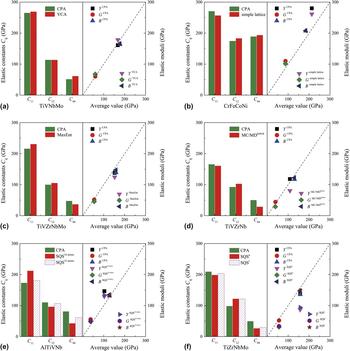
Experiments indicated that the equiatomic TiVNbMo adopts a single bcc solid solution phase.Reference Chen, Yang, Dahmen, Liaw and Zhang80 The VCA (using the Cambridge Sequential Total Energy Package, CASTEPReference Clark, Segall, Pickard, Hasnip, Probert, Refson and Payne81) and CPA predictions for the lattice constants are 3.125 Å and 3.132 Å,Reference Tian, Wang, Shen and Wang82 respectively, which compare reasonably well with the corresponding experimental value of 3.211 Å.Reference Chen, Yang, Dahmen, Liaw and Zhang80 The three independent elastic constants are calculated based on the stress–strain relation in the VCA method, whereas in the CPA method, they are obtained from the total energy as a function of strain. At this point, we should mention that the stress–strain and the energy–strain approaches are expected to be fully equivalent as long as the stress prediction is fully consistent with the total energy. As shown in Fig. 1(a), the VCA values for C 11 and C 12 are 269.4 GPa and 113.8 GPa, respectively, which are close to the CPA values of 265.5 GPa and 114.0 GPa. In the case of C 44, the VCA value is 61.6 GPa, which is ∼19% larger than the CPA value of 51.7 GPa.Reference Tian, Wang, Shen and Wang82
Comparison between the CPA and other techniques of single-crystal elastic constants (C 11, C 12, and C 44) and polycrystalline elastic moduli (B, G, and Y) of (a) TiVNbMo, (b) CrFeCoNi, (c) TiVZrNbMo, (d) TiVZrNb, (e) AlTiVNb, and (f) TiZrNbMo. The “average” values are obtained from the rule of mixture based on the corresponding experimental data of the alloy components. Data taken from Ref. Reference Tian, Wang, Shen and Wang82 for (a), Ref. Reference Tian, Varga, Chen, Delczeg and Vitos84 for (b), Refs. Reference Tian, Wang, Harris, Irving, Zhao and Vitos76 and Reference Zheng, Feng and Wang92 for (c), Refs. Reference Tian, Wang, Harris, Irving, Zhao and Vitos76 and Reference Feng and Widom98 for (d), Ref. Reference Tian, Wang and Vitos102 for (e), and Ref. Reference Tian, Wang, Harris, Irving, Zhao and Vitos76 for (f).

Both VCA and CPA results for the single-crystal elastic constants satisfy the mechanical stability criteria of a cubic crystal. The good ductility of the present alloy is predicted by the Pugh ratio, Poisson ratio, and Cauchy pressure.Reference Tian, Wang, Shen and Wang82 The Young’s modulus calculated from the VCA and CPA methods are 178.6 GPa and 161.1 GPa, respectively, which are close to the average value of 167.4 GPa obtained from the rule of mixture based on the corresponding experimental data of the alloy components.Reference Gschneidner83 The comparisons of bulk modulus and shear modulus are shown in Fig. 1(a). One can see that there exists a generally good agreement between these theoretical predictions. The success of VCA in the case of the equiatomic TiVNbMo can be ascribed to the similar electronic structures of the alloy components.
B. CPA and supercell
1. Simple distribution
A simple supercell is constructed with fcc underlying lattice for the equiatomic CrFeCoNi. The four elements are distributed so that they obey a specified atomic arrangement being neighbors to each other within a conventional fcc unit cell.Reference Tian, Varga, Chen, Delczeg and Vitos84,Reference Lucas, Wilks, Mauger, Muñoz, Senkov, Michel, Horwath, Semiatin, Stone, Abernathy and Karapetrova85 The magnetic state is treated using the DLM approach, which mimics the random distribution of the local magnetic moments corresponding to the paramagnetic state. We notice that the present alloy possesses a magnetic transition temperature well below room temperature.Reference Kao, Chen, Chen, Chu, Yeh and Lin86–Reference Niu, Zaddach, Oni, Sang, Hurt, LeBeau, Koch and Irving89 The lattice constants calculated from the simple supercell (EMTO) and CPA methods are 3.522 Å and 3.530 Å, respectively.Reference Tian, Varga, Chen, Delczeg and Vitos84 The available experimental results are found to scatter with the fabrication methods, heat-treatment processes, etc.Reference Kao, Chen, Chen and Yeh28–Reference Wang, Wang, Wang, Tsai, Lai and Yeh30,Reference Lucas, Mauger, Muñoz, Xiao, Sheets, Semiatin, Horwath and Turgut90 For instance, the lattice constants for the as-cast, -homogenized, and -deformed samples are 3.559 Å, 3.561 Å, and 3.554 Å, respectively.Reference Kao, Chen, Chen and Yeh28 All these values are in reasonable agreement with the predicted theoretical values, and the ∼1% difference can be ascribed to the used exchange-correlation approximation (using the form of Perdew–Burke–Ernzerhof, PBEReference Perdew, Burke and Ernzerhof58) and to the effect of temperature neglected in the calculations.
The single-crystal elastic constants obtained from the two methods differ on average by ∼4% as shown in Fig. 1(b), and both sets of data satisfy the mechanical stability conditions. The Young’s modulus obtained from the simple supercell method is 262 GPa, which is close to the CPA value of 280 GPa.Reference Tian, Varga, Chen, Delczeg and Vitos84 Meanwhile, a reasonable agreement is seen for some other polycrystalline elastic parameters. The average values obtained from the rule of mixture based on the corresponding experimental data of the alloy components are plotted for comparison.Reference Gschneidner83
2. Maximum-entropy method
The MaxEnt structure is an ideal periodic model, which is generated by the principle that all same-element atoms should disperse homogeneously.Reference Wang91,Reference Zheng, Feng and Wang92 This model is an algorithm that has been suggested to describe the random alloy theoretically.Reference Wang91,Reference Zheng, Feng and Wang92 Take the equiatomic TiVZrNbMo as an example, which shows only a single bcc phase based on the X-ray diffraction pattern.Reference Zhang, Yang and Liaw93,Reference Wu, Cai, Chen, Wang, Si, Wang, Wang and Hui94 The performance of the MaxEnt method (using the CP2K first-principles packageReference VandeVondele, Krack, Mohamed, Parrinello, Chassaing and Hutter95) for the lattice constant is 3.253 Å,Reference Zheng, Feng and Wang92 which is close to the CPA value of 3.252 Å.Reference Tian, Wang, Harris, Irving, Zhao and Vitos76
The single-crystal elastic constants obtained from the MaxEnt method are C 11 = 231.0 GPa, C 12 = 105.6 GPa, and C 44 = 36.9 GPa.Reference Zheng, Feng and Wang92 The CPA values are C 11 = 216.3 GPa, C 12 = 100.2 GPa, and C 44 = 47.8 GPa.Reference Tian, Wang, Harris, Irving, Zhao and Vitos76 The theoretical results verify the mechanical stability of the present alloy. Figure 1(c) shows the comparisons of polycrystalline elastic moduli between the ab initio results (MaxEnt and CPA) and the average values obtained from the rule of mixture based on the corresponding experimental data of the alloy components.Reference Gschneidner83 It is found that the different sets of data are in general close to each other.
3. Hybrid MC/MD simulations
The hybrid MC/MD has been utilized to mimic the configurations of HEAs.Reference Widom, Huhn, Maiti and Steurer96–Reference Feng and Widom98 This method is based on the first-principles total energy that alternates MC swapping of atomic species with conventional MD.Reference Widom, Huhn, Maiti and Steurer96 For instance, a 16-atom 2 × 2 × 2 bcc supercell with a random distribution of atomic species is constructed as an initial configuration. It is thoroughly annealed under MC/MD at a given temperature. Then the annealed structure is applied to create larger supercells, of size 32, 64, and eventually 128 atoms, thoroughly annealing at each size. The feasibility of this approach depends on adequate acceptance rates for attempted species swaps.
The equiatomic TiVZrNb has been reported to show an essentially single-phase bcc crystal structure.Reference Senkov, Senkova, Miracle and Woodward99 The CPA lattice constant is 3.290 Å,Reference Tian, Wang, Harris, Irving, Zhao and Vitos76 which is close to the experimental value of 3.325 Å.Reference Senkov, Senkova, Miracle and Woodward99 The single-crystal elastic constants obtained from the hybrid MC/MD (VASP) and CPA methods are shown in Fig. 1(d). The theoretical results demonstrate the mechanical stability of the present alloy. Compared to the average Young’s modulus obtained from the rule of mixture based on the corresponding experimental data of the alloy components (108.6 GPa),Reference Gschneidner83 the CPA predicts a larger value (118.2 GPa),Reference Tian, Wang, Harris, Irving, Zhao and Vitos76 whereas the hybrid MC/MD shows a lower value (80.6 GPa).Reference Feng and Widom98 The comparisons of bulk modulus and shear modulus are shown in Fig. 1(d). Generally, these theoretical predictions are in line with each other.
4. SQS method
a. Lattice symmetry
The quasi-random chemical distribution in the SQS supercell leads to a highly anisotropic environment, even though the atoms are on a cubic fcc or bcc underlying lattice, and thus there exists large deviations in the predicted elastic constants.Reference Gao, Yeh, Liaw and Zhang15 To reduce this symmetry-lowering effect of SQS, one generally averages the relevant cubic parameters obtained for the three main directions, viz.,  ${\bar{C}_{11}} = {{\left( {{C_{11}} + {C_{22}} + {C_{33}}} \right)} / 3}$,
 ${\bar{C}_{12}} = {{\left( {{C_{12}} + {C_{23}} + {C_{13}}} \right)} / 3}$, and
 ${\bar{C}_{44}} = {{\left( {{C_{44}} + {C_{55}} + {C_{66}}} \right)} / 3}$. This arithmetical approach was previously applied in cubic solid solutions described by the SQS method.Reference Hebbache and Zemzemi100,Reference Gao, Suzuki, Schweiger, Doğan, Hawk and Widom101 To illustrate the elastic properties of cubic HEAs, the average values are used in this work unless specified differently.
b. Cell size
The optimal cell-size is important for the sake of computational efficiency. In general, one can expect that the chemical distribution will be better represented by very large SQS supercell, which should approach the real random material. Here, different numbers of atoms in the SQS configurations are constructed using the MC simulated annealing procedure with an objective function.Reference van de Walle, Tiwary, de Jong, Olmsted, Asta, Dick, Shin, Wang, Chen and Liu75,Reference Tian, Wang and Vitos102 The equiatomic AlTiVNb is chosen as an example, which adopts a bcc crystal structure according to experimental observations.Reference Stepanov, Shaysultanov, Salishchev and Tikhonovsky103,Reference Stepanov, Yurchenko, Skibin, Tikhonovsky and Salishchev104 The lattice constants obtained from 16-atom and 32-atom SQS methods (CASTEP) are 3.187 Å and 3.189 Å, respectively. The CPA lattice constant is 3.187 Å.Reference Tian, Wang and Vitos102 These theoretical data are in excellent agreement with the experimental value of 3.186 Å.Reference Stepanov, Yurchenko, Skibin, Tikhonovsky and Salishchev104
In Fig. 1(e), the single-crystal elastic constants of AlTiVNb are found to be C 11 = 180.9 (212.5) GPa, C 12 = 107.0 (96.5) GPa, and C 44 = 61.5 (42.9) GPa by the 32-atom (16-atom) SQS method. The results of the CPA method are C 11 = 173.6 GPa, C 12 = 110.5 GPa, and C 44 = 81.4 GPa. It is found that the values obtained from the 32-atom SQS cell are rather close to the CPA results. Nevertheless, all three sets of data satisfy the mechanical stability conditions. Moreover, the obtained Pugh ratio, Poisson ratio, and Cauchy pressure imply the ductile nature of the present alloy.
The Young’s modulus of AlTiVNb obtained from the CPA and 32-atom (16-atom) SQS methods is 146.5 GPa and 137.1 (131.0) GPa, respectively. These results are somewhat large when compared to the average value of 103.3 GPa.Reference Gschneidner83 The comparisons of bulk modulus and shear modulus are shown in Fig. 1(e). In general, these results are close to each other.
c. Local lattice distortion
The atomic positions within the SQS can be relaxed by minimizing the interatomic forces during the self-consistent calculations, which account properly for the local lattice distortion (LLD) effect. Two ab initio-based approaches, CPA and SQS (with and without LLD), are carried out to establish the impact of LLD on the properties in question and check whether the associated errors can overwrite the chemical effects.Reference Tian, Wang, Harris, Irving, Zhao and Vitos76 Take the equiatomic TiZrNbMo as an example, which has a simple bcc solid solution phase.Reference Zhang, Yang and Liaw93 The CPA lattice constant is 3.306 Å, which compares well with the SQSu (VASP) value of 3.311 Å that obtained without relaxing the atomic positions. When considering the LLD effect, the SQSr (VASP) lattice constant increases to 3.322 Å.
Figure 1(f) shows the CPA and both sets of SQS calculations of the single-crystal elastic constants of TiZrNbMo. When comparing the CPA and SQS results, some values are found to be sensitive to the applied method. For instance, the CPA C 44 is 49.9 GPa, which is larger than 26.9 (29.6) GPa obtained from the SQSu (SQSr) method. These deviations may originate from the errors associated with the underlying DFT methods (VASP versus EMTO). In this case, one can notice that the EMTO C 44 values are higher than those by the VASP for all of the alloy components in the bcc structure. For bcc V, Nb, and Mo, VASP underestimates C 44 relative to the corresponding experimental values by 46%, 39%, and 23%, respectively, compared to 22%, 12%, and 6% errors found for EMTO.Reference Tian, Wang, Harris, Irving, Zhao and Vitos76,Reference Söderlind, Eriksson, Wills and Boring105 Hence, one has to be very careful when comparing results obtained for different alloy models to see whether the deviations come from the DFT method or the alloy theory.
The elastic constants remain almost unchanged upon taking into account the LLD effect, which is clear when comparing the SQSu and SQSr data in Fig. 1(f). For TiZrNbMo, C 11 and C 44 increase by 4.5 GPa (2.3%) and 2.7 GPa (10.0%), respectively, whereas C 12 decreases by 0.6 GPa (0.5%) with the local lattice relaxation. The somewhat larger relative change in C 44 is due to the small absolute value. On the other hand, the three independent elastic constants obtained from the SQS with the LLD effect are rather close to the CPA data.
The mechanical stability conditions are fulfilled by all three sets of data as indicated from Fig. 1(f). In addition, for the present alloy, the Pugh ratio is always larger than the critical value of 1.75, the Poisson ratio is above 0.31, and the Cauchy pressure is positive. Thus, it is predicted to exhibit ductile behavior by both CPA and SQS calculations. The LLD effect shows very weak impact on the phenomenological ductility indicators.
The Young’s modulus obtained from the CPA and SQSu (SQSr) methods are 138.4 GPa and 87.1 (94.1) GPa, respectively. The average value obtained from the rule of mixture based on the corresponding experimental data of the alloy components is 157.6 GPa.Reference Gschneidner83 The relatively large differences for the Young’s modulus, as well as the shear modulus, are primarily due to the strong underestimation of C 44 of pure metals (also HEAs) by VASP when compared to the EMTO and experimental data. Notice that the present alloy is relatively isotropic (A Z is close to 1), which places the shear modulus close to the single-crystal elastic constants C′ and C 44. The average bulk modulus and shear modulus are presented in Fig. 1(f) for comparison.Reference Gschneidner83
IV. ELASTICITY OF HEAS
The measurement of the elastic constants usually requires sufficiently large, homogeneous, and defect-free single crystals, and thus, the experimental data are only available for a small portion of materials. First-principles calculations can be of great help in investigating materials and provide valuable reference for experimental research.
As mentioned above, various atomistic simulations based on ab initio theory were applied to study the elastic properties of HEAs. For example, in the framework of the EMTO-CPA approach, Huang et al. investigated the equiatomic CrFeCoNiGa for the fcc and bcc structures and for the ferromagnetic and paramagnetic states, respectively.Reference Huang, Vida, Li, Molnár, Kwon, Holmström, Varga, Varga and Vitos106 The predicted Young’s (shear) modulus varies with the state within ∼159.8–178.2 (∼59.9–67.4) GPa, which compare well with the experimental value of 168 (65) GPa.Reference Vida, Varga, Chinh, Molnár, Huang and Vitos107 Furthermore, the single-crystal elastic constants of many cubic HEAs were accumulated, such as CrFeCoNiCuTix (x = 0–1),Reference Tian, Varga, Chen, Delczeg and Vitos84 CrFeCoNiAlx (x = 0–2),Reference Tian, Delczeg, Chen, Varga, Shen and Vitos108 CrMnFeCoAlx (x = 0.6–1.5),Reference Huang, Li, Huang, Holmström and Vitos109 TiZrNbMoVx (x = 0–1.5),Reference Tian, Varga, Chen, Shen and Vitos110 and TiVNbMoAlx (x = 0–1.5).Reference Cao, Ni, Tian, Varga and Vitos111 Here, the relevant data are established for completely disordered solid solutions and static lattices.
Meanwhile, Qiu et al. investigated TiVZrNbAlx (x = 0, 0.31, 1, 1.8) within the VASP-SQS method.Reference Qiu, Miao, Zhou, Guo and Sun112 Several configurations with different sizes and atomic positions were considered. A slight reduced-symmetry was revealed by the calculated 36 elastic constants (6 × 6) from C 11 to C 66 for the optimized system. The average elastic constants of TiVZrNb are close to the EMTO-CPA values.Reference Tian, Wang, Harris, Irving, Zhao and Vitos76,Reference Tian, Varga, Chen, Shen and Vitos110,Reference Qiu, Miao, Zhou, Guo and Sun112 From VASP in combination with MaxEnt structures, Feng et al. investigated FeCoNi(AlSi)x (x = 0, 0.2, 0.4, 0.8).Reference Feng, Qi and Wang113 The effects of chemical short-range order were considered. The obtained elastic properties of FeCoNi such as bulk modulus, shear modulus, and Young’s modulus were in reasonable agreement with the EMTO-CPA values.Reference Feng, Qi and Wang113,Reference Tian, Varga, Shen and Vitos114
Most of the previous SQS and CPA calculations considered HEAs with cubic lattices. However, the elastic parameters of hexagonal HEAs can also be derived using an ab initio approach. Take the hcp TiZrHfTa0.8 alloy as an example. The lattice constant optimized by the EMTO-CPA method is 3.084 Å, and the corresponding hexagonal axial ratio is 1.631. The five independent elastic constants are C 11 = 200.8 GPa, C 12 = 67.9 GPa, C 13 = 58.1 GPa, C 33 = 224.4 GPa, and C 44 = 34.0 GPa. The theoretical results indicate that the hcp phase is mechanically stable. We notice that in experiments, reducing the Ta level in the TiZrHfTax alloys leads to the appearance of the hcp phase embedded in the bcc matrix.Reference Huang, Wu, He, Wang, Liu, An, Wu and Lu115 The calculated polycrystalline elastic moduli are B = 110.5 GPa, G = 52.8 GPa, and Y = 136.7 GPa, which compare well with the average values of 120.4, 47.7, and 126.4 GPa, respectively. Here, the average value is obtained from the rule of mixture based on the corresponding experimental data of the alloy components.Reference Gschneidner83
Below, several cubic HEAs consisting of refractory and late 3d elements are selected to further illustrate their elastic properties, including single-crystal elastic constants (C 11, C 12, and C 44) and polycrystalline elastic moduli (B, G, and Y). The elastic anisotropy is analyzed using the Zener ratio, as well as the Young’s modulus in different directions.
A. Refractory HEAs
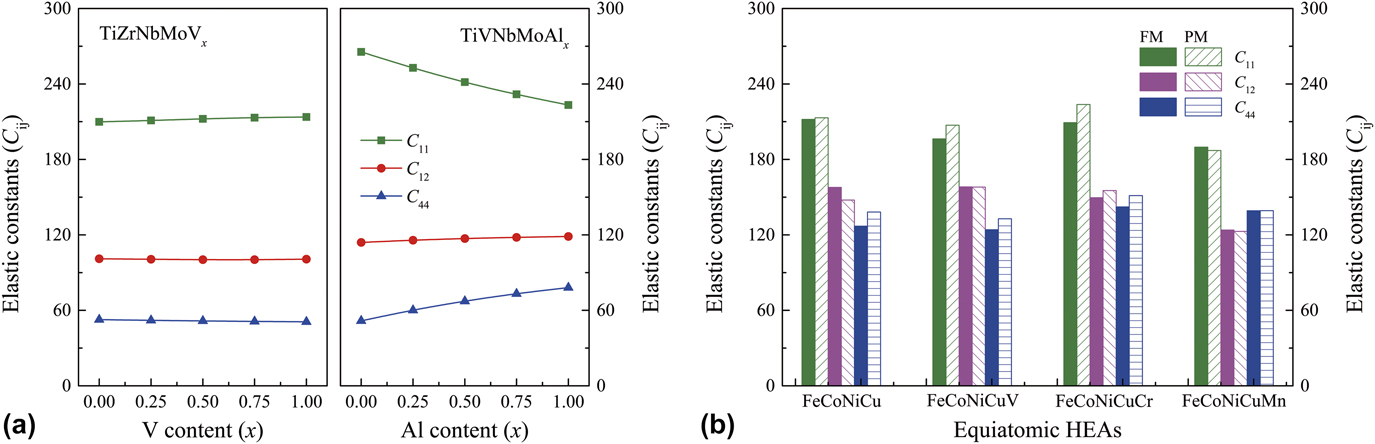
According to the experiments, a single solid solution phase with bcc crystal structure forms in the TiZrNbMoVx (x = 0–1)Reference Zhang, Yang and Liaw93 and TiVNbMoAlx (x = 0–1)Reference Chen, Yang, Dahmen, Liaw and Zhang80 HEAs. The ab initio calculations demonstrate that the bcc structure is energetically favorable over the fcc and hcp structures.Reference Tian, Varga, Chen, Shen and Vitos110,Reference Cao, Ni, Tian, Varga and Vitos111 Figure 2(a) plots the three independent elastic constants (C 11, C 12, and C 44) of the present alloys in an ideal solid solution phase with the bcc underlying lattice.Reference Tian, Varga, Chen, Shen and Vitos110,Reference Cao, Ni, Tian, Varga and Vitos111 It is found that for TiZrNbMoVx, C 11, C 12, and C 44 have only small concentration dependence. In the case of TiVNbMoAlx, C 11 decreases with increasing Al content, whereas C 12 and C 44 increase simultaneously. The calculated single-crystal elastic constants indicate that all HEAs considered here are mechanically stable. In addition, the weak increase of the tetragonal shear modulus C′ with V content in TiZrNbMoVx suggests that V slightly enhances the elastic stability of the bcc phase against tetragonal deformation. For TiVNbMoAlx, C′ is found to decrease with the increase of Al content.
Theoretical single-crystal elastic constants (C 11, C 12, and C 44) of (a) TiZrNbMoVx and TiVNbMoAlx and (b) FM FeCoNiCu and PM FeCoNiCuX (X = V, Cr, and Mn) (FM: ferromagnetic; PM: paramagnetic). Data taken from Refs. Reference Tian, Varga, Chen, Shen and Vitos110 and Reference Cao, Ni, Tian, Varga and Vitos111 for (a) and Ref. Reference Huang, Vida, Heczel, Holmström and Vitos124 for (b).

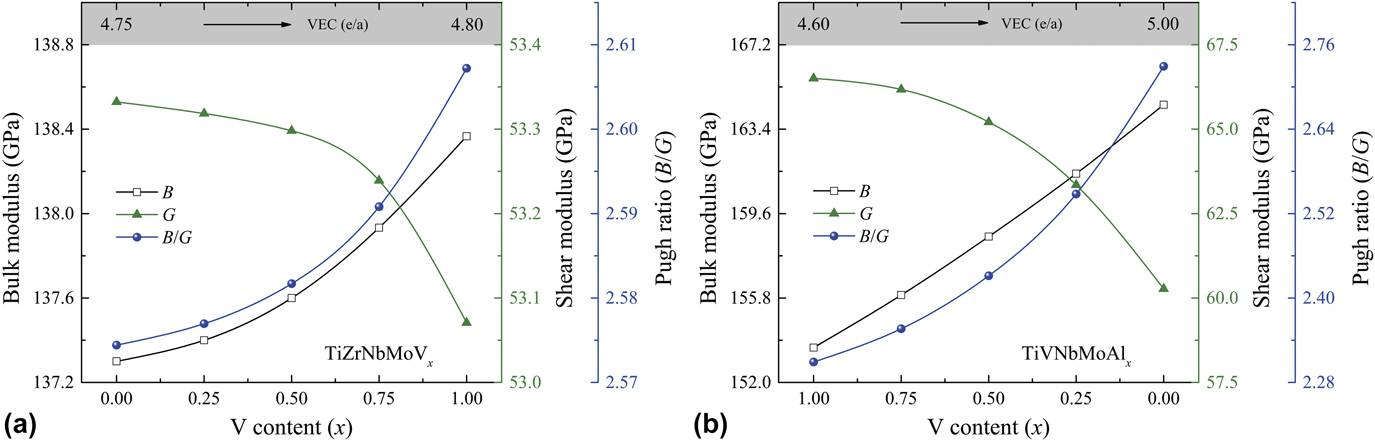
Figure 3 shows the calculated bulk modulus, shear modulus, and Pugh ratio of the considered HEAs. For TiZrNbMoVx, the bulk modulus changes between 137.3 and 138.5 GPa, and the shear modulus changes between 53.3 and 53.2 GPa. Thus, V doping has very small effect on these polycrystalline elastic moduli, similar to the case of the single-crystal elastic constants. For TiVNbMoAlx, the bulk modulus changes from 164.5 to 153.5 GPa, and the shear modulus changes from 60.3 to 66.5 GPa when x changes from 0 to 1. The changes in the Pugh ratio correlate reasonably well with those found for the Cauchy pressure for both alloys. It is noteworthy that a high Pugh ratio indicates a tendency for ductility, while a small one for brittleness with the critical value of around 1.75.Reference Pugh45 Based on this phenomenological model, all alloys considered here are predicted to be ductile. On the other hand, the alloying-induced changes are small and the quoted correlation between the elastic parameters and ductility too vague to be able to draw more solid conclusions.
Correlations between bulk modulus (B), shear modulus (G), and Pugh ratio (B/G) of (a) TiZrNbMoVx and (b) TiVNbMoAlx. VEC is valence electron concentration obtained via VEC = ∑c ie i, where c i and e i are the atomic fraction and number of valence electron of element i, respectively. Data taken from Ref. Reference Tian, Varga, Chen, Shen and Vitos110 for (a) and Ref. Reference Cao, Ni, Tian, Varga and Vitos111 for (b).

The valence electron concentration (VEC) has often been used to classify the single solid solution phases of HEAs, i.e., the fcc phase was found to be stable at a larger VEC value, while the bcc phase formed at a smaller VEC value.Reference Guo, Ng, Lu and Liu116–Reference Guo and Liu118 Besides, the VEC should also reflect the change of the metallic bond and thus the change of polycrystalline elastic moduli. Indeed, as shown in Fig. 3, a correlation between the bulk (shear) modulus and the VEC is revealed for the present alloys. The increase in the VEC is followed by an increase (slightly decrease) in the bulk (shear) modulus. The opposite trends in bulk modulus and shear modulus explain the enhanced ductility of TiZrNbMoVx (TiVNbMoAlx) for large (small) x values.
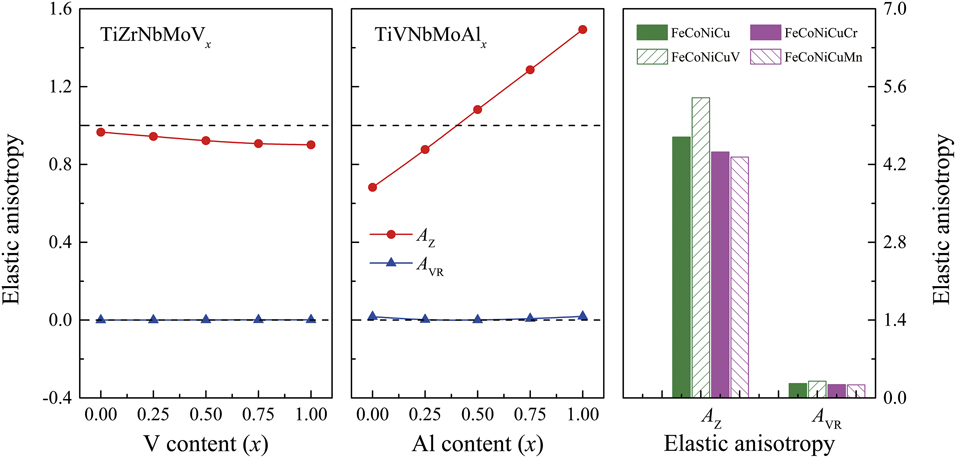
For an isotropic cubic crystal, the tetragonal shear modulus C′ equals the cubic shear modulus C 44. Accordingly, the Zener ratio A Z = 1 and the elastic anisotropy ratio A VR = 0. The degree of elastic anisotropy can be quantified by the deviation of A Z from 1 and A VR from 0. As shown in Fig. 4, the obtained A VR for the considered HEAs are close to 0, indicating that the statistical averaging methods (in the present case, the Voigt and Reuss methods) give almost the same polycrystalline shear modulus. The calculated A Z for TiZrNbMo is 0.966, and it decreases monotonously to 0.9 when equimolar V is introduced. Thus, V slightly enhances the anisotropy of TiZrNbMoVx. For TiVNbMoAlx, the Al content has a large effect on the elastic anisotropy. With increasing Al content from null to x = 1, A Z increases from 0.682 to 1.493, crossing the isotopic value of 1.
Theoretical elastic anisotropy (A Z and A VR) of TiZrNbMoVx, TiVNbMoAlx, FM FeCoNiCu, and PM FeCoNiCuX (X = V, Cr, and Mn) (FM: ferromagnetic; PM: paramagnetic). Data taken from Refs. Reference Tian, Varga, Chen, Shen and Vitos110, Reference Cao, Ni, Tian, Varga and Vitos111, and Reference Huang, Vida, Heczel, Holmström and Vitos124.

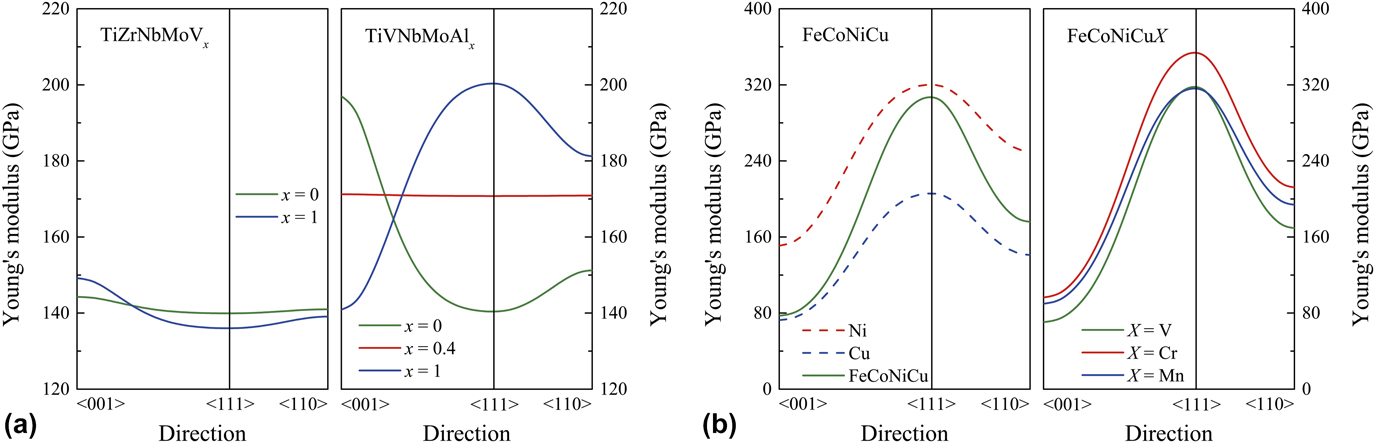
As shown in Fig. 5(a), the Young’s modulus changes between 139.9 and 144.3 GPa for TiZrNbMo, between 136.0 and 149.2 GPa for TiZrNbMoV, and between 140.4 and 197.0 GPa for TiVNbMo. The largest Young’s modulus is realized along the 〈001〉 direction, whereas the smallest one belongs to the 〈111〉 direction for the above HEAs. Interestingly, TiVNbMoAl has the largest Young’s modulus (200.3 GPa) along the 〈111〉 direction and the smallest one (140.9 GPa) along the 〈001〉 direction. It should be mentioned that the Young’s modulus has its largest value in the 〈111〉 direction when A Z is larger than 1. Furthermore, TiVNbMoAl0.4 has Young’s modulus around 171 GPa along the different crystallographic directions, which indicates that this alloy is almost elastically isotropic.
Theoretical Young’s modulus of (a) TiZrNbMoVx and TiVNbMoAlx, and (b) FM FeCoNiCu and PM FeCoNiCuX (X = V, Cr, and Mn) (FM: ferromagnetic; PM: paramagnetic) as a function of direction, including the three main cubic directions. The corresponding data of pure fcc Ni and Cu metals are plotted for comparison. Data taken from Refs. Reference Tian, Varga, Chen, Shen and Vitos110 and Reference Cao, Ni, Tian, Varga and Vitos111 for (a) and Refs. Reference Huang, Vida, Heczel, Holmström and Vitos124 and Reference Simmons126 for (b).

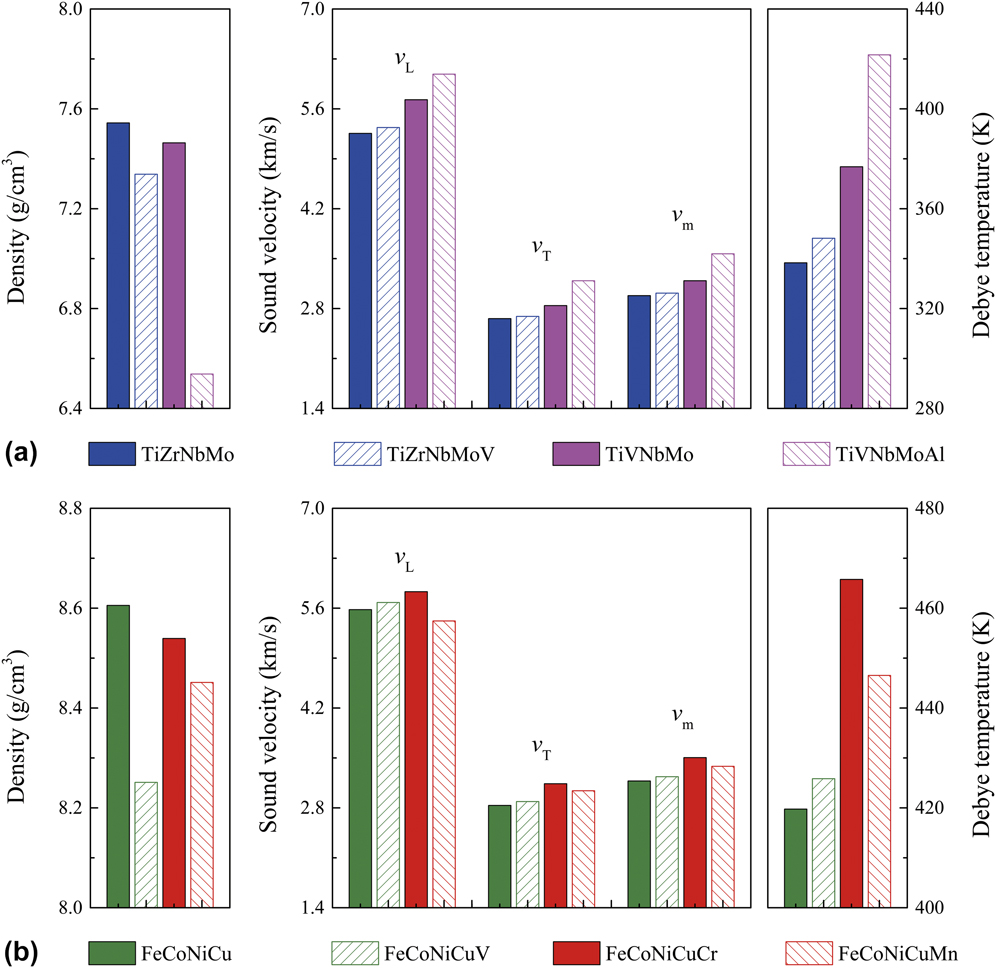
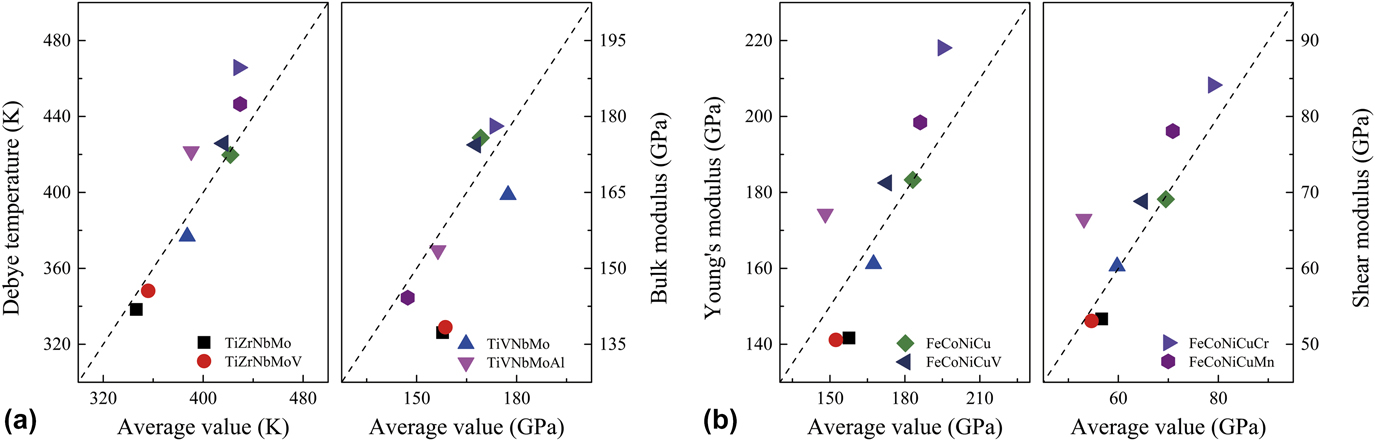
The Debye temperature is an important parameter that correlates with many thermal characteristics of materials. It can be derived from specific heat measurement, elastic constants, melting point, electrical resistivity, thermal expansion, X-ray and neutron diffraction intensity data, and so on. Figure 6(a) shows the calculated elastic Debye temperature, as well as the density and the longitudinal, transverse, and average sound velocities for the considered alloys. The longitudinal sound velocities of these alloys are much larger than the transverse velocities. That is because the shear modulus is always below the bulk modulus, which is a result of the fact that C′ < C 44 for all alloys considered here. The calculated elastic Debye temperature of TiZrNbMo is 338 K. Since the Debye temperature vary with temperature, one should be careful when comparing them that obtained by different methods. To the best of our knowledge, there is no other theoretical or experimental data available for the Debye temperature to make comparison with the present value. On the other hand, previous work indicates that the elastic Debye temperature for Ti, Zr, Nb, and Mo are 373, 231, 328, and 454 K, respectively.Reference Gschneidner83 The average value obtained from the rule of mixture based on the corresponding experimental data of the alloy components (347 K) is close to the ab initio data. Figure 7 shows the comparisons of elastic Debye temperature for the present alloys.
Theoretical density, sound velocity, and Debye temperature of (a) TiZrNbMo, TiZrNbMoV, TiVNbMo, and TiVNbMoAl, and (b) FM FeCoNiCu and PM FeCoNiCuX (X = V, Cr, and Mn) (FM: ferromagnetic, PM: paramagnetic). Data taken from Refs. Reference Tian, Varga, Chen, Shen and Vitos110 and Reference Cao, Ni, Tian, Varga and Vitos111 for (a) and Ref. Reference Huang, Vida, Heczel, Holmström and Vitos124 for (b).

Theoretical (a) Debye temperature and bulk modulus, and (b) Young’s modulus and shear modulus of TiZrNbMo, TiZrNbMoV, TiVNbMo, TiVNbMoAl, FM FeCoNiCu, and PM FeCoNiCuX (X = V, Cr, and Mn) (FM: ferromagnetic, PM: paramagnetic). The “average” values are obtained from the rule of mixture based on the corresponding experimental data of the alloy components. Data taken from Refs. Reference Gschneidner83, Reference Tian, Varga, Chen, Shen and Vitos110, Reference Cao, Ni, Tian, Varga and Vitos111, and Reference Huang, Vida, Heczel, Holmström and Vitos124.

B. 3d-metal-based HEAs
The equiatomic FeCoNiCu and FeCoNiCuX (X = V, Cr, and Mn) HEAs have been found to possess a single fcc solid solution phase.Reference Yeh, Chen, Lin, Gan, Chin, Shun, Tsau and Chang1,Reference Tong, Chen, Yeh, Lin, Chen, Shun, Tsau and Chang27,Reference Liu, Zhu, Zhang, Li and Jiang119–Reference Praveen, Murty and Kottada123 The ab initio calculations confirm the stability of the fcc structure relative to the hcp and bcc structures for all considered HEAs.Reference Huang, Vida, Heczel, Holmström and Vitos124 Particularly, the experiments indicate that FeCoNiCuCr exhibits typical paramagnetism at room temperature.Reference Wang, Zhang, Qiao and Chen121 A key parameter to describe the magnetic state of a material is Curie temperature, which can be estimated from mean-field approximation based on ab initio ferromagnetic and paramagnetic energies.Reference Huang, Holmström, Eriksson and Vitos88,Reference Sato, Bergqvist, Kudrnovský, Dederichs, Eriksson, Turek, Sanyal, Bouzerar, Katayama-Yoshida, Dinh, Fukushima, Kizaki and Zeller125 Here, the calculated Curie temperature for FeCoNiCu is 796 K, and the equimolar V, Cr, and Mn additions to FeCoNiCu decrease the Curie temperature to 246, 251, and 146 K, respectively.Reference Huang, Holmström, Eriksson and Vitos88 As results, ferromagnetic FeCoNiCu and paramagnetic FeCoNiCuX (X = V, Cr, and Mn) are mainly discussed below unless specified differently.
The single-crystal elastic constants of the present alloys are shown in Fig. 2(b). One can see that all HEAs considered here are mechanically stable. The relevant values for FeCoNiCu are C 11 = 211.9 GPa, C 12 = 157.8 GPa, and C 44 = 126.9 GPa. It is found that adding equimolar V to FeCoNiCu does not show significant effect on the three independent elastic constants. On the other hand, C 11 (C 44) is found to increase by 11.8 (24.4) GPa, whereas C 12 decreases slightly when equimolar Cr is introduced to FeCoNiCu. In the case of the equimolar Mn addition, C 11 (C 12) is found to decrease by 24.8 (35.0) GPa, whereas C 44 increases by 12.4 GPa when compared to FeCoNiCu. It is noteworthy that negative Cauchy pressure (C 12 − C 44) is found for FeCoNiCuMn. The relatively large change of the Cauchy pressure upon equimolar doping indicates that Mn makes the host alloy especially brittle.
Figure 4 indicates that the present alloys possess relatively high elastic anisotropy. For example, the calculated A Z and A VR for FeCoNiCu are 4.7 and 0.26, respectively. Furthermore, as shown in Fig. 5(b), the obtained Young’s modulus shows a rather strong orientation dependence for the considered HEAs. In the case of FeCoNiCu, the Young’s moduli are 77.2, 306.9, and 176.0 GPa along the 〈001〉, 〈111〉, and 〈011〉 directions, respectively. For comparison, the corresponding data of pure fcc Ni and Cu metals that are obtained from the single-crystal elastic constants are plotted.Reference Simmons126 It is found that the largest (lowest) Young’s modulus of FeCoNiCu is close to the value of 320.2 (72.6) GPa obtained for the 〈111〉 (〈001〉) direction of pure fcc Ni (Cu) metal. In addition, the Young’s modulus varies between 70.5 and 317.8 GPa for FeCoNiCuV, between 96.4 and 353.7 GPa for FeCoNiCuCr, and between 89.8 and 316.1 GPa for FeCoNiCuMn. The large changes of Young’s modulus indicate that these alloys show noteworthy anisotropy.
It is indicated from Fig. 6(b) that the theoretical density at static conditions for FeCoNiCu (∼8.605 g/cm3) is ∼0.8% larger than the experimental value derived from the measured lattice parameter at room temperature.Reference Liu, Zhu, Zhang, Li and Jiang119 The equimolar V, Cr, and Mn additions decrease the density of the host alloy. For the elastic Debye temperature, we get 420, 426, 466, and 447 K for FeCoNiCu, FeCoNiCuV, FeCoNiCuCr, and FeCoNiCuMn, respectively.
Figure 7 shows the comparisons of Debye temperature and polycrystalline elastic moduli (B, G, and Y) obtained from ab initio calculations and rule of mixture for the present alloys. In general, these data are consistent with each other. Moreover, the relative values reveal the alloying effect when going from a four-component to a five-component equiatomic alloy. Take the Young’s modulus as an example. For FeCoNiCu, the CPA value is 183.3 GPa,Reference Huang, Vida, Heczel, Holmström and Vitos124 which is close to the average value of 183.1 GPa.Reference Gschneidner83 Equimolar V addition to FeCoNiCu slightly decreases the Young’s modulus, whereas Cr and Mn are found to increase the Young’s modulus from 183.3 to 218.1 and 198.4 GPa, respectively. The same trend is found for the shear modulus. Actually, the experimental Young’s modulus and shear modulus of Cr are much larger than other metals (V, Mn, Fe, Co, Ni, and Cu),Reference Gschneidner83 which could partly explain the largest Young’s modulus and shear modulus obtained for FeCoNiCuCr when compared to other FeCoNiCu-based HEAs. In general, the average polycrystalline elastic moduli are consistent with the theoretical values in the CPA calculations.
In an arbitrary direction [hkl], the Young’s modulus of a cubic lattice is given in terms of the elastic compliance coefficients S 11, S 12, and S 44, viz., Y[hkl]−1 = S 11 − (2S 11 − 2S 12 − S 44)N 4, where  ${N^4} = n_1^2n_2^2 + n_1^2n_3^2 + n_2^2n_3^2$, and n 1, n 2, and n 3 are the direction cosines for the direction [hkl], i.e.,
 ${n_1} = {h / {\sqrt {{h^2} + {k^2} + {l^2}} }}$,
 ${n_2} = {k / {\sqrt {{h^2} + {k^2} + {l^2}} }}$, and
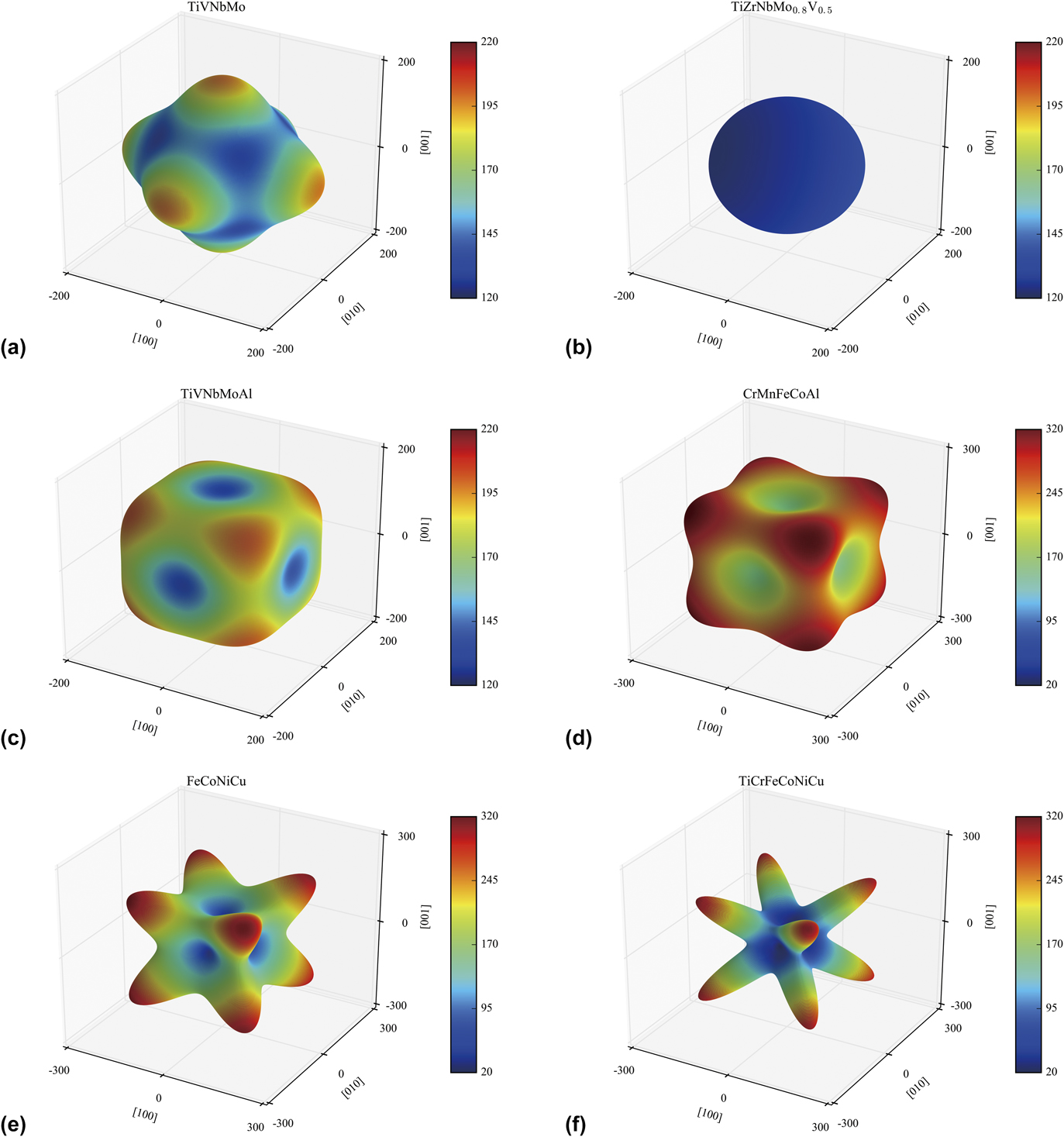
 ${n_3} = {l / {\sqrt {{h^2} + {k^2} + {l^2}} }}$. In general, N 4 varies between 0 and 1/3 in the 〈001〉 and 〈111〉 directions, respectively. Usually, Zener ratio A Z > 1 implies that the Young’s modulus has its largest (smallest) value along the 〈111〉 (〈001〉) direction, while for Zener ratio A Z < 1, the largest (smallest) Young’s modulus is along the 〈001〉 (〈111〉) direction. Figure 8 shows the three dimensional Young’s modulus for TiVNbMo,Reference Tian, Wang, Shen and Wang82 TiZrNbMo0.8V0.5,Reference Tian, Varga, Chen, Shen and Vitos110 TiVNbMoAl,Reference Cao, Ni, Tian, Varga and Vitos111 CrMnFeCoAl,Reference Huang, Li, Huang, Holmström and Vitos109 FeCoNiCu,Reference Huang, Vida, Heczel, Holmström and Vitos124 and TiCrFeCoNiCu.Reference Tian, Varga, Chen, Delczeg and Vitos84 The calculated Zener ratios for the selected HEAs are 0.68, 1.0, 1.49, 2.35, 4.7, and 9.8, respectively. The above conclusion is valid only at low temperatures since the present results correspond to static conditions.
Characteristic surfaces of Young’s modulus of (a) TiVNbMo, (b) TiZrNbMo0.8V0.5, (c) TiVNbMoAl, (d) FM CrMnFeCoAl, (e) FM FeCoNiCu, and (f) PM TiCrFeCoNiCu (FM: ferromagnetic; PM: paramagnetic). The values on the color scale and the axes are in GPa. Data taken from Ref. Reference Tian, Wang, Shen and Wang82 for (a), Ref. Reference Tian, Varga, Chen, Shen and Vitos110 for (b), Ref. Reference Cao, Ni, Tian, Varga and Vitos111 for (c), Ref. Reference Huang, Li, Huang, Holmström and Vitos109 for (d), Ref. Reference Huang, Vida, Heczel, Holmström and Vitos124 for (e), and Ref. Reference Tian, Varga, Chen, Delczeg and Vitos84 for (f).

V. CONCLUSIONS
The present article reviews the widely used theoretical methodologies and investigations of the elastic properties of HEAs. Two kinds of ab initio-based solid solution models for HEAs are introduced: the effective medium approximation (e.g., CPA and VCA) and the supercell technique (e.g., SQS, MaxEnt, and hybrid MC/MD). Comparisons of the elastic parameters obtained from the above methods are provided. In general, the different sets of data are consistent with each other for most of the considered HEAs. Whenever a larger deviation between these two alloy approaches is observed, one should verify that if it is ascribed to the underlying DFT methods, and only the remaining deviation should be associated with the performance of the particular solid solution models.
The average polycrystalline elastic moduli (B, G, and Y) determined from the linear rule of mixture based on the corresponding experimental data of the alloy components are presented. This simple rule of mixture of the selected property of HEAs can provide useful first-level estimation of the general trend when compared to the ab initio calculations.
Two kinds of HEAs, i.e., the refractory HEAs (TiZrNbMoVx and TiVNbMoAlx) and the 3d-metal-based HEAs (FeCoNiCu–V/Cr/Mn), are selected as examples to illustrate the elastic properties. The elastic anisotropy is analyzed and discussed within the Zener ratio and Young’s modulus along different directions. The nearly elastic isotropic HEAs can be reached by adjusting the composition, such as TiZrNbMo0.8V0.5, and TiVNbMoAl0.4 predicted by the EMTO-CPA approach for completely disordered solid solutions and static lattices.
During the last few years, the ab initio determination of the basic elastic parameters has become a powerful tool to predict the elasticity of HEAs. Gaining access to a large amount of reliable ab initio parameters is nowadays a standard procedure thanks to the great progress both in DFT methodology and alloy theory. Such theoretical databases play an important role in understanding and describing the mechanical performance of multicomponent alloys and also in verifying the often very cumbersome experimental measurements. Based on the results reviewed here, both effective medium and supercell models are generally suitable for investigating the elasticity of nonmagnetic HEAs, but the effective medium model (CPA) seems to be the more powerful when it comes to magnetically disordered HEAs. We emphasize that when selecting the alloy theory one should pay attention to choose the right DFT methodology and the right model system to reach reliable and well converged theoretical data.
Supplementary Material
To view supplementary material for this article, please visit https://doi.org/10.1557/jmr.2018.237.
ACKNOWLEDGMENTS
This work was supported by the Swedish Research Council, the Swedish Foundation for Strategic Research, the Swedish Foundation for International Cooperation in Research and Higher Education, the Carl Tryggers Foundation, the Sweden’s Innovation Agency (VINNOVA Grant No. 2014-03374), the Swedish Energy Agency, the National Natural Science Foundation of China (Grant Nos. 51771015 and 51401014), the China Scholarship Council, and the Hungarian Scientific Research Fund (OTKA 109570). We acknowledge the Swedish National Supercomputer Center in Linköping and Stockholm for computer resources.