

Financial markets bridge the gap between credit seekers and those looking to invest, allowing capital to move towards its most productive use. Well-integrated and efficient financial markets promote resource allocation and facilitate economic development. The integration of European financial markets in the eighteenth and nineteenth centuries has been quantitatively analysed, establishing that European financial markets were already highly integrated and efficient in exploiting arbitrage opportunities (Schubert Reference Schubert1989; Neal Reference Neal1990; Flandreau et al. Reference Flandreau, Galimard, Jobst, Nogues-Marco, Atack and Neal2009a; Nogues-Marco Reference Nogues-Marco2013; Bignon et al. Reference Bignon, Chen and Ugolini2017). Since the seventeenth century, bills of exchange were commonly discounted and assigned to a third party with endorsement. Banks were established to manage monetary affairs by receiving deposits, issuing bank money and processing bills of exchange (Sieveking Reference Sieveking and Van Dillen1964; Van Dillen Reference Van Dillen and Van Dillen1964; ’t Hart et al. Reference ’t Hart, Jonker and Van Zanden1997, pp. 37–63). Furthermore, information about the state of markets was widely available and easily accessed by the regular issue of price currents: sheets listing the current prices of commodities and exchange rates traded in markets (Neal Reference Neal1990, pp. 20–43; McCusker and Gravesteijn Reference Mccucker and Gravesteijn1991). Against these developments, this article assesses how well financial markets performed in the second half of the seventeenth century by analysing arbitrage operation to exploit the difference between direct- and cross-exchange rates.
Taking into consideration the availability of data, the particular time period studied runs from 1668 to 1680. In this period London fell victim to the Stop of Exchequer of 1672, and northwestern Europe was ravaged by the Franco-Dutch War and the Third Anglo-Dutch War. Exchange arbitrage between four cities in northern Europe – Amsterdam, Hamburg, London and Paris – is examined. Although the selection of cities is purely data-driven, they represent major exchange markets in northwestern Europe (Flandreau et al. Reference Flandreau, Galimard, Jobst and Nogues-Marco2009b, p. 161). The results reveal that international credit markets based on bill of exchange operations were highly efficient in responding to arbitrage opportunities, and the estimated transaction costs associated with arbitrage are consistent with empirical evidence. Although warfare resulted in rising transaction costs, the level of market efficiency remained more or less the same.
The rest of the article is divided into five sections. Some historical background to set against the analysis, e.g. financial innovation and the Franco-Dutch War, is briefly described in Section i. Section ii explains the econometric model used to estimate the effectiveness of arbitrage and is followed by discussion of the sources of data and the construction of cross-exchange rates in Section iii. The operation of arbitrage in exchange markets is discussed in Section iv and Section v concludes.
I
Since the medieval period, bills of exchange had been used extensively in international trade to facilitate transfers of funds between distant places, and to act as short-term credit instruments. However, due to the Church prohibition on usury, and medieval secular laws, bills were neither discountable nor transferable, thereby limiting their function as credit instruments. After the resurgence in transcontinental overland trade and the increase in the flow of trade, the primitive medieval financial method was by the sixteenth century no longer able to cope with the pressure exerted on the demand for money. Several financial innovations were developed, finally maturing in the seventeenth century into full and routine practice.
The liquidity problem embedded in the medieval financial method became severe as the flow of trade and the demand for money increased at the turn of the sixteenth century. The first step to solve the liquidity problem was to remove the usury ban; the payment of interest first became legalised in the Habsburg Netherlands in 1542, up to 12 per cent, and then England in 1545, up to 10 per cent (Munro Reference Munro2003, p. 554). Once the charging of interest was legally permitted, bills of exchange could be sold to a third party before the maturity. To allow a secondary market for commercial credit instruments to properly emerge, these bills had to be negotiable. A negotiable bill of exchange is one for which a court must recognise the full legal status of a third person, who has received the bill of exchange from its former holders. In the case of default, whoever is holding the bill has the right to take legal action against the original issuer and any previous holders of the bill until final payment is received. The first national legislation to recognise the full legal rights of the assignee was established in the Netherlands by Charles V's ordinances of 1536 and 1541. The relaxation of limits on usury and negotiability largely increased the use and acceptability of bills of exchange.Footnote 1 The secondary markets for bills of exchange thus developed, and exchange markets acquired sufficient capacity to provide credit for merchants engaged in international trade.
With the mounting quantity and variety of trade, brokers had to update their customers with commercial and financial information on a regular basis. As early as 1540, Antwerp started to issue price currents listing the prices of commodities and exchange rates. By the late sixteenth century, price currents were issued regularly in Venice and northern Europe (McCusker and Gravesteijn Reference Mccucker and Gravesteijn1991, pp. 21–41). By means of regular issues of price currents, information about the state of the market can be widely and easily disseminated to the public. Consequently, prices converge and respond to shocks more quickly, and markets become more integrated and efficient.
Apart from these financial innovations, the seventeenth century also witnessed chronic warfare, political turbulence and Dutch hegemony in finance and trade. The period studied coincides with the Franco-Dutch War (1672–8) and the Third Anglo-Dutch War (1672–4). At one point, the presence of French troops outside Amsterdam provoked a run on capital, and widespread panic in the city. The prolonged conflict in the Rhineland and the Spanish Netherlands severely disrupted trade and caused bankruptcies in northern Europe.
Drawing upon skilful diplomacy and generous subsidies, Louis XIV dismantled the fragile Triple Alliance and gained the support of Charles II of England for a joint attack on the Dutch Republic by sea. War against the Dutch was declared on 6 April 1672. French troops reached the heart of the Dutch Republic in the summer of that year. On 20 June, Muiden, approximately six miles from Amsterdam, was taken by the French, though the Dutch recaptured it the following day. To prevent the French from reaching Amsterdam, the Dutch opened the sluices to flood the land, frustrating further incursions by the French and diverting them to the Rhineland later that year.
The surrender of Utrecht and the rapid advance of the French towards Amsterdam caused a wave of panic in the coastal cities. Daunted by the military situation, people withdrew their deposits from the Dutch Republic, moving financial assets to safer places, such as Antwerp and Venice. The runs on the banks resulted in the collapse of the Banks of Rotterdam and Middelburg, but the Bank of Amsterdam withstood the panic.Footnote 2 The Dutch gulden, as quoted in exchange rates with other European cities, immediately depreciated and the premium on bills drawn on Antwerp rose to 15 per cent.Footnote 3 For Amsterdam, the crisis was short-lived, but intermittent conflicts blocked trade routes and increased risk in commercial ventures. Uncertainties, such as confused exchange rates and delays in business decision-making due to the fear of war, fuelled speculation in commodities, causing a great degree of interruption to international trade, as demonstrated in commercial correspondence of the time.Footnote 4
Against these financial and political developments in the seventeenth century, to what degree did financial markets adjust to arbitrage opportunities? Supported by the case of Stephen Evance's arbitrage on means of international payment, Stephen Quinn (Reference Quinn1996) argues that international markets were integrated by the late seventeenth century. To statistically verify Quinn's results and extend the quantitative analysis of financial market integration before the eighteenth century, this article uses exchange rates quoted in both mercantile correspondence and price currents to estimate the degree of international financial market integration and efficiency against the backdrop described above.
II
According to Giovanni Federico (Reference Federico2012, pp. 474–85), the concept of market integration can be deconstructed into two different but related elements: price convergence (the law of one price) and market efficiency. The former addresses whether prices in two locations are equal after taking into account transaction costs, and the latter regards the speed of price adjustment after the shock. The driving force behind price convergence and market efficiency is the operation of arbitrage. If arbitrage is effective, prices soon adjust to eliminate profitable opportunities; prices converge to each other; and any violation of the law of one price is temporary. The degree of price convergence and market efficiency can be measured by transaction costs associated with arbitrage and the speed at which arbitrage eliminates price differentials, respectively (Nogues-Marco et al. Reference Nogues-Marco, Herranz-Loncán and Aslandinis2017).
In the literature, scholars address financial market integration against two different means of international payment (Canjels et al. Reference Canjels, Prakash-Canjels and Taylor2004; Volckart and Wolf Reference Volckart and Wolf2006; Esteves et al. Reference Esteves, Reis and Ferramosca2009; Li Reference Li2015). Merchants can either send bills of exchange or ship bullion (gold or silver) to make international payments. The means employed depended on whichever was more cost-efficient. As a result of arbitrage, the difference between exchange rates and mint parity would be limited within a band of transaction costs. A threshold autoregressive model is usually used to estimate the degree of market integration and transaction costs associated with arbitrage.
Instead of arbitrage between bills of exchange and bullion as means of international payment, this article focuses on arbitrage between direct-bills of exchange and cross-bills of exchange. In the mainstream literature, arbitrage operates as in the following example: if the exchange rates of London on Amsterdam suddenly fell below the lower band of specie points, arbitrage would be triggered to switch means of payment from bills of exchange to bullion. As a result, the demand for London bills drawn on Amsterdam declined; exchange rates rose; and the difference between exchange rate and mint parity returned within the band of specie points.Footnote 5 However, considering transportation, length of time, regulation and retrievability, shipping bullion was a last resort for merchants in making payments abroad, and was only carried out when exchange rates persistently and significantly deviated from specie points, as in Evance's case between 1668 and 1690 (Quinn Reference Quinn1996). Without engaging in arbitrage on bullion for bills of exchange, the difference between exchange rates and mint parity outside specie points could be removed by arbitrage on other means of international payment.
Rather than shipping bullion, merchants could use cross-bills of exchange to remit funds from London to Amsterdam via a third city, such as Paris or Hamburg, leading to the same effect: decline in the demand for London bills drawn on Amsterdam and a rise in the exchange rate. Alternatively, by taking advantage of the falling exchange rate in London on Amsterdam, merchants who, for example, borrowed in Venice and repaid later in Amsterdam, could draw cross-bills of exchange via London on Amsterdam. In this case, the supply of bills of London on Amsterdam increased and the exchange rate rose. In both scenarios, the excessive difference between exchange rates and mint parity was reduced without moving bullion. Regarding costs and regulations, merchants would be more likely to carry out arbitrage on cross-bills of exchange rather than shipping bullion. Furthermore, legal restrictions on shipping bullion could lead to less effective arbitrage on bullion (Nogues-Marco Reference Nogues-Marco, Battilossi, Cassis and Yagoforthcoming).
Responding to these concerns, this article, following the approach employed by Schubert (Reference Schubert1989), examines financial market integration on the basis of triangular exchange arbitrage. The dual functions of bills of exchange allowed an international credit market operating upon exchange dealings to develop. When merchants drew bills of exchange on another city to borrow money, they could choose either direct-exchange or cross-exchange via a third place. Which exchange route they used depended on exchange rates and transaction costs. Transaction costs include the brokerage and post fee for the second bill, the interest forgone in a longer transaction and the extra risk arising from conducting the transaction in a third place. Considering the additional transaction cost, it ought to be cheaper to use direct-bills of exchange rather than cross-bills of exchange. Borrowers, who would prefer to pay less foreign money in the destination city for the debt borrowed in their home city, switched from using direct exchange, and arbitrage was triggered when the condition below was satisfied:Footnote 6
 $$E_t^d \gt E_t^c + \tau $$
On the other hand, lenders, who would prefer to receive more foreign money for the loan, carried out arbitrage when
 $$E_t^d \lt E_t^c -\tau $$
The triangular exchange arbitrage can be expressed by a symmetric three-regime threshold autoregressive model, given as follows:
 $$\Delta e_t^d -\Delta e_t^c = \left\{ {\matrix{ {\alpha ^{out1}\; \left( {e_{t-1}^d -e_{t-1}^c -\tau } \right) + \varepsilon _t} & {if\; e_{t-1}^d -e_{t-1}^c \gt \tau } \cr {\varepsilon _t\; } & {\; \; if-\tau \le e_{t-1}^d -e_{t-1}^c \le \tau } \cr {\alpha ^{out2}\; \left( {e_{t-1}^d -e_{t-1}^c + \tau } \right) + \varepsilon _t} & {if\; e_{t-1}^d -e_{t-1}^c \lt -\tau } \cr } } \right.$$
where e d and e c are the direct- and cross-exchange rates in natural logarithmic form. The parameter τ estimates the level of transaction cost associated with arbitrage. The parameters (α out1, α out2) measure the speed of adjustment in exchange markets with regard to the upper (or lower) level of transaction cost, and their absolute value is expected to lie between 0 and 1. When the differential between direct- and cross-exchange rates (arbitrage gain) exceeds transaction cost, arbitrage will be triggered to return the exchange rate difference back within the band of transaction cost; therefore, α out1 < 0 and α out2 > 0, otherwise the movement of exchange rates will follow a random walk. In order to compare the degree to which arbitrage is carried out, the values of parameters are transformed into the speed of adjustment in terms of half-life and expressed as 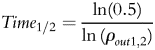 $Time_{1/2} = \displaystyle{{{\rm ln}\lpar {0.5} \rpar } \over {\ln \lpar {\rho_{out1,2}} \rpar }}$, where ρ out1 = 1 + α out1 for the borrowers’ response and ρ out2 = 1 − α out2 for the lenders’.
III
As mentioned, the price currents were printed and circulated to provide information about the condition of the market from the late sixteenth century onwards. Information about current rates of exchange was reproduced and spread in the form of handwritten notes and correspondence. Additionally, contemporary mercantile handbooks provided quotations of exchange rates as illustrative examples. These are the archival sources from which exchange rate quotations can be extracted, but the surviving documents vary in time, place and type (Flandreau et al. Reference Flandreau, Galimard, Jobst and Nogues-Marco2009b). The printed price current is the most preferable source, as it presents the market price. However, the surviving printed price currents issued in the seventeenth century are too fragmentary to produce a continuous series of exchange rates, therefore exchange rates of the seventeenth century also have to be drawn from commercial correspondence. Contrary to the printed currents, which provide a comprehensive list of quotations, the exchange rates recorded in correspondence were confined to the extent of the merchants’ personal trade interests and financial networks concerned. Nevertheless, Amsterdam, London, Paris and Venice, as hubs of the exchange network, tended to be quoted in correspondence. This article relies mainly on exchange rates listed in private correspondence, supplemented by surviving printed price currents, to construct weekly series of exchange rates between northwestern European cities in the late seventeenth century.
A large number of the exchange rates used here come from the Marescoe-David correspondence with the firm's agents in Europe.Footnote 7 Charles Marescoe was a Lille-born merchant living in London, whose business focused mainly on the import of pitch, tar, iron and copper from Sweden; he also acted as a commission agent on behalf of many European principals to purchase various English goods for export. After his death in 1670 his widow, Leonora Marescoe, continued her late husband's trading business, joining with a new partner, Jacob David, who had worked as a clerk for Charles Marescoe. The Marescoe-David papers contain a variety of items: journals, ledgers, account books, more than 10,000 letters from clients and agents abroad, and a huge number of miscellaneous documents.Footnote 8 In addition to the Marescoe-David letters, the correspondence of William Attwood, a London merchant, with his agents in Hamburg and the United Provinces also provides some quotations of exchange rates between London and European cities in the years 1655–82.Footnote 9
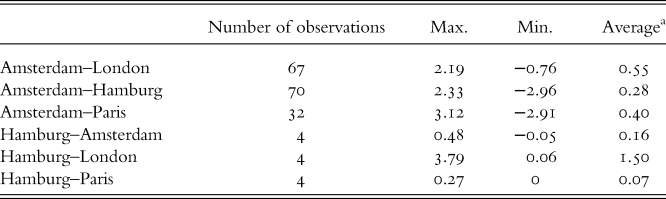
How reliable are the exchange rates recorded in the correspondence of a couple of merchants? How well can they be regarded as market prices? One way to examine the representativeness of these quotations is to compare them with those appearing on price currents, which are taken as market prices. Though fragmentary, a few price currents issued in Amsterdam and Hamburg in the 1670s have been preserved. Since price currents were issued once or twice a week, the exchange rates quoted in the letters written within three days of the date of issue of the price currents are used to calculate the percentage of deviations. This approach implies that (1) price currents consolidated the prevalent exchange rates of the three days up to their publication and (2) when reporting current exchange rates, merchants were inclined to quote those on price currents within three days of their publication. Since price currents acted as an indication of the general market situation, the two assumptions can reasonably be accepted.
The result of the comparison is given in Table 1. The average deviation, in absolute terms, of the exchange rates quoted in commercial letters from those listed on price currents ranges between 0.07 and 1.50 per cent. The deviation is quite modest. Although deviations as large as 3.79 per cent can be observed (Hamburg on London exchange rate of 12 December 1676), most of the deviations are well below 0.5 per cent. Moreover, instead of being consistently higher or lower, the exchange rates quoted in the correspondence fluctuated up and down the range of those listed on price currents; there was no structural difference between these two exchange rates. It seems acceptable to regard the exchange rates quoted in commercial letters as market prices, even though wide deviations very occasionally occur.
The deviation of exchange rates quoted in correspondence from those listed in price currents (%), 1668–80

aThe average is calculated on the absolute value.
Sources: Marescoe-David correspondence (C114/63 78), the National Archives, London; Attwood's papers (C109/19 24), the National Archives, London; Amsterdam's price currents 1. SP119/973 992, 997 998, the National Archives, London; 2. ARCH01080 and ARCH04174, Nederlandsch Economisch-Historisch Archief, Amsterdam; 3. N18.76/01-34, Stadsarchief, Amsterdam; 4. 23572006, Kungliga Biblioteket, Stockholm.
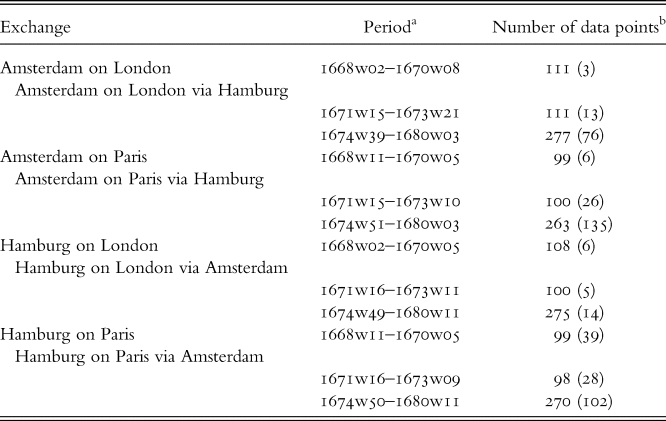
Considering the completeness and continuity of the exchange rates series, the following analysis focuses on the exchange markets of Amsterdam, Hamburg, London and Paris. Overall, the Marescoe-David correspondence recorded 658 exchange rate quotations in Amsterdam on London (Amsterdam–London), 411 Amsterdam on Hamburg, 392 Amsterdam on Paris, 1,072 Hamburg on Amsterdam, 1,276 Hamburg on London, and 938 Hamburg on Paris in the years 1668–80. Attwood's correspondence provided another 274 quotations in Hamburg on London in the years 1657–82. This high frequency of data helps to mitigate the problems of time aggregation and subsequent mis-estimation, and allows for estimation with greater precision (Federico Reference Federico2012; Brunt and Cannon Reference Brunt and Cannon2014). Considering the number and distribution of observations, the series of exchange rates with weekly frequency is constructed for the period 1668–80.Footnote 10 The weekly exchange rate is comparable to the data frequency used in measuring market integration in the eighteenth and nineteenth centuries. Apart from some irregular missing data, there are two large data lacunae for the years 1672 and 1673–4. The weekly exchange rate series are thus divided into three subperiods as shown in Table 2.
The three subperiods of exchange arbitrage

a1668w2–1670w8 reads as the period covered from 1668 week 2 to 1670 week 8, and so on. bThe cardinal spline interpolation is employed to calculate the irregular missing data points, and the total number of missing data within each subperiod is presented in brackets.
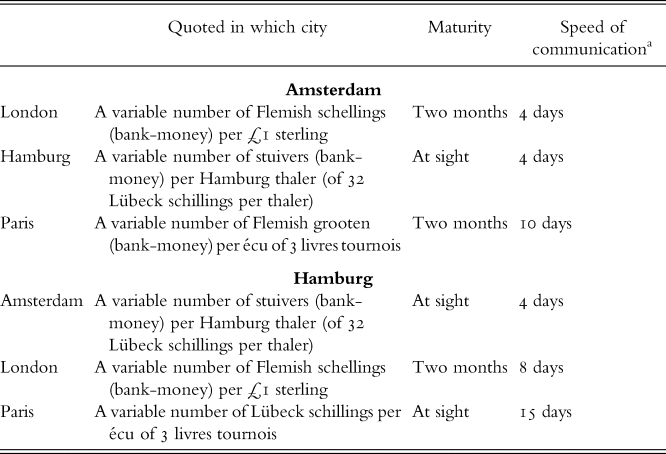
The method of exchange quotation and the maturity of a bill are reported in Table 3. As shown, exchange rates were quoted with two maturities: at sight and at two months’ usance. The difference between the exchange rate payable at sight and that payable in two months is the interest forgone over those two months. Exchange rates payable in two months can be converted into sight exchange rates by removing the two months’ interest. Some price currents were issued with exchange rates quoted at two maturities (Amsterdam, London and Paris), and the shadow interest rate can thus be calculated (Flandreau et al. Reference Flandreau, Galimard, Jobst, Nogues-Marco, Atack and Neal2009a). Considering the shadow interest rate is not available for each year, the average shadow interest rate is used to convert exchange rates quoted for two months’ usance into sight exchange rates.Footnote 11
The method of exchange quotation in Amsterdam and Hamburg

aThe speed of communication is estimated based on (a) the Marescoe-David correspondence; (b) the fact that postal traffic between Hamburg and London had to pass through Amsterdam; (c) the assumption that the average distance covered by a courier in the seventeenth century was 30 miles a day.
Source: Roseveare (Reference Roseveare1987), pp. 592–4.
Based on the available direct exchange rates, there are four series of cross-exchange rates calculated using the following formula:
 $$E_t^{HAL} = \displaystyle{{E_{t-1}^{AL}} \over {E_t^{HA}}} *32\eqno \lpar4{\rm a}\rpar$$
 $$E_t^{AHL} = \displaystyle{{E_{t-1}^{HL}} \over {32}}*E_t^{AH} \eqno \lpar4{\rm b}\rpar$$
 $$E_t^{AHP} = \displaystyle{{E_{t-1}^{HP}} \over {32}}*E_t^{AH} *2\eqno \lpar4{\rm c}\rpar$$
 $$E_t^{HAP} = \displaystyle{{E_{t-1}^{AP}} \over {2*E_t^{HA}}} *32\eqno \lpar4{\rm d}\rpar$$
where E AL, E AH, E AP, E HL, E HA, E HP, E AHL, E AHP, E HAL and E HAP are designated as the Amsterdam–London, Amsterdam–Hamburg, Amsterdam–Paris, Hamburg–London, Hamburg–Amsterdam, Hamburg–Paris, Amsterdam–Hamburg–London, Amsterdam–Hamburg–Paris, Hamburg–Amsterdam–London and Hamburg–Amsterdam–Paris exchange rates, respectively. As the communication time between these cities was about a week, the calculation of cross-exchange rates is based on the exchange rates of the third city quoted in the previous week in order to account for information delays.
IV
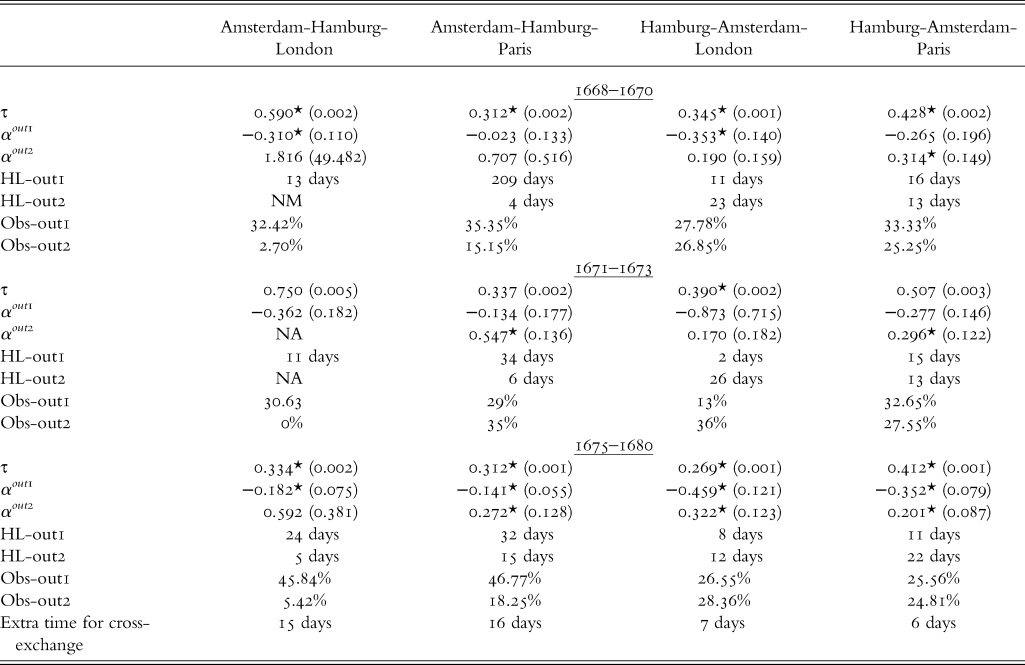
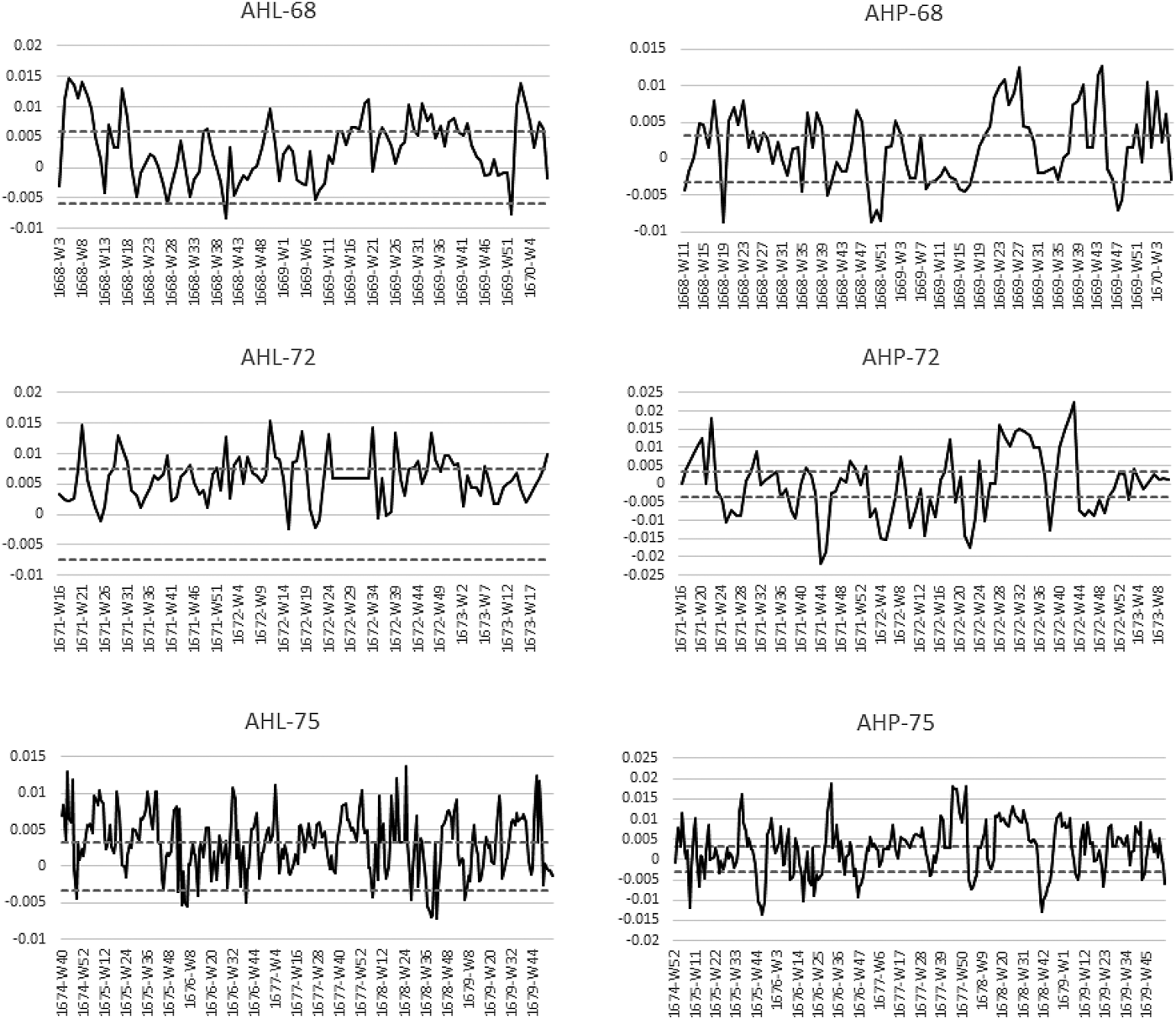
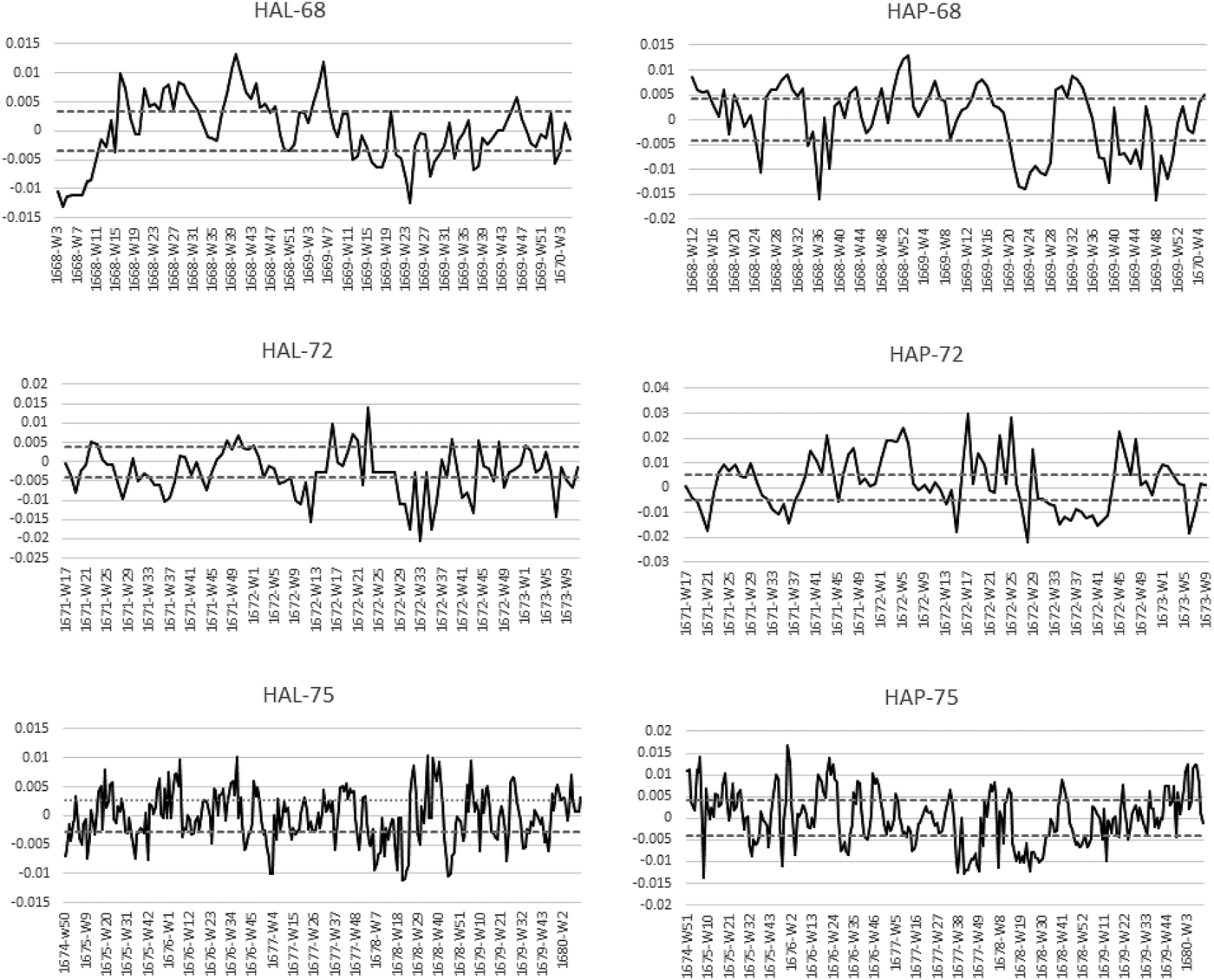
If arbitrage is in operation, shocks should not have a long-term effect on exchange rates, and differences between direct- and cross-exchange rates should eventually return to the band of transaction costs. This implies a stationary process of exchange rate differences. The hypotheses of unit root and stationarity have been tested, and the results indicate that the exchange rate differences are stationary. Hence, the threshold model can be applied to estimate the degree of integration in seventeenth-century exchange markets.Footnote 12 The results of estimated transaction costs and the speeds of adjustment for the triangular exchange arbitrage in the three subperiods are summarised in Table 4. The exchange rate difference and the estimated threshold are presented in Figures 1 and 2. Overall, they indicate that exchange markets in the 1670s were integrated and arbitrage worked effectively.
Estimation results for the three subperiods

Note: τ is presented as a percentage. The standard error is given in brackets. NA denotes that the estimation results are not available because of the characteristics of the time series. NM denotes non-mean-reverting. HL-out1 and HL-out2 denote the half-life of arbitrage responding to the upper and lower band of transaction costs in terms of days, respectively. Obs-out1 and Obs-out2 denote the number of observations outside the upper and lower band of transaction costs in terms of percentage of total observations. The extra time for cross-exchange incorporates (1) one week allowing the first bill being paid and the second bill being drawn and (2) the speed of communication reported in Table 3. * denotes statistical significance at least at 5%.
The movement of exchange rate differences between Amsterdam, London and Paris via Hamburg

The movement of exchange rate differences between Hamburg, London and Paris via Amsterdam

Through the correspondence from trading partners cross Europe, merchants regularly received information about the current state of foreign markets and course of exchange rates, enabling them to form expectations about the movement of exchange rates, and calculate the potential arbitrage profit. According to contemporary mercantile guidebooks, the foreign exchange brokerage fee was 0.15 to 0.25 per cent in Amsterdam, and probably similar in other cities.Footnote 13 Another important element of the transaction cost of exchange arbitrage was the interest forgone. As shown in Tables 3 and 4, the direct exchange took one to two weeks and cross-exchange required another one to two weeks to complete arbitrage. The annual shadow interest rate, on average, is calculated at 4.63 per cent. Therefore, the interest forgone for direct exchange was 0.09 to 0.18 per cent, and 0.27 to 0.36 per cent for cross-exchange. Together with the brokerage fee, the transaction cost for direct-exchange ranged from 0.17 to 0.31 per cent, and 0.42 to 0.61 per cent for cross-exchange.
The estimated thresholds to trigger exchange arbitrage accord with the empirical evidence of transaction cost. The slightly higher transaction costs during the crisis years reflect the greater risk premium since Amsterdam was so close to falling to the invading French in the summer of 1672. Although the conflict did not end until 1678, transaction costs returned to their pre-war levels in the second half of the 1670s, once peace was concluded with England, the survival of the Republic was ensured, and most of the continuous fighting shifted outside the Republic.
In the seventeenth century, Amsterdam was the centre of information in northern Europe, with its advantage strengthened by a bilateral agreement with Hamburg requiring all mail from Holland and England to and from Hamburg to pass through Amsterdam.Footnote 14 Amsterdam serving as a relay for postal traffic gave any cross-exchange via Amsterdam a great advantage in communication. For example, no matter whether direct- or cross-exchange, Hamburg–London bills of exchange had to pass through Amsterdam, thus losing very little time in communication associated with cross-exchange via Amsterdam. On the other hand, the Amsterdam–London cross-exchange via Hamburg required a longer time for communication – the first bill had to be sent to Hamburg and the second one had to return to Amsterdam before continuing to London. The extra time for cross-exchange initiated in Hamburg was half of that initiated in Amsterdam (as shown in Table 4). Speedy communication incurs less opportunity cost, consequently, the transaction costs of cross-exchange via Amsterdam were low, but via Hamburg they were high. However, the information advantage enjoyed by Amsterdam seems to disappear in the case of Paris being the destination city.
Nevertheless, it is not surprising that the transaction costs of exchange triangular arbitrage increased for the years 1671–3. In this period, Amsterdam's advantages in postal traffic disappeared in the face of the French military advance. The disruption to traffic passing through Amsterdam was concisely described in one letter sent from Hamburg to London: ‘this one [letter] is going through Antwerp because it seems quicker and we have today safely received yours … by the same route’.Footnote 15 As soon as the immediate effects of war abated, Amsterdam's status as the information centre for northern Europe resumed, which is visible in the relatively low transaction costs of cross-exchange via Amsterdam in 1675–80.
Although the transaction cost of arbitrage exhibits a downward trend between the sixteenth (4 per cent) and nineteenth centuries (0.5 per cent), the transaction cost of arbitrage estimated in this article is relatively low compared to that available in the existing literature (Nogues-Marco Reference Nogues-Marco2013, pp. 21–3; Li Reference Li2015, p. 1219; Bignon et al. Reference Bignon, Chen and Ugolini2017, pp. 29–35; Nogues-Marco et al. Reference Nogues-Marco, Herranz-Loncán and Aslandinis2017). As pointed out earlier, this article considers arbitrage based on triangular exchange rather than shipping bullion: the transaction cost includes brokerage fee and opportunity cost in the former case, but brokerage fee, charges for loading and unloading, insurance, freight and opportunity costs in the latter case. The comparison confirms that arbitrage on shipping bullion was more expensive, and thus shipping bullion was most likely carried out only when very profitable, or when alternative arbitrage was not available.
Regardless of the destination city, London or Paris, triangular exchange arbitrage reveals a similar speed of adjustment. Overall, the speed of adjustment, in terms of half-life time, is estimated to have been between one and three weeks in the late seventeenth century. Does this tell us anything about how effective exchange arbitrage was at the time? The operation of arbitrage included two main elements: (1) discovering profitable arbitrage opportunities and (2) acting upon recognised opportunities; both relying heavily on the flow of information. Information on direct-exchange rates can be obtained in the home city, but the calculation of cross-exchange rates requires information about the exchange rates between the third city and the destination city. Furthermore, because of the communication time factor, whether or not to act upon an arbitrage opportunity was also influenced by the expectation of the future movement of exchange rates between t o when the arbitrage occurred and t i when the arbitrage was completed. If the exchange rates had been expected to change greatly (to offset the exchange difference), merchants would have not carried out cross-exchange arbitrage, even when presented with a profitable arbitrage opportunity.
Therefore, the efficiency of arbitrage has to be judged by comparing the estimated speed of adjustment with contemporary communication. An information network based on a credit nexus was established during the seventeenth century, enabling merchants to operate arbitrage in international capital markets.Footnote 16 As illustrated by the Marescoe-David letters, merchants received the latest foreign exchange rates on a regular basis. Since the 1660s a regular packet-boat system (twice a week) had begun to travel between London and Amsterdam. The travelling time was approximately three to six days, depending on the weather.Footnote 17 It was customary to record a letter's sent date and receipt date on the cover. Therefore, the speed of communication, listed in Table 3, can be calculated from mercantile correspondence. The comparison suggests that exchange markets in late seventeenth-century northern Europe were already well integrated, with arbitrage working effectively to exploit profitable opportunities.
The existing literature observes that war had a heavy impact on market efficiency and integration.Footnote 18 The proximity of the French army and Amsterdam's miserable prospects manifested themselves in a sudden plunge in exchange rates of Dutch money in 1672. During that summer the exchange rate of Dutch money depreciated by 7 per cent in Hamburg and 4 per cent in Rouen, but remained relatively stable in Venice. In the autumn, as soon as the danger abated, exchange rates returned to their pre-summer levels. Faced with high transport costs and uncertainty, the transaction cost rose during the crisis years. In other words, arbitrage profit had to be sufficiently large to compensate for the risk of taking cross-exchange. Once arbitrage profit was larger than transaction cost, arbitrage was carried out at the same level of efficiency as in the non-crisis years. By and large, the speed of adjustment remained at the same level over the years 1668–80; the disruptive effect of warfare was reflected in the higher level of transaction cost but not the speed of adjustment.
The disruptive effect on international exchange arbitrage was only temporary and to a limited degree. Markets were very resilient. As soon as the imminent danger was removed and the situation improved, transaction costs returned to their pre-war levels. Although merchants still had to face intermittent conflicts and the interruption of trade routes in the years 1675–80, the speed of adjustment, within a range of one to three weeks, was consistent with the speed of communication. Overall, in the second half of the seventeenth century, the exchange markets of northwestern Europe, based on correspondence networks, were well integrated.
V
By using weekly exchange rates, this article shows that triangular exchange arbitrage of the 1670s operated effectively and exchange markets in northwestern Europe were well integrated. The transaction cost measures the level of price convergence, and speed of adjustment indicates the efficiency of markets responding to shocks. Though relatively lower than arbitrage on shipping bullion, the estimated threshold to trigger arbitrage, ranging between 0.3 and 0.7 per cent, was in accordance with empirical evidence of brokerage fees and interest rates. The speed of adjustment, in terms of half-life, is estimated to have been one to three weeks, which is consistent with the time needed to communicate information. Warfare increased transaction costs associated with arbitrage, but arbitrage operated at the same level of market efficiency.
The other finding of this article is that shadow rates of interest implied in exchange rates exhibited a downward trend from 10–14 per cent annually in the mid sixteenth century to 4.6 per cent in the late seventeenth century.Footnote 19 Because the shadow rate of interest is derived from exchange rates, the fall suggests that the financial innovations introduced at the turn of the seventeenth century greatly increased the use of bills of exchange and significantly reduced the cost and risk involved in exchange dealings.
The study of market integration based on exchange rates sheds light on our understanding of the degree of integration in the late seventeenth century, hitherto only speculatively based on qualitative evidence. Bills of exchange functioned as instruments of credit and an easy way to transfer funds between distant places. Integrated exchange markets can greatly facilitate the international flow of capital and allocate resources to the places where they are most needed. Consequently, with the help of integrated exchange markets, regardless of their economic and political background, merchants occupied in foreign trade could borrow efficiently to finance commercial ventures in distant places, and adjust to shocks effectively by moving capital around. Credit, as the bloodstream of commerce, would thus flow to the most profitable investment opportunity and European commerce accordingly progressed.