Country background
Cambodia, a Southeast Asian country, is a constitutional monarchy with a $7 billion GDP (constant 2000 US$) and 14 million inhabitants resulting in $500 GDP per capita (constant 2000 US$). Agriculture uses 75% of the labour force (80% of population is rural) and represents 40% of GDP.
Introduction
Cambodia's experience with HPAI after it was discovered on a farm outside Phnom Penh in January 2004 reveals important aspects of how a developing country, with limited resources and capabilities, responds to crises with global public health implications, and how this global response in turn affected Cambodia. Cambodian authorities were successful in capturing a large share of funds because Western donors were keen on reducing pandemic potential at the source after media outlets revealed Cambodia's notoriously weak health infrastructure, or lack thereof. This influx of resources resulted in at least 15 implementing agencies executing $22 million to combat avian influenza across four areas: Animal Health; Human Health; Information, Education, and Communication; and Pandemic Preparedness. This article is a section summary of a larger, multidimensional study (Ear, Reference EAR2009) conducted in Cambodia during 2008 that looked at the political economy of avian influenza in Cambodia. The findings suggest that livelihood issues were overlooked in Cambodia owing to the low priority ranking assigned to agriculture, aid dependence combined with low tax revenues, a historic disregard for people's livelihoods, an upcoming election for which bad publicity from HPAI would erode confidence in the ruling party, and an overall lack of purposeful guidance.
How do social researchers look into livelihood issues in developing countries?
To approach this topic in the most comprehensive manner, a literature review was conducted to collect all pertinent, relevant and useful information. Search words like ‘Cambodia’, ‘livelihoods’, and ‘avian influenza’ were used. Also, considering that extensive research on pro-poor livestock policy and political economy in Cambodia had earlier been completed (Ear, Reference EAR2005; Reference EAR2007), many documents from institutions like FAO, WHO, OIE, ASEAN, ADB and the World Bank were used to complement these online searches. Wiegers (Reference WIEGERS2008) provides a much more general and detailed review of the many linkages between avian influenza, gender and smallholder poultry in developing countries seen strictly through a livelihood lens. Additionally, a qualitative research methodology consisting of mostly one-on-one semi-structured interviews across government, the private and non-governmental sectors was used. More than forty interviews were conducted in Khmer, French, and English primarily in the capital city and the environs, with field visits to the provinces of Kampong Som and Kampong Speu. An online 14-question elite survey was launched in May 2008 targeting individuals known to be deeply involved in avian influenza work in Cambodia (17 out 44 survey visitors completed the entire online survey). Respondents were requested to answer using a Likert scale and to add written comments.
What narratives, discourses and arguments arise in relation to livelihoods in Cambodia?
From literature reviews – a 36 village survey carried out in central Cambodia points out that it is difficult for rural smallholders to escape from raising poultry as part of their livelihoods as this activity is mainly a source of food, not money (CEDAC, 2007). In fact, seasonal poultry losses are expected and therefore accounted into their risk constructs. Their birds are more frequently afflicted with Newcastle disease, which is seen as something quite similar to avian influenza symptoms – confusion between these two diseases arises, resulting in dissonant bio-scientific categories (Hickler, Reference HICKLER2007). Low risk perceptions translate into high-risk practices such as preparation of dead or moribund poultry for household consumption and handling sick birds without personal protective equipment, however, substantial variation in the frequency of different practices and thus the potential risk of transmission of H5N1 from poultry to humans is not uniform across age and gender (Van Kerkhove et al., Reference VAN KERKHOVE, LY, HOLL, GUITIAN, MANGTANI, GHANI and VONG2008). This reinforces earlier findings that lasting behaviour changes involve comprehensive and multidisciplinary interventions, which combine risk perception communication with feasible and practical recommendations that include economic considerations (Ly et al., Reference LY, VAN KERKHOVE, HOLL, FROEHLICH and VONG2007). A more recent study conducted in northern Cambodia ascertained that the poor and poorest rural farmers are not directly or seriously affected by avian influenza outbreaks because these households depend much more on selling their labour for farming or non-farming (garments and construction) activities (CENTDOR, 2008). However these fast poultry income estimates may underestimate the importance of poultry to livelihoods as they do not take into account to whom within the household this income accrues (Burgos et al., Reference BURGOS, HINRICHS, OTTE, PFEIFFER, ROLAND-HOLST, SCHWABENBAUER and THIEME2008). The overzealous response to avian influenza in comparison to other livelihood-disrupting diseases, such as dengue fever, has generated scathing criticism from locally-based human health practitioners who rightly claim that “bird flu is a threat to the Western world, so they pour money and commitment into that … But dengue? There's no threat to the United States or Europe so nobody's interested” (Richner, Reference RICHNER2007).
From semi-structured interviews – different issues were raised by interviewees depending on their respective expertise and professional background; however, two main issues seem to dominate their narratives and responses. These were related to:
1) Detrimental disease mitigation measures – from the proposed portfolio of mitigation measures, uncompensated culling is the most damaging to livelihoods given the country's level of poverty (circa 35%). Birds are physical assets that can be easily converted into food or cash depending on needs. Loss of assets thus affects nutrition and income. Lack of monetary compensation for birds culled is widely considered, from the perspective of those whose livelihoods depend partially or totally on poultry, as a catastrophic intervention. Respondents felt that poverty and livelihoods had been subsumed into HPAI policy without having been made explicitly part of policy goals. Regrettably, donors too are motivated by concerns other than protecting livelihoods (Burgos et al., Reference BURGOS, HINRICHS, OTTE, PFEIFFER, ROLAND-HOLST, SCHWABENBAUER and THIEME2008; Ear, Reference EAR2009).
2) Lack of impact mitigation options – this comes as no surprise given Cambodia's low tax revenue base and refusal to compensate when culling suspected poultry flocks. The lack of a social protection system (Chan and Ear, Reference CHAN and EAR2004) and absence of a systematic approach to deal with critical emergencies, notwithstanding the existence of a National Committee for Disaster Management, exacerbate an already poor situation. Furthermore, institutional failures are evident through slow, largely deficient, under-staffed and under-funded human and animal health departments. Rural farmers are not only marginally placed in current development agendas, but are also handicapped by missing aid and rehabilitation alternatives such as soft loans, low interest rates, technical assistance, and restocking schemes (Ear, Reference EAR2005; Reference EAR2009).
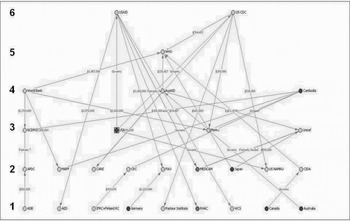
From elite surveys – in order to select elite respondents, there was an urgent need to know who the actors are? Which are their links and networks? What interests are they representing?
Figure 1 shows a plethora of actors, networks and many economic links among them by degree node.
Representative map of actors, networks and interests linked to avian flu in Cambodia by degree nodes.

Once respondents were carefully selected, a series of questions were laid out for them to rate according to a predefined scale. Two questions will be herewith discussed in detail.
question No. 1
With respect to avian influenza, the Royal Government of Cambodia has intervened effectively and appropriately, given resource allocations?13650

Only 33 percent of respondents (N=4) agreed or strongly agreed that the government intervened effectively and appropriately to protect livelihoods. Some explanatory comments include: “Nothing is done for livelihoods of smallholders”, “I am not aware of specific livelihood interventions”, “suspected cases were not being investigated”, “good strong coordination between government, NGOs and UN agencies ensured consistency in messages at local levels” and “there is no record of any discussions on compensation for poultry culls”. One quarter (N=3) of respondent chose “Not Applicable”.
question No. 2
With respect to avian influenza, donors have intervened effectively and appropriately, given resource allocations?

Here, donors were also dismally rated on protecting livelihoods, with 38 percent of respondents agreeing (N=5), and not one strongly agreeing that donors had intervened effectively and appropriately to protect livelihoods. It seems that donors assume that livelihoods, as so often happens with ‘gender’, can be ‘mainstreamed away’.
Key messages emerging from literature, interviews and surveys
The abovementioned results suggest that there is a non-alignment of interests among the government, donors, implementing agencies and rural smallholder farmers that have important implications for effectiveness of disease mitigation measures and livelihood impact. Many internationally-led and government-mandated disease control measures were implemented under emergency mode without a guiding compass indicating a clear path under highly uncertain circumstances. Although it is acknowledged that immediate action needs to take place to halt disease spread, it is now evident that significantly less emphasis was consequently placed on assessing the efficacy of risk reduction measures, including their effects on the livelihoods of smallholder farmers and their families. Combined with a Royal Government of Cambodia policy not to compensate for culling suspected poultry, this lack of emphasis on livelihoods has resulted in mistrust of the government, avoidance to report outbreaks, discovery of human victims before poultry outbreaks are detected, low risk perceptions, risky behaviours, confusion, and outright disregard of animal and public health efforts. It is now clear that when dealing with zoonoses, protecting livelihoods should not be assumed, but made explicit in the form of pro-poor impact mitigation measures beginning with a policy to compensate farmers whose poultry must be culled.
Selected remarks on the political economy of avian flu in Cambodia
Politically, Cambodia is characterised as a weak state with poor governance, plagued with institutional failures that are exacerbated by strong patronage politics and power monopolies. An historical top-down approach in decision-making processes stymies personal initiatives and pro-activity, and ignites inter-ministerial conflicts and discord.
Economically, it is a low-productivity labour-based agricultural country. Low wages, enormous tax incentives, and lack of regulation have attracted foreign direct investments into garment manufacturing and tourism. In turn, this has serious implications for authorities’ incentives to comply with reporting of outbreaks because of the negative publicity and potentially detrimental consequences derived from such events.
With respect to poultry, Cambodia has between 18 and 20 million birds mainly under traditional backyard production systems. These represent petty-cash compared to ruminants like cattle which are the savings accounts for major events like weddings or funerals (which happen infrequently). Small to medium enterprises service the urban markets of major cities such as Phnom Penh, Battambang, and Siem Reap. Throughout its territory, only 25 outbreaks of avian influenza have resulted in thirty thousand bird deaths, which roughly translates as $50,000 worth of direct asset losses, however, as described above, disease control measures have proved detrimental to livelihoods in the long term. In humans, eight cases have been confirmed positive, with seven fatalities. The eighth victim was discovered through sentinel testing of provincial hospital blood samples by the United States Naval Area Medical Research Unit Two (NAMRU-2). This, coupled with small outbreaks, has led to low risk perceptions and challenging behavioural changes. Cambodia is faced with a difficult surveillance and monitoring task as it engages in frequent cross border trade with Thailand, Viet Nam and Lao PDR. Targeted behavioural change communication programmes and public health campaigns in rural as well as urban settings may well prove in the end the most cost-effective strategies to deal with this complex transmissible animal disease.
Aid dependence has proven an effective and successful strategy for authorities. Not only do authorities vociferously clamour for a share of development funds to propel their nation into the global trading commons while in the process acting as gatekeepers, but they also have successfully managed to cleverly handle multilateral donors, international technical agencies and private organization to capture a non-trivial portion of animal and human influenza funds. As long as Western powers arrive with wads of money to pay, Cambodian authorities will be more than happy to play.
Conclusions
Livelihood issues were overlooked in Cambodia owing to the low priority ranking assigned to agriculture, aid dependence combined with low tax revenues, government manipulation of the media, a historic disregard for people's livelihoods, societal conformism, an upcoming election for which bad publicity from HPAI would erode confidence in the ruling party, lack of mechanisms to voice rural concerns, weak social cohesion, and an overall lack of purposeful guidance.
To begin to address these problems, we urge two policy actions. First, greater government-donor coordination and oversight is needed to align national and international interests. Second, protecting livelihoods cannot be assumed; it must be made explicit in the form of ‘pro-poor’ avian influenza risk reduction. Because 90 percent of poultry is raised in backyard villages, almost anything achieved with poultry (or livestock) can be considered pro-poor. The high cost of targeting the poor (to prevent leaks to the non-poor) is often raised as an issue in the developing world and elsewhere. Focusing assistance and development programs on livestock owners (including poultry) in Cambodia is a win-win proposition for poverty reduction and the protection of livelihoods.
However, ultimate responsibility for the success or failure of policies in Cambodia must rest with the Royal Government of Cambodia, for ownership of national development plans cannot be in the hands of donors. Poor governance and pervasive institutional failures have hindered disease mitigation responses in Cambodia. Effective responses and effective governance must go hand-in-hand. A rushed, emergency-oriented response to avian influenza may indeed have undermined already weak governance capacity in Cambodia, fuelling patronage networks and encouraging rent-seeking behaviours. Whether such funds have increased the ability of Cambodia—and the world—to prevent a future pandemic remains uncertain.
Acknowledgements
This paper would not have been possible without the STEPS Centre's ‘Avian flu: the politics and policy of a global response project’: http://www.steps-centre.org/ourresearch/avianflu.html, a core project within the Centre's epidemics research programme. The project was supported by the Food and Agriculture Organization of the United Nations’ Pro-Poor Livestock Policy Initiative, the UK Department for International Development-funded Pro-Poor Risk Reduction project and the ‘Livestock sector governance in developing countries’ project coordinated by Chatham House, London with support from DFID and the World Bank. Previous versions benefited from comments by Ian Scoones, Nicoline De Haan and anonymous peer reviewers. John La, Linda Tauch, Pete Pin, Vannarith Chheang, Sopheary Ou, and Chhorvivoinn Sumsethi provided excellent research assistance. Most of all, the authors are grateful to respondents and interviewees for their time and patience.