Introduction
Rice is the staple food crop for more than 65% of the population in China (Hsiaoping, Reference Hsiaoping, Toriyama, Heong and Hardy2005), and therefore, its production plays a pivotal role in ensuring national food security (Peng, Reference Peng2017). However, in recent years, urban expansion has led to a labour shortage and an increase in wages for agricultural production in China, which have been major problems confronting rice production in China (Peng et al., Reference Peng, Tang and Zou2009). To overcome this, several simplified cultivation technologies have been developed for rice production in China (Huang et al., Reference Huang, Ibrahim, Xia and Zou2011) and mechanised large-scale farming is a feasible way to utilise labour effectively. Under government guidance, farmland rental has increased in China, and a new class of farmers who obtain farmland on lease for large-scale farming has emerged (Kung, Reference Kung2002; Xia et al., Reference Xia, Xin and Ma2017). However, large-scale farming has caused some changes and led to challenges in crop production. For example, increases in time of farming operations (e.g. land preparation and seedling transplanting) often occur under large-scale farming conditions (Huang and Zou, Reference Huang and Zou2018), which can lead to delayed transplanting (DTP). Some studies have evaluated the effect of DTP on rice growth (Lampayan et al., Reference Lampayan, Faronilo, Tuong, Espiritu, De Dios, Bayot, Bueno and Hosen2015; Liu et al., Reference Liu, Zhou, Li and Xin2017), showing that DTP delayed growth stages in the main field and prolonged total growth duration (from sowing to maturity). However, there is little room to prolong growth duration in rice, especially in intensive cropping systems, because the current durations coincide with suitable seasons for growth (Mitchell and Sheehy, Reference Mitchell and Sheehy2006).
Double-season cropping using early- and late-season rice is a major intensive rice-based system in China (Zou, Reference Zou2011). For late-season rice, daily temperatures tend to decrease during the growing season in the main field (Huang et al., Reference Huang, Shan, Zhou, Chen, Cao, Jiang and Zou2018), and a delay in heading stage may result in low temperature stress at anthesis and induce spikelet sterility in rice (Zeng et al., Reference Zeng, Zhang, Xiang, Uphoff, Pan and Zhu2017). Here, we hypothesised that DTP may reduce spikelet filling and grain yield because of low temperature stress at anthesis in late-season rice in mechanised large-scale faming systems. To test this hypothesis, field experiments were carried out over 2 years to determine the effects of DTP on growth stages, growing-season temperature and yield attributes in two late-season rice cultivars under machine-transplanted conditions.
Materials and Methods
Field experiments were conducted in Yongan Town (28°09′N, 113°37′E, 43 m asl), Hunan Province, China, in the late rice-growing season in 2016 and 2017. The soil of the experimental field was clayey with the following properties: pH 5.85, 38.4 g kg−1 organic matter, 75.4 mg kg−1 available N, 12.8 mg kg−1 available P and 115 mg kg−1 available K. Soil tests were based on the samples collected from the upper 20 cm of soil, with standard practices used for soil assessment.
Two hybrid rice cultivars, Longjingyou 1212 and Taiyou 390, were grown under normal transplanting (NTP) with 15- to 20-day-old seedlings and DTP with 30-day-old seedlings. These two cultivars were selected because they are widely grown by rice farmers in the study region. The experiment was laid out in a randomised block design with three replications and a plot size of 30 m2.
Pre-germinated seeds were manually sown in seedling trays (58 × 23 cm) on June 25, 2016 and June 27, 2017, with a seed rate of 80 g tray−1. Seedlings were transplanted on July 15 and 25, 2016 and on July 12 and 27, 2017 for NTP and DTP, respectively. Transplanting was done at a hill spacing of 25 × 11 cm with 4–5 seedlings per hill, using a high-speed rice transplanter (PZ80-25, Dongfeng Iseki Agricultural Machinery Co., Ltd., Xiangyang, China). Nitrogen was applied in three splits: 75 kg N ha−1 as basal fertiliser 1 day before transplanting, 30 kg N ha−1 at early tillering (7 days after transplanting) and 45 kg N ha−1 at panicle initiation. Phosphorus (75 kg P2O5 ha−1) was applied as basal fertiliser. Potassium (150 kg K2O ha−1) was split equally at basal fertilisation and panicle initiation. The experimental field was kept flooded from transplanting until 7 days before maturity. Insects, diseases and weeds were intensively controlled by chemicals to avoid yield loss.
Daily mean temperature was monitored using a Vantage Pro2 automatic weather station (Davis Instruments Corp., Hayward, CA, USA). Heading stage was recorded as the day on which about 50% of panicles had emerged. Ten hills were sampled in each plot at maturity, when more than 90% of grains had lost their green colour. Plant samples were separated into straw and panicles. Panicle number was counted in each hill. Panicles were hand-threshed and the filled spikelets were separated from unfilled spikelets by submerging them in tap water. Three subsamples of 30 g of filled spikelets and all unfilled spikelets were taken to count the number of spikelets. Dry weight of filled grains was determined after oven-drying at 70 °C to a constant weight. Spikelet number per m2 and spikelet filling percentage were calculated. Grain yield was determined from a 5-m2 area in each plot and adjusted to the standard moisture content of 0.14 g H2O g−1.
Data were analysed by analysis of variance (Statistix 8.0, Analytical software, Tallahassee, FL, USA). Means of treatments (NTP and DTP) were compared based on the least significant difference test at the 0.05 probability level for each cultivar in each year.
Results and Discussion
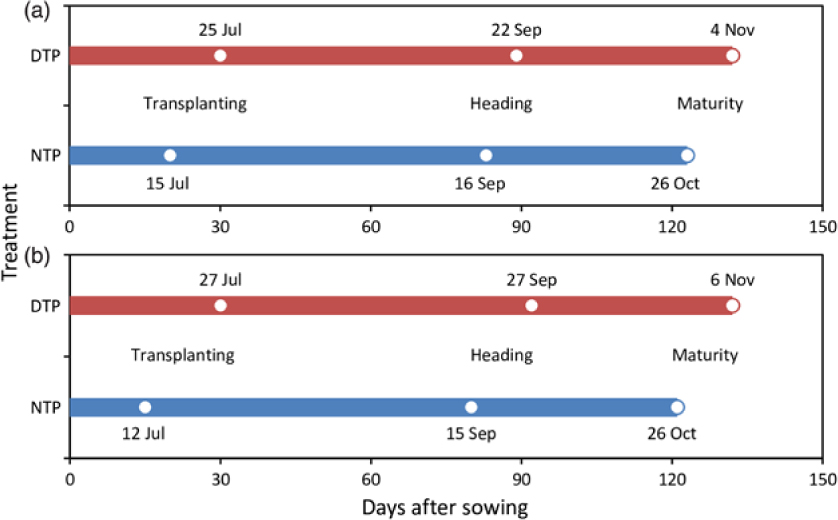
In 2016, a 10-day delay in transplanting of 20-day-old seedlings led to 6- and 9-day delays in heading and maturity stages, respectively (Figure 1a). In 2017, heading and maturity stages were delayed by 12 and 11 days, respectively, due to a 15-day delay in transplanting of 15-day-old seedlings (Figure 1b). These delays under DTP were higher than those reported by Liu et al. (Reference Liu, Zhou, Li and Xin2017), who observed that heading and maturity stages were delayed by only 2–3 days from a 10-day delay in transplanting of 25-day-old seedlings in machine-transplanted single-season rice (cv. Shengdao 19). It is suggested that delayed growth stages under DTP were attributed to a longer plant recovery time due to stronger stress of seedling competition during the seedling period and a more intense transplanting shock because of higher probability of root damage (Lampayan et al., Reference Lampayan, Faronilo, Tuong, Espiritu, De Dios, Bayot, Bueno and Hosen2015). Both aspects can be exacerbated by accelerated seedling growth under higher temperatures during the seedling period. This might be partially responsible for delaying growth stages under DTP in the late-season rice as compared to the single-season rice (Liu et al., Reference Liu, Zhou, Li and Xin2017), as temperatures during the seedling period are generally higher for late-season rice than for single-season rice. Our results also suggest that more attention should be paid to the response of late-season rice to DTP.
Growth stages in machine-transplanted late-season rice under NTP and DTP in 2016 (a) and 2017 (b).

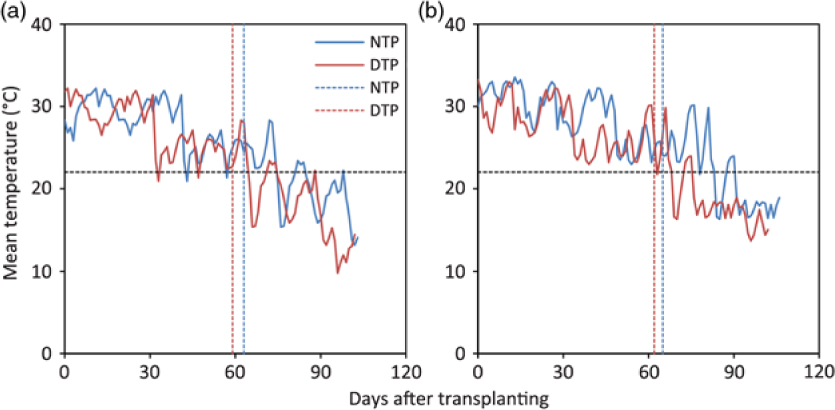
As a consequence of the different transplanting date and changes in growth stages, daily mean temperature during the growing season in the main field differed between DTP and NTP (Figure 2). For the pre-heading period, average daily mean temperature was 0.6 °C and 1.3 °C lower under DTP than NTP in 2016 (28.1 °C vs. 27.5 °C) and 2017 (29.1 °C vs. 27.8 °C), respectively. For the post-heading period, average daily mean temperature was lower under DTP than NTP by 2.1 °C in 2016 (20.6 °Cvs. 18.5 °C) and by 2.8 °C in 2017 (21.8 °C vs. 18.9 °C). In addition, the daily mean temperature was lower than 22 °C – the critical low temperature for anthesis in rice (Yoshida, Reference Yoshida1981) – at 6–10 days after heading in 2016 and at 1 day and 7–10 days after heading in 2017 under DTP. Daily mean temperature was higher than 22 °C during the first 10 days after heading under NTP in both years. These results indicate that DTP had a larger effect on average daily mean temperature during post-heading than during the pre-heading period, and low temperature stress occurred at anthesis under DTP.
Daily mean temperature during the rice-growing season under NTP and DTP in 2016 (a) and 2017 (b). Vertical dashed lines represent the heading stage. Horizontal dashed lines represent the critical low temperature for anthesis in rice (22 °C).

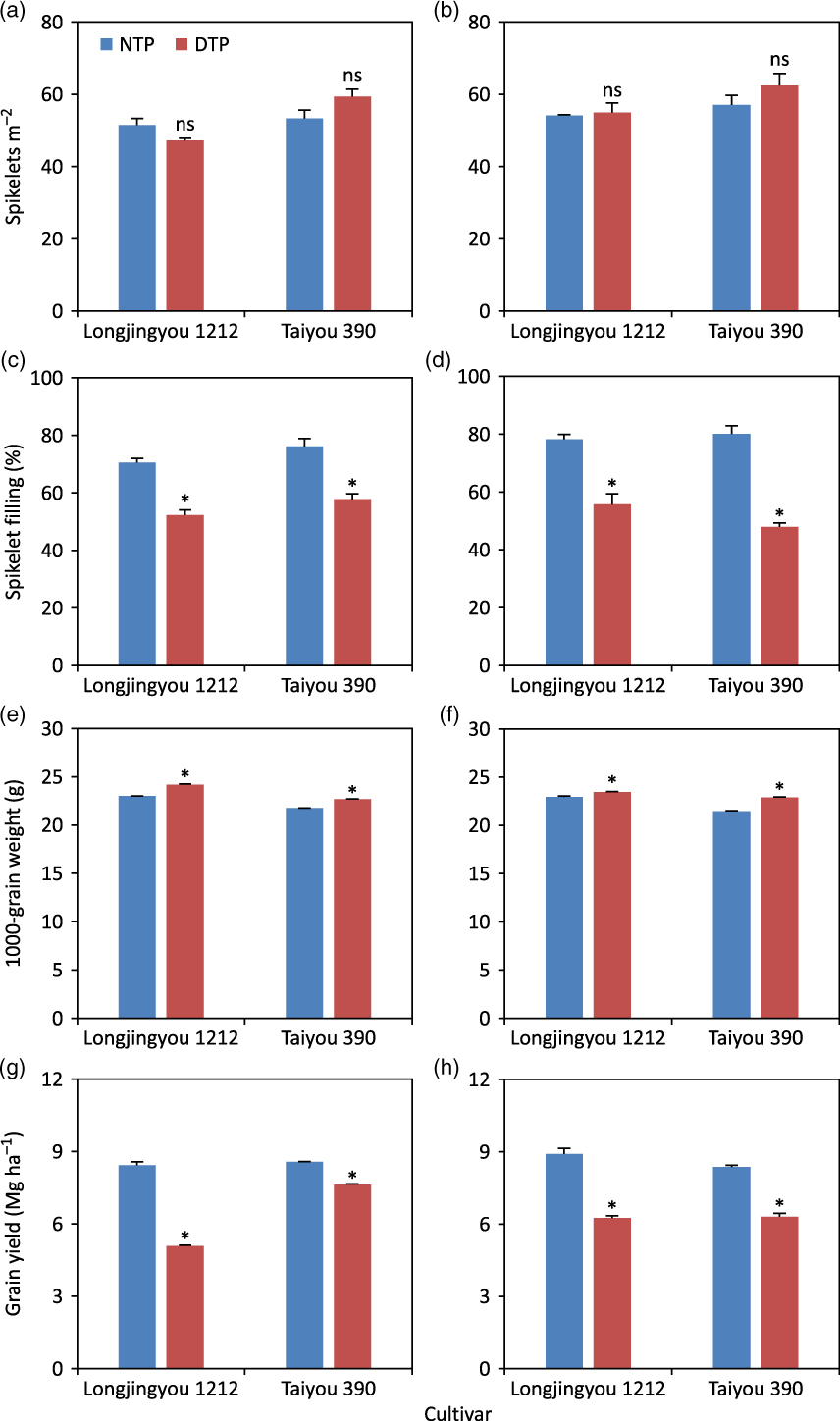
Consistent with the effect on the daily mean temperature, DTP had a more significant effect on spikelet filling and grain weight than on spikelets per m2 (Figure 3a–f). In particular, there was no significant difference in spikelets per m2 between DTP and NTP for Longjingyou 1212 or Taiyou 390. Spikelet filling was significantly lower (−23%) under DTP than under NTP for both cultivars in both years. Grain weight was slightly but significantly higher under DTP than under NTP for both cultivars in both years. Primarily due to the decreased spikelet filling, grain yield was significantly reduced under DTP compared to NTP for both cultivars in both years, showing an average reduction of 26%. These results confirm that DTP reduces spikelet filling and grain yield due to low temperature stress at anthesis in machine-transplanted late-season rice.
Yield attributes in machine-transplanted late-season rice under NTP and DTP in 2016 [(a), (c), (e) and (g)] and 2017 [(b), (d), (f) and (h)]. Data are means and SE (n = 3). ns and * denote non-significant and significant differences between NTP and DTP at the 0.05 probability level for each cultivar, respectively.

Concluding, a potential new problem brought by newly emerged mechanised large-scale farming in late-season rice production is delayed growth stages and an effective solution is the development of high-yielding short-duration rice cultivars. Rice yield can be increased by increasing biomass production and/or harvest index. However, because there is little scope to further increase harvest index, further improvement in rice yield depends on increasing biomass production (Peng et al., Reference Peng, Cassman, Virmani, Sheehy and Khush1999). Biomass production is the product of intercepted solar radiation by the canopy and radiation use efficiency (RUE), and the former is determined by incident solar radiation and intercepted percent. It is apparent that the incident solar radiation cannot be increased under shortened growth duration conditions. It is also difficult to increase the intercepted percent, because it depends on canopy architecture, which is close to the optimum in current high-yielding rice cultivars (Peng, Reference Peng, Sheehy, Mitchell and Hardy2000; Phyo and Chung, Reference Phyo and Chung2013). Increasing RUE may be the only way to achieve a substantial increase in grain yield in short-duration rice cultivars. RUE can be increased by increasing photosynthesis and/or decreasing respiration. However, large reductions in respiration are unlikely, so increasing photosynthesis is probably the only option for increasing RUE (Mitchell and Sheehy, Reference Mitchell and Sheehy2006). Therefore, to develop high-yielding short-duration rice cultivars, efforts should be made to increase photosynthesis in rice, whether from conventional breeding, biotechnology or both (Long, Reference Long2014). Although this research topic is not new, it has become more important and challenging under the scenario of rapid development of mechanised large-scale rice farming.
Author ORCIDs
Min Huang 0000-0002-6944-8538
Acknowledgements
This work was supported by the National Key R&D Program of China (2017YFD0301503) and the Earmarked Fund for China Agriculture Research System (CARS-01).