1. Introduction
This study investigates the labor market under increased automation of middle-skilled jobs with job mismatch possibilities for workers. A rapid increase in automation, especially for routine tasks, which suggests the replacement of middle-skilled workers by machines, has been observed (see Autor and Dorn, Reference Autor and Dorn2013; Autor, 2015; Cortes et al. Reference Cortes, Jaimovich and Siu2017; Graetz and Michaels, Reference Graetz and Michaels2017, Reference Graetz and Michaels2018; Acemoglu & Restrepo, Reference Acemoglu and Restrepo2020, Reference Acemoglu and Restrepo2022). According to OECD employment outlook for 2020, the share of employment for middle-skilled jobs has declined in developed economies over the past two decades. If a worker can adequately perform any middle-skilled job, given the wage gap between middle- and low-skilled labor, increased automation in middle-skilled jobs may not be important for job seeking. However, due to various specific skills required to perform middle-skilled tasks, workers are often proficient at certain tasks but not at other tasks. If the main tasks of a middle-skilled job are automated, then workers who are suitable for those tasks are not needed. It may be difficult for these workers who are replaced by machines to find jobs because their suitable tasks are performed by machines. It should be also noted that machines simultaneously perform tasks that are unsuitable for some workers. Because they are no longer assigned to those tasks, their job seeking may be less difficult.
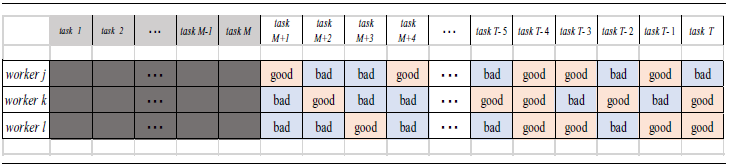
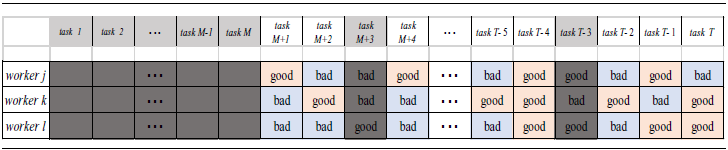
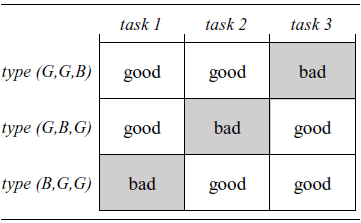
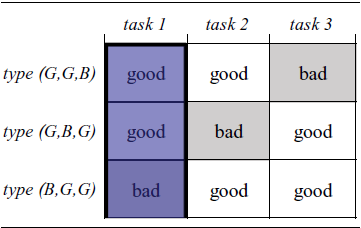
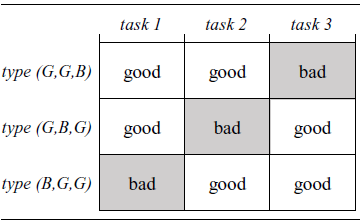
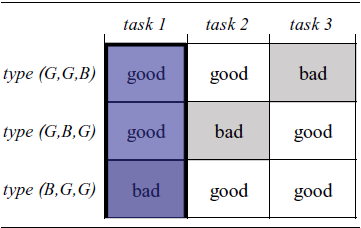
In the literature that examines the effects of automation on the labor market, little attention has been paid to worker suitability for tasks. Therefore, this study considers worker suitability for tasks. As a result of education or training, workers can execute some suitable middle-skilled tasks, although they may be unsuitable for other tasks. Due to the difference in their specialization areas, the suitability patterns can differ among them. Therefore, we examine the pattern of task suitability for a worker that represents which tasks are suitable and unsuitable for the worker. Table 1 illustrates the task suitability of three workers. The rows and columns in Table 1 correspond to these three workers and tasks, respectively. In this table, “good” and “bad” imply whether workers are able or unable, respectively, to perform each task appropriately. These three workers have the same number of suitable tasks. That is, their ability level is the same. As illustrated in the table, the three workers have different suitability patterns for tasks because these patterns depend on their specialization areas.Footnote 1 In Table 2, newly automated tasks are illustrated by the darker-shaded columns. These automated tasks are no longer available to workers. The number of suitable and unsuitable tasks covered by machines can vary among the three workers. Whether their job seeking is more or less difficult depends on their suitability for the remaining labor tasks.
Examples of workers’ suitability for middleskilled tasks

Under increased automation
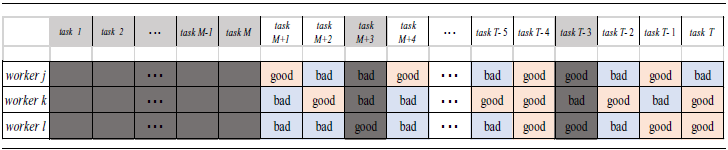
In the study, we have made two assumptions to examine the possibility of job mismatch. The first assumption is about the task suitability of a worker. Upon receiving an education, workers can be proficient at certain middle-skilled labor tasks. We consider workers with the same ability level, which implies the same number of suitable tasks. Due to the difference in their specialization areas, the suitability pattern for labor tasks can differ among them. A suitability pattern for labor tasks is assumed to be randomly assigned to a worker.Footnote 2 Therefore, under the law of large numbers, there is the same number of workers in each pattern of task suitability. In each of labor tasks, the number of workers who are suitable (unsuitable) for that task is the same. The second assumption regards the uncertainty about the matching between a job seeker and a firm. We consider that a firm does not know whether a job seeker is suitable or unsuitable for the firm’s task ex ante. Although a worker knows the worker’s suitability pattern for middle-skilled labor tasks, they know little about firms. Therefore, we assume a random matching between a worker and a firm.
The following three properties exist under these two assumptions. First, workers are equally exposed to a possible increase in automation. That is, we assume no bias effect of the increased automation on workers. Second, the distribution of their job mismatch probabilities is a mean-preserving spread under the increased automation. Third, even when there is diversity in their job mismatch probabilities, we can easily calculate the matching probability between a firm and a suitable worker.
The individual mismatch probability (IMP) of a worker is defined as the ratio of the number of their unsuitable middle-skilled tasks to the total number of middle-skilled labor tasks. If there is no increase in automation, then a worker’s IMP depends on the worker’s ability level, represented by the number of the worker’s unsuitable tasks, and the automation level. That is, the IMP value is the same among workers with the same ability level. Regarding low-skilled labor, we consider no uncertainty for low-skilled job matching because specific skills are not required.
In a two-period OLG model, workers work in two periods and have one job-seeking opportunity in each of those periods. We assume a rise in the efficiency of machines that increases automation. Under a rational expectation, workers make decisions about their education investment. The study demonstrates the following two effects of increased automation on workers.
The first effect is the diversity in the IMPs of workers with the same ability level. As a result of increased automation, the available labor tasks decline while newly automated tasks are performed by machines. These newly automated tasks include suitable and unsuitable tasks for a worker. If machines perform a worker’s suitable jobs more (or less) than the worker’s unsuitable jobs, then the worker’s job mismatch probability rises (or declines). That is, the individual effect of the increased automation on the IMP of a worker depends on the worker’s suitability for tasks. These individual effects cancel each other out among workers because of the two assumptions concerning workers’ suitability for tasks and the random matching between a job seeker and a firm. That is, there is no aggregate effect of the diversity in their IMPs on the labor market in the period of increased automation. In the subsequent period, a large number of workers who have larger IMPs remain job seekers. This makes the matching between a firm and a suitable worker more difficult due to a relatively large number of unsuitable workers. Consequently, there is an aggregate effect on the labor market, which implies a rise in underemployment.Footnote 3 The second effect is the possibility of replacement by machines. Workers who engage in tasks that will be newly automated cannot avoid being replaced by machines, because they do not know which tasks will be automated. Although they seek new middle-skilled jobs, some of them will be unable to find a new middle-skilled job due to job mismatch. Therefore, underemployment rises because of these two effects.
The remainder of this paper is structured as follows. Section 2 explains the related literature. Section 3 examines an economy under no increase in automation. Section 4 explores the equilibrium under an increase in automation. Section 5 considers workers with the difference in their ability levels, and Section 6 concludes the paper. The Appendix presents the proofs.
2. Related literature
This study is related to the following three types of studies. The first is research that explores the effect of automation on the labor market by using task-based models. Several studies have identified the following two opposing effects: a decline in the demand for labor that is directly caused by automation and a rise in the demand for labor induced by automation. Regarding the positive effect of automation, Zeira (Reference Zeira1998) considered a greater input of capital due to a rise in the capital’s marginal product. Acemoglu (Reference Acemoglu2010) generalized this type of technical change as “labor-saving technologies.” Several studies have explored the different mechanisms that lead new task creation to increase the demand for labor (Acemoglu and Restrepo, Reference Acemoglu and Restrepo2018; Hemous & Olsen, Reference Hemous and Olsen2022; Nakamura & Zeira, Reference Nakamura and Zeira2018). Alvarez et al. (Reference Alvarez, Gomez, Zuleta and Acosta2019) studied the possible effects of labor-saving innovations on birth rates and, in this way, on future labor supply. The novelty of this study is to consider worker suitability for tasks when examining the individual effect of increased automation on a worker. We demonstrate the diversity in their IMPs due to the increased automation. We also explore the aggregate effect on the labor market through these individual effects.
The second type of related study is underemployment research. In many developed economies, underemployment is becoming a social problem (Allen and van der Velden, Reference Allen and van der Velden2001; Dooley and Prause, Reference Dooley and Prause2004; Flisi et al. Reference Flisi, Goglio, Meroni, Rodrigues and Vera-Toscano2017; Bell and Blanchflower, Reference Bell and Blanchflower2018; Barnichon and Fylberberg, Reference Barnichon and Fylberberg2019). One possible cause of underemployment is a change in the job market due to technological change, including automation (Marco and Steijn, Reference Marco and Steijn2000; Mendes et al., Reference Mendes de Oliveira, Santos and Kiker2000; Caroleo and Pastore, Reference Caroleo and Pastore2015). If some middle-skilled labor jobs, or the main tasks of these jobs, are replaced by machines, the knowledge and skills required for these tasks become unnecessary. Therefore, workers with specific knowledge and skills for these automated tasks may face difficulty in finding adequate jobs. Considering task suitability of a worker, we explore how increased automation affects underemployment. We demonstrate that due to the replacement by machines and an increasing difficulty in the matching between a firm and a suitable worker, underemployment rises.
The third type of related study comprises the research that was developed by Diamond (Reference Diamond1982), Mortensen (Reference Mortensen1982), and Pissarides (Reference Pissarides1985). Pissarides (Reference Pissarides1992) and Postel-Vinay (Reference Postel-Vinay2002) explored how technical change increases the difficulties in finding employment. In our model, the probability that a labor-use firm engages in production is the same with the matching probability between an entry firm and a suitable worker. The matching probability between these two has been decomposed into two probabilities that are mutually independent. The first is the probability of an entry firm being able to find a job applicant, which is related to market tightness. The second is the probability of an applicant being suitable for the firm, which can be considered by the mean of the IMPs of job seekers. That is, we examine the matching probability between an entry firm and a suitable worker alongside the distribution of the IMPs of job seekers.
3. Economy under no increased automation
Consider an economy that produces a single final good that is used for both consumption and investment. This final good can be produced by two technologies: one that uses intermediate goods and one that uses low-skilled labor. Each intermediate good is produced by the use of either machines or middle-skilled labor. We assume perfect competition in the markets of the final good, intermediate goods, and low-skilled labor. The middle-skilled labor market is imperfect due to the possibility of job mismatch. We also assume that the economy is small and open. The final good is tradable, while intermediate goods are non-tradable. The economy is open to capital mobility. In this section, we assume no increased automation.
3.1. Worker suitability for tasks
In a two-period OLG model, workers live in two periods and have one job-seeking opportunity in each of those periods. The population size of each generation is
 $\frac{1}{2}$
, so the overall population is
 $1$
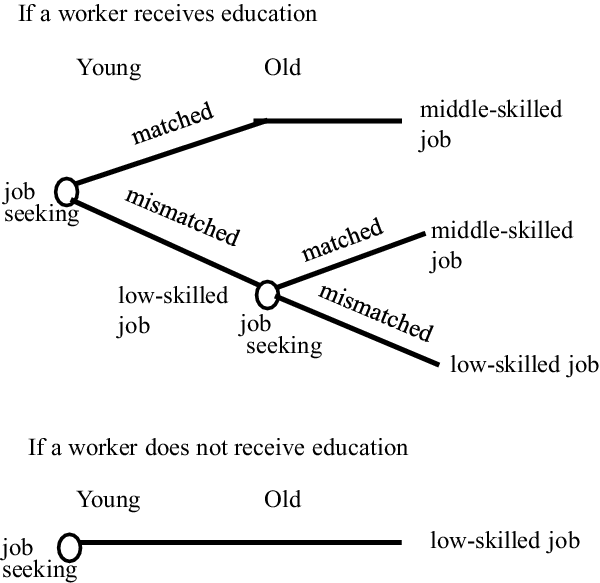
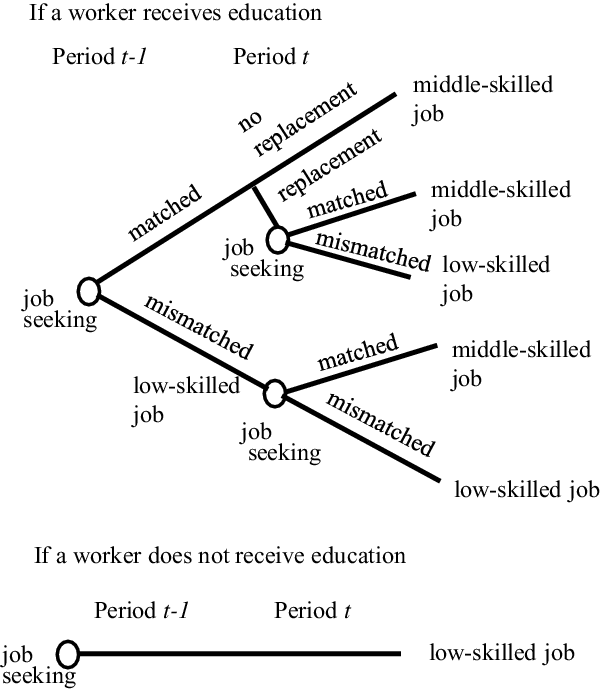
. Figure 1 illustrates education, job seeking, and employment of a worker. In the first period, a worker initially decides whether to acquire specific skills for some middle-skilled tasks by receiving an education. Although workers know their suitability for certain tasks, knowledge about firms is limited. Therefore, they face job mismatch possibilities when they seek middle-skilled jobs. In the second period, workers who experience job mismatch in the first period once again seek middle-skilled jobs.
Job seeking under no increased automation.

In period
 $t$
, middle-skilled tasks have been decomposed into automated and labor tasks:
 \begin{align*} T_t=M_t+(T_t-M_t), \end{align*}
where
 $T_t$
is equal to the total number of tasks,
 $M_t$
is the number of automated tasks, and
 $T_t-M_t$
is the number of labor tasks. In this section, we assume no change in these tasks, that is,
 $T_t=T$
and
 $M_t=M$
. Before receiving education, a worker is unsuitable for any middle-skilled labor task:
 $T-M=b$
where
 $b$
is the number of unsuitable tasks. If a worker invests in education, then that worker can obtain skills for suitable tasks. That is, that worker can reduce tasks that are unsuitable for the worker:
 $ 0\lt b\lt T-M$
. Therefore, after receiving education, labor tasks are decomposed into suitable and unsuitable tasks for a worker:
 \begin{align} T-M=g +b, \end{align}
where
 $g$
is the number of suitable tasks (
 $0\lt g\lt T-M$
). We assume no difference in productivity among these suitable (or unsuitable) tasks. The ability level of a worker is measured by the number of suitable tasks. We examine workers with the same ability level.
We consider the individual job mismatch probability (IMP) of a worker for middle-skilled labor tasks under two assumptions. The first assumption regards the worker’s suitability for tasks. After receiving an education, workers with the same ability level obtain the same number of suitable tasks. The suitability pattern for tasks that represents which tasks are suitable and unsuitable for a worker can differ among workers due to the difference in their specialization areas. In our model, a pattern of suitability for middle-skilled labor tasks is randomly assigned to a worker. The second assumption is that there is a random matching between a job seeker and a firm with one job-seeking opportunity in a period.
Therefore, the IMP of a worker is defined as the ratio of the number of a worker’s unsuitable middle-skilled tasks to the total number of middle-skilled tasks. The IMP of a worker who is born in period
 $t$
is represented as follows:
 \begin{align} q (b,T-M) = \frac{b}{T-M}, \end{align}
where
 $0 \lt q (\cdot ) \lt 1$
because
 $0 \lt b \lt T-M$
.Footnote 4 We denote
 $q(b,T-M)$
as
 $q$
. The numerator in (2) denotes the number of remaining unsuitable middle-skilled labor tasks after receiving an education. That is, this is an individual-specific factor. If the ability level of a worker is high, the worker’s IMP value becomes low because of a low number of unsuitable tasks. The denominator in (2) denotes the number of middle-skilled labor tasks, which is a technology factor. This factor is always the same among workers, regardless of their abilities. Although there is the difference in the task suitability patterns among workers with the same ability, their IMP value is the same under no technical change.
3.2. Decision of education investment
We examine a worker who was born in period
 $t$
. For simplicity, the utility function of a worker is assumed to be linear with respect to the consumption levels when young and old:
 \begin{align} U\!\left(c^y_t,c^o_{t+1}\right)=c^y_t +\frac{c^o_{t+1}}{1+\rho }, \end{align}
with their budget constraints,
 \begin{align} c^y_t+e+s_t =I^y_t \quad and \quad c^o_{t+1}=I^o_{t+1}+Rs_t, \end{align}
where
 $\rho$
is the time discount rate.
 $c^y_t$
and
 $c^o_{t+1}$
are the consumption levels in periods
 $t$
and
 $t+1$
when young and old, respectively,
 $s_t$
is the savings in period
 $t$
when young, and
 $e$
is the cost of education. The sum of the interest rate and the rate of depreciation is denoted by
 $R=1+r$
. Here,
 $I^y_t$
and
 $I^o_{t+1}$
are the wage income levels in periods
 $t$
and
 $t+1$
when young and old, respectively. We assume that the gross interest rate exceeds the discount rate:
 \begin{align} R \gt 1+\rho. \end{align}
Under this assumption, workers save all their disposable income, and this implies
 $c^y_t =0$
.
If a worker decides to invest in education, then their indirect utility is
 \begin{align} V\!\left( I^y_t -e, I^o_{t+1} \right) = \frac{1}{1+\rho } \left[ R \!\left(I^y_t -e \right) +I^o_{t+1} \right], \end{align}
where
 $V(\cdot )$
is the indirect utility function. The income level in each of periods
 $t$
and
 $t+1$
is either the wage rate of middle- or low-skilled labor. That is, these income levels depend on the employment status. The probability of employment in periods
 $t$
and
 $t+1$
is represented by
 $Pr (I^y_t, I^o_{t+1})$
. These probabilities are
 \begin{align} Pr \!\left(w_{m,t},w_{m,t+1}\right)=1-q, \ \ Pr \!\left(w_{m,t},w_{l,t+1}\right)=0,\nonumber \\ Pr \!\left(w_{l,t},w_{m,t+1}\right)=q\!\left(1-q\right), \ \ Pr \!\left(w_{l,t},w_{l,t+1} \right)=q^2, \end{align}
where
 $w_{m,t}$
and
 $w_{l,t}$
are the wage rates of middle- and low-skilled labor in period
 $t$
. Note that
 \begin{align*} \sum _{I^y_t=w_{m,t},w_{l,t}} \sum _{I^o_{t+1}=w_{m,t+1},w_{l,t+1} } Pr \!\left(I^y_t, I^o_{t+1}\right) =1. \end{align*}
From (6) and (7), the expected utility level of receiving an education is
 \begin{align} E \!\left( V\!\left( I^y_t -e, I^o_{t+1} \right) \right) = \sum _{I^y_t=w_{m,t},w_{l,t}} \sum _{I^o_{t+1}=w_{m,t+1},w_{l,t+1}} Pr \!\left(I^y_t, I^o_{t+1}\right) V\!\left(I^y_t-e, I^o_{t+1} \right). \end{align}
If a worker does not decide to receive an education, then that worker cannot obtain skills for any middle-skilled labor task. The worker works in low-skilled labor in both periods
 $t$
and
 $t+1$
:
 \begin{align} V\!\left( I^y_t, I^o_{t+1} \right)= V \!\left(w_{l,t}, w_{l,t+1} \right)= \frac{1}{1+\rho } \left( Rw_{l,t} +w_{l,t+1} \right). \end{align}
Using (8) and (9), we assume that the expected utility of receiving an education exceeds the utility level of not receiving an education:
 \begin{align} F\!\left(q, sp_t, sp_{t+1},e\right) \equiv E\!\left(V\!\left( I^y_t -e, I^o_{t+1} \right) \right) - V \!\left(w_{l,t},w_{l,t+1} \right) \gt 0, \end{align}
where
 $sp_t$
is the skill premium between middle- and low-skilled labor in period
 $t$
:
 $sp_t \equiv w_{m,t}-w_{l,t}$
. It holds that
 $\frac{\partial F }{\partial q}\lt 0$
,
 $\frac{\partial F }{\partial sp_t}\gt 0$
, and
 $\frac{\partial F }{\partial e}\lt 0$
. Therefore, the incentive for receiving an education declines with a rise in the IMP of a worker, a decline in the skill premium, or a rise in the cost of education. Under the assumption in (10), a worker obtains skills for suitable tasks through education.
3.3. Firms
First, we examine the final good firms. Two types of technology can be used: One uses intermediate goods, and the other uses low-skilled labor alone. We assume a logarithmic production function when intermediate goods are used:
 \begin{align} \ln Y_t=\frac{ 1}{T} \sum _{i=1}^{T} \ln y_t(i), \end{align}
where
 $Y_t$
is the total output and
 $y_t(i)$
is the input of intermediate goods
 $i$
. Intermediate goods are produced by tasks, and the output level is normalized by the number of total tasks
 $T$
, which is exogenously given. The profit of final good firms is
 \begin{align*} Y_t- \sum _{i=1}^T p_t(i) y_t (i), \end{align*}
where
 $p_t(i)$
is the price of intermediate goods. The FOCs of the inputs of intermediate goods are
 \begin{align} p_t(i) y_t(i)=\frac{Y_t}{T}, \end{align}
where
 $ i \in [1,\cdots, T]$
. When low-skilled labor is used, we assume a linear production function:
 \begin{align} Y_t=A_{l} L_{l,t}, \end{align}
where
 $A_{l}$
is exogenously given and
 $L_{l,t}$
is the input of low-skilled labor. The wage rate of low-skilled labor is
 $w_{l,t} =A _{l}$
.
We then examine intermediate good firms. Each intermediate good is produced by use of either machines or middle-skilled labor:
 \begin{align} y_t (i)= \gamma (i) k_t (i) + \lambda _m l_{m,t} (i), \end{align}
where
 $i \in [1,\cdots, T]$
. In the production of
 $i$
-th intermediate goods,
 $k_t(i)$
is the input of machines, and
 $l_{m,t} (i)$
is the input of middle-skilled labor. If a machine for a task is available, the efficiency of the machine input is positive, and it is zero otherwise. The efficiency of the machine input is
 \begin{align*} \gamma (i)=d (i) \gamma, \end{align*}
where
 $\gamma \gt 0$
.
 $d(i)$
takes either
 $1$
or
 $0$
. We assume that
 \begin{align} \sum _{i=1}^{T} d(i)=M. \end{align}
That is, the level of automation is exogenous. If machines are used in the
 $i$
-th intermediate good under
 $d(i)=1$
, the price of intermediate goods that use machines, represented as
 $p_k$
is
 \begin{align*} p_k = \frac{R}{\gamma }. \end{align*}
A firm that uses middle-skilled labor must find a suitable worker for production. Hence, the probability that a firm engages in production is the same with the matching probability between an entry firm and a suitable worker. This matching probability is considered based on the following two variables. The first variable is market tightness in the middle-skilled labor market, which is the jobs-to-applicants ratio:
 $\theta _t \equiv{v_t}/{ \tilde{L}_{m,t}}$
. Here,
 $\theta _t$
is market tightness,
 $v_t$
is the number of entry firms with vacancy
 $v_t$
, and
 $\tilde{L}_{m,t}$
is the number of middle-skilled job seekers. Assuming that
 $\theta _t \geq 1$
, the probability of a firm being able to find a job applicant can be considered by
 $\theta _t^{-1}$
. If the number of entry firms is large, then a firm finds it difficult to recruit a job applicant. The second variable is the probability that a recruited worker is suitable for a firm. Under the two assumptions concerning workers’ suitability for tasks and the random matching between a firm and a worker, this probability that a recruited worker is suitable for a firm is the same among these firms. This probability is represented as
 $1-\mu _t^a$
where
 $\mu _t^a$
is the mean of the IMPs of job seekers. Because the IMP value of any job seeker is
 $q$
, it holds that
 $\mu _t^a=q$
.Footnote 5 Consequently, the probability that a firm engages in production,
 $\phi _t$
, is represented as follows:
 \begin{align} \phi (\theta _t ;\, q) =\frac{1-\mu _t^a}{\theta _t} =\frac{1-q}{\theta _t}. \end{align}
It holds that
 $ \frac{\partial \phi _t}{\partial \theta _t}\lt 0$
and
 $ \frac{\partial \phi _t}{\partial q}\lt 0$
. Using (16), the expected profit of a firm is
 \begin{align} G \!\left(\theta _t ;\, q, A_{m,t}, w_{m,t}, z\right) \equiv \frac{1-q}{\theta _t} \left( A_{m,t} -w_{m,t}\right) -z, \end{align}
where
 $A_{m,t} \equiv p_{m,t} \lambda _m$
.
 $p_{m,t}$
is the price of intermediate goods that use middle-skilled labor.
 $A_{m,t }-w_{m,t}$
is the firm’s profit when the firm succeeds in production.
 $z$
is the fixed cost in which
 $z\gt 0$
. In (17), the expected profit of a firm is a decreasing function of the number of entry firms.
Under Nash bargaining, we consider the wage rate of middle-skilled labors. Unless a worker who received an education is employed in a middle-skilled job, the worker works in low-skilled labor. Hence, we assume Nash bargaining as follows:
 \begin{align*} \max _{w_{m,t}} \left(w_{m,t}-w_{l,t}\right)^{\beta } \left( A_{m,t} -w_{m,t}\right)^{1-\beta }, \end{align*}
where
 $0\lt \beta \lt 1$
. Thus, the middle-skilled wage rate is
 \begin{align} w_{m,t}=\beta A_{m,t} + (1-\beta ) A_{l}. \end{align}
Note that
 $w_{l,t}=A_l$
. The wage rate in (18) is lower than the perfectly competitive wage rate,
 $w_{m,t}=A_{m,t}$
, due to the possibility of job mismatch.Footnote 6
From (17) and (18), as a result of the free entry of firms, the zero profit condition
 $G( \hat{\theta }_t)=0$
implies
 \begin{align} \hat{\theta }_t = (1-q) \frac{1-\beta }{\beta } \frac{ sp_t}{z}. \end{align}
Thus, the entry of firms is
 $ \hat{v}_t = \hat{\theta }_t \tilde{L}_{m,t}$
. The number of job seekers that include old and young individuals is
 \begin{align*} \tilde{L}_{m,t}=\frac{1}{2} q+ \frac{1}{2}. \end{align*}
An increase in the IMP of a worker decreases the market tightness:
 $\frac{\partial \hat{\theta }_t}{\partial q}\lt 0$
. It also holds that
 $\frac{\partial \hat{\theta }_t}{\partial sp_t}\gt 0$
and
 $\frac{\partial \hat{\theta }_t}{\partial z}\lt 0$
.
3.4. Equilibrium
We examine equilibrium under no technical change. The equilibrium condition in the final good market implies
 \begin{align} \sum _{i=1}^T \ln \left ( \frac{1}{p_t (i)} \frac{1}{T} \right ) =0. \end{align}
From the price of intermediate goods that use machines,
 $p_k = \frac{R}{\gamma }$
, the price of intermediate goods that use middle-skilled labor, represented as
 $p_m$
is
 \begin{align} \ln p_{m} = \frac{1}{T-M} \left ( M \ln \frac{\gamma }{R} -T\ln T \right ). \end{align}
If
 $M=0$
, then it holds that
 $p_m=T^{-1}$
. If the number of total tasks is large, then the total cost of production is also large. The price of intermediate goods should be low to satisfy (20). Under a sufficiently large efficiency of machines, which implies
 $\gamma \gt R$
, a rise in the level of automation increases the price of labor-based intermediate goods:
 $\frac{\partial p_m}{\partial M}\gt 0$
. When machines are widely used in the production of the final good production, the marginal product of intermediate goods using labor rises.
We consider the adoption of automation in equilibrium. If
 $\frac{R}{\gamma } \gt T^{-1}$
holds due to a small efficiency of machines, then all tasks are performed by middle-skilled workers because using middle-skilled labor is less expensive than that of machines. That is, there is no use of machines,
 $M=0$
. If the following inequality holds due to a sufficiently large efficiency of machines
 \begin{align} \frac{R}{\gamma } \leq T^{-1}, \end{align}
then the use of machines is more profitable than or equal to the use of middle-skilled labor. Condition (22) implies inequality,
 $\gamma \gt R$
, because
 $T \gt 1$
. That is, provided that the machine technology is available, the automation level is positive:
 $M\gt 0$
. In the following analysis, we consider what happens when (22) holds. This implies that
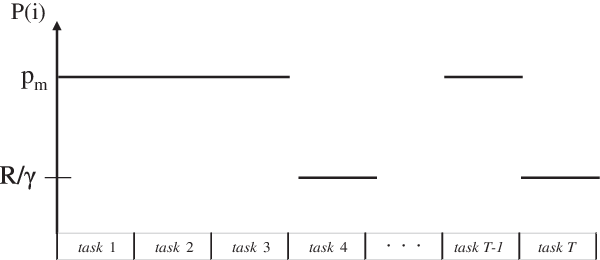
 $p_m \gt \frac{R}{\gamma }$
. See Figure 2.
Prices of intermediate goods.

From FOCs in (12), the expenditure share of inputs is equal among intermediate goods:
 \begin{align} R k_t= p_{m}\lambda_{m} l_{m,t}, \end{align}
where
 $ k_t=\frac{K_t}{M}$
and
 $ l_{m,t}=\frac{L_{m,t}}{T-M}$
.
 $K_t$
is the total input of capital and
 $L_{m,t}$
is the total input of middle-skilled labor. From (11) and (23), the production function is of the Cobb-Douglas type, which depends on the degree of automation,
 $\frac{M}{T}$
:
 \begin{align*} \ln Y_t= \frac{M}{T} \ln \gamma + \left (1- \frac{M}{T} \right ) \ln \lambda _m + \frac{M}{T} \ln \frac{K_t}{M} + \left (1- \frac{M}{T} \right ) \ln \frac{L_{m,t}}{T-M}. \end{align*}
We investigate equilibrium in the middle- and low-skilled labor markets. We assume the incentive compatibility for education investment noted in (10). The number of middle-skilled workers is
 \begin{align} L_{m,t} = L^o_{m,t} + L^y_{m,t}, \end{align}
where
 $L^o_{m,t}$
and
 $L^y_{m,t}$
are old and young middle-skilled workers, respectively. Under the law of large numbers, old and young middle-skilled workers are, respectively,
 \begin{align*} L^o_{m} (q)= \frac{1}{2}[(1-q)+q(1-q)]=\frac{1}{2}\left(1-q^2\right) \ \ and \ \ L^y_{m}(q) = \frac{1}{2} (1-q). \end{align*}
These are endogenously determined due to the endogeneity of the IMP value of a worker. The number of low-skilled workers is
 \begin{align*} L_{l,t} =L^o_{l,t} +L^y_{l,t}, \end{align*}
where
 $L^o_{l,t}$
and
 $L^y_{l,t}$
are, respectively, old and young low-skilled workers, respectively. Because a worker is either a middle- or low-skilled worker, it holds that
 $L^o_{m,t}+ L^o_{l,t}=\frac{1}{2}$
and
 $L^y_{m,t}+ L^y_{l,t}=\frac{1}{2}$
. Old and young low-skilled workers are, respectively,
 \begin{align*} L^o_l (q)= \frac{1}{2}q^2 \ \ and \ \ L^y_l (q) = \frac{1}{2}q. \end{align*}
These low-skilled workers work as low-skilled labor despite their investment in education. That is, they are underemployed.
4. Economy under increased automation
We assume that, at the beginning of period
 $t$
, the efficiency of capital input randomly increases from zero to
 $\gamma$
for some middle-skilled labor tasks; that is, automation increases in these tasks:
 \begin{align} \sum _{i=1}^{T} d_t(i)=M +\Delta M_t. \end{align}
That is,
 $\Delta M_t$
is exogenous. The available labor tasks decline from
 $T-M$
to
 $T-M-\Delta M_t$
. Depending on the suitability of tasks, some suitable and unsuitable tasks are newly performed by machines (Table 1). When workers who are born in period
 $t$
decide whether to receive an education, they do not know which tasks will be automated. Workers working at automated tasks
 $\Delta M_t$
are replaced by machines. Hence, they once again seek middle-skilled jobs (Figure 3). For simplicity, we assume that, in period
 $t+1$
and after that, no further increase in automation occurs. Because of this assumption, we can identify the effect of the increased automation in period
 $t$
.
Job seeking of a worker who is born in period
 $t-1$
under increased automation in period
 $t$
.

4.1. Workers’ IMPs in the period of increased automation
As a result of increased automation in period
 $t$
, workers are divided into the following four types. The first type is old workers who can continue working as middle-skilled labor due to no replacement by machines. The number of these workers is
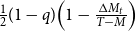 $\frac{1}{2} (1-q) \Bigl (1- \frac{\Delta M_t}{T-M} \Bigr )$
. The second type is old workers who cannot continue working as middle-skilled labor due to the replacement by machines. The number of these replaced workers is
 $ \frac{1}{2} (1-q) \frac{\Delta M_t}{T-M}$
. The third type is old workers who cannot find middle-skilled jobs in period
 $t-1$
. The number of these mismatched workers is
 $\frac{1}{2}q$
. These second- and third-type workers seek middle-skilled jobs again. The fourth type is young workers who are born in period
 $t$
with the population size
 $\frac{1}{2}$
.
The IMP of a worker endogenously changes because machines cover some suitable and unsuitable tasks of the worker. The worker’s IMP is equal to the ratio of the number of the worker’s unsuitable labor tasks that cannot be performed by machines to the number of available labor tasks:
 \begin{align} q (x_t;\, \Delta M_t,b,T-M) = \frac{b -x_t}{T-M -\Delta M_t }, \end{align}
where
 $0\lt T-M-\Delta M_t$
and
 $0 \leq q (x_t) \leq 1$
. For simplicity, we represent (26) as
 $q(x_t;\, \Delta M_t)$
. In (26),
 $x_t$
is the number of the worker’s unsuitable tasks performed by machines and
 $x_t \in [\underline{x}, \cdots, \bar{x}]$
. Equation (26) includes two factors. First, the numerator in (26) denotes the number of the worker’s unsuitable tasks that cannot be performed by machines; this is an individual-specific factor. This factor differs even among workers with the same ability level. For example, if all unsuitable tasks for a worker are covered by machines (i.e., if
 $x_t=b$
), then the worker always finds middle-skilled jobs with
 $q(x_t)=0$
. If only unsuitable tasks remain for a worker (i.e., if
 $x_t=b-(T-M-\Delta M_t)$
), then the worker cannot find any middle-skilled jobs with
 $q(x_t)=1$
. Subsequently, the denominator in (26) denotes the number of available labor tasks; this is a technology factor. The increased automation decreases the number of available labor tasks. Therefore, whether the IMP of a worker declines or rises depends on the number of the worker’s unsuitable tasks that cannot be performed by machines,
 $x_t$
, and the increased automation,
 $\Delta M_t$
.
Regarding the domain of
 $x_t$
, the lower bound is the same among job seekers in which
 $\underline{x}= \max\!(0, b-(T-M-\Delta M_t) )$
. It holds that
 $ \bar{x}= \min\! (b, \Delta M_t )$
for young workers as well as mismatched old workers. However, when a worker is replaced by machines due to increased automation, then the worker will surely lose one of his or her suitable tasks. This implies
 $\bar{x}=\min\!( b, \Delta M_t-1)$
. That is, the upper bound of
 $x_t$
can differ between these mismatched and replaced workers. If increased automation exceeds the number of intrinsically unsuitable tasks:
 $ \Delta M_t-1 \gt b$
, then
 $\bar{x}=b$
holds. That is, if the number of newly automated tasks is large or if the number of unsuitable tasks is small, then we do not need to consider the difference in the domain of
 $x_t$
between these mismatched and replaced workers. Henceforth, we assume this.Footnote 7
The density function of
 $x_t$
measures the ratio of the number of worker types that belong to the
 $x_t$
-th group to the total number of worker types. Given the number of unsuitable tasks
 $b$
, the number of patterns for task suitability (i.e., the number of worker types) is calculated by the number of unsuitable task patterns:
 \begin{align} \left ( \begin{array}{c} T-M \\ b \\ \end{array} \right ). \end{align}
The number of worker types belonging to the
 $x_t$
-th group is calculated using two binomial coefficients:
 \begin{align} \left ( \begin{array}{c} \Delta M_t \\ x_t \\ \end{array} \right ) \left ( \begin{array}{c} T-M-\Delta M_t \\ b-x_t \end{array} \right ). \end{align}
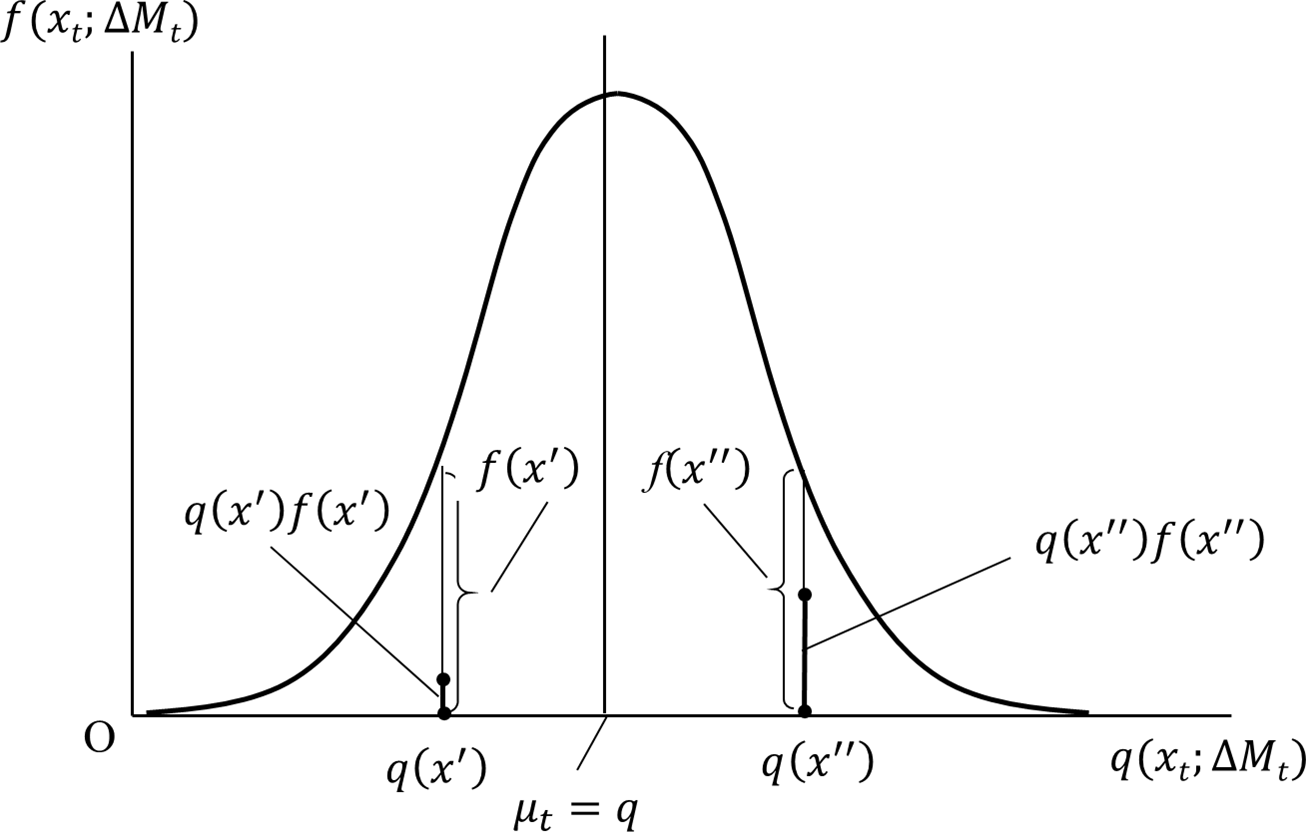
IMP distribution of young and old job seekers in the period of increased automation.

The first coefficient measures the number of patterns under which the machines cover labor tasks that are unsuitable for workers. The second coefficient measures the number of patterns where the number of labor tasks includes the remaining unsuitable tasks. Dividing (28) by (27), we obtain the hypergeometric distribution as follows (Mood et al. Reference Mood, Graybill and Boes1974):
 \begin{align} f(x_t;\, \Delta M_t, b,T-M) \equiv \frac{ \left ( \begin{array}{c} \Delta M_t \\ x_t \\ \end{array} \right ) \left ( \begin{array}{c} T-M -\Delta M_t\\ b-x_t \\ \end{array} \right ) }{ \left ( \begin{array}{c} T-M \\ b \\ \end{array} \right ) }, \end{align}
where
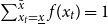 $ \sum _{x_t=\underline{x } }^{\bar{x } } f(x_t)=1$
. Equation (29) describes the probabilities for the success of
 $x_t$
in
 $b$
draws without replacement from
 $T-M$
; it contains
 $\Delta M_t$
successful states. While each draw is either a success or a failure, a success (failure) indicates one less option in the unsuitable (suitable) tasks. We examine the mean and variance of
 $q(X_t)$
:
 \begin{align*} \mu _{t} \equiv E(q (X_t;\, \Delta M_t, b,T-M) ) \ \ and \ \ \sigma _{t}^2 \equiv Var(q(X_t;\, \Delta M_t,b,T-M) ), \end{align*}
where
 $X_t$
is a random variable of
 $x_t$
.
Lemma 1 (Distribution of workers’ IMPs).
 \begin{align}\mu _{t} =q =\frac{b}{T-M}, \end{align}
 \begin{align} \sigma ^2_t = \sigma ^2 ( q, \Delta M_t ) = \frac{\Delta M_t}{T-M-\Delta M_t} \frac{ q (1- q) }{T-M-1}. \end{align}
The proof is shown in Appendix B.
In (30), the mean of workers’ IMPs under
 $\Delta M_t\gt 0$
is equal to their IMP under
 $\Delta M_t=0$
, which is noted in (2). While workers are equally exposed to an increase in automation ex-ante, they have different effects on their job mismatch possibilities ex-post. Whether the IMP of a worker rises or declines depends on the worker’s suitability for tasks. If machines perform a worker’s suitable tasks more (or less) than the worker’s unsuitable tasks, then the worker’s IMP rises (or declines), which implies more (or less) difficulty for obtaining a middle-skilled job. In Figure 4, we illustrate the IMP distribution.Footnote 8 The horizontal axis represents the IMP values, while the vertical axis represents the density function,
 $f(x_t)$
. We examine
 $x^{\prime}$
and
 $x^{\prime\prime}$
(
 $x^{\prime} \gt x^{\prime\prime}$
), which satisfy
 \begin{align*} q(x^{\prime} )\lt q \lt q(x^{\prime\prime}) \ \ and \ \ f(x^{\prime})=f(x^{\prime\prime}). \end{align*}
In this figure,
 $q(x_t) f(x_t)$
indicates the ratio of workers who cannot find jobs to those who have
 $x_t$
. It holds that
 $q(x^{\prime}) f(x^{\prime}) \lt q(x^{\prime\prime}) f(x^{\prime\prime})$
because it is more difficult for a worker who has a large IMP value to find a job. The inidividual effects of the increased automation on their IMPs cancel each other out because of the two assumptions concerning workers’ suitability for tasks and the random matching between a firm and a worker. Therefore, the mean of their IMPs is never affected by the increased automation.
In (31), the IMPs of workers are diverse due to increased automation. The variance of their IMPs depends on the mean of their IMPs and the increased automation. A large increased automation implies a large variance of their IMPs:
 $\frac{\partial \sigma ^2_t }{\partial \Delta M_t}\gt 0$
. In addition, provided that
 $q \leq \frac{1}{2}$
holds, a large
 $q$
implies a large variance:
 $\frac{ \partial \sigma ^2_t}{\partial q} \gt 0$
. Therefore, we can demonstrate the variance effect of the increased automation on the IMPs of workers while preserving the mean of their IMPs.
Proposition 1 (Workers’ IMPs). Due to increased automation, the IMPs of workers with the same ability level are diverse.
We examine the decision of education investment by a worker who was born in period
 $t-1$
. If a worker works at a middle-skilled task in period
 $t-1$
, the probability of replacement by machines is
 $\frac{\Delta M_t}{T-M}$
. The probability of finding a middle-skilled job in period
 $t$
is
 $1-\mu _t$
. Hence, after receiving an education, a worker expects the following probabilities of employment in a middle- or low-skilled job:
 \begin{align} Pr (w_m, w_{m,t} ) & =(1-q ) \left [ \left ( 1- \frac{\Delta M_t}{T-M} \right ) + \frac{\Delta M_t}{T-M} (1-\mu _t) \right ],\nonumber\\ Pr (w_m, w_{l,t} ) & = (1-q) \frac{\Delta M_t}{T-M} \mu _t, \ \ Pr (w_l, w_{m,t} )=q(1-\mu _t), \ \ Pr (w_l, w_{l,t} )=q\mu _t, \end{align}
where, as shown in (30),
 $\mu _t=q$
.
 $w_m$
and
 $w_l$
are the wage rates of middle- and low-skilled labor in period
 $t-1$
, repsectively. The expected utility level of a worker after receiving an education is
 \begin{align*} E \!\left(V\!\left( I^y_{t-1} -e, I^o_{t} \right) \right) = \sum _{I^y_{t-1}=w_m,w_l} \sum _{I^o_t=w_{m,t},w_{l,t}} Pr \!\left(I^y_{t-1},I^o_t \right) V\!\left(I^y_{t-1}-e, I^o_{t}\right). \end{align*}
The expected utility level of receiving an education declines because of the possibility of replacement by machines. The incentive-compatibility condition is:
 \begin{align} F_t =F \!\left( q, \mu _t, sp, sp_t, e, \Delta M_t \right) = E\!\left(V\!\left( I^y_{t-1} -e, I^o_{t} \right) \right) -V \!\left(w_l, w_{l,t}\right) \gt 0, \end{align}
where
 $V\!\left(w_l, w_{l,t}\right) = \frac{1}{1+\rho } \left( R w_l +w_{l,t} \right)$
. Due to the possibility of replacement by machines, the incentive for receiving an education declines:
 $\frac{\partial F }{\partial \Delta M_t } \lt 0$
.
4.2. Workers’ IMPs in the subsequent periods of increased automation
At the beginning of period
 $t+1$
, under no further increase in automation, workers are classified into the following three types. The first type is workers who continue working as middle-skilled workers. The number of these workers is
 $\frac{1}{2} (1-\mu _t)$
. The second type is old workers who have a mismatch in period
 $t$
while they once again seek middle-skilled jobs. Their number is
 $\frac{1}{2}\mu _t$
. The third type is young workers who are born in period
 $t+1$
with a population size
 $\frac{1}{2}$
.
We examine the IMPs of job seekers who were born in period
 $t$
. In period
 $t+1$
, the ratio of these job seekers to old workers is
 $\mu _t$
. The ratio of job seekers who have unsuitable tasks performed by machines
 $x_t$
to the old job seekers is
 \begin{align*} \frac{1}{\mu _{t} } q(x_t;\, \Delta M_t) f(x_t;\, \Delta M_t). \end{align*}
Hence, the IMP mean of those job seekers is
 \begin{align*} \mu _{t+1} = \sum _{x_t=\underline{x}}^{\bar{x}} \frac{1}{\mu _t} q(x_t;\, \Delta M_t) q(x_t;\, \Delta M_t) f(x_t;\, \Delta M_t). \end{align*}
Lemma 2 (IMP mean of old job seekers in period
 $t+1$
).
 \begin{align} \mu _{t+1}=\mu ( q, \Delta M_t )= q + \frac{1}{q} \sigma ^2 \left(q, \Delta M_t \right). \end{align}
The proof is shown in Appendix B.
In period
 $t+1$
, workers who have relatively large IMP values owing to small
 $x_t$
account for a large portion of the job seekers. Those job seekers tend to face a high likelihood of job mismatch due to their large IMP values. Hence, in (34), the mean of their IMPs rises from
 $\mu _{ t}$
to
 $\mu _{ t+1}$
. Unlike in period
 $t$
, large and small IMP values do not cancel each other out in period
 $t+1$
due to the large portion of workers who have large IMP values. Therefore, the IMP mean of old job seekers in period
 $t+1$
positively depends on the IMP variance,
 $\sigma ^2_t$
.
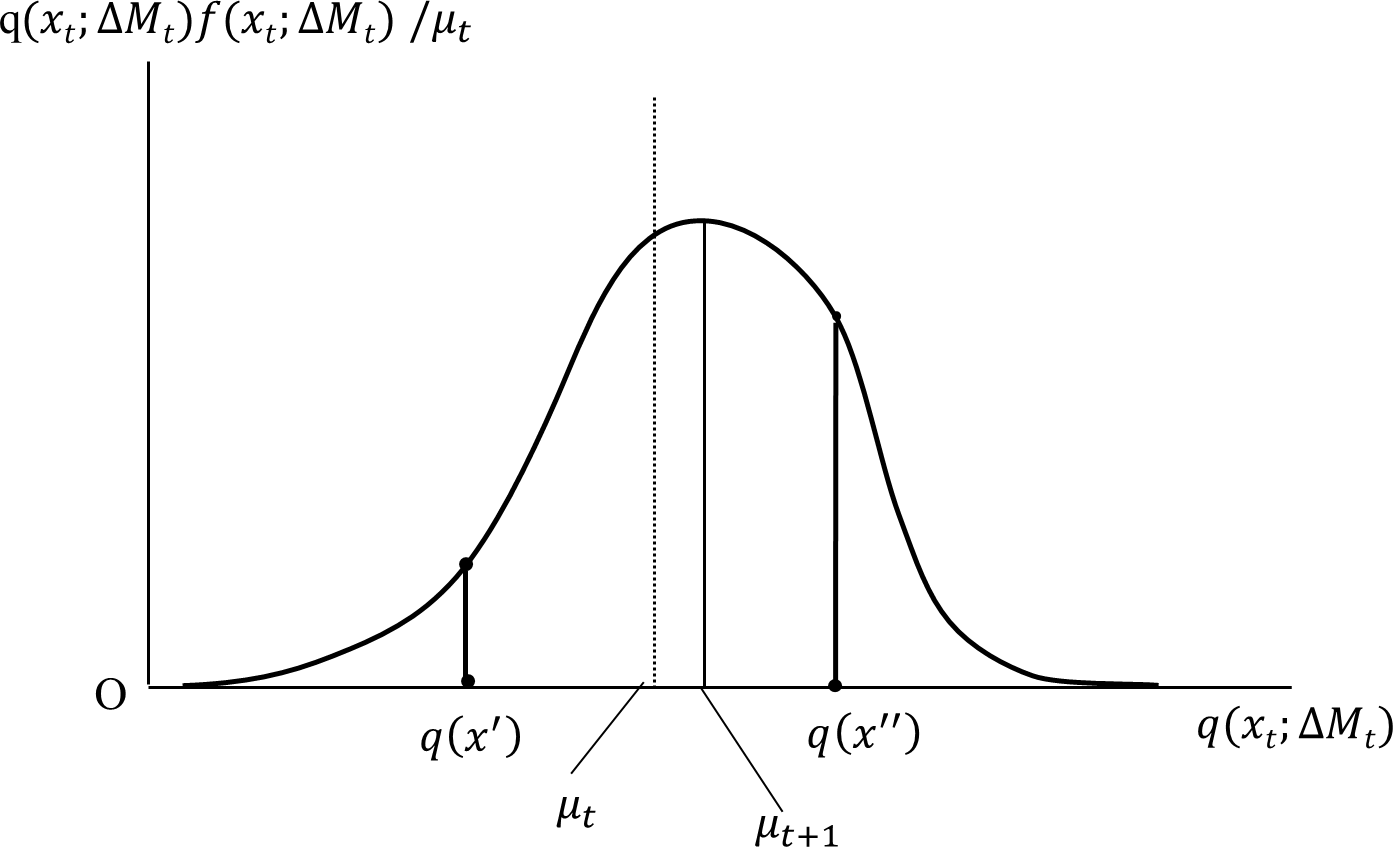
In Figure 5, we illustrate the
 $t+1$
-th period IMP distribution of job seekers who were born in period
 $t$
. On the horizontal axis, the values of workers’ IMPs remain equal. That is, there is no change in
 $q(x^{\prime} )$
and
 $q(x^{\prime\prime})$
. The vertical axis measures
 $q(x_t) f(x_t)/\mu _t$
, which represents the ratio of job seekers who have
 $x_t$
to the total job seekers in period
 $t+1$
. As shown in Figure 4, it holds that
 $q (x^{\prime\prime}) f(x^{\prime\prime}) \gt q (x^{\prime}) f(x^{\prime})$
because
 $q(x^{\prime\prime})\gt q(x^{\prime})$
. Moreover, in period
 $t+1$
, the ratio of unemployed workers to job seekers is larger for the workers having
 $x^{\prime\prime}$
compared to workers with
 $x^{\prime}$
:
 $q^2(x^{\prime\prime}) f(x^{\prime\prime}) \gt q^2 (x^{\prime}) f(x^{\prime}).$
Consequently, the IMP mean in period
 $t+1$
exceeds that in period
 $t$
because a higher number of workers who have larger IMPs remain job seekers.
IMP distribution of old job seekers in the subsequent period of increased automation.

Corollary 1 (A comparison between
 $\mu _t$
and
 $\mu _{t+1}$
).
 \begin{align} \mu _{t} \lt \mu _{t+1}. \end{align}
We examine the decision of education investment by a worker who was born in period
 $t$
. Because they have job seeking after increased automation, they can avoid automated tasks. However, they do not know which tasks will be automated when receiving an education. The probabilities of employment in a middle- or low-skilled job are as follows:
 \begin{align} Pr \!\left(w_{m,t}, w_{m,t} \right) =\left(1-\mu _t \right), \ \ Pr \!\left(w_{m,t}, w_{l,t} \right) = 0,\nonumber \\ Pr \!\left(w_{l,t},w_{m,t}\right) =\mu _t \left(1-\mu _{t+1}\right), \ \ Pr \!\left(w_{l,t},w_{l,t}\right)=\mu _t \mu _{t+1}. \end{align}
Note that there is no change in the wage rates of middle- and low-skilled labor in period
 $t+1$
due to no technical change. The expected utility level of receiving an education is
 \begin{align*} E \!\left( V\!\left( I^y_t -e, I^o_{t+1} \right) \right) = \sum _{I^y_t=w_{m,t},w_{l,t}} \sum _{I^o_{t+1}=w_{m,t}, w_{l,t}} Pr \!\left(I^y_t,I^o_{t+1}\right) V\!\left(I^y_{t}-e, I^o_{t+1}\right). \end{align*}
A large
 $\mu _{t+1}$
implies a low level of expected utility. The incentive-compatibility condition for education investment is
 \begin{align} F_{t+1} =F \!\left( \mu _t, \mu _{ t+1}, sp_t, e \right) =E \!\left(V\!\left( I^y_t -e, I^o_{t+1} \right) \right) -V \!\left(w_{l,t}, w_{l,t}\right) \gt 0. \end{align}
Due to the variance of the IMPs of workers, the incentive for receiving an education declines:
 $\frac{\partial F_{t+1}}{\partial \mu _{t+1}} \lt 0$
. That is, the incentive for receiving education declines due to increased automation:
 $\frac{\partial F_{t+1}}{\partial \Delta M_t} \lt 0$
.
Finally, we consider a worker who was born in period
 $t+1$
. Under the assumption of no further increase in automation, they know the available labor tasks
 $T-M-\Delta M_t$
when they decide on an education investment. Because the number of these labor tasks declines due to increased automation, it may be natural to consider a decline in the unsuitable tasks of a worker. Therefore, for simplicity, we assume that the IMP value of a worker remains
 $q$
, which is equal to
 \begin{align} q = \frac{ \tilde{b}}{T-M-\Delta M_t}, \end{align}
where
 $\tilde{b}$
is the number of the worker’s unsuitable tasks in which
 $\tilde{b}\lt b$
. Note that
 $q=\frac{b}{T-M}$
. The probabilities of employment in a middle- or low-skilled job are the same as those in (7). The expected utility under receiving an education is
 \begin{align*} E \!\left(V\!\left( I^y_{t+1} -e, I^o_{t+2} \right) \right) = \sum _{I^y_{t+1}=w_{m,t},w_{l,t}} \sum _{I^o_{t+2}=w_{m,t},w_{l,t}} Pr \!\left(I^y_{t+1}, I^o_{t+2}\right) V\!\left(I^y_{t+1}-e, I^o_{t+2}\right). \end{align*}
The incentive-compatibility condition is
 \begin{align*} F_{t+2} =F \!\left( q, sp_t, e \right) =E \!\left(V\!\left( I^y_{t+1} -e, I^o_{t+2} \right) \right) -V\!\left(w_{l,t},w_{l,t}\right) \gt 0. \end{align*}
4.3. Equilibrium in the period of increased automation
As a result of increased automation, the price of labor-use intermediate goods rises:
 \begin{align} \ln p_{m,t} = \frac{1}{T-M-\Delta M_t} \left [ (M+\Delta M_t) \ln \frac{\gamma }{R} -T\ln T \right ]. \end{align}
As shown in (18), the wage rate of middle-skilled labor also rises. In addition, the share of labor incomes declines with the increased automation.Footnote 9
To simplify the analysis, we assume no change in the skill premium:
 \begin{align} \Delta sp_t=0. \end{align}
Equations (18) and (40) imply that
 $ \lambda _m \Delta p_{m,t}=\Delta A_{l,t}$
. Under these assumptions, we can focus on the effect of increased automation on job mismatch probabilities of workers.Footnote 10
We explore the probability that a labor-use firm engages in production. In period
 $t$
, three types of job seekers exist: old workers who are replaced by machines, old workers who cannot find middle-skilled jobs in period
 $t-1$
, and young workers who seek middle-skilled jobs in period
 $t$
. The IMP mean of these three types is
 $\mu _t$
. The mean of the IMPs of job seekers,
 $\mu ^a_t$
is equal to
 $\mu _t$
. Therefore, the probability that a labor-use firm engages in production is
 \begin{align} \phi (\theta _t ;\, \mu _t) =\frac{1-\mu ^a_t}{\theta _t} =\frac{1-\mu _t}{\theta _t}. \end{align}
Note that
 $\mu _t=q$
. Under assumption (40), the market tightness in equilibrium is the same as with (19).
As a result of job seeking in period
 $t$
, the number of middle-skilled workers is
 \begin{align*} L_{m,t}=L^o_{m,t} +L^y_{m,t}, \end{align*}
where
 $L^o_{m,t}$
and
 $L^y_{m,t}$
are the numbers of old and young middle-skilled workers, respectively. There are three types of old middle-skilled workers:
 \begin{align} L^o_{m,t} = \frac{1}{2} (1-q) \left (1 - \frac{\Delta M_t}{T-M} \right ) + \frac{1}{2}(1-q) \frac{\Delta M_t}{T-M} (1-\mu _t) + \frac{1}{2} q (1-\mu _t), \end{align}
which reduces to
 \begin{align*} L^o_{m,t} = L^o_m \left(q, \Delta M_t \right) = \frac{1}{2} \left [ \left(1-q^2\right) - q(1-q) \frac{\Delta M_t}{T-M} \right ]. \end{align*}
The first term of the RHS of (42) represents workers who are not replaced by machines in period
 $t$
, while the second term of the RHS includes workers who are replaced by machines but find additional middle-skilled jobs. The third term of the RHS includes workers who have job mismatch in period
 $t-1$
but find middle-skilled jobs in period
 $t$
. The number of young middle-skilled workers is
 \begin{align*} L^y_{m,t}=L^y_m (q)= \frac{1}{2} (1-\mu _t ) =\frac{1}{2} (1-q). \end{align*}
Similarly, the number of low-skilled workers is
 \begin{align*} L_{l,t}= L^o_{l,t}+L^y_{l,t}, \end{align*}
where
 \begin{align*} L^o_{l,t} = L^o_l \left(q, \Delta M_t \right) =\frac{1}{2} \left [ q^2+ q(1-q) \frac{\Delta M_t}{T-M} \right ] \ \ and \ \ L^y_{l,t}=L^y_l (q)=\frac{1}{2} q. \end{align*}
Consequently, due to the replacement of middle-skilled workers by machines, the number of middle-skilled workers declines, while that of low-skilled workers (i.e., underemployed workers) rises:
 \begin{align*} L_{m,t}\lt L_m \ \ and \ \ L_{l,t} \gt L_l. \end{align*}
4.4. Equilibrium in the subsequent periods of increased automation
We consider the probability that a labor-use firm engages in production in period
 $t+1$
. In that period, there are two types of job seekers. The first type is old workers who cannot find middle-skilled jobs in period
 $t$
. The mean of their IMPs is
 $\mu _{t+1}$
with a size of
 $\frac{1}{2}\mu _t$
. The second type is young workers while they have the same IMP,
 $q$
with a size of
 $\frac{1}{2}$
. Thus, the mean of the IMPs of these two types is
 \begin{align} \mu ^a_{t+1} = \frac{ (1/2)q+(1/2)\mu _t\mu _{t+1}}{ (1/2) + (1/2) \mu _t}. \end{align}
The denominator of the RHS of this equation shows the number of job seekers in period
 $t+1$
, while the numerator of the RHS shows the expected value of the number of job seekers who are unsuitable for a task. Because workers who have large IMPs remain job seekers, the mean of the IMPs of job seekers rises:
 \begin{align*} \mu ^a_{t+1} =q \frac{1+\mu (q, \Delta M_t) }{1+q} \gt q. \end{align*}
Note that
 $\mu _{t+1}=\mu (q,\Delta M_t)$
. Consequently, the probability that a firm engages in production in period
 $t+1$
is
 \begin{align} \phi \!\left(\theta _{t+1} ;\, \mu ^a_{t+1} \right) =\frac{1-\mu ^a_{t+1} }{\theta _{t+1}}, \end{align}
which implies a decline in the market tightness:
 \begin{align*} \hat{\theta }_{t+1}= \left(1-\mu ^a_{t+1}\right) \frac{1-\beta }{\beta } \frac{ sp}{z}. \end{align*}
Proposition 2 (Difficulty in finding a middle-skilled worker). Due to increased automation, workers who have large IMPs remain job seekers. Therefore, the matching between a firm and a suitable worker is more difficult.
As a result of job seeking in period
 $t+1$
, the number of middle-skilled workers is
 \begin{align*} L_{m,t+1}=L^o_{m,t+1} +L^y_{m,t+1}. \end{align*}
Using (30) and (34), the old middle-skilled workers, including workers who find middle-skilled jobs in period
 $t$
and find these jobs in period
 $t+1$
but not in period
 $t$
, are as follows:
 \begin{align} L^o_{m,t+1}= \frac{1}{2} (1-\mu _t ) + \frac{1}{2} \mu _t (1-\mu _{t+1}), \end{align}
which reduces to
 \begin{align*} L^o_{m,t+1}=L^o_m \left(q, \Delta M_t\right) = \frac{1}{2} \left( 1- q^2 - \sigma ^2_t \right). \end{align*}
Due to the variance of the IMPs of workers, the number of old middle-skilled workers declines. The number of young middle-skilled workers is
 \begin{align*} L^y_{m,t+1}=L^y_m (q)=\frac{1}{2}(1-q). \end{align*}
Similarly, the number of low-skilled workers is
 \begin{align*} L_{l,t+1}= L^o_{l,t+1}+L^y_{l,t+1}, \end{align*}
where
 \begin{align*} L^o_{l,t+1} = L^o_l \left(q, \Delta M_t\right)= \frac{1}{2} \mu _t \mu _{t+1} =\frac{1}{2} \left( q^2 + \sigma ^2_t \right) \ \ and \ \ L^y_{l,t+1}=L^y_l (q)= \frac{1}{2} q. \end{align*}
Compared to the steady-state level, the number of middle-skilled workers declines, while that of low-skilled workers (i.e., underemployed workers) rises:
 \begin{align*} L_{m,t+1}\lt L_m \ \ and \ \ L_{l,t+1}\gt L_l. \end{align*}
Finally, under assumption (38) with the assumption of no further increase in automation, the number of middle-skilled (low-skilled) workers in period
 $t+2$
is the same as that in the steady-state level under no increased automation.
Theorem 1 (Underemployment). Assume
 $\Delta sp_t=0$
in (40). Due to increased automation, underemployment rises:
 $L_{l,t+1}\gt L_l$
.
5. Workers with the difference in their ability levels
We assume that, if workers receive an education, the number of unsuitable tasks is distributed as a uniform distribution with the range,
 $[\underline{b}, \bar{b}]$
in which
 $0 \leq \underline{b}$
and
 $\bar{b}\lt T-M$
. That is, the IMP of a worker is distributed as a uniform distribution with range
 $[\underline{q}, \bar{q}]$
in which
 $\underline{q} \equiv \underline{b}/(T-M)$
and
 $ \bar{q}\equiv \bar{b}/(T-M)$
.
First, we assume no increased automation. Using (10), the threshold in the IMP of a worker for receiving education is determined as follows:
 \begin{align} F( \hat{q} ;\, sp,e)=0, \end{align}
where
 $\hat{q}$
is the threshold in the IMP of a worker with the number of unsuitable tasks,
 $\hat{b}$
in which
 $\hat{q} = \frac{ \hat{b} }{T-M}$
. A worker receives education if
 $q \leq \hat{q}$
, that is, if
 $b \leq \hat{b}$
.
Next, we assume increased automation in period
 $t$
. First, we consider workers who are born in period
 $t-1$
. Using (30) and (33), the threshold in the IMP for education investment satisfies
 \begin{align} F ( \hat{q}_t ;\, sp, sp_t, e, \Delta M_t )=0, \end{align}
where
 $\hat{q}_t$
is the threshold in the IMP of a worker:
 $\hat{q}_t= \frac{\hat{b}_t}{T-M}$
. If the ability of a worker is sufficiently high to satisfy
 $b \leq \hat{b}_t$
, then the worker receives an education. That is, it holds that
 \begin{align} \hat{q} \gt \hat{q}_t. \end{align}
Due to the possibility of the replacement by machines, a lower number of workers receives an education. Second, we consider workers who are born in period
 $t$
. Using (30), (34), and (37), the threshold in the IMP for education investment satisfies
 \begin{align} F \!\left( \hat{q}_{t+1} ;\, sp_t, e, \Delta M_t \right)=0, \end{align}
where
 $\hat{q}_{t+1}= \frac{\hat{b}_{t+1}}{T-M}$
. A worker whose ability is sufficiently high to satisfy
 $b \leq \hat{b}_{t+1}$
receives an education. It holds that
 \begin{align} \hat{q} \gt \hat{q}_{t+1}. \end{align}
That is, the number of workers who receive an education in period
 $t$
declines because of a rise in the mean of their IMPs.
Proposition 3 (Job seeking). Assume
 $\Delta sp_t=0$
in (40). Under increased automation, due to the possibility of replacement by machines and an increasing difficulty in the matching between a firm and a suitable worker, a worker does not seek a middle-skilled job, even if the worker’s ability level is not low.
6. Concluding remarks
In this paper, we presented a framework to analyze how increased automation affects the labor market with the possibilities of replacement by machines and job mismatch. We demonstrated that as a result of the increased automation, the difficulty in finding a middle-skilled job differs even among workers with the same ability level. A large number of workers who have larger IMPs once again seek middle-skilled jobs, thereby increasing underemployment. We also examined workers with the difference in their ability levels. We demonstrated that a worker is discouraged from seeking a middle-skilled job, even if the worker’s ability level is not low.
This study can inspire research beyond the issue of automation. Using a framework that considers worker suitability for jobs, we can investigate the effect of the creation and destruction of tasks on economic growth, wages, and employment. We can also examine the effects of trade specialization on these factors.
Conflict of interest
There is no conflict of interest.
Appendix A. Examples of workers’ IMPs
We consider three middle-skilled labor tasks,
 $1$
,
 $2$
, and
 $3$
, that is, thee are three total labor tasks:
 $T-M=3$
. For example, task
 $1$
could be machine operation, which requires knowledge and experience of the use of machines, task
 $2$
could be driving, which requires driving skill, and task
 $3$
could be sales, which requires face-to-face communication. Workers have a random pattern of suitability for the three tasks, with one unsuitable task. That is, there are three types of workers,
 $(G,G,B)$
,
 $(G,B,G)$
, and
 $(B,G,G)$
, where
 $G$
and
 $B$
represent situations in which the task is performed well or poorly, respectively. See Table 3. The ratio of workers in each of the three types is
 $1/3$
.
To begin, all three labor tasks are available to workers. The IMP value is the same for all three types of job seekers:
 \begin{align*} q (G,G,B)=\frac{ 1}{ 3}, \ q (G,B,G)=\frac{ 1}{ 3}, \ q (B,G,G)=\frac{ 1}{ 3}, \end{align*}
where
 $q (G,G,B)$
,
 $q (G,B,G)$
, and
 $q(B,G,G)$
are the IMP values of the three types of workers. The mean of their IMPs is
 \begin{align*} \mu =\frac{1}{3} [ q (G,G,B) + q (G,B,G) + q (B,G,G) ] =\frac{ 1}{ 3}. \end{align*}
Due to no difference in the IMP among workers, there is no variance:
 $\sigma ^2=0$
We assume that in period
 $t$
, task
 $1$
has been newly automated and tasks
 $2$
and
 $3$
are available to workers, that is,
 $\Delta M_t=1$
(Table 4). The workers of type
 $(G,G,B)$
will face job mismatch if they are assigned to task
 $3$
. The workers of type
 $(B,G,G)$
are always matched because they are suited to both tasks
 $2$
and
 $3$
. The workers of type
 $(G,B,G)$
will be mismatched if they are assigned to task
 $2$
. Thus, the IMP values for the three types of workers are
 \begin{align*} q (G,G,B)=\frac{1}{2}, \ q(G,B,G)=\frac{1}{2}, \ q (B,G,G)=0. \end{align*}
Although increased automation causes the difference in their IMPs, the mean of their IMPs remains unchanged:
 \begin{align*} \mu _t =\frac{1}{3} [ q (G,G,B) + q (G,B,G) + q (B,G,G)] =\frac{ 1}{ 3}. \end{align*}
The IMP variance increases:
 \begin{align*} \sigma _t^2=\frac{1}{3} \Bigl \{ [q (G,G,B)-\mu _t ]^2 + [q (G,B,G)-\mu _t ]^2 + [q (B,G,G)-\mu _t ]^2 \Bigr \} = \frac{1}{18}. \end{align*}
As a result of job seeking, the number of mismatched workers for the type
 $q(G,G,B)$
is
 $\frac{1}{3}\cdot \frac{1}{2}=\frac{1}{6}$
, while that of the type
 $q(G,B,G)$
is also
 $\frac{1}{6}$
. The total number of mismatched workers is
 $\frac{1}{3}$
which is equal to that under no increased automation.
Example of workers’ suitability for three labor tasks
Under increased automation
In period
 $t+1$
, the mean of the IMPs for job seekers is
 \begin{align*} \mu _{t+1} =\Bigl [\frac{1}{6} q(G,G,B)+ \frac{1}{6} q(G,B,G) \Bigr ] \cdot \Bigl ( \frac{1}{3} \Bigr )^{-1}=\frac{1}{2}. \end{align*}
It holds that
 $\mu _{t}\lt \mu _{t+1}$
. Compared to period
 $t$
, the IMP mean of these job seekers increases because workers who have large IMP values seek jobs. That is, the ratio of workers who cannot find middle-skilled jobs increases.
Appendix B. Proofs
Proof of Lemma 1:
The mean and variance of
 $X_t$
are, respectively (Mood et al. Reference Mood, Graybill and Boes1974):
 \begin{align*} E(X_t) & = b\frac{\Delta M_t}{T-M} \ \ and \ \ Var(X_t) =\frac{T-M-b}{T-M-1} b \frac{\Delta M_t}{T-M} \left (1- \frac{\Delta M_t}{T-M} \right ) .\\ \mu _t & = \sum _{x=\underline{x} }^{\bar{x} } q (x_t;\,\Delta M_t ) f(x_t;\, \Delta M_t)\\ & = \frac{b}{T-M-\Delta M_t} \sum _{x_t=\underline{x} }^{\bar{x} } f(x_t;\, \Delta M_t) -\frac{ E(X_t)}{T-M-\Delta M_t} =\frac{b}{T-M}. \\ \sigma ^2_{t} & = \sum _{x=\underline{x}}^{\bar{x}} \Bigl [q (x_t;\, \Delta M_t) -q \Bigr ]^2 f(x_t;\, \Delta M_t) \\ & =\frac{ 1}{(T-M-\Delta M_t)^2} Var (X_t)=\frac{\Delta M_t}{T-M-\Delta M_t} \frac{ 1}{T-M-1} q (1-q ). \end{align*}
Proof of Lemma 2:
 \begin{align*} \mu _{t+1} & = \frac{1}{ \mu _t } \sum _{x_t=\underline{x}}^{\bar{x}} q\!\left(x_t;\, \Delta M_t\right)^2 f(x;\, \Delta M_t)\\& = \frac{1}{q} \left(q^2 +\sigma _{t}^2 \right). \end{align*}
Note that
 \begin{align*} E\!\left(q^2(X_t)\right)=Var(q(X_t))+E^2(q(X_t)). \end{align*}
Appendix C. Approximation of a hypergeometric distribution
First, given a sufficiently large
 $T-M$
, the hypergeometric distribution (29) can be approximated by the following binomial distribution:
 \begin{align*} f_{bin} (x_t;\, \Delta M_t ) \equiv \left ( \begin{array}{c} b \\ x_t \\ \end{array} \right ) \left ( \frac{\Delta M_t}{T-M} \right ) ^{x_t} \left (1- \frac{\Delta M_t }{T-M} \right )^{b-x_t}, \end{align*}
where
 $x_t \in [0,\cdots, b]$
. This binomial distribution describes the probabilities of getting
 $x_t$
successes in
 $b$
independent Bernoulli trials. In each Bernoulli trial, the success and failure probabilities are, respectively,
 $\frac{\Delta M_t}{T-M}$
and
 $1-\frac{\Delta M_t}{T-M}$
. The mean and variance of
 $x$
are, respectively,
 \begin{align} \mu _x \equiv b \frac{\Delta M_t}{T-M} \ \ and \ \ \sigma ^2_x \equiv b \frac{\Delta M_t}{T-M} \left (1- \frac{\Delta M_t}{T-M} \right ). \end{align}
From these, the mean and variance of
 $q(X_t)$
are, respectively,
 \begin{align*} E(q(X_t))=\frac{b}{T-M} \ \ and \ \ Var(q(X_t))= \frac{\Delta M_t}{T-M-\Delta M_t} \frac{b}{T-M} \frac{1}{T-M}. \end{align*}
Hence, compared with (30) and (31), we obtain the same conclusion about the effect of increased automation on the mean and variance.
Next, given a sufficiently large
 $b$
, the binomial distribution can be approximated by the following normal distribution:
 \begin{align*} f_{n} (x_t;\, \Delta M_t)\equiv \frac{1}{ \sqrt{2 \pi } \sigma _{x} } \exp \left (-\frac{ (x_t -\mu _{x} )^2}{2 \sigma _{x}^2 } \right ), \end{align*}
where
 $\mu _x$
and
 $\sigma ^2_x$
are denoted in (A1).