Disaster medicine as well as emergency preparedness are expanding medical professionals’ scope of practice in their daily operations, and this trend will continue to evolve as physicians take an active role. Natural and manmade disasters have become increasingly prevalent not only in the United States but around the world. In the United States alone, there have been 241 weather and climate disasters that had damages meeting or exceeding 1 billion USD, with historic records in the years 2016 through 2018.Reference Smith1 Despite recent unprecedented numbers, and increasing terrorist events, a survey of emergency physicians showed that 93% of 247 doctors surveyed believed their emergency departments (EDs) were not “fully prepared” for surge events.2
With the introduction of new Centers for Medicare and Medicaid Services (CMS) standards, emergency preparedness capability is directly tied with reimbursement, which may encourage expanding the roles and responsibilities for clinicians from their current state.3
In addition to the increasing number of catastrophic natural disasters, active shooter incidents have also increased in the United States Between 2000 and 2013, an average of 11.4 incidents occurred annually with increasing occurrence in the second half of the time period studied.4 Ensuring ED as well as hospital readiness to respond is paramount to increasing staff comfort in managing the initial surge of patients as well as acuity, which is currently lacking, based on a survey by the American College of Emergency Physicians.2 A prior study also showed that only 20% of physicians felt prepared to play a role in the event of a terrorist activity.Reference Alexander and Wynia5 Although the role of an emergency physician as clinician during a mass casualty event is clear, how academic medical centers are currently using emergency physicians for hospital preparedness is less well known.
This study sought to determine emergency physician involvement in hospital emergency preparedness, their roles and responsibilities, formal training for the role, and compensation for the role, if applicable. This study also assessed participants feelings on the importance of having a physician with expertise in disaster medicine assisting with ED and hospital preparedness.
METHODS
A structured survey was developed to examine emergency physician involvement in hospital preparedness at US academic medical centers nationwide. The questions for the survey were tested and reviewed by the authors and research assistants to ensure clarity of questions. The survey was then distributed between February and August 2019 to 148 academic medical centers based on the Society of Academic Emergency Medicine’s website, sending the email to the respective Chair of the department. Each address had a unique survey link to track response rates and target follow-up emails for nonresponders. After sending the initial link, 109 e-mail addresses were deliverable and counted as part of the total study population. Up to 4 follow-up emails were sent to nonresponders to encourage participation.
Study data were collected and managed using REDCap (Research Electronic Data Capture) electronic data capture tools hosted at Boston University, CTSI 1UL1TR001430.Reference Harris, Taylor and Thielke6 REDCap is a secure, Web-based application designed to support data capture for research studies. For categories that allowed individuals to click “Other,” free text responses were analyzed to determine similar answers among responders and placed into new categories. Survey responses were summarized with descriptive statistics using frequencies and percentages. This study was approved by the institutional review board at Boston Medical Center (Boston, MA).
RESULTS
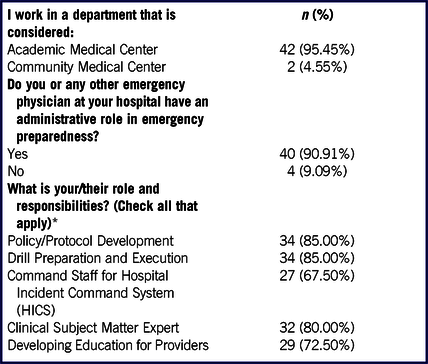
During the study period in 2019, a total of 109 email addresses were deliverable to email addresses obtained and a total of 44 people participated, with a response rate of 40.4%. Of the responders, 42 (95.45%) worked in an academic medical center and 40 (90.91%) had an administrative role in hospital preparedness with responsibilities ranging from policy development to clinical subject matter expert and developing educational content as noted in Table 1. Of the participants, nearly half reported to either the Chief Medical Officer (25.00%) or their Department Chair/Chief (22.50%).
Participants’ Department Practice Setting and Roles Performed

* Percentages will be > 100% as multiple options possible.
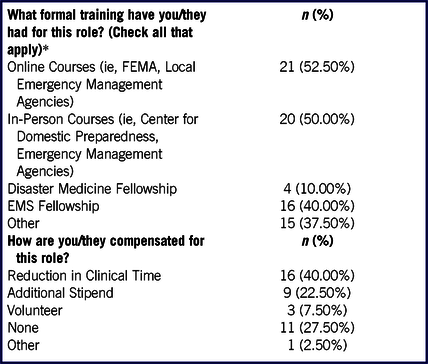
The background education and training of emergency physicians involved in hospital preparedness varied, as noted in Table 2. Participants could select more than 1 option, and the majority had pursued online or in-person training for their roles by means of Federal Emergency Management Agency (FEMA) or other emergency management agencies. Fellowship training in disaster medicine was less common than emergency medical services (EMS) fellowship (10.00% vs 40.00%, respectively). Other training experiences included responses such as training with their urban search and rescue (USAR) team, military experiences and training, prior EMS/fire experience, master’s programs, and self-taught training.
Training and Compensation for the Participant’s Role

* Percentages will be > 100% as multiple options possible.
With increasing hospital and department preparedness, participants noted different compensation plans for their participation and role in hospital emergency preparedness. As noted in Table 2, the majority of participants saw a reduction in clinical time to complete the necessary tasks associated with their roles. This reduction, combined with additional stipend, was the source of compensation for 62.5% of participants. However, just over a quarter of participants saw no compensation for the additional responsibilities and role.
Despite the varied roles, responsibilities, and compensation of participants, the vast majority (93.18%) strongly agreed that it was important to have an emergency medicine physician with expertise in disaster medicine assisting with hospital preparedness. Only 1 (2.27%) somewhat disagreed with the statement.
DISCUSSION
EDs across the United States provide care for patients around the clock. With the increasing number of both intentional and natural events putting more people at risk, health-care institutions must continue to develop their preparedness.Reference Smith1,4 Despite the development of drills and Emergency Managers within hospitals to improve preparedness, less is known about the current role of emergency physicians in hospital preparedness.
In this study, the majority of participating physicians played an administrative role in their hospital’s preparedness. However, their training for the role varied greatly, with many obtaining their training from online courses through emergency management agencies, such as the FEMA or in-person courses. The least common manner for formal training was through disaster medicine fellowships, while more participants received formal training through their EMS fellowship for their role. This may be related to the number of programs available, as the Society for Academic Emergency Medicine (SAEM) lists 15 disaster medicine fellowships compared with 64 for EMS.7 As the field of disaster medicine and the involvement of physicians increases, the number of these programs will likely increase as well.
Not only do emergency physicians provide care during disaster events, the need for collaboration and serving as a resource has become increasingly recognized. Among participants, 90.91% held an administrative role in hospital preparedness and would provide assistance with policy and protocol development, drill execution, and serving as a subject matter expert for their hospital. MacFarlane et al. noted the important role emergency physicians play in developing disaster medicine, disaster medicine training programs and how emergency physicians can help grow this important field.Reference MacFarlane, Joffe and Naidoo8 Additionally, a survey of community health centers found that, although their preparedness was improved, a need still existed for assistance in decontamination training as well as personal preparedness.Reference Ablah, Tinius and Horn9 Emergency physicians with expertise in disaster medicine can provide this critical linkage for community health centers, building resiliency in their community.
The study participants overwhelmingly agreed (93.18% strongly) that having an emergency physician with expertise in disaster medicine was important when it came to hospital and ED preparedness. Prior studies examining preparedness found that many believed their departments were not prepared or they themselves were not prepared.2,Reference Alexander and Wynia5 When examining the level of preparedness, a previous study found similar low results for preparedness, although larger EDs felt more prepared than smaller EDs.Reference Morton, Kirsch and Rothman10 Incorporating emergency physicians with expertise in preparedness may help to improve these low levels of preparedness both for individuals in the department and across the hospital. However, emergency physicians are just 1 link in preparedness. Successful preparedness activities involve a team of teams responding as noted in prior events such as the Dallas shootings in 2016.Reference Burgher and Klein11 Preparedness requires a coordinated multidisciplinary approach, including prehospital personnel and Chaplains, nursing, and physicians of various specialties to evaluate, reassess, and treat the surge of casualties.Reference Burgher and Klein11,Reference Smith, Cheatham and Safcsak12 Without a coordinated and multidisciplinary approach, including emergency physicians, optimal patient care will not be achieved during times of disaster.
It is important to note that, with all studies, there are potential limitations. With this study, the response rate was 40.4% and may have resulted in a nonresponder bias. Responding participants overwhelmingly held a role in emergency preparedness, and this may be related to those with an interest in the topic completing the survey compared with nonresponders as well as the survey being directed to Department Chairs. Among the 148 initial emails, 39 were undeliverable; another limitation of the study as no contact information was available for survey completion for these institutions. This study also only surveyed academic medical centers, and the emails were directed to the Chairs, which may limit the generalizability of the results compared with all hospital types, including community hospitals and free-standing emergency departments given the convenience sampling. The survey tool asked if individuals held an administrative role and did not include other avenues of emergency preparedness participation including hospital committee involvement.
CONCLUSIONS
Hospital emergency preparedness will remain paramount given the increasing number of natural and intentional disaster events across the United States. Of participating academic medical centers, emergency physicians have taken an active role in hospital preparedness, seeking out training to better equip them for development of contingency plans and caring for patients. However, further information is necessary to determine emergency physician involvement at community hospitals, free-standing emergency rooms, and health centers as part of a multidisciplinary approach to hospital preparedness activities.