INTRODUCTION
Schistosome and soil-transmitted helminth (STH) infections continue to attract an increasing interest among health researchers, policy makers and donor agencies due to their impact on subtle and severe morbidity in endemic regions. An estimated 207 million people in 74 countries are infected with schistosomiasis (Steinmann et al. Reference Steinmann, Keiser, Bos, Tanner and Utzinger2006), with a bulk of the global cases (90%) residing in sub-Saharan Africa (WHO, 2002; Hotez and Yamey, Reference Hotez and Yamey2009). It is estimated that over 9·1 million Kenyans are infected with schistosomiasis (WHO, 2010). Similarly, STH infections are most prevalent in tropical and sub-tropical regions of the developing world where adequate water and sanitation are lacking, with estimates suggesting that Ascaris lumbricoides infects 1,221 million people, Trichuris trichiura 795 million, and hookworms 740 million (de Silva et al. Reference de Silva, Brooker, Hotez, Montresor, Engels and Savioli2003). According to the recently launched Global Atlas of Helminth Infections (GAHI, 2010), over 9·1 million Kenyans are at risk of STH infections, out of which 2·4 million are school-aged children.
Despite the availability of effective and safe drugs for their treatment, schistosome and STH infections continue to exert significant morbidity in sub-tropical countries. Among the morbidities are under-nutrition, anaemia and cognitive impairment (Booth and Bundy, Reference Booth and Bundy1992; Stephenson et al. Reference Stephenson, Latham and Ottesen2000), with school children harbouring the heaviest burden of disease (Warren et al. Reference Warren, Bundy, Anderson, Davis, Henderson, Jamison, Prescott, Senft, Jamison, Mosley, Measham and Bobadilla1993). The degree of morbidity is related to the intensity of infection (Stoltzfus et al. Reference Stoltzfus, Albonico, Chwaya, Savioli, Tielsch, Schulze and Yip1996) and the number of different species harboured (Booth et al. Reference Booth, Bundy, Albonico, Chwaya, Alawi and Savioli1998). Increased urbanization characterized by inadequate sanitation and overcrowding may promote the transmission of STH infections. By 2007, it was predicted that more than half of the global human population will be urban citizens, most of them living in the rapidly growing cities of Africa, Asia and Latin America (United Nations, 2003).
There is a global commitment to finance and im-plement helminth control strategies with a focus on school-based chemotherapy programmes. In Kenya, the Ministry of Health's Department of Child Health seeks to promote good health and nutrition, and it recognizes the detrimental effects of STH infections in primary-school-aged children (MOH, 2008). Several challenges exist towards the implementation of cost-effective helminth control strategies. First, while schistosomiasis tends to be focal in distribution, there is inadequate attention given to research on the geographical distribution of STH infections and an understanding of helminth epidemiology in low-income settings of urban areas. Second, although STH infections flourish in impoverished areas, data on STH infections from such areas in urban settings are remarkably few. Assessment of helminth distribution and prevalence in such settings therefore serves to inform the design and implementation of cost-effective control efforts and to monitor their impact both at national and regional levels.
The objective of this cross-sectional study was to determine the prevalence and distribution of schistosomiasis and soil-transmitted helminth infections among school children in informal urban settlements in Kisumu City, western Kenya in preparation for a Community Directed Intervention (CDI) strategy for helminth control. Relationships between infection intensities and anthropometric indices were also evaluated. Although there have been previous surveys on schistosomiasis and STH infections in the informal settlements of Kisumu, detailed reports were not compiled and none of these surveys were published in peer reviewed journals.
MATERIALS AND METHODS
Study site and population
The study was conducted in Kisumu City, which borders Lake Victoria in western Kenya, between September and November 2010. Kisumu is the third largest urban centre in Kenya with an area of 417 sq. km (157 sq. km. of water and 260 sq. km. of land) and a population estimated at 500,000 (UN Habitat, 2005). The urban area consists of eight informal settlement areas, namely Bandani, Kaloleni, Manyatta A, Manyatta B, Nyalenda A, Nyalenda B, Nyamasaria and Obunga (UN Habitat, 2005). In the Lake Victoria region, the lake is the primary source of S. mansoni infection, with an inverse association between distance to the lake and prevalence of infection (Handzel et al. Reference Handzel, Karanja, Addiss, Hightower, Rosen, Colley, Andove, Slutsker and Secor2003).
Like many other rapidly growing cities, Kisumu faces many socio-economic challenges such as overcrowding and lack of adequate water and sanitation that accompany urbanization. For instance, Kisumu is faced with acute water shortage as only 40% of the population have access to piped water. A majority of slum dwellers rely on unprotected wells, the lake, and springs that are subject to high degrees of contamination due to the rampant use of pit latrines and to high water tables (UN Habitat, 2005). High water tables coupled with black cotton soils and rock outcrops in these informal areas also affect both drainage and latrine construction. Some 11% of slum residents have no latrines and must rely on undignified coping mechanisms such as relying on neighbours' toilets, wrap and throw (“flying toilet”) and use of open fields (UN Habitat, 2005). Consequently, there is a high prevalence of water- and sanitation-related morbidity in the slums.
Study design
All primary schools within the informal settlement areas (n=34) were selected for participation in the study. One boarding school (Jan's Academy) was excluded from the survey because the students came from outside the region. A list of registered students in classes 5, 6 and 7, aged between 10 and 18 years was obtained from the headmaster at each school. Fifty students were randomly chosen from each school list using a random number generator. In cases where there were fewer than fifty students per class, all the students in that class were included in the survey. In addition, an appropriate number was selected from the next lower class to attain the closest number to fifty. Informed consent was obtained from the parent or guardian, and assent was obtained from the student prior to enrolment in the survey. Children infected with schistosomiasis were treated with 40 mg/kg praziquantel (PZQ) and those infected with STH were treated with 400 mg albendazole (ALB). Prior to the current study, there was one school-based national deworming exercise that was conducted in May 2009, where a single dose of ALB (400 mg) was administered. The current study was reviewed and approved by the Scientific and Ethical Review Committees of the Kenya Medical Research Institute.
Geographical distribution of infections
To determine the geographical distribution of the infection prevalence, positions of all primary schools in the informal settlements were mapped using hand-held differential geographic global positioning system (GPS) units (Trimble Navigation Ltd, California, USA) with an estimated accuracy of ±1 meter (Hightower et al. Reference Hightower, Ombok, Otieno, Odhiambo, Oloo, Lal, Nahlen and Hawley1998). Rivers, sewage line, airport and the lakeshore were also mapped. Data were downloaded with differential correction into a GPS database (GPS pathfinder office 2.8 Trimble Navigation Ltd, California, USA) and analyses performed using ArcView version 9.2 software (Environmental Systems Research Institute Inc., Redlands, California, USA). Mapped school prevalence was categorized according to WHO prevalence thresholds for mass drug administration (WHO, 2002), with an added category denoting zero prevalence: 0%, 0·1–9·9%, 10–49·9% and 50–100%.
Parasitological assessment
Parasitological assessment was based on one stool and urine sample per child. Plastic stool containers and polypropylene urine tubes were given to children on the morning of the day for the survey, and the children were instructed to bring samples of their stool and urine. Up to 85·6% and 95% of children returned stool and urine samples respectively. All stool and urine samples were transported to The Ministry of Health's Division of Vector-Borne Diseases (DVBD) laboratory, Kisumu, where they were processed. Hookworm eggs were examined within 1 hour of slide preparation whereas all other helminths were examined within one month. Each stool sample was analyzed in duplicate by the Kato-Katz method for eggs of S. mansoni, A. lumbricoides, T. trichiura and hookworms (WHO, 1994). A template was used that when filled contained approximately 41·7 mg of faeces. Eggs were counted by two independent microscopists and any discrepancy in results was reconciled. The concentration of eggs was expressed as eggs per gram (epg) of faeces. Intensity of infection was categorized according to the World Health Organization (WHO)-proposed thresholds (WHO, 2002). S. haematobium was categorized as either positive or negative. Approximately 15 mL of urine was collected from each student. Haematuria was determined using URiSCAN test strips (YD Diagnostics, Kyunggi-Do, Korea) and was used as a proxy indicator of urinary schistosomiasis (Savioli et al. Reference Savioli, Hatz, Dixon, Kisumku and Mott1990).
Anthropometric assessments
Children's heights were measured to the nearest 0·1 cm using a standard retractable steel measuring tape (CTO International, Shenzhen, China), and weights were measured to the nearest 0·1 kg using a portable mechanical bathroom scale (Salter Housewares Ltd, Tonbridge, UK, model # 144). Children were lightly clothed and shoes were removed during weighing. Height-for-age and Body Mass Index-for-age Z-score values (HAZ and BMIZ respectively) were derived from the recently updated WHO international height and BMI references for children and adolescents aged 5–19 years (WHO, 2006b).
Statistical analysis
All analyses were performed using SAS statistical software (v. 9.2; SAS Institute Inc., Cary, North Carolina, USA) and P values <0·05 were considered statistically significant. Unless otherwise indicated, values are presented as means±S.D. Data were tested for normality prior to analysis, and where necessary log-transformed to achieve normality. Arithmetic means of egg counts were calculated and expressed as eggs per gram (epg) of stool. Number of infected individuals among informal settlements was compared using a 5×8 contingency table. Comparisons for anthropometric morbidities between infected and uninfected groups were performed using Fischer's exact test. Associations between infection intensity and anthropometric outcomes were determined using spearman correlations (rs). The effect of age and gender on whether a child was infected was analysed using logistic regression. Given the typical overdispersion of egg counts, Kruskal-Wallis analyses were used to assess the variation of egg counts by age and gender.
RESULTS
A total of 1,308 children were included in the survey, with ages ranging from 10 to 18 years. The mean age was 12·9 and the median was 13 years.
Geographical distribution of infections
As expected, schools in closest proximity to Lake Victoria had the highest S. mansoni prevalence while schools with STH infections were more homogeneously distributed (Fig. 1). S. mansoni recorded the highest number of schools within the 10–49·9% prevalence threshold followed by T. trichiura (Fig. 1). S. mansoni was absent in 1 school, hookworm in 7, A. lumbricoides in 8 while T. trichiura was absent in 5 schools (Fig. 1).
Geographical distribution of Schistosoma mansoni, hookworm, Ascaris lumbricoides and Trichuris trichiura among schools in informal settlement areas of Kisumu City, Kenya.

Parasitological outcomes
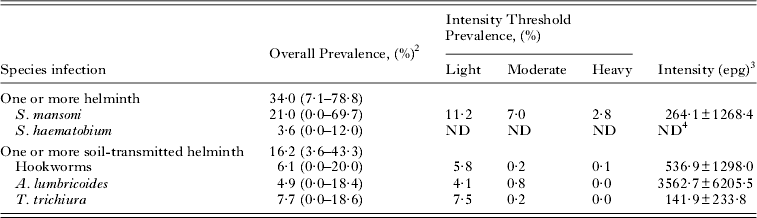
Overall, 34% of the children were infected with either S. mansoni or one of the STH, while 16·2% of children were infected with one or more STH species (Table 1). The most prevalent helminth infection among the children was S. mansoni (21%) (Table 1). Only 2 schools (Dunga and Rae Kanyaika), situated close to the lakeshore and river Nyamasaria, respectively, had S. mansoni prevalence >50% (Fig. 1). S. mansoni prevalence was ⩾10% but <50% in 27 schools (Fig. 1). The overall prevalence of STH species was >10% in 25 schools, but no school had STH prevalence >50%. S. mansoni infections were mainly light and moderate, whereas STH infections were predominantly light (Table 1). Analysis of log-transformed epg among schools revealed significant differences for S. mansoni (F 28, 207=2·04, P=0·0025), A. lumbricoides (F 21, 32=3·32, P=0·0011) and T. trichiura (F 26, 70=2·78, P=0·0004) but not for hookworm. For both S. mansoni and hookworm, the lowest infection intensity prevalence was in the heavy infections (Table 1).
Prevalence and intensity of infection for schistosomiasis and soil transmitted helminths among children 10–18 years old in Kisumu City, Kenya1

1 Sample size: 10 years-15, 11 years- 99, 12 years-362, 13 years-480, 14 years-208, 15 years-87, 16 years-33, 17 years-14, 18 years-1.
2 Values in parentheses indicate prevalence range in schools.
3 Intensity of infection expressed as arithmetic mean±SD.
4 Not determined.
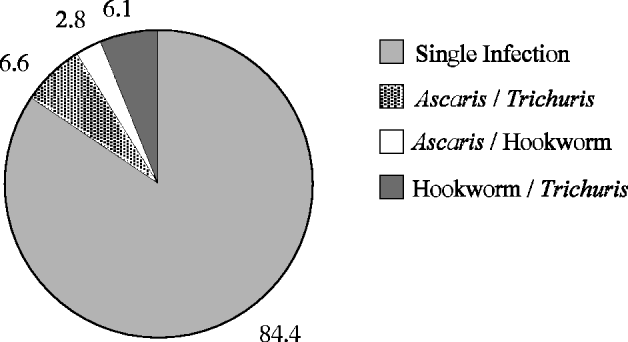
The proportions of children infected with multiple helminth species were very low. Out of the 1,308 children surveyed, 3% harboured two species infections, 0·2% harboured three species infections and none harboured all 4 species of helminths. 3·1% of children harboured both S. mansoni and at least one STH infection. The distribution of STH co-infections among infected children is shown in Fig. 2. Ascaris-Trichuris was the most common STH co-infection observed in children. None of the children harboured all the three species of STH (Fig. 2).
Prevalence (%) of mono-specific soil transmitted helminths and co-infections among 212 infected primary school children in Kisumu City, Kenya.

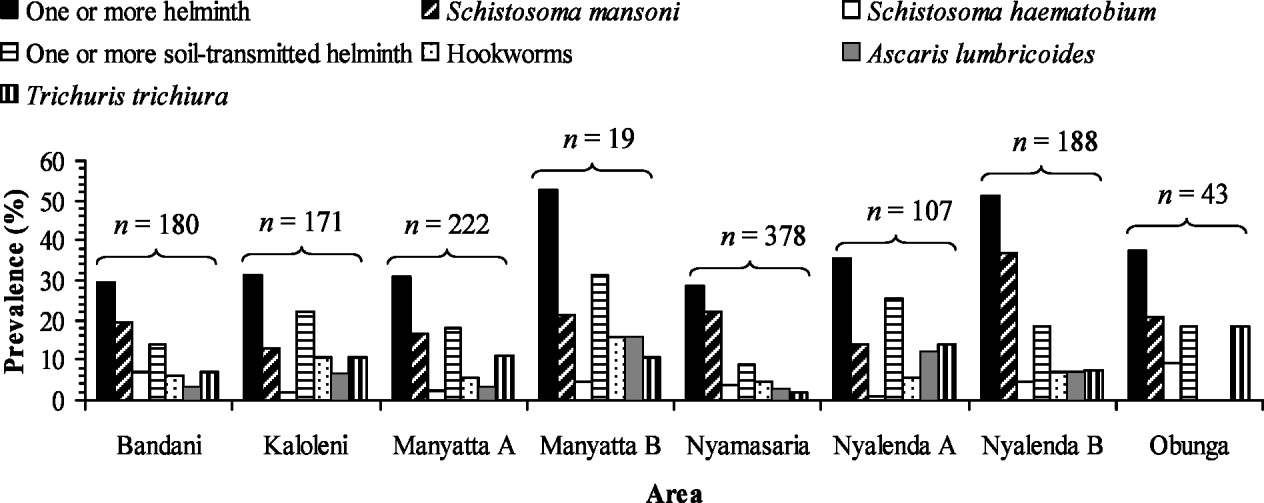
With regards to helminth prevalence by area, there was a significant difference in number of individuals infected with the 5 helminths from the eight informal settlement areas (5 by 8 contingency table: Χ2=7·3, df=28, P=0·000). Overall, S. mansoni prevalence was highest in Nyalenda B and lowest in Kaloleni, S. haematobium prevalence was highest in Obunga and lowest in Nyalenda, whereas STH prevalence was highest in Manyatta B and lowest in Nyamasaria (Fig. 3). S. mansoni prevalence >20% was recorded in Manyatta B, Nyalenda B, Nyamasaria and Obunga, whereas STH prevalence >20% was recorded in Kaloleni, Manyatta B and Nyalenda A (Fig. 3). None of the areas reported prevalence >50% for both S. mansoni and STH infections.
Prevalence of schistosomiasis and soil transmitted helminths among informal settlements in Kisumu City, Kenya.

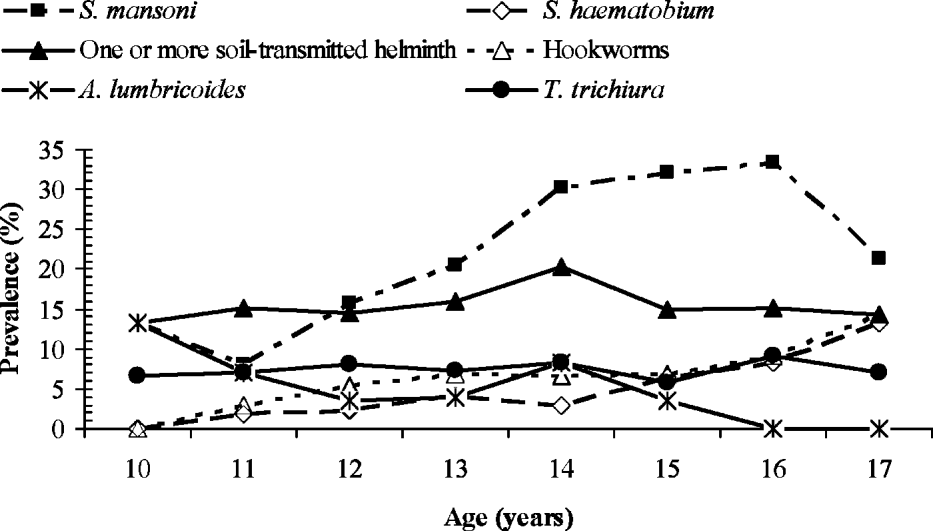
We also determined the prevalence of schistosome and STH infections among the study population by age. Among all the helminths surveyed, S. mansoni had the highest prevalence across all ages (Fig. 4). Logistic regression revealed a significant relationship between host age and being infected with S. mansoni (P<0·0001), S. haematobium (P=0·002) and hookworm (P=0·048) within the 10–17 year age bracket. Prevalence increased from 13·3% among children aged 10 years to peak at 33·3% among children aged 16 years before declining for S. mansoni, and steadily increased from 0% among children aged 10 years to peak at 13·3% and 14·3% among children aged 17 years for S. haematobium and hookworm, respectively (Fig. 4). In contrast, no significant relationship between host age and infection prevalence was detected for A. lumbricoides and T. trichiura. Prevalence for A. lumbricoides steadily decreased from 13·3% in 10-year olds to 0% in 16-year olds, whereas the prevalence for T. trichiura remained similar across the ages (Fig. 4).
Prevalence of Schistosoma mansoni, Schistosoma haematobium, hookworm, Trichuris trichiura and Ascaris lumbricoides infections by age.

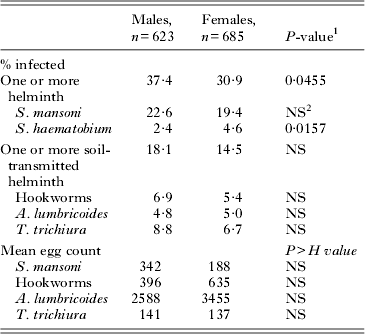
Whereas the prevalence of S. haematobium was ∼2-fold higher in females compared to males, there was no difference in the prevalence and intensity of infection for S. mansoni and STH between males and females (Table 2). Females were more than twice as likely to be infected with S. haematobium than males (OR=2·11; 95% CI: 1·15–3·88).
Prevalence and intensity of infection for schistosomiasis and soil transmitted helminths among school children by gender

1 Significance tested by logistic regression for prevalence and Kruskal-Wallis for egg counts.
2 Not significant.
Anthropometric outcomes
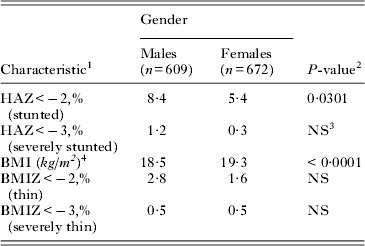
Compared with standard reference data, 6·8% out of 1,281 children were stunted (HAZ<−2) and 0·7% were severely stunted (HAZ<−3), while 2·2% were thin (BMIZ<−2) and 0·5% were severely thin (BMIZ<−3). Females were less likely to be stunted than males (OR=0·61; 95% CI: 0·39–0·95). The BMI was higher in females than in males (X2=33, df=1, P<0·0001) (Table 3).
Prevalence of anthropometric morbidities among school children 10–18 years old in Kisumu City, Kenya

1 HAZ=Height-for-age Z-score, BMI=Body mass index, BMIZ=Body mass index-for-age Z-score. Data were considered biologically implausible and excluded if HAZ was<−6 or >+6 and BMIZ was<−5 or >+5.
2 Significance tested by logistic regression for prevalence (%) and Kruskal-Wallis for BMI.
3 Not significant.
4 Values are means.
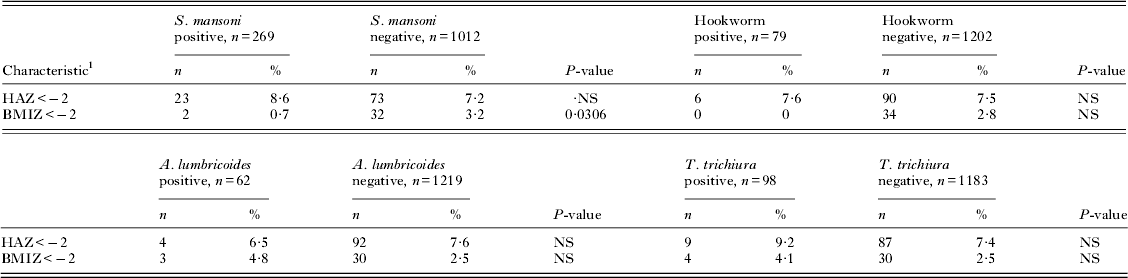
There was no association between the four helminths (S. mansoni, Hookworm, A. lumbricoides and T. trichiura) and related morbidities such as stunting (as indicated by the height-for-age Z score) or thinness (as indicated by the BMI-for-age Z score) (Table 4). Contrary to expectation, prevalence for thinness was lower in S. mansoni-positive than S. mansoni-negative children (Table 4). None of the STH had any impact on thinness in the children. In addition, we did not find any significant correlation between infection intensities and anthropometric indices.
Schistosomiasis and STH-associated morbidities by infection status in 10–18 year-old school children in Kisumu City, Kenya

1 HAZ=Height-for-age Z-score, BMI=Body mass index, BMIZ=Body mass index-for-age Z-score. Data were considered biologically implausible and excluded if HAZ was<−6 or >+6 and BMIZ was<−5 or >+5.
DISCUSSION
This cross-sectional study highlights the significant burden of schistosomiasis and STH infections and outlines their distribution among schools in an informal urban setting. Over one-third of the school children were infected with one or more helminth species. S. mansoni was the most prevalent with over one-fifth of the school children infected. About one in six of the children tested were infected with one or more STH. Consistent with previous research (Handzel et al. Reference Handzel, Karanja, Addiss, Hightower, Rosen, Colley, Andove, Slutsker and Secor2003), our data demonstrate that schools in closest proximity to Lake Victoria had the highest S. mansoni prevalence while schools with STH infections were more homogeneously distributed, and that GIS is a useful tool for identifying high-risk populations and transmission sites.
The mean school prevalence of S. mansoni in our study (21%) was higher compared to previous studies in western Kenya (16·3%) (Handzel et al. Reference Handzel, Karanja, Addiss, Hightower, Rosen, Colley, Andove, Slutsker and Secor2003) and in Kampala City, Uganda (4·1%) (Kabatereine et al. Reference Kabatereine, Kazibwe and Kemijumbi1996). Differences may be due to the focal distribution of S. mansoni (Booth et al. Reference Booth, Vennervald, Kenty, Butterworth, Kariuki, Kadzo, Ireri, Amaganga, Kimani, Mwatha, Otedo, Ouma, Muchiri and Dunne2004) and close proximity of schools in Kisumu City to Lake Victoria. On the other hand, the prevalence and intensity of STH infections should be interpreted in light of the fact that there had been one deworming exercise prior to this study. Nevertheless, the STH prevalence for schools in our study accords well with another study (Phiri et al. Reference Phiri, Whitty, Graham and Ssembatya-Lule2000), but was lower compared to other studies (Albonico et al. Reference Albonico, Chwaya, Montresor, Stolfzfus, Tielsch, Alawi and Savioli1997; Kabatereine et al. Reference Kabatereine, Kemijumbi, Kazibwe and Onapa1997; Ndenecho et al. Reference Ndenecho, Ndamukong and Matute2002) conducted in urban areas of similar socio-economic characteristics in Africa. Two observations may explain the relatively low STH prevalence in our study; first the direct smear microscopic analysis of single stool samples may miss light infections because of poor sensitivity and day-to-day fluctuation in egg excretion (Booth et al. Reference Booth, Vounatsou, N'Goran, Tanner and Utzinger2003), thus 16·2% is a minimum estimate of prevalence. Future surveys may be enhanced by examining stool samples collected for at least two consecutive days. Second, low STH prevalence may be attributable to the Kenya National deworming exercise conducted in 2009, in which all schools in our study participated. S. mansoni and S. haematobium prevalence increased with age, consistent with age-prevalence curves that peak in early adolescence (Fulford et al. Reference Fulford, Webster, Ouma, Kimani and Dunne1998). The higher prevalence for S. haematobium in females compared to males in our study needs cautious interpretation. Use of urine reagent strips for diagnosing S. haematobium is known to have a lower sensitivity, especially among women of reproductive age due to contamination of urine with vaginal blood (Brooker et al. Reference Brooker, Kabatereine, Gyapong, Stothard and Utzinger2009). In future, cases positive for haematuria need to be inspected for eggs by either simple sedimentation or by urine filtration to confirm infection status more precisely. In the context of this study, however, treatment alogrithms for administration of praziquantel by school were determined by local prevalence of intestinal schistosomiasis alone.
Multiple STH infections were less common than in other studies in East Africa. In Busia, Kenya, 26% of children were infected with all 3 STHs and 31·1% with 2 (Brooker et al. Reference Brooker, Miguel, Moulin, Luoba, Bundy and Kremer2000). In Pemba, Tanzania 67% of children were infected with all 3 STHs and 28% with 2 (Albonico et al. Reference Albonico, Chwaya, Montresor, Stolfzfus, Tielsch, Alawi and Savioli1997). Such differences might arise from differences in study subjects, socio-demographic conditions and socio-economic characteristics of the areas. The highest co-infection prevalence observed for Ascaris and Trichuris in our study supports findings by Booth and Bundy (Reference Booth and Bundy1992) that these two species have a closely related distribution.
The prevalence and distribution of schistosomiasis and STH infections in our study has several implications for mass treatment programmes. WHO recommends mass drug administration with PZQ (for schistosomes) and ALB or mebendazole (MBD) (for STH) wherever the prevalence of infection exceeds 10% (WHO, 2002). Following this recommendation, 29 (over 85%) of the schools require mass treatment for schistosomiasis. Of the 1,308 school children surveyed, 1,137 (87%) would benefit from mass treatment. This would include 267 (97%) of 274 children infected with intestinal schistosomiasis. Only 2 schools (S. mansoni prevalence >50%, classified as high risk) and 13 schools (S. mansoni prevalence ⩾20% but <50%, classified as moderate risk) would require treatment once a year and once every 2 years, respectively (WHO, 2006a).
In our study, 25 (over 70%) of the schools would require mass treatment for STH. Of the 1,308 school children surveyed, 944 (72%) would benefit from mass treatment. This would include 188 (89%) of 212 children infected with STH. 9 schools (STH prevalence ⩾20% but <50%, classified as low risk) would require treatment once each year (WHO, 2006a). Based on our findings, 22 schools would require co-administration of PZQ and ALB or MLB, 7 schools would require PZQ and 3 schools would require ALB or MBD. The absence of STHs in several schools, absence of schools with >50% STH prevalence and the very low prevalence of moderate-heavy infection intensities perhaps reflects the impact of the 2009 National deworming exercise. Low prevalence of heavy infections for both S. mansoni and hookworm infection is consistent with the aggregation phenomenon (Anderson and May, Reference Anderson and May1991), which is often accompanied by significant morbidity based on anthropometric indices.
Height- and weight-based anthropometric measurements in children are important tools for gauging general nutritional and health status in a population. The approximately 7% stunting and 2% thinness in our study would be classified as ‘low prevalence’ and ‘acceptable’, respectively (WHO, 1995), and suggests that monitoring is required. Besides helminth infections, stunting and thinness may be associated with multiple micronutrient deficiencies and chronic malarial infections that are common among Kenyan school children (Siekmann et al. Reference Siekmann, Allen, Bwibo, Demment, Murphy and Neumann2003; Clarke et al. Reference Clarke, Brooker and Njagi2004). The other parameter of interest was BMI. BMI is positively associated with fat mass in adolescents (Pietrobelli et al. Reference Pietrobelli, Faith, Allison, Gallagher, Chiumello and Heymsfield1998), and the higher BMI in females in the present study may be associated with higher level of body fat in females compared to males. However, since BMI in children is age- and gender-dependent unlike in adults, it may only serve as a screening tool and not a determinant of an adolescent's health status.
Despite the significant prevalence of S. mansoni and STH infections among children in this study, helminth-related morbidities were not associated with infection. Absence of schistosomiasis- or STH-associated morbidities may be related to lower intensity infections that perhaps lead to subtle or non-measurable sequelae, or may be explained by the low prevalence of multiple helminth infections. Children with multiple helminth infections especially those with heavy infection intensities tend to experience more severe cognitive outcomes and other health problems such as malnutrition than children with only one helminth infection (Jardim-Botelho et al. Reference Jardim-Botelho, Raff, de Avilla Rodrigues, Hoffman, Diemert, Correa-Oliveira, Bethony and Gazzinelli2008). Furthermore, consequences of infection on growth may take years to manifest and may not be immediately apparent using such a cross-sectional study. Nevertheless, our anthropometry data provide useful baseline information for local public health initiatives involving nutritional surveillance. Prospective longitudinal studies of growth after treatment are recommended to fully elucidate the associations between helminth infections and their associated morbidity.
In summary, our study demonstrates that schools in closest proximity to Lake Victoria and River Nyamasaria had the highest S. mansoni prevalence while schools with STH infections were more homogeneously distributed among informal settlements in Kisumu City, western Kenya. The significant burden of schistosomiasis and STH infections in these schools highlights the need for routine deworming programmes alongside other interventions in such settings. Health education, strengthening of basic infrastructure and sanitation, and community involvement are advocated for to complement chemotherapy.
ACKNOWLEDGEMENTS
We appreciate the support from the Ministry of Education, Ministry of Public Health and Sanitation, Municipal Council of Kisumu and the local administration. We thank the head teachers, teachers and students in each of the schools that participated in this study. We also thank Maurice Ombok for his assistance in the collection of GIS data, Boaz Mulonga, Geoffrey Muchiri, Rosemary Musuva, Joseph Oduol, Elizabeth Tulo, Blasto Kwanya, Edward Otieno, James Ooro, Charles Odah and Tobias Osewe for their assistance in the field and laboratory work. This paper is published with the permission of the Director of the Kenya Medical Research Institute.
FINANCIAL SUPPORT
This work was supported by The European Foundations Initiative for Neglected Tropical Disease (EFINTD) (grant number I/85 041) to PNM.