Introduction
RTC corresponds to a repertoire of behaviors that hinder assistance with activities of daily living (ADLs), including help with dressing, meals, use of toilets, bathing, and daily hygienic care (Mahoney et al., Reference Mahoney1999). Also called combativeness, lack of collaboration or care refusal, it occurs in about 70% of PWD in the course of the disease (Hope et al., Reference Hope, Keene, Fairburn, Jacoby and McShane1999; Keene et al., Reference Keene, Hope, Fairburn, Jacoby and Gedling1999). Considered a defensive response (as opposed to aggressive behaviors considered offensive; Gibson, Reference Gibson1997), resistive behaviors nonetheless represent a very serious clinical problem, especially for nursing home residents requiring a high level of care assistance.
Numerous researchers have examined RTC directly or indirectly by targeting agitated or aggressive behaviors in various contexts, including ADL assistance. They showed that aggressive behaviors of PWD occur most often during care provision. Hygienic care, in particular, is identified as the precipitating event in most cases of aggressive incidents. Many explanations have been suggested as to why this context might be critical regarding RTC. Touch and physical proximity, which can cause discomfort, pain, or a feeling of invasion of personal space, are among them. The resident's perception regarding the activity interpreted as threatening, unnecessary, or unpleasant is another. Organizational aspects (being short staffed, rushed, or on an inflexible schedule) can also affect staff attitudes and the resulting interaction (Zeller et al., Reference Zeller, Hahn, Needham, Kok, Dassen and Halfens2009).
Earlier work has identified associations between specific caregiver behaviors and aggressive behaviors, agitation, or RTC in PWD. Touching in the context of ADL assistance seems to be eliciting problematic behaviors, at least in some PWD (Marx et al., Reference Marx, Werner and Cohen-Mansfield1989; Burgio et al., Reference Burgio, Butler, Roth, Hardin, Hsu and Ung2000). However, some studies did not find this association (Burgener et al., Reference Burgener, Jirovec, Murrell and Barton1992; Roth et al., Reference Roth, Stevens, Burgio and Burgio2002). Others conclude that the care recipient's reaction depends upon numerous personal and situational factors which remain to be elucidated, since these behaviors can be triggered by both touch and absence of touch (Somboontanont et al., Reference Somboontanont, Sloane, Floyd, Holditch-Davis, Hogue and Mitchell2004).
Verbal interaction between caregiver and PWD is generally considered to elicit agitation, aggressiveness, or RTC (Burgener et al., Reference Burgener, Jirovec, Murrell and Barton1992; Cohen-Mansfield and Werner, Reference Cohen-Mansfield and Werner1995; Hart and Wells, Reference Hart and Wells1997; Roth et al., Reference Roth, Stevens, Burgio and Burgio2002; Somboontanont et al., Reference Somboontanont, Sloane, Floyd, Holditch-Davis, Hogue and Mitchell2004). However, reaction to caregiver verbal behaviors may also vary according to the nature of the verbalizations (Roth et al., Reference Roth, Stevens, Burgio and Burgio2002; Somboontanont et al., Reference Somboontanont, Sloane, Floyd, Holditch-Davis, Hogue and Mitchell2004; Whall et al., Reference Whall2008; Williams et al., Reference Williams, Herman, Gajewski and Wilson2009; Williams and Herman, Reference Williams and Herman2011), its complexity (Hart and Wells, Reference Hart and Wells1997), or could vary from one person to another (Burgio et al., Reference Burgio, Butler, Roth, Hardin, Hsu and Ung2000).
In short, results from these studies indicate that physical and verbal behaviors of caregivers are important contributing factors to RTC behaviors. However, current knowledge is insufficient to give a clear description of their precise effect on PWD. They also indicate that interactions that take place during hygienic care could be crucial to our understanding of the phenomenon. Of course, the very nature of RTC, which occurs in a context characterized by complex interactions between caregiver and care recipient poses serious methodological difficulties. No study has succeeded in encompassing the dynamic dimension of interactions involved in RTC. Studies based on a sound methodology are needed to elucidate the relationships involved. Moreover, a context-specific approach to the study of RTC seems critical, since agitated, resistive, or aggressive manifestations elicited in different situations probably have different precipitating factors, functions, and ultimately require different management strategies (Gibson, Reference Gibson1997; Volicer et al., Reference Volicer, Bass and Luther2007).
It is noteworthy that the majority of studies on the subject focus exclusively on “dysfunctional” behaviors of PWD. No study, to our knowledge, has identified associations between specific care provider behaviors and collaborative behaviors in care situations. The literature on collaboration, participation, or cooperation to care in PWD is very scarce. A few qualitative studies explore the hygienic care context and finds that cooperation can characterize certain portions of the care routine (Westerberg and Strandberg, Reference Westerberg and Strandberg2007), and describe the quality of the cooperative relationships that can place (Hallberg et al., Reference Hallberg, Holst, Nordmark and Edberg1995). Only one systematic observation considered cooperative behavior in PWD as an outcome, but among other functional and calm behaviors (Burgener et al., Reference Burgener, Jirovec, Murrell and Barton1992), making it impossible to draw specific conclusions.
The specific aim of this research was to study the interplay between various physical and verbal behaviors of caregivers and the RTC and collaborative behaviors of PWD in the context of daily hygienic care. A methodology of direct systematic observation supplemented by video recording was conducted. Sequential analyses on observational data were performed. Hypotheses about possible antecedent – consequence sequential relationships between predetermined behavioral categories were tested. Various verbal (positive, neutral and negative statements, positive and negative instructions, distraction) and physical caregiver behaviors (instrumental and expressive behaviors) were examined as possible antecedents to RTC and collaborative behaviors of PWD. Care recipient behaviors (resistant, collaborative, or no particular behavior) that preceded actions by the caregiver were taken into account in the analyses.
Methods
Participants and settings
Eight PWD participated in this study. At recruitment, participants had to be living in the nursing home for at least three months and their medical record had to confirm a dementia diagnosis. In addition, they had to exhibit RTC behaviors at least three to five times during most acts of hygienic care during the previous two weeks, (according to the RTC Behaviors Grid, described below). The caregivers who regularly gave daily hygienic care to the participants were also recruited as participants in the study. Forty-three caregivers are included in the sample.
Consent to participate was obtained from the health care proxy or surrogate decision-maker. Caregivers participating in hygienic care also signed consent forms. Procedures followed were in accordance with the ethical standards of the responsible committees and with the Helsinki Declaration of 1975, as revised in 1983.
Measures and material
Care recipient and caregiver identification sheets
Information on the care recipient's gender, age, marital status, level of education, and number of months residing in the nursing home were obtained from the participant's next of kin. Information on the diagnosis of dementia, other current diagnoses, and medications administered were recorded on the identification sheet after consulting the medical record.
As for the caregiver identification sheet, it allowed collection of data on gender, age, level of education, position held, number of years in the current position, and number of years of experience with geriatric patients.
Rtc behaviors grid
This grid, developed for this study to confirm inclusion criteria, assessed the frequency of five types of RTC behaviors (either passive physical, active physical, aggressive physical, verbal, or verbally aggressive) for the two weeks prior to questioning.
Clinical dementia rating scale – qualidem (cdr-q)
The CDR-Q is a French-language adaptation of the Clinical Dementia Rating scale (CDR; Hugues et al., Reference Hugues, Berg, Danziger, Cohen and Martin1982). It is used to determine the stage of dementia based on an evaluation of memory, orientation, judgment and problem solving, social abilities, and involvement in household activities and personal care.
The functional autonomy measurement system-adl (smaf-adl)
The SMAF (Desrosiers et al., Reference Desrosiers, Bravo, Hébert and Dubuc1995) is a scale for evaluating the needs of individuals by measuring their impairments and disabilities. The section concerning ADL was completed: the items covered the degree of functional autonomy concerning meals, personal hygiene, dressing, urinary and fecal incontinence, and use of toilets, with results varying from 0 (independent) to –21 (dependent).
Severe impairment battery (sib)
The SIB (Saxton et al., Reference Saxton, McGonigle-Gibson, Swihart, Miller and Boller1990) is an instrument used with persons with severe dementia, which evaluates a wide range of cognitive and functional abilities. Scores range from 0 to 100, with lower scores representing greater impairment. A score below 63 on the SIB is associated with very serious impairment, corresponding to a score on the Mini-Mental State Examination of less than 4/30.
Neuropsychiatric inventory-nursing home version (npi-nh)
The goal of the NPI-NH is to obtain information from caregiver teams on the psychological and behavioral symptoms of PWD (Cummings et al., Reference Cummings, Mega, Gray, Rosenberg-Thompson, Carusi and Gornbein1994).
Observational data collection apparatus
The observation system comprised a discreet-table microphone (Shure model MX391) and a one-way bedroom mirror mounted on a wooden frame on feet, 160-cm high, behind which a digital camera (Sony model DCR-HC85) was installed.
Grid for observation of physical and verbal behaviors of caregiver and resident
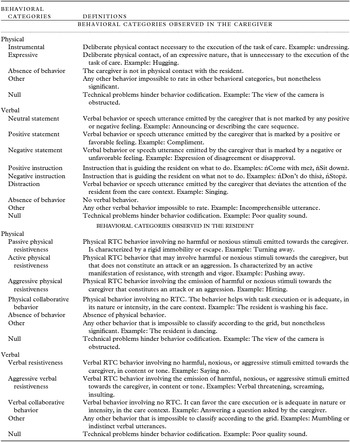
To obtain objective rating of the observations collected, this grid comprised operational definitions and examples related to each exhaustive and mutually exclusive behavioral category. The grid (see Table 1) was developed specifically for this study.
Definitions and examples of behavioral categories observed in the caregiver and the resident

The observer 5.0 video-pro for windows
This software was used to collect, manage, and analyze the observational data collected.
Ots and gseq 4.2.0
The OTS program was used to convert the observational data coded with The Observer in SDIS (Sequential Data Interchange Standard) format. This data format is compatible with GSEQ, a general statistical analysis program used to process the sequential data (Bakeman and Quera, Reference Bakeman and Quera1995).
Procedures
Collection of descriptive data on participants
Information was obtained from the healthcare proxy or surrogate decision-maker of residents, and completed by consultation of the medical record. CDR-Q, SMAF-ADL, and NPI-NH were administered to a caregiver knowing the resident well. Finally, the residents were met for administration of the SIB. The caregivers completed their identification sheets.
Collection and coding of observational data
After a four-week period for desensitization to the presence of the research apparatus and personnel, 30 periods of daily hygienic care per PWD were recorded, for a total of 240 observations. The daily care routine corresponded to a range of activities related to the personal care of a resident, and could vary from one participant to another, but generally included daily hygiene, changing of incontinence protection, and dressing. About five minutes before the care, the research team member installed the recording apparatus in the participant's room and removed it afterwards.
Five trained observers coded the recordings with The Observer software, using the Grid for observation of physical and verbal behaviors of caregiver and resident. Two independent observers both coded 25 percent of the observations (for a total of 60 recordings), for interobserver agreement analyses.
Statistical analyses
Data processing
Some theoretically linked behavioral categories of the observation grid were grouped in order to perform the analyses. The objective was to reduce the number of sequences analyzed in order to eliminate Type 1 errors. The following caregiver behaviors are considered: absence of behavior (no physical or verbal behavior), instrumental physical behavior, expressive physical behavior, neutral statement, positive statement and negative statement, positive instruction, negative instruction, and distraction. On the part of the resident: absence of behavior (no physical or verbal behavior), RTC (grouping the various physical and verbal RTC manifestations), and collaborative behavior (grouping physical and verbal collaborative manifestations) were considered for the analyses.
Analysis of agreement between observers
Sixty observation sessions were subjected to analysis for agreement between observers, executed with The Observer. The method used to calculate agreement made it possible to take into account not only agreement on the frequency and duration of coded behaviors, but also their sequence. An average κ of 0.73 (SD = 0.06) was obtained for agreement on frequency of occurrences, which is considered satisfactory. As concerns agreement on duration, an average κ of 0.88 (SD = 0.06) was obtained, which can be considered excellent.
Sequential analyses
A sequential analysis strategy based on use of temporal windows was applied. It allowed the definition of a temporal window attached to the caregiver's behavior (considered here as a criterion or antecedent behavior), used to determine its association with the behavior of the resident (the target behavior here). The temporal window defined started with the onset of the criterion behavior and continued through its duration, to which five seconds were added. For each occurrence of the criterion behavior, the type of behavior already exhibited by the care recipient at the moment of its onset was also specified. Once this was defined in the data, the onset of each target behavior within that window was considered a distinct occurrence.
The overall degree of sequential association between the behaviors of the caregiver and those of the PWD was tested using a contingency table and Pearson's χ2 test (χ 2). After establishing overall sequential association, which confirmed that the temporal relationship observed between two variables was not due to chance, specific pairs of categories that were significantly related were singled out. Each of these sequences was tested for the degree of association in a 2 × 2 table. Adjusted residuals (AR), odds ratio (OR), and Yule's Q were calculated from such tables. The AR corresponds to the standardized gross residuals. The OR is a statistic often used in epidemiology to quantify the magnitude of an effect, and its value can vary from 0 to infinity (Bakeman and Quera, Reference Bakeman and Quera1995). When it differs from 1, it indicates a relationship between the variables studied. The Yule's Q statistic varies between −1 and +1 and its interpretation resembles that of a correlation. Certain criteria allow one to qualify the strength of the relationship they represent. The associations whose strength is considered clinically significant in this study are those for which the Yule's Q is moderate (0.30–0.49), strong (0.50–0.69), or very strong (0.70–1.00).
Since the number of sequences to be tested is considerable despite the grouping of categories performed, Bonferroni's correction was applied to offer protection from Type 1 error. The Cronbach's α level is thus 0.000196, corresponding to a Cronbach's α level of 0.01 divided by the number of tests performed. For ease of reading, Cronbach's α level was rounded to 0.0002.
Results
Descriptive statistics
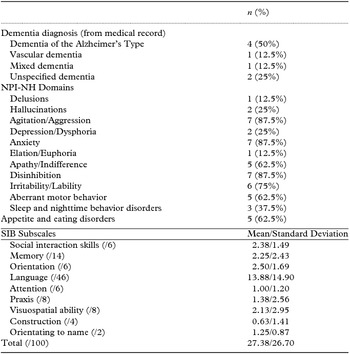
The sample included eight persons (five women and three men) with moderate to severe dementia (CDR-Q; M = 17, SD = 1.70), aged between 76 and 86 years old (M = 80.75, SD = 3.24), and living in a nursing home for an average of 58.12 months (SD = 48.13). Table 2 presents the dementia diagnoses of the participants as shown in their medical record, as well as their scores on the sub-scales of the NPI-NH and SIB. As shown by the results of the SIB, the majority of participants were very severely cognitively impaired (M = 27.38, SD = 26.40). On the functional level, they showed a near total to total degree of dependence in their ADLs, as indicated by an average score of –19.31/–21 (SD = 1.94) in the SMAF-ADL.
Clinical characteristics of the sample

The NPI-NH shows evidence of behavioral and psychological symptoms of dementia, notably agitation and aggression, apathy, disinhibition, and irritability in the majority of participants.
The majority of the caregivers (83.70%) were women holding a variety of positions: nurses’ aides (79.10%), nursing assistants (18.60%), and one head nurse (2.30%), on average for 7.90 years (SD = 8.23 years) in their current jobs. The average age of the caregivers was 41.91 years old (SD = 12.00 years). On average, they had worked with a geriatric clientele for 12.63 years (SD = 8.89 years). Most of them had part-time positions (55.80%).
Observational descriptive statistics
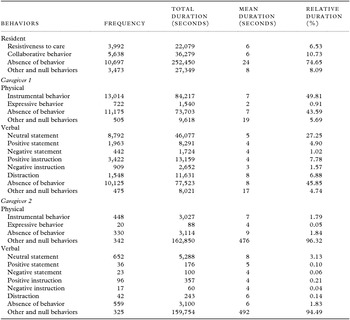
In all, 240 observation sessions were conducted, for a total duration of 46 hours, 57 minutes, and 58 seconds. The average duration of a care period was 11 minutes 44 seconds. The frequencies and durations of behaviors of caregivers and care recipients are presented in Table 3.
Descriptive statistics of observational data

During the observations, 3,992 RTC behaviors occurred, for a total duration of 6.53% of observation time. The participants also exhibited 5,638 collaborative behaviors for a total duration equal to 10.73% of observation time. For their part, the caregivers (including a caregiver 2 when a second caregiver assisted in the hygienic care) exhibited 13,462 instrumental physical behaviors and 742 expressive physical behaviors. Amongst verbal behaviors, it was neutral statements, which occurred most often, with 9,444 times. Negative statements were least frequent, with 465 occurrences. Nonetheless, even the least frequent behavioral categories occurred in sufficient numbers to perform analyses.
Behavioral sequences: Antecedents to residents’ behaviors
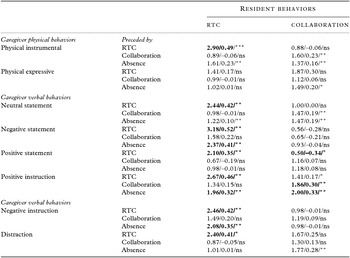
The first analysis confirmed that there is a significant overall association between certain caregiver behaviors and the onsets of certain care recipient behaviors (χ 2 (16, N = 16,907,844) = 679,322.06, p < 0.0001). Table 4 presents the results of sequential analyses performed on specific pairs of behavioral categories, with the behaviors of the caregiver as the antecedents (specified for the care recipient behavior active at its onset) and the behaviors of the care recipient as the consequences.
Associations between caregiver behaviors as antecedents and resident behaviors as consequences

Note. Moderate to strong associations are in bold.
aOdds ratio/Yule's Q/p value: *p < 0.0002, **p < 0.0001, ns = non-significant.
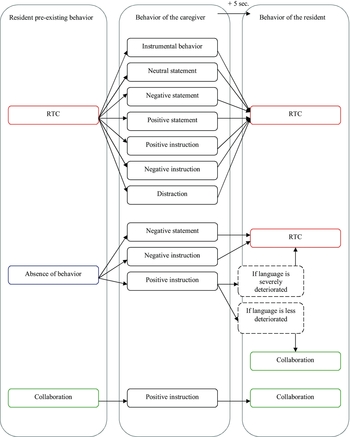
Figure 1 synthesizes the significant sequences; that is, those that are positively related, with at least moderate strength (Yule's Q ≥ 0.30) and statistically significant (p < 0.0002).
Impact of caregiver behaviors on the onset of RTC and collaborative behaviors, considering pre-existing resident behavior.

Instrumental physical behavior is moderately associated with the occurrence of RTC behaviors in a PWD who is already displaying resistiveness at the moment of instrumental touch onset (AR = 21.16, p < 0.001, OR = 2.90, Yule's Q = 0.49). When the care recipient displayed an absence of behavior at the onset of the instrumental touch, the association with RTC is weak (AR = 14.04, p < 0.001, OR = 1.61, Yule's Q = 0.23). This same result applies to other antecedents analyzed. A neutral statement is moderately associated with RTC when the care recipient was already resistive (AR = 17.00, p < 0.001, OR = 2.44, Yule's Q = 0.42), while it was weakly associated when no particular behavior was shown (AR = 5.36, p < 0.001, OR = 1.22, Yule's Q = 0.10). A negative statement is strongly associated with the onset of RTC when resistiveness is already being manifested (AR = 10.61, p < 0.001, OR = 3.18, Yule's Q = 0.52). The association to RTC is moderate if the PWD showed no particular behavior before the occurrence of the negative statement (AR = 8.26, p < 0.001, OR = 2.37, Yule's Q = 0.41).
Only two caregiver behaviors, positive statement (AR = 6.70, p < 0.001, OR = 2.10, Yule's Q = 0.35) and distraction (AR = 5.94, p < 0.001, OR = 2.40, Yule's Q = 0.41), are associated with RTC solely when the PWD was already resistive. On the other hand, the analyses show a moderate association between instructions and RTC, whether the care recipient shows no particular behavior beforehand (AR = 15.09, p < 0.001, OR = 1.96, Yule's Q = 0.32 for positive instruction and AR = 9.31, p < 0.001, OR = 2.08, Yule's Q = 0.35 for negative instruction), or whether resistiveness has already been shown (AR = 13.87, p < 0.001, OR = 2.67, Yule's Q = 0.46 and AR = 8.22, p < 0.001, OR = 2.46, Yule's Q = 0.42, respectively).
Positive instruction is moderately associated with the onset of collaboration when the care recipient was already exhibiting collaborative behavior at the onset of the instruction (AR = 8.43, p < 0.001, OR = 1.86, Yule's Q = 0.30), but also in the absence of particular behavior (AR = 18.78, p < 0.001, OR = 2.00, Yule's Q = 0.33). Thus, when a PWD shows no particular behavior, positive instruction is almost as closely associated with collaboration (AR = 18.78, p < 0.001, OR = 2.00, Yule's Q = 0.33) as to RTC (AR = 15.09, p < 0.001, OR = 1.96, Yule's Q = 0.32). To elucidate this ambiguous result, additional analyses were conducted.
The level of language impairment could be relevant to adequately assess the impact of positive instruction on behavior (Hart and Wells, Reference Hart and Wells1997; Potkins et al., Reference Potkins2003; Small et al., Reference Small, Gutman, Makela and Hillhouse2003; Volicer et al., Reference Volicer, Bass and Luther2007). Therefore, two groups with distinct levels of language impairment were formed, using the mean SIB language subscale score as a cut-off (13.88/46). The first group (n = 5; observed 30 times each for a total of 150 hygienic care routines in total) was composed of PWD with severely deteriorated language abilities (x = 3.40/46). The second group (n = 3; observed 30 times each for a total of 90 hygienic care routines in total) consisted of PWD whose language abilities were considered less deteriorated (x = 31.33/46). Sequential associations between behavioral categories were tested separately on each group.
For participants with very severe language impairment, positive instruction was moderately related to the onset of RTC (AR = 13.51, p < 0.001, OR = 1.97, Yule's Q = 0.33), when it was given when the care recipient was showing no particular behavior. For people belonging to this sub-group, positive instruction is only weakly associated with collaboration (AR = 11.28, p < 0.001, OR = 1.78, Yule's Q = 0.28). For PWD whose language skills are less altered, positive instruction was more closely associated with collaboration (AR = 16.94, p < 0.001, OR = 2.45, Yule's Q = 0.42) than with RTC (AR = 5.56, p < 0.001, OR = 1.72, Yule's Q = 0.27).
Discussion
The goal of this study was to examine the interplay between various physical and verbal behaviors of caregivers and RTC and collaboration during hygienic care of PWD. A video-assisted systematic observation methodology was used and sequential analyses were performed. Results show that many caregiver behaviors are significantly associated with the onset of RTC, consistent with the observations of numerous researchers (Marx et al., Reference Marx, Werner and Cohen-Mansfield1989; Burgener et al., Reference Burgener, Jirovec, Murrell and Barton1992; Cohen-Mansfield and Werner, Reference Cohen-Mansfield and Werner1995; Burgio et al., Reference Burgio, Butler, Roth, Hardin, Hsu and Ung2000; Roth et al., Reference Roth, Stevens, Burgio and Burgio2002; Somboontanont et al., Reference Somboontanont, Sloane, Floyd, Holditch-Davis, Hogue and Mitchell2004; Whall et al., Reference Whall2008; Williams et al., Reference Williams, Herman, Gajewski and Wilson2009; Williams and Herman, Reference Williams and Herman2011). However, our findings bring important clarifications on the interactions contributing to RTC that takes place during hygienic care.
The results reveal that the onset of RTC behaviors in the context of daily hygienic care in PWD is not simply associated with particular caregiver behaviors. The strength of the relationship between caregiver behavior and the care recipient's reaction also depends on the behavior already displayed by the resident. Thus, instrumental touches, like all types of verbal behaviors studied here in caregivers (statements, instructions, and distraction) are at risk of eliciting resistive behavior, particularly when the resident is already exhibiting RTC. When no particular behavior of the PWD precedes their use by caregivers, their relationship to RTC exists all the same, but is weaker in a majority of cases. When the resident is showing collaboration, the use of the same behaviors by caregivers is not associated with resistiveness. Therefore, the risk that certain caregiver behaviors will be followed by RTC varies considerably: it is moderate to high when the PWD already shows resistiveness, weak to moderate when the care recipient shows no particular behavior, and negligible when he or she is showing collaboration.
Several authors interested in this caregiver–patient interaction have identified cues for resistive, agitated, or aggressive behaviors. They have raised the possibility that the relationship between caregiver and PWD behaviors may also be influenced by a wider context, an emotion, or previous behaviors (Marx et al., Reference Marx, Werner and Cohen-Mansfield1989; Burgener et al., Reference Burgener, Jirovec, Murrell and Barton1992; Burgio et al., Reference Burgio, Butler, Roth, Hardin, Hsu and Ung2000; Small et al., Reference Small, Gutman, Makela and Hillhouse2003; Somboontanont et al., Reference Somboontanont, Sloane, Floyd, Holditch-Davis, Hogue and Mitchell2004; Whall et al., Reference Whall2008; Williams et al., Reference Williams, Herman, Gajewski and Wilson2009; Williams and Herman, Reference Williams and Herman2011). Our study is the first to show that the residents’ pre-existing behavioral state is determinant on the outcome of caregiver's actions. Our scope on a specific care context and the nature of our analyses strengthen our ability to interpret the relationships found between antecedents and resistive behaviors.
Our results indicate that caregiver behaviors during hygienic care can bring collaboration in PWD. Positive instruction, used when a resident is already showing collaboration, is associated with a display of other collaborative behaviors. Although other researchers have explored and described collaboration between caregiver and PWD in care contexts (Burgener et al., Reference Burgener, Jirovec, Murrell and Barton1992; Hallberg et al., Reference Hallberg, Holst, Nordmark and Edberg1995; Westerberg and Strandberg, Reference Westerberg and Strandberg2007), none had established a link between specific antecedents and collaborative behavior of a PWD during care. These findings contribute to the very limited knowledge available on this topic, since positive and functional behaviors of PWD during care have rarely been studied. It is important to emphasize that no caregiver behavior alone necessarily leads to collaboration, the relationship being influenced by the resident's previous state as for RTC.
Additionally, positive instruction seems to prompt collaboration on the part of residents exhibiting no particular behavior, but only with those whose language capacity is relatively preserved. Our results reveal that for PWD with greater language impairment, positive instruction is more likely to be associated with resistiveness. This result is consistent with other observations made concerning the probable impact of language impairments on behavior (Talerico et al., Reference Talerico, Evans and Strumpf2002; Potkins et al., Reference Potkins2003; Volicer et al., Reference Volicer, Bass and Luther2007). In particular, it echoes those of Hart and Wells (Reference Hart and Wells1997), who showed that PWD exhibit greater agitation when the instruction given exceeds the level of language complexity they are able to process. Admittedly, the complexity of instructions given was not evaluated in the present study. However, the participants’ difficulties understanding what is said, or their inability to perform an appropriate action following instructions from the caregiver, can probably explain this result, considering their cognitive deficits. Even though this result is preliminary, it may be relevant to consider the extent of language deficits when interacting with a PWD. Further research efforts to study the relationship between language capacities and behaviors during ADL would be relevant.
Our results suggest we remain cautious as to the clinical implications drawn from various work. Certain caregiver behaviors have been identified as either appropriate or not, considering the impact they appeared to have on resident behavior, or on the quality of resident–caregiver interaction (Burgener et al., Reference Burgener, Jirovec, Murrell and Barton1992; Burgio et al., Reference Burgio, Butler, Roth, Hardin, Hsu and Ung2000; Wells et al., Reference Wells, Dawson, Sidani, Craig and Pringle2000; Mickus et al., Reference Mickus, Wagenaar, Averill, Colenda, Gardiner and Luo2002; Roth et al., Reference Roth, Stevens, Burgio and Burgio2002; Somboontanont et al., Reference Somboontanont, Sloane, Floyd, Holditch-Davis, Hogue and Mitchell2004; Whall et al., Reference Whall2008). As shown in the present study, although certain caregiver behaviors may be more or less likely to elicit resistiveness or collaboration, it is the pre-existing state of the care recipient that will determine their reaction to the caregiver's behavior. Thus, it appears that once a resident shows RTC, the most probable outcome of almost any caregiver behavior at this point may be the onset of new resistive behaviors.
This raises two important questions. First, why is resistiveness elicited in the first place (or would already be present)? Many factors that could contribute to RTC, including resident (pain, cognitive impairment, infection, anxiety, fatigue), caregiver (skills, communication strategies), and environmental factors (noise, lighting, temperature, privacy), have been described (Potts et al., Reference Potts, Richie and Kaas1996; Kable et al., Reference Kable, Guest and McLoed2012). Many of these factors have not been taken into account in our study and might contribute to explain RTC in any given individual. It is probable that an idiosyncratic combination of these factors might explain the onset of resistive reactions. Thus, it appears crucial, in clinical practice, to individually assess each situation and address these factors in order to prevent them from interfering in care provision (Potts et al., Reference Potts, Richie and Kaas1996; Kable et al., Reference Kable, Guest and McLoed2012).
The second important question raised by our findings is about the most appropriate strategy to be used to manage resistiveness once it is displayed, since no caregiver behavior among those studied could bring a resistive care recipient to exhibit collaboration. Even positive instruction (associated with collaboration in certain circumstances) is associated with further resistiveness if it is used with an already resistive resident. It would be dangerous, and inaccurate, to conclude that the approaches used by caregivers have no impact on the course of behaviors of PWD, or that they can do nothing in the presence of RTC. It is clear from our results that they do have an impact on the care recipient's behaviors: their actions can onset new resistive behaviors, which may potentially escalate from passive resistive behaviors to more aggressive manifestations.
The first step in managing resistiveness, in the light of our results, is certainly the careful observation, by the caregiver, of the care recipient's behavior during interaction, in order to adopt appropriate behaviors in relation to what is being expressed. Theoretical models, training programs, or intervention methods emphasize the importance of this approach (Algase et al., Reference Algase1996; Magai et al., Reference Magai, Cohen and Gomberg2002; Rader et al., Reference Rader2006; Cohen-Mansfield and Parpura-Gill, Reference Cohen-Mansfield and Parpura-Gill2007). It is probably not generally difficult for caregivers to identify severely aggressive manifestations. Of RTC, however, RTC includes a range of behaviors of varying degrees of severity. More subtle forms of resistiveness are presumably less obvious to caregivers, which might lead them to persist in care provision despite the resistance that is expressed by the care recipient.
Results presented here show that RTC is perpetuated when the caregiver continues the interventions. Hence, once a caregiver has detected a resistive behavior, the most appropriate option might be to postpone or stop care provision. Inserting pauses when the caregiver perceives anxiety, agitation, or resistiveness might be considered to put an end to it or to prevent escalation into combative behavior (Volicer et al., Reference Volicer, Bass and Luther2007). Offering care in small units of brief duration, allowing the caregiver to stop care when necessary, and simply resume it later might be another possibility. Certainly, our results do not permit us to take position on the effectiveness of such methods. They are however consistent with these intervention strategies, which warrant further examination.
This study has several notable strengths. Among them is the use of systematic observation assisted by video, based on a reliable coding system, as well as the quality and quantity of observational data collected. Procedures for desensitization to the observational apparatus and the tests of agreement between observers were included to maximize internal validity and the reliability of the data collected. Moreover, the study was performed in the participants’ natural environment. The methodology, conjoined to a novel strategy for sequential data treatment, permitted analyses of complex temporal relationships between behavioral events. The flexibility and precision of our strategy notably allowed us to tease out relevant clinical applications. Their consideration, however, must take into account the limitations of the study.
Firstly, even though we desensitized the participants to the observational apparatus, it is likely that caregivers, knowing they were filmed, changed their behaviors during care provision. It is important to note that all the targeted behavioral categories were observed a sufficient number of times to allow for analyses performance. Many RTC behaviors occurred (3,992), even though caregivers might have presented a positive version of themselves during the interactions. It is nonetheless possible, considering this bias, that our sample might not be representative of a completely natural setting.
Secondly, the sample size, as well as some of its characteristics, limits our ability to generalize from the results. The residents in the study suffered from moderate to severe dementia. Interpretations presented here must be limited to this type of person. It remains difficult to know whether the range of significant sequences in our results reflect what would be observed for a representative sample. Likewise, it cannot be inferred that our conclusions can be generalized to contexts of care other than daily hygienic care. Other studies performed with larger numbers of PWD and in other contexts (for example, during meals or bathing) are required in order to generalize results. More robust and broader-spectrum clinical implications may emerge from such future work.
Conflict of interest
None.
Description of authors’ roles
G. Belzil designed the study, collected the data, analyzed the data, and wrote the paper.
J. Vézina supervised the study design and data collection and assisted with writing the paper.
Acknowledgments
We would like to thank residents and their families, nursing homes and caregivers that consented to participate in this study. We would like to acknowledge the contribution of Stéphanie Cummings, Amélie Légaré, Shirley Imbeault, Annie Lavigne, Marie-Michelle Racine, Julie Castonguay, Geneviève Ingles-Fortier, Vanessa Hudon, and Stéphanie Bourassa in our study.