Introduction
Recent years have brought a flurry of reports that bilinguals are advantaged over monolinguals in cognitive control. Bilinguals outperform monolinguals in tests of inhibitory function (e.g., Carlson & Meltzoff, Reference Carlson and Meltzoff2008), flanker paradigms (Costa, Hernandez, & Sebastian-Galles, Reference Costa, Hernandez and Sebastian-Galles2008), and Stroop (for review, see Bialystok, Craik, Green, & Gollan, Reference Bialystok, Craik, Green and Gollan2009). Additionally, aging bilinguals and multilinguals maintain higher levels of cognitive functioning than monolinguals (Kave, Eyal, Shorek, & Cohen-Mansfield, Reference Kave, Eyal, Shorek and Cohen-Mansfield2008), and bilingualism (Bialystok, Craik, & Freedman, Reference Bialystok, Craik and Freedman2007; Craik, Bialystok, & Freedman, Reference Craik, Bialystok and Freedman2010) or multilingualism (Chertkow et al., Reference Chertkow, Whitehead, Phillips, Wolfson, Atherton and Bergman2010) may delay the onset of Alzheimer's disease. These findings have been attributed to bilinguals’ need to continuously monitor and control the non-target language when conversing, and suggest a tight relationship between linguistic and non-linguistic processing mechanisms in which bilinguals rely on general mechanisms of executive control to achieve language control (Green, Reference Green1998; Philipp & Koch, Reference Philipp and Koch2009). However, this connection between bilingual language use and cognitive advantages remains implicit in the extant literature and the specific aspects of bilingualism that lead to cognitive advantages are unknown. What about bilingualism produces an advantage in executive control? A more recently identified bilingual advantage is that bilinguals switch between non-linguistic tasks more efficiently than monolinguals (Prior & MacWhinney, Reference Prior and MacWhinney2010). This bilingual advantage most naturally seems related to language switching, a cognitively demanding skill that monolingual speakers do not develop. The current study investigated the association between language and task-switching more specifically by examining them together in two different bilingual groups.
The literatures on language and task-switching reveal many compelling similarities. In both cases, there are “switch costs” such that changing the response set results in slowed reaction times when compared with trials in which there is no such change (Meiran, Chorev, & Sapir, Reference Meiran, Chorev and Sapir2000; Meuter, Reference Meuter2005; Monsell, Reference Monsell2003). Similarly, in both paradigms, there is an asymmetry in switch costs such that switching from an easier task (or dominant language) to a more difficult task (or less proficient language) results in smaller switch-costs than switching in the other direction (Meuter & Allport, Reference Meuter and Allport1999). In both cases, this asymmetry is cited as evidence for inhibition of the language or task set that was active on the previous trial (Green, Reference Green1998; but see Gollan & Ferreira, Reference Gollan and Ferreira2009; Verhoef, Roelofs, & Chwilla, Reference Verhoef, Roelofs and Chwilla2009; Yeung & Monsell, Reference Yeung and Monsell2003).
Neural imaging studies also suggest a relationship between task and language-switching (Abutalebi & Green, Reference Abutalebi and Green2007; Garbin et al., Reference Garbin, Sanjuan, Forn, Bustamante, Rodriguez-Pujadas, Belloch and Avila2010) demonstrating similarities between neural substrates used for both. The dorsolateral prefrontal cortex (DLPFC) shows higher activation rates in mixed language conditions than in single language conditions (Hernandez, Martinez, & Kohnert, Reference Hernandez, Martinez and Kohnert2000; Hernandez, Dapretto, Mazziotta, & Bookheimer, Reference Hernandez, Dapretto, Mazziotta and Bookheimer2001; Wang, Xue, Chen, Xue, & Dong, Reference Wang, Xue, Chen, Xue and Dong2007; Wang, Kuhl, Chen, & Dong, Reference Wang, Kuhl, Chen and Dong2009) and has also been implicated in imaging studies of task-switching (Botvinick et al., Reference Botvinick, Braver, Yeung, Ullsperger, Carter and Cohen2004; Dove, Pollmann, Schubert, Wiggins, & von Cramon, Reference Dove, Pollmann, Schubert, Wiggins and von Cramon2000; Wager, Jonides, Smith, & Nichols, Reference Wager, Jonides, Smith and Nichols2005; Wager, Jonides, & Smith, Reference Wager, Jonides and Smith2006). Similarly, bilinguals recruit middle prefrontal areas for managing interference from the non-target language (Rodriguez-Fornells et al., Reference Rodriguez-Fornells, van der Lugt, Rotte, Britti, Heinze and Munte2005).
Bilingual groups can vary greatly in how they use their two languages and how frequently they code-switch and mix languages (Basnight-Brown & Altarriba, Reference Basnight-Brown and Altarriba2007; Heredia & Altarriba, Reference Heredia and Altarriba2001; Myers-Scotton, Reference Myers-Scotton1993; Reference Myers-Scotton1997; Muysken, Reference Muysken2000). However, studies of bilingual advantages to date have either examined heterogeneous groups, in which participants spoke a wide variety of language pairs (e.g., Bialystok, Craik, & Luk, Reference Bialystok, Craik and Luk2008; Prior & MacWhinney, Reference Prior and MacWhinney2010), or a single group of highly balanced bilinguals (e.g., Colzato et al., Reference Colzato, Bajo, Wildenberg, Paolieri, Nieuwenhuis, La Heij and Hommel2008; Costa et al., Reference Costa, Hernandez and Sebastian-Galles2008). Neither design allows for a direct comparison between different bilingual populations, or an investigation of the extent to which one must be bilingual before exhibiting any advantage. Therefore, it is difficult to identify precisely what about bilingualism is critical for each observed effect. This also presents challenges in clinical settings, because it is not clear how performance should be adjusted for each case, or which subgroups constitute sufficiently “different” groups that will ultimately require separate normative data.
To this end, we compared Spanish–English bilinguals and Chinese–English bilinguals who are respectively the first and second largest bilingual groups in the United States (US Census, 2000). Most Chinese speaking undergraduates at UCSD speak Mandarin–Chinese. Spanish–English and Mandarin–English bilinguals at UCSD differ in several ways. Spanish–English bilinguals mix and switch their languages extensively, whereas Mandarin–English bilinguals are less likely to engage in these behaviors. Additionally, Spanish–English bilinguals tend to maintain higher proficiency in their first language (Spanish) than do Mandarin–English bilinguals in theirs’ (Mandarin), perhaps because Spanish is more readily accessible in the environment than Mandarin. Thus, the Spanish–English speakers as a group were more balanced bilinguals than the Mandarin–English group. Finally, Spanish–English bilinguals in the USA sometimes have lower socio-economic status (SES; here indexed by parental education level), than the other participant groups, a finding of particular importance in the current context because of established links between SES and executive control (e.g., Diamond, Barnett, Thomas, & Munro, Reference Diamond, Barnett, Thomas and Munro2007). To incorporate these group differences, participants reported parent-education level, language proficiency, and frequency of language-switching. As objective measures of language proficiency and switching ability, bilinguals completed a verbal fluency task in both languages, and a language-switching task.
We hypothesized that Spanish–English bilinguals might demonstrate more efficient task- and language-switching because they switch languages more often, or because they are more balanced bilinguals than the Mandarin–English bilinguals tested here (Bialystok, Craik, & Ruocco, Reference Bialystok, Craik and Ruocco2006), or both. Conversely, one could imagine that because language-switching is more effortful when the two languages are very different Mandarin–English bilinguals might show a stronger switching advantage. Finally, because both groups are life-long users of two languages, and certainly switch languages much more often than monolinguals, it was also possible that all bilinguals would have a task-switching advantage. To test these predictions we tested all three groups on task-switching abilities, and then examined the putative relation between the task-switching and language-switching paradigms for the two bilinguals groups.
Method
Participants
Monolingual English speakers (n = 47), Spanish–English bilingual (n = 41) and Mandarin–English bilingual (n = 43) undergraduates at the University of California San Diego (UCSD) participated for course-credit. Participants gave informed consent and their rights were protected in accord with the ethical standards of the American Psychological Association and the approval given for the study by the university's Institutional Review Board. The bilinguals had first been exposed to both languages before the age of 6, and had continuously used both languages since that time. The protocol lasted for approximately 1.5 to 2 hrs. Table 1 shows the results of a self-report questionnaire on language-history using Likert scales and demographic information in each language group. Such questionnaires are widely used in bilingual research, and are significantly correlated with objective measures of language proficiency (Gollan, Weissberger, Runnqvist, Montoya, & Cera, in press; Marian, Blumenfeld, & Kaushanskaya, Reference Marian, Blumenfeld and Kaushanskaya2007).
Means and standard deviation of participant characteristics

Means in the same row with different superscript letters differ from each other significantly at p < .01.
* Means significantly different at p < .05.
Materials and Procedure
Participants completed a battery of cognitive and linguistic measures. Computerized tasks were presented using PsyScope 1.2.5 (Cohen, MacWhinney, Flatt, & Provost, Reference Cohen, MacWhinney, Flatt and Provost1993) on a Macintosh computer with a 17-inch color monitor. Naming times were recorded using headset microphones connected to PsyScope response boxes. Spoken responses were recorded live with a digital recorded. Participants were seated approximately 60 cm from the monitor. The tasks were administered in the following order except that the order of the task-switching and language-switching paradigms was counter-balanced across participants.
Non-linguistic task-switching
Participants made color and shape judgments on visually presented stimuli, using button presses to indicate their selection. Each trial started with a fixation cross presented for 350 ms, followed by a 150-ms blank screen. The task cue then appeared on the screen for 250 ms, 3.5 cm above the fixation cross. The cue for the color task was a color gradient, and the cue for the shape task was a row of small black shapes (5 cm × 1.2 cm). The cue remained on the screen, and the target appeared in the center of the screen. Targets were red or green circles (3-cm radius) and triangles (3-cm base, 2.5-cm height). The cue and target remained on the screen until the participant responded, or for a maximum duration of 4 seconds. Incorrect responses were followed by a 100-ms beep. An 850 ms inter-trial blank screen interval was presented before the onset of the following trial.
Participants performed one task (either shape or color, counterbalanced across participants) using the right hand, and the other task using the left hand. This mapping of task to hand was preserved throughout the single-task and mixed-task blocks. A template laid over the response box helped participants remember which key corresponds to which response.
Participants completed three parts of the experiment, comprising a sandwich design. First, two single-task blocks (color and shape, order counterbalanced across participants), each including 8 practice trials and 36 experimental trials. Second, 16 mixed-task practice trials, followed by 3 mixed-task blocks of 48 trials each. In each mixed block half of the trials were switch trials and half were non-switch trials, of both the color and shape tasks, randomly ordered with a maximum of 4 consecutive trials of the same type. Two additional dummy trials were added at the beginning of each block and were not included in the analysis. Finally, in the third part of the experiment, participants again performed two single-task blocks, presented in the opposite order from that used in the first part. Participants were notified regarding the nature of each block performed (single or mixed). The sandwich design enables a comparison of 72 switch trials, 72 non-switch trials, and 144 single-task trials (72 color and 72 shape). In this design participants gain practice with each task before completing the mixed-task blocks, and the estimation of single-task proficiency includes both initial and later (well-practiced) responses, thus avoiding exclusive influence of order effects on mixed block performance.
Language-switchingFootnote 1
The setup of the language-switching paradigm was based on the task-switching paradigm—two single language blocks, followed by three mixed language blocks, followed by two more single language blocks. The stimuli in all blocks were single digits (1–9), and participants named the digit out loud as quickly as possible. Reaction times (RTs) were registered by a voice-key and responses were recorded and later coded for accuracy off-line. The cues were the American flag for English, the Mexican flag for Spanish, and the Chinese flag for Mandarin. Cue and target presentation times were identical to those used in the task-switching paradigm.
Participants first performed two single-language naming blocks one in English and the other in their second language, with order counterbalanced across participants. Each block included 8 practice trials and 36 experimental trials. Next they completed three mixed-language blocks, each including 48 experimental trials, half in each language. Additionally, half of the trials were switch trials and half were non-switch trials. The same digit never appeared on two consecutive trials, and there were no sequences of serially ordered numbers longer than 2, either ascending or descending. Finally, there were at most 4 consecutive trials of the same type (switch or no-switch). The mixed-language blocks were followed by 2 additional single-language blocks, in the opposite order than that used in the first part of the experiment.
Shipley vocabulary test (Shipley, Reference Shipley1946)
This test consists of 40 multiple-choice questions in which participants are asked to choose which of four words is closest in meaning to a target word. The raw test scores consisted of the number of correct responses.
Verbal fluency
Monolinguals completed 2 semantic fluency trials in English, and bilinguals completed 2 trials in each language, first in English and then in the other language. In each trial participants were given one minute to name as many items belonging to a semantic category as they could. Categories were animals and fruit or clothing and vegetables. Bilinguals completed different categories in their two languages, and this was counterbalanced across participants. The fluency score for each language was the number of correctly produced names belonging to the two categories combined.
Matrices subtest, Kaufman brief intelligence test, second edition (KBIT-2; Kaufman & Kaufman, Reference Kaufman and Kaufman2004)
This is a test of non-verbal reasoning in which participants see a series of pictures or abstract designs that follow a pattern but are missing one element, and are instructed to point to the picture that completes the pattern. The test includes 46 items. The test was administered and scored according to the manual with the exception that all participants started from the first item.
Results
Correct response times (RTs) were analyzed, using SPSS 15. Outlier responses, deviating by more than 2 SDs from the mean for each participant, were trimmed separately for single task and mixed task blocks. This procedure eliminated 4.6% and 5.5% of the data from the single task blocks and mixed blocks in the task-switching paradigm, respectively, and 4.3% and 5.0% from the single language and mixed language blocks, respectively. RTs in color versus shape judgments did not differ significantly for any of the participant groups, and so we collapsed across this factor (see also Rubin & Meiran, Reference Rubin and Meiran2005).
Task-Switching
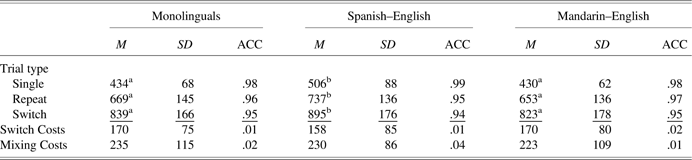
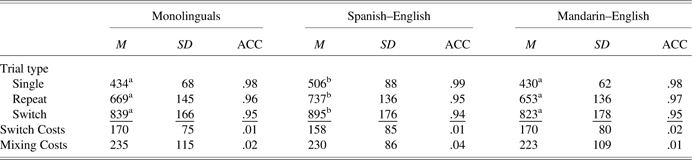
To determine whether bilinguals completed task-switching more efficiently than monolinguals we conducted a repeated measures analysis of variance with language group as a between subject variable (Monolingual, Spanish–English, Mandarin–English) and condition (switch, repeat) as a within subject variable (Table 2).
Mean reaction time, standard deviations, accuracy rates, and costs in the task-switching paradigm by language group
Means in the same row with different superscript letters differ from each other significantly at p < .01.
This analysis revealed a significant main effect of trial-type, F(1,128) = 565.46, MSE = 1799260, p < .001, η 2 = .82; participants responded more quickly on task-repeat than on task-switch trials, and a main effect of participant group, F(2,128) = 3.09, MSE = 142343, p < .05, η 2 = .04. Planned contrasts revealed that whereas the Mandarin–English bilinguals and the monolinguals responded equally quickly (p = .623) the Spanish–English bilinguals responded significantly more slowly than the two other groups (both ps < .05). The interaction between language group and switch condition was not significant (F < 1). Therefore, in this preliminary analysis neither bilingual group exhibited reduced switch costs relative to monolinguals and the Spanish–English group even exhibited slower overall response times.
Spanish–English bilinguals were disadvantaged on several factors not necessarily related to bilingualism that could also affect executive control. They produced slightly but significantly lower Matrices reasoning scores, and they reported lower levels of parent-education. Examining the performance of the Spanish–English bilinguals alone, switch costs were negatively correlated with education levels of both the primary and secondary caregivers (r = −.34; p = .02 and r = −.32; p = .04, respectively), but not with Matrices subtest scores, r = .05; p = .72. Task-mixing costs (i.e., the difference between task-repeat trials and responses in the single-task blocks; see below) did not correlate significantly with any of these measures (all ps > .45).
With these disadvantages and slower response times, it is surprising that Spanish–English bilinguals did not also exhibit larger switch-costs relative to monolinguals and Mandarin–English bilinguals. On this view, Spanish–English bilinguals exhibited relatively more efficient switching than would be expected given their overall slower performance. To determine if this relative advantage was significant, we controlled for between group differences in response latencies with a calculation of relative switch costs in which we divided the switch cost (difference between switch and repeat times) by the mean RT on repeat trials. The relative switch cost scores then served as the dependent variable in an analysis of covariance (ANCOVA) comparing the three language groups (monolingual, Mandarin–English, Spanish–English) as a between subject variable while controlling for differences in parent education level by including it as a covariateFootnote 2. Several participants did not report parental education levels (i.e., 1 monolingual, 3 Mandarin–English bilinguals, and 6 Spanish–English bilinguals), and were excluded from the analysis. In this analysis there was a significant main effect of language group, F(2,117) = 4.18; MSE = .062; p < .05; η 2 = .07, because this time Spanish–English bilinguals exhibited a significantly smaller proportional (M = 17.5%; SE = .03) switch-cost than Mandarin–English bilinguals (M = 27.3%; SE = .02) and monolinguals (M = 27%; SE = .02; both ps ⩽ .005), who did not differ significantly from each other (p = .90). Thus, after controlling for differences in response speed and SES, the Spanish–English, but not the Mandarin–English, bilinguals showed smaller task-switching costs. A parallel analysis of accuracy rates revealed no group differences (F < 1).
Given some inherent limitations in the use of ANCOVA for matching participant groups (Adams, Brown, & Grant, Reference Adams, Brown and Grant1992), we also carried out a second analysis in which we matched subgroups of 20 Spanish–English bilinguals and 20 monolinguals on parental education level, t(38) = 1.5; p = .13. To achieve this matching we selected the bilinguals who reported the highest levels of parental education and the monolinguals who reported the lowest levels of parental education. Matched subgroups did not differ in Matrices scores (p = .46) and age (p = .22), but Spanish–English bilinguals still had significantly lower English vocabulary scores than monolinguals, t(38) = 2.7, p < .05 (thus bilingual disadvantages in language related skills seem to be independent of SES and non-verbal reasoning; for a review see Bialystok et al., Reference Bialystok, Craik, Green and Gollan2009). Importantly, switch costs remained substantial in these subgroups, F(1,38) = 187.09; MSE = 2372; p < .001; η 2 = .83). Of great interest, and consistent with the results of the ANCOVA reported above, Spanish–English bilinguals did not respond more slowly overall (F < 1), and exhibited smaller switch costs (118 ms; 753 ms on repeat and 872 ms on switch trials) than SES-matched monolinguals (180 ms; 713 ms on repeat and 893 ms on switch trials), a significant interaction between group and switch condition, F(1,38) = 7.96; MSE = 2373; p < .01; η 2 = .17).
Task-mixing costs in this paradigm are not affected by bilingualism (Prior & MacWhinney, Reference Prior and MacWhinney2010), but for the sake of completeness we assessed them using the same approach as taken in the ANCOVA just reported, controlling for parent education level, and calculating mixing costs as a function of single-task trials (baseline RT). The main effect of language group was not significant, F(2,117) < 1, MSE = .017, p = .75, η 2 = .005, demonstrating equivalent mixing costs for all three participant groups. Once again, the analysis of error rates revealed no group differences (F < 1).
Thus, after controlling for between group differences in parental education level, Spanish–English bilinguals incurred significantly smaller switch costs than monolinguals, but equivalent mixing costs. This pattern of results confirms the benefit of bilingualism for reducing switching-costs but not mixing-costs in the current paradigm (replicating Prior & MacWhinney, Reference Prior and MacWhinney2010).
Language-Switching
The above analyses replicate and extend previous reports of a bilingual effect on task-switching, and suggest that experience with language-switching introduces this bilingual advantage. To make this implicit association between task and language-switching more explicit we compared the two bilingual groups to determine if the same bilinguals who exhibited a task-switching advantage would also exhibit more efficient language-switching.
The analyses of the language data mirrored those reported above for the color/shape task but including language-dominance as a variable. Participant group (Mandarin–English, Spanish–English) was a between subjects variable, and condition (switch versus repeat for switching effects, and repeat versus single for mixing effects), and language (dominant versus non-dominant) were within subject variables. Language-dominance was assigned according to self-ratings. If the self-rated proficiency was identical in the two languages, dominance was assigned based on the discrepancy in the fluency scores for the two languagesFootnote 3.
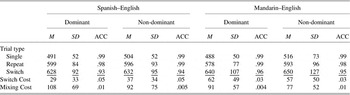
In the analysis of language-switching performance, the main effect of trial type was significant, F(1,82) = 120.89; MSE = 178306; p < .001; η 2 = .60; bilinguals responded more slowly on language switch than on language repeat trials. Bilinguals named numbers equally quickly in the dominant and non-dominant languages (p > .23), and there were no overall speed differences between the two groups (F < 1). Of great interest, and confirming the association between task and language-switching, there was a significant interaction between language group and trial type in the switching contrast, F(1,82) = 9.81; MSE = 14466; p < .01, η 2 = .11; Spanish–English bilinguals had significantly smaller language-switching costs than Mandarin–English bilinguals. The size of switching costs was not modulated by language dominance (F < 1), and neither was the Spanish–English switching advantage (p > .12); Spanish–English bilinguals incurred smaller switch-costs than Mandarin–English bilinguals in both the dominant (p < .001) and the non-dominant language (p < .05). In a parallel analysis of error rates, the only significant finding was a main effect of switch condition, F(1,82) = 67.90, MSE = .135, p < .001, η 2 = .45; bilinguals were more accurate in language repeat than in language switch trials. All other effects were not significant (all ps > .17). Most importantly, Spanish–English and Mandarin–English bilinguals had statistically equivalent errors rates in language-switch trials (p = .46; see Table 3).
Mean reaction times, standard deviations, accuracy rates, and costs in the language switching task, by language-dominance and by group

The analysis of language-mixing effects also mirrored the results reported above for task-switching; there was no evidence of a mixing advantage for Spanish–English bilinguals in either task or language-mixing. In the analysis of language-mixing costs, a main effect of language dominance emerged; naming times were faster in the dominant than in the non-dominant language, F(1, 82) = 7.92, MSE = 13,588, p < .01, η 2 = .09. In addition, responses were faster in the single-language than in the mixed-language blocks, F(1, 82) = 194.05, MSE = .709483, p < .001, η 2 = .70. The main effect of bilingual group was not significant (F < 1), and there were no interactions with group. However, there was a significant interaction between dominance and condition, F(1,82) = 11.27, MSE = 4,539, p < .005, η 2 = .12, because mixing costs to the non-dominant language were smaller than costs to the dominant-language (Table 3). In a parallel analysis of error rates, the only significant finding was a main effect of mix condition, F(1,82) = 11.4, MSE = .005, p < .001, η 2 = .12; bilinguals were more accurate in the single-language blocks than in repeat trials within the mixed language blocks. All remaining main effects and interactions were not significant (all ps > .13).
Exploring the Role of Bilingual Proficiency in the Switching Advantage
The finding of an advantage for both language switching and non-linguistic task switching in Spanish–English but not Mandarin–English bilinguals suggests a tight link between language-switching and general switching ability, and suggests that certain aspects of bilingual language use, which are not universal to all bilinguals, introduce the advantage. Table 1 reveals some possibly important differences between bilingual types. Most obviously relevant was that Mandarin–English bilinguals reported switching languages significantly less often in daily conversations than Spanish–English bilinguals. Also potentially important was that Mandarin–English bilinguals had lower Mandarin fluency scores than the Spanish–English bilinguals had in Spanish—and they rated themselves as less proficient in Mandarin than the Spanish–English bilinguals rated themselves in Spanish. Less balanced bilinguals have been shown to have smaller (and non-significant) executive function advantages than well-balanced bilinguals (Bialystok et al., Reference Bialystok, Craik and Ruocco2006). A question that arises is whether the Spanish–English bilingual switching advantage is exclusively related to their better language-switching, and their higher reports of language-switching in daily conversation, or if fluency in Spanish also plays a role. To consider the possible role of Mandarin and Spanish fluency on switching performance, we conducted some additional analyses.
Confirming the hypothesis of a relationship between non-dominant language fluency and switching ability, Mandarin fluency scores were negatively and significantly correlated with task-switching costs, r = −.49, p = .001 (Figure 1). Thus, although Mandarin–English bilinguals did not exhibit a switching-advantage relative to monolinguals, within this group bilinguals with higher fluency scores in Mandarin incurred smaller switching costs in the task-switching paradigm. This analysis seems to confirm a role for other-language fluency in switch costs. A similar analysis with the Spanish–English bilinguals produced no significant correlation between Spanish fluency and task-switching costs, r = .13, p = .407. The lack of robust correlations in this group might reflect the higher degree of bilingualism in this group as a whole, and the reduced variability of non-English fluency scores for the Spanish–English bilinguals.
Correlation of Mandarin fluency scores with task-switching cost for Mandarin–English bilinguals.

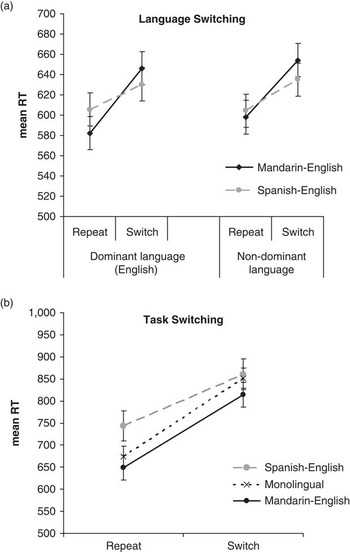
Additional analyses, however, suggested that bilingual proficiency alone does not introduce a switching advantage. In this analysis we matched as many Spanish–English and Mandarin–English bilinguals as we could (n = 30 in each group) for non-English fluency scores. In this subset Spanish–English bilinguals (M = 18.53; SD = 5.63), and Mandarin–English bilinguals (M = 18.65; SD = 6.32) produced the same number of correct responses (F < 1) in non-English semantic fluency, but Spanish–English bilinguals still reported switching languages significantly more often than fluency-matched Mandarin–English bilinguals (p = .04). Comparing fluency-matched subgroups on switch-costs, Spanish–English bilinguals exhibited smaller task-switching costs (117 ms) than the other two groups (165 ms Mandarin–English bilinguals, 177 ms monolinguals), a significant interaction between trial type and group (p = .03; for this analysis parent education level was included as a covariate as above). Similarly, Spanish–English bilinguals exhibited significantly smaller language switch costs than fluency matched Mandarin–English bilinguals, a significant interaction between trial type and group (p ⩽ .01). The means for these analyses are shown in Figure 2.
Analysis of fluency matched Spanish–English and Mandarin–English bilinguals. Panel A: Reaction times (in ms) for repeat and switch trials for the dominant and non-dominant language. Errors not shown; Error rates ranged from 1 to 2% on repeat trials, and 2 to 6% on switch trials for Mandarin–English bilinguals, and 1% on repeat trials, and 2 to 4% on switch trials for Spanish–English bilinguals across conditions; but there were no interactions with bilingual group (all ps ⩾ .20). Panel B: Reaction times (in ms) for repeat and switch trials in the non-linguistic task switching paradigm, parental education level included as a covariate. Errors not shown; Error rates ranged from 3 to 5% for all subject groups; and there were no interactions with participant group (all Fs < 1).

These analyses suggest that language switching performance (and perhaps daily rates of switching), and not degree of other-language fluency, is the key difference leading to a switch advantage. Interestingly, in language switching, Spanish–English bilinguals responded more slowly than fluency-matched Mandarin–English bilinguals on repeat trials, but more quickly than Mandarin–English bilinguals on switch trials. Similarly, in the color-shape task, Spanish–English bilinguals responded more slowly than the two other groups on repeat trials, but about as quickly as monolinguals on switch trials. Thus, a more general conclusion suggested by these analyses is that an efficient strategy for switching (both linguistic and nonlinguistic) involves slowing down responses overall (i.e., on both repeat and switch trials). This resembles a strategy previously reported to be most efficient for voluntary language switching (in which unbalanced bilinguals slowed the dominant language in mixed blocks to produce a profile of switching costs that resembles that typically seen only in more balanced bilinguals; Gollan & Ferreira, Reference Gollan and Ferreira2009).
General discussion
The current study probed the limits of the bilingual advantage in task-switching to examine what dimensions of bilingual language-use play a role in producing a switch-advantage. The results replicated previous reports of smaller task-switching costs for bilinguals, and make the connection between task-switching and bilingual language use more explicit. At the same time, they demonstrate that bilingual advantages are not uniform across different bilingual populations and underline the importance of taking into account additional variables that influence executive function, such as SES.
Of the two bilingual populations tested, only the Spanish–English bilinguals exhibited smaller task-switching costs, a finding that partially extends previous work (Prior & MacWhinney, Reference Prior and MacWhinney2010) to a different bilingual population, and aligns well with other findings of bilingual advantages (Bialystok et al., Reference Bialystok, Craik, Green and Gollan2009). Importantly, the advantage was present only after controlling for parent-education level. Without these controls the Spanish–English bilinguals exhibited equivalent switch costs as the other two groups, despite having slower response speed and lower levels of parent-education level. The absence of greater switch costs despite slower response times can be viewed as a relative strength in executive control given the expected levels of performance for individuals in this demographic group. Carlson and Meltzoff (Reference Carlson and Meltzoff2008) reached a similar conclusion when comparing English speaking monolinguals and Spanish–English bilingual pre-school children; despite an SES disadvantage for the bilinguals, the two groups performed similarly on tasks of executive function. Additionally, as above, once they adjusted for differences in SES, the bilingual preschoolers outperformed the monolinguals. Thus, the current study extends this pattern of results from preschoolers to young adults, demonstrating persistent effects of SES even in bilinguals pursuing higher education at a highly selective university. Thus, bilingualism can offset other factors that lower executive-control.
The examination of language-switching ability in the same participant groups allows us to formulate further suggestions regarding the precise relations between patterns of bilingual language use and the nature of executive advantages accrued. Specifically, the same Spanish–English bilinguals who exhibited the task-switching but not a task-mixing advantage, also incurred smaller language-switching but not language-mixing costs in both languages when compared with the Mandarin–English bilinguals. Additional analyses demonstrated that this could not be attributed to the lower bilingual proficiency (at least as measured by semantic fluency scores) in the Mandarin–English group. These analyses suggest that habitual language-switching leads to more efficient switching in both linguistic and non-linguistic tasks, supporting previous claims that language control and cognitive control share common mechanisms, and further suggesting that experience with language-switching specifically improves general switching abilities. Although our results seem to associate efficient language-switching with efficient task-switching, a possibility that cannot be ruled out is that high proficiency in both languages coupled with frequent switching may both be necessary for bilingual advantages to emerge.
A challenge for establishing whether switching or proficiency or both is the more important variable is that the two are likely to be correlated. For example, in voluntary switching paradigms more balanced bilinguals choose to switch languages more often than unbalanced bilinguals (Gollan & Ferreira, Reference Gollan and Ferreira2009). Also challenging in this regard is the lack of a standardized method for determining degree of bilingualism. Even in the context of the present study, bilinguals displayed different patterns of language proficiency and dominance in different experimental tasks. Thus, both bilingual groups exhibited a pattern of language-switching costs typically seen only in relatively balanced bilinguals (e.g., Costa & Santesteban, Reference Costa and Santesteban2004; i.e., symmetrical switch costs in the dominant and non-dominant languages) but much lower verbal fluency scores in the other-language than in English. These patterns can be reconciled by noting that the digit-naming task was highly repetitive and far less sensitive than the fluency task to differences in language proficiency. However, we should qualify our claims by noting that other between-group differences could explain the different pattern of results found for the two bilingual groups. For example, it may be easier in some respects to maintain separation and control over two very different languages such as Mandarin and English, than the more similar Spanish and English. Of course, similar criticisms could be raised against any contrast between language-membership groups given that individuals are not randomly assigned to speaker groups. Finally, it is worth emphasizing that participants in the current study were undergraduates highly familiar with computers and test-taking procedures. Thus, it remains to be seen to what degree the current findings would generalize to other populations that differ in literacy and education profiles. This is an important issue that should be addressed in future studies.
To conclude, the current results replicate previous reports of bilingual advantages in task-switching, and extend them by associating the advantage more specifically with language-switching, both in terms of self-reported switching-frequency in daily language use, and in an objective measure of language-switching costs in an experimental paradigm. In addition, the current study demonstrates that executive control advantages can vary across different bilingual populations, and underlines the importance of considering language proficiency, patterns of language use, and demographic variables that may be correlated with bilingualism in certain parts of the world (low or high SES). Such considerations will be important both for investigating the theoretical implications of the cognitive consequences of bilingualism, and for interpreting bilingual performance on standardized measures of executive function.
Acknowledgments
This research was supported by an R01 from NICHD (HD050287) awarded to Tamar H. Gollan, and by an R01 from NIH (HD051030) awarded to Victor S. Ferreira. The authors wish to thank Cynthia Cera, Rosa Montoya, and Jane You for assistance with data collection, and Dan Kleinman for programming elegant scripts in Psyscope. The authors state that there were no conflicts of interest in completing this research. Correspondence concerning this article should be addressed to Anat Prior, University of Haifa, Mount Carmel, Haifa, Israel, 31905 ( E-mail: aprior@edu.haifa.ac.il) or Tamar H. Gollan, 9500 Gilman Drive, La Jolla, CA 92093-0948 (E-mail: tgollan@ucsd.edu).