Children with a congenital cardiac defect that requires early surgical correction or palliation are at high risk for brain injury and subsequent developmental disability. Aetiological factors involve a complex interplay between intrauterine, pre-operative, intra-operative, and post-operative events and exposures. Developmental sequelae are common and can include gross and fine motor delays, behavioural difficulties, oral–motor dyspraxia, and specific learning challenges.Reference Ballweg, Wernovsky and Gaynor1–Reference Massaro, El-Dib, Glass and Aly3 A range of risk factors have been identified to include socio-demographic factors, intra-operative procedures, peri-operative status, lesion subtype, and genetic predisposition.Reference Massaro, El-Dib, Glass and Aly3–Reference Wray7
Recent evidence suggests that there is a predilection for a gender-specific response to hypoxic–ischaemic insults to the immature central nervous system.Reference Renolleau, Fau and Charriaut-Marlangue8 Studies on the mechanisms of perinatal brain damage indicate that there are intrinsic male–female differences in cell death pathways. Boys appear to be more vulnerable to a glutamate-mediated excitotoxicity cascade following hypoxic–ischaemic injury causing apoptosis, whereas girls may be more susceptible to brain injury following oxidative stress through the activation of caspase 3-dependent pathways to produce apoptosis.Reference Renolleau, Fau and Charriaut-Marlangue8, Reference Johnston and Hagberg9 This association between gender and vulnerability to brain injury and subsequent developmental sequelae has been demonstrated in children born premature. Hypoxic–ischaemic injury is one of the mechanisms thought to be involved in the pathogenesis of developmental sequelae associated with congenital heart disease.Reference McQuillen and Majnemer10
Important gender differences exist in the incidence of various lesion subtypes of congenital cardiac defects, that is, boys are more likely to have hypoplastic left heart syndrome, transposition of the great arteries, and tetralogy of Fallot. Girls are at a greater risk for in-hospital mortalityReference Azakie and Russell11, Reference Miller-Hance and Tacy12 and boys are at a greater risk for complication following cardiac catheterisation.Reference Mehta, Lee, Chaturvedi and Benson13 However, the prognostic significance of gender on outcomes remains unclear. The focus of this limited literature has been on cardiovascular physiology and disease outcome discrepancies, but not on neurodevelopmental differences.Reference Miller-Hance and Tacy12 With respect to developmental outcomes, boys appear to be less physically active and report lower self-esteem as adolescents when compared with girls with congenital cardiac defects.Reference Miller-Hance and Tacy12, Reference Kao, Chang, Chiu, Wu and Tsai14, Reference Paridon, Mitchell and Colan15 Indeed, in typically developing adolescents without congenital cardiac defects, the converse is true.Reference Garcia, Broda, Frenn, Coviak, Pender and Ronis16 The influence of gender on other outcomes has not been adequately explored. Therefore, the objective of this study was to determine whether there are any gender-specific differences in developmental and functional outcomes at school entry in children who were born with a congenital cardiac defect and required early open heart surgery.
Methods
Subjects and procedures
This is a prospective cohort study of 94 infants with congenital cardiac defects who were recruited in early infancy – newborn period from the neonatal intensive care unit or between 1 month and 2 years of age – before their first open heart surgery. Infants with a hypoplastic left heart syndrome, preterm birth, clinically documented evidence of a brain malformation, known chromosomal anomaly, genetic syndrome, or perinatal asphyxia were excluded because of their known greater risk for developmental disability. Patients were examined by a neurologist and evaluated using standardised developmental measures before surgery; post-operatively, before discharge; 12–18 months following surgery; and at 5 years of age. Evaluators, including occupational or physical therapists, psychologists, neurologists, were blinded to each other's findings and previous results, as well as to the child's medical history. Testing and questionnaires were provided either in English or French, based on the preferences of the child and family. This cohort has been described in detail elsewhere, with a recent overview of the key findings and outcomes reported by Majnemer et al.Reference Majnemer, Limperopoulos, Shevell, Rohlicek, Rosenblatt and Tchervenkov2 This study was ethically approved by the Institutional Review Board and informed consent was obtained by a parent or guardian at recruitment.
Outcome measures
This study compares clinical outcomes at school entry, that is, at 5 years of age, between boys and girls with congenital cardiac defects. Measures included developmental – cognitive, motor, behavioural – and functional – performance in everyday age-appropriate activities, measures of health status, and parental stress levels, as well as neurological examination. A formal neurological examination was performed by a paediatric neurologist and was classified as normal or abnormal. Findings documented included abnormalities in muscle tone, head circumference, that is, microcephaly, muscle bulk and power, quality of movements, cranial nerves, reflexes, general development, and behaviour. The Wechsler Preschool and Primary Scale of Intelligence17 was used to assess cognitive ability, whereas gross and fine motor skills were evaluated using the Peabody Developmental Motor Scale.Reference Folio and Fewell18 Receptive language was assessed with the Peabody Picture Vocabulary Test.Reference Dunn19 Parents completed the Child Behaviour Checklist – behavioural difficulties;Reference Achenbach20 the Child Health Questionnaire – child's health-related quality of life;Reference Landgraf, Abetz and Ware21 and the Parenting Stress Index – family stress.Reference Abidin22 Functional limitations were determined by semi-structured interview using the Vineland Adaptive Behavior Scale – typical performance in everyday activitiesReference Sparrow, Balla and Cicchetti23 – and the Functional Independence Measure for Children – WeeFIM, used with permission, measures level of assistance required to perform activities independently.24 All standardised outcome measures are age appropriate, norm referenced, have sound psychometric properties, and are routinely used in clinical practice. Cut-offs used, that is, normal/abnormal, are based on recommendations in the manuals and represent clinically meaningful cut-offs.
Statistical analysis
Descriptive statistics were used to describe the sample. T-tests were used to compare group means on outcome measures between boys and girls. In addition, chi-square analysis was used to compare the proportion of girls and boys falling below the cut-off value – typically 1.5 standard deviations below the normative mean – for each of the outcome measures. Sample size was calculated on the basis of the use of 8–10 predictor variables in multivariate regression models. This paper presents post hoc analysis of gender differences of prospectively collected data, and therefore should be viewed as exploratory and preliminary.
Results
Of the 131 young infants recruited to this longitudinal study, 13 died and 24 either refused follow-up testing or could not be located. There were no significant differences between those followed up and those lost to follow-up on baseline characteristics. The most common cardiac lesions, more than 75 percent, were transposition of the great arteries, tetralogy of Fallot, ventricular septal defect, univentricular heart variants, and double-outlet right ventricle. In diagnostic categories with at least 10 infants, gender distribution was similar, that is, transposition of the great arteries, 12 boys, 11 girls; tetralogy of Fallot, 11 boys, 12 girls; and ventricular septal defect, 4 boys, 6 girls. Cyanotic lesions were diagnosed in 64 of the 94 infants, whereas the remainder had acyanotic lesions. All underwent open heart surgery, of which 84 percent had corrective surgery and 16 percent were palliative procedures. A total of 94 children, of which 49 percent were boys, were assessed at a mean age of 64.2 plus or minus 11.3 months. There were no significant differences in height (boys: 39.6 percentile plus or minus 27.3, girls: 37.3 percentile plus or minus 27.8), weight (boys: 37.6 percentile plus or minus 28.7, girls: 40.2 plus or minus 30.5), or head circumference (boys: 31.9 percentile plus or minus 20.8, girls: 35.8 percentile plus or minus 23.4) percentiles between boys and girls.
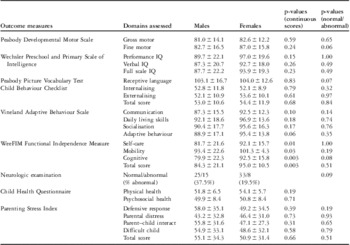
A comparison of mean scores and proportions abnormal between boys and girls on all outcome measures is shown in Table 1. Boys were twice as likely to have an abnormal neurological examination when compared with girls. Mean gross motor scores were more than one standard deviation below the normative mean, with about half of the children (47.4 percent boys, 53.8 percent girls) exhibiting gross motor delays. Fine motor scores were also shifted down; however, there was a trend for boys to be more likely to have fine motor delays than girls (50.0 percent as compared with 28.2 percent, respectively; probability equals 0.06). Mean intelligence quotients were 5–7 points lower in boys as compared with girls; however, this did not reach statistical significance. Receptive language scores were not significantly different between groups; however, three boys had scores less than 78, whereas no girls had scores below this cut-off, indicative of a language delay. The mean scores of boys on all the WeeFIM functional subscales, namely self-care, mobility, cognition, were significantly lower than that of the girls. There were 5–7 point differences in the Vineland mean subscale scores, with boys performing lower, with differences in communication (boys: 87.3 plus or minus 15.5, girls: 92.5 plus or minus 12.3; probability equals 0.097) and adaptive behaviour (boys: 88.9 plus or minus 17.1, girls: 95.4 plus or minus 13.8; probability equals 0.061). There were no gender differences noted with respect to behavioural difficulties, health status, or parental stress levels.
Comparison of developmental and functional outcomes between males and females.

IQ = intelligence quotient
Discussion
Boys born with a congenital cardiac defect that requires early open heart surgery appear to be at higher risk for activity limitations, with a trend to exhibiting greater neuromotor impairments as well. Small sample size may have limited our ability to demonstrate statistically significant differences in motor, cognitive, and possibly other domains. To our knowledge, only one published study has examined possible gender differences associated with the developmental sequelae following open heart surgery. Physical activity level and average total energy expenditure were reported to be lower in boys in the age group of 9–12 years when compared with girls.Reference Kao, Chang, Chiu, Wu and Tsai14 This is supported by experimental data indicating that aerobic capacity – percent-predicted peak oxygen consumption – and stroke volume – percent-predicted maximum oxygen pulse – are diminished in male adolescents when compared with their female counterparts with congenital cardiac defects.Reference Paridon, Mitchell and Colan15
When compared with girls, 5-year-old boys in our cohort of children with congenital cardiac defects were twice as likely to exhibit neurological abnormalities on examination. There was a trend for boys to have poorer fine motor skills, and intelligence quotient scores were consistently lower, although this did not reach statistical significance. Performance in daily living skills has been shown to be more difficult in children with congenital cardiac defects following open heart surgery;Reference Limperopoulos, Majnemer and Shevell25, Reference Majnemer, Limperopoulos, Shevell, Rohlicek, Rosenblatt and Tchervenkov26 however, closer inspection reveals that boys are at considerably enhanced risk for greater dependency. It is conceivable that the neurodevelopmental challenges described above may contribute to greater difficulties with complex functional tasks in self-care, for example eating, grooming, bathing, dressing, toileting; mobility, for example transfers, locomotion, stairs; and social cognition, for example age-appropriate communication skills, social interactions, problem-solving tasks. Indeed, fine motor (correlations ranging from 0.37 to 0.41; probability less than 0.005) and intelligence quotient scores (correlations ranging from 0.51 to 0.60; probability less than 0.001) were significantly correlated with WeeFIM functional independence subscales, and children with neurological abnormalities were more likely to have lower self-care and cognition scores on the WeeFIM (probability less than 0.05). It is also possible that boys may have been selectively more overprotected by their parents, further contributing to greater dependency; however, this would need to be validated by objective data.
Our findings, suggesting that boys with congenital cardiac defects may be at greater risk for neuromotor deficits and functional limitations, support gender differences in the pathogenesis of early brain injury following hypoxic–ischaemic insults. In animal models, females sustain less brain damage after concussion or cerebral ischaemia. Sex hormones in adult females can reduce cell death; however, in immature animals, gender differences in the mechanisms of molecular cell death pathways also exist in the absence of hormonal exposure.Reference Renolleau, Fau and Charriaut-Marlangue8, Reference Hurn, Vannucci and Hagberg27, Reference Yager, Wright, Armstrong, Jahraus and Saucier28 After hypoxic–ischaemic insult to the immature animal, males are more sensitive to glutamate and oxygen–glucose deprivation and have greater translocation of apoptosis-inducing factors following Poly(ADP-ribose) Polymerase activation along the excitotoxic cascade. Conversely, females have greater activation of caspase-3, and therefore caspase-dependent cell death. As a result, neuroprotective strategies may need to be gender specific to be maximally effective.Reference Mayoral, Omar and Penn29, Reference Turtzo and McCullough30 For females, inhibitors along the cytochrome C-caspase 3 pathway that prevent caspase activation would be an effective strategy, whereas in males pharmacological Poly(ADP-ribose) Polymerase inhibition would be preferable.Reference Renolleau, Fau and Charriaut-Marlangue8, Reference Nijboer, Groenendaal, Kavelaars, Hagber, van Bel and Heijnen31 Moderate hypothermia in rats appears more protective in females, both in terms of eventual lesion size and deficits.Reference Hurn, Vannucci and Hagberg27
Preliminary evidence of sexual dimorphism following perinatal brain injury also exists in human studies. Numerous epidemiological studies of stroke indicate that the incidence is lower in the female population – adults and children; however, female patients who experience a stroke are more likely to have a severe disability at discharge.Reference Hurn, Vannucci and Hagberg27, Reference Fullerton, Wu, Zhao and Johnston32, Reference Golomb, Fullerton, Nowak-Gottl and deVeber33 Female population has a better outcome after traumatic brain injury.Reference Renolleau, Fau and Charriaut-Marlangue8 Cerebral palsy, a disorder that is associated with brain injury occurring either in utero and/or in the perinatal period, is more common in the male population. Furthermore, after preterm birth, male infants are reported to have worse neurodevelopmental outcome than their female counterparts.Reference Mayoral, Omar and Penn29
Gender-specific responses to early hypoxic–ischaemic exposures suggest that different neuroprotective strategies may need to be pursued to optimise outcomes.Reference Renolleau, Fau and Charriaut-Marlangue8, Reference Johnston and Hagberg9 The results of our study suggest that these gender-specific responses to an insult to the immature brain may also apply to infants with congenital cardiac defects. Given the exploratory nature of these post hoc analyses and the relatively small sample size, validation of these findings on larger population-based samples is needed. If validated by others, these gender differences may need to be considered in future therapeutic trials to minimise or prevent early brain injury in infants born with a congenital cardiac defect who require early surgical repair. Consideration should be given to the timing of a brain injury, which may occur in utero, before, during, and/or after open heart surgery. The selective vulnerability of boys to injury should therefore be examined with respect to the timing of the insult to the immature nervous system. Furthermore, results suggest that early rehabilitation interventions should be individualised, with consideration of the enhanced risk of neuromotor sequelae and functional limitations in boys with congenital cardiac defects.
Acknowledgements
Many thanks to our research coordinator Lisa Steinbach, as well as our research assistants Nicholas Hall and Anna Radzioch. We are grateful to the children and families for their participation in this longitudinal study. Special thanks to Dr Harder and the late Dr Darwish for assistance in follow-up of children living in Alberta. This study was funded by the March of Dimes (United States of America; Grant no. 12-FY99-244), the Heart and Stroke Foundation, and the National Health Research and Development Program, Canada. The research team was supported by infrastructure provided by the Montreal Children's Hospital Research Institute and CRIR, both funded by FRSQ. This study was presented at the Child Neurology Society meeting in Providence, Rhode Island, October, 2010.