





Relevance statement
There are escalating mental health problems but despite efforts to reduce the onset of mental health problems, there has been limited insight around the best preventative approaches for children and young people. The UK Government has highlighted a central role for schools in this and research has supported this to some extent, yet the field lacks large-scale and robust trials to determine efficacy. This large-scale and methodologically rigorous trial provides insight into the potential viability of two existing approaches to reduce pressure on specialist services by preventing escalation in mental health problems.
Studies have consistently suggested an increase in mental health problems in children and young people, Reference Ford, Vizard, Sadler, McManus, Goodman and Merad1 with recent estimates suggesting 1 in 5 young people aged 8–16 in England are now meeting criteria for one or more probable disorders. Reference Newlove-Delgado, Marcheselli, Williams, Mandalia, Dennes and McManus2 This trend was apparent before the pandemic and appears to have been exacerbated since, Reference Mansfield, Santos, Deighton, Hayes, Velikonja and Boehnke3 with increased rates of mental health problems being maintained. Reference Newlove-Delgado, Marcheselli, Williams, Mandalia, Dennes and McManus2 Mental health difficulties are associated with poor long-term psychosocial, educational and occupational outcomes, Reference Gibb, Fergusson and Horwood4,Reference Goodman, Joyce and Smith5 and mental health and well-being are recognised as a human right. Reference Patel, Saxena, Lund, Thornicroft, Baingana and Bolton6 Hence, there is an urgent public health requirement to develop preventative interventions that successfully reduce the risk of developing mental health problems Reference Fusar-Poli, Correll, Arango, Berk, Patel and Ioannidis7 and test the efficacy of existing promising international interventions.
Adolescence presents a key period of opportunity for preventative interventions, as many mental health difficulties emerge during this developmental stage and rise further between adolescence and young adulthood. Reference Solmi, Radua, Olivola, Croce, Soardo and De Pablo8 By targeting the period before the likely first onset of a clinical episode, it may be possible to alter the developmental course of a condition and ultimate diagnosis. Reference Munoz, Cuijpers, Smit, Barrera and Leykin9 Developmentally, adolescence is also associated with heightened sensitivity to social cues and brain plasticity, Reference Fuhrmann, Knoll and Blakemore10 suggesting it may be an optimal period to learn adaptive strategies and behaviours for coping with subsequent mental health challenges.
Due to their central role in young people’s lives, schools have been proposed as a suitable setting to deliver preventative interventions to adolescents. 11,12 Numerous school-based interventions aiming to improve adolescent mental health have been developed. Reference Humphrey13 One area of focus has been on interventions that seek to improve mental health literacy and help-seeking intentions. Studies report that universal school-based mental health literacy interventions appear to be successful at increasing mental health knowledge, Reference Wei, Hayden, Kutcher, Zygmunt and McGrath14–Reference Amado-Rodríguez, Casañas, Mas-Expósito, Castellvi, Roldan-Merino and Casas16 but effects on help-seeking are mixed. Reference Hayes, Mansfield, Mason, Santos, Moore and Boehnke17
Interpretation of these findings is limited by overall low methodological study quality. Reference Hayes, Mansfield, Mason, Santos, Moore and Boehnke17 Studies often do not report dosage, intervention fidelity and implementation factors, which can vary across schools and interventions, despite evidence suggesting effectiveness likely varies with implementation. Reference Feiss, Dolinger, Merritt, Reiche, Martin and Yanes18 Similarly, longer-term outcomes of the interventions are often not reported, Reference Hayes, Mansfield, Mason, Santos, Moore and Boehnke17,Reference Clarke, Sorgenfrei, Mulcahy, Davie, Friedrich and Mcbride19 despite these being key to evaluate, since the overall aim is to have a lasting impact. In addition, few trials of school-based mental health interventions have also incorporated subgroup treatment effect modification, risking a ‘one size fits all’ assumption in mental health programming. Reference Mansfield, Ukoumunne, Jayne, Kuyken, Marin and Byford20
Recent research has highlighted the potential for some mental health interventions to have unintended consequences, thus emphasising the importance of studies monitoring possible deterioration as well as improvement. Reference Foulkes and Stringaris21 Given the urgent need to establish efficacious solutions to the problem of rising mental health problems in adolescents, large-scale high-quality studies are required.
In this article, we investigate the impact of two universal interventions in English secondary schools that have previously been found to be effective in other countries: Reference Wasserman, Hoven, Wasserman, Wall, Eisenberg and Hadlaczky22–Reference Kutcher, Wei and Morgan25 Youth Aware of Mental Health (YAM) Reference Wasserman, Hoven, Wasserman, Wall, Eisenberg and Hadlaczky22 and The Mental Health and High School Curriculum Guide (The Guide) Reference Kutcher, Wei and Morgan25 (trial protocol: Hayes et al Reference Hayes, Moore, Stapley, Humphrey, Mansfield and Santos26 ). Both YAM and The Guide are universal interventions that aim to increase awareness of mental health and disorders. Reference Wasserman, Hoven, Wasserman, Wall, Eisenberg and Hadlaczky22,Reference Kutcher, Wei and Morgan25 YAM has been shown to be effective at reducing suicidality Reference Wasserman, Hoven, Wasserman, Wall, Eisenberg and Hadlaczky22 and depressive symptoms, Reference Trivedi, Nandy, Mayes, Wang, Forbes and Anderson27 while The Guide has been shown to improve help-seeking, Reference Simkiss, Gray, Kemp, Dunne and Snowden28 reduce stigma Reference Milin, Kutcher, Lewis, Walker, Wei and Ferrill24 and increase mental health-related knowledge. Reference Milin, Kutcher, Lewis, Walker, Wei and Ferrill24,Reference Ravindran, Herrera, da Silva, Henderson, Castrillo and Kutcher29
The primary aim of this study was to investigate the effectiveness of The Guide on intended help-seeking, and of YAM on depressive symptoms, both measured 3–6 months after the start of the intervention compared with usual practice.
Method
Study design
Approaches for Well-being and Mental Health Literacy: Research in Education (AWARE) was a three-arm, parallel cluster, randomised controlled trial (RCT) (trial registration number: ISRCTN17631228) conducted in 153 schools in England. Recruitment of schools took place between March 2018 and September 2022. Recruitment was carried out for two separate trials in parallel: this trial (AWARE) and a trial of ‘light touch’ universal interventions developed for English schools, known as the INSPIRE trial. Reference Deighton, Thompson, Hayes, March, Thornton and Santos38 The AWARE trial investigated the effectiveness of YAM and The Guide compared with provision as usual (control) on the outcomes noted below. The authors assert that all procedures contributing to this work comply with the ethical standards of the relevant national and institutional committees on human experimentation and with the Helsinki Declaration of 1975, as revised in 2013. All procedures involving human subjects were approved by the University College London Research Ethics Committee (6735/009 and 6735/014). The study design was published in the trial protocol, Reference Hayes, Moore, Stapley, Humphrey, Mansfield and Santos26 including required study design updates due to the COVID-19 pandemic (i.e. amendment to the timeline of the second cohort data collection and the addition of a third recruitment cohort). The trial ended after the completion of the third cohort of the trial. The manuscript was checked against the appropriate Consolidated Standards of Reporting Trials (CONSORT) guidelines. Reference Juszczak, Altman, Hopewell and Schulz30
Participants
Eligible participants were pupils in schools across England in Year 9 (aged 13–14 years) during baseline data collection. Schools were contacted via a variety of UK charity networks, school commissioners and governmental organisations (further details in Supplementary Materials). To ensure representation across England, schools were recruited across ‘hubs’ located in the North East, North West, South East and South West of England. All mainstream secondary schools were deemed eligible if:
-
(a) they were willing to deliver or have an intervention delivered to approximately 60 Year 9 pupils (across three delivery classes);
-
(b) they could allocate 1 hour per week to deliver the intervention over 6 weeks (in the spring term of 2019, 2020 or 2022);
-
(c) staff could attend one of the training sessions, if required;
-
(d) the school returned a signed Memorandum of Understanding and data sharing agreement and provided pupil lists to the research team;
-
(e) they were not currently taking part in similar trials (e.g. HeadStart (31)).
Young people were eligible if:
-
(a) they were not opted out of the trial by their parents/guardians;
-
(b) they provided written assent.
Participant gender was provided by the school staff based on school administrative data collected for the National Pupil Database. The only categories available in this administrative data are ‘male’ or ‘female’. Recruitment was conducted in three cohorts (March 2018, February 2019, February 2022). Following school recruitment, schools selected classes that would receive the intervention (if allocated), then letters were sent to the parents/guardians of the pupils in these classes, providing an opportunity for parents/guardians to opt their children out. Finally, prior to completion of the baseline surveys, young people provided assent after reading through the information sheet and ticking boxes online agreeing to take part. Any young people that did not provide assent at the baseline survey did not take part in the trial. Young people were asked to provide their assent on each occasion of completing the surveys.
Randomisation and masking
After completion of baseline data collection, schools were allocated in a 1:1:1 ratio, to one of two interventions or a control group. Allocation was carried out by an independent body that was not involved in the rest of the trial: Kings Clinical Trials Unit. Within each cohort, schools were allocated via minimisation, stratifying for current mental health provision (structured lessons on mental health, other types of mental health support or no mental health support), region (North East, North West, South East and South West of England), deprivation (indicated by the share of pupils eligible for free school meals: bottom third of schools in sample, middle third of schools in sample and top third of schools in sample) and urban/rural situation (city or town/rural). Allocation was based on clusters (schools) and the sequence was concealed until interventions were assigned. For more information on the minimisation procedures implemented, see the Education for Wellbeing Technical Report.
The school allocation was masked from the statistician (J.R.B.), quantitative data analyst (P.P.) and economists (K.Z., E.L., E.B.), who were unblinded after their respective analyses were confirmed to be finished. Several steps were taken to ensure masking was successful, detailed in the Supplementary Materials. Due to the nature of the interventions, participants and school staff were not blind to treatment allocation.
Procedures
The trial involved the comparison of two intervention programmes with a ‘treatment-as-usual’ control group within a school setting. A description of the interventions is provided in the Supplementary Materials. Interventions were delivered between January and March (inclusive) (after baseline measures and randomisation were completed).
Schools allocated to the control group were not required to deliver a specific mental health intervention during their participation in the programme but were allowed to continue with their usual provision. Usual provision was assessed using a questionnaire that asked about activities and approaches to mental health that had been used within the schools within the last two years. We derived a percentage score across the following domains: staff mental health training, universal school provision and targeted provision. The results are included in Table S1.
Outcomes
Primary and secondary study outcomes were measured at the individual level at three time points: baseline (prior to randomisation), 3–6 months after the start of the intervention and 9–12 months post-intervention (as specified in a pre-registered statistical analysis plan (SAP)). Reference Boehnke, Deighton, Evans-Lacko, Hayes, Humphrey and Patalay32 All questionnaires were completed online. The primary and secondary outcomes differ for each intervention (Table S2). Measures are described in the Supplementary Materials. Due to disruption of the second cohort of the trial as a result of the COVID-19 pandemic, the 3–6 months time point data were not collected in cohort 2. As this is the primary outcome measure time point, only data from cohorts 1 and 3 are included in the primary outcome analysis.
Choice of primary measure
While YAM has primarily been trialled as a suicide prevention programme, the current study was commissioned to test if YAM might have an impact on depressive symptoms – an outcome which might be seen as a potential precursor for suicidal ideation and for which YAM had previously shown promise. The Short Mood and and Feelings Questionnaire (SMFQ) Reference Angold, Costello, Messer, Pickles, Winder and Silver33 was therefore selected as the primary outcome for YAM. It is a 13-item self-report questionnaire that is widely used to measure depressive symptoms in children and adolescents. Cronbach’s α has previously been reported as 0.91. Reference Thabrew, Stasiak, Bavin, Frampton and Merry34 Scores range from 0 to 26 with a score of 12 or more indicating depression. The General Help Seeking Questionnaire (GHSQ) Reference Wilson, Deane, Ciarrochi and Rickwood35 was the primary outcome selected for The Guide – an 18-item self-report scale measuring intended help-seeking, which is widely used with young people and has been reported to have good reliability (Cronbach’s α = 0.85, test–retest reliability assessed over a three-week period = 0.92). Reference Wilson, Deane, Ciarrochi and Rickwood35 Scores range from 18 to 126.
Assessment of safety and adverse events
School safeguarding leads – school staff holding the safeguarding remit within their schools – were asked to report any adverse events occurring during the course of the trial. This included serious adverse events (SAE): suicidal ideation, suicidal intent, admission due to psychiatric use of substances and death including suicide, and other adverse events, such as violent behaviour, self-harm or any other event that the safeguarding lead felt could be classed as adverse.
Statistical analysis
The analysis followed a detailed SAP which was logged on the Open Science Framework more than 3 months before the data were shared with the analyst (J.R.B.). Reference Boehnke, Deighton, Evans-Lacko, Hayes, Humphrey and Patalay32
Sample size
The target sample size of 144 schools (48 schools per arm; with 60 students each) of which 48 schools serve as the control group for both interventions. In short, the study was planned for a minimally detectable effect size 0.20 for each respective trial arm comparison, assuming a statistical significance level of α = 0.05, power β = 0.80, assuming that controlling for individual pre-test values explains 20% of variance in the outcome variables. Since the analysis of the primary outcome only compares each active treatment individually against the control arm, no correction of error rates was applied. Reference Wason, Stecher and Mander36
The analyses reported in this paper follow the intention-to-treat (ITT) principle. Excluded from the analyses are all participants who were eligible at baseline but did not provide any data at baseline or the following cohorts. All other participants are included in the analyses. The analyses for the primary outcome analyses (and secondary outcomes at months 3–6) are based on cohorts 1 and 3 as the target analysis samples. These are the samples that were assessed either before or after the pandemic. Analyses that assess the secondary outcomes at 9–12 months are conducted using data from all three cohorts.
Analysis of outcome variables
Means and standard deviations were produced for quantitative outcomes and category frequencies for categorical data. The analysis was conducted on an ITT basis, whereby participants that provided at least demographic information at baseline were retained in the analyses. All analyses conducted were by originally assigned groups. Complete case data were the main basis for inference. Sensitivity analyses were also run to evaluate the impact of missing data on the primary outcome analysis results and the use of multiple imputation (see Supplementary Material).
Mixed linear models with a random effect for school were used to test for the effect of the intervention. The mixed model for each outcome included fixed effects for the intervention group (school level), the pre-test value of the primary outcome variable of the respective analysis (pupil level; centred to the overall sample mean across both cohorts), the school-level stratification variables’ regional representation, current mental health provision, deprivation and urban/rural situation, and the trial cohort the school was recruited to (https://osf.io/h5nbe/). The models were estimated using Stata 14.0 using b = 1000 bootstrap samples (stratified by condition and resampling schools). Effect sizes for the intervention are reported as s.m.d. by dividing the a.m.d. from the model by the total s.d. Reference Xiao, Kasim and Higgins37
The intervention groups were compared with the control group only; no tests were conducted comparing the interventions directly.
Effect modification
To test for the differential intervention effects by a number of moderators, the same analytic strategy was used as for the trial main effects with an interaction term added (intervention*moderator), for each of the following moderators separately, while including main effects for the intervention and moderator: sex (male/female), free school meal status of the pupil, ethnicity (broad White/Ethnic minority groups), previous mental health, Special Educational Needs (SEN) status, school-level deprivation, rural/urban situation of school, previous implementation of universal mental health programmes (prior support/no prior support). All these analyses were exploratory and outlined in the SAP. Reference Boehnke, Deighton, Evans-Lacko, Hayes, Humphrey and Patalay32
All analyses were conducted in Stata version 17 for Windows (College Station, Texas, USA; https://www.stata.com/install-guide/windows/download/ ).
A data monitoring and ethics committee, consisting of independent members, advised on the ongoing conduct of the trial.
Role of the funding source
The commissioner and funder of the study had no role in data collection, data analysis, data interpretation or writing of the report.
Results
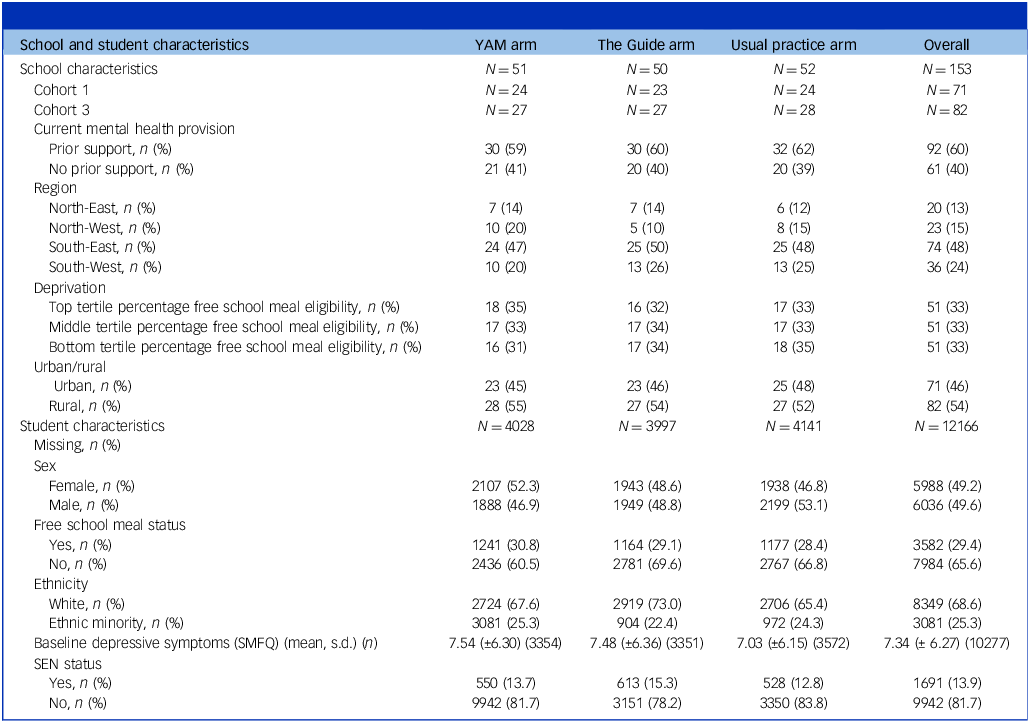
Recruitment took place between March 2018 and September 2022. The information below pertains specifically to cohorts 1 and 3, which together comprise the analytic sample for the primary outcome analyses. Recruitment details for all three cohorts (relevant for interpretation of outcomes at 9–12 months follow-up) are presented thereafter. We received 734 Expressions of Interest from schools. Of these, 264 did not return the Memorandum of Understanding, 29 did not meet inclusion criteria, 237 were allocated to the INSPIRE trial (38) instead and 51 failed to provide baseline data. Consequently, 12 166 participants from 153 schools were randomised (see Fig. 1). Baseline characteristics for the sample are included in Table 1 (Table S3 presents the same characteristics for all three cohorts). Table S7 presents baseline imbalance checks and Table S8 the results for the sensitivity analysis for missing data (which does not indicate any changes to the interpretation of the results of the primary outcome analysis). Secondary outcomes assessed at 9–12 months follow-up additionally incorporate pupils from cohort 2. For this larger sample, we received 1175 Expressions of Interest from schools. Of these, 499 did not return the Memorandum of Understanding, 29 did not meet inclusion criteria, 317 were allocated to the INSPIRE trial Reference Deighton, Thompson, Hayes, March, Thornton and Santos38 instead and 91 failed to provide baseline data. Consequently, 19 121 participants from 239 schools were randomised (see Supplementary Material for an extended CONSORT diagram illustrating the flow of pupils from all three cohorts).
CONSORT diagram of schools and pupils through the Approaches for Well-being and Mental Health Literacy: Research in Education (AWARE) trial.
Disruption due to COVID-19 meant wave 2 pupils returned surveys for T3 but not T2. Hence, there are instances where the number of surveys returned are higher for the second follow-up than for the first. King’s Clinical Trials Unit (KCTU) confirmed that one school was randomised in error after manual entry of the school identifiers (the school was part of, correctly randomised and analysed in INSPIRE). Both KCTU and the data monitoring ethics committee (DMEC) confirmed that beyond reporting this error no further adjustments needed to be made. CONSORT, Consolidated Standards of Reporting Trials; MoU, Memorandum of Understanding.

Baseline characteristics

Table 1 Long description
The table presents baseline characteristics of participants across three arms: YAM arm, The Guide arm, and Usual Practice arm. It includes data on school characteristics, current mental health provision, region, deprivation, urban/rural classification, student characteristics, sex, free school meal status, ethnicity, baseline depressive symptoms, and SEN status. The table has 15 rows and 5 columns. Column headers are YAM arm, The Guide arm, Usual Practice arm, and Overall. Row labels include School characteristics, Current mental health provision, Region, Deprivation, Urban/rural, Student characteristics, Sex, Free school meal status, Ethnicity, Baseline depressive symptoms, and SEN status. Each row provides specific data points for each arm and overall totals. Notable trends and comparisons are not summarized here but are visible in the detailed data points.
YAM, Youth Aware of Mental Health; The Guide, Mental Health and High School Curriculum Guide; SMFQ, Short Mood and Feelings Questionnaire; SEN, Special Educational Needs.
The current mental health provision data included here comes from the stratification variable. The numbers included are from cohorts 1 and 3 only.
Primary outcomes
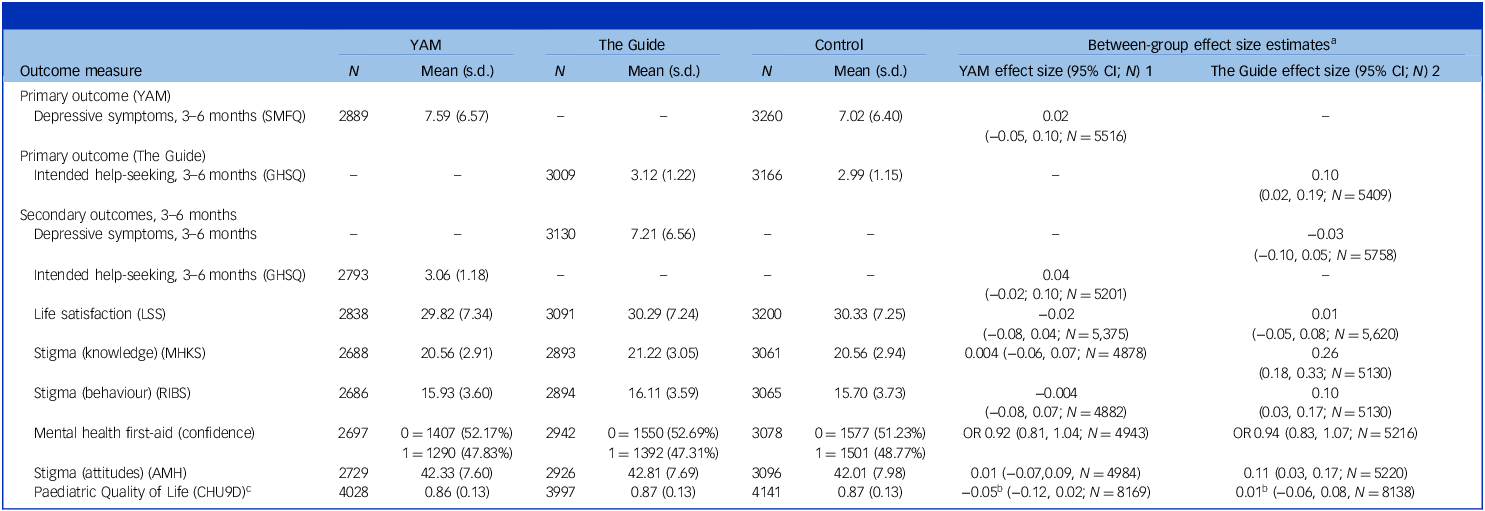
For YAM, the primary outcome analysis of the SMFQ at 3–6 months, indicated an average score difference (ASD) between schools randomised to the interventions and those in the control condition of +0.13 (s.m.d. = 0.02; 95% CI −0.23 to 0.53; Table 2). According to the pre-set criteria, no statistically significant group difference in adjusted means was detected.
Main comparisons of student outcomes (3–6 months)

Table 2 Long description
The table compares student outcomes across different interventions and control conditions over 3-6 months. It includes columns for YAM, The Guide, and Control groups, with rows for various outcomes such as depressive symptoms, intended help-seeking, life satisfaction, stigma knowledge, stigma behavior, mental health first-aid confidence, stigma attitudes, and pediatric quality of life. Each row provides the number of participants (N), mean scores (with standard deviations), and between-group effect size estimates. For example, the primary outcome for YAM shows depressive symptoms with a mean of 7.59 for YAM and 7.02 for Control. The table also includes effect sizes and confidence intervals for various comparisons.
YAM, Youth Aware of Mental Health; The Guide, Mental Health and High School Curriculum Guide; SMFQ, Short Mood and Feelings Questionnaire; GHSQ, General Help-Seeking Questionnaire; LSS, Huebner Life Satisfaction Scale; MHKS, Mental Health Knowledge Schedule; RIBS, Reported and Intended Behaviour Scale; AMH, attitudes towards mental health; CHU9D, Child Health Utility-9D; OR, odds ratio.
Comparisons are between YAM and the control group, and The Guide and the control group, respectively.
a. 3–6 months follow-up data includes Cohorts 1 and 3 only with participants missing baseline data on the primary outcome or covariates excluded from adjusted analyses (see Table S8 for sensitivity analyses).
b. Due to there being missing individual items, this effect size was estimated on the imputed data and accompanied by a normal-theory confidence interval.
c. To align with a parallel economic evaluation which requires complete data, analyses of CHU9D data were conducted on a fully imputed data set comprising all participants allocated to their respective trial arms during Cohorts 1 and 3.
For The Guide, the primary outcome analysis of the GHSQ at 3–6 months, indicated an ASD between schools randomised to the interventions and those in the control condition of +0.11 (s.m.d. = 0.10; 95% CI 0.02 to 0.19; Table 2). These results are indicative of having an effect, in line with an increase in intended help-seeking in the intervention group compared with the control group.
Secondary outcomes
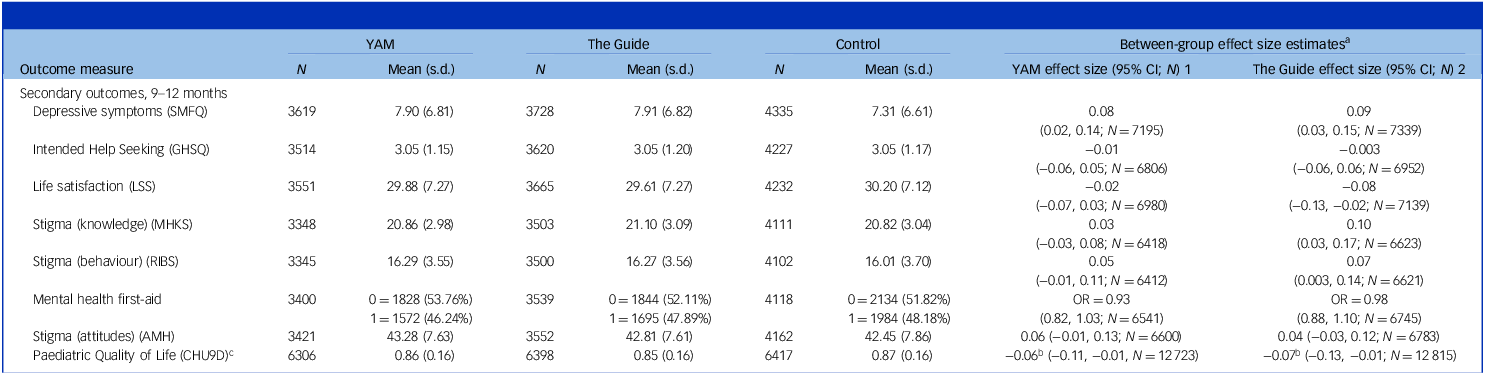
In terms of secondary outcomes, there were no detected effects of YAM compared with the control group on any secondary outcomes at 3–6 months. At the 9–12 months follow-up, there was an increase in depressive symptoms of +0.44 (s.m.d. = 0.08; 95% CI 0.11 to 0.74; Table 3) in the YAM group compared with the control group.
Student outcomes at 9–12 months follow up

Table 3 Long description
A table comparing student outcomes across different groups at 9-12 months follow-up. The table has 10 rows and 12 columns. The columns are labeled as follows: Outcome measure, YAM N, YAM Mean (s.d.), The Guide N, The Guide Mean (s.d.), Control N, Control Mean (s.d.), YAM effect size (95% CI; N 1), The Guide effect size estimates, The Guide effect size (95% CI; N 2). The rows are labeled with different outcome measures: Depressive symptoms (SMFQ), Intended Help Seeking (IHSQ), Life satisfaction (LSS), Stigma (knowledge) (MHKS), Stigma (behaviour) (RBS), Mental health first-aid, Stigma (attitudes) (AMH), Paediatric Quality of Life (PedsQL). Each row provides the mean and standard deviation for each group (YAM, The Guide, Control) and the effect sizes for YAM and The Guide compared to the control group. Notable trends include the increase in depressive symptoms in the YAM group compared to the control group.
SMFQ, Short Mood and Feelings Questionnaire; GHSQ, General Help-Seeking Questionnaire; LSS, Huebner Life Satisfaction Scale; MHKS, Mental Health Knowledge Schedule; RIBS, Reported and Intended Behaviour Scale; AMH, attitudes towards mental health; CHU9D, Child Health Utility-9D; OR, odds ratio.
Comparisons are between YAM and the control group, and The Guide and the control group, respectively.
a. 9–12 months follow-up data includes Cohorts 1, 2 and 3 with participants missing baseline data on the primary outcome or covariates excluded from adjusted analyses.
b. Due to there being missing individual items, this effect size was estimated on the imputed data and accompanied by a normal-theory confidence interval.
c. To align with a parallel economic evaluation which requires complete data, analyses of CHU9D data were conducted on a fully imputed data-set comprising all participants allocated to their respective trial arms during Cohorts 1, 2 and 3.
For The Guide, at 3–6 months there were more positive attitudes towards mental health (AMH) (ASD = 0.71; s.m.d. = 0.10; 95% CI 0.25 to 1.18; Table 2), increased knowledge of mental health (Mental Health Knowledge Schedule (MHKS)) (ASD = 0.71; s.m.d. = 0.26; 95% CI 0.49 to 0.92; Table 2) and more positive mental health behaviours (Reported and Intended Behaviours Scale (RIBS)) (ASD = 0.32; s.m.d. = 0.10; 95% CI 0.09 to 0.54; Table 2) in the group that received The Guide compared with the control group.
At the 9–12 months follow-up, there was an increase in depressive symptoms (ASD = 0.49; s.m.d. = 0.09; 95% CI 0.13 to 0.80; Table 3), decreased life satisfaction (ASD = −0.45; s.m.d. = −0.08; 95% CI −0.77 to −0.11; Table 3), increased mental health knowledge (ASD = 0.29; s.m.d = 0.10; 95% CI 0.10 to 0.50; Table 3) and more positive mental health behaviours (ASD = 0.23; s.m.d. = 0.07; 95% CI 0.02 to 0.44; Table 3) in the group that received The Guide compared with the control group.
Effect modification
Effect modification analysis suggested two significant findings: YAM led to increased depressive symptoms at the first follow-up in schools who reported no prior provision of universal mental health programmes, while The Guide showed increased intended help-seeking in girls at the long-term follow-up. Effect modification results are presented in full in the Supplementary Materials (Tables S4 and S5).
Adverse events
There were five adverse events reported, two of which were classed as serious adverse events, both in the YAM arm. One of these was determined by the school safeguarding lead as possibly related to study procedures (Table S6). None of these were deemed by the adverse events oversight group to be sufficient to stop the trial.
Discussion
Findings
AWARE was a large-scale and rigorously conducted trial of universal school-based interventions in secondary schools in England. The Guide significantly increased intended help-seeking relative to the control group at first follow-up. In terms of secondary outcomes, The Guide also improved attitudes, knowledge and behaviours relating to mental health. At the long-term follow-up, the increase in mental health knowledge and behaviours were sustained, but there was also decreased life satisfaction and increased depressive symptoms. YAM also led to increased depressive symptoms at the long-term follow-up (see Fig. 2 for a summary of findings).
Summary of research findings.

Comparison with other studies
The Guide led to improved intended help-seeking scores. While the detected effect was marginally lower than the minimal detectable effect size the trial was powered for, the findings are consistent with the notion that even small effects can translate into a substantial population health impact Reference Matthay, Hagan, Gottlieb, Tan, Vlahov and Adler39 and with recent reviews showing smaller effect sizes achieved by universal mental health interventions in schools. Reference Hayes, Deniz, Nisbet, Thompson, March and Mason40 Findings are also in line with several studies that have reported that mental health literacy can be improved by participating in interventions such as The Guide. Reference Milin, Kutcher, Lewis, Walker, Wei and Ferrill24,Reference Simkiss, Gray, Kemp, Dunne and Snowden28 Intentions to seek help is one component of mental health literacy, alongside beliefs, and understanding of mental health, including mental disorders, how to obtain and maintain positive mental health and stigma reduction. We also report that The Guide led to improvements in the mental health literacy domains of knowledge, mental health behaviours and stigma at the first follow-up, in line with previous studies, Reference Simkiss, Gray, Kemp, Dunne and Snowden28 and that the increase in mental health knowledge and behaviours were sustained at the long-term follow up. In the long-term follow up, there was no reported increase in intended help-seeking scores; however, the effect modification analysis suggests there was increased intended help-seeking in girls at this time point. However, due to the exploratory nature of the effect modification analysis and the number of comparisons made, this finding should be interpreted with caution.
The second intervention, YAM, showed no impact on the specified primary outcome of young people’s depressive symptoms at first or second follow-up. YAM was developed primarily as a suicide prevention intervention and the majority of the evidence accrued to date centres on its utility in preventing suicide attempts and suicidal ideation, Reference Wasserman, Hoven, Wasserman, Wall, Eisenberg and Hadlaczky22 with many of these studies having found a positive effect, Reference Wasserman, Hoven, Wasserman, Wall, Eisenberg and Hadlaczky22,Reference McGillivray, Shand, Calear, Batterham, Rheinberger and Chen41 although two studies have reported an impact of YAM on depressive symptoms. Reference Trivedi, Nandy, Mayes, Wang, Forbes and Anderson27,Reference McGillivray, Shand, Calear, Batterham, Rheinberger and Chen41 The current trial primarily investigated the impact of YAM on depressive symptoms and found no discernible impact of the intervention on this outcome or any of the secondary outcomes at the first follow-up. In the current study, it is important to note that there were significantly more schools from the YAM arm of the trial that failed to implement the intervention, with schools citing difficulties in scheduling the sessions and some schools declining to implement due to the requirement that no school staff be present for the sessions. Reference Stapley, March, Mansfield, Ashworth, Burrell and Thompson42 Where possible, these schools were retained on the basis of ITT and, as such, could have diluted any potential impact. Indeed, in a corresponding paper for this study investigating the impact of implementation variability on the outcomes in this trial, it is reported that for schools that did successfully deliver YAM, there was a reduction in depressive symptoms at the primary outcome time point, suggesting overall impact is ‘washed out’ by failure to implement. Reference Knowles, Thornton, Panayiotou, Ashworth, Mason and Hayes43 When considering these findings, it is important to consider the challenges faced by UK schools and the different context in which YAM was delivered in this trial compared with other studies. The findings from this trial suggest YAM appeared to be challenging for UK school staff. While this may have led to the overall lack of reported impact, that many schools were unable to deliver the intervention is an important finding in itself. The fact that several of the schools cited some of the requirements of the intervention (most notably that school staff should not be present for sessions) to be against school policy, therefore preventing their participation, warrants further consideration in terms of the need for better adaptation of interventions and the contexts within which they are implemented and the potential need to co-design these approaches with schools.
Effect modification analysis indicated that pupils from schools that reported no prior provision of universal mental health programmes showed higher levels of depressive symptoms at follow-up in the YAM intervention group than schools with higher levels of prior provision. Given that effect modification analysis were exploratory, this finding should be interpreted with caution; however, it is possible that YAM raises awareness of issues for which young people might need to seek further help. If schools have limited support available, it is possible that awareness of difficulties without access to the support needed may further increase the distress of participating young people. However, this possibility warrants further investigation.
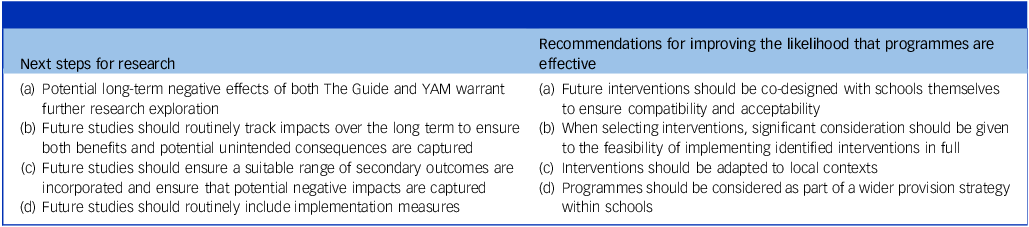
Both The Guide and YAM led to increased depressive symptoms at the long-term follow-up. The Guide was also associated with decreased life satisfaction. To our knowledge, other studies have not reported such negative impacts, but most have not studied such a wide range of outcomes or with a longer-term follow-up such as the one included here. Two possible explanations may account for the current findings. One is that mental health literacy programmes that provide detailed content about the nature of mental disorders may lead to greater understanding of mental disorders in young people that allows them to better identify and report their own mental health challenges, leading to increased reporting of symptoms. Reference Foulkes and Andrews44 The second is that these kinds of programmes may encourage rumination and self-labelling in such a way that it increases emotional distress, particularly where intervention places significant focus on mental ill-health as opposed to good mental health. Reference Foulkes and Stringaris21 Such unintended consequences may be particularly pertinent in adolescence, when young people have greater capacity and propensity for self-reflection Reference Sebastian, Burnett and Blakemore45 and in contexts where little additional support or guidance is available. While the current findings cannot specify which explanation is most likely, they do highlight the importance of incorporating a wide range of relevant outcomes and tracking impacts over the longer term to ensure both benefits and potential unintended consequences are captured (see Table 4 for future directions and recommendations).
Next steps and recommendations

Table 4 Long description
A table with two columns and four rows each. The first column is titled ‘Next steps for research’ and the second column is titled ‘Recommendations for improving the likelihood that programmes are effective’. The first row under ‘Next steps for research’ lists (a) Potential long-term negative effects of both The Guide and YAM warrant further research exploration, (b) Future studies should routinely track impacts over the long term to ensure both benefits and potential unintended consequences are captured, (c) Future studies should ensure a suitable range of secondary outcomes are incorporated and ensure that potential negative impacts are captured, and (d) Future studies should routinely include implementation measures. The first row under ‘Recommendations for improving the likelihood that programmes are effective’ lists (a) Future interventions should be co-designed with schools themselves to ensure compatibility and acceptability, (b) When selecting interventions, significant consideration should be given to the feasibility of implementing identified interventions in full, (c) Interventions should be adapted to local contexts, and (d) Programmes should be considered as part of a wider provision strategy within schools.
Study strengths
It was a large-scale, cluster RCT rolled out across England. Minimisation procedures allowed us to account for regional, urban/rural and poverty-related variations across schools in different trial arms. In addition, a period of consultation and feasibility testing allowed for some adaptations to be made to interventions with permission from intervention developers to suit the English school context. Reference Mansfield, Stapley and Mansfield46 Adaptations to the YAM intervention were small but it was possible to refine the materials for The Guide in consultation with school staff in such a way that maintained the key aspects of the programme while ensuring they were more tailored to schools in England.
Study limitations
Notably, there was a large drop-out from intervention implementation in the YAM arm of the trial (Fig. 1). While this drop-out perhaps reflects the challenges for this intervention being implemented in English schools, it also diluted the potential impact of YAM on young people’s depressive symptoms and may be a potential source of bias. In addition, outcomes for the trial were based entirely on children’s self-reported mental health and mental health literacy. Finally, school safeguarding leads were asked to report adverse events during the course of the trial. While they were reminded of this at regular intervals, it is not possible to know if all possible events would have been reported.
In conclusion, The Guide was successful at improving help-seeking in the short-term although this did not sustain to the long-term follow-up. YAM did not improve depressive symptoms, but implementation findings suggest it may be effective if implemented in full. Reference Knowles, Thornton, Panayiotou, Ashworth, Mason and Hayes43 However, this appears to have been a challenge for a significant number of UK schools. Both interventions were associated with worse depressive symptoms in the long-term. Explanations for this are speculative; however, findings may warrant caution about implementing these interventions in a universal manner, especially in the absence of other local supports, school experience delivering mental health universal programmes and adequate adaptation to the local context.
Supplementary material
The supplementary material is available online at https://doi.org/10.1192/bjp.2026.10667
Data availability
An anonymised data-set will be made publicly available in the future (planned late 2025). Please contact the corresponding author for further information.
Acknowledgements
We would like to thank all schools, pupils and parents who engaged with or participated in the programme. We would also like to thank the advisory group members, members of the data monitoring and ethics committee and members of the trial steering committee.
Author contributions
J.D. – conceptualisation, methodology, investigation, resources, writing – original draft, writing – review and editing, visualisation, supervision, project administration, funding acquisition. D.H. – methodology, investigation, resources, writing – review and editing, supervision, project administration, funding acquisition. A.T. – investigation, resources, writing – original draft, writing – review and editing, supervision, project administration. A.M. – conceptualisation, methodology, investigation, data curation, writing – review and editing, supervision, project administration. E.T. – validation, formal analysis, data curation, project administration. J.S. – investigation, resources, data curation, writing – review and editing, project administration. P.P. – conceptualisation, methodology, formal analysis, investigation, resources, writing – original draft, writing – review and editing, visualisation, funding acquisition. R.M. – conceptualisation, methodology, validation, investigation, data curation, writing – review and editing, project administration. E.D. – formal analysis, investigation, data curation. C.K. – formal analysis, investigation, data curation, visualisation. N.H. – conceptualisation, methodology, writing – original draft, writing – review and editing, supervision, funding acquisition. P.S. – conceptualisation, writing – review and editing, funding acquisition. E.A. – methodology, formal analysis, investigation, data curation, project administration. B.M. – conceptualisation, methodology, writing – review and editing, funding acquisition. K.N. – investigation, resources, data curation, writing – review and editing, project administration. C.M. – investigation, resources, data curation, project administration. J.S. – investigation, writing – original draft. J.R.B. – conceptualisation, methodology, formal analysis, resources, writing – original draft, writing – review and editing, supervision, funding acquisition.
Funding
This research was commissioned and funded by the UK Department for Education (DfE). The commissioner and funder of the study had no role in data collection, data analysis, data interpretation or writing of the report. The DfE selected the interventions to be trialled and chaired an advisory group of researchers and educators regarding the progress and quality of the research. Views expressed herein are those of the authors and not necessarily the views of the DfE.
Declaration of interest
None.
Transparency declaration
The lead author confirms that the manuscript is an honest, accurate and transparent account of the study being reported; that no important aspects of the study have been omitted; and that any discrepancies from the study as planned (and, if relevant, registered) have been explained.
Analytic code availability
Analytic code will be publicly available in the future (planned early 2027). The code will be made available at https://osf.io/kxug7/overview.
Research material availability
A selection of research materials are available in the public Education for Wellbeing Technical Report. For any other materials, or if you have any questions, please contact the corresponding author.




 Open access


eLetters
No eLetters have been published for this article.