Introduction
The evolution of population differentiation in the absence of geographical isolation (i.e. sympatric speciation) has long remained a major puzzle in evolutionary biology (Berlocher & Feder, Reference Berlocher and Feder2002). The main difficulty consists in understanding how natural selection can be strong enough to counteract the homogenising effect of gene flow and to eventually lead to speciation; recently, ecological specialization following host-shift has proven to be a convincing explanation in both theoretical and empirical studies. The hypothesis that a species can split into divergent populations through host-shift was first proposed by Walsh (Reference Walsh1864) to account for the many host-specific phytophagous insect species observed. In this scenario, specialization on a host-plant species recently introduced in the home-range of the insect may result in strong ecological divergence leading to the formation of what is known as ‘host races’ (Diehl & Bush, Reference Diehl and Bush1984), which are genetically differentiated, sympatric populations of parasites that use different hosts and between which there is appreciable gene flow (Drès & Mallet, Reference Drès and Mallet2002). Host-race formation would limit gene flow and is, thus, thought to be a route to the emergence of sympatric good species (Rice, Reference Rice1987; Via, Reference Via2001; Berlocher & Feder, Reference Berlocher and Feder2002).
Many host races have now been reported, mainly in phytophagous and saprophagous insects (Wood & Guttman, Reference Wood and Guttman1982; McPheron et al., Reference McPheron, Smith and Berlocher1988; Carroll & Boyd, Reference Carroll and Boyd1992; Feder et al., Reference Feder, Berlocher, Opp, Mopper and Strauss1998; Via, Reference Via1999; Scheffer & Wiegmann, Reference Scheffer and Wiegmann2000; Barker, Reference Barker2005; Craig et al., Reference Craig, Itami and Craig2007; Malausa et al., Reference Malausa, Leniaud, Martin, Audiot, Bourguet, Ponsard, Lee, Harrison and Dopman2007; Ohshima, Reference Ohshima2008). In the pea aphid Acyrthosiphon pisum (Harris), European and North American populations are structured in host races, each specialized on various Fabaceae species (Via, Reference Via1999; Simon et al., Reference Simon, Carré, Boutin, Prunier-Leterme, Sabater-Muñoz, Latorre and Bournoville2003; Frantz et al., Reference Frantz, Plantegenest, Mieuzet and Simon2006a). In French populations of A. pisum, three host races are associated with plants strongly differing in their levels of temporal and spatial variability; the ‘pea/broad bean’ race lives on periodically disappearing annual plants while the ‘clover’ and the ‘alfalfa’ races live in more stable perennial crops (Frantz et al., Reference Frantz, Plantegenest, Mieuzet and Simon2006a). These host races are genetically distinct (Frantz et al., Reference Frantz, Plantegenest, Mieuzet and Simon2006a) and are differentiated on a series of phenotypic traits, such as the colour (Müller, Reference Müller1981), the prevalence of facultative symbionts (Leonardo & Muiru, Reference Leonardo and Muiru2003; Simon et al., Reference Simon, Carré, Boutin, Prunier-Leterme, Sabater-Muñoz, Latorre and Bournoville2003) and the susceptibility to natural enemies such as parasitoids and fungal pathogens (Hufbauer & Via, Reference Hufbauer and Via1999; Ferrari et al., Reference Ferrari, Darby, Daniell, Godfray and Douglas2004). They have also been shown to invest differently in the sexual phase of their life cycle (Frantz et al., Reference Frantz, Plantegenest and Simon2006b). As many aphid species, the pea aphid exhibits a high variability in the life cycle; ‘sexual’ lineages alternate several generations of parthenogenetic females and a single sexual generation once a year involving males and sexual females, while ‘asexual’ lineages reproduce by continuous obligate parthenogenesis (Simon et al., Reference Simon, Rispe and Sunnucks2002). By placing lineages collected from sympatric pea aphid populations sampled in various fields of pea, broad bean, red clover and alfalfa in laboratory conditions inducing the production of sexual morphs, we found that ‘sexual’ lineages (producing males and sexual females) were in higher proportions on pea and on broad bean, while ‘asexual’ lineages were predominant on red clover and alfalfa (Frantz et al., Reference Frantz, Plantegenest and Simon2006b). We have proposed that this pattern results from the higher temporal variability to which aphids living on annual crops are submitted that may act as a selective pressure for the maintenance of sex, which confers a better adaptability to changing environments (Kondrashov, Reference Kondrashov1988; Hadany & Becker, Reference Hadany and Becker2003).
Here, we investigate the winged/wingless phenotypes of the males produced in relation to host plant specialization among these sympatric pea aphid populations. As frequently observed in insects, two alternative dispersal phenotypes coexist in aphids, a winged morph and a wingless morph, respectively specialized in dispersal and in philopatry (Harrison, Reference Harrison1980; Zera & Denno, Reference Zera and Denno1997). This coexistence may result either from a polyphenism (i.e. a given genotype can produce alternative phenotypes depending on environmental conditions) or from a polymorphism (i.e. different genotypes produce one morph or the other: Nijhout, Reference Nijhout1999). During the asexual phase, aphid parthenogenetic females display a winged/wingless polyphenism, which is primarily determined by population density (Sutherland, Reference Sutherland1969). During the sexual phase, sexual females are wingless in virtually all aphid species, while males display a winged/wingless polymorphism in about 10% of species, including the pea aphid (Braendle et al., Reference Braendle, Davis, Brisson and Stern2006). In this species, male winged and wingless phenotypes are genetically determined by a single biallelic locus ‘aphicarus’ linked to the X-chromosome (Smith & MacKay, Reference Smith and MacKay1989; Caillaud et al., Reference Caillaud, Boutin, Braendle and Simon2002; Braendle et al., Reference Braendle, Caillaud and Stern2005a). In aphids, sexual and parthenogenetic females possess two X-chromosomes while males carry only one. Consequently, three aphicarus genotypes may coexist in A. pisum females: homozygous api w/api w lineages produce only winged males, api wl/api wl lineages produce only wingless males, while heterozygous api w/api wl lineages produce both male types in equal proportions (w for ‘winged’ and wl for ‘wingless’: Braendle et al., Reference Braendle, Caillaud and Stern2005a). Since winged males are the only sexual morph able to achieve long-range dispersal in autumn, the production of winged vs. wingless males may strongly influence gene flow between populations, as well as habitat specialization.
Materials and methods
To investigate the dispersal phenotypes of the males produced by pea aphid host races, we used a collection of clonal lineages. Each lineage represents a set of offspring individuals of a given parthenogenetic female collected in the field and raised in the laboratory, thus sharing the very same genotype. The lineages were obtained from 159 females collected in mid-June of 2002 and 2003 in western France in 20 fields separated by a maximum distance of 30 km and planted with four crops, two annual (pea Pisum sativum L. and broad bean Vicia faba L.) and two perennial (alfalfa Medicago sativa L. and red clover Trifolium pratense L.). Each pea aphid lineage was kept isolated as a clonal lineage in the laboratory and reared at 18°C and 16L:8D (light:dark regime) on broad bean, which is a favourable host for pea aphids in laboratory irrespective of their plant origin (Losey & Eubanks, Reference Losey and Eubanks2000; Ferrari et al., Reference Ferrari, Godfray, Faulconbridge, Prior and Via2006; Frantz et al., Reference Frantz, Plantegenest, Mieuzet and Simon2006a). One female of each of these lineages was then retained for male production experiments.
The genotype of each of these lineages had been previously determined with 14 microsatellite loci (see Frantz et al., Reference Frantz, Plantegenest, Mieuzet and Simon2006a for details on microsatellite scoring). Since all pea aphid lineages reproduce parthenogenetically at the season of collection (June), a given genotype can be sampled several times. This means several lineages can share the same genotype; indeed, the 159 lineages corresponded to 130 different multilocus genotypes (see supplementary material). Whether such clonal copies are included in the analyses or not may strongly affect the phenotypic proportions observed. On one hand, elimination of clonal copies results in a random sampling at the genotype level; on the other hand, dataset reduced to unique genotypes only is no longer a random sample of the population (Sunnucks et al., Reference Sunnucks, DeBarro, Lushai, Maclean and Hales1997). To solve this dilemma and investigate the impact of clonal copies on population analyses, we performed analyses both with and without clonal copies.
Characterization of male phenotypes
Male production was achieved by placing aphids from each lineage in temperature and day-length conditions, inducing the production of sexual forms in the pea aphid. For each lineage, a third instar larva was isolated from the stock culture and placed on a broad bean plant at 12L:12D and 18°C (MacKay, Reference MacKay1987). It developed into a wingless adult; and the first larva it produced, in turn, was isolated, developed into parthenogenetic female and started offspring production. Once she had produced about 20 larvae, the female was removed and placed on a new plant, where she continued offspring production. This procedure was repeated until the female died. Once the larvae developed into adults, they were counted and the dispersal morph of the males (winged or wingless) was determined. Experiments were repeated three times for each lineage to get a reliable male production response at the lineage level. Lineages collected in June 2002 were tested in November–December 2002, while those collected in June 2003 were tested in January–February 2004; thus, all lineages were kept for between ten and 15 asexual generations before experimental tests. The potential problem that all lineages were not tested the same year was overcome (i) by including some lineages already tested in 2002 in the experimental tests of 2004 as reference sample and (ii) by testing for the effect of year in the statistical analyses (see below).
The genotype of each lineage at the aphicarus locus was inferred from the morph of the males it produced. Lineages producing only winged males were considered as homozygous api w/api w, those producing only wingless males were considered as homozygous api wl/api wl, and those producing both winged and wingless males were considered as heterozygous api w/api wl. The inference of the genotype of a female from the phenotype of the males she produces relies on the absence of bias in the transmission of X-chromosomes from a female to her sons. However, such biases have been reported in aphids, including Rhopalosiphum padi (Frantz et al., Reference Frantz, Plantegenest, Bonhomme, Prunier-Leterme and Simon2005) and Sitobion species (Wilson & Sunnucks, Reference Wilson and Sunnucks2006). Therefore, we searched for the potential existence of such transmission bias among lineages producing both winged and wingless males to test the validity of our inference method (see below).
Biological experiments were carried out on broad bean. Since the determination of male dispersal phenotype is exclusively genetic (Braendle et al., Reference Braendle, Caillaud and Stern2005a), using broad bean as laboratory plant should have no influence on the dispersal phenotype of the males.
Finally, data from previous studies on male morph production in pea aphid populations from North America (Smith & Mackay, Reference Smith and MacKay1989; Caillaud et al., Reference Caillaud, Boutin, Braendle and Simon2002; Braendle, Reference Braendle2003) and from Russia (Erlykova, Reference Erlykova2003) were also considered for comparison with our results.
Statistical analyses
We tested for the potential existence of biases in the transmission of X-chromosomes from females to sons. For each lineage producing both winged and wingless males, we calculated the probability of the observed ratios under the hypothesis of equal frequencies of transmission of both X-chromosomes. P-values were corrected for multiple comparisons (dividing the significance threshold by the number of comparisons made: 0.05/21=0.0024 according to Bonferroni's correction) and calculations were achieved with the binomial function of Microsoft Excel 2003. We also tested the normality of the distribution of the proportion of winged males produced by lineages producing both types of males (using the Kolmogorov-Smirnov test provided by ‘proc univariate’ in software package SAS, SAS System, version 9.1, SAS Institute, Inc., Cary, NC), and we tested whether its mean differed significantly from 0.50 (using ‘proc ttest’ in SAS).
We tested the effects of host race, year of collection and their interaction on the proportion of the api w allele (generalized linear model, SAS Genmod procedure). A binomial distribution with a Logit link was assumed. Pairwise comparisons between proportions of the api w allele according to crop origin were achieved with contrasts (using ‘CONTRAST’ statement in SAS).
For data collected during this work and those from previous studies, a ‘sample population’ was defined by the geographic area and the host of collection. Within each sample population, deviation from Hardy-Weinberg proportion at the aphicarus locus was assessed using exact tests available in Genepop ver. 3.4 (Raymond & Rousset, Reference Raymond and Rousset1995). For each sample population, the genotypic frequencies inferred from the proportion of each type of male-producing lineage were used to calculate the frequency of api w and its credibility interval (Andow & Alstad, Reference Andow and Alstad1999).
Results
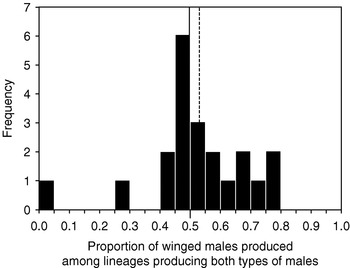
Among the 159 A. pisum French lineages exposed to conditions inducing sexual reproduction, 120 produced some males while the remaining 39 lineages continued parthenogenetic reproduction without producing any male (for more details on sexual morph production, see Frantz et al., Reference Frantz, Plantegenest and Simon2006b). Whenever sexual females were produced, they were always wingless and produced first in the reproductive sequence followed by males and, then, parthenogenetic females. Male-producing lineages first produced some parthenogenetic females only, then parthenogenetic females and wingless and/or winged males, then parthenogenetic females only again. Of the 21 lineages that produced both winged and wingless males, only one did significantly depart from equal probabilities of transmission of both X-chromosomes (one winged and 76 wingless males, P<0.0001). In addition, the distribution of the proportion of winged males produced by all lineages that produced both types did not significantly depart from a normal distribution (Kolmogorov-Smirnov test of normality, P=0.085; fig. 1), and its mean was not significantly different from 0.50 (m=0.53±0.04 SE; t-test=0.72, df=20, P=0.4813).
Distribution of the frequency of winged males produced by the 21 lineages producing both types of males. The frequency of each class is calculated as the number of lineages producing winged males in a proportion higher than the minimum and lower or equal to the maximum of that class. The mean of the distribution (dashed line, 0.53) is not different statistically from the mean expected under the hypothesis of equiprobability of transmission of both X-chromosomes (solid line, 0.50).

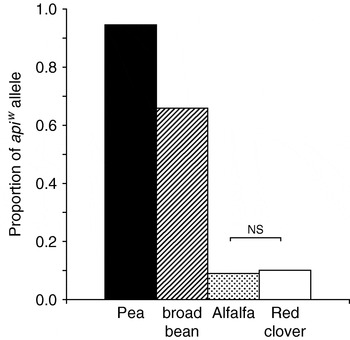
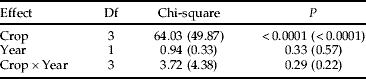
Allelic proportions were then inferred from the phenotype of the males produced. We considered various thresholds for the minimum number of males used to ensure the genotype of the lineages at the aphicarus locus being accurately inferred; but, since most lineages produced much more than a dozen males, all analyses led to nearly identical results. For the sake of simplicity, we only present the results obtained with the 104 lineages that produced at least six males (the probability for a heterozygous lineage to produce more than five males of one morph only is <0.05). The field had no significant effect (P=0.36) and was removed from the model. The proportion of api w allele strongly differed depending on the host population but not on the year of collection or on the crop×year interaction (table 1, fig. 2). This allele was in higher proportion among lineages from pea than among lineages from broad bean (P<0.05), from alfalfa (P<0.0001) and from red clover (P<0.0001), and higher among lineages from broad bean than among those from alfalfa (P<0.0001) and from red clover (P<0.0001). No significant difference was observed between the proportions of api w allele from alfalfa and red clover (P=0.82). Analyses retaining only one copy of each genotype (N=83) led to very similar results (table 1).
Frequency of api w allele at the aphicarus locus among pea aphid host races. All pairs differ significantly except those surmounted by a horizontal line (NS, P>0.05).

Results of the generalized linear model fitted for the analysis of the effects of crop origin, of year of sampling and their interaction on the proportion of the api w allele among 104 pea aphid lineages producing at least six males (results without clonal copies are shown in parentheses; N=83).

Df, degrees of freedom.
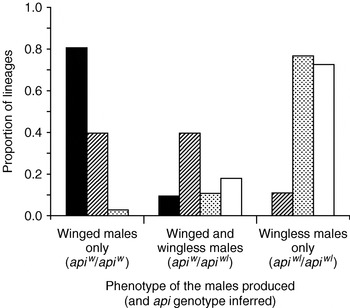
Overall, the proportions of heterozygous lineages were low among host populations except on broad bean (fig. 3). These proportions did not significantly depart from those expected under Hardy-Weinberg equilibrium within each host population, as shown by the non-significance of the tests for heterozygous excess and deficit (table 2).
Proportions of the three male type lineages of the pea aphid according to their host plant (▪, pea;  , broad bean;
 , alfalfa; □, red colver).

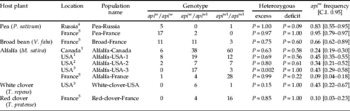
Number of lineages of each genotype inferred from the phenotypes of the males they produced (api w/api w producing winged males; api w/api wl winged and wingless males; api wl/api wl wingless males) from diverse geographical origins. Plant origin, location and reference to previous work are indicated (1, Smith, MacKay, Reference Smith and MacKay1989; 2, Caillaud et al., Reference Caillaud, Boutin, Braendle and Simon2002; 3, Braendle, Reference Braendle2003; 4, Erlykova, Reference Erlykova2003; 5, this study). Results of tests for conformity to Hardy-Weinberg proportions, the frequency of api w allele and its 95% credibility interval (C.I. 0.95) are given.

Patterns of male wing variation detected at a large geographical scale were qualitatively consistent with what was described above for French populations of pea aphids (table 2). In all sample populations, a polymorphism in male dispersal phenotype was observed. All populations conformed to Hardy-Weinberg proportions, except one on alfalfa from USA (population Alfalfa-USA-3; table 2). Results obtained through statistical analysis on api w proportion, including data collected worldwide, were close to those obtained among French lineages only (table 3; proportion of males was higher on pea than on broad bean (P<0.001), alfalfa and red clover (P<0.0001), was higher on broad bean than on alfalfa and red clover (P<0.0001); was similar on red clover and alfalfa (P=0.884)). The frequency of api w allele and its 95% credibility interval were calculated for each population (table 2). A trend was consistently found for a higher proportion of clones producing winged males only on both broad bean and pea, and for a higher proportion of clones producing wingless males only on alfalfa and on red clover and white clover (Trifolium repens L.). However, geographical origin had a significant effect on the proportion of api w, and the observations between the various geographical areas were not quantitatively equivalent. Notably, proportions between populations according to plant origin were much more dramatically differentiated in our study than those from other populations collected in Canada and in the USA (table 2).
Results of the generalized linear model fitted for the analysis of the effects of crop origin and geographical origin and their interaction on the proportion of the api w allele among pea aphid lineages producing more than five males.

Df, degrees of freedom.
Discussion
Pea aphid host races collected in western France exhibited a high variability in the proportion of male dispersal phenotypes. The three types of lineages documented in the species (Smith & MacKay, Reference Smith and MacKay1989; Caillaud et al., Reference Caillaud, Boutin, Braendle and Simon2002; Braendle et al., Reference Braendle, Caillaud and Stern2005a) were found to coexist locally. In addition, male dispersal morph was strongly associated with host plant; lineages producing only winged males were very abundant among pea and broad bean populations, while those producing only wingless males mostly belonged to alfalfa and clover populations. The same pattern, though less pronounced, was consistently observed in samples from North America and from Russia (Smith & Mackay, Reference Smith and MacKay1989; Caillaud et al., Reference Caillaud, Boutin, Braendle and Simon2002; Braendle, Reference Braendle2003; Erlykova, Reference Erlykova2003). A weaker relation could result from various factors, such as: (i) the inclusion of many clonal copies of a few over-represented lineages (Sunnucks et al., Reference Sunnucks, DeBarro, Lushai, Maclean and Hales1997); (ii) an earlier seasonal date of collection, resulting in the inclusion of genotypes not yet eliminated by host selection (Frantz et al., Reference Frantz, Plantegenest, Mieuzet and Simon2006a); (iii) weaker selective pressures for male dispersal; or (iv) a lower level of host plant specialization in some pea aphid populations (Leonardo, Reference Leonardo2004).
We detected a single lineage of A. pisum that significantly departed from equal probabilities of transmission of both X-chromosomes, suggesting transmission biases are very rare in this species. A drawback of our approach is that it does not allow detecting potential cases of complete elimination of one of the two X-chromosomes (because, in that case, a heterozygous lineage, producing only one type of male, would not be distinguished from homozygous ones). However, in the few cases where X-chromosome transmission biases have been reported, they were only partial (Frantz et al., Reference Frantz, Plantegenest, Bonhomme, Prunier-Leterme and Simon2005; Wilson & Sunnucks, Reference Wilson and Sunnucks2006); hence, complete elimination of one X-chromosome is unlikely to be a frequent phenomenon. Overall, the inference of the genotype of a female from the phenotype of the males produced seems reliable at the population level.
Genotypic frequencies within each host race at the aphicarus locus conformed to Hardy-Weinberg proportions, suggesting each host race is panmictic at this locus. In addition, heterozygous lineages did not constitute monophyletic clusters but appeared instead randomly distributed (data not shown) in the individual genetic tree based on microsatellite markers (Frantz et al., Reference Frantz, Plantegenest, Mieuzet and Simon2006a). Hence, heterozygous lineages do not derive from hybridization events between host races, but instead result from a polymorphism within each host race.
This polymorphism could be maintained by frequency-dependent selection. Aphids experience high levels of local relatedness among individuals and of competition between relatives for access to resources, particularly since sexual morphs produced through parthenogenesis share the same genotype (Moran, Reference Moran, Wrensch and Ebbert1993). These insects suffer from negative consequences of local mate competition (Yamaguchi, Reference Yamaguchi1985) and of inbreeding depression (Akimoto, Reference Akimoto2006), both expected to select for increased dispersal (Perrin & Mazalov, Reference Perrin and Mazalov2000). Hence, lineages producing winged males would be initially favoured, which would decrease the intensity of local mate competition and the occurrence of mating between relatives and, consequently, lead to the selection of aphid lineages producing wingless males. Alternatively, male polymorphism may be a by-product of the selection during the asexual phase through pleiotropy at the aphicarus locus. Braendle et al. (Reference Braendle, Friebe, Caillaud and Stern2005b) found that higher frequencies of wingless males were associated with stronger wing induction among parthenogenetic females, suggesting that aphicarus might also be involved in wing induction pathway among females. This hypothesis would suggest higher selective pressures for dispersal abilities of parthenogenetic females among aphid populations living on perennial crops, which seems counter-intuitive since these aphids may remain on their host all year long. Though this hypothesis can not be ruled out, it invokes a rather complex scenario and relies on a relation that still requires confirmation (Braendle et al., Reference Braendle, Friebe, Caillaud and Stern2005b).
Proportions of winged vs. wingless males strongly differed between pea aphid host populations. Winged males were produced in much higher proportions among the pea and broad bean populations, while wingless males were very abundant among the alfalfa and the clover populations. Though our data can not demonstrate that this contrasted pattern results from selective pressures, it suggests that the balance between the respective costs and benefits of dispersal phenotypes somehow depends on the host. Since the habitats in which pea aphids live differ primarily in their spatio-temporal dynamics, environmental heterogeneity may be a key selective force for male dispersal phenotype. In particular, perennial crops (e.g. clover and alfalfa) might exert low selective pressures on male dispersal as pea aphid populations may reproduce sexually and asexually on these hosts all year long. In contrast, pea aphid populations living on annual crops (e.g. pea and broad bean) have to disperse periodically to other hosts where they spend the winter. These winter hosts, among which are wild vetches (Carré & Bournoville, Reference Carré and Bournoville2003), tend to have a patchy distribution that could represent a high selective pressure for male dispersal abilities to mate with unrelated females. However, properly demonstrating the link between host population and male wing phenotype and identifying the exact factors responsible for these contrasted patterns require further investigation on a higher number of both annual and perennial host plants.
The differences in wing male variation between host races revealed here have presumably profound consequences on population differentiation and ecological specialization. High proportions of philopatric males would result in increased possibilities for population specialization among populations living on alfalfa and red clover, respectively. In contrast, high production of winged males by aphids populations living on pea and broad bean may enhance population mixing and prevent genetic differentiation, which is consistent with the low genetic structure observed between pea aphid populations on these host plants (Simon et al., Reference Simon, Carré, Boutin, Prunier-Leterme, Sabater-Muñoz, Latorre and Bournoville2003; Frantz et al., Reference Frantz, Plantegenest, Mieuzet and Simon2006a). Hence, our work suggests that male dispersal phenotypes further influence the possibility of the divergence between host races by modulating gene flow between host populations.
Acknowledgements
We thank C. Braendle and anonymous reviewers for useful comments on the manuscript; J. Bonhomme, M.T. Querrien, Y. Outreman and B. Chaubet for helping with aphid collections, laboratory rearing and biological experiments; L. Mieuzet for helping in the microsatellite genotyping; R. Bournoville and S. Carré for providing the A. pisum clones from Central France; and C. Braendle and T. Leonardo for providing additional data. This work was supported by a grant from Région Bretagne (Opération A1C701 Programme 691) and by Programme ECOGER. The experiments conducted in this study complied with current French laws.