Introduction
The number of cases of herbicide-resistant weeds continues to increase. Relying solely on herbicides to combat this problem is not sustainable because of limited herbicide options and the development of multiple resistance (Crespo et al. Reference Crespo, Wingeyer, Kruger, Riggins, Tranel and Bernards2017; Heap Reference Heap2019). Instances of herbicide resistance have increased to 1,063 cases globally and are considered a major threat to production agriculture (Heap Reference Heap2019; Holt and LeBaron Reference Holt and LeBaron1990; Yu and Powles Reference Yu and Powles2014). Increasing trends in herbicide-resistance cases and the desire to adopt more sustainable practices have led growers to develop integrated weed management (IWM) programs. One IWM strategy is to use cover crops. Cover crops are currently used for erosion control, recovering soil nitrogen, and increasing soil organic matter, but they also can be used for weed suppression (Burket et al. Reference Burket, Hemphill and Dick1997; Clarke Reference Clarke2007; Dabney et al. Reference Dabney, Delgado and Reeves2001; Teasdale Reference Teasdale1996). The number of cover crop hectares planted increased almost twofold from 2012 to 2017, according to a 2017 survey (CTIC 2017), with greatest adoption in the mid-Atlantic and southeastern regions of the United States (USDA ERS 2012). According to a 2017 survey, 69% of respondents stated a cereal rye cover crop sometimes or always improved herbicide-resistant weed control (CTIC 2017).
Fall-planted cover crops suppress weeds in subsequent cash crops after termination by creating a mulch layer on the soil surface to block germination cues, providing a physical barrier to weed growth, and some species exude allelochemicals that will hinder weed germination and growth (Mirsky et al. Reference Mirsky, Ryan, Teasdale, Curran, Reberg-Horton, Spargo, Wells, Keene and Moyer2013). Many species can be used as a fall-planted cover crop (Clarke Reference Clarke2007). Popular grass species used include cereal rye (Secale cereal L.), oats (Avena sativa L.), winter wheat (Triticum aestivum L.), annual ryegrass [Lolium perenne L. ssp. multiflorum (Lam.) Husnot], triticale [Triticosecale rimpaui C. Yen & J.L. Yang (Secale cereale × Triticum aestivum)], and winter barley (Hordeum vulgare L.) (CTIC 2017). Among brassicaceous species, radish (Raphanus sativus L.) is most popular, followed by rapeseed. Among legumes, crimson clover is most popular, followed by winter pea and hairy vetch (CTIC 2017).
Biomass accumulation is one of the best predictors of weed suppression; as biomass of a cover crop increases, weed suppression also increases (Mirsky et al. Reference Mirsky, Ryan, Teasdale, Curran, Reberg-Horton, Spargo, Wells, Keene and Moyer2013). To allow cover crops to gain the most biomass possible, cover crop selection, planting date, and termination timing are important factors (Lawson et al. Reference Lawson, Cogger, Bary and Fortuna2015; Mirsky et al. Reference Mirsky, Curran, Mortensen, Ryan and Shumway2011). Cover crop selection also plays a role in biomass accumulation; some cover crop species can produce more biomass than others, with small grains cover crops usually producing more compared with legumes (Lawson et al. Reference Lawson, Cogger, Bary and Fortuna2015). These species that produce more biomass provide a thicker residue layer to suppress weeds. Delaying termination increases biomass, which increases weed suppression. Lawson et al. (Reference Lawson, Cogger, Bary and Fortuna2015) reported a twofold increase of biomass in cereal rye–hairy vetch mixtures if termination was delayed for 4 wk.
Cover crop termination is important because if not done correctly, it can interfere with planting or allow surviving cover crops to compete with the following cash crop (Curran et al. Reference Curran, Wallace, Mirsky and Crockett2015; Wayman et al. Reference Wayman, Cogger, Benedict, Burke, Collins and Bary2014). Mechanical methods available to terminate cover crops include tillage, mowing, rolling, or undercutting. Success of mechanical methods often relies on the cover crop species reaching a certain maturity or growth stage. For example, mechanical methods most effectively terminate cereal rye at anthesis and hairy vetch at late flowering through pod set (Mirsky et al. Reference Mirsky, Curran, Mortensen, Ryan and Shumway2009; Mischler et al. Reference Mischler, Duiker, Curran and Wilson2010). However, cover crops do not always reach the ideal stage for mechanical termination before planting time for the following cash crop (Mirsky et al. Reference Mirsky, Curran, Mortensen, Ryan and Shumway2009; Mischler et al. Reference Mischler, Duiker, Curran and Wilson2010; Miville and Leroux Reference Miville and Leroux2018). Also, it is unlikely that growth stages ideal for mechanical termination will coincide if multiple cover crop species are planted together. Some mechanical termination methods, such as tilling and mowing, render cover crop residue less suitable for weed suppression. Herbicides are successful for use at multiple growth stages, making them a preferred method of terminating cover crops (Cornelius and Bradley Reference Cornelius and Bradley2017; Westgate et al. Reference Westgate, Singer and Kohler2005).
Research efforts into cover crop termination with herbicides are increasing because growers need reliable options to control cover crop species before planting cash crops. Studies have been conducted in Arkansas and Missouri to determine the best herbicide treatment to control various cover crop species (Cornelius and Bradley Reference Cornelius and Bradley2017; Palhano et al. Reference Palhano, Norsworthy and Barber2018). However, more research needs to be conducted comparing the effectiveness of single active-ingredient treatments with mixes on a variety of commonly grown cover crop species. Similar studies did not include halauxifen-methyl, mixes with halauxifen-methyl, or saflufenacil. Halauxifen-methyl and saflufenacil are registered for preplant weed control in many common crops, such as corn (Zea mays L.), soybean [Glycine max (L.) Merr.], and cotton (Gossypium hirsutum L.), with particular utility for horseweed [Conyza canadensis (L.) Cronq.] control (Owen et al. Reference Owen, Mueller, Main, Bond and Steckel2011; Waggoner et al. Reference Waggoner, Mueller, Bond and Steckel2011; Zimmer et al. Reference Zimmer, Young and Johnson2018a,b). In addition, cover crop species such as winter oats and winter barley were not evaluated in these previous studies. The objectives of this research were to determine the most effective herbicide options to terminate a wide range of cover crop species and determine if combining glyphosate or paraquat with other herbicides will improve termination.
Materials and Methods
Field studies were conducted from 2016 through 2018 at Kentland Farm in Blacksburg, VA (37.19°N, 80.57°W), and at the Tidewater Agricultural Research and Extension Center in Holland, VA (36.66°N, 76.73°W). The site in Blacksburg, VA, was located on a Ross loam (fine-loamy, mixed, superactive, mesic Cumulic Hapludolls) with a pH of 6.7 and 4.3% organic matter. The site in Suffolk was on a Kenansville loamy sand (loamy, siliceous, subactive, thermic Arenic Hapludults) soil with a pH of 6.3 and 0.5% organic matter. Both locations were prepared for planting with a preplant application of glyphosate at 1,260 g ae ha−1 (Roundup Powermax; Monsanto Co., St. Louis, MO). Studies were repeated in 2 years at each location for a total of 4 site-years.
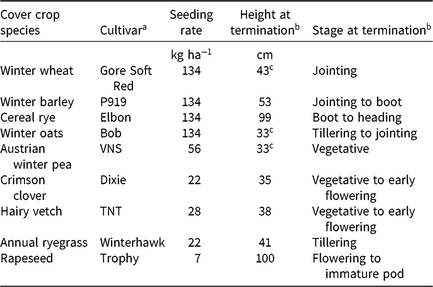
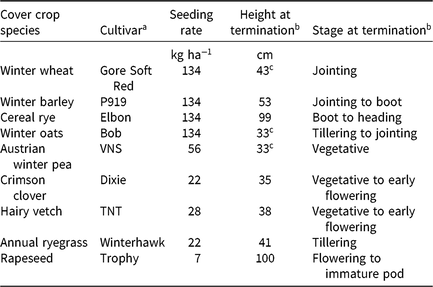
The studies were arranged as a randomized complete split block design with four replications. Each block was split by cover crop species, which were planted in twin rows with 16.5-cm spacing. Cover crop species included winter wheat, winter barley, cereal rye, winter oats, Austrian winter pea, crimson clover, hairy vetch, annual ryegrass, and rapeseed (Green Cover Seeds, Bladen, NE). Cover crops were planted using a drill to a depth of approximately 1.5 cm, except rapeseed and crimson clover, which were drilled approximately 0.5 cm deep. Seeding rates are presented in Table 1 and were based on the Virginia National Resources Conservation Service Cover Crop Guide (USDA 2015). In Holland, cover crop species were planted on September 1, 2016, and September 6, 2017. In Blacksburg, planting occurred on September 19, 2016, and September 11, 2017. There were no additional inputs to the cover crops.
Cover crop species, cultivar, seeding rate, and average height at herbicide application for the termination studies in Blacksburg and Holland, VA, in 2017 and 2018.
a Abbreviation: VNS, variety not stated.
b Averaged across 4 site-years, except where noted.
c Averaged across 3 site-years, due to missing data, winterkill, or poor stand establishment.
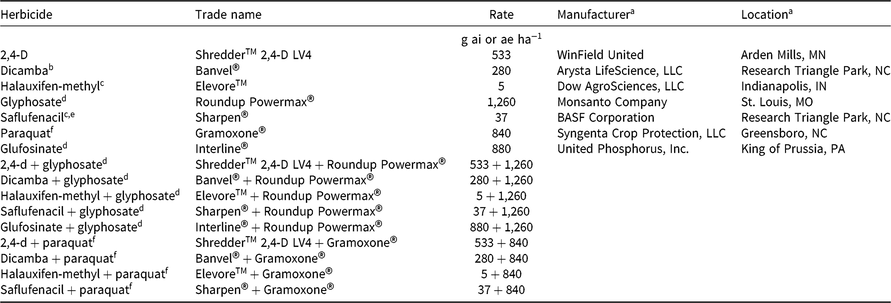
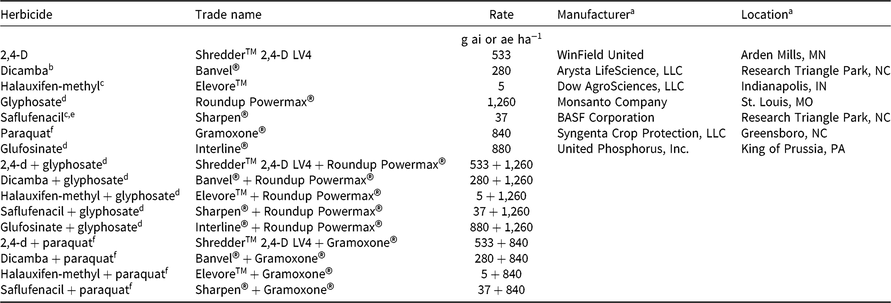
The herbicide treatments are presented in Table 2, and a nontreated check was also included. Herbicides were applied perpendicular to the cover crop rows on April 19, 2017, and March 27, 2018, in Holland; and on April 13, 2017, and April 11, 2018, in Blacksburg, which is a typical time to burndown prior to cash crop planting in Virginia. Plot sizes were 3 by 7.6 m. Applications were made using a CO2-pressurized backpack sprayer with a four-nozzle boom with 46-cm spacing. The boom was fitted with TeeJet Flat Fan XR 11002 nozzles (Spraying Systems Co., Wheaton, IL) calibrated to deliver 147 L ha−1 of spray solution.
Herbicide treatments used in cover crop termination studies in Blacksburg and Holland, VA, in 2017 and 2018.
a Manufacturer and location are only listed at first mention.
b Includes nonionic surfactant at 0.25% vol/vol.
c Includes methylated seed oil at 1% vol/vol.
d Includes ammonium sulfate at 10.2 g L−1.
e Includes UAN at 4.67 L ha−1.
f Includes crop oil concentrate at 2.34 L ha−1.
Data collected after herbicide application included visible control ratings 2 and 4 wk after application (WAA) and heights 4 WAA. Visible control was rated on a scale of 0 to 100, with 0 being no control and 100 being complete necrosis (Frans et al. Reference Frans, Talbert, Marx, Crowley and Camper1986). Visible control of grass cover crops was only collected in 3 site-years (Blacksburg in 2017 and 2018, and Holland in 2018). Four WAA, average heights were measured for individual species in each plot across 1 m of row. Previous studies have demonstrated high correlation between plant height and biomass in various cereal and broadleaf cover crops (Bendig et al. Reference Bendig, Bolten, Bennertz, Broscheit, Eichfuss and Bareth2014; Ehlert et al. Reference Ehlert, Horn and Adamek2008; Roth and Streit, Reference Roth and Streit2018). In Blacksburg in 2018, data were not collected for oats and Austrian winter pea because of winterkill and poor stand establishment, respectively.
Data were analyzed by species. The model included herbicide as a fixed effect, with block and site-year serving as random effects, because this allows inferences about herbicide efficacy over a broad range of environments (Blouin et al. Reference Blouin, Webster and Bond2011; Carmer et al. Reference Carmer, Nyquist and Walker1989; Stephenson and Bond Reference Stephenson and Bond2012). After an overall ANOVA indicated significant treatment differences, visible rating data were analyzed first with a means separation using Fisher protected LSD (α = 0.05) of the treatments that included a single active ingredient and then using contrasts to compare the efficacy of using a single active ingredient compared with combinations including glyphosate or paraquat. The height data were analyzed by species, using the same model used for the visible rating data. Oat height data were square-root transformed to meet the model assumption of normality. Means comparison using the Dunnett method (α = 0.05) was used to compare the height 4 WAA for each treatment to the nontreated check. Nontransformed data are presented, with means separation based on analysis of transformed data, where necessary. Visible control and height reduction of grasses resulting from the synthetic auxin herbicides and saflufenacil alone were excluded because of known lack of activity. Contrasts were not conducted for the grass cover crop species because of the amount of treatments that included an herbicide with known lack of acceptable activity. Data were analyzed in JMP (JMP Pro 13; SAS Institute, Cary, NC).
Results and Discussion
Grass Cover Crops
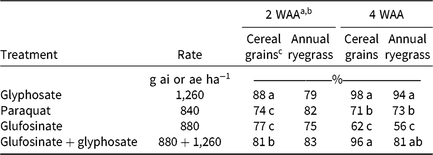
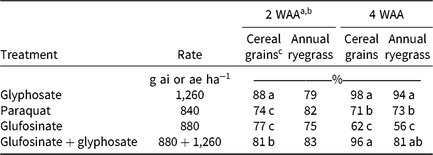
Visible control data were pooled across cereal grain cover crop species (i.e., winter wheat, winter barley, cereal rye, and winter oats) for response to herbicidally active treatments, including glyphosate, glufosinate, paraquat, and glufosinate plus glyphosate (Table 3). Saflufenacil was not included because control was less than 16% at 2 WAA and less than 5% at 4 WAA for cereal grains and annual ryegrass, which is well below an acceptable standard for control. Glyphosate provided the best control of the cereal grains at 2 WAA and 4 WAA (Table 3). Paraquat and glufosinate alone provided similar control of the cereal grains 2 WAA, but control declined for both 4 WAA. Annual ryegrass was best controlled with glyphosate 4 WAA, when 94% control was observed, despite glyphosate, paraquat, and glufosinate resulting in similar control (75% to 82%) 2 WAA (Table 3). The mix of glufosinate and glyphosate provided similar control to glyphosate alone at 4 WAA for both cereal grains and annual ryegrass.
Visible estimates of control of grass cover crop species, including winter wheat, winter barley, cereal rye, winter oats, and annual ryegrass, from herbicidally active treatments across 3 site-years in Blacksburg and Holland, VA, in 2017 and 2018.
a Numbers in each column that are not followed by the same letter are significantly different from according to Fisher protected LSD (α = 0.05).
b Abbreviation: WAA, weeks after application.
c Data were pooled across species for analysis because herbicide by cover crop species interaction was not detected. Oats were excluded in Blacksburg in 2018 because of winterkill.
Similar studies also have indicated that glyphosate and combinations with glyphosate generally provided better control than other herbicide options for winter wheat, cereal rye, and annual ryegrass control (Cornelius and Bradley Reference Cornelius and Bradley2017; Palhano et al. Reference Palhano, Norsworthy and Barber2018). Other research indicates that glyphosate provides better control of annual grasses compared with glufosinate (Culpepper et al. Reference Culpepper, York, Batts and Jennings2000; Whitaker et al. Reference Whitaker, York, Jordan and Culpepper2011).
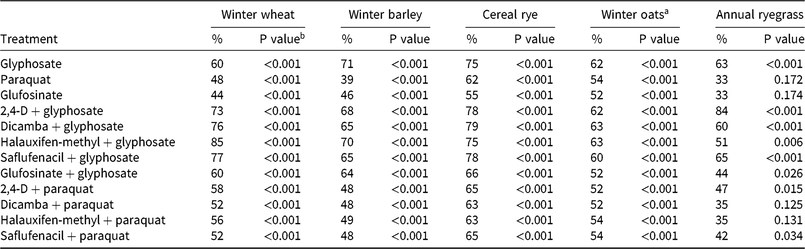
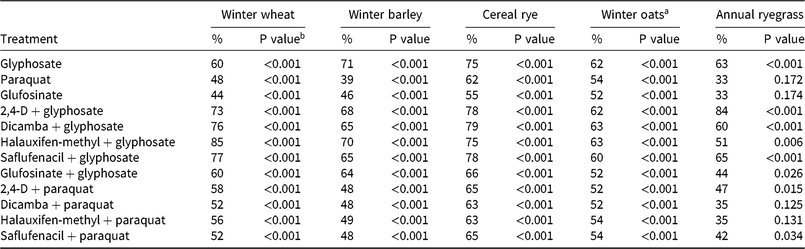
Cover crop heights measured 4 WAA mostly corroborate visible control findings (Table 4). For the cereal cover crop species, which include winter wheat, winter barley, cereal rye, and winter oats, all treatments reduced height in comparison to the nontreated check.
Percent reduction in grass cover crop heights compared to the nontreated check 4 weeks after application, averaged across 4 site-years in Blacksburg and Holland, VA, in 2017 and 2018.
a Oats were excluded in Blacksburg in 2018 because of winterkill. Oat height data were square-root transformed to meet the model assumption of normality. Nontransformed data are presented, with means separation based on analysis of transformed data.
b Significance of heights shown for each treatment when compared to the nontreated check using the Dunnett method (α = 0.05).
Annual ryegrass heights were affected differently than the other grass cover crops for the other treatments. Differences could not be detected in annual ryegrass height measured 4 WAA for paraquat, glufosinate, dicamba plus paraquat, and halauxifen-methyl plus paraquat compared to the nontreated check, but differences were detected among these treatments and the nontreated check for the other four grass cover crop species. Cornelius and Bradley (Reference Cornelius and Bradley2017) reported that paraquat-based programs did not consistently control annual ryegrass.
Legume Cover Crops
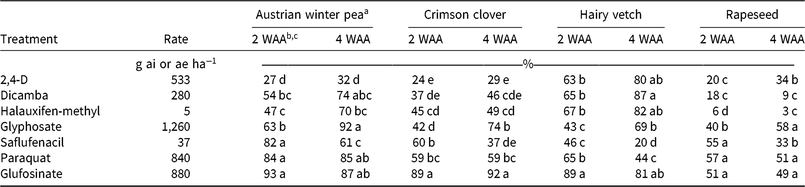
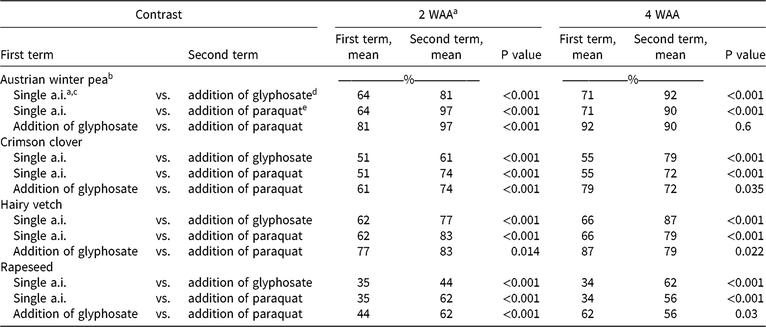
Treatment was significant for the visible control ratings for all of the legume cover crop species, both 2 and 4 WAA. Each of the legume species in this study responded differently to individual herbicide treatments, but there was greater control from mixes with paraquat or glyphosate compared with the single active-ingredient treatments for each of the three species.
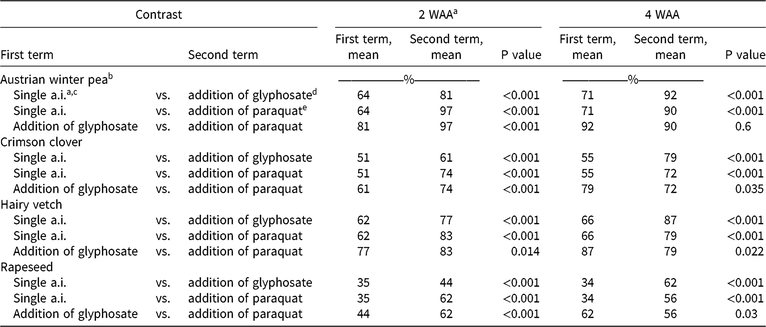
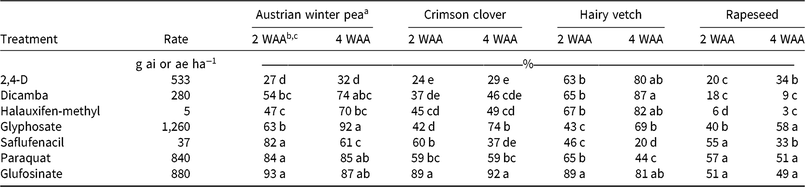
For Austrian winter pea, saflufenacil, paraquat, and glufosinate provided the best initial control: 82% to 93% control at 2 WAA (Table 5). Control from saflufenacil decreased to 61% at 4 WAA, showing recovery from initial injury. Glyphosate, paraquat, and glufosinate provided greater than 80% control at 4 WAA. Austrian winter pea control increased with both the addition of glyphosate and paraquat; however, control was similar with the addition of glyphosate or paraquat: 92% and 90% control, respectively (Table 6).
Visible estimates of control of legume cover crops (Austrian winter pea, crimson clover, and hairy vetch) and rapeseed to herbicide treatments, averaged across 4 site-years in Blacksburg and Holland, VA, in 2017 and 2018.
a Austrian winter pea was excluded in Blacksburg in 2018 because of poor stand establishment.
b Numbers in each column that are not followed by the same letter are significantly different according to Fisher’s protected LSDα = 0.05.
c Abbreviation: WAA, weeks after application.
Contrast statements showing the visible control of legume cover crops, including Austrian winter pea, crimson clover, and hairy vetch, and rapeseed, averaged across 4 site-years in Blacksburg and Holland, VA, in 2017 and 2018.
a Abbreviation: WAA, weeks after application.
b Austrian winter pea was excluded in Blacksburg in 2018 due to poor stand establishment.
c Single active-ingredient treatments included 2,4-D, dicamba, halauxifen-methyl, glyphosate, glufosinate, paraquat, and saflufenacil.
d Addition of glyphosate to 2,4-D, dicamba, halauxifen-methyl, saflufenacil, and glufosinate.
e Addition of paraquat to 2,4-D, dicamba, halauxifen-methyl, and saflufenacil.
Cornelius and Bradley (Reference Cornelius and Bradley2017) reported similar findings, showing that herbicide mixes containing paraquat controlled Austrian winter pea similarly or slightly better than mixes containing glyphosate. This is the only species in our study in which mixes with glyphosate did not increase control 4 WAA when compared to mixes with paraquat.
Glufosinate provided the best control for crimson clover at 2 and 4 WAA: 89% and 92% control, respectively (Table 5). Halauxifen-methyl, dicamba, 2,4-D, saflufenacil, and paraquat resulted in less than 60% crimson clover control at 4 WAA. No difference was detected in control between glyphosate and paraquat, but mixes with the addition of glyphosate provided more control 4 WAA than mixes with the addition of paraquat (Table 6).
The poor performance of auxin herbicides is in contrast to other research, which showed 91% and 100% control from 2,4-D and dicamba, respectively, and the 2019 Mid-Atlantic Weed Management Guide that suggests 2,4-D and dicamba should provide 75% to 85% control of crimson clover (McCurdy et al. Reference McCurdy, McElroy and Flessner2013; Wallace et al. Reference Wallace, Lingenfelter, VanGessel, Johnson, Vollmer, Besancon, Flessner and Chandran2019). McCurdy et al. (Reference McCurdy, McElroy and Flessner2013) cut crimson clover plants to 8 cm in the days before herbicide application, which would have made them much smaller than plants in this study, which were 35-cm tall at application. Multiple studies show that as plant size increases, herbicide efficacy decreases (Kegode and Fronning Reference Kegode and Fronning2005; Klingaman et al. Reference Klingaman, King and Oliver1992; Sellers et al. Reference Sellers, Ferrell, MacDonald and Kline2009). In a similar study, in which crimson clover was 57 to 62 cm, dicamba and 2,4-D did not provide adequate control (Palhano et al. Reference Palhano, Norsworthy and Barber2018).
Hairy vetch control from the three synthetic auxin herbicides (i.e., 2,4-D, dicamba, and halauxifen-methyl) and glufosinate ranged from 80% to 87%, greater than control afforded by saflufenacil, and paraquat: 20% and 44% control, respectively (Table 5). Although glyphosate and paraquat alone did not provide the best control of the single active-ingredient treatments, addition of glyphosate or paraquat increased control by 21% and 13%, respectively, over the single a.i. treatments (Table 6). Similar studies also reported adequate hairy vetch control from applications of 2,4-D and dicamba, as well as increased control from mixes containing glyphosate as compared to paraquat (Cornelius and Bradley Reference Cornelius and Bradley2017; Curran et al. Reference Curran, Wallace, Mirsky and Crockett2015).
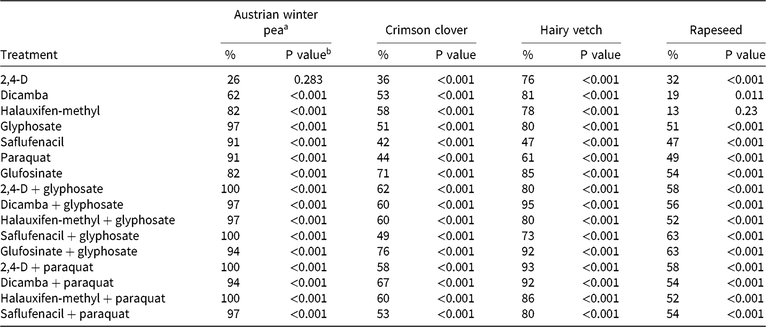
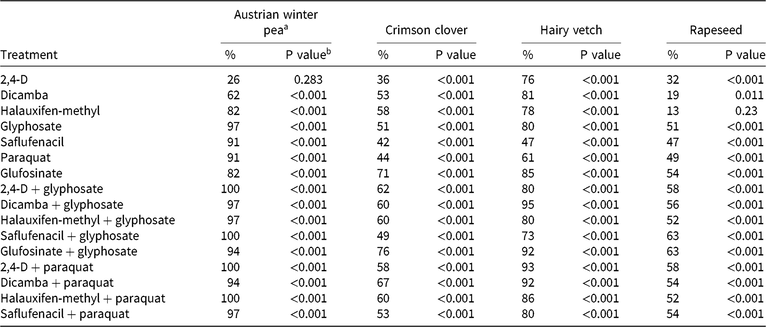
All herbicide treatments led to a reduction in height as compared with the nontreated check for all legume cover crop species with the exception of 2,4-D on Austrian winter pea, which is consistent with the visible control data that all herbicides had some effect on the legume cover crop species. Of the legume cover crop species, Austrian winter pea had the greatest reduction in height, with most treatments reducing height by 82% to 100%. The reduction in height was not as severe in the other two cover crop species; generally, there was a greater reduction in height with herbicide mixes compared with the single active-ingredient treatments (Table 7).
Percent reduction in broadleaf cover crop heights compared to the nontreated check 4 weeks after application, averaged across 4 site-years in Blacksburg and Holland, VA, in 2017 and 2018.
a Austrian winter pea was excluded in Blacksburg in 2018 because of poor stand establishment.
b Significance of heights shown for each treatment when compared to the nontreated check using the Dunnett method (α = 0.05).
Rapeseed
Treatment was significant for the visible control ratings for rapeseed 2 and 4 WAA. The greatest control observed 4 WAA ranged from 49% to 58%, from glufosinate, paraquat, and glyphosate applications, which is not a commercially acceptable level of control (Table 5). Poor control resulted from all the synthetic auxin herbicides, but there was a difference between control from 2,4-D (34% control) compared with dicamba and halauxifen-methyl (<10% control) 4 WAA. Saflufenacil had similar control to paraquat and glufosinate 2 WAA, and control decreased 4 WAA, indicating that rapeseed was beginning to recover from the herbicide application; this trend was noted across all broadleaf cover crop species. Adding glyphosate or paraquat increased control compared with the single active-ingredient treatments (Table 6). At 4 WAA, the addition of glyphosate had greater control than the addition of paraquat: 62% and 56%, respectively. However, this level of rapeseed control before cash-crop planting is not satisfactory. Rapeseed height was reduced by all herbicide treatments except halauxifen-methyl, which aligns with the visible control ratings 4 WAA (Table 7).
Rapeseed is a difficult cover crop species to control late in the spring. Palhano et al. (Reference Palhano, Norsworthy and Barber2018) reported a maximum control of 71% from treatments in their study and maximum control of 55% from treatments also used in this study. Askew et al. (Reference Askew, Cahoon, Flessner, VanGessel, Langston and Ferebee2019) reported less than 38% control from herbicides on rapeseed that was the same size as that in this experiment. Control improved on rapeseed half that size, 52 cm, reaching 68% from glyphosate (Askew et al. Reference Askew, Cahoon, Flessner, VanGessel, Langston and Ferebee2019). To effectively terminate rapeseed, herbicide applications need to be made at an earlier growth stage when plants are smaller. Beckie et al. (Reference Beckie, Nair, Warwick and Johnson2004) reported greater success when controlling volunteer rapeseed with 2,4-D at a two- to three-leaf stage compared with a five- to six-leaf stage. In our study, rapeseed had reached 100 cm in height and was flowering at the time of application. When using rapeseed as a cover crop, termination as early as in the Beckie et al. (Reference Beckie, Nair, Warwick and Johnson2004) study is impractical because the plants would not get large enough to provide weed-suppression benefits.
Practical Implications
As implementation of cover crops is becoming more prevalent, proper termination of the cover crop is important to prevent interference of the cover crop in the cash crop that follows it. The results of this study indicate herbicide selection to terminate cover crops depends heavily on the species grown, because these cover crop species responded differently to herbicides, especially the legumes. Overall, grass cover crop species, including winter wheat, winter barley, cereal rye, winter oats, and annual ryegrass, were best controlled by glyphosate and mixes containing glyphosate. However, for legume species, herbicides selection should include glyphosate or paraquat and be selected on the basis of which individual herbicide has better activity on the specific legume species. Cover crops that are difficult to control, like rapeseed, which was not adequately controlled in this study by any single active-ingredient treatment or mix, need to be terminated earlier when the plants are smaller or by alternative methods.
Acknowledgements
We thank Shawn Beam, Susannah Gonia, and Ranjeet Randhawa for aiding in data collection. We are grateful to the Virginia Corn Board, the Virginia Agricultural Experiment Station, and the Hatch Program of the National Institute of Food and Agriculture, U.S. Department of Agriculture, for providing funding for this research. No conflicts of interest have been declared.