Introduction
Family firms occupy a central position in the global economy. These enterprises, defined as businesses owned and operated by members of the same family (Neufeld, Reference Neufeld2023), emerge from entrepreneurial wealth creation and intergenerational transfer. Their economic significance manifests through impressive statistics: family businesses operate 90% of global enterprises (Neufeld, Reference Neufeld2023) and generate substantial economic value across diverse contexts. In India, they contribute 79% of GDP (Neufeld, Reference Neufeld2023). Within the UK, family firms comprise 85.9% of all enterprises, generate 44.4% of GDP, and provide 51% of private sector employment (IFB Research Foundation, 2022). In China’s private sector, family businesses contribute 85% of activity, representing at least 60% of recent GDP (IE Foundation, 2020). This economic prominence positions family firms at the forefront of technological evolution.
Digital transformation is a strategic and multifaceted process through which firms integrate advanced digital technologies (e.g., artificial intelligence, big data, and cloud computing) into their core operations, organizational structures, and business models (Wu, Hu, Lin, & Ren, Reference Wu, Hu, Lin and Ren2021; Zhen, Wang, & Fang, Reference Zhen, Wang and Fang2023; Zhou, Ying, & Wu, Reference Zhou, Ying and Wu2021). However, research on digital transformation remains an evolving field, with substantial variation in both its conceptualization and operationalization. In a widely cited review, Vial (Reference Vial2019: 118) examined over 20 definitions of digital transformation and proposed a synthesis that highlights its essential features: ‘a process that aims to improve an entity by triggering significant changes to its properties through combinations of information, computing, communication, and connectivity technologies’. The definition aligns with this study’s conceptualization, which emphasizes digital transformation as a strategic endeavor that reshapes operational models, decision-making structures, and value creation mechanisms. It aligns with this study’s definition, which emphasizes digital transformation as a strategic endeavor that reshapes operational models, decision-making structures, and value creation mechanisms. Recent research further highlights how such transformations reconfigure the foundations of competitive advantage by enabling new pathways for enhancing productivity and generating value (Ceipek, Hautz, De Massis, Matzler, & Ardito, Reference Ceipek, Hautz, De Massis, Matzler and Ardito2021; Soluk & Kammerlander, Reference Soluk and Kammerlander2021). For family firms, whose economic significance is considerable, engaging in digital transformation entails the assimilation of a wide range of digital tools, including social media platforms and embedded systems, which facilitate business model innovation and operational renewal (Bouncken & Schmitt, Reference Bouncken and Schmitt2022; Del Vecchio, Secundo, & Garzoni, Reference Del Vecchio, Secundo and Garzoni2024).
Academic literature presents conflicting findings regarding family firms’ engagement with digital transformation. Some studies portray family firms as proactive adopters of digital technologies (Ano & Bent, Reference Ano and Bent2022; Ren, Liu, & Ding, Reference Ren, Liu and Ding2023; Soluk, Kammerlander, & De Massis, Reference Soluk, Kammerlander and De Massis2021), while others highlight significant resistance to digital initiatives (Chung & Lee, Reference Chung and Lee2024; Liu, Zhou, & Li, Reference Liu, Zhou and Li2023; Quarato, Pini, & Positano, Reference Quarato, Pini and Positano2020). This study contends that these conflicting findings reflect variation in the socioemotional wealth (SEW) dimensions that dominate strategic decision-making under different conditions. The research focuses on three dimensions: control, legitimacy, and longevity, and examines how these shape family firms’ digital transformation behavior. Family ownership, reflecting the control dimension of SEW, tends to negatively influence digital transformation, as digital technologies often promote transparency and professionalization, which may undermine concentrated family control (Basly & Hammouda, Reference Basly and Hammouda2020; Struijk, Angelopoulos, Cxj, & Davison, Reference Struijk, Angelopoulos, Cxj and Davison2023). However, this relationship varies depending on broader contextual conditions. External and internal influences activate other SEW dimensions that may offset control-based resistance. The externally oriented legitimacy dimension of SEW becomes salient when family firms participate in formal business networksFootnote 1, which are structured associations operating across municipal, provincial, and national levels (Ge & Wang, Reference Ge and Wang2013; Schoonjans, Van Cauwenberge, & Vander Bauwhede, Reference Schoonjans, Van Cauwenberge and Vander Bauwhede2013). The internally driven longevity dimension becomes prominent when multiple second-generation family members hold governance or leadership roles (Jaskiewicz, Combs, & Rau, Reference Jaskiewicz, Combs and Rau2015; Makó, Csizmadia, & Heidrich, Reference Makó, Csizmadia and Heidrich2018). This dispersion reinforces the importance of intergenerational harmony and continuity, which can be supported by equitable data access and transparent resource allocation (Chrisman, Chua, De Massis, Minola, & Vismara, Reference Chrisman, Chua, De Massis, Minola and Vismara2016; Kammerlander & Ganter, Reference Kammerlander and Ganter2015). These external and internal factors help explain the variation in how family firms respond to digital transformation, depending on which SEW priorities are most salient (Kammerlander & Ganter, Reference Kammerlander and Ganter2015; Soluk et al., Reference Soluk, Kammerlander and De Massis2021).
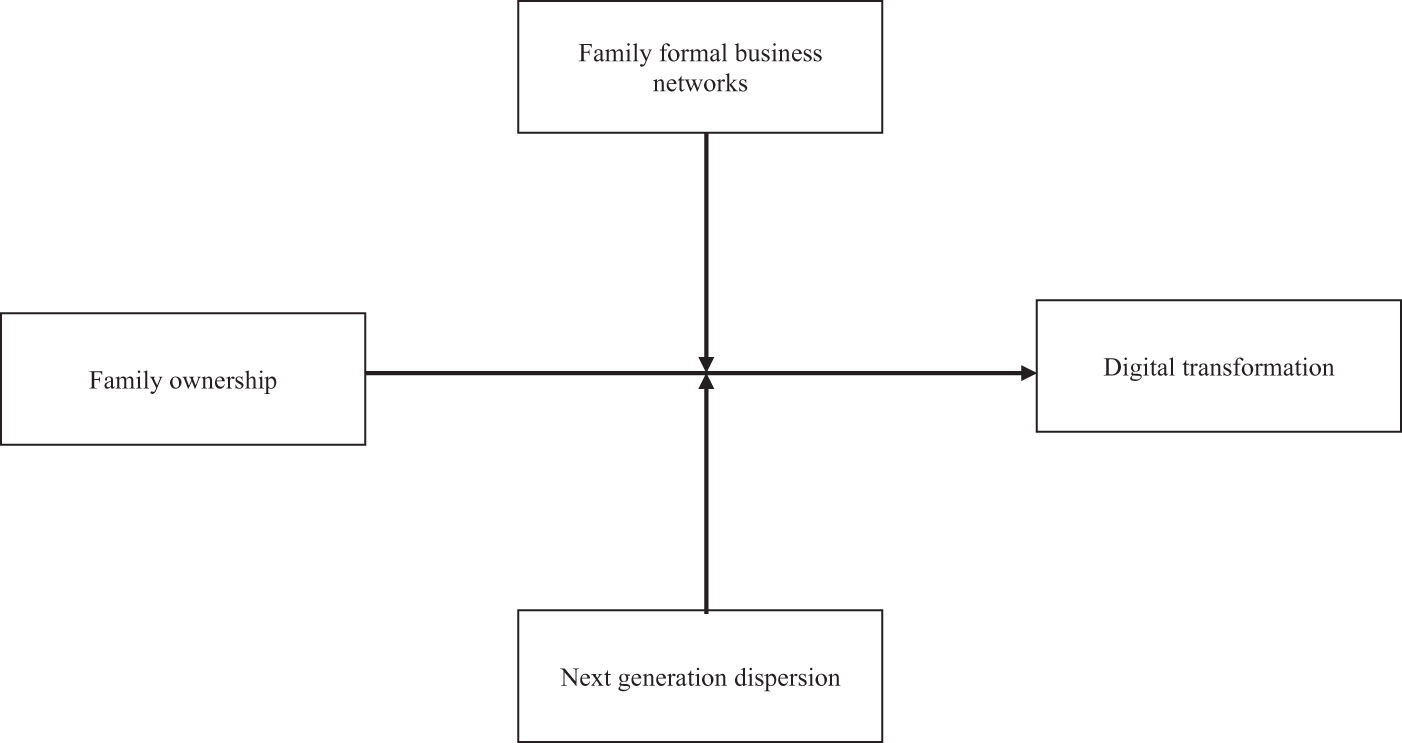
This research examines these relationships (Figure 1) using panel data from Chinese listed family firms (2016–2020). China provides an ideal empirical context, combining a dominant family business sector with digital transformation leadership (Liu et al., Reference Liu, Zhou and Li2023). Chinese family firms are shaped by distinct cultural and institutional conditions, including strong family-oriented collectivism, centralized decision-making, and participation in formal business networks (Li, Chen, Chua, Kirkman, Rynes-Weller, & Gomez-Mejia, Reference Li, Chen, Chua, Kirkman, Rynes-Weller and Gomez-Mejia2015). Many are also undergoing generational transitions, with next-generation members often holding diverse educational and international experiences (Lin, Zhao, & Zhai, Reference Lin, Zhao and Zhai2024). These features make China a compelling setting in which to examine how family firms respond to digital transformation while balancing tradition and change.
Conceptual framework

This study advances research on digital transformation and SEW in family firms by offering a theoretically integrated and context-sensitive framework that explains when and why family firms resist or embrace digitalization. First, it clarifies how control-related SEW concerns, reflected in concentrated family ownership, inhibit digital transformation by reinforcing preferences for authority preservation, risk aversion, and limited transparency (Gómez-Mejía, Chirico, Withers, Martin, & Wiseman, Reference Gómez-Mejía, Chirico, Withers, Martin and Wiseman2024; Gomez-Mejia, Cruz, Berrone, & De Castro, Reference Gomez-Mejia, Cruz, Berrone and De Castro2011; Gu, Lu, & Chung, Reference Gu, Lu and Chung2019). Second, this shows that external engagement in formal business networks activates legitimacy-centric SEW, aligning firms with institutional expectations and reputational norms, thereby weakening resistance to digital initiatives (Berrone, Cruz, Gomez-Mejia, & Larraza-Kintana, Reference Berrone, Cruz, Gomez-Mejia and Larraza-Kintana2010; He & Liu, Reference He and Liu2022; Liu et al., Reference Liu, Zhou and Li2023). Third, it demonstrates that next-generation dispersion strengthens longevity-centric SEW by encouraging long-term strategic thinking and openness to organizational renewal (Bürgel & Hiebl, Reference Bürgel and Hiebl2023; Pan, Chen, & Qiu, Reference Pan, Chen and Qiu2023; Sciascia, Mazzola, & Chirico, Reference Sciascia, Mazzola and Chirico2013). Together, these mechanisms reconcile prior inconsistent findings by showing that digital transformation behavior in family firms is contingent on how different SEW dimensions are prioritized in response to shifting internal and external conditions (Foss, Klein, Lien, Zellweger, & Zenger, Reference Foss, Klein, Lien, Zellweger and Zenger2021; Swab, Sherlock, Markin, & Dibrell, Reference Swab, Sherlock, Markin and Dibrell2020). From a managerial perspective, the findings suggest that firms can ease digital resistance by fostering inclusive succession structures and by actively engaging with legitimizing institutional platforms that support digital transformation while preserving core family values.
Theoretical Background and Hypotheses Development
Role of SEW in Family Business Strategy
Research on digital transformation in family firms reveals a central tension. One stream identifies family firms as proactive adopters of digital technologies, viewing them as strategic imperatives for innovation and competitiveness (Ano & Bent, Reference Ano and Bent2022; Ren et al., Reference Ren, Liu and Ding2023; Soluk et al., Reference Soluk, Kammerlander and De Massis2021). Another stream presents a contrasting perspective, highlighting substantial resistance to digital initiatives, particularly in firms with entrenched control structures and conservative governance practices (Chung & Lee, Reference Chung and Lee2024; Liu et al., Reference Liu, Zhou and Li2023; Quarato, Pini, & Positano, Reference Quarato, Pini and Positano2020). This divergence suggests that variation in organizational and institutional conditions shapes how family firms respond to digital transformation.
A more nuanced understanding of these conflicting findings emerges through consideration of how external and internal factors influence family firm behavior. External factors shape institutional expectations and resource access (Soluk et al., Reference Soluk, Kammerlander and De Massis2021; Wang, Jiang, Li, Chen, Cui, & Wang, Reference Wang, Jiang, Li, Chen, Cui and Wang2023), while internal factors affect decision-making structures and strategic priorities (Appleton & Holt, Reference Appleton and Holt2024; Bouncken & Schmitt, Reference Bouncken and Schmitt2022). Together, these factors activate different dimensions of SEW, a perspective that helps explain the heterogeneity in digital transformation responses. SEW refers to the nonfinancial priorities that family firms seek to preserve, including identity, influence, status, and continuity (Gomez-Mejia et al., Reference Gomez-Mejia, Cruz, Berrone and De Castro2011).
Berrone, Cruz, and Gomez-Mejia (Reference Berrone, Cruz and Gomez-Mejia2012) identify five core dimensions of SEW: family control and influence, identification of family members with the firm, binding social ties, emotional attachment, and renewal of family bonds through succession. These dimensions are not static but vary in salience depending on contextual factors such as stakeholder expectations, institutional pressures, and generational stage (Miller & Le Breton–Miller, Reference Miller and Le Breton–Miller2014; Swab et al., Reference Swab, Sherlock, Markin and Dibrell2020). Building on this foundation, recent research introduces a distinction between ‘focused’ and ‘broad’ SEW orientations, which helps explain variation in strategic responses (Gómez-Mejía et al., Reference Gómez-Mejía, Chirico, Withers, Martin and Wiseman2024; Gu et al., Reference Gu, Lu and Chung2019). A focused orientation prioritizes short-term control and stability for the core family group, while a broad orientation reflects long-term concerns for continuity, legacy, and reputation. Strategic initiatives such as digital transformation may thus be resisted under a focused orientation but embraced under a broad one (Del Vecchio et al., Reference Del Vecchio, Secundo and Garzoni2024; Firfiray & Gomez-Mejia, Reference Firfiray and Gomez-Mejia2021). This study contributes by demonstrating how these logics interact. While family ownership typically aligns with focused SEW, legitimacy concerns activated through network engagement, and longevity motives arising from next-generation dispersion can foster broad SEW (Gu et al., Reference Gu, Lu and Chung2019; He & Liu, Reference He and Liu2022; Sciascia et al., Reference Sciascia, Mazzola and Chirico2013), enabling more future-oriented strategies. These dynamics help clarify the specific mechanisms through which SEW orientations influence strategic decision-making in family firms, particularly in relation to digital transformation.
More specifically, control, operationalized through family ownership, represents a focused SEW orientation and often leads to resistance to digital transformation. This resistance arises because digital technologies typically promote transparency, decentralized decision-making, and professionalization, all of which can weaken concentrated family control (Basly & Hammouda, Reference Basly and Hammouda2020; Liu et al., Reference Liu, Zhou and Li2023). Ownership, in this context, is not merely a structural or legal arrangement but a behavioral force that shapes strategic preferences. Foss et al. (Reference Foss, Klein, Lien, Zellweger and Zenger2021) conceptualize this influence through the notion of ownership competence, which refers to how different ownership forms affect strategic decision-making by shaping what owners value and how they perceive change. In family firms, high levels of ownership concentration may strengthen preferences for risk aversion and preservation of influence, thereby reducing willingness to engage in transformative initiatives such as digitalization. However, this control-oriented logic does not operate in isolation. Under certain conditions, other SEW motives become more salient and can alter the firm’s strategic orientation.
The legitimacy and longevity dimensions, by contrast, reflect a broader SEW orientation. Legitimacy becomes prominent when family firms participate in formal business networks. These networks serve as external signals of credibility and institutional alignment, reinforcing the firm’s social standing and reputational capital (Berrone et al., Reference Berrone, Cruz, Gomez-Mejia and Larraza-Kintana2010; He & Liu, Reference He and Liu2022). In such contexts, maintaining recognition and meeting stakeholder expectations can override concerns about diminished control, thereby encouraging digital transformation. Longevity becomes salient when multiple next-generation family members are involved in leadership roles and succession. This internal condition fosters a long-term orientation and a concern for intergenerational harmony, making transparency and digital coordination tools more attractive despite the potential erosion of control (Sciascia et al., Reference Sciascia, Mazzola and Chirico2013). Gu et al. (Reference Gu, Lu and Chung2019) further demonstrate that intergenerational motives and legacy preservation can serve as powerful drivers of strategic change. Their findings show that family business groups motivated by SEW preservation engage in innovation and new industry entry. This supports the argument that longevity-related concerns may promote digital transformation, particularly during periods of generational transition.
The research centers on Chinese family firms, representing a dominant business sector with strong digital transformation leadership (Liu et al., Reference Liu, Zhou and Li2023). These firms display distinctive characteristics that align closely with the selected SEW dimensions. Family-oriented collectivism and centralized decision-making reflect strong control concerns. Extensive government and industry network participation demonstrates the importance of legitimacy motives (Li et al., Reference Li, Chen, Chua, Kirkman, Rynes-Weller and Gomez-Mejia2015). The ongoing generational transition, often involving multiple siblings with diverse educational and international backgrounds, reflects the salience of longevity concerns (Lin et al., Reference Lin, Zhao and Zhai2024). This intersection of SEW dimensions within the Chinese context offers a theoretically and empirically grounded foundation for theory development. The next section develops a series of hypotheses to examine how specific SEW dimensions shape digital transformation behavior in Chinese family firms.
Family Ownership and Digital Transformation
Family ownership constitutes a central dimension of SEW through its emphasis on control. This control manifests in concentrated ownership structures where family members maintain decision-making authority, prioritizing influence preservation and limiting external intervention (Gomez-Mejia et al., Reference Gomez-Mejia, Cruz, Berrone and De Castro2011). High ownership stakes often strengthen emotional attachment, family identification, and desire for autonomy, which together form the foundation of control-centric SEW (Miller & Le Breton–Miller, Reference Miller and Le Breton–Miller2014). This represents what recent scholarship terms a ‘focused’ SEW orientation that prioritizes short-term control and stability for the core family group rather than broader stakeholder interests (Gu et al., Reference Gu, Lu and Chung2019).
Digital transformation poses a strategic challenge to this control-centric orientation. By its nature, digital transformation entails operational transparency, process re-engineering, and increased dependency on nonfamily professionals and external technological expertise (Basly & Hammouda, Reference Basly and Hammouda2020; Bouncken & Schmitt, Reference Bouncken and Schmitt2022). These features directly conflict with focused SEW orientations, as they dilute the authority traditionally held by family owners. Advanced digital tools and performance management systems promote decentralized decision-making and professionalized practices, potentially reducing family owners’ discretion over strategic and operational matters. Furthermore, digital transformation often requires substantial capital investment, external partnerships, and willingness to share sensitive organizational data with third parties (Wu et al., Reference Wu, Hu, Lin and Ren2021; Zhen et al., Reference Zhen, Wang and Fang2023). These requirements heighten concerns over both financial risk and reduced privacy, exacerbating the reluctance to adopt digital solutions (Chrisman et al., Reference Chrisman, Chua, De Massis, Minola and Vismara2016; Gunawan, Pratama, & Sundjaja, Reference Gunawan, Pratama and Sundjaja2023). The concept of ownership competence provides additional theoretical insight into this relationship. Foss et al. (Reference Foss, Klein, Lien, Zellweger and Zenger2021) demonstrate how different ownership forms affect strategic decision-making by shaping what owners value and how they perceive change. In family firms with high ownership concentration, this competence often manifests as heightened preferences for risk aversion and influence preservation, thereby reducing willingness to engage in transformative initiatives like digitalization. The tension between digital transformation and preservation of control-centric SEW thus creates resistance within family firms, particularly where ownership concentration is high.
These concerns become especially pronounced in the Chinese context. Chinese family firms operate within cultural and institutional environments that intensify the control dimension of SEW. Traditional values such as filial piety and hierarchical family structures reinforce the primacy of family authority, particularly among founding or dominant shareholders (Li et al., Reference Li, Chen, Chua, Kirkman, Rynes-Weller and Gomez-Mejia2015). Decision-making tends toward centralization, with strong reluctance to dilute family influence through professionalization or external transparency. Furthermore, digital transformation in China links closely to government-led initiatives and institutional expectations requiring firms to modernize operations and disclose sensitive data (Ren et al., Reference Ren, Liu and Ding2023; Zhou et al., Reference Zhou, Ying and Wu2021). These requirements challenge the autonomy and opacity valued by family owners. Additionally, Chinese family firms often face limitations in internal technological capacity, increasing dependence on third-party providers and raising further concerns over control and confidentiality (Liu et al., Reference Liu, Zhou and Li2023). These dynamics suggest that family ownership may have a negative influence on digital transformation in Chinese family firms.
Hypothesis 1 (H1): Family ownership negatively affects digital transformation in Chinese family firms.
Family Formal Business Networks
The theoretical framework in H1 establishes how family firms prioritize control-centric SEW through ownership concentration, which often leads to resistance toward digital transformation. This motive, however, does not operate in isolation. Family firms are also embedded within institutional and social environments that demand legitimacy, creating tensions between competing SEW logics. The legitimacy dimension of SEW reflects family firms’ aspirations for endorsement through regulatory, normative, and cognitive channels (Berrone et al., Reference Berrone, Cruz, Gomez-Mejia and Larraza-Kintana2010). These aspirations include gaining stakeholder approval, conforming to institutional norms, and achieving reputational standing within the business community. This dynamic signals a shift from a focused SEW orientation, which emphasizes internal authority and short-term control, to a broader orientation that prioritizes public recognition and long-term continuity (Gómez-Mejía et al., Reference Gómez-Mejía, Chirico, Withers, Martin and Wiseman2024; Gu et al., Reference Gu, Lu and Chung2019).
Participation in formal business networks activates legitimacy-centric SEW by embedding family firms within politically and professionally sanctioned platforms such as government councils, trade associations, and industry alliances (He & Liu, Reference He and Liu2022; Liu et al., Reference Liu, Zhou and Li2023). These affiliations confer symbolic recognition while introducing normative expectations concerning transparency, innovation, and digital modernization. Such expectations often conflict with control-oriented preferences, particularly when digital initiatives require organizational openness or engagement with external expertise (Basly & Hammouda, Reference Basly and Hammouda2020; Bouncken & Schmitt, Reference Bouncken and Schmitt2022). In such settings, legitimacy concerns may outweigh control preservation, leading to a rebalancing of SEW priorities.
Digital transformation introduces a strategic dilemma for family firms. On one hand, digital transformation offers reputational advantages by signaling innovation and responsiveness to institutional expectations (Appleton & Holt, Reference Appleton and Holt2024; Soluk & Kammerlander, Reference Soluk and Kammerlander2021). On the other hand, digital transformation raises concerns about diminished family control due to increased transparency, decentralized decision-making, and dependence on nonfamily professionals (Basly & Hammouda, Reference Basly and Hammouda2020; Foss et al., Reference Foss, Klein, Lien, Zellweger and Zenger2021). These competing pressures create an SEW-based tension between authority preservation and legitimacy pursuit. The decision to engage in digital transformation thus reflects how firms navigate and balance these socioemotional priorities within specific institutional and cultural environments (Gomez-Mejia et al., Reference Gomez-Mejia, Cruz, Berrone and De Castro2011; Gu et al., Reference Gu, Lu and Chung2019).
In the Chinese context, legitimacy pressures are culturally magnified through the concept of mianzi (face), a socially embedded form of moral reputation and honor that governs interpersonal and organizational behavior. Although mianzi is not a formal dimension of SEW, mianzi functions as a cultural amplifier that heightens the salience of legitimacy within SEW frameworks. Specifically, mianzi acts as a reputational accountability mechanism that intensifies the consequences of institutional nonconformity (Hwang, Reference Hwang1987). In family firms, this pressure is especially pronounced because reputation is closely tied to the honor and standing of the family across generations. Strategic inaction or lag in digital modernization may cast doubt on the family’s legacy and future trajectory. Participation in formal networks subjects these firms to heightened symbolic scrutiny and public comparison, thereby amplifying the reputational stakes of strategic decisions and reinforcing the imperative to meet institutional expectations (Zhang, Reference Zhang2023).
As a result, formal network participation activates two concurrent mechanisms. The first involves institutional conformity through legitimacy-centric SEW. The second involves cultural signaling through mianzi preservation. Together, these mechanisms elevate the reputational consequences of strategic decisions and reduce the influence of control-based resistance. In doing so, they foster a shift toward broader SEW orientations that favor digital transformation. The influence of family ownership on digital transformation is therefore attenuated when family firms are embedded in legitimizing network affiliations that intensify reputational and institutional pressures (Appleton & Holt, Reference Appleton and Holt2024; Chrisman et al., Reference Chrisman, Chua, De Massis, Minola and Vismara2016).
Hypothesis 2 (H2): Family formal business networks weaken the negative relationship between family ownership and digital transformation in Chinese family firms.
Next-Generation Dispersion
Family firms often aspire to sustain the business across generations. This commitment to transgenerational continuity reflects a longevity-centric dimension of SEW, whereby safeguarding the family legacy and ensuring the firm’s survival take precedence over short-term outcomes (Berrone et al., Reference Berrone, Cruz, Gomez-Mejia and Larraza-Kintana2010; Jaskiewicz, Combs, & Rau, Reference Jaskiewicz, Combs and Rau2015). As such, decisions surrounding strategic renewal, including digital transformation, are influenced not only by immediate control preferences but also by long-term survival concerns. This dimension represents another key aspect of the ‘broad’ SEW orientation identified in recent literature (Gu et al., Reference Gu, Lu and Chung2019), which emphasizes transgenerational sustainability over immediate family control.
Next-generation dispersion refers to the extent to which multiple next-generation family members are involved in the business. A wider dispersion often introduces structural complexity, overlapping roles, and increased internal scrutiny (Dou & Li, Reference Dou and Li2013; Ibrahim, Soufani, & Lam, Reference Ibrahim, Soufani and Lam2001; Jebran, Chen, & Chen, Reference Jebran, Chen and Chen2024). While this may appear to reinforce family dominance, it simultaneously moderates the influence of control-centric SEW. As decision-making is distributed among more actors, the relative concentration of control decreases (Jaskiewicz et al., Reference Jaskiewicz, Combs and Rau2015). This shift creates space for broader strategic considerations that prioritize continuity, visibility, and adaptive capability (Chrisman et al., Reference Chrisman, Chua, De Massis, Minola and Vismara2016; Miller, Amore, Le Breton-Miller, Minichilli, & Quarato, Reference Miller, Amore, Le Breton-Miller, Minichilli and Quarato2018).
In this context, longevity-centric SEW may take precedence over control preservation, facilitating a shift from focused to broad SEW orientation. Families may recognize that digital transformation is essential not only for current competitiveness but also for securing the firm’s relevance for future generations. The involvement of multiple successors, particularly those with diverse educational backgrounds and international exposure as noted in the literature review, can reinforce the perception that transformation is necessary to ensure long-term viability (Chrisman et al., Reference Chrisman, Madison and Kim2021; Gunawan et al., Reference Gunawan, Pratama and Sundjaja2023). Consequently, when next-generation dispersion is high, the weight of resistance rooted in ownership control may diminish in favor of a shared long-term orientation.
This dynamic becomes particularly salient in Chinese family firms, where business is embedded in dense relational structures and shaped by traditional ideals of hierarchy and continuity (Li et al., Reference Li, Chen, Chua, Kirkman, Rynes-Weller and Gomez-Mejia2015; Liu et al., Reference Liu, Zhou and Li2023). In earlier stages of succession, decision-making is often centralized under a single dominant figure. However, as multiple successors assume roles in the business, intra-family dynamics shift. These members frequently bring global exposure and a higher comfort level with digital technologies (Lin et al., Reference Lin, Zhao and Zhai2024; Liu et al., Reference Liu, Zhou and Li2023). Their growing influence introduces cognitive diversity and internal momentum toward modernization. In such settings, digital transformation emerges not only as a technical initiative but also as a strategic expression of the family’s commitment to ongoing relevance and long-term prosperity (Du, Ma, Li, & Ma, Reference Du, Ma, Li and Ma2024; Gunawan et al., Reference Gunawan, Pratama and Sundjaja2023). In this way, the desire to preserve the firm for future generations may override reluctance to cede control, particularly when internal family dynamics reflect a broader distribution of influence and a shared concern for longevity.
Hypothesis 3 (H3): Next-generation dispersion weakens the negative relationship between family ownership and digital transformation in Chinese family firms.
Methods
Data Sources
China represents a particularly suitable context for this study, given its high concentration of family firms and strong policy support for digitalization (Liu et al., Reference Liu, Zhou and Li2023; Zhou et al., Reference Zhou, Ying and Wu2021). The country’s rapid advancement in digital infrastructure, combined with institutional pressure through national initiatives, creates an environment in which family firms must actively respond to technological change (Chung & Lee, Reference Chung and Lee2024; Ren et al., Reference Ren, Liu and Ding2023). These features make China an empirically rich and relevant setting for investigating family firm digital transformation. The study analyzes empirical data from Chinese family firms listed between 2016 and 2020. This timeframe aligns with China’s digital transformation initiative, launched through the ‘Guiding Opinions of the State Council on Actively Promoting the “Internet Plus” Action Plan’ in 2015 (Zhou et al., Reference Zhou, Ying and Wu2021). Data collection began in 2016 to account for the natural lag between policy implementation and organizational response. The selection of 2020 as the terminal year serves two purposes. It captures the immediate pre-pandemic period whilst allowing for potential lag effects in digital transformation responses. It also enables the creation of a COVID-19 control variable, where 2020 receives a value of 1 and 2016–2019 receive a value of 0.
The sample derives from enterprises listed on the Shanghai and Shenzhen Stock Exchange main boards. The selection process utilizes the China Stock Market and Accounting Research (CSMAR) dataset. Family firm classification requires meeting two primary conditions. The actual controller must own 25% or more shares, ensuring significant family ownership (Meng, Gomez-Mejia, & Yi, Reference Meng, Gomez-Mejia and Yi2024). Additionally, at least one family member besides the controller must hold a position on the board, senior management team, or supervisory board (De Massis, Sharma, Chua, & Chrisman, Reference De Massis, Sharma, Chua and Chrisman2012). Initial filtering yields 5,524 firm-year observations. Several exclusion criteria ensure data reliability. Companies designated as ST (Special Treatment) or PT (Particular Transfer) are removed. ST refers to firms experiencing sustained financial losses or operational difficulties and are therefore placed under special regulatory supervision with restricted trading. PT, a now less commonly used designation, indicates more severe financial distress or restructuring events. Both classifications signal financial instability and are excluded to ensure the robustness of the sample. After applying this criterion, the sample reduces to 5,437 observations. Financial services sector companies are excluded due to their distinctive financial structures and high debt ratios. This exclusion encompasses monetary services, financial industries, insurance, and capital market services, resulting in 5,408 final observations. The study also excludes companies involved in backdoor listings or experiencing controller changes during the study period.
Variable Identification
As no universally accepted method for measuring digital transformation exists, this study combines conceptual and empirical perspectives to develop a theoretically grounded and context-sensitive approach. Vial (Reference Vial2019) provides the conceptual foundation through a synthesis of more than 20 definitions and a widely cited framework that characterizes digital transformation as a multidimensional process. According to this perspective, digital transformation involves significant changes to an organization’s properties through the integration of information, computing, communication, and connectivity technologies. This definition underscores that the breadth of technologies adopted, the domains in which they are applied, and the organizational outcomes they generate jointly reflect the extent and depth of transformation.
Building on this conceptualization, the study adopts and extends the empirical measurement strategy developed by Wu et al. (Reference Wu, Hu, Lin and Ren2021), who propose a keyword-based method to capture the intensity of digital transformation among Chinese listed companies. While Vial (Reference Vial2019) provides theoretical grounding, Wu et al. (Reference Wu, Hu, Lin and Ren2021) offer an operational approach tailored to the institutional and discursive context of China. Specifically, the present study constructs an expanded digital transformation dictionary by integrating terms from Wu et al. (Reference Wu, Hu, Lin and Ren2021), recent academic literature (Zhao, Wang, & Li, Reference Zhao, Wang and Li2021; Zhen et al., Reference Zhen, Wang and Fang2023), and official industrial policy documents. Many of these additional terms have already been incorporated into the keyword repositories developed by Zhao et al. (Reference Zhao, Wang and Li2021) and Zhen et al. (Reference Zhen, Wang and Fang2023), reflecting advances in digital technologies since the original publication by Wu et al. (Reference Wu, Hu, Lin and Ren2021). The resulting keywords represent a wide range of technologies and practices, including artificial intelligence, big data, cloud computing, and blockchain.
A Python-based web crawler was used to collect annual reports from A-share listed companies on the Shanghai and Shenzhen Stock Exchanges, and the Java PDFBox library was used to extract the relevant text. Following the dual-domain keyword strategy, 314 digital transformation keywords were identified. To align with Vial’s (Reference Vial2019) conceptual structure, the keywords were organized into three levels: (1) digital technology, referring to the infrastructure and foundational tools adopted; (2) process application, denoting the deployment of these technologies in specific business functions; and (3) organizational capability, reflecting firm-wide integration and strategic alignment with digital technologies. This three-level structure enables the study to map abstract conceptual dimensions to observable textual indicators, thereby enhancing construct validity through the combination of theoretical depth and empirical specificity. Keywords preceded by negation terms (e.g., ‘no’ and ‘not’) or unrelated to the focal firm (e.g., references to clients, suppliers, or third parties) were excluded. Python algorithms computed the frequency of keyword appearances, which served as a proxy for digital transformation intensity. As the frequency data were right-skewed, a logarithmic transformation was applied, with one added to each count prior to transformation for use in the XTTobit analysis. For the PPMLHDFE robustness checks, the raw (untransformed) counts were used. Further methodological details are provided in Appendix 2.
Family ownership measurement utilizes cash flow rights, calculated as the ratio of all family members’ rights (Villalonga & Amit, Reference Villalonga and Amit2006). This includes shares where family members share investment or voting rights. The measurement treats family members as a collective entity, combining all methods of company control. Manual calculations assess kinship relationships based on surnames and ages, using information from annual reports, prospectuses, and IPO announcements. Research team members perform these calculations independently with final uniform verification.
Family formal business networks serve as a key moderator, measured following Zhu, Li, and Zhao’s (Reference Zhu, Li and Zhao2021) methodology. This approach evaluates political and industrial connections across two generations, including roles as People’s Congress delegates, Political Consultative Conference committee members, and industry association leaders. The framework assigns hierarchical values: national-level positions receive 3, provincial-level 2, and municipal-level 1. Multiple generational position holdings create cumulative measures capturing formal network connections’ full scope.
Next-generation dispersion introduces a novel measurement beyond traditional sibling rivalry research (Ibrahim et al., Reference Ibrahim, Soufani and Lam2001; Jebran et al., Reference Jebran, Chen and Chen2024). This captures the next-generation involvement breadth through key position counting, including children, in-laws, nephews, and nieces. The analysis considers board memberships, management roles, and shareholding positions. Data collection utilizes the CSMAR database with web scraping enhancement and manual verification. This approach reflects empirical observations of next-generation interest alignment (Chrisman, Madison, & Kim, Reference Chrisman, Madison and Kim2021).
The study incorporates three control variable categories: firm characteristics, corporate governance characteristics, and financial characteristics (Jaskiewicz, Block, Combs, & Miller, Reference Jaskiewicz, Block, Combs and Miller2017). These variables influence family firms’ digital transformation engagement (Ceipek et al., Reference Ceipek, Hautz, De Massis, Matzler and Ardito2021; Du et al., Reference Du, Ma, Li and Ma2024; Liu et al., Reference Liu, Zhou and Li2023; Pan et al., Reference Pan, Chen and Qiu2023). Firm characteristics include age, size, and digital economy index, reflecting resource reserves (de Groote, Soluk, Laue, Heck, & Kammerlander, Reference de Groote, Soluk, Laue, Heck and Kammerlander2023; Soluk & Kammerlander, Reference Soluk and Kammerlander2021). Regional variations receive consideration through the digital economy index (Priharsari, Abedin, Burdon, Clegg, & Clay, Reference Priharsari, Abedin, Burdon, Clegg and Clay2023). To account for pandemic effects, the study incorporates a binary COVID-19 control variable. This variable assigns a value of 1 for 2020 observations, when Chinese businesses faced strict containment measures. It assigns 0 for 2016–2019 observations, representing the pre-pandemic period. This coding structure isolates the specific effects of pandemic restrictions on digital transformation initiatives.
Corporate governance structure receives control through multiple dimensions. CEO duality serves as a binary variable (1 when the CEO holds the board chairman position), while CEO shareholding measures the total share ownership percentage. The ownership-control separation reflects percentage differences between beneficial owners’ rights. These concentrated governance patterns may foster overconfidence, potentially impeding digital transformation (Bouncken & Schmitt, Reference Bouncken and Schmitt2022). Board composition includes total member count, independent director proportion, and family director ratio. Larger boards often face coordination challenges in digital transformation (Li, Sun, & Zhang, Reference Li, Sun and Zhang2024), while independent directors provide crucial external perspectives for long-term digital initiatives (Bornhausen & Wulf, Reference Bornhausen and Wulf2023; Du et al., Reference Du, Ma, Li and Ma2024).
This study also incorporates three control variables reflecting core generational aspects in family firms. Founder indicates ongoing founder involvement through a binary measure, where 1 signifies active founder participation in board, management, or supervisory roles. The second variable, generational stage, identifies the controlling family generation, using values of 1 for founding generation, 2 for second generation, and 3 for subsequent generations (Beck, Janssens, Debruyne, & Lommelen, Reference Beck, Janssens, Debruyne and Lommelen2011). The third variable, generational involvement, measures concurrent multi-generational participation in leadership positions, coded as 1 when both previous and next generations hold simultaneous roles on the board, management team, or supervisory board (Sciascia et al., Reference Sciascia, Mazzola and Chirico2013). These variables capture different transition scenarios in Chinese family firms. For instance, the combination of an active founder and second-generation control indicates first-to-second generation transition, while third-generation control with multi-generational participation suggests second-to-third generation transition. Given Chinese family firms’ relatively short history, most generational changes fall into these categories. While Handler (Reference Handler1994) establishes generational change as a dynamic process that resists direct measurement, these three variables create a practical framework for capturing key transition patterns in family firms.
For financial characteristics, the study controls for the debt-to-asset ratio, capital intensity, and current ratio. These financial characteristics reflect the family firm’s financial health, flexibility, and slack resource reserves that can support digital transformation (de Groote et al., Reference de Groote, Soluk, Laue, Heck and Kammerlander2023; Soluk & Kammerlander, Reference Soluk and Kammerlander2021). Finally, the study controls for industry and year effects by using a series of dummy variables for the years 2016–2020 and the industries of the sample firms. These two controls reflect external environmental conditions (Barile, Secundo, & Del Vecchio, Reference Barile, Secundo and Del Vecchio2024; Soluk et al., Reference Soluk, Kammerlander and De Massis2021) and industry conditions (Soluk et al., Reference Soluk, Kammerlander and De Massis2021; Wang et al., Reference Wang, Jiang, Li, Chen, Cui and Wang2023) that may affect a family firm’s engagement in digital transformation, respectively. By including these comprehensive control variables, the study aims to isolate the effects of digital transformation on family firm outcomes while accounting for various factors that may influence this relationship. The summary of the variables appears in Appendix 1.
Results
Main Findings
Descriptive statistics from Table 1 reveal significant patterns across the primary variables. Digital transformation presents substantial variation, with a mean of 3.95 and a standard deviation of 1.3, indicating diverse technological adoption approaches. Family ownership averages 45.61, suggesting considerable family control within sample firms. Family formal business networks demonstrate meaningful variation, with a mean of 0.65 and a standard deviation of 1.43, reflecting diverse levels of network engagement across firms. Next-generation dispersion averages 1.14, indicating that relatively few companies distribute management responsibilities broadly across multiple next-generation family members, with most firms concentrating authority among a select few family successors.
Descriptive statistics

Notes: Sample size (observation) = 5,408. The values of the year variable are 2016, 2017, 2018, 2019, and 2020. The industry classification adopts the standardized codes from the China Securities Regulatory Commission (CSRC), excluding financial industry firms. The industry and year variables function solely as categorical classifiers, with their statistical values lacking substantive meaning, and thus, this table excludes them.
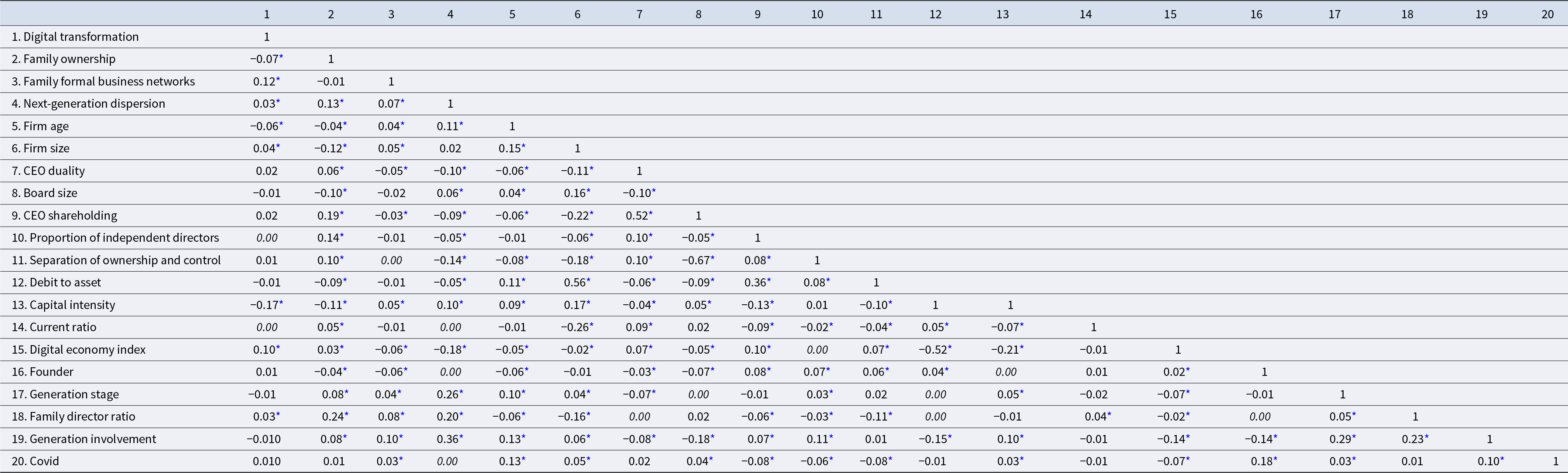
The correlation matrix in Table 2 shows a significant negative correlation between family ownership and digital transformation (β = −0.07, p < 0.01), indicating that firms with higher family ownership engage less in digital transformation. The small correlation coefficients between independent and most control variables suggest weak relationships, reducing concerns about confounding effects. A variance inflation factor (VIF) test assessed multicollinearity among key variables (Cohen, Cohen, West, & Aiken, Reference Cohen, Cohen, West and Aiken2003), yielding an average score of 1.54 and a maximum of 2.68 (both well below the threshold of 10), confirming no significant multicollinearity.
Correlation analysis

* Notes: N = 5,408. Due to rounding of extremely small values, coefficients in this table are displayed as 0.00 in italics. *p < 0.5.
This study employed XTTobit regression analysis in STATA 18.0 to examine truncated data with numerous zero-bound observations (Baum & Hurn, Reference Baum and Hurn2021), incorporating one-year lags between explanatory and dependent variables to establish clear causal relationships. Table 3 revealed that capital-intensive firms demonstrated lower digital transformation adoption, while larger organizations showed increased digital engagement. Firms experiencing COVID-related disruptions, particularly those implementing remote work arrangements, displayed enhanced digital transformation efforts. These findings extend current theoretical understanding by illuminating how organizations adapt their digital strategies under conditions of technological and operational uncertainty, contributing substantively to management literature through the identification of specific organizational characteristics that influence digital transformation decisions.
Main findings

* Notes: N = 5,408. Dependent variable = Digital transformation. Standard errors are in parentheses. *p < 0.10, **p < 0.05, ***p < 0.01.
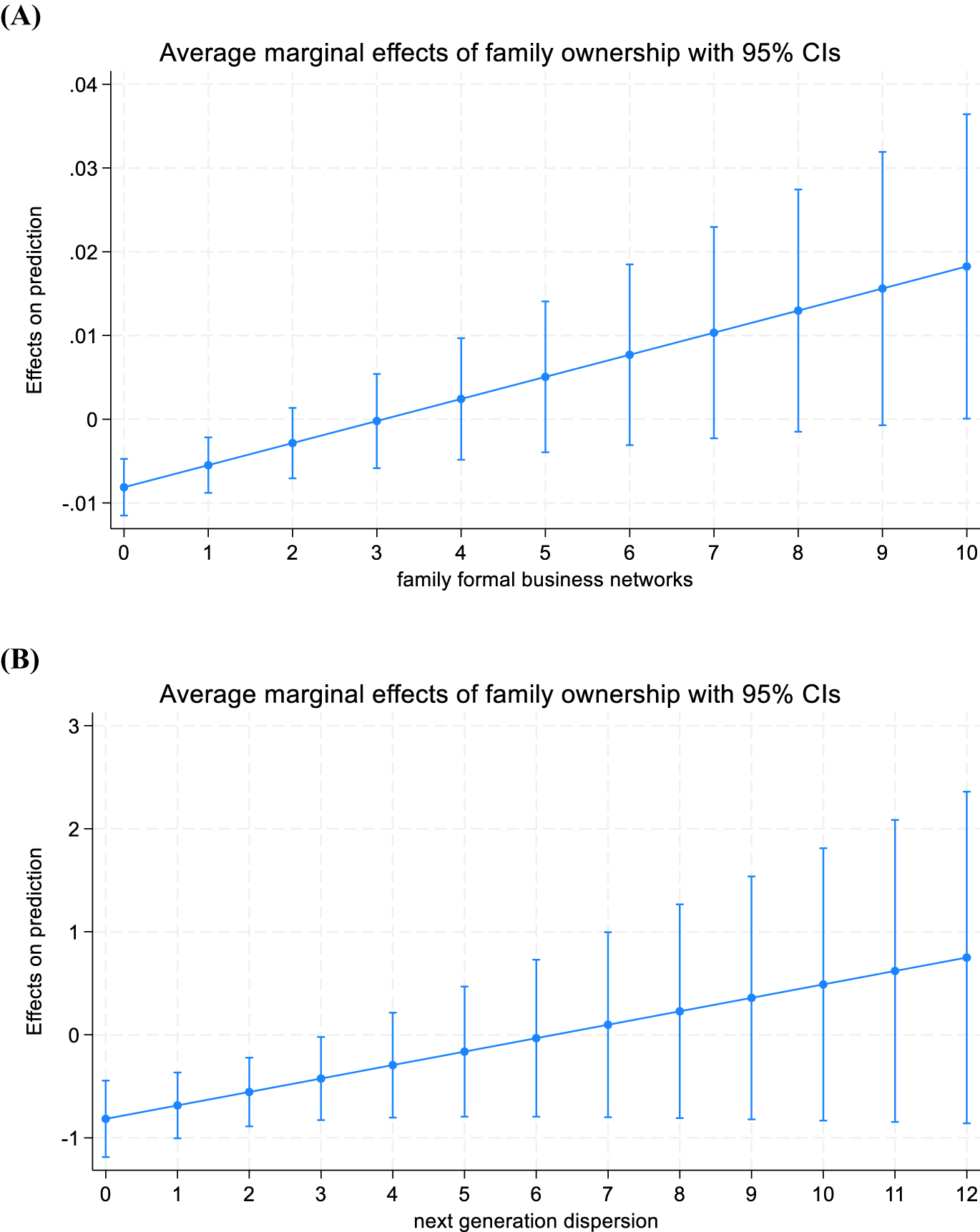
Model 2 examines family ownership’s impact on digital transformation, revealing a significant negative correlation (β = −0.007, p < 0.01). This finding confirms H1. The analysis then expands through Models 3 and 4, which introduce two moderating variables: family formal social networks and next-generation dispersion. Model 3 tests the moderating effect of family formal social networks. The interaction between family ownership and these networks produces a positive coefficient (β = 0.003, p < 0.01). Figure 2A illustrates how these networks reduce the negative impact of family ownership on digital transformation, supporting H2. Similarly, Model 4 demonstrates that next-generation dispersion moderates the primary relationship (β = 0.003, p < 0.01). Figure 2B shows this moderating effect, confirming H3. The comprehensive Model 5 incorporates all variables and provides additional support for all three hypotheses. These findings establish both the direct negative effect of family ownership on digital transformation and the mitigating influence of formal networks and next-generation involvement.
Graph of lagged moderating effect (A) The moderating effect of family formal business networks (B) The moderating effect of next-generation dispersion

Robustness Test
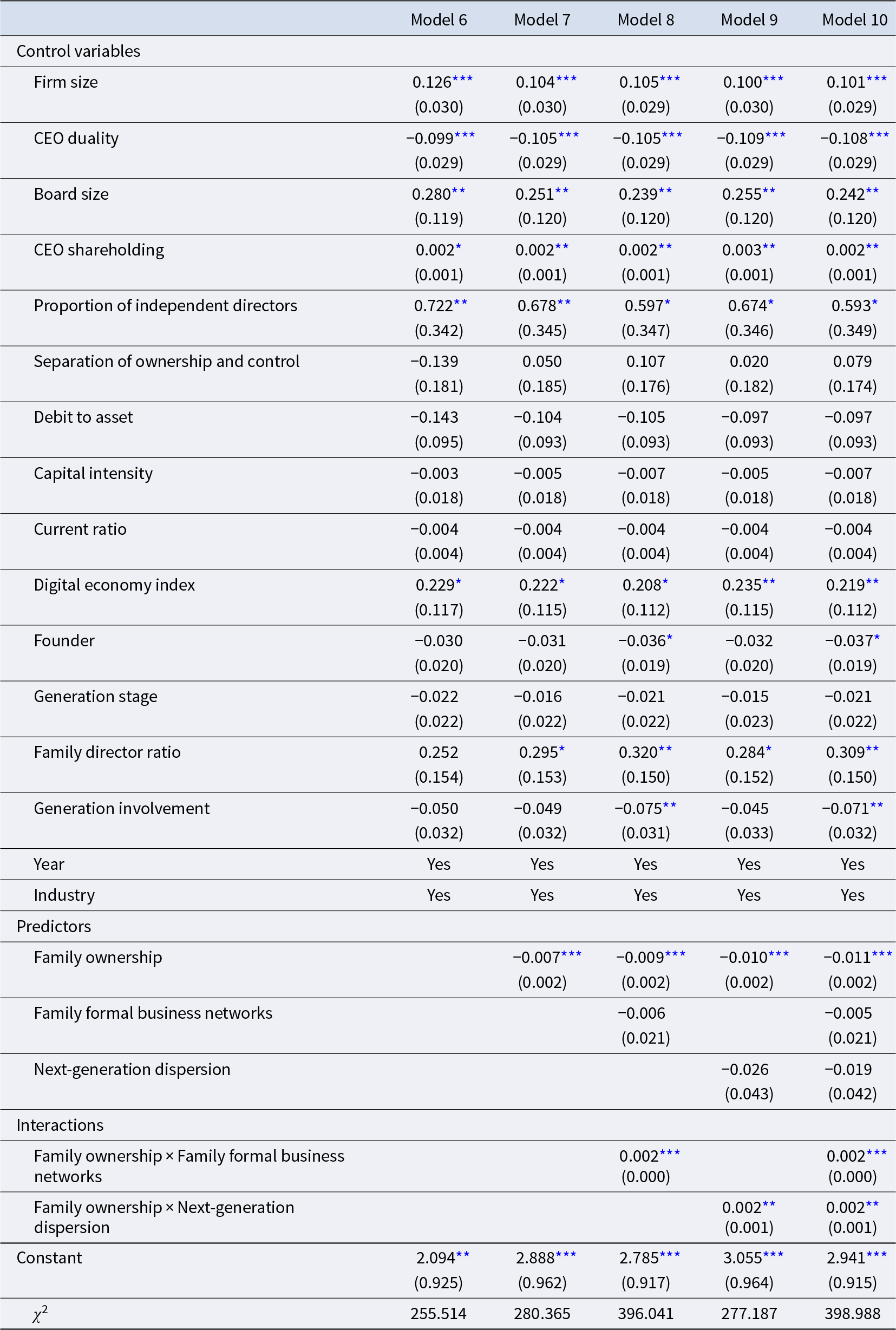
Additional analyses verified the results and established robustness. First, this study employs the PPMLHDFE (Poisson Pseudo-Maximum Likelihood with High Dimensional Fixed Effects) regression model to analyze the data (Correia, Guimarães, & Zylkin, Reference Correia, Guimarães and Zylkin2019). This model offers key advantages over the XTTOBIT approach. The dependent variable consists of frequency counts of digital transformation terms, represented as non-negative integers. PPMLHDFE enables simultaneous control of individual and time fixed effects. The results from Table 4 strongly support the original findings. Model 7 confirms the significant negative relationship between family ownership and digital transformation (β = −0.007, p < 0.01). Models 8 and 9 validate the moderating effects. Family formal business networks demonstrate a positive moderating influence (β = 0.002, p < 0.01). Next-generation dispersion similarly shows a significant positive moderation effect (β = 0.002, p < 0.05). These consistent results across different statistical approaches strengthen the robustness of the study’s findings.
Robust test – PPMLHFE regression

* Notes: N = 5,136. Dependent variable = Digital transformation. Standard errors are in parentheses. This regression employs PPMLHDFE with the raw frequency count of ‘Digital transformation’ as the dependent variable. The analysis differs from Table 3 by implementing both individual and time fixed effects rather than using natural logarithm transformation. This inclusion of dual fixed effects creates substantial multicollinearity. The multicollinearity necessitated the removal of several variables. Both ‘firm age’ and the ‘Covid’ indicator were dropped entirely. Multiple categories within the industry classification system also required removal. These adjustments resulted in a final sample of 5,136 observations. This represents a reduction from the 5,408 observations analyzed in Table 3. *p < 0.10, **p < 0.05, ***p < 0.01.
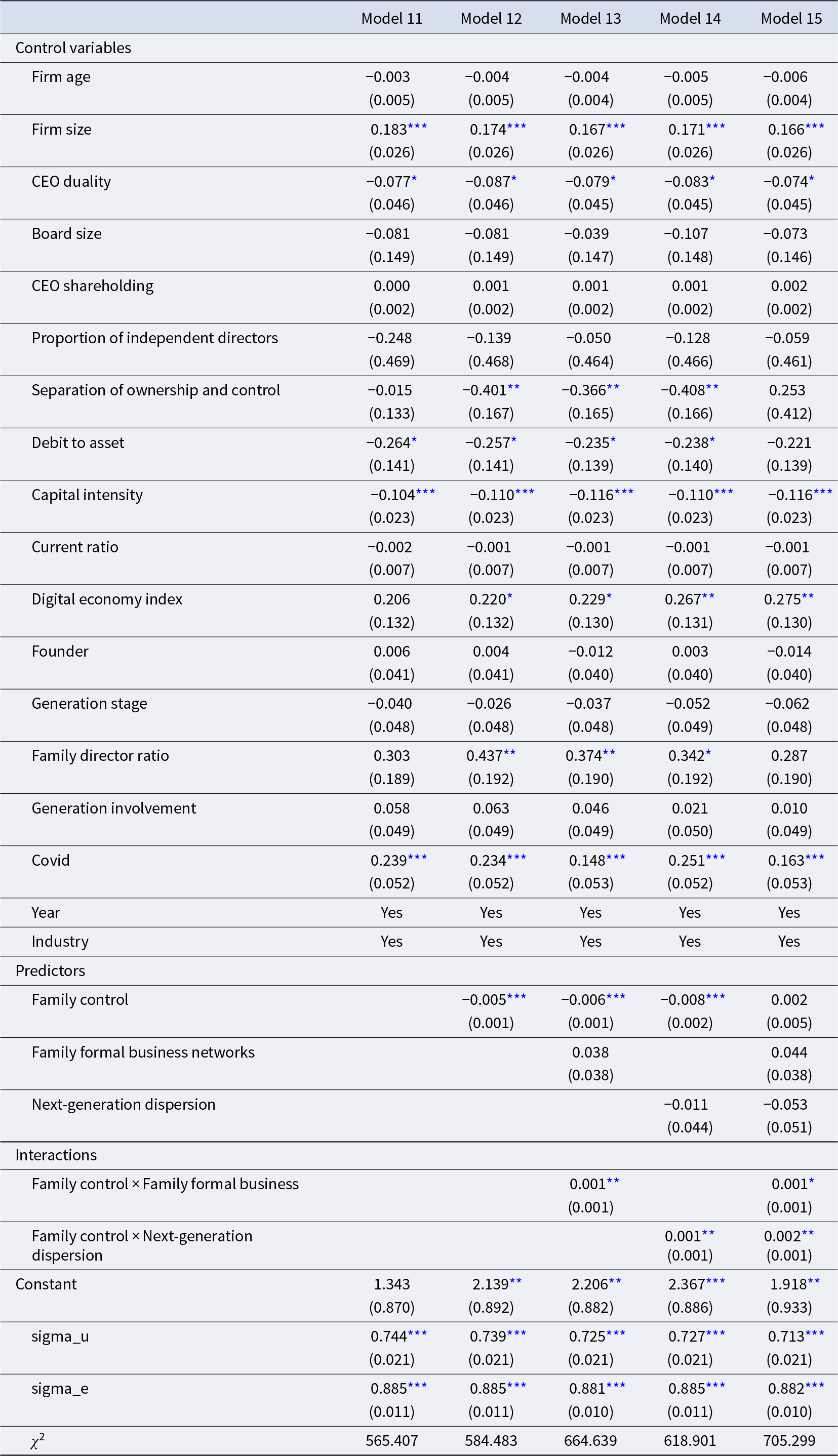
Second, the study replaced cash flow rights with family voting rights (family control) as a measure of the independent variable, acknowledging the limitations of this approach. The calculation of family cash flow rights follows the method proposed by La Porta, Lopez‐de‐silanes, and Shleifer (Reference La Porta, Lopez‐de‐silanes and Shleifer1999). The study re-ran the main and moderating effects to demonstrate the robustness of the new independent variable. Table 5 presents the overall results, which show no significant differences from Table 3. Model 12 included family control as an independent variable, revealing a negatively significant main effect on digital transformation (β = −0.005, p < 0.01. Models 13 and 14 in Table 5 added two interaction variables, yielding significant results like Table 3. These findings support the robustness of the study’s conclusions, demonstrating that the relationships between family control, digital transformation, and the moderating effects hold even with a different measure of family influence.
Robustness test – substitute independent variable (family control)

* Notes: N = 5,408. Standard errors are in parentheses. Dependent variable = Digital transformation. *p < 0.10, **p < 0.05, ***p < 0.01.
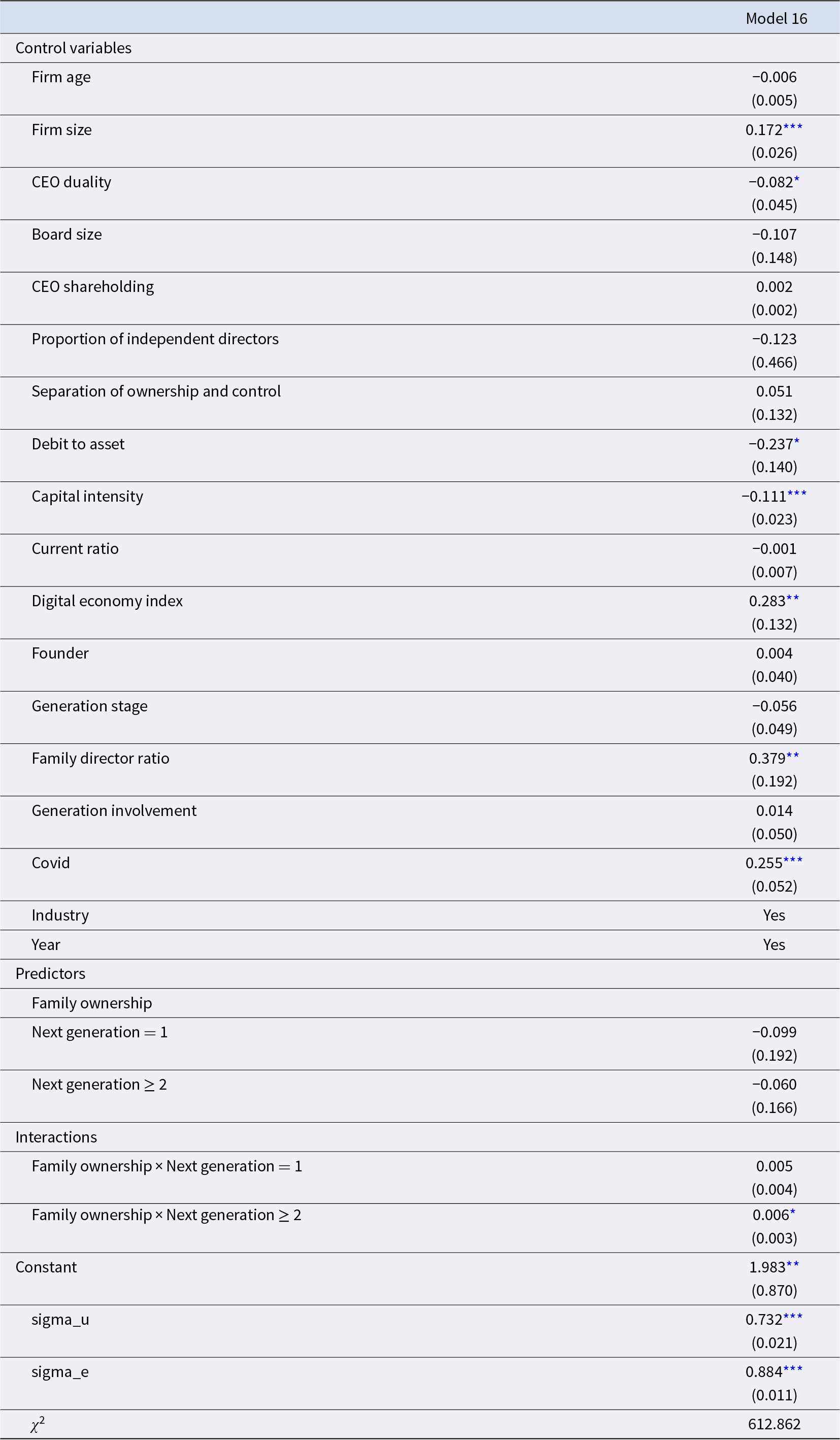
Third, this study conducted additional analyses to examine the moderating effects of next-generation dispersion in family firms by categorizing next-generation participation into three distinct groups: no involvement (value = 0, reference category), single member involvement (value = 1), and multiple member involvement (value ≥ 2). The regression results in Table 6, Model 16, reveal a compelling pattern. Single next-generation member involvement showed no significant moderating effect compared to the reference group (β = 0.005, p > 0.1). However, the presence of multiple next-generation members demonstrated a significant positive moderating effect (β = 0.06, p < 0.1). These findings substantiate the theoretical argument that next-generation dispersion, rather than mere involvement, drives digital transformation. Multiple next-generation members create productive tensions that encourage senior leadership to embrace digital solutions for enhanced transparency and accountability. The stark contrast between single and multiple next-generation involvement highlights the unique dynamics that emerge when multiple successors participate in family firm leadership.
Robust test-threshold value of next generation dispersion

* Notes: N = 5,408. Standard errors are in parentheses. Dependent variable = Digital transformation. The reference group for ‘Next-generation dispersion’ is Next-generation dispersion = 0. *p < 0.10, **p < 0.05, ***p < 0.01.
Fourth, the study addresses potential sample selection bias stemming from the voluntary nature of digital transformation disclosures in corporate reporting. Some firms demonstrate greater inclination to report digital initiatives, introducing endogeneity concerns that require methodological attention. Following Hamilton and Nickerson (Reference Hamilton and Nickerson2003), the analysis employs charitable donations as an instrumental variable and calculates the inverse Mills ratio (IMR) to control for selection bias. The charitable donation amounts undergo a logarithmic transformation with a one-period lag to align with other control variables. Table 7 presents regression results incorporating the IMR as a control variable, demonstrating remarkable consistency across specifications. Family ownership maintains its significant negative effect on digital transformation. The moderating effects of family formal business networks and next-generation dispersion retain their significance after IMR inclusion. These robust results across different model specifications in Table 7 strengthen confidence in the study’s core findings and theoretical framework. The persistence of hypothesized relationships, despite controlling for potential selection bias, validates the reliability and generalizability of the conclusions.
Robustness test – endogeneity test

* Notes: N = 5,408. The dependent variable in Model 17 is ‘if digital transformation’. It takes a value of 1 if the company reports digital transformation, and 0 if the company does not report digital transformation. The xtprobit model is used for estimation. Models 18–22 use ‘Digital transformation’ as the dependent variable. ‘Donation’ represents corporate charitable donations, transformed by taking the natural logarithm after adding 1 to the raw value. IMR refers to the inverse Mills ratio. Standard errors are provided in parentheses. *p < 0.10, **p < 0.05, ***p < 0.01.
Lastly, this study addresses endogeneity concerns through three instrumental variables. First, for family ownership, the total family ownership of all firms within each city was calculated. Each sample firm’s proportion relative to its city’s total was used as an instrumental variable. This instrument exhibits a strong correlation with the independent variable (r = 0.349, p < 0.001), but no significant correlation with the dependent variable (digital transformation) (r = 0.020, p > 0.1). This approach builds on the institutional context of Chinese family firms, which originate either as family-founded entities or emerge through the privatization of state- or collectively owned enterprises. Second, for formal business networks, separate totals were calculated for each type of origin (family-founded vs. privatized). The proportion of each sample firm’s network connections relative to its origin-type total was employed as the instrumental variable. This measure correlates significantly with the formal network variable (r = 0.120, p < 0.001) and remains uncorrelated with digital transformation (r = 0.014, p > 0.1). Third, for next-generation dispersion, the proportion of each firm’s dispersion score relative to the origin-type total was used as the instrument. It correlates significantly with the corresponding moderator (r = 0.063, p < 0.001) and is not significantly associated with the dependent variable (r = −0.021, p > 0.1). Endogeneity tests were conducted in Stata using these three instruments. Table 8 reports the results. Models 23, 25, and 27 demonstrate that each instrument satisfies the relevance condition. Models 24, 26, and 28 confirm that the key main and interaction effects remain statistically significant after instrumenting, thereby reinforcing the robustness of the study’s findings.
Robustness test – instrumental variable test

* Notes: N = 5,408. The dependent variable in Model 24, 26, or 28 is ‘if digital transformation’. The dependent variables of Model 23, Model 25, and Model 27 are ‘Family ownership’, ‘Family formal business networks’, and ‘Next-generation dispersion’, respectively. *p < 0.10, **p < 0.05, ***p < 0.01.
Discussion
Theoretical Contribution
This study contributes to research on digital transformation and SEW in family firms by offering a theoretically integrated and context-sensitive framework that explains when and why family firms resist or embrace digital transformation. The first contribution lies in clarifying how a focused SEW orientation rooted in control-related concerns shapes resistance to digital transformation (Gómez-Mejía et al., Reference Gómez-Mejía, Chirico, Withers, Martin and Wiseman2024; Gu et al., Reference Gu, Lu and Chung2019). Existing literature presents conflicting views, with some studies portraying family firms as digital laggards due to risk aversion and path dependence (Liu et al., Reference Liu, Zhou and Li2023; Quarato et al., Reference Quarato, Pini and Positano2020), and others emphasizing adaptability through long-term commitment and family cohesion (Ren et al., Reference Ren, Liu and Ding2023; Soluk et al., Reference Soluk, Kammerlander and De Massis2021). The present findings support the former perspective, showing that concentrated family ownership fosters authority-preserving logics that conflict with the transparency, decentralization, and external engagement required by digital initiatives (Struijk et al., Reference Struijk, Angelopoulos, Cxj and Davison2023). This resistance emerges especially pronounced in Chinese family firms, where cultural traditions reinforce hierarchical control and internal autonomy (Li et al., Reference Li, Chen, Chua, Kirkman, Rynes-Weller and Gomez-Mejia2015).
The second contribution demonstrates how participation in formal business networks weakens control-based resistance by activating broader SEW concerns related to legitimacy. Engagement in institutional networks enhances firms’ reputational visibility and embeds them within structures that value transparency, innovation, and alignment with public goals (He & Liu, Reference He and Liu2022; Liu et al., Reference Liu, Zhou and Li2023). Participation in formal business networks activates legitimacy concerns that center on maintaining public credibility, political alignment, and reputational honor – core components of the legitimacy dimension of SEW (Berrone et al., Reference Berrone, Cruz, Gomez-Mejia and Larraza-Kintana2010). These concerns reflect both instrumental and emotional needs, as family firms seek validation from key stakeholders such as government bodies, industry peers, and the broader business community. In the Chinese context, these legitimacy needs appear particularly pronounced. Political affiliations and national or provincial associations serve as powerful vehicles for signaling alignment with institutional expectations, while simultaneously enhancing public recognition (Meng et al., Reference Meng, Gomez-Mejia and Yi2024). This context-specific dynamic is further amplified by the cultural logic of mianzi, which operates as a reputational mechanism that heightens the visibility and consequences of institutional nonconformity (Hwang, Reference Hwang1987; Zhang, Reference Zhang2023). In Chinese family firms, where reputational standing often reflects on the entire family lineage, mianzi reinforces the legitimacy dimension of SEW by adding cultural urgency to institutional expectations. Engagement in such networks places normative and reputational pressures on family firms to adopt modern practices, including digital transformation. This dynamic shows how legitimacy-centric SEW, often associated with broader SEW orientations that prioritize long-term continuity and public standing (Gómez-Mejía et al., Reference Gómez-Mejía, Chirico, Withers, Martin and Wiseman2024; Gu et al., Reference Gu, Lu and Chung2019), can partially reconfigure control-centric logics. As a result, the pursuit of legitimacy enables firms to embrace digitalization not in opposition to socioemotional goals, but as a way of protecting and reinforcing them in the face of evolving institutional demands.
Third, the study introduces next-generation dispersion as an internal organizational condition that activates longevity-centric SEW. Involving multiple next-generation members in governance roles increases the salience of transgenerational survival and continuity, particularly in contexts of succession or generational transition. This dynamic encourages investment in systems such as digital technologies that support transparency, coordination, and long-term sustainability (Bürgel & Hiebl, Reference Bürgel and Hiebl2023; Pan et al., Reference Pan, Chen and Qiu2023). Longevity-centric SEW, like legitimacy concerns, aligns with broader SEW orientations (Gu et al., Reference Gu, Lu and Chung2019) by promoting forward-looking priorities centered on continuity and legacy. This insight extends the literature by moving beyond binary succession categories (e.g., founder vs. successor) to focus on how structural dispersion among successors shifts SEW priorities. It also contributes to emerging research on how generational dynamics influence innovation-related decisions (Del Vecchio et al., Reference Del Vecchio, Secundo and Garzoni2024; Gu et al., Reference Gu, Lu and Chung2019)
Taken together, these contributions provide a comprehensive framework for reconciling conflicting findings in the literature on family firms’ engagement with digital transformation. By examining how control-, legitimacy-, and longevity-centric SEW shape strategic responses under different conditions, the study demonstrates that digital transformation outcomes depend not on SEW dimensions in isolation, but on how they become activated, moderated, or rebalanced through both internal dynamics and external pressures. In particular, the findings deepen understanding of Chinese family firms, which are shaped by culturally embedded mechanisms such as hierarchical authority and mianzi, and institutional environments that both reinforce control-centric preferences and demand public legitimacy (Buckley, Clegg, & Tan, Reference Buckley, Clegg and Tan2006; Meng et al., Reference Meng, Gomez-Mejia and Yi2024). Rather than treating mianzi as a formal SEW dimension, the study conceptualizes it as a cultural mechanism that amplifies legitimacy-related SEW, especially under the symbolic scrutiny associated with formal network participation. The analysis shows how SEW priorities in Chinese family firms appear fluid rather than fixed, and how legitimacy and longevity logics can counterbalance control-driven resistance to transformation (He & Liu, Reference He and Liu2022; Liu et al., Reference Liu, Zhou and Li2023). This dynamic interplay illustrates a more flexible and context-sensitive view of SEW, responding to recent calls for theorization that better captures the complexity of family firm behavior in rapidly evolving digital environments (Foss et al., Reference Foss, Klein, Lien, Zellweger and Zenger2021; Gómez-Mejía et al., Reference Gómez-Mejía, Chirico, Withers, Martin and Wiseman2024; Swab et al., Reference Swab, Sherlock, Markin and Dibrell2020).
Managerial Implications
The empirical findings yield three significant practical implications for family business management. First, high levels of family ownership can make digital transformation more difficult to implement. Strong central control often leads to reluctance to delegate authority or adopt systems that increase transparency. Digital initiatives, however, require openness to new processes, collaboration with external specialists, and changes to long-standing internal routines. To address this challenge, family firms may benefit from clearly separating strategic oversight from day-to-day digital execution. Appointing dedicated digital project teams, hiring experienced nonfamily managers, or establishing advisory boards focused on technology can enable firms to pursue innovation while retaining core decision-making influence within the family. These adjustments allow firms to modernize operations while protecting the cohesion and values that often underpin long-term business continuity.
Second, active participation in formal business networks can help accelerate digital progress. These networks often create expectations around modern practices and offer access to valuable resources, including funding, expert advice, and peer learning. Family firms engaged in such platforms are more likely to be exposed to new technologies and industry standards and may face stronger incentives to keep up with digital developments. Leaders can use their network roles to demonstrate a forward-looking orientation and strengthen relationships with regulators, customers, and partners. Taking visible roles in associations, contributing to digital policy initiatives, or hosting knowledge-sharing events can position the firm as a trusted and progressive organization. In contexts where public recognition and institutional trust are important, such engagement offers a clear pathway for firms to align digital investment with external credibility and stakeholder expectations.
Third, involving multiple members of the next generation in leadership or governance positions can help build momentum for digital change. When several family successors take part in running the business, firms often place greater emphasis on long-term planning, professional management, and forward-looking investments. Younger members typically bring fresh perspectives, digital fluency, and broader exposure to international practices. Their collective involvement can reduce over-reliance on any one individual, improve coordination, and support more transparent systems. Firms may consider encouraging successors to lead pilot programs, form digital working groups, or engage with technology partners. These efforts can ensure that innovation becomes embedded in the organization’s structure and supported across generations. Where continuity and sustainability serve as guiding priorities, shared leadership across successors can facilitate the adoption of digital tools that build resilience and strategic alignment for the future.
Limitations and Future Research Opportunities
This study acknowledges several limitations that create opportunities for future research. First, this study focuses on family ownership as a key mechanism of control, operationalized through the collective cash flow rights of family members. This approach captures a formal and economically grounded dimension of control, aligning with SEW theory’s emphasis on ownership-based influence. However, control in family firms may also manifest through other mechanisms, including executive decision-making authority, board representation, and informal founder influence. Future research could examine how these additional forms of control affect strategic responses to digital transformation. Such extensions would complement the current findings and offer a more comprehensive understanding of control-centric SEW in family firms. Second, the time interval requires extension to validate findings’ robustness. Future research could leverage the temporal dimension to explore how family control proportions at different enterprise stages influence digital transformation. This longitudinal perspective would enrich understanding of how control dynamics evolve.
Third, although this study provides a comprehensive approach to measuring digital transformation, further conceptual refinement remains necessary. As noted in prior research, including (Vial, Reference Vial2019), digital transformation represents a complex and evolving construct, and its boundaries may differ across empirical settings. While the keyword-based measurement employed in this study draws on established academic and policy sources and captures three distinct levels of digital engagement, namely digital technology, process application, and organizational capability, the breadth of included terms may extend beyond narrower interpretations of the construct. Future research would benefit from the development of more granular and context-sensitive frameworks that better reflect the multidimensional nature of digital transformation and its application across diverse organizational domains, including innovation, operations, and workforce practices.
Fourth, the relationship between family ownership and digital transformation may exhibit nonlinear patterns. Although preliminary testing with squared terms proved insignificant, more complex relationships might exist. Future scholars should employ sophisticated methodological approaches, such as piece-wise regression or spline functions. These methods could identify threshold effects or curvilinear relationships, revealing how ownership concentration levels optimally support digital transformation. Fifth, the dataset cannot capture internal stakeholder dynamics during critical organizational moments affecting longevity-centric SEW. Longitudinal case studies focusing on succession announcements could examine how multiple next-generation members interpret longevity-centric SEW differently. This research would enhance understanding of how next-generation dispersion influences digital transformation through SEW preservation.
Sixth, next-generation influence measurement requires greater sophistication. Current metrics emphasize numerical presence without examining qualitative dimensions like digital literacy, education, or work experience. Cross-industry comparative studies could reveal how different business sectors shape next-generation involvement patterns. Future research must develop multidimensional frameworks for understanding next-generation impact. Seventh, the study’s focus on formal networks and next-generation dispersion opens additional research opportunities. Future studies should examine how external stakeholders and internal dynamics shape digital transformation. Research could investigate how succession announcements, leadership transitions, and employee readiness influence technological adoption. These investigations would enhance understanding of family firms’ digital transformation ecosystem.
Conclusion
This research examines how family ownership influences digital transformation in Chinese family firms through the lens of SEW theory. Analysis of panel data reveals that family ownership negatively affects digital transformation efforts, yet this effect becomes moderated by formal business networks and next-generation dispersion. These findings advance theoretical understanding by demonstrating that SEW dimensions can evolve and even compete depending on generational composition and institutional exposure. This dynamic interplay reflects a more flexible and adaptive view of SEW than previously assumed, refining its explanatory power in contexts of technological disruption. The study further contributes to SEW theory by showing that legitimacy and longevity considerations may attenuate control-oriented preferences, especially when institutional engagement or intergenerational continuity becomes salient. Such dimensional interactions help reconcile divergent findings in the literature concerning family firms’ responses to digital transformation.
The practical implications of these findings suggest that family firms can reduce digital resistance by fostering inclusive next-generation involvement and actively engaging with formal business networks. These strategies support the adoption of digital practices while preserving essential family values, particularly in settings where tradition and innovation must coexist. By combining a multidimensional SEW perspective with empirical insights from Chinese family firms, the study offers a robust framework for understanding how family businesses manage the trade-offs inherent in digital transformation. Future research may extend this approach to other institutional settings, explore nonlinear dynamics among SEW dimensions, and examine qualitative aspects of next-generation leadership to further enrich understanding of technological adaptation in family firms.
Data availability statement
The data that support the findings of this study are available from the China Stock Market & Accounting Research (CSMAR) database at https://www.csmar.com/ These data are subject to licensing restrictions and are not publicly accessible. Researchers may obtain access through institutional subscription or by contacting the database provider directly. No new datasets were generated for this study.
Funding statement
The authors have disclosed receipt of the following financial support for the research, authorship, and/or publication of this article: This work was supported by the National Social Science Funds of China (23GLB04648), the National Natural Science Foundation of China (71972042; 71802114), the National Natural Science Foundation of Fujian Province (2025J01453), and the Special Undergraduate Practical Teaching Reform Project of Ningbo University (No. JYSJZX-JD-2025001) and the ‘Special Fund for Case Studies of Youngor New Business School, Ningbo University’.
Appendix 1: Measurement

Appendix 2: Digital Transformation Measurement
This study examines the degree of digital transformation among listed companies from 2016 to 2020 through a systematic analysis of Management Discussion and Analysis (MD&A) reports. The measurement approach builds on Wu, Hu, Lin and Ren (Reference Wu, Hu, Lin and Ren2021), Zhao, Wang and Li (Reference Zhao, Wang and Li2021), and Zhen, Wang and Fang (Reference Zhen, Wang and Fang2023) and reflects the three-level structure of digital transformation used in the study.
Step 1: Text Extraction
The analysis extracted text from the ‘Discussion and Analysis of Business Operations’ section of annual reports published by A-share listed companies on the Shanghai and Shenzhen Stock Exchanges (2016–2020), using Java PDFBox. A Python-based web crawler collected these reports, and the Java PDFBox library was used to extract the textual content.
Step 2: Defining ‘Digital Transformation’ ‘Keywords’
The keyword dictionary was constructed by combining academic and policy sources. A total of 314 keywords were compiled from:
• Wu, Hu, Lin and Ren (Reference Wu, Hu, Lin and Ren2021): 76 terms across foundational digital technologies (e.g., artificial intelligence, big data, cloud computing, and blockchain)
• Zhao, Wang and Li (Reference Zhao, Wang and Li2021): 99 terms across applied digital practices (e.g., intelligent manufacturing, modern information systems, and Internet-enabled business models).
• Zhen, Wang and Fang (Reference Zhen, Wang and Fang2023): 139 terms reflecting organizational empowerment, digital capabilities, and strategic application
The digital transformation keyword lexicon contains 314 terms drawn from academic literature and policy documents. The keywords were categorized into the following three levels:
1. Digital Technology: Infrastructure-related terms such as artificial intelligence, big data, cloud computing, and blockchain.
2. Process Application: Terms reflecting the operational use of digital tools in business processes.
3. Organizational Capability: Terms referring to firm-wide integration of digital practices and the development of digital strategy and resources.
This classification aligns with the multidimensional view of digital transformation articulated in the main text.
Step 3: Preprocessing MD&A Text
The MD&A text was cleaned and segmented using the Jieba Python library. Keywords preceded by negation words (e.g., ‘no’, ‘not’, ‘without’, ‘none’, ‘never’, ‘neither’, ‘no need’, and ‘irrelevant’) or unrelated to the firm’s transformation efforts were excluded from analysis.
Step 4: Detailing Digital Transformation Term Frequencies
The filtered keywords were grouped according to the three levels and frequency counts were calculated for each firm-year. This step captures both the scope and intensity of a firm’s engagement with digital transformation.
Step 5: Calculating Digital Transformation Metrics
The final digital transformation score was calculated by taking the natural logarithm of the keyword frequency count (after adding 1) for XTTobit analysis. For robustness checks using PPMLHDFE, raw frequencies were used without transformation.
Wai Wai (Joyce) Ko (joyce.ko@brunel.ac.uk) is Reader in Strategic Entrepreneurship and Head of Department at Brunel Business School, University of London. Her research examines how SMEs and social enterprises build innovation capabilities through knowledge flows, stakeholder engagement, and informal governance. Integrating strategy, marketing, and organizational theory, she advances understanding of decision-making and capability development in resource-constrained contexts. Her work bridges commercial and social entrepreneurship, offering contextually grounded frameworks with relevance for both academic research and managerial practice.
Shihui Chen (chenshihui@nbu.edu.cn) is an associate professor at Ningbo University, holding a PhD in Management and serving as a master’s supervisor. A visiting scholar at the University of Strathclyde and Missouri University of Science and Technology, her research appears in leading journals such as Journal of Business Research, Asia Pacific Journal of Management, and Management World. She serves as a reviewer for top-tier publications, including Entrepreneurship Theory and Practice, Asia Pacific Journal of Management, and Management and Organization Review and has won case and conference awards.
Gordon Liu (cygliu@gmail.com) is a professor of marketing strategy at the Open University. A certified management and business educator, UKCGE-recognized research supervisor, and Senior Fellow of Advance HE, he won the 2023 Gerald E. Hills Best Paper on Entrepreneurial Marketing award. His research explores strategic marketing, innovation, IT-business integration, and networks. His work appears in leading journals, including Entrepreneurship Theory and Practice, Strategic Entrepreneurship Journal, Journal of Product Innovation Management, and Journal of Supply Chain Management.
Bingde Wu (bdwu@fzu.edu.cn) is an associate professor at the School of Economics and Management, Fuzhou University, China. He is also a co-founder of hi-tech venture in China and has years of working experience in telecom industry. His research primarily focuses on family firms, innovation, and entrepreneurship. His work has appeared in Asia Pacific Journal of Management, Journal of Business Research, and top Chinese journals such as Management World (in Chinese).
Nan Jiang (nan.jiang@brunel.ac.uk) is a lecturer in strategy and management and Co-Lead of the Sustainable Family Enterprises Research Lab at Brunel University London. She has led UK government-funded SME support programs, including Help to Grow and Build Back Better, and is a Fellow of the Higher Education Academy. Her research critically examines the structural and cultural barriers faced by disadvantaged groups in entrepreneurial contexts. Her work has been published in the International Small Business Journal and in research handbooks on family business and entrepreneurship (Edward Elgar and Routledge).