Introduction
In May, 1973 the senior author (A.B.) arrived in Ottawa as a university summer student. It was clear that the Diptera Unit was a hub of activity, with the Manual of Nearctic Diptera a major focus for the strong group of dipterists working there. Willi Hennig had visited 6 years earlier and there was a continued quest to interpret the homology of character states of adult and larval Diptera and to write chapters for the various families of flies. When A.B. returned in 1978 it was to begin a Ph.D. program through Carleton University but based in what was then the Biosystematics Research Institute. Again, it was to be immersed in this group of devoted dipterists who were working together on getting Volume 1 of the Manual published. There was a palpable pursuit of excellence, to provide thorough and complete chapters on each family, and to ensure that characters were homologous throughout. This in part led to a course on Diptera phylogeny taught by Monty Wood that became the basis for the chapter on the phylogeny of the Nematocera in Volume 3 of the Manual (Wood and Borkent Reference Wood and Borkent1989). The rest, as they say, was history and today the Manual stands as the “Bible” for dipterists worldwide (and as recently emulated by the Manual of Central American Diptera). Ten years after A.B. returned to Ottawa, the junior author (B.J.S.) arrived as a Ph.D. student and took the same Diptera phylogeny/morphology course taught by Monty Wood. This course led also to a number of morphological studies including the trilogy of papers on the homologies of the male genitalia (Wood Reference Wood1991; Sinclair et al. Reference Sinclair, Cumming and Wood1994; Cumming et al. Reference Cumming, Sinclair and Wood1995).
The paper presented here is a direct descendant of the impetus provided by the coordinators of the Manual of Nearctic Diptera in their pursuit of homology, and its corollary, the interpretation of phylogenetic relationships. It is a continuation of a broad morphological and phylogenetic analysis of the male genital tract of Diptera, Mecoptera, and Siphonaptera by Sinclair et al. (Reference Sinclair, Borkent and Wood2007) and Borkent et al. (Reference Borkent, Borkent and Sinclair2008). At that time there were a number of gaps in knowledge, where entire families of Diptera were unstudied. In this paper we report on the gross morphology of the male genital tract of two phylogenetically enigmatic families, Axymyiidae and Tanyderidae, to increase our broad comparisons within the Diptera.
Materials and methods
Adults of Axymyia furcata McAtee and Protoplasa fitchii Osten Sacken were previously preserved and subsequently dissected in 70% ethanol. Preparation and examination of the male genital tract followed Sinclair et al. (Reference Sinclair, Borkent and Wood2007). Voucher specimens of both species are deposited in the Canadian National Collection of Insects (Ottawa). The specimens of A. furcata were reared by Greg Courtney and preserved shortly after emergence.
Results
To allow direct comparisons with other families of Diptera described by Sinclair et al. (Reference Sinclair, Borkent and Wood2007), we follow the same descriptive format at the family level, followed by interpretation of each of the two families studied.
Axymyiidae
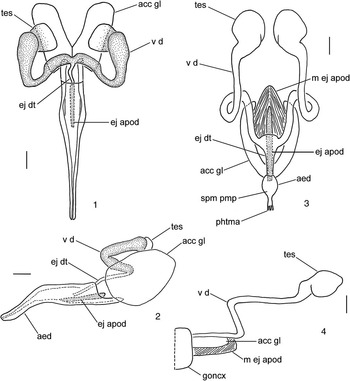
Male genital tract. 1.Axymyia furcata, dorsal view. 2.A. furcata, lateral view. 3.Protoplasa fitchii, dorsal view. 4.P. fitchii, lateral view. Scale bar = 0.1 mm (acc gl – accessory gland; aed – aedeagus; ej apod – ejaculatory apodeme; ej dt – ejaculatory duct; goncx – gonocoxite; m ej apod – muscles of ejaculatory apodeme; phtma – phallotrema; spm pmp – sperm pump; tes – testis; v d – vas deferens).

Testis. The testis is thick, sac-like, rounded anteriorly, and gradually tapered posteriorly to become the vas deferens (the distinction between the two is uncertain). The testis extends anteriorly past the anterior portion of the accessory gland or is pressed against its dorsal surface (they differed in the two specimens examined, perhaps due to differing degrees of maturity). The testes often have chromatophores over their basal portion.
Epididymis. Not differentiated.
Vas deferens. Each duct is short, thick, and expanded apically to the base of the testis. They extend posteriorly and then bend abruptly ventromedially and arch somewhat anteriorly to meet near the base of fused (or firmly appressed) accessory glands and near the base of the aedeagus to enter the ejaculatory duct. The ducts are covered with a layer of chromatophores. The lateral portion of each vas deferens is firmly appressed against tergite 7. Because it is covered with chromatophores, it can be seen externally through the cuticle of tergite 7 as a darker brown mass.
Accessory gland and seminal vesicle. The two thick, oblong accessory glands are either fused or firmly appressed posteromedially. This fusion is ventral to the area where the two vasa deferentia meet medially and then the bases of accessory glands surround the abutting or fused vasa deferentia from there to where they enter the aedeagus. The glands appear to empty separately, with poorly defined ducts from the inner face entering the point of junction of the vasa deferentia. The accessory glands are partially attached to the pleura of segment 8 and extend to the posterior quarter of segment 7.
Ejaculatory duct. The ejaculatory duct is short, extending dorsally from the meeting of the vasa deferentia. The duct enters the aedeagus dorsally and extends posteriorly past the base of the ejaculatory apodeme. Similar details can be seen from cleared preparations of the genitalia, where a single ejaculatory duct enters the base of the aedeagus (Wood Reference Wood1991, fig. 9e, duct dorsal to ejaculatory apodeme).
Ejaculatory apodeme, sperm pump, and aedeagus. The ejaculatory apodeme is present as a short rod in the basal portion of the aedeagus (Wood Reference Wood1991, figs. 9a, e). The aedeagus is elongate, broadened basally, with a narrow apical phallotrema (or secondary gonopore at apex of the aedeagus).
Phylogenetic interpretation and remarks. As indicated by Wood and Borkent (Reference Wood and Borkent1989) there are no synapomorphies indicating the phylogenetic position of Axymyiidae within the nematocerous Diptera, other than it belonging to the clade which is the sister group of Tipulidae (s. lat.). Axymyiidae are peculiar in every life stage and our study of the male genital tract of A. furcata shows the same – no obvious synapomorphies group it with other nematocerous Diptera. The vasa deferentia each have a small U-shaped bend and appear to be fused at their very apex (just anterior of the ejaculatory duct). These features may be reduced expressions of synapomorphy 1 of Sinclair et al. (Reference Sinclair, Borkent and Wood2007), considering that the entire genital tract of A. furcata is compacted or foreshortened. Regardless, synapomorphy 1 of Sinclair et al. (Reference Sinclair, Borkent and Wood2007) is a synapomorphy grouping Mecoptera, Siphonaptera, and all Diptera (with subsequent reversals) and therefore of limited significance here. Similarly, the accessory glands appear separate from the vasa deferentia; this is a reversal to the plesiomorphic condition (Sinclair et al. Reference Sinclair, Borkent and Wood2007, synapomorphy 2), also independently occurring in a number of nematocerous Diptera. Sinclair et al. (Reference Sinclair, Borkent and Wood2007) synapomorphy 4 is the lack of apical fusion of the vasa deferentia. The condition in A. furcata is difficult to interpret as the two vasa deferentia meet medially just anterior to the base of the elongate aedeagus. It is possible that there is fusion but this area was difficult to dissect and therefore the details are uncertain. If there is fusion, it is for a short distance. Other character states are uninformative regarding phylogenetic affinities.
Axymyiidae also have been assigned as sister to the remaining Bibionomorpha (Oosterbroek and Courtney Reference Oosterbroek and Courtney1995) or sister to Perissommatidae and these together as the sister group of Pachyneuridae (Amorim Reference Amorim1993). Michelsen (Reference Michelsen1996) assigned the family to “Neodiptera”, a group including Bibionomorpha (sensu Amorim Reference Amorim1993), based on several synapomorphies including the presence of the precervicale and episternal lobe. Blagoderov et al. (Reference Blagoderov, Grimaldi and Fraser2007) placed Axymyia McAtee within a mostly unresolved Bibionomorpha. Bertone et al. (Reference Bertone, Courtney and Wiegmann2008) found the placement of Axymyiidae as ambiguous and concluded that current molecular data are inadequate to resolve its relationships with other nematocerous Diptera. Wiegmann et al. (Reference Wiegmann, Trautwein, Winkler, Barr, Kim and Lambkin2011) placed Axymyiidae within Bibionomorpha based on combined molecular and purported morphological evidence but it is unclear what synapomorphies might support this conclusion. Fossil Axymyiidae have been described (Zhang Reference Zhang2010) but do not shed light on the phylogenetic placement of the family.
Although we could discern no synapomorphies in the male genital tract grouping Axymyiidae with other nematocerous Diptera, A. furcata does have a distinctive suite of features. No other Diptera are known to have a combination of short, thick vasa deferentia that are basally fused near the base of the aedeagus and with thick, basally fused accessory glands.
Borkent et al. (Reference Borkent, Borkent and Sinclair2008) reported the rotation of the male genitalia and mating position of each of the available families of nematocerous Diptera. Although mating has never been reported for Axymyiidae the male genitalia are not rotated.
The male abdomen of A. furcata has seven complete segments, each with a spiracle. Segment 8 is modified such that tergite 8 is a small circular sclerite and sternite 8 is missing or fused to the hypandrium (sternite 9) (see Wood Reference Wood1981, fig. 5 in which there is a small sclerite [probably tergite 8] anterior to the epandrium [labeled as tergite 9]). We are unsure of the significance of this reduction because we have not made comparisons with other nematocerous Diptera in this regard.
Material examined. United States of America, North Carolina, Haywood Co., Great Smoky Mountains National Park, seep across Rough Fk nr trailhead, 35°37′N 83°07′ W, 865 m, 1.iv.2008 in wood, G.W. Courtney, reared in plastic bag emerged 8.iv.2008 (3 ♂♂ A. furcata, dissected).
Tanyderidae
Testis. The testis is thick, sac-like, rounded anteriorly, and gradually tapered posteriorly to become the vas deferens (the distinction between the two is uncertain).
Epididymis. Not differentiated.
Vas deferens. Each duct is long and moderately thick. From the testes they extend posteriorly and bend medially to empty into the anterolateral margin of the ejaculatory duct. Mature specimens are packed with spermatozoa.
Accessory gland and seminal vesicle. The accessory glands were difficult to identify with confidence in the two specimens examined. There is a pair of glands on either side of the ejaculatory duct that extend anteriorly along the dorsal midlength portion of the vasa deferentia. It is uncertain where these empty.
Ejaculatory duct. There is a well-developed ejaculatory duct dorsal to the ejaculatory apodeme. The vasa deferentia enter at its anterolateral margins. The duct appears to be quite robust and muscular, tapered posteriorly as it enters the sperm pump.
Ejaculatory apodeme, sperm pump and aedeagus. There is a well-developed and long ejaculatory apodeme ventral to the ejaculatory duct, extending anteriorly well beyond the junction of the vas deferens and ejaculatory duct. The sperm pump is short and surrounded by the aedeagus. The aedeagus abruptly narrows to a narrow tube that extends to the trifid apical phallotrema (or secondary gonopore (with three openings) at the apex of the aedeagus) (Sinclair Reference Sinclair2000).
Phylogenetic interpretation and remarks. Hennig (Reference Hennig1973), Wood and Borkent (Reference Wood and Borkent1989), and Oosterbroek and Courtney (Reference Oosterbroek and Courtney1995) considered Tanyderidae and Ptychopteridae as sister groups and the only families in Ptychopteromorpha. Hennig (Reference Hennig1973) placed these two families as the sister group of Psychodidae, and these three as the sister group of Blephariceridae + Deuterophlebiidae and these all together as the sister group of all remaining Diptera other than Tipulidae + Trichoceridae. Wood and Borkent (Reference Wood and Borkent1989) and Oosterbroek and Courtney (Reference Oosterbroek and Courtney1995) considered Ptychopteromorpha as the sister group of Culicomorpha. In a different interpretation based primarily on wings and fossils, Krzeminski (Reference Krzeminski1992) and Krzeminski and Krzeminska (Reference Krzeminski and Krzeminska2003) placed Tanyderidae as the sister group of Psychodidae, called these Diarchineura, and interpreted them as the sister group of all remaining Diptera. Blagoderov et al. (Reference Blagoderov, Grimaldi and Fraser2007) place Tanyderidae as sister to Ptychopteridae and these together as sister to Psychodidae and all three as sister to Culicomorpha + Bibionomorpha + Brachycera. Recent molecular analyses have questioned these groupings in part. Bertone et al. (Reference Bertone, Courtney and Wiegmann2008) assigned Tanyderidae as the sister group of Psychodidae, these as the sister group of Blephariceridae and these three as sister to Perissommatidae + Anisopodidae + Scatopsidae + Canthyloscelidae + Bibionomorpha + Brachycera. Wiegmann et al. (Reference Wiegmann, Trautwein, Winkler, Barr, Kim and Lambkin2011) used a combined but unweighted molecular and morphological character set to place Tanyderidae as sister to Psychodidae also, and these together as the sister group of Blephariceridae. However, they further concluded that these three families were the sister group of Culicomorpha. There were no reported morphological synapomorphies that we can appraise in this regard.
There are no obvious male genital tract synapomorphies grouping Tanyderidae with other nematocerous Diptera. Examined specimens lack the U-shaped vasa deferentia (although they are bent) but reversals have occurred in numbers of lineages (Sinclair et al. Reference Sinclair, Borkent and Wood2007, synapomorphy 1). The accessory glands are partially appressed against the vasa deferentia but are not continuous with them; this is a reversal to the plesiomorphic condition (Sinclair et al. Reference Sinclair, Borkent and Wood2007, synapomorphy 2), also independently occurring in a number of other nematocerous Diptera. In Sinclair et al. (Reference Sinclair, Borkent and Wood2007) synapomorphy 4 is the lack of apical fusion of the vasa deferentia and this condition occurs widely, including in some Tipulomorpha, all Blephariceridae, all Psychodomorpha (sensu Wood and Borkent), all Culicoidea, and most Brachycera. It is also present in Tanyderidae. Other characters are uninformative. It is important to note that Tanyderidae lack the synapomorphic divisions of the accessory gland into two to three chambers present in Ptychopteridae + Bibionomorpha + Culicomorpha (with one reversal). As such, our observations indicate that Tanyderidae and Ptychopteridae may not be sister groups.
The anterior extent of the accessory glands of P. fitchii is uncertain. Due to the age of the 1928 specimen and the high amount of fat body and elongate, intertwining malpighian tubules of the South Carolina specimen, it was difficult to define the anterior boundaries of the accessory glands.
Downes (Reference Downes1968) discussed the trifid phallotrema (as aedeagus) of P. fitchii and noted that these line up with the three spermathecal ducts of the female without, however, being able to penetrate them (the points of the aedeagus are thicker than the width of the spermathecal ducts).
The ejaculatory ducts of the two specimens examined here differed considerably, with the 1928 specimen being significantly narrower than that of the South Carolina specimen.
Material examined. United States of America, South Carolina, Chester Co., Little Rocky Creek, 22.iv.2008, J.K. Moulton (1 ♂ P. fitchii); unknown locality, 28.iv.1928, Chandler (1 ♂ P. fitchii).
Discussion
Our study of the male reproductive system of exemplars of two previously unstudied families of Diptera was an attempt to uncover morphological evidence of interfamilial relationships. We discovered no evidence of sister group relationships and suggest that the male genital tract of Tanyderidae lacks the synapomorphy grouping Ptychopteridae with Culicomorpha and Bibionomorpha, which may indicate that Tanyderidae and Ptychopteridae are not sister groups as proposed by Hennig (Reference Hennig1973), Wood and Borkent (Reference Wood and Borkent1989), and Oosterbroek and Courtney (Reference Oosterbroek and Courtney1995).
It will be important to study other families of Diptera (e.g., Nymphomyiidae, Perissommatidae) for which we have no male genital tract information to further test interfamilial relationships within the nematocerous Diptera. In addition, the study of intrafamilial variation will help to better understand the familial characteristics that are of importance in interpreting interfamilial relationships, as well, of course, as potentially providing further insight on the relationships between species and genera within these families (e.g., Zwick Reference Zwick1977).
Borkent et al. (Reference Borkent, Borkent and Sinclair2008) pointed out that there are some correlations between features of the internal male genital tract, rotation of the male genitalia, and mating position of Diptera (including Tanyderidae). Unfortunately, although we know that male Axymyiidae do not have rotated genitalia and swarms have been observed (T. Saigusa, personal communication), mating has never been recorded in this family.
Acknowledgments
The first author thanks his wife Annette for continued support of his systematic studies. Doug Craig (University of Alberta) and Kevin Moulton (University of Tennessee) graciously donated material of P. fitchii, as did Greg Courtney (Iowa State University) of A. furcata. Without these specimens, this paper could not have been completed. We extend our thanks to Jeffery M. Cumming and one anonymous reviewer for their critical review of our manuscript and to Danielle Takoff who provided the French translation of the abstract.