Background
There have been several reports on treprostinil sodium (Treprost®, Mochida Pharmaceutical, Japan) for treating children with neonatal and idiopathic pulmonary artery hypertension.Reference Levy, Del Cerro and Nadaud1–Reference Skoro-Sajer, Gerges and Balint3 The most noteworthy feature of treprostinil is its ability to be administered subcutaneously as well as intravenously. However, some patients are forced to cease subcutaneous infusion because of severe pain at the infusion site, even when receiving analgesics including opioids.Reference Barst, Galie and Naeije4,Reference Mathier, McDevitt and Saggar5 As far as we know, there are no reports about changing the infusion site to the upper buttocks to allow continuance of treprostinil administration by subcutaneous infusion. This study was approved by the ethics committee at our institution.
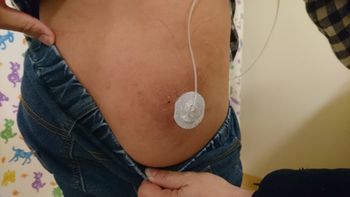
Treprostinil infusion site is at the right upper buttock.

Case presentation
A 14-year-old boy with pulmonary artery hypertension with onset at the age of five was referred to our centre for further examination and treatment. After starting oral bosentan, sildenafil, and continuous infusion of epoprostenol, his pulmonary artery pressure had been decreased dramatically. Epoprostenol was discontinued 2 years later. His pulmonary artery pressure was elevated again 1 year after stopping epoprostenol. As a result of further examination, a congenital extrahepatic porto-systemic shunt was revealed. Ligation of shunt vessels was performed at 9 years old; however, epoprostenol was resumed because his pulmonary artery pressure did not decrease despite ligation. At that time, cardiac catheterisation revealed a mean pulmonary artery pressure of 60 mmHg and the pulmonary vascular resistance index was 20.47 mmHg/L/min/m2. We selected epoprostenol infusion via a central venous line because he had only mild atopic dermatitis before the initial procedure. After a year, his epoprostenol infusion route using a central venous line frequently became infected because of atopic dermatitis. Although his oral drugs were increased and changed, attempting to reduce the dose of epoprostenol, we could not decrease the dose. We decided to withdraw central venous epoprostenol infusion and initiate subcutaneous infusion of treprostinil. We selected the lower abdominal or upper arm region as his infusion site. Although he took analgesics with maximum doses of naproxen and acetaminophen, his pain gradually worsened. He was forced to stay home from school some days after changing the infusion site because of severe pain. As the infusion rate of treprostinil increased, his pain became worse. We increased the treprostinil concentration and at the same time slowed the infusion rate. We changed the concentration of treprostinil from 2.5 to 5 mg/mL and the infusion rate from 2.2 to 1.1 mL/hours. After 6 months, however, his infusion site pain was not relieved. We consulted a palliative care specialist as to how to administer opioid. He recommended that the infusion site of treprostinil be changed to the upper buttocks, where there is more abundant fat, before adopting opioid. After changing the location, his pain markedly improved (Fig. 1). He received the same concentration and infusion rate before and after changing the infusion site. Finally, he could go to school every day, and oral analgesic drug could be reduced. His haemodynamics and symptoms have not changed compared with the time of starting treprostinil. He had no problems when sitting, but slept sideways with the puncture site up.
Discussion
Subcutaneous infusion of treprostinil is effective and one of the therapeutic options for the patients with severe pulmonary artery hypertension. Some studies report that the most common (over 90%) adverse event of treprostinil infusion is pain at the infusion site, which can lead to permanent treatment discontinuation of treprostinil in 5–23%.Reference Barst, Galie and Naeije4,Reference Lang, Gomez-Sanchez and Kneussl6 It has been reported that 12/56 children (21%) did not respond to simple analgesics, 3 patients used opioids transiently, and there were no patients who stopped treprostinil because of infusion site pain.Reference Levy, Del Cerro and Nadaud1 Pain treatments including local and systemic analgesics may be available and could be used for different intensities of infusion site pain.Reference Mathier, McDevitt and Saggar5 Although our patient took multiple analgesics (naproxen and acetaminophen) for serious site pain for about 6 months, his pain did not resolve. As far as we know, there are no reports regarding the recommendation of changing the infusion site for relieving site pain. Usually infusion sites are selected in the lower abdominal region, upper arm, femur, or around the navel. Thin children have less fat in the abdomen. Several subcutaneously injectable drugs have been traditionally administered in the buttocks, particularly in children. For the reasons mentioned above, we tried to infuse treprostinil in the upper buttocks because there is more abundant fat and fewer nerves.
In conclusion, the change of infusion site to the upper buttocks may be one effective method for reducing infusion site pain and allow continuance of subcutaneous treprostinil therapy, particularly in children.
Financial support
The authors declare no financial support associated with this manuscript.
Conflicts of interest
None.
Acknowledgements
None.