Introduction
Intejocerids are a unique group of cephalopods, previously known only from Siberia (Balashov, Reference Balashov1960, Reference Balashov1962, Reference Balashov1968) and North America (Flower, Reference Flower1964, Reference Flower1968; VanCamp Gil, Reference VanCamp Gil1988). The most conspicuous characters of intejocerids are their long septal necks and their large siphuncles, which are filled with heavy lamellar deposits and which form a coral-like radial pattern in cross section. Like other cephalopods with long septal necks and heavy endosiphuncular deposits, intejocerids were relatively large for their time, with conch diameters reaching more than 100 mm. The isolated, several-decimeters-long steinkerns of the specimens described herein occur exclusively and in relatively high abundance at a single locality in the northern Ciudad Real province where they are found as the weathered residue of the soft mudstone of the Navas de Estena Formation. The steinkerns are often superficially eroded, and parts of the phragmocone, such as septa and outer shell, are not preserved. This obstructed the correct identification of these remains as cephalopods; they were originally interpreted as remains of hexactinellid dictyospongids (Gutiérrez-Marco et al., Reference Gutiérrez-Marco, Rábano, Sá, García-Bellido, Sarmiento, Vegas, Salazar, Díaz-Martínez and Marchán2013, p. 596, fig. 4c; Reference Gutiérrez-Marco, Rábano, Sá, Baeza Chico, Sarmiento, Herranz Araújo, San José Lancha, Amengual and Asensio2015a, p. 130, fig. 20A). Here we identify and describe these fossils for the first time in detail.
Geological setting
The examined material comes from three nearby localities in the central part of the Mounts of Toledo area, central Spain. Two of them situated within the Cabañeros National Park (‘Los Medianiles’ and ‘Navaldelchorro’; see Gutiérrez-Marco et al., Reference Gutiérrez-Marco, Rábano, Sá, García-Bellido, Sarmiento, Vegas, Salazar, Díaz-Martínez and Marchán2013, Reference Gutiérrez-Marco, Rábano, Sá, Baeza Chico, Sarmiento, Herranz Araújo, San José Lancha, Amengual and Asensio2015a), and the third is immediately adjacent to same (‘Cuesta de Valderuelo’ section, see Reyes-Abril et al., Reference Reyes-Abril, Villas and Gutiérrez-Marco2010; Gutiérrez-Marco and Sá, Reference Gutiérrez-Marco and Sá2017) (Fig. 1). This area belongs to the southern part of the Central Iberian Zone of the Iberian Massif, where large outcrops of Paleozoic fossiliferous rocks have been known since the middle half of the nineteenth century, including early reports and illustrations of Middle Ordovician cephalopods from both the Portuguese (Sharpe, Reference Sharpe1849) and Spanish parts (Verneuil and Barrande, Reference Verneuil and Barrande1855).
Details of fossil localities and stratigraphy of the occurrences of Cabaneroceras aznari n. gen. n. sp., Middle Ordovician, central Spain. (1) General location of the studied area in the Iberian Peninsula (arrow). Gray area corresponds to the Neoproterozoic basement and Paleozoic rocks affected by the Variscan Orogeny (Iberian Massif). (2) Geological sketch map of a part of the central Mounts of Toledo region showing the position of the localities yielding Cabaneroceras aznari n. gen n. sp. (type locality in c). (3) Stratigraphic log of a part of the Navas de Estena Formation with the range of the new taxon.

All studied specimens come from a relatively narrow (5–45 m) stratigraphic interval of fossiliferous mudstones located at the lower third of the Navas de Estena Formation. The formation is a thick (up to 800 m) Darriwilian succession of massive dark mudstones and siltstones, partly with noduliferous horizons. The Navas de Estena Formation stratigraphically overlies the Lower Ordovician sandstone group comprising the Armorican Quartzite (Floian age) and the transitional Marjaliza beds (Floian–Dapingian ages).
From north to south, the fossiliferous localities in the Navas de Estena Formation are as follows:
Locality ‘Navaldelchorro’ is ~10,000 m to the south of Los Navalucillos (province of Toledo), east of Posturero's house on the left bank of La Calanchera stream (39°34′28″N, 4°39′13.7″W). From this locality (Fig. 1.2a) came a single limonitic siphuncle (MGM-8196O), from mudstone beds ~100 m above the base of the Navas de Estena Formation.
Locality ‘Cuesta de Valderuelo’ is located ~5,600 m southeast from Navas de Estena, province of Ciudad Real (39°27′33″N, 4°28′31″W). This locality corresponds to the bed NE-IIIA of the section (Reyes-Abril et al., Reference Reyes-Abril, Villas and Gutiérrez-Marco2010), from which some brachiopods (Reyes-Abril et al., Reference Reyes-Abril, Villas and Gutiérrez-Marco2010) and ichnofossils (Gutiérrez-Marco and Sá, Reference Gutiérrez-Marco and Sá2017) were described and illustrated. The locality (Fig. 1.2b) is ~120–135 m above the base of the Navas de Estena Formation, in the southwestern flank of the Navas de Estena syncline. A single siphuncle preserved in shale was found at Cuesta de Valderuelo (MGM-8197O).
Locality ‘Los Medianiles’ is ~8,700 m east-northeast of Horcajo de los Montes, province of Ciudad Real, in the northern bank of La Chorrera stream south of Sierra de Valdefuertes (39°21′42.2″N, 4°33′41″W). From this locality (Fig. 1.2c), we have recovered about 90 fragments of isolated steinkerns of intejocerid siphuncles. Only a few specimens of this collection occurred strictly in situ, ~80–85 m above the base of the Navas de Estena Formation. Most specimens have been collected on a labor field that gently dips south from the narrow outcropping area in the northern flank of La Chorrera syncline.
All three localities contain an assemblage of trilobites, brachiopods, mollusks, ostracods, and echinoderms, detailed by Gutiérrez-Marco et al. (Reference Gutiérrez-Marco, Rábano, Sá, García-Bellido, Sarmiento, Vegas, Salazar, Díaz-Martínez and Marchán2013, Reference Gutiérrez-Marco, Rábano, Sá, Baeza Chico, Sarmiento, Herranz Araújo, San José Lancha, Amengual and Asensio2015a) for assemblages from Cabañeros National Park (see also Reyes-Abril et al., Reference Reyes-Abril, Villas and Gutiérrez-Marco2010; Gutiérrez-Marco and Sá, Reference Gutiérrez-Marco and Sá2017) for the Cuesta de Valderuelo section. The occurrence of the graptolite Didymograptus artus Elles and Wood, Reference Elles and Wood1901 plus some trilobites and brachiopods of regional biochronological significance, indicate an early Oretanian age to the assemblage according to the Bohemo-Iberian regional scale (Gutiérrez-Marco et al., Reference Gutiérrez-Marco2015b, Reference Gutiérrez-Marco, Sá, García-Bellido and Rábano2017), equivalent to an early mid-Darriwilian age at the global chronostratigraphy (Bergström et al., Reference Bergström, Chen, Gutiérrez-Marco and Dronov2009).
Materials
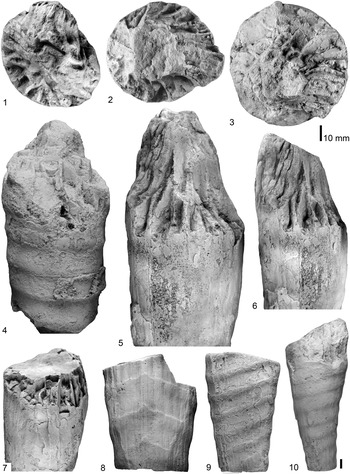
The available material consists of isolated steinkerns of siphuncles, some with impressions of septal necks as molds within the sediment. The steinkerns consist of massive limonite and limonitic mudstone. No original calcareous material is preserved. Preserved parts of septa and septal necks are silicified. Differences in texture of the limonite allow tracing of the original characters of the siphuncle. The cross sections of the specimens are often slightly diagenetically deformed, which is indicated by the similarly deformed endosiphuncular lamellae. Imprints of bryozoan epizoans occur on the silicified shelly surface of the septal necks and on the surface of the steinkern itself (Figs. 2.8, 3.2) (specimen MGM-8181O).
Siphuncular fragments of Cabaneroceras aznari n. gen. n. sp., from Navas de Estena Formation, Middle Ordovician, central Spain: (1) holotype, MGM-8183O, adapical view; (2) specimen MGM-8182O, adapical view; (3) specimen MGM-8184O, adapical view; (4) specimen MGM-8184O, dorsal view; (5) holotype, ventral view; (6) holotype, lateral view; (7) MGM-8186O, lateral view; (8) specimen MGM-8181O, ventral view, note horizontal traces of bryozoan overgrowth (see details in Fig. 3.2); (9) specimen MGM-8198O, lateral view; (10) specimen MGM-8187O, lateral view. (1–8) Upper scale bar = 10 mm; (9, 10) lower scale bar = 10 mm. All specimens were whitened with MgO before photography.

Details of siphuncular fragments of Cabaneroceras aznari n. gen. n. sp. from Navas de Estena Formation, Middle Ordovician, central Spain. (1) Longitudinal cross section of steinkern of siphuncular fragment of Cabaneroceras aznari, specimen MGM-8199O. Dark area is massive limonite and probably originally was calcareous endosiphuncular deposit. (2) Detail of traces of bryozoan epizoans on specimen MGM-8181O (marked with arrow). Specimen was whitened with MgO before photography. Scale bars = 10 mm.

Repository and institutional abbreviation
The material described herein is deposited at the Museo Geominero of Madrid (MGM), which belongs to the Instituto Geológico y Minero de España / IGME (Spanish Geological Survey).
Systematic paleontology
Order Intejocerida Balashov, Reference Balashov1960
Family Padunoceratidae Balashov, Reference Balashov1960
Genus Cabaneroceras new genus
Type species
Cabaneroceras aznari new species, by monotypy.
Diagnosis
As for the type species by monotypy.
Occurrence
Mounts of Toledo, Navas de Estena Formation, central Spain.
Etymology
The name refers to the Cabañeros National Park in Spain. All currently known specimens of this genus are from this territory or its immediate surroundings (Valderuelo section).
Remarks
The placement of the new genus within the Padunoceratidae is justified by the occurrence of branching, irregularly shaped lamellar endosiphuncular deposits and the holochoanitic septal necks. Cabaneroceras n. gen. differs from other intejocerids in having a curved conch, a relatively large angle of expansion, and relatively shallow concave siphuncular segments. The endosiphuncular lamellae of Cabaneroceras n. gen. are relatively widely spaced, similar to Evencoceras, from which they differ in forming an irregularly spaced ventral endosiphotube.
Cabaneroceras aznari new species
Figures 2–4
Camera lucida drawings of cross-section view of siphuncle steinkerns of Cabaneroceras aznari n. gen. n. sp. from Navas de Estena Formation, Middle Ordovician, central Spain. The radial structures are interpreted here either as interspaces between folded siphuncles or as endosiphoblades (sensu Flower, Reference Flower1964). All figured specimens are arranged in a position with assumed ventral side down. Note the different orientations and grades of diagenetic compression, which reflect the original position in the sediment. (1) Specimen MGM-8188O. (2) Specimen MGM-8189O. (3) Specimen MGM-8182O. (4) Holotype, specimen MGM-8183O. (5) Specimen MGM-8180O.

Holotype
MGM-8183O (Figs. 2.1, 2.5, 2.6, 4.4), Navas de Estena Formation, ~100 m above the base. Lower mid-Darriwilian, Didymograptus artus graptolite Zone, ‘Los Medianiles’ site in the northern flank of La Chorrera syncline, northeast of Horcajo de los Montes, province of Ciudad Real, central Spain.
Diagnosis
Slightly curved brevicones with marginal siphuncle. Siphuncle at concave margin of conch curvature with slightly compressed or circular cross section with angle of expansion of ~8°–12°. Ventral margin of siphuncle slightly flattened. Siphuncle diameter about three to four times the septal distance. Siphuncular segments slightly concave. Septal necks holochoanitic. Endosiphuncular deposits longitudinally subdivided into ~25 irregularly spaced radially arranged lamellae separated by narrow, folded blades as interspaces. Lamellae laterally downcurved toward the ventral side forming an endosiphuncular tube with an irregularly compressed semicircular shape in cross section at ventral side of siphuncle.
Occurrence
As for genus, by monotypy.
Description
The holotype is a fragment of a siphuncle, slightly diagenetically laterally compressed with a dorsoventral diameter of 46–73 mm, a width of 38–60 mm, and a length of 135 mm, expanding with an angle of 11.5° dorsoventrally. The siphuncle is slightly curved, with the ventral side less curved than the dorsal side. Traces of the septa and septal necks are visible on the steinkern only on the dorsal side of the holotype, indicating a slightly concave shape of the siphuncular segments and an at least holochoanitic length of the septal necks that ranges over the entire height of chamber. The former position of the septa is visible around the surface of the holotype as rounded ridges. These ridges are oblique toward the growth axis, with an angle that is ~20° from the angle perpendicular to the growth axis and slopes toward the dorsal (antisiphuncular) side of the conch. In places where the steinkern exposes the inner surface of siphuncular deposits (which is the outer surface of the siphuncle), ~25 lamellae are visible as broad bands divided by thin (<1 mm) longitudinal grooves. In cross section, these lamellae are visible, reaching into a depth of up to 20 mm of the siphuncle, where they are radially arranged and irregularly folded, leaving a central space or tube filled with massive limonite. The central tube is eccentrically positioned within the siphuncle with a ventral contact to the siphuncular wall and irregularly compressed, with semicircular cross section.
Specimen MGM-8184O (Fig. 2.4) is a part of a steinkern of a siphuncle with a maximum diameter of 71 mm; it has a slightly compressed cross section with particularly well-preserved holochoanitic septal necks; at its ventral side, it is in contact with the outer shell, which in its best-preserved parts is smooth. Details of potential ornamentation are not visible, probably due to preservation.
Etymology
The name was given in honor of Alejandro Aznar, the owner of the private property of the type locality, supporter of the 11th International Symposium on the Ordovician System, Spain, 2011, and producer of the fine Rioja wine ‘Marqués de Riscal.’
Materials
Seventeen paratype specimens (MGM-8180O–MGM-8189O, MGM-8191O–MGM-8195O, MGM-8198O, and MGM-8199O) were available for closer examination. Fourteen additional, less valuable or more incomplete specimens, were deposited in the same collection (MGM-8196O–MGM-8197O, MGM-8200O–MGM-8206O, and MGM-8225O–MGM-8230O).
Remarks
The material of Cabaneroceras aznari n. gen. n. sp. consists exclusively of fragments of siphuncles. Many of the specimens are also diagenetically slightly deformed. This fragmentary preservation constrains the diagnosis of this new species to the preserved internal characters. However, the erection of a new species and genus is justified because the known internal features are unique (see discussion of Cabaneroceras n. gen.) and unknown in this combination from any other padunoceratid cephalopod.
Discussion
Little can be said about the taphonomy and depositional history of the material. The now limonitic mineralogy of the steinkerns probably represents a primary deposition and burying under anoxic conditions with pyrite (FeS) as replacement of organic rich spaces, and later oxidation and dissolution of the calcareous deposits. Alternatively, massive pyrite may have preferentially replaced the shelly material rich in organics (e.g., nacre), while carbonate-poor inorganics may have been replaced by crystalline pyrite (personal communication, D. Evans, Reference Fang, Burrett, Li, Zhang, Zhang, Chen and Wu2019). The local presence of bryozoan epizoans, which covered parts of already broken septa and outer surfaces of the septal necks, is evidence of a relatively complex depositional history with potential secondary reworking.
The massive limonitic parts of the siphuncles are interpreted by us as originally organic rich shelly material. By contrast, the less massive, more porous limonitic spaces are interpreted as representing areas originally filled with porous calcareous endosiphuncular deposits. This results in a reconstruction of a pattern with a number of radially arranged lamellae and elongated endoconic cells or compartments that where divided by folded interspaces or endosiphoblades (sensu Flower, Reference Flower1964; see Fig. 4), a reconstruction that is consistent with siphuncular features of better-preserved material of intejocerids, specifically with Evencoceras Balashov, Reference Balashov1960 (Balashov, Reference Balashov1960, pl. 28, fig 1; VanCamp Gil, Reference VanCamp Gil1988, fig. 14.6). The siphuncles described herein differ from those of all other known intejocerids in having a wider angle of expansion and in being slightly curved, which justifies the erection of a new genus and probably would be adequate to suggest a new family if more complete material were available.
Conclusions
Our interpretation and systematic classification of the cephalopod siphuncles collected from the Navas de Estena Formation has two main consequences: (1) the known paleogeographic range of the Intejocerida now widens from being restricted to low-paleolatitude Siberia and Laurentia toward high-latitude peri-Gondwana; (2) the known morphological diversity of the Intejocerida widens significantly from originally being restricted to slender orthoconic forms to now also including slightly curved brevicones. Notably, distinct groups of curved brevicones are known also from other predominantly hemi-holochoantic higher cephalopod taxa, such as the Piloceratidae of the Bisonocerida (cf. Evans and King, Reference Evans and King2012) and Cyrtendoceratidae of the Endocerida (Teichert, Reference Teichert and Moore1964).
The intejocerids reported herein also add to the known diversity of Ordovician cephalopods from the Iberian Peninsula. Currently, this incudes members of the Ascoceridae, Ellesmerocerida, Endocerida, Orthocerida, Lituitida, and Tarphycerida (for previous compilation see Babin and Gutiérrez-Marco, Reference Babin and Gutiérrez-Marco1992; Sá and Gutiérrez-Marco, Reference Sá and Gutiérrez-Marco2009). With the exception of two tarphycerid species, most of the previously published taxa are based on poorly preserved material occurring as incomplete molds and casts in siliceous mudstones and sandstones. The absence of critical internal structures in many of these specimens does not allow for a taxonomic identification at genus or species level, and many taxa are in need of a revision. We hope that the recent reappraisals of early Paleozoic peri-Gondwanan cephalopod faunas from elsewhere (e.g., Kröger and Lefebvre, Reference Kröger and Lefebvre2012; Evans et al., Reference Evans, Ghobadi Pour and Popov2013, Reference Evans, Ghobadi Pour, Popov and Jahangir2015; Bogolepova et al., Reference Bogolepova, Kröger, Falahatgar and Javidan2014; Niko and Sone, Reference Niko and Sone2014, Reference Niko and Sone2015; Aubrechtová, Reference Aubrechtová2015; Cichowolski et al., Reference Cichowolski, Waisfeld, Vaccari and Marengo2015, Reference Cichowolski, Uriz, Alfaro and Galeano Inchausti2018; Ghavidel-Syooki et al., Reference Ghavidel-Syooki, Evans, Ghobadi Pour, Popov, Álvaro, Rakhmonov, Klishevich and Ehsani2015; Rolet and Plusquellec, Reference Rolet and Plusquellec2016; Aubrechtová and Turek, Reference Aubrechtová and Turek2018; Manda and Turek, Reference Manda and Turek2018; Ebbestad et al., Reference Ebbestad, Polechová, Kröger, Gutiérrez-Marco, Hunter, Álvaro, Lefebvre, van Roy and Zamora2019; Fang et al., Reference Fang, Burrett, Li, Zhang, Zhang, Chen and Wu2019) will stimulate future research on the Iberian cephalopods.
Acknowledgments
This research was initiated with a grant from the Spanish Autonomous Organism of National Parks (Ref. 052/2009, years 2010–2013) and is a contribution to the projects CGL2017-87631-P of the Spanish Ministry of Science, Innovation and Universities and IGCP project 653 (IUGS-UNESCO). We thank D.H. Evans (Peterborough, UK) and M. Aubrechtová (Prague, Czech Republic) for their careful and constructive reviews. JCG-M expresses his gratitude to the authorities of the Cabañeros National Park and especially the owners of the Los Medianiles locality, the family AznarOriol, for permission given for the field work and the facilities received. C. Alonso (Universidad Complutense de Madrid, Spain) photographed the specimens.