Introduction
With the post-war baby-boom generation currently reaching retirement age, the question of how people respond to withdrawal from the workforce is becoming more and more pressing (Ekerdt Reference Ekerdt2010). Retirement can be an intrusive transition in terms of day-to-day activities and wellbeing (Atchley Reference Atchley1976; Savishinsky Reference Savishinsky2000; Weiss Reference Weiss2005). But also from a societal viewpoint, it is vital to gain an insight into the way people organise their social life following retirement. When a person retires, does society only lose someone from the paid labour force, or gain a socially active and productive citizen in other domains of life? This study addresses this question by investigating how retirement affects people's civic engagement.
Providing help and support to family and friends is one form of social engagement. The effects of retirement on these activities have scarcely been investigated. Research has often been focused on only the number of contacts with close family members or friends (Bossé et al. Reference Bossé, Aldwin, Levenson, Spiro and Mroczek1993; Dorfman Reference Dorfman2002; Remnet Reference Remnet1987; Szinovacz and Davey Reference Szinovacz and Davey2001; Van Tilburg Reference Van Tilburg2003), yielding mixed results. For example, contacts with friends seem to decline, although this appears to largely be an age effect (Bossé et al. Reference Bossé, Workman-Daniels, Aldwin, Levenson and Ekerdt1990; Cornwell, Laumann and Schumm Reference Cornwell, Laumann and Schumm2008), while retirement appears to have little effect on the contacts with (adult) children (Dorfman Reference Dorfman2002; Remnet Reference Remnet1987; Szinovacz and Davey Reference Taylor and Turner2001). Few studies investigate the support given (De Jong Gierveld and Dykstra Reference De Jong Gierveld and Dykstra2008; Kahn, McGill and Bianchi Reference Kahn, McGill and Bianchi2011), and these are not focused on the transition of retirement.
Regarding other, more formal civic activities, studies are not omnipresent. It has been shown that older people are more involved in voluntary work, although these rates seem to decline above an age of around 75 (Choi Reference Choi2003; Cornwell, Laumann and Schumm Reference Cornwell, Laumann and Schumm2008; Einolf Reference Einolf2009; Gallagher Reference Gallagher1994; Hank Reference Hank2010; Morrow-Howell Reference Morrow-Howell2010; Okun and Schultz Reference Okun and Schultz2003; Strain et al. Reference Strain, Grabusic, Searle and Dunn2002; Wilson and Musick Reference Wilson and Musick1997). Much of this research, however, treats employment status merely as a control variable and is based on cross-sectional data. This provides information on differences between retirees and workers, not necessarily the transition effect (Bossé et al. Reference Bossé, Workman-Daniels, Aldwin, Levenson and Ekerdt1990; Cornwell, Laumann and Schumm Reference Cornwell, Laumann and Schumm2008; Hank and Buber Reference Hank and Buber2008; Remnet Reference Remnet1987). With such data, it has been shown that retirees are more often involved in volunteer work than workers (Chambré Reference Chambré1984; Hank Reference Hank2010; Hank and Stuck Reference Hank and Buber2008). Only a limited number of present-day studies focus on retirement as an important life transition and investigate its consequences for people's social life. Studies employing longitudinal data find considerable (Hank and Erlinghagen Reference Hank and Erlinghagen2009; Mutchler, Burr and Caro Reference Mutchler, Burr and Caro2003) and small effects of retirement on voluntary activities (Palmore, Fillenbaum and George Reference Palmore, Fillenbaum and George1984).
This study is among the first to combine these separate topics of research and offer a comprehensive, exploratory description of the effects of retirement on different aspects of civic engagement using two-wave panel data. One aspect of civic engagement that is investigated is the support given to friends and family, which is relevant for several reasons. First of all, the research field of the retiree as support provider is largely unexplored: most research is focused on contact frequency or the number of relationships a person has (Cornwell, Laumann and Schumm Reference Cornwell, Laumann and Schumm2008; Szinovacz and Davey Reference Szinovacz and Davey2001; Van Tilburg Reference Van Tilburg2003; Waite and Harrison Reference Waite and Harrison1992), or the retiree as support receiver (Bossé et al. Reference Bossé, Workman-Daniels, Aldwin, Levenson and Ekerdt1990, Reference Bossé, Aldwin, Levenson, Spiro and Mroczek1993; Van Tilburg Reference Van Tilburg1992, Reference Van Tilburg1998). Second, support is a markedly different concept than contact frequency or number of contacts. Seeing each other often or having many friends does not necessarily mean exchange of support. At the same time a relationship can be supportive without there being much contact (Barrera Reference Barrera1986; Höllinger and Haller Reference Höllinger and Haller1990). Thus, support says more about the qualitative properties of a relationship than contact frequency (Cohen and Wills Reference Cohen and Wills1985). Having high-quality relationships can give people higher self-esteem, better health and provide them with feelings of belonging by fulfilling a meaningful role for a significant other (Fiori, Antonucci and Cortina Reference Fiori, Antonucci and Cortina2006; Wellman and Wortley Reference Wellman and Wortley1990). Finally, while retirement may cause people to lose touch with former colleagues and the workforce, it may also cause them to strengthen other ties – like those with family and friends. This can increase social capital for the retiree and cohesion in society in general.
Three other forms of civic engagement are also explored in this study: volunteering, care provided to non-family and the number of organisations people are involved in. These kinds of activities can contribute to successful ageing: socially active people report higher physical and mental wellbeing and feel more purposeful (Adelmann Reference Adelmann1994; Moen, Dempster-McClain and Williams Reference Moen, Dempster-McClain and Williams1992; Rowe and Kahn Reference Rowe and Kahn1987, Reference Rowe and Kahn1997, Reference Rowe and Kahn1998). Moreover, civically engaged retirees can be seen as an important resource for society, adding to its social and economic capital (Erlinghagen and Hank Reference Erlinghagen and Hank2006; Kaskie et al. Reference Kaskie, Imhof, Cavanaugh and Culp2008; Putnam Reference Putnam1995; Sander and Putnam Reference Sander, Putnam, Wilson and Simson2006).
Overall, this study contributes to the literature in several ways. It follows Morrow-Howell (Reference Morrow-Howell2010), who pointed out in her overview of the literature that it is important to bring different social dimensions of retirement together. This exploratory perspective provides a more complete picture of the changes in peoples' social lives after retirement because it addresses both strong and weak ties. Help given to the family reveals the strong ties that older people have, whereas volunteering and organisational memberships involve mostly weaker ties. Second, this study is among the first to take the phenomenon of phased retirement into account. Most research in the field approaches retirement as a rather dichotomous situation: a person either works or is retired. This approach is too simplistic for the multifaceted phenomenon that retirement is, since the line between work and retirement has been blurring in recent times (Bonsdorff et al. Reference Bonsdorff, Shultz, Leskinen and Tansky2009; Wang et al. Reference Wang, Zhan, Liu and Shultz2008). More people gradually retire, or ‘phase’ out of employment, rather than suddenly transitioning from full-time work to full-time leisure (Ulrich and Brott Reference Ulrich and Brott2005). Finally, in this paper panel data are analysed. This offers the possibility to properly determine the transition effect of retirement. The data also include information on continuous workers, who will serve as a control group so retirees can actually be compared to those who kept working.
The data were collected in the Netherlands. Like elsewhere, labour-market policies in the Netherlands were starting to change at the time of data collection. Early exit from the labour market was gradually becoming less financially attractive and working longer was being encouraged. More recently, it was decided that the retirement age would gradually be raised to 67. The general culture, however, remains one of early exit, as a substantial number of retirees move out of the labour force – partly or fully – before the age of 65. In terms of retirement, the picture thus does not diverge much from most Western European countries (Commission of the European Union 2000; Euwals, de Mooij and van Vuuren Reference Euwals, de Mooij and van Vuuren2009; Mercer Reference Mercer2007; Organisation for Economic Co-operation and Development 2006). In terms of volunteering, the Netherlands is different in that it has relatively high rates of formal and informal volunteering (Erlinghagen and Hank Reference Erlinghagen and Hank2006; Hank and Erlinghagen Reference Hank and Erlinghagen2009). These high rates could indicate a strong norm to participate in voluntary work, which might have consequences for the analyses and results. This is discussed further in the conclusions.
Theoretical perspective
The benefits of work
Although people may not always find it apparent, (paid) work provides a number of benefits. Atchley (Reference Atchley1976) argued that besides income, and with it a minimum level of subsistence, work gives people something to do, a way to fill time. But work has several more important features. It defines people through their ties and relationships to others, and thus can secure their social status (Sieber Reference Sieber1974). Moreover, work links people to places and activities, and gives a sense of purpose to their lives through challenging, creative or meaningful experiences (Christiansen Reference Christiansen1999; Friedmann and Havighurst Reference Friedmann and Havighurst1954; Laliberte-Rudman Reference Laliberte-Rudman2002). Although it has been argued that the meaning of work has diminished because of individualisation processes (Allan Reference Allan2008; Beck Reference Beck1992), work remains an important, identity-providing pastime for people.
Retirement then, or the loss of work, would mean a loss of (weak) ties, as well as a significant reduction in all kinds of advantageous activities related to work. One might expect this to have negative consequences for the wellbeing of retirees. Research, however, has shown that retirees deal with their new circumstances quite well. Although occasional studies have found negative effects of retirement (Kim and Moen Reference Kim and Moen2002; Richardson and Kilty Reference Richardson and Kilty1991), in general no evident negative effects of retirement on life satisfaction or psychological wellbeing have been attested (Gall, Evans and Howard Reference Gall, Evans and Howard1997; Pinquart and Schindler Reference Pinquart and Schindler2007; van Solinge and Henkens Reference Van Solinge and Henkens2008; Wang Reference Wang2007; Wang, Henkens and van Solinge Reference Wang, Henkens and van Solinge2011). Continuity theory proposed that this is because people strive for continuity, to maintain internal and external structures. They attempt to create coherence and consistency in patterns over time (Atchley Reference Atchley1971, Reference Atchley1989; Bonsdorff et al. Reference Bonsdorff, Shultz, Leskinen and Tansky2009). This does not mean that people will try to keep everything as it was, because with ageing, change is inevitable. They will, however, adapt in such a way that even though the context may change, underlying structures remain. As discussed above, regarding work and retirement continuity theory states that retirees will somehow substitute for their lost interaction with colleagues and meaningful activities.
Informal voluntary activities, such as being a helpful or supportive parent, child or friend, are examples of informal ties and activities that can offer continuity. First of all, they tie people to significant others, providing friendship, social status and interaction (Dykstra Reference Dykstra1990). Second, they can serve as a pastime that provides people with a sense of significance, or ‘mattering’ (Rosenberg and McCullough Reference Rosenberg and McCullough1981; Taylor and Turner Reference Taylor and Turner2001). Helping in and around the house with chores like cooking, cleaning and small repairs are examples of supportive activities that can provide such a sense of meaning and importance. Also, parents can take on the role of grandparent and help out with childrearing (Hayslip and Kaminski Reference Hayslip and Kaminski2005; Kaptijn et al. Reference Kaptijn, Thomese, Van Tilburg and Liefbroer2010; Pebley and Rudkin Reference Pebley and Rudkin1999). In this respect, such activities relate to ‘doing well by doing good’: social helpfulness with health benefits for the benefactor (Bengtson Reference Bengtson2001; Piliavin Reference Piliavin, Keyes and Haidt2003, Reference Piliavin and Omoto2005; Silverstein and Bengtson Reference Silverstein and Bengtson1994). In short, following retirement relationships with former colleagues are largely diminished, as well as work-related activities that provide a sense of significance. To create some continuity in these spheres, it is expected that retirees expand their support-giving activities with children, parents and friends (Hypothesis 1, H1).
A parallel expectation is formulated for informal help and care provided to ill or disabled people with whom the retiree has weaker ties, like non-family neighbours and acquaintances. Although these types of relationships are more remote, supplying voluntary care and help can give a sense of relevance to a person's life. For this reason it is expected that retirees increase the number of times they care for ill or disabled neighbours and acquaintances (Hypothesis 2, H2).
The above relates to rather informal types of civic engagement, but there are more formal sorts of community involvement, like being a member of certain organisations. Although such memberships are not necessarily productive, they offer contacts with other people, and can involve a wide range of activities. As such, these memberships stimulate social integration, provide raisons d’être for the retiree, increase social cohesion in society, and thus can partly substitute work. Even more so, performing voluntary work for organisations can be interpreted as a good substitution of a paid job. Besides providing retirees with a way to fill their newly gained free time, these activities give people something to do (Swartz Reference Swartz1978), they provide them with a sense of purpose and importance (Ekerdt Reference Ekerdt1986; Morrow-Howell Reference Morrow-Howell2010; Piliavin Reference Piliavin, Keyes and Haidt2003, Reference Piliavin and Omoto2005), and increase their social contacts and status (Kaskie et al. Reference Kaskie, Imhof, Cavanaugh and Culp2008; Wilson Reference Wilson2000). Moreover, depending on the type of work people did, there may also be considerable overlap in the kind of activities people do for voluntary organisations and the work activities they previously engaged in. In this sense, these civic activities can be substitutes for the job that is lost, providing continuity in terms of meaningful activities and contacts with others. The expectations are therefore that following retirement, people will become affiliated with more organisations (Hypothesis 3, H3) and be more inclined to perform (formal) voluntary work (Hypothesis 4, H4).
The strength of ties
At the retirement age, relationships with parents, children and friends are often well established and have crystallised into a certain form: there is a particular amount of contact and support (Kahn and Antonucci Reference Kahn, Antonucci, Baltes and Brim1980). More importantly, one is constrained by the time, opportunities and needs of the other party: a relationship is reciprocal, a two-way street (Gouldner Reference Gouldner1960). The other person may have a well-occupied life and not have the possibility or the need to intensify the relation with the retired person. Hence, there may be relatively small effects of retirement on relationships unless people experience the retirement transition simultaneously (e.g. partners). Apart from this, work is an example of an activity that provides people with different ties compared to relations with family and close friends. Such ties are often strong, and the network is usually tightly knit, meaning that most contact is directed within the group. The workplace is a source of weak ties (Podolny and Baron Reference Podolny and Baron1997), which are valuable because they form a bridge to other networks and open doors to information and resources not present in a person's core social circle (Granovetter Reference Granovetter1973, Reference Granovetter1983). Research has shown that these ties with former co-workers are often lost. In order to have continuity – namely weak ties – in retirement, people may prefer activities that provide such ties. Thus, it can be expected that retirees are more inclined to increase their volunteering and number of memberships – activities that provide weak ties – than their support given to family and close friends (Hypothesis 5, H5).
Differences between full- and part-time retirement
In current times, a substantial number of people retire in phases. This can take on several forms: they start working less in the approach to retirement, or take on a new (part-time) job after retirement (Shultz Reference Shultz, Adams and Beehr2003; Zhan et al. Reference Zhan, Wang, Liu and Shultz2009). With this trend in mind, the question is when is someone really retired, and, subsequently, whether people substitute their work even when they are not fully retired. In part-time retirement there is additional free time, so people can be expected to seek activities that serve as a pastime. However, even though someone may spend less time at work, there are still responsibilities, activities and ties with co-workers that come with the job. In this sense, the worker role is not lost, and there is no strong need or inclination for substitution. For these reasons, it is expected that part-time retirees will be less inclined to expand non-work civic engagement compared to full-time retirees (Hypothesis 6, H6).
Methods
Data and sample
The data for this study stem from the Netherlands Kinship Panel Study (Dykstra et al. Reference Dykstra, Kalmijn, Knijn, Komter, Liefbroer and Mulder2004, Reference Dykstra, Kalmijn, Knijn, Komter, Liefbroer and Mulder2007). This is a large-scale panel survey focused on family ties, representative for adults aged 18–79 in the Netherlands. The overall response rate was 45 per cent, which is equivalent to analogous surveys in the Netherlands (De Leeuw and De Heer Reference De Leeuw, De Heer, Groves, Dillman, Eltinge and Little2001). A total of 8,155 people completed the survey for wave 1, of which 6,080 people participated in wave 2, leading to a total attrition rate of about 25 per cent. Data were collected by conducting computer-assisted personal interviews and self-completion questionnaires, with waves in 2002–2004 and 2006–2007. The average interval was about 3.5 years.
The sample has been restricted to people aged 50–65 at wave 1. The minimum was set at 50 since in the Netherlands, the mean retirement age at the time of the surveys was around 60 (Siermann and Dirven Reference Siermann and Dirven2005), with many retiring earlier. A person aged 50 at wave 1 was around 54 at wave 2, so at this point in life, retirement is generally close. The upper limit is 65 since this is the mandatory retirement age at which a person is eligible for a public pension. Of the 1,727 people in the age range, 806 were removed from the sample because they reported to not be working at wave 1. The main reasons for this were that they were disabled (20%), already retired (31%), a housewife (40%) or unemployed (5%). The large proportion of housewives reflects the low labour participation of women in older cohorts in the Netherlands (Langenberg Reference Langenberg2004). Of the 921 people left, some had small part-time jobs, as is quite common in the Netherlands (Langenberg Reference Langenberg2004). A total of 214 people (23%) worked less than 24 hours a week in the first wave. When working such a number of hours, the job might not be the primary activity. On average for example, this group of people worked 14.5 hours a week, or less than two days a week. This means that by far the majority of a person's time is not spent in paid work. In this case a person does not have a ‘normal’ job, but rather a small part-time occupation, and it is unwieldy to determine part-time retirement since people already work so few hours. Overall, when working such a limited number of hours, retirement may not be an important transition, or the loss of an important enough activity, so these people were not included in the sample.
Part of the survey was a self-completion questionnaire. Unfortunately, not all respondents filled this in completely, leading to some missing values (N = 53; 7%). Because multiple dependent variables are investigated, the total number of respondents available for analyses varies per analysis. This is the case because some outcomes apply only to certain subgroups (e.g. people who have living children). For all these reasons the total number of respondents per analysis as well as the number of transitions is given in the tables showing the results.
Dependent variables
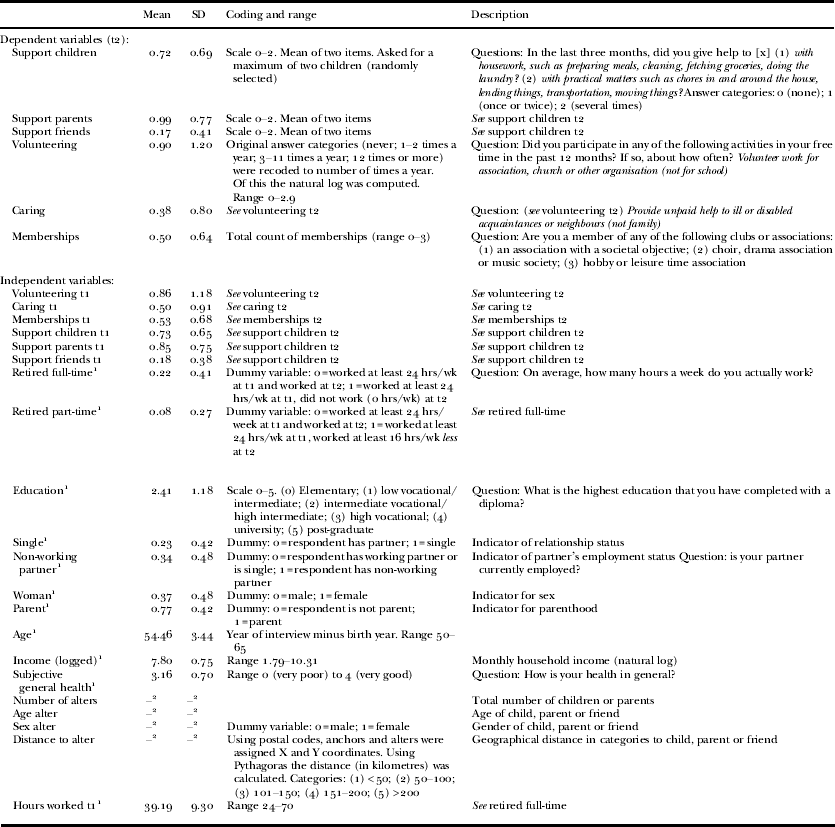
For support given to family and friends, see Table 1 for the exact coding of variables and wording of questions, as well as descriptive statistics. This operationalisation of instrumental support has been used in earlier research (Kalmijn Reference Kalmijn2007; Knijn and Liefbroer Reference Knijn, Liefbroer, Dykstra, Kalmijn, Knijn, Komter, Liefbroef and Mulder2006; Mandemakers and Dykstra Reference Mandemakers and Dykstra2008). People were asked to answer support questions for two children. If they had only one child, this child was the only child selected. If they had three or more children, two were randomly selected. The same questions were answered for the parents (if still alive). With regard to friends, respondents were asked to give the names of no more than five of their closest friends. One of these was randomly selected for more detailed questions. For the second wave, identical questions were asked about the same family members and friend. In the end, there are three dependent variables for support: to children, parents and friends. A glance at the descriptive statistics in Table 1 shows that people tend to give most support to their parents (0.99), a little less to their children (0.72) and least to friends (0.17).
Means, standard deviations (SD), coding of items and descriptions of all variables

Notes: 1. Descriptive statistics calculated for base sample (N = 654). Statistics can vary somewhat per analytic sample, conditional upon dependent variable. 2. We analyse relationships with children, parents and friends, and use four characteristics of these alters: age, sex, distance and number. This means that there are 3 × 4=12 (minus 1 because the N of friends is undeterminable in our data) variables for the alters. To keep the descriptive table clear and concise we have chosen not to include descriptive statistics for all these different variables. They are available on request. t1: time 1. t2: time 2. hrs/wk: hours per week.
Source: Netherlands Kinship Panel Study (authors' calculations).
Table 1 provides all relevant information for all the other variables as well. There is a measure for the number of times spent per year on organised volunteering (volunteering) and one for informal help given to neighbours and acquaintances (caring). Although distinct concepts, both relate to voluntary, unpaid social work. Note that these variables do not measure the amount of time spent on volunteering, but the number of times that someone volunteered. Although these are likely to be related, they are not the same. Further, a variable was created denoting the total number of memberships of the following organisations: an association with a societal objective; choir, drama association or music society; hobby or leisure time association. This variable (memberships) can also be seen as an indicator of how (socially) active people are.
Looking at these variables in Table 1, it becomes clear that (formal) volunteering is more prevalent than providing unpaid help to ill or disabled non-family, which is a more informal kind of volunteering. Moreover, the group of volunteers is larger (53%, not in table) than the group of informal care-givers (30%). For organisational memberships, on average people report being a member of 0.5 of the three types of organisations used to create the scale.
Predictor variables
For retirement, use has been made of variables indicating the average number of hours a respondent works per week in a paid job, which is an effective way to measure retirement (Denton and Spencer Reference Denton and Spencer2009). Two variables for retirement have been used in the analyses: full-time retirement and part-time retirement. To define retirement, the number of (paid) work hours is considered at both wave 1 and 2. Full-time retirement is defined as not working at wave 2. Thus, a full-time retiree is someone who worked at least 24 hours a week at wave 1, and zero hours at wave 2. The average number of working hours at wave 1 for this group is 38.1. To be considered part-time retired, a respondent must indicate working at least 24 hours a week at wave 1 (the same as for full-time retirement) and indicate a reduction in the number of working hours by at least 16 at wave 2. For example, someone who works 32 hours at wave 1 and 10 hours at wave 2 is considered a part-time retiree. On average, these people reported working 45 hours a week at wave 1, and 21 hours at wave 2. People who reduce their working hours by less than 16 a week are considered continuously employed. For both full- and part-time retirement, the reference category is the group of people who kept working. This group reported working 38.8 hours at wave 1 and 37.2 hours at wave 2. In total, 21.9 per cent of the respondents retired full-time (N = 143), while 8.1 per cent retired part-time (N = 53). Descriptions and coding properties for other predictor variables can be found in Table 1.
Method
Since two waves of data are available, the design is quasi-experimental. There are basically three groups: a ‘control’ group (those who kept working) and two ‘treatment’ groups (full- and part-time retirees). To analyse the difference between these groups, ordinary least squares (OLS) regression is employed with the lagged dependent variable included as a predictor variable. In other words: the value of the dependent at wave 1 (Y1) is included as a predictor in the model in order to hold constant for prior levels of the dependent (Y2) (Allison Reference Allison1990, Reference Allison1994). This is done since it is possible that the initial levels of support, contacts and activities of those retiring were different from those remaining in the workforce (Johnson Reference Johnson2005). This is controlled for on account of Y1 being a predictor variable, creating a so-called conditional change model. This model is mathematically equivalent to using the change score as a dependent variable and controlling for the initial score to take into account bottom and ceiling effects (Allison Reference Allison1990).
Analyses for support given to children and parents have been performed on a dyadic level, meaning that the unit of analysis is not the respondent but rather the relationship. Thus a respondent can be included in the analyses several times, once for every relationship. Since these observations are related there is essentially a nested structure: the individual within the family. Standard OLS regression can then lead to an underestimation of standard errors, because the assumption of independent errors is violated (Moulton Reference Moulton1986). To tackle this issue, the cluster option in Stata is used. This adjusts for clustered errors by making no assumptions about the within-group correlation, allowing it to vary without restrictions (Nichols and Schaffer Reference Nichols and Schaffer2007).
Results
Provided support
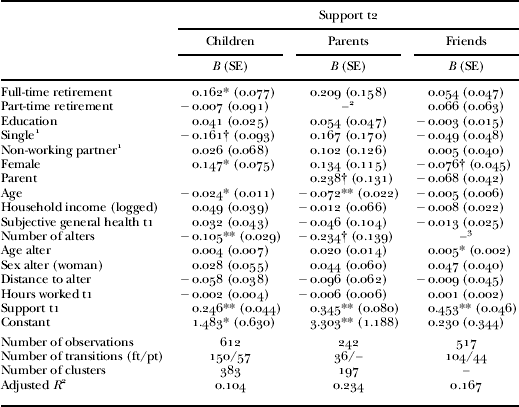
The results of analyses regarding strong-tie support are shown in Table 2. Looking at the first column, full-time retirement appears to have a positive effect on the support provided to children (B = 0.162; p < 0.05). This provides support for the idea that retirees – at least those who stop working altogether – start helping their children more with chores in and around the house. In terms of Cohen's d, the effect size is 0.23 (B full-time retirement/SDsupport children = 0.162/0.69, where SD is standard deviation), which is modest. Regarding support given to parents (column 2), the effect of full-time retirement is positive and substantial (B = 0.209), but does not achieve statistical significance.
Regression (ordinary least squares) of support given to children, parents and friends on full- and part-time retirement and other independent variables
Notes: 1. Reference group: working partner. 2. Transitions into part-time retirement too low for useful analysis. 3. Total N could not be determined in the Netherlands Kinship Panel Study. SE: standard error, corrected for clusters with children and parents. t1: time 1. t2: time 2. ft: full-time. pt: part-time.
Source: Netherlands Kinship Panel Study (authors' calculations).
Significance levels: † p < 0.10, * p < 0.05, ** p < 0.01.
People do not seem to start providing friends with more support when they retire (column 3). However, adding the interaction of retirement and whether the friend is known from work (not shown in table) reveals a positive and significant effect for non-work friends (B = 0.093; p < 0.1) and a negative effect for friends who are known from work (B = 0.093 − 0.158 = −0.07; p < 0.1). This is in line with earlier research showing that relationships with former colleagues are often discontinued after retirement.
The coefficients for part-time retirement in Table 2 do not achieve statistical significance. This seems to demonstrate that part-time retirees do not alter their relationships with family and friends. Perhaps this is due to the low number of transitions into part-time retirement, but the magnitude of the coefficients is also quite small.
Overall, there is some confirmation for the hypothesis that retirees expand their support activities (H1). The results are not unequivocal though: the effect for support given to parents is not significant, and for support given to (non-work) friends only significant at the p < 0.10 level. Finally, part-time retirement seems to have no effect on the investigated relationships. This suggests that even though more time is available in part-time retirement, people do not increase support-giving, which is in line with the hypothesis (H5).
Weak ties: volunteering, caring and organisational memberships
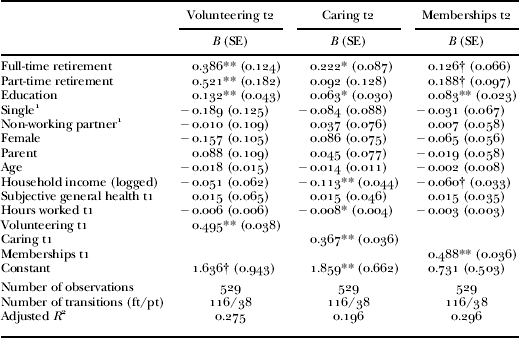
The results of regressions with the weak-tie variables are shown in Table 3. The first column reveals that full-time retirement has a significant effect on the number of times people volunteer (B = 0.386; p < 0.01). Compared to continuous workers, full-time retirees significantly increase their involvement in voluntary activities. This seems to be a substantial effect: in terms of Cohen's d for effect size it is 0.32 (B full-time retirement/SDvolunteering t2 = 0.39/1.20, where t2 is time 2). Auxiliary analyses showed that of the group of retirees, 42 per cent reported doing any amount of volunteering prior to retirement. This percentage rose to 53 per cent after they had retired, an increase of 26 per cent in the number of volunteers. The odds ratio for volunteering before and after retirement is then (0.42/0.58)/(0.53/0.47) = 1.57. Moreover, the group of ‘busiest’ volunteers (12 times or more a year) grew the most: from 20 per cent before retirement to 26 per cent after.
In column 2, the results are presented regarding the number of times care was provided to non-kin. Here as well, there is a significant positive effect of full-time retirement (B = 0.222; p < 0.05). People seem to increase the number of times giving unpaid help to ill or disabled acquaintances or neighbours after (full-time) retirement. Around 34 per cent of the people reported providing such help after retirement, while this was 27 per cent prior to retirement. The effect size is 0.222/0.80 = 0.28.
The third column shows the results for involvement in organisations. It demonstrates that retirement increases the likelihood of being a member of the specified kinds of organisations. The coefficient for full-time retirement suggests that those who retire increase their number of memberships (B = 0.126; p < 0.06). A significant number of new retirees thus appear to join either a club with a societal objective; a choir, drama or music society; or a hobby or leisure association. Also when taking into account the mean number of memberships that people are involved in (around 0.5 at both waves 1 and 2), the magnitude of this effect is evident. The effect size is B full-time retirement/SDmemberships t2 = 0.126/0.64 = 0.20.
Regression (ordinary least squares) of volunteering, caring and number of memberships on full- and part-time retirement and other independent variables
Notes: 1. Reference group: working partner. SE: standard error. t1: time 1. t2: time 2. ft: full-time. pt: part-time.
Source: Netherlands Kinship Panel Study (authors' calculations).
Significance levels: † p < 0.10, * p < 0.05, ** p < 0.01.
Effects of part-time retirement were also tested. Part-time retirement significantly affects both volunteering (B = 0.521; p < 0.01) and the number of memberships (B = 0.188; p < 0.06), but not caring. It appears that part-time retirees also (partly) expand their activities that feature weak ties, which is a contrasting result compared to strong-tie activities (Table 2) and contradictory to the hypothesis (H5). Part-time retirees appear to replace their partially lost work activities with other activities that provide weak ties instead of changing their relationships with family and friends. Finally, only education has a consequent positive effect on the change in the dependent variables. Other variables do not appear to have a consistent influence.
Conclusions
Retirement causes key changes in people's activities. The general picture is that retirees create some continuity for themselves by expanding activities that are beneficial for themselves and for society at large by strengthening ties and increasing social capital. The present study showed that retirees start giving more instrumental support to family and friends. This finding is novel and fits well with continuity theory: valuable interaction and activity related to the job appears to be replaced with other meaningful activities. In this sense, retired parents can be a valuable asset for their offspring. Their children are likely to be in the ‘rush hour’ of their lives, with a time-demanding career and family. Parents providing instrumental support can then be of immeasurable worth, for instance in the form of grandparenting (Hayslip and Kaminski Reference Hayslip and Kaminski2005; Kaptijn et al. Reference Kaptijn, Thomese, Van Tilburg and Liefbroer2010; Pebley and Rudkin Reference Pebley and Rudkin1999). This ‘instrumentalisation’ of the relationship can perhaps also lead to stronger ties, and better relationships. For friends, it matters greatly whether they are known from work or not. Relationships with former colleagues seem to suffer from retirement in terms of support.
Perhaps most notably, this study found that retirees tend to expand other civic activities that supply mainly weak ties such as volunteering, caring for non-family and organisational involvement. At least partly, retirees invest in ‘productive’ leisure activities. They become more socially involved after retirement and, as such, they can be viewed as a valuable resource for society. It must be noted that these results stem from Dutch data. Volunteering among older age groups is relatively high and still rising in the Netherlands (Erlinghagen and Hank Reference Erlinghagen and Hank2006; Hank and Erlinghagen Reference Hank and Erlinghagen2009; Suanet, Broese van Groenou and Braam Reference Suanet, Broese van Groenou and Braam2009), and the general definition of volunteering differs across countries and people (International Labour Organization 2011). The results produced by this study may thus be country specific, since conceivably the norm to volunteer for Dutch retirees is quite strong. Perhaps specifically in the Netherlands, retirees are socialised to think of volunteering as ‘the normal thing to do’, which could mean that similar effects of retirement will not be found in other countries. Finally, partial evidence was offered for the idea that activities providing weak ties are preferred as substitution for paid work: effects of retirement on such activities (volunteering, caring, organisational involvement) seemed more clear-cut than the effects on support giving. Some trepidation is required with this interpretation, however, since it was not tested formally.
The hypothesis that part-time retirees would be less or not at all inclined to substitute work was only partially confirmed. Part-time retirement did seem to increase involvement in some activities, like volunteering and the number of memberships. A possible reason for this finding could be that people actively anticipate their retirement. They replace their work role consciously in order to reduce the shock of retirement by spending less time at work and getting used to other activities (van Solinge and Henkens Reference Van Solinge and Henkens2008). In other words, part-time retirement and increased activity in other spheres could be preparation for full-time retirement. This is in line with results from earlier research dealing with pre-retirement processes (Ekerdt and DeViney Reference Ekerdt and DeViney1993), and the finding that volunteering prior to retirement can be beneficial for retirement adjustment (van Solinge and Henkens Reference Van Solinge and Henkens2008). It does raise a causality issue: people may (partially) retire because they want to start volunteering or become more socially active. If so, an interesting question would be to what extent people consciously phase out of employment and into other activities.
Apart from the results, this study has several noteworthy strengths. The use of panel data made it possible to adequately determine the effect of retirement, and the exploratory approach covered a broad range of variables. This resulted in a solid and comprehensive approach that has not been utilised before. To a certain extent, finally, it approached retirement as a complex process by differentiating between full- and part-time retirement.
This research was not without limitations, however. It is imperative to note that only a limited number of transitions into retirement were available for analyses. For this reason, the study was less suited for differentiating between retirees because it can be difficult to achieve statistical significance. Future research can investigate, for example, if the education of the retiree or the type of job that a person retires from matters for retirement outcomes. Other data limitations include the inability to differentiate between innovation and intensification: do people take up new activities, or do they expand existing ones? Moreover, measurements were sometimes crude. It was not possible to clearly distinguish between different types of volunteering and to determine the exact amount of time that was spent on certain activities. This relates to another issue: although this study found that retirees increase their civic engagement, the effects most likely cannot account for the total increase in leisure time after retirement. How do people fill the remainder of their newly gained leisure time? Perhaps they pursue other activities not incorporated in this study (e.g. vacation, watching television), but it can also be suggested that everyday life after retirement takes on a slower pace, or shifts into a lower gear. People may take more time for the same tasks after retirement. This idea of ‘taking it easy’ can form an interesting topic of future research.
Despite its limitations, this study has shed light on effects of retirement on civic activities. Although continuity theory appears to be a useful tool in investigating this subject, future research can include measurements of wellbeing and life satisfaction to investigate more directly whether people indeed employ substitution to maintain their wellbeing. This study has shown that people increase their activities in different spheres following retirement, and in doing so they benefit society at large.
Acknowledgements
This paper uses data from the Netherlands Kinship Panel Study. The Netherlands Kinship Panel Study is funded by grant 480-10-009 from the Major Investments Fund of the Netherlands Organization for Scientific Research (NWO), and by the Netherlands Interdisciplinary Demographic Institute (NIDI), Utrecht University, the University of Amsterdam and Tilburg University. These institutions played no role in the analysis and interpretation of the data.