“It is a kind of BDSM,” said Ainhoa.
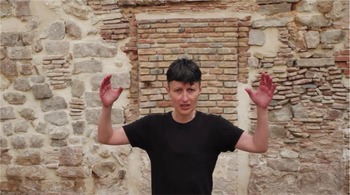
Barcelona, Spain, 14 June 2013. We were all watching the final cut of our video-dance piece (Parèntesi). Ainhoa Irueta raised both arms, bent at the elbows, to the level of their shoulders/head, then placed their hands at each side of the head, open palms facing each other, moving up and down, with their fingertips drawing the lines of an imaginary parenthesis. “The waiting has both, a painful side—of, look what I had to live through—as well as a kind of pleasure side—in, damn! I can be somewhere else I’ve never been before. BDSM practices also have this kind of liminal quality, you know?” (Irueta Reference Irueta2013)
oncogrrrls is a research-creation project that I launched in 2011, in which women and gender dissidents Footnote 1 who care about cancer relations make performance pieces together. Individuals with diverse cancer experiences (some are diagnosed and others not) join each residency. Footnote 2 I call these residencies on_co-creations. For us, they are experiments towards joint modes of refusing the “split,” the parentheses:
When you are diagnosed with breast cancer, doctors tell you: take it as a parenthesis to your life. As if we could stop life. A parenthesis, an imposed and false corset. How can one stop inner demons, love, the readings made on us from outside, nonsense memories, fear, the blood and cellular movement, futile projections, enriching reflections, the anxiety of waiting, vulnerability, our own body transformations, and the somatopolitical fictions that pierce and aim to bind us? (oncogrrrls 2013)
The “split” refers to the different kinds of biomedical and cultural practices that, in oncological experiences (as with many other serious and chronic illnesses), aim to place a life in suspension, waiting for a cure, and creating the “sick role” (Lobel Reference Lobel2019). This dividing technique aligns with medical/individual models of disability (Kafer Reference Kafer2013) and enacts many kinds of alienating cancer relations (Ehrenreich Reference Ehrenreich2010; Jain Reference Jain2007, Reference Jain2013; Shildrick Reference Shildrick2009; Spanier Reference Spanier, Mayberry and Banu Subramaniam2001; Sulik [Reference Sulik2010] 2012).
In the oncogrrrls’ 2013 Barcelona creative residency, eight individuals investigated through rehearsals—physical explorations, dance improvisation scores, and conversations emerging from a critical analysis of our discomforts—the question: What are we waiting for? Footnote 3 The question emerged in April 2013 during a potluck brunch at my place, one in which we set up the expectations, limits, and working agreements for the process. We introduced each other, shared our cancer experiences, and established the tone of our process: an activist project aiming to critically examine the many implications of waiting while refusing the attentional split between living and being “sick.”
Ainhoa identified the true liminality imposed on diagnosed women: staying in a “sick role,” putting aside pleasure until they get better. When in treatment, Ainhoa was both individualized and isolated by this imperative, yet they still felt pleasure, sexuality, and power. They invoked BDSM, which names the relational game of negotiating pleasure, power, and sociality; and reversed the jarring nature of being looked after by looking out and at others, full of desire as well as illness.
We met for five weeks, two days per week, and made a video-dance piece, which we entered in the competition for the MiTs (Moviment i Transformació Social, Movement and Social Transformation) award in Barcelona. In June 2013, the piece was honored with the first MiTs award. Through oncogrrrls we used rehearsals as a space to find and maintain agency, to identify and refuse the mechanisms that create the parenthetical split, and to reoccupy our bodyminds. Footnote 4
Ainhoa Irueta Isusi, in (Parèntesi) by oncogrrrls. Plaça del 8 de març, Barcelona, June 2013. (Screenshot by Carlota Grau and Paitu; courtesy of oncogrrrls)

A few weeks after my own diagnosis, I invited a friend to join me on a research-creation project. Marissa Paituví, an anthropologist interested in arts-based research with women diagnosed with breast cancer, recalls: “the moment when you told me to do something about it and to do it together opened a new world to me… This way of positioning in relation to the disease, transforming it from the individual to the collective was groundbreaking” (2019). Angry at the many suspensions and seclusions, I craved shared projects. Coming from problem-posing epistemologies, dance and movement studio practice, training in community dance, and social justice work, I was interested in joint modes of production, or cocreation, that were oriented toward social change commitment. Footnote 5 I envisioned oncogrrrls as a research-creation project, Footnote 6 grounded on dance and somatic practices, as a kind of on_co-creation experiment. By this, I mean an experiment in cocreating (creating performance pieces within a group) as well as an experiment in creating onco-relations (creating oncological practices and relations refusing the split, and imbricating living while tending to our health). At the time, I was also on medical leave from my doctoral program at UC Davis, where I had just been accepted with a research proposal on a practice-based inquiry with teenagers on gender violence. Curious about praxis for socially engaged performance, oncogrrrls became my unforeseen practice-as-research doctoral project. oncogrrrls emerged, therefore, as a platform to make a new “onco-world” as well as a research project on methodologies for creating performance for social change, and an inquiry into performance as cancer activism.
After two years of trying to gather participants for a two-month long creative laboratory, the first creative residency became possible when I met and invited the members of the Barcelona-based transfeminist activist group marimachos cancerosas (cancerous butches). Footnote 7 At that time, I also was training in contemporary dance; three dancers from the class joined. Footnote 8
What Are We Waiting For?
In May 2013, oncogrrrls materialized as a creative performance laboratory asking, What are we waiting for? At our first meeting we noted different kinds of waiting:
Waiting room at the hospital; being aware of death; changes in the pace of life; waiting for results; hoping for good news. The waiting, time placed “on hold,” “lost” times and forced rhythms that are crossed by many emotions: pain, fear, vulnerability, dependency, rage […] Footnote 9
This inquiry into waiting was related not only to time and rhythms but also to physical and cultural spaces of containment: the places where we waited, especially the waiting rooms, and the limitations and barriers set to hold us in the biomedical sphere, a set of relations that suspended life, creating a kind of “suspended waiting.” These relations conjure what Maren Klawiter calls a “disease regime” (2004), a life-versus-health status split enacting specific biomedical and cultural cancer relations that individualize cancer and split a “normal” life from a “sick” one. Many friends, feminist scholars, and activists are critiquing the set of relationalities that held us back from living a full life, epitomized by the words of my gynecologist at the time (and pervasive in cancer media Footnote 10 ): “place your life in parentheses and only care about your health.” They are speaking out against the ways in which we were expected to perform while “on cancer,” and the kinds of surgeries, makeup, or wig that would pretend us back to normal. Footnote 11
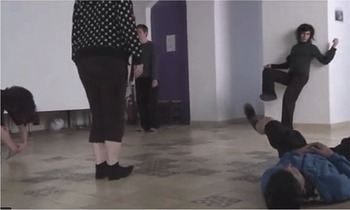
Rehearsal documentation. From left: Paitu, Julia Ojuel Solsona, Carol Vallverdú, Ona Malleu, and Ainhoa Irueta Isusi in (Parèntesi) by oncogrrrls. Casa de la Dona, May 2013. (Screenshot courtesy of oncogrrrls)

And yet waiting—espera in Catalan and Spanish—leads into the semantic field of dreams and uncertainties: the subjunctive tense, the verb form that signals possibilities and socialities, visionary futures and wishes dealing with life and death and with how we are hoping to live and to die.
“What are we waiting for?” invoked an inquiry about the structures that restrained us as well as a cry to ignite movement together: an activation of the intensities of hope as a field of potentials, Footnote 12 the emotional field of hoping, so flattened by commercialized hope, like the “run for the cure” spectacles; a refusal of the biomedical and cultural limitations imposed on cancer and chronic or serious illnesses, and a call to take back our “fixed/immobilized” lives; a realization that we did not need anyone’s permission, or that we were always already moving, despite sociocultural norms of suspension; a call to transform the suspended waiting into an engaged waiting.
While cancer is recognized under the umbrella of disability, Footnote 13 in terms of activism and mobilization, cancer and chronic illnesses are still mostly confined to the medical/individual model of disability, where it “continues to be seen primarily as a personal problem afflicting individual people, a problem best solved through strength of character and resolve” (Kafer Reference Kafer2013). As Brian Lobel reminds us in Theatre and Cancer (2019), cancer performances are (for the most part) about individual experiences, autobiographical solos. Only a few performances extend beyond the sick person (for example, Exposed: Experiments in Love, Sex, Death and Art by Annie Sprinkle and Elizabeth Stephens [2007]). Activism and performance rarely go beyond raising awareness or fundraising, suggesting the stronghold of the medical model. Alternatively, in the collective processes of performance-making it is in rehearsals where social disruption and social bond coexist, and where new futures emerge (see Bishop Reference Bishop2012; Jackson Reference Jackson2011; Matarasso Reference Matarasso2019). Footnote 14
In Spanish, the word for rehearsal is ensayo. This word is used also in medicine, ensayo clinico (clinical test), and in epistemology, ensayo y error (trial and error). Ensayo is a way of finding out and a process of inquiry. My rehearsals, my ensayos, constitute a “liquid space of openness and plasticity” (Bueso Reference Bueso, Buchmann, Lafer and Ruhm2016:114).
My deep questions for oncogrrrls were and are: How can rehearsals engage cancer relations and refuse the split? How might rehearsals answer the question “What are we waiting for?” How do we change from practices of individualization to practices of togethering and collective structural change? How can we merge critical inquiry and interpersonal relations?
Rehearsing the Parenthesis
The group included Ainhoa, Bárbara, Carlota, Carol, Júlia, Marissa, Ona, and me. Footnote 15 At the beginning, each of us took on particular production, facilitation, and support/care roles. But as we moved into the process, these roles fluctuated. Marissa was the liaison with the MiTs competition organizers and Júlia with the rehearsal site; Ona and I created the scores; Bárbara supported the facilitation; Ona and Marissa did the camera work; and Ainhoa and Júlia made sure we remained activists by keeping our conversations engaged with structural issues. At the beginning, only those diagnosed with cancer offered their lived-experience perspective but these conversations widened as we moved into the process. Using input from everyone, I guided the creative process.
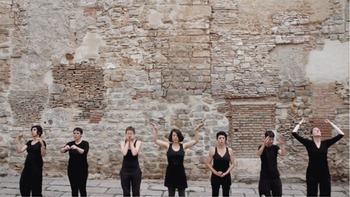
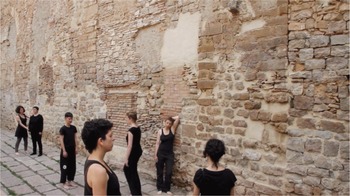
From left: Ona Malleu, Júlia Ojuel Solsona, Carol Vallverdú, Paitu, Caro Novella Centellas, Ainhoa Irueta Isusi, and Bárbara Wiltschek in (Parèntesi) by oncogrrrls. Plaça del 8 de març, Barcelona, June 2013. (Screenshot by Carlota Grau and Paitu; courtesy of oncogrrrls)

We met at Ca la Dona (Woman House), a building in Barcelona’s Gothic Quarter near la Plaça del 8 de març, a square named in recognition of International Women’s Day. Ca la Dona hosts several feminist community projects, so Ainhoa, Júlia, and I knew the space from our experiences in feminist organizing. Júlia proposed the space and became our liaison with the women managing it. We rehearsed in the main meeting room, an open space with high ceilings, a colorful tile floor, and glass windows and doors. Although the room is more prepared for discussions than dancing (with tables, chairs, and whiteboards), we felt comfortable, at home.
On the first day, over a potluck that set the cocreation tone, we laid out agreements for our practice and articulated our main questions. Ona and I planned the starting sessions and crafted some scores to use for initial explorations (O’Connor Reference O’Connor2019), drawing on our shared and varied contemporary dance vocabularies. We wanted to investigate the temporal and sociocultural qualities of the “waiting” question, and we designed scores exploring rhythmic variations, as well as contact- and touch-based routines. Crafting exercises was an ongoing activity that primarily I led, adjusting, revising, and devising new scores according to the outcome of each rehearsal. We met twice a week for five weeks in three- to four-hour sessions roughly from 9:30 a.m. to 1:30 p.m. Each session had three main phases: warmups, Footnote 16 a core exploration theme/exercise, and feedback. Footnote 17 Similarly, the arc of the creative process evolved in three stages: holding, arousing, and posing—terms I’ve developed to indicate, respectively, practices creating the conditions for a supportive space/time; practices generating material; and practices for editing a final piece (Novella Reference Novella2021). The three vignettes outlined below, one from each phase of rehearsal, are drawn from my journal and from my close reading of video recordings of rehearsal and transcriptions of the feedback sessions.
Practice as Research: Three Vignettes
Warming-up as Bodying the Space (Vignette #1: On Holding)
A Warm-up Score: From light skin touch to joint mobilizing. Footnote 18
Work in partners: A, the traveler, and B, the mover.
1. Traveler’s score: bring your attention to the somatic experience.
2. Mover’s score: attend to the partners’ body and offer kinds of touch from light to mobilizing as needed. Listen carefully and trust your intuition.
From my journal—5 June 2013, Plaça del 8 de Març:
Today we shoot the scores. It is 10 a.m. and we plan to work for four hours. We revisit the various scores, try the different angle shots, and agree on the order in which we will shoot them: we will first warm up and work on “gestures,” then “interferences,” then the “wire,” and then on “doll.” Footnote 19
In couples and a trio, we start massaging and manipulating the body of our partner with full confidence. Marissa and I work with Carol and alternate our physical offerings. Without much facilitation (only as needed), we gradually move from caressing and touching to mobilizing the joints: rotating neck, opening and closing the jaw, articulating elbows and wrists, pressing shoulders, moving fingers… increasing the movement range of our partners in the exploration, bending knees, rotating hips and folding backs, creating shapes and instigating movements in the bodies. Bárbara puts both hands on Júlia’s upper trunk, one on her chest and the other on her back while mobilizing her spine in undulations. Ona poses Ainhoa’s body in relation to the space; facing the wall, touching and caressing the stones. In one moment, we all start entering the space with different parts of our bodies: Aino… aligns herself with the big Roman stone steps, and Júl… imitates her and aligns a bit farther away. I align in between. Mar… leans into the wall and caresses the stones with her cheek while Bá… lounges her face over her right arm, leaning into the wall. As if by contagion, we follow each other’s movements and silent instructions, listening to each other’s suggestions to warm up our bodies and the space. […] Accommodating to give each other enough space to move. Attuning to the spatial disposition of the whole, some shift places, as it feels more comfortable. A distributed unfolding: Se empieza a grabar [(se) Start shooting]. Footnote 20
“Se” is the reflexive particle in the Spanish reflective verb form: tocar(se) (to touch one’s self or one another). “Se” is a practical-reflexive-relational pronoun. It activates the infinitive (to) (without which the verb lacks actuality). “Se” makes the practice relational. In “se empieza a grabar,” the pronoun emerges from the practice as a relational particle that diffuses individual authorship while engaging the group in the doing.
The Warm-up as a Way of Making Room for More than One
The touch-based warm-up increasingly builds from massaging and manipulating our partners’ bodies to an activation of the space. This activation gets the group ready to perform/shoot the first of the scores. Using touch and attending to touch activates deeper listening. Attuning to our partners ripples into attending to the whole group, a kind of a contagious warming up of bodies and space. Having regularly practiced the score over five weeks, we launch easily into an unspoken shared exploration of boundaries and turning points: what is needed (for movement), what is long enough for a given movement, which area of the body requires stimulation, where are the spatial edges of our exploration, and how can we activate the space. The warmup turns into a sensory entanglement with each other through touch. Footnote 21 Observing the kinetic and affective synergies of the group and engaging in a kind of listening to movements amongst the group and within the space in which we let go of individualities, we attuned to movement cues and allowed ourselves to be affected in and by the process. As if by contagion, we built “se,” a larger body. In “se empieza a grabar,” “se” becomes a distributed larger-than-any-one body, moving from practice that centers on one-on-one actions to actions that decenter any one body and, instead, centers what is happening among all group members. We became, in Deleuze and Guattari’s terms, a multiple body impossible to attribute to any single one (1987), an assemblage of facilitating practices, technical support, moving bodies, flows of energy and care.
This warm-up extends into the space, activating our relationship to the architecture of the square that is la Plaça del 8 de març: caressing stones, aligning with the steps, facing the wall. Se, this relational cocoon of emerging practices and disaggregating individuals, extends into the structures of the whole square. In doing so, we make room for our multiple presence in the public space, something that, in turn, becomes a political intervention. As Ainhoa suggested, “performing in the public space is intervening in a space that is generally negated and unfriendly to us when we are in treatment, or as (read as) women in general. To me, this is a reclamation of public space, I feel we are doing a political intervention by performing here, and we will be fine.”
Somato-Political Reorientations in Public Spaces
In the practice, we also warm up the space for other kinds of cancer socialities. Yet, despite Ainhoa’s claim, on the day of the performance the estrangement and curiosity of passersby did not necessarily expose the cancerophobic structures of the public space. Our corporealities read as normal because none of us bore signs of oncological treatment visible to an untrained eye. However, perhaps another kind of politics was taking place, closer to what Petra Kuppers calls “a politics of engagement and relationality, of embodied contact, of shared space and common ground” (2011:16). Sara Ahmed reminds us that “orientation involves aligning body and space,” and that “the work of inhabiting space involves a dynamic negotiation between what is familiar and unfamiliar, such that it is still possible for the world to create new impressions, depending on which way we turn, which affects what is within reach” (2006:8). Thinking with her queer reorientations, this warming up becomes a kind of somato-political reorientation in which we engage the public space, moving out of the private (and individual) space of illness and into a shared and public enactment of cancer.
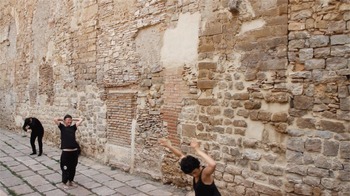
From left: Júlia Ojuel Solsona, Ainhoa Irueta Isusi, and Caro Novella Centellas in (Parèntesi) by oncogrrrls. Plaça del 8 de març, Barcelona, June 2013. (Screenshot by Carlota Grau and Paitu; courtesy of oncogrrrls)

The Gestures Exercise: Arousing Ecologies through Disappearance (Vignette #2: On Arousing)
Score: The gestures rehearsal. Footnote 22
1. Work in trios to collect your three gestures.
2. Transpose the gestures: Footnote 23
Go to your rehearsal space and follow instructions given by the facilitator of the rehearsal.
Facilitator: offer instructions to enact the gestures in different ways (play with changing the order, speed, position, location, etc.).
From left: Paitu, Júlia Ojuel Solsona, Ainhoa Irueta Isusi, Caro Novella Centellas, Bárbara Wiltschek, Carol Vallverdú, and Ona Malleu in (Parèntesi) by oncogrrrls. Plaça del 8 de març, Barcelona, June 2013. (Screenshot by Carlota Grau and Paitu; courtesy of oncogrrrls)

From my journal—15 May 2013, Plaça del 8 de Març:
I facilitate the exploration. Ainhoa, Marissa, Carol, Ona, and Júlia are dispersed, each in their own “private” rehearsal space, moving their particular gestures. Ona slides against the wall, Marissa marks the air with knees and toes, Júlia stands with rigid arms, Carol scratches her face standing near the wall, and Ainhoa moves her legs as in an imaginary bicycle riding the ceiling. Five dancers in the same space with no seeming relation to each other but with synchronized shifts any time that I give a prompt: now move only gesture number two. I offer more cues: repeat your gestures from one to three, move at a speed of 2, 4, 10, 20, 1. Change your level; move with another part of your body; put it upside down; move at 2, 10, 1. Moving in the space, changing tempos, shapes, and positions; the gestures start to fragment. Side to side, disjointed stories punctuate each other, amplifying, responding, reverberating, even collapsing gestures into a kind of syncopated bodily chatter, undoing any possible sense of linear time, containment, or storyline.
The room activates into a textured dynamic field. An electrical wavelength runs through us. […] I sense the thickness in the air. […] A sense of luring porousness connecting the space and all of us entices me into the feedback-loop; I keep offering shifts/instructions: with another part of your body, move at 2 at 10, at 1; find another place; face another direction. […] The differentials boost the energy in the room, and the vibrational quality of the emerging form launches epidermal threads within all of us. A thickening marrow tissue of partial memories, motions, and cancer relations accrues in the space. The exploration brings an unexpected response to the individual coherent signed stories about waiting. More than this, the intensity of what is happening not only unsettles the distinct stories but also weaves a thick ecology of “fleshystories.” Narratives of cure and life-suspension are only one little tiny part.
Refusing the Split in the Gestures Exercise
The exploration transposes personal stories on “waiting” into gestures, and then unsettles their coherence by playing around with their somato-kinetic relations. Igniting a kinetic exploration by randomly shifting the different components of the gesture (body part, place in the room, orientation) and its dynamics (rhythm, size/length, order) shifts the internal logic of the story. The exploration opens the bundles of meaning-memory-gesture-emotion of each personal story to the possibilities of unknowing and making new expressions. Marissa recalled in the feedback circle after the exercise that the meaning and emotional quality of her gestures mutated, opening her to not-knowing:
Yeah. When I changed the plane, one of the gestures was a completely different thing. It was the same but it changed the meaning, it was another sensation, more beautiful and positive. It was the same but with a different perspective. It was better. I don’t know how to say what it meant because I am still trying to understand it.
Or, Ainhoa:
The speeds to me were also…wow… They transmitted a lot. Perhaps the same sensation, not a different one but if I did [the gesture] very slowly it was as if I gained perspective to analyze what I was feeling in that instant. Like a hamster wheel, as I exactly know what the sensation is when I do it… if I did it slowly this allowed me to analyze it and…wow look!…if I did it faster instead […D]epending on how you move you can produce something that is overwhelming that you cannot grasp, or something that you can look at and observe closely.
Ainhoa’s “wow look” is an expression of wonder. Sara Ahmed says that to wonder is “to remember the forgetting and to see the repetition of form as the ‘taking form’ of the familiar” (2006:82). Techniques of defamiliarization (Brecht) and disorientation (Ahmed) may foreground the structures sedimented by routines or ignite an awareness of sorts. Further, in the joint exploration (let’s do something, and let’s do it together) of this rehearsal, disorientation techniques take place in relation to each other, inspiring other kinds of arousals: the arousal of formlessness and imbrication.
Arousing Formlessness and Imbrication
In rehearsal, I am interested in arousal as a kind of agitation and unsettling to dissolve cultural assumptions about the sociality of illness. An agitation of horizons. In the gestures rehearsal, the thickness in the air, the blurring of borders, the porousness of skin membranes as they open to the haptic density of the space around us arouses formlessness—the dissolution of the sociosituated and sociopolitical gestures of “waiting” with cancer. Being touched by the toxicity of oncological treatments shaped my understanding of arousal as an undoing of the individuated self (see Novella Reference Novella2018:55). The sensory rouse, which fragmented my own sense of containment while “on chemo,” resonated with Mel Chen’s queering of animacy in their episode of intimacy with a couch. Chen points out that “human patients get defined as inanimate” (2012:210), particularly through the diagnostic parenthetical metaphor.
Arousal emerges in the oncogrrrls work as a shattering of horizons, the unsettling of the individuated self, opening up to the exchange and a renewal of bonds, allowing us, together, to become a greater entity through rehearsal. Lynette Hunter examines how rehearsals navigate between legible (discursive) and not-yet-legible worlds. Hunter’s phrase for these not-yet-legible worlds is “the alongside” (2019). Valuing the political work of rehearsal/practice, Hunter discusses the energy of changing, of affect, of how performers make this energy available to others so they can engage in changing themselves. Thinking with Hunter, I try to create a nurturing feedback loop, an evolving field in which performers (artists, friends, art critics, and engaged beings) make themselves different through a mutually vulnerable exchange—a differentiating exchange of energies.
Arousal is about not only awakening sedimented thoughts and feelings, but also moving away from the individual by unraveling possessiveness, exploring the unknown, and weaving into the group. In opening the gesture to unexpected possibilities through physical exploration, the individual becomes entangled with a larger, collective/social body. Rehearsal fosters imbrication; it disappears distinct individuals. The “original” story about the waiting, its affects and how it is stored in cellular memories, entangle within the group, creating a new bundle of body parts, rhythms, and memories. We are no longer waiting alone or having an individual cancer experience. By asking “What are we waiting for?” rehearsal gives form to an awareness necessary for social change.
Inquiry as Performance (Vignette #3: On Posing)
Score: Score inquiry, not resolution
Practice: 20 May 2013, Plaça del 8 de Març.
It is too soon.
It is our third week into the process and Carlota, Ona, Marissa, and I are waiting in the square for everyone else to arrive. We muse over the material we’ve collected so far. The MiTs competition is approaching and we are sensing the pressure of the deadline. At some point in the conversation, Carlota—responding to her urge to set the choreography—proposes a final scenario: “With this wall behind, which represents the weight of the wait, we can create a story which tells how difficult it is to wait. One body could stay in the middle, and then another body would approach… We need to craft some movements that depict the slowness and […]” She starts planning the final shooting, already defining shots and angles, thinking on what would represent what and what would mean what. Intuition tells me that the deep politics of rehearsal reside in not allowing a single answer to the question “what are we waiting for.” Over time this intuition solidified into the principle “score inquiry, not resolution” (Novella Reference Novella2021:82).
Operating from the mission of our creative laboratory—“Let’s do something about it, and let’s do it together”—we decided not to accept Carlota’s suggestion. On the one hand, we had agreed at our first meeting not to let anybody from outside the process record and tell the story. As Ainhoa said then: “There are enough stories told about us, let’s make this our own” (Irueta Reference Irueta2013). No one should impose an interpretation of the work on the rest of the group. On the other hand, a fixed choreography with a set meaning would focus our exploratory process into a single story, as if we had found only one solution to the inquiry. Our most profound aim in this exploration was to exist outside the fixed narratives of cure and the biomedical split of life vs. health. Our nonconclusive, nonprescriptive practices had opened a space to maintain our lives as full and changing, despite biomedical halting and “suspension.” We had made room for holding onto affective complexity, for exploring our experiences together, and for weaving our individual cancer stories as one cloth comprising questions bigger than any one narrative. Essentializing this into one story would erase differences, preventing us from continuing to explore and change. We wanted to express, not erase difference.
Finding answers to “What are we waiting for” meant we had to arouse, to stir up, the suspended waiting to reveal more possibilities. Unexpectedly, this discussion led to a score for inquiry, not representation. Scoring inquiry emerged as a composition technique for an open-ended performance, a “final” piece posing inquiry or rehearsal as performance.
(Parenthesis)
Two weeks after the five-week rehearsal period, the whole group met and decided on four improvisations to edit into the final piece. We named them and planned the arc of the piece. By going with a piece with open-ended scores, we performed our rehearsal. That is, we gave our inquiries a form and foregrounded exploration. Yet, our story of waiting is not about suspended waiting but about ongoing inquiry. With its criticism of the cancer industry and the profits some are making from it, and the parenthetical metaphor that aimed to restrict and stifle us, the story in (Parèntesi) is not an oppositional monolithic voice or a direct transgressive critique. It is a story with multiple perspectives and meanings: the interruptions brought by the diagnosis, the burden of waiting, the resilience of our bodies, the movement within the parenthesis metaphor, individual elaborations of the journey, the potential for change even in this disjointed time. The jarring soundtrack, a live recording of an MRI, marks the tempo of the piece, which, as Carol said: “foregrounds the irregular paces of our transit through treatments—where some stages feel hectic while others are an endurance performance. Jamming rhythm through sound, we also gesture towards the disruptions of social time that occurs in illness, pointing to our own reorientation during the process of making the piece. We named the piece (Parèntesi) as an answer to the question: What are we waiting for? (Parèntesi) is a response charged with the affective forces of engaging in change. Perhaps, as Ainhoa said, the parenthesis is one kind of sensual and liminal space of arousal: a space where the discomforts brought by the experience coexist with the pleasures of unsettling settled relations.
The Politics of Rehearsal
Attending to our oncogrrrls rehearsals as performance revealed the political work of weaving inquiry into somatic exploration to transform cancer relations. Cancer politics was reimagined as onco-bodies jointly took an activist approach to cancer. Instead of living the experience individually and in isolation, oncogrrrls proposed a joint creation to challenge the predominant medical/individual model for cancer and chronic diseases.
Through our various movement practices we fleshed out memories and biomedical protocols and in the process of making (Parèntesi) changed together. In this exploration, while keeping a critical stance towards cure narratives of normalization, biomedical life and health divisions, expectations of pink-hyperfeminized gender performance, etc., we also entangled our fleshystories to move beyond individual experiences into the group, transforming the public square into not only the political space of illness, but also into a relational ecology beyond biomedical notions of cure. oncogrrrls became a laboratory where each rehearsal-as-experiment enacted cancer relations differently, using rehearsal to enact onco-bodies that are multiple, entangled with the public space, and engaged in continuous inquiry. Footnote 24 The bodies we enacted were not the fixed, asexualized, domestic, and isolated suspended onco-bodies of the “life in a parenthesis.” Just imagine how different the cancer experience would be if doctors said: Now, think of your life as a rehearsal: your body will become more porous, and you will have space and time to observe this becoming; engage with it and sense the possibilities emerging. Perhaps then we could live through the experience as Ainhoa proposed, as one kind of sensual and erotic liminal space. A time-space where the discomforts brought by the experience coexist with the pleasures of arousing sedimented relationalities.
Post-cript
(Parèntesi) and the MiTs award fueled my doctoral investigation on rehearsal as a performative intervention into cancer activism. Since this laboratory, I have continued developing cocreation processes with women and queer individuals through the oncogrrrls project, using rehearsal as method. A total of 42 people participated in oncogrrrls’ creative processes in Mexico and Spain between 2013 and 2017. My current investigation into rehearsal as an arousing mechanism for the joint creation of new cancer relations engages, in addition to oncogrrrls, the performance collectives Quimera Rosa and the Ecosexuals (Annie Sprinkle and Beth Stephens), with whom I collaborated between 2015 and 2019. In 2021, I started facilitating creative cancer rehearsals with groups online in the US and Canada. The challenge is to keep tending to cancer performance as processes of collective justice and mutual aid beyond individual cures.
In the time of Covid-19, while scarcity and divisiveness put us all at risk, rehearsing arousal politics is particularly relevant. Artists, scholars, and activists for health justice need to propose mechanisms for developing our relational imaginations that will keep us noticing and resisting structures that separate and divide. We cannot afford to put our lives in parentheses.