Mental state terms refer to abstract, invisible referents like desires, intentions and beliefs. Because of their absent and subjective reference, words for mental states and experiences are thought to be particularly difficult for young children to acquire. Infants begin to use such terms in their second year (Bartsch & Wellman, Reference Bartsch and Wellman1995; Bretherton & Beeghly, Reference Bretherton and Beeghly1982; Shatz, Wellman & Silber, Reference Shatz, Wellman and Silber1983). Terms for desire and intention are produced first, followed by terms for cognition. How do children assign reference to mental state terms, allowing them to comprehend their meaning, and in turn accurately use them in their own speech? There are likely to be multiple influences on the development of mental state vocabulary in young children. However, one prominent hypothesis is that mothers and other conversational partners explicitly label children's own mental states for them, and this allows them to map from the appropriate lexical items onto their internal mental experiences (Bartsch & Wellman, Reference Bartsch and Wellman1995; Nelson, Reference Nelson, Astington and Baird2005; Symons, Reference Symons2004; Thompson, Reference Thompson2006).
A number of correlational studies provide support for this hypothesis. The frequency and richness of family members' talk about internal mental states like desires, feelings and beliefs, correlates with children's mentalistic vocabulary and theory of mind understanding in the preschool period. These correlations have been observed both concurrently and longitudinally (Dunn, Bretherton & Munn, Reference Dunn, Bretherton and Munn1987; Jenkins, Turrell, Kogushi, Lollis & Ross, Reference Jenkins, Turrell, Kogushi, Lollis and Ross2003; Ruffman, Slade & Crowe, Reference Ruffman, Slade and Crowe2002; Sabbagh & Callanan, Reference Sabbagh and Callanan1998).
The majority of studies showing links between maternal and child mental state language have focused on the preschool period. There are also studies that suggest mothers' mental state talk to younger children, infants and toddlers, may have longitudinal effects on the children's mental state vocabulary and their propensity to mention mental states and processes in conversation. Beeghly, Bretherton & Mervis (Reference Beeghly, Bretherton and Mervis1986) found that mothers' tendencies to use internal state language with their toddlers at 1 ; 1, 1 ; 8 and 2 ; 4 were related to the size of their toddlers' internal state vocabulary, as reported by mothers, at 2 ; 4. This suggests that maternal mental state input may have an influence prior to the child's acquisition of the relevant vocabulary. Symons, Fossum & Collins (Reference Symons, Fossum and Collins2006) analyzed mother–toddler free-play transcripts and found links between mothers' mental state talk to their two-year-olds, and the toddler's own use of mental state terms for desires and thoughts. Their data also revealed a high degree of specificity in the types of mental states terms that were linked, such that mothers' use of desire terms was correlated with their children's spoken references to desire, and mothers' use of cognitive terms was related to their children's references to cognition.
Taumoepeau & Ruffman (Reference Taumoepeau and Ruffman2006, Reference Taumoepeau and Ruffman2008) reported longitudinal links between mothers' frequency of talk about emotions, desires and beliefs when describing pictures to their toddlers at 1 ; 3 and 2 ; 0 and the toddlers' mental state vocabulary, measured via maternal report on the MacArthur Communicative Development Inventory (Fenson et al., Reference Fenson, Dale, Reznick, Thai, Bates, Hartung, Pethick and Reilly1993), at 2 ; 0 and 2 ; 9. As well as exploring mothers' talk about different types of mental states, they also separately coded mothers' references to the mental states of their toddlers versus the mental states of other people (e.g. the mother herself or characters in the pictures being described). This coding decision was based on the idea that mothers' labeling of their toddlers' mental states may be most effective for young children learning the vocabulary of mental states because it may allow children to map relevant lexical items onto their own internal, mental experiences as they occur. Taumoepeau and Ruffman's results indicated that mothers' tendencies to talk about their toddlers' desires at 1 ; 3 was the strongest correlate of the child's mental state vocabulary at both later age points. Maternal references to other people's desires were also linked with later child mental state talk, but not as strongly or as consistently. No effects were observed for maternal use of affect or cognition terms when the toddler was 1 ; 3. However, at later assessments, maternal talk about cognition became a significant correlate of children's mental state vocabulary and performance on theory of mind tasks.
Thus the literature reveals that mothers' tendencies to talk about mental states in general, and to make verbal references to their children's own mental experiences in particular, are correlated with their children's emerging mental state vocabulary. This overall pattern supports the hypothesis that children's learning of mental state terms is facilitated when mothers provide relevant mental state input. But what might be the causal direction of these correlations? It is known that there are wide individual differences in mothers' propensities to engage in mentalistic discourse with their children (Dunn, Brown, Slomkowski, Tesla & Youngblade, Reference Dunn, Brown, Slomkowski, Tesla and Youngblade1991; Peterson & Slaughter, Reference Peterson and Slaughter2003; Slaughter, Peterson & Mackintosh, Reference Slaughter, Peterson and Mackintosh2007), so one possibility is that a mother whose own conversational style involves frequent talk about desires and thoughts may ‘bring mental states to children's attention’ (Astington, Reference Astington2001: 686) earlier than another mother whose talk to her infant or toddler is less mentalistic. Although they did not investigate children's mental state vocabulary, Meins et al. (Reference Meins, Fernyhough, Wainwright, Clark-Carter, Gupta, Fradley and Tuckey2003) argued along these lines, suggesting that mothers who are generally ‘mind-minded’ provide various experiences, including relevant language input as early as 0 ; 6, that promote their children's emerging awareness of the mind and mental activity.
An infant-to-parent direction of influence is also possible. Taumoepeau & Ruffman (Reference Taumoepeau and Ruffman2006, Reference Taumoepeau and Ruffman2008) suggested that mothers' verbal references to different types of mental states may be responsive to their infants' early understanding of the mind. Their longitudinal study indicated that mothers' references to desires and intentions tended to decline from the 1 ; 3 to 2 ; 0 assessment, whereas references to cognitive states like thoughts and beliefs increased. As an explanation, Taumoepeau & Ruffman (Reference Taumoepeau and Ruffman2006) cited experimental work indicating that infants begin to reason about the mental states of desire and intention around the beginning of their second year, and they suggested that mothers may implicitly recognize this and so increase their verbal references to desires at that early stage in order to scaffold their infants' knowledge. However, by 2 ; 0, they argued, children have acquired the vocabulary of desire and have some mastery of the concept, so mothers may then switch their focus to other mental states such as belief.
The current study extends this work by investigating whether mothers' tendencies to talk about mental states change concurrently with their infants' emerging capacity to communicate their interest, preferences, desires and goals. Rather than relying on developmental findings suggesting that infants in general begin to understand others' desires and goal-directed action around 0 ; 9 to 1 ; 0 (e.g. Behne, Carpenter, Call & Tomasello, Reference Behne, Carpenter, Call and Tomasello2005; Gergely, Nádasdy, Csibra & Biro, Reference Gergely, Nádasdy, Csibra and Biro1995; Phillips, Wellman & Spelke, Reference Phillips, Wellman and Spelke2002), we examined mothers' references to mental states in relation to their own infants' early gestural communication. By focusing on preverbal communicative gestures, we can explore the earliest links between infants' capacities to express their own mental states, and their mothers' tendencies to refer to mental states when conversing with their infants. This will provide new information about whether and how maternal input relates to infants' emerging awareness of intangible, abstract mental states.
Communicative gestures (including pointing, showing, giving and reaching to request) first emerge around the end of the first year of life (Bates, Benigni, Bretherton, Camaioni & Volterra, Reference Bates, Benigni, Bretherton, Camaioni and Volterra1979; Volterra, Caselli, Capirci & Pizzuto, Reference Volterra, Caselli, Capirci, Pizzuto, Tomasello and Slobin2005). These early gestures fall into two functional categories: declarative gestures (e.g. holding up an object to show it to the partner) specifically communicate one's attitude of interest toward a given referent, as well as one's desire to share attention with a social partner. Imperative gestures (e.g. reaching towards an object to request it) communicate one's immediate instrumental desires and goals.
There is debate about whether infants' production of pointing and other communicative gestures indicates that infants assume that their communicative partners possess mental states (Legerstee & Barillas, Reference Legerstee and Barillas2003; Liszkowski, Carpenter & Tomasello, Reference Liszkowski, Carpenter and Tomasello2007; Moore & Corkum, Reference Moore and Corkum1994). However, there is no doubt that adults interpret communicative gestures as reflecting such states. Therefore when infants produce communicative gestures, by holding out a hand to request an object, or by pointing at something, this provides an ideal opportunity for mothers to label, comment on or describe what they take to be their infants' current mental state. Thus we predicted that infants' acquisition of communicative gestures would be positively correlated with their mothers' tendencies to talk about mental states, and in particular, mental states of intention, desire or interest, which are the focus of these early gestural communications.
For the current investigation, we were interested both in how maternal talk about mental states might relate to infants' early gestural communicative behaviours (as rated independently by mothers and by outside observers) and also in individual differences among both mothers and infants in the timing and extent to which such patterns might emerge and be synchronized. For infants, how early they demonstrate an understanding of desires or intentional states and how clearly they communicate that understanding are likely to vary. Similarly, mothers may differ in their own dispositions to take note of their infants' emerging competencies, and to respond to them with the appropriate language.
To explore these issues, we investigated relations between mothers' mental state language during three 10-minute free-play sessions with their infants, and two explicit measures of the timing and frequency of their infants' ability to express their mental states, namely: (a) the age at which the infant initially began to engage in communicative gestures in experimental tasks; and (b) mothers' monthly records of their infants' deliberate gestural communication, via the MacArthur CDI (Fenson et al., Reference Fenson, Dale, Reznick, Thai, Bates, Hartung, Pethick and Reilly1993), from 0 ; 9 through 1 ; 3. The maternal language data were coded from written transcripts of free-play sessions conducted when the infants were 0 ; 9, 1 ; 0 and 1 ; 3. Because we were working from transcripts, it was not possible to determine if the maternal mental state talk we coded was produced in response to their infants' gestures. Rather, the transcript coding captured general tendencies and developmental changes in mothers' mental state talk to their infants.
In line with Taumoepeau & Ruffman (Reference Taumoepeau and Ruffman2006), maternal references to the infants' mental states during the free-play sessions were coded separately from mothers' references to their own or other people's mental states. This was based on the idea that mothers might recognize and make the most of opportunities to label their infants' mental states when these are expressed via preverbal gestures. This also allowed us to test whether any increase in mothers' mental state language was specific to the infant, as hypothesized, as opposed to a global change in the amount of mental state talk mothers produced.
We separately tallied the frequencies of mothers' references to three types of mental states: volition, cognition and disposition (see definitions below). This was based on the idea that imperative and declarative gestures have different communicative functions, with declaratives primarily signalling mental states of interest and attention, whereas imperatives primarily communicate immediate goals or desires. We therefore expected that mothers' verbal references to specific types of mental states might vary with the types of gestures their infants tended to produce. Specifically, we predicted that mothers' references to their infants' states of cognition and disposition would be linked to the production of declarative gestures and that mothers' references to their infants' volitional states would be linked to the production of imperative gestures.
METHOD
In order to carry out the investigation we used a subset of measures from a larger archival dataset involving longitudinal assessments of infant communication, joint attention and cognitive development over the 0 ; 9 to 1 ; 3 period (Carpenter et al., Reference Carpenter, Nagell and Tomasello1998).
Participants
Twenty-four mother–infant pairs participated. There were equal numbers of male and female infants. Twenty-two were Caucasian and two were African-American. All twenty-four pairs attended seven monthly test sessions, starting at 0 ; 9 and ending at 1 ; 3.
Materials, procedure and scoring
We used three main measures: (1) the frequencies and types of mothers' mental state speech to their infants while the dyad interacted together in free play at 0 ; 9, 1 ; 0 and 1 ; 3; (2) mothers' reports of the number of meaningful communicative gestures used by their infants at ages 0 ; 9, 0 ; 10, 0 ; 11, 1 ; 0, 1 ; 1, 1 ; 2 and 1 ; 3; and (3) infants' responses on structured laboratory tests designed to elicit imperative and declarative gestures at 0 ; 9, 1 ; 0 and 1 ; 3. The first of these measures is new, whereas the others were borrowed from a previously published study of this sample of infants (Carpenter et al., Reference Carpenter, Nagell and Tomasello1998). Details of these measures follow.
Mothers' mental state speech to infants
As a novel addition to the existing longitudinal data on the early development of joint attention and communication (Carpenter et al., Reference Carpenter, Nagell and Tomasello1998), we examined mothers' mental state speech to their infants at three longitudinal time points: when infants were 0 ; 9, 1 ; 0 and 1 ; 3. At each point, mothers and infants were videotaped while playing by themselves in a 10 by 12 foot playroom decorated with child-friendly posters and equipped with an attractive range of toys including buckets, balls, blocks, dolls/figurines, wheeled toys and a picture book. (Sets of toys were rotated across sessions to avoid participant boredom.) The three free-play sessions each lasted for ten minutes, for a total of thirty minutes over the six months. Using transcriptions of these free-play sessions, we coded mothers' talk to their infants for references to three mental state types, namely: (a) volition (desire or intention); (b) cognition (thinking, knowing, etc.); and (c) disposition (states of physiological or emotional arousal or preference). These categories were chosen because they describe internal, unobservable mental states that are likely to be expressed in young infants' gestures. These mental state terms are also relevant because they can only be inferred from behaviour and therefore pose a referential challenge for the young word-learner.
Table 1 provides definitions and transcript examples for each mental state coding category. Because these transcripts were of mothers talking to very young children, without specific mental-state relevant stimuli such as pictures of social scenes (cf. Taumoepeau & Ruffman, Reference Taumoepeau and Ruffman2006), the range of mental state references we observed was relatively restricted.
Definitions for mental state coding categories and examples of maternal mental state utterances from the free play transcripts

We separately coded references to the mental states of others and references to the infants' own mental states. Utterances that referred simultaneously to the infants' and another person's mental states (e.g. ‘We think X … ’) were counted in both categories (but this was uncommon). We did not code utterances made by the infants, which were extremely rare. As a measure of maternal verbosity, we also tallied (separately for each session) the total number of words (including pseudo-words like mhmm and uhn-uh and repeated words) that mothers uttered during the ten minutes of free play.Footnote 1
A research assistant blind to the infants' performance on the structured task and the checklist (both described below) coded all the mothers' transcripts using the definitions and examples given in Table 1. Twenty percent of the data (fifteen transcripts in total; five infant–mother dyads observed at 0 ; 9, 1 ; 2 and 1 ; 3) were also coded independently by the first author and percent agreement across all mental state coding categories was 93·4%; Cohen's kappa was 0·92.
Maternal reports of infant communicative gestures
Using the MacArthur Communication Development Inventory (CDI) we obtained mothers' reports of the meaningful gestures their infants were using at 0 ; 9, 0 ; 10, 0 ; 11, 1 ; 0, 1 ; 1, 1 ; 2 and 1 ; 3 from the Communicative Gestures subscale (Part II, Section A). This subscale presents descriptions of twelve commonly used gestures (e.g. ‘waves “bye-bye”’, ‘nods head “yes”’, ‘extends arm and finger to point at interesting object’). Mothers indicate on a 3-point scale (‘not yet, sometimes, often’) if their infant produces each gesture. We credited an infant as having a given gesture when the mother indicated that the infant produced that gesture ‘sometimes’. Mothers completed these ratings on a monthly basis in a cumulative test booklet for a total of seven reports.
We inspected each mother's responses at the initial 0 ; 9 visit in detail to check on likely accuracy. Results of this informal evaluation were reassuring. Mothers did not seem to be overinterpreting or inappropriately reading meaning into their infant's random movements. In fact, at 0 ; 9, the mothers on average reported that their infants used only two of twelve possible gestures (mean=2·21), and this is consistent with developmental norms (e.g. Acredolo & Goodwyn, Reference Acredolo, Goodwyn and Vasta1990). Furthermore, there was a high degree of consistency in the specific gestures the mothers reported at 0 ; 9. The most frequently reported was an upward stretch of the arms as an imperative request to be picked up. Seventeen of the twenty-four mothers (71%) reported that their nine-month-olds did this. Given the relatively small number of gestures reported for most infants at most observation points, we gave each infant a total monthly score, reflecting the number of meaningful gestures their mothers ascribed to them at each month of the assessment.
Laboratory tests of emergence of imperative and declarative gestures
We used archival data from a previous publication (Carpenter et al., Reference Carpenter, Nagell and Tomasello1998) as our source of information on outside observers' ratings of infants' gestural communication during structured laboratory tasks. As described in Carpenter et al., a female experimenter tested each infant monthly from 0 ; 9 through 1 ; 3. Clear gestures that occurred at any time during the session were counted. There were four tasks specifically designed to elicit imperative and declarative gestures. For the two imperative gesture tasks, the experimenter either placed an attractive toy inside a transparent box and locked it, or activated a small wind-up toy for several seconds (with randomized toys and boxes across monthly assessments). She then gave the locked box or motionless wind-up toy to the infant. These tasks were designed to create a desire or goal in the infant (e.g. to access the toy inside the box or to get the motionless toy to move again) and thereby elicit imperative gestures.
For the two declarative gesture tasks, initially the infant was given a relatively uninteresting toy to play with. A few seconds later, an assistant surreptitiously either (a) made a stuffed animal dance in midair using a string attached to a pulley or (b) made a puppet move around from behind a barrier. Both objects were initially out of reach. The experimenter and the infant's mother pretended not to notice. These tasks were designed to capture infants' attention and interest, and thereby elicit declarative gestures.
In both the imperative and declarative elicitation tasks, the experimenter responded to the infant's gestures to the object in such a way as to help coders distinguish between imperative and declarative gestures (in cases in which this was not clear from the behaviour accompanying the gestures; see below): Following Perucchini & Camaioni (Reference Perucchini and Camaioni1993), in each type of task she responded first with just a comment about the object (e.g. ‘Yes, that's Grover!’). Then, if the infant gestured further, the experimenter gave the object or operated the wind-up toy for the infant.
The communicative function of an infant's gesture was established by the context in which it was observed (e.g. the imperative versus declarative task context, or a naturally occurring event prior to or following the eliciting tasks) as well as by the infant's behaviour. Imperative gestures were coded when the infant gave, reached for or pointed to an object while alternating gaze between the object and an adult's face. They were typically accompanied by grunts or whines and persisted when the object was not given to them or the toy was not activated immediately. Declaratives were coded when the infant pointed at, showed or gave an object to an adult while alternating gaze between the adult and the object. These were typically accompanied by vocalizing as if to comment on the object to the adult and ceased once the adult commented on the object herself.
Gestures were coded online by the assistant, and then 20% of the data were later coded independently from videotapes by the experimenter. This resulted in 90% agreement on imperatives and 97% agreement on declaratives, with Cohen's kappas of 0·77 and 0·87, respectively (Carpenter et al., Reference Carpenter, Nagell and Tomasello1998). The age of emergence (AOE) of imperative or declarative gestures was considered to be the first month at which infants showed a clear gesture.
RESULTS
We initially explored patterns of mental state term usage in mothers' talk to their young infants. The longitudinal data allowed us to investigate whether mothers were consistent in their tendencies to refer to mental states across the six-month period when their infants were 0 ; 9 to 1 ; 3, in line with Meins and colleagues' (Meins & Fernyhough, Reference Meins and Fernyhough1999; Meins, Fernyhough, Wainwright, Gupta, Fradley & Tuckey, Reference Meins, Fernyhough, Wainwright, Gupta, Fradley and Tuckey2002; Meins et al., Reference Meins, Fernyhough, Wainwright, Clark-Carter, Gupta, Fradley and Tuckey2003) idea that mothers differ in their ‘mind-mindedness’, one aspect of which is the frequency of their linguistic references to the mind and mental states.
Mothers' mental state talk during free play
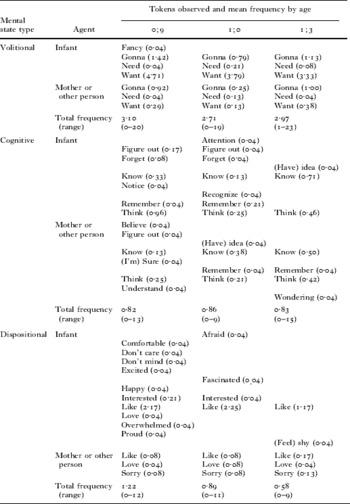
In terms of mothers' total amount of talk during the free-play sessions (irrespective of mental state content), there was an increase that was not statistically significant across the 0 ; 9, 1 ; 0 and 1 ; 3 sessions. Mothers addressed a mean of 393·4 words (SD=184·8) to their infants at 0 ; 9, compared with 409·7 words (SD=183·4) at 1 ; 0 and 445·7 words (SD=204·9) at 1 ; 3 (F(2, 46)=1·09, n.s.). Mothers' overall use of mental state terms also remained relatively constant over the period of the study. Table 2 shows the mental state tokens observed at each free-play session, together with the mean number of times each term was used (collapsed across all mother–infant dyads) at each testing time. As can be seen in this table, mothers' comments on the infants' own desires using want were the most frequent of all the individual tokens observed at each of the three-monthly sessions, with the average mother doing so roughly four times per session.
Listing of mental state tokens used by mothers during free play with their infants, by age (mean frequencies for each token are given in parentheses). Total frequency and range for each mental state type is collapsed across agent

Within these general parameters, there was considerable variability among individual mothers in how often they used mentalistic speech, both referring to their infant and in total. For example, at 0 ; 9 one mother expressed a total of 34 mental state tokens, of which 28 referred to her infant's mental state. At the other extreme, another mother expressed only 2 mental state tokens during the 0 ; 9 free-play session, both of which referred to her infant. At the older ages, total mental state tokens ranged from 1 to 35 at 1 ; 0 and 5 to 39 at 1 ; 3. Of these, mental state terms addressed to the infant ranged from 1 to 27 at 1 ; 0 and 2 to 28 at 1 ; 3.
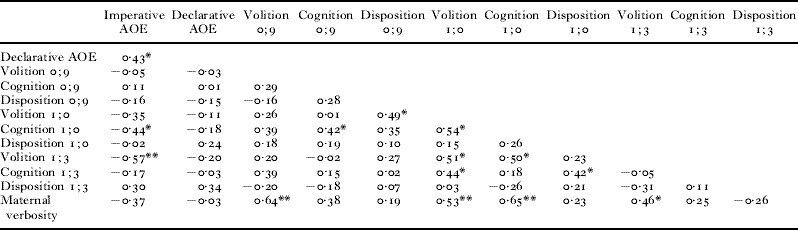
To see if those mothers who used mental state language most often at 0 ; 9 were the same ones who also did so at 1 ; 0 and 1 ; 3, we computed Spearman correlations for each mother's use of each type of mental state term (volition, cognition, disposition; summed across references to the infant and to others in order to reduce the number of independent correlations computed) across the 0 ; 9, 1 ; 0 and 1 ; 3 free-play sessions. These are included in Table 3. For volition term use, there was no significant correlation between the 0 ; 9 observation and either the 1 ; 0 or the 1 ; 3 observations, though the 1 ; 0 and 1 ; 3 observations were significantly correlated with one another (p<0·05). Cognition term use was significantly correlated only for the 0 ; 9 and 1 ; 0 observations (p<0·05). For disposition, none of the three inter-correlations were statistically significant. Overall, of the 36 inter-correlations computed over frequency of volitional, cognitive and dispositional term use at 0 ; 9, 1 ; 0 and 1 ; 3, only 7 (i.e. 19·4%) were statistically significant at p<0·05. In other words, mothers appeared to vary the amount and type of mental state talk they addressed to their infants over the six-month longitudinal period, suggesting that they might be responding to changes in the infant's behaviour, rather than employing a fixed and continuous style of mental state talk, irrespective of their infant's development.
Spearman correlations between ages of emergence (AOEs) for imperative and declarative gestures, and maternal references to mental states of volition, cognition and disposition (infants' and mothers' combined) during free play with their infants

note: * denotes p<0·05; ** denotes p<0·01 (all two-tailed).
Correlations between maternal mental state references and infants' production of imperative and declarative gestures
To explore whether mothers' mentions of mental states during free play with their infants were related to the age at which infants began to use communicative gestures, we initially computed non-parametric Spearman correlations between infants' AOE scores for declarative and imperative gestures and maternal references to mental states of volition, cognition and disposition at 0 ; 9, 1 ; 0 and 1 ; 3. For this analysis, all references to mental states (the infants' and other people's) were combined. These results are listed in the leftmost columns of Table 3. We also included mean transcript length combined across the three free-play assessments as a variable in this analysis (displayed in the bottom row of Table 3), to explore whether maternal verbosity per se was related to their infants' acquisition of communicative gestures. In this and subsequent analyses, we report correlational findings without adjusting for multiple statistical tests. Our reasoning was as follows: First, all analyses were driven by specific, theoretically motivated hypotheses about how mothers' mental state talk to their infants may be linked to their infants' gestural communication. We designed our investigation with these hypotheses in mind and limited our analyses to the subset of relevant variables from Carpenter et al.'s (Reference Carpenter, Nagell and Tomasello1998) broader dataset of longitudinal data across a range of cognitive tasks (e.g. joint attention, imitation, object permanence, etc.). Second, statistical significance is strongly influenced by sample size and since the total N of this unique and valuable dataset is relatively small, adjusting significance levels upward would risk Type II errors. Finally, in interpreting the results, we will focus on effect sizes (Cohen, Reference Cohen1988) more than significance levels, and will interpret only those results that fit into a coherent pattern of correlations.
The mean AOE for imperative gestures was 12·7 months and for declarative gestures it was 10·3 months (Carpenter et al., Reference Carpenter, Nagell and Tomasello1998). As displayed in Table 3, the Spearman correlations revealed some links between mothers' mental state talk and their infants' AOE for imperative but not declarative gestures. Namely, the earlier infants generated imperative gestures in the experimental context (i.e. the lower the infant's AOE for imperative gestures), then the more their mothers talked about cognitive states in the 1 ; 0 session and the more they mentioned volitional states in the 1 ; 3 free play-session.
In order to explore more thoroughly these significant relations between infants' production of imperative gestures and their mothers' mental state talk during free play, we next correlated the AOE for imperative gestures with maternal mental state references to the infants' own mental states and those of other people, separately. Based on the previous analysis, we did not include declarative gestures since the AOE for declaratives did not correlate with any of the maternal language measures.
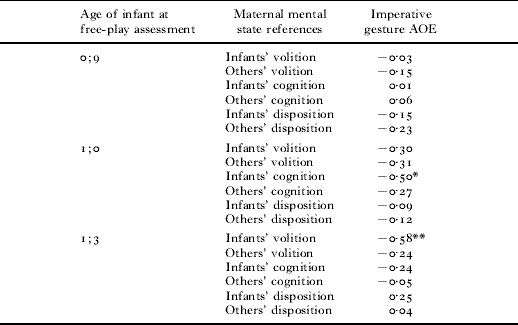
The results of this analysis are displayed in Table 4. Imperative gesture AOEs were negatively correlated with mothers' tendencies to talk about the infants' own cognitive states at 1 ; 0, and to the infants' own volitional states at 1 ; 3. These were medium to large effects (Cohen, Reference Cohen1988) that were also both statistically significant in the non-parametric analyses. Since mothers varied considerably in the total amount of speech they addressed to their infants at each session, we decided to control maternal verbosity in order to see if it was the relative amount of mental state reference, rather than absolute amount of mental state talk, that was linked with gestural AOEs. To do this, we used Pearson partial correlations, controlling for mean transcript length across the three free-play sessions. When controlling for maternal verbosity, the partial correlation between infants' AOE for imperative gestures and mothers' mentions of their infants' cognitive states at 1 ; 0 fell substantially (to r=−0·27, p=0·212), whereas that between infants' AOE for imperative gestures and mothers' mentions of their infants' volitional states at 1 ; 3 remained a medium-sized effect that just missed statistical significance (r=−0·41, p=0·054, both two-tailed).
Spearman correlations between age of emergence for imperative gestures and frequency of maternal references to mental states during free play with their infants at 0 ; 9, 1 ; 0 and 1 ; 3

note: * denotes p<0·05; ** denotes p<0·01 (all two-tailed).
Correlations between maternal reports of infants' gestural communication and mothers' mental state talk
The AOE scores represent an objective assessment of infants' expression of imperative and declarative gestures, as determined by trained observers in an experimental context designed to elicit them. However a mother's own subjective belief that her infant is communicating deliberately with her may be as relevant (or possibly even more so) to her decisions about how much and what types of mental state talk to address to her infant during dyadic free play. Therefore we next examined links between mothers' reports of their infants' communication via the MacArthur CDI and their references to mental states. To do this we computed Spearman correlations between total CDI infant communicative gestures at each month from 0 ; 9 to 1 ; 3, with maternal references to the infants' volitional, cognitive and dispositional states during free play at 0 ; 9, 1 ; 0 and 1 ; 3. For this analysis, we restricted the maternal input categories to only include references to the infants' own mental states based on: (a) the hypothesis that mothers tend to label or describe their infants' mental states when these are expressed via gestures; (b) the findings of the previous analysis in which the only correlate of imperative gestures was maternal references to the infants' mental states; and (c) a desire to reduce the number of independent correlations computed.
All infant gestures were combined for this analysis, since it is difficult to discern from the MacArthur form whether some of the gestures (e.g. ‘Extends arm to show you something he/she is holding’) functions as a declarative or imperative communicative bid. The mean number of communicative gestures infants produced, as reported by their mothers via the MacArthur CDI, increased over the six months of assessment. The mean number of gestures reported was 2·04 (SD=1·81) at 0 ; 9; 3·79 (SD=1·97) at 0 ; 11; 5·00 (SD=1·88) at 1 ; 0; 6·92 (SD=1·82) at 1 ; 1; 7·83 (SD=1·71) at 1 ; 2; to a mean of 8·54 (SD=1·91) at 1 ; 3 (Carpenter et al., Reference Carpenter, Nagell and Tomasello1998). These means are in line with the norms reported by Fenson, Dale, Reznick, Bates, Thal & Pethnick (Reference Fenson, Dale, Reznick, Bates, Thal and Pethnick1994).
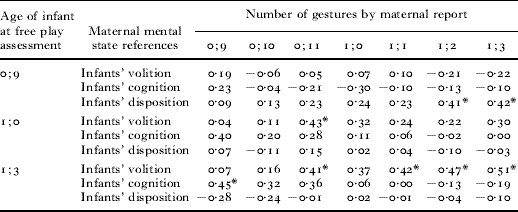
The pattern of associations between infants' gestural competence using this measure and maternal mental state talk was similar to what was seen in the previous analyses. As Table 5 indicates, the most consistent correlations emerged between mothers' talk about the infants' states of volition at 1 ; 3, and the number of communicative gestures mothers rated their infants as having produced at ages 0 ; 11, 1 ; 1, 1 ; 2 and 1 ; 3. Like the others, the correlation at 1 ; 0 also indicated a medium-sized effect (Spearman's rho=0·37) but it missed statistical significance (p=0·078). These were all positive correlations, indicating that the more meaningful gestures infants used, the more their mothers mentioned the infants' volitional states during free play at 1 ; 3. These same correlations remained high and all were statistically significant (with two-tailed tests) when run as Pearson correlations with maternal verbosity partialled out: maternal references to the infants' volition at 1 ; 3 correlated with CDI infant gestures at 0 ; 11 (Pearson's partial r=0·45, p=0·033); at 1 ; 0 (r=0·43, p=0·038); at 1 ; 1 (r=0·50, p=0·016); at 1 ; 2 r=0·54, p=0·008); and at 1 ; 3 (r=0·49, p=0·019).
Spearman correlations between total number of communicative gestures (as reported by mothers via the MacArthur CDI) and maternal references to their infants' mental states during dyadic free play at 0 ; 9, 1 ; 0 and 1 ; 3

note: * denotes p<0·05 (two-tailed).
Since the first of these significant associations emerged when infants were 0 ; 11, we tallied the individual gestures infants were reported to produce at this initial point. We found that the most common CDI infant gestures at 0 ; 11 were ‘extends his/her arm upward to signal a wish to be picked up’ (87·5% of infants), ‘extends arm to show you something he/she is holding’ (79·2% of infants), ‘reaches out and gives you a toy or some object that he/she is holding’ (75% of infants), ‘waves bye-bye on his/her own when someone leaves’ (66·7% of infants) and ‘requests something by extending arm and opening and closing hand’ (54·2%). Again, these data are consistent with published norms (Fenson et al., Reference Fenson, Dale, Reznick, Bates, Thal and Pethnick1994). Since the majority of these infant gestures can be interpreted as broadly volitional (e.g. ‘desires to be picked up’, ‘desires you to take the object’, etc.), the links with spoken maternal references to the infant's volition seem plausible.
DISCUSSION
The results of this study confirmed, firstly, that there are notable individual differences in mothers' tendencies to refer to different types of mental states when talking to their young infants. Similar variation in frequency of references to internal, mental states have been observed in previous work with mother–preschooler dyads (Ruffman et al., Reference Ruffman, Slade and Crowe2002; Slaughter et al., Reference Slaughter, Peterson and Mackintosh2007) as well as with mother–toddler dyads (Dunn et al., Reference Dunn, Bretherton and Munn1987; Symons et al., Reference Symons, Fossum and Collins2006) and mothers' speech to their six-month-old infants (Meins et al., Reference Meins, Fernyhough, Wainwright, Clark-Carter, Gupta, Fradley and Tuckey2003). Our six-month longitudinal data on mothers' mental state talk to their infants add to the general patterns revealed in some of this earlier work with the suggestion that individual mothers are not consistently ‘mind-minded’ or non-mind-minded in their discourse with their infants. Across the 0 ; 9, 1 ; 0 and 1 ; 3 free-play assessments, there were few significant inter-correlations among individual mothers' frequencies of referring to the three categories of mental state terms we coded, suggesting that mothers changed their patterns and frequencies of mental state references across the six-month period in which their infants developed from 0 ; 9 to 1 ; 3. We acknowledge, however, that the small sample size of this study may have compromised our capacity to observe interrelations among mothers' references to the different mental states over the assessment period.
The pattern of results further suggests that mothers' talk about mental states in conversation with their infants is linked to their infants' gestural communicative competence. Two converging correlational analyses support this conclusion. First, in this sample of twenty-four infant–mother dyads, we found that the earlier infants generated imperative gestures in an experimental task, the more their mothers talked about the infants' cognitive states at 1 ; 0 and their volitional states at 1 ; 3. The magnitude of this second correlation indicated a large effect and it remained so even when maternal verbosity was controlled. Second, we also found that the number of communicative gestures mothers observed their infants using at 0 ; 11, 1 ; 0, 1 ; 1, 1 ; 2 and 1 ; 3 was correlated with the frequency of mothers' talk about their infants' volitional states in the 1 ; 3 free-play session, again, even when maternal verbosity was controlled. Taken together, these data support the hypothesis that some mothers may notice and sensitively respond to their infants' budding capacity to express their desires and intentions through imperative gestures. Thus, maternal verbal labelling, describing or commenting on mental states of volition may be reactive to the infant. This interpretation of an infant-to-mother direction of causation is supported by the fact that the relevant maternal language was in the 1 ; 3 free-play session, subsequent to, rather than prior to, infants' acquisition of communicative gestures.
It is also conceivable, however, that some mothers are generally more prone to talking about their infants' mental states at 1 ; 3 than other mothers, and this tendency may be reflected in earlier non-verbal behaviours that drive their infants to produce communicative gestures relatively early. This interpretation would support the idea that there is a trait of ‘mind-mindedness’ that varies among mothers, but would also suggest that such a trait may not be consistently captured in mothers' mental state language to their infants during free play.
Of course, both causal mechanisms might operate simultaneously. Mothers who are disposed to communicate about volition might be more sensitive than other mothers to their infants' first communicative efforts in this domain and, by responding appropriately, may both stimulate infant understanding and gear their own communications to their infants' perceived ‘zone of proximal development’ (Taumoepeau & Ruffman, Reference Taumoepeau and Ruffman2008; Vygotsky, Reference Vygotsky1962). Finally, it is conceivable that ‘mind-mindedness’ is at least partially heritable, so that the correlations we observed are driven by a shared genetic mechanism.
Some features of the present results are notable. The correlation between maternal talk about infants' volitional states and infants' gestural competence was only evident in the 1 ; 3 free-play session. We take this as support for the idea that mothers observe, and then respond to, their infants' emerging capacity to communicate their desires and intentions. We might still ask why a similar correlation was not observed in mothers' language during free play when their infants were younger. At 0 ; 9, only one infant produced an imperative gesture during the experimental session, and at 1 ; 0, only nine of the twenty-four infants did so. These proportions are consistent with developmental progressions reported in other studies that have used similar gesture elicitation tasks (Desrochers, Morissette & Ricard, Reference Desrochers, Morissette, Ricard, Moore and Dunham1995; Perucchini & Camaioni, Reference Perucchini and Camaioni1993). If mothers were especially likely to respond to their infants' emerging capacity to express their desires through gestures, then there may have been too few infants who could express their desires in the laboratory context, for the correlation to be evident at the earlier assessments. This was not an issue for the MacArthur CDI data, which indicated that half of the infants used three or more communicative gestures as early as 0 ; 9. However, the youngest infants' use of these gestures might not have been robust or frequent enough for it to affect their mothers' language. This interpretation is supported by the fact that only seven of the twenty infants who used communicative gestures at 0 ; 9, according to the MacArthur CDI reports, were reported to do so ‘often’; the majority of communicative gestures at 0 ; 9 were only exhibited ‘sometimes’. Thus it may be that mothers change the nature of their references to volition only when their infants' communicative competence is firmly established.
Besides the consistent relation between mothers' talk about their infants' volitional states at 1 ; 3 and infants' use of imperative and communicative gestures, there was also a significant bivariate correlation between the age of emergence of imperative gestures and mothers' talk about the infants' cognitive states at 1 ; 0. We have not interpreted this latter correlation because: (a) it dropped to non-significance when maternal verbosity was controlled; and (b) it was not corroborated by the maternal report data from the MacArthur CDI, as was the correlation with maternal talk about volition at 1 ; 3. Thus we are not confident that maternal talk about the infants' cognitive states increases around the same time that infants begin to produce imperative gestures. There were also statistically significant correlations observed between infants' gestures at 1 ; 2 and 1 ; 3, measured via the MacArthur CDI and mothers' references to their infants' dispositional states at 0 ; 9, but again as these were not supported by data from either of the laboratory gesture tasks, we do not consider that these isolated correlations constitute a reliable trend.
Infants' performance on the declarative gestures task was not correlated with their mothers' mental state talk at any age. This is perhaps curious since the production of declarative gestures is often characterized as one of the first reflections of infants' early theory of mind, because it suggests that infants recognize others as being attentive, interested communicative partners (Baron-Cohen, Reference Baron-Cohen, Baron-Cohen, Tager-Flusberg and Cohen1993; Tomasello & Carpenter, Reference Tomasello and Carpenter2005). Thus, on our model, we might have expected that when infants generate such signals then mothers respond by labelling or commenting on the attendant mental states. It may be, however, that declaratives primarily provide opportunities for mothers and infants to engage in triadic interactions about an external object. This promotes word learning (Tomasello & Todd, Reference Tomasello and Todd1983). However, these triadic exchanges may not give rise to obvious opportunities for mothers to label or comment on the infants' mental states, in the same way as imperative situations in which infants explicitly try to communicate a goal-directed desire or intention. In line with this interpretation, we found in a different analysis of the current dataset that mothers' references to perception (e.g. look, see, watch, etc.) actually declined after their infants became capable of engaging in joint visual attention (Slaughter et al., Reference Slaughter, Peterson and Carpenter2008). We speculated that mothers' talk about perception may be used primarily to establish and maintain joint attention with their young infants and, once reliable, mothers move directly to talking about the referent of their shared attention. In contrast, it may be that mothers make reference to their infants' volitional states when these are expressed in gestures at least partly to promote their infants' acquisition of the appropriate terms to enable verbal communication of their internal mental experiences.
In sum, the results of the current study add unique data to the literature on relations between maternal mental state language and children's emerging understanding of mind. Similar to Meins and colleagues (Meins & Fernyhough, Reference Meins and Fernyhough1999; Meins et al., Reference Meins, Fernyhough, Wainwright, Gupta, Fradley and Tuckey2002, Reference Meins, Fernyhough, Wainwright, Clark-Carter, Gupta, Fradley and Tuckey2003), we observed individual differences in mothers' tendencies to talk about mental states to their young infants. However, in our relatively small sample, mothers' tendencies toward mentalistic talk to their infants was not highly consistent across the six-month assessment period. The key finding was of coherent patterns of correlation between infants' imperative and CDI communicative gestures and their mothers' tendencies to refer to their infants' volitional states at 1 ; 3. We propose that this pattern may reflect some mothers' tendencies to label, comment on or describe the volitional state that their infants' gestures express, supporting the hypothesis that one route to the acquisition of mental state vocabulary is through mothers' responsive and appropriate linguistic input. Further studies with larger samples of infants and a broader range of converging measures and methodologies, ideally ones that examine mothers' online responses to their infants' communicative gestures during free play, are required to confirm this hypothesis.