Implications
The impact of sanitary conditions on the ability of pigs to cope with changes related to farming practices is poorly known. Quantifying the response of pigs to these changes, in terms of performance and behaviour, will elucidate the mechanisms that allow an animal to interact with its environment. This knowledge may contribute to improve feeding and management strategies by accounting for the sanitary conditions of the farm.
Introduction
Common farming practices expose pigs to various aversive stimuli or stressors. These can be sanitary (degree of sanitation in farm), environmental (change of housing, animal density, space allowance, room temperature), nutritional (changing diet composition or presentation) or social (animal mixing). The stress response can be seen as the set of physiological and behavioural processes developed by the animal to respond to these disruptions and to restore homeostasis (Young et al., Reference Young, Walker, Dixon and Walker1989). The stress response occurs through the activation of the sympathetic nervous system and corticotrop axis (Dantzer and Mormède, Reference Dantzer and Mormède1983), which mainly results in transient changes in nutrient metabolism and partitioning to provide energy and nutrients required for the behavioural and metabolic responses (Mormède et al., Reference Mormède, Foury and Meunier-Salaün2006). However, a long-lasting stress response can have detrimental effects on health and behaviour, thereby altering animal well-being, feed intake and growth (Mormède, Reference Mormède1995; Schrama et al., Reference Schrama, Parmentier and Noordhuizen1997).
The sanitary conditions differ between farms, and poor sanitary conditions reduce animal performance (Klasing and Johnstone, Reference Klasing and Johnstone1991), activate the immune system (Williams et al., Reference Williams, Stahly and Zimmerman1997) and represent an important risk for health disturbances, particularly digestive disorders (Madec et al., Reference Madec, Bridoux, Bounaix and Jestin1998). Poor sanitary conditions also induce an inflammatory response (Klasing and Johnstone, Reference Klasing and Johnstone1991; Le Floc'h et al., Reference Le Floc'h, Jondreville, Matte and Sève2006) that interferes with growth because of competition for nutrients between structural tissues (i.e. muscle, adipose tissue) and immune function (Le Floc'h et al., Reference Le Floc'h, Le Bellego, Matte, Melchior and Sève2009 and Reference Le Floc'h, Matte, Melchior, van Milgen and Sève2010). To our knowledge, no information is available on the impact of the degradation of the sanitary conditions on the behaviour of the pig.
In commercial piggeries, stressors rarely occur alone or only once. However, research in this area mainly focused on the adaptive response of the animal to individual stressors (von Borell, Reference von Borell2001). Studies that test the behaviour of the animal confronted with a novel situation typical in animal husbandry, such as being housed in a new environment or confronted with a new diet, are rare (Wechsler and Lea, Reference Wechsler and Lea2007). In addition, stressors lead to multiple alterations in performance, health and behaviour (Dantzer and Mormède, Reference Dantzer and Mormède1983).
As the degradation of the sanitary conditions generates significant metabolic changes, it could also impair the adaptive response of pigs to other stressful situations. The consequences on performance and behaviour of exposure to a diet and housing change might be exacerbated in pigs reared in poor sanitary conditions. Consequently, our objective was to study how weaned pigs housed in poor or good sanitary conditions respond to changes in diet and housing in terms of performance, health and behavioural responses.
Material and methods
Experimental design
The experiment was conducted under the guidelines of the French Ministry of Agriculture for animal research. During the experiment, sanitary conditions were modified according to the experimental model described previously (Le Floc'h et al., Reference Le Floc'h, Le Bellego, Matte, Melchior and Sève2009 and Reference Le Floc'h, Matte, Melchior, van Milgen and Sève2010) to reproduce the effects of a subclinical disease. Briefly, under good sanitary conditions, pigs were housed in rooms that were cleaned and disinfected (TH5®, Alkyl dimethyl benzyl ammonium chloride, Sogeval, Laval, France) before and during the experiment. They received a feed antibiotic supplementation every day (2 g colistin per kg of feed in the weaning unit and 4 g oxytetracycline per kg of feed in the grower unit). Under poor sanitary conditions, pigs were housed in rooms that were not disinfected or cleaned after previous occupation and the pigs did not receive antibiotic supplementation. In addition, non-experimental pigs were also housed in these rooms to further increase microbial pressure.
Within each sanitary condition, pigs were submitted to two successive stressors dividing the experimental period into three successive phases. The first stressor consisted of a diet change where the starter diet was replaced by a weaner diet over a 3-day period (from day 12 to 14 post weaning). The second stressor was the transfer of pigs from the weaning to the grower unit, which occurred at 33 days post weaning. Thus, the first phase of the experiment (phase I) corresponded to the first 12 days post weaning (from day 0 to 11), during which pigs were housed in a weaning unit and received a starter diet. The second phase (phase II) corresponded to the next 21 days (from day 12 to 32 post weaning), during which the pigs were still housed in weaning unit but received a weaner diet. The third phase (phase III) corresponded to the next 10 days (from day 33 to 42 post weaning), during which the pigs were housed in a grower unit but still received the weaner diet. Starting on post-weaning day 43, pigs were offered a grower diet and were vaccinated against swine influenza on post-weaning days 47 and 61 (Gripovac vaccine, Merial, Villeurbanne, France).
Animal and housing
Twenty barrows and gilts (Piétrain × (French Landrace × Large-White)) from the INRA herd in Saint-Gilles (France) were weaned at 4 weeks of age. Pigs (10 barrows and 10 gilts) were assigned to 10 blocks of two littermates each according to BW (8.3 ± 0.2 kg average weight). At weaning (day 0), each piglet within a block was assigned randomly to one of the two sanitary conditions. In the weaning unit (phases I and II), pigs were housed in individual pens with slatted floors (0.82 × 0.59 m). Pens were separated by transparent partitions preventing physical contact with other pigs. In the grower unit (phase III), pigs were housed in individual pens with partially slatted floors (2.6 × 0.85 m). Pens were separated by bars permitting physical and visual contact with other pigs.
Diet and feeding
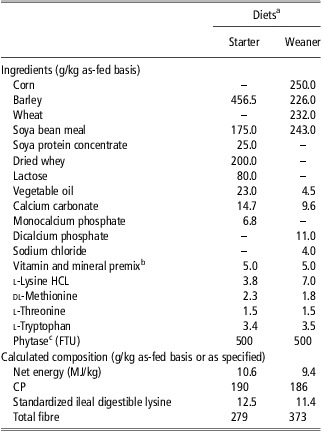
Commercial diets were used (Table 1). The starter diet was based on barley, soya bean meal and whey, and the weaner diet was based on corn, barley, wheat and soya bean meal. The starter and weaner diets provided 10.6 and 9.4 MJ net energy/kg and 12.5 and 11.4 g/kg standardized ileal digestible lysine, respectively. The starter and weaner diets were offered as pellets with a diameter of 2.2 and 3.0 mm, a length of 4.5 and 7.0 mm and a hardness of, respectively, 6.4 and 8.7 KH (Kahl Pellet Hardness Tester, Amandus Kahl GmbH & Co. KG, Reinbek, Germany). During the first 6 days post weaning, feed was offered restrictively at successively 50, 80, 100, 150, 200 and 400 g/day to prevent the digestive disorders. From day 6 onwards and until the end of the experiment, feed was offered ad libitum. Water was available ad libitum throughout the experiment.
Ingredients and composition of the diets

aStarter diet was distributed during phase I and weaner diet during phases II and III.
bPremix supplied per kg as-fed basis; for starter diet: vitamin A, 15 000 IU; vitamin D3, 3000 IU; vitamin E, 40 IU; Fe as iron sulfate, 104 mg; Cu as copper sulfate, 20 mg; Zn as zinc oxide, 99 mg; Mn as manganese oxide, 40 mg; Co as carbonate cobalt, 2 mg; Se as sodium selenium, 0.3 mg; I as calcium iodate, 1 mg. For weaner diet: vitamin A, 10 000 IU; vitamin D3, 2000 IU; vitamin E, 20 mg; Fe, 104 mg; Cu, 20 mg; Zn, 99 mg; Mn, 40 mg; Co, 1 mg; Se, 0.3 mg; I, 0.6 mg.
cEC 3.1.3.8, Natuphos®, BASF, Limburgerhof, Germany.
Measurements, observations and sampling
Pigs were weighed individually, after an overnight fast at the beginning of each phase and on day 42, and without overnight fasting at days 4, 8, 15, 19, 22, 26, 36 and 40 to calculate growth for successive periods. Rectal temperature was measured on these days. Feed refusals were collected daily to determine feed intake. The consistency of faeces was monitored daily and scored using a 3-level score (0 = solid, 1 = soft and 2 = diarrhoeic faeces) and the percentage of pig-days with soft or diarrhoeic faeces was calculated.
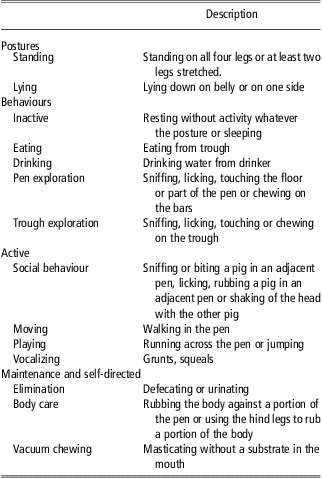
Behavioural observations of pigs were performed at 1000 h (i.e. after feed distribution) by using 2-min instantaneous scan sampling (Altmann, Reference Altmann1974) for 50 min per day (equivalent to 25 observations per day for each pig). Behavioural observations began from day 4 post weaning because on the first 3 days pigs were submitted to a test of habituation to the presence of experimenter. Behaviour of pigs was observed every day (except for Sunday) around of each potentially stressful situation (i.e. weaning, diet change, housing change) and every 2 or 3 days in situation where pigs were acclimated to their environment (i.e. on the last week of phase II). Thus, behavioural observations were performed on 7 days in phase I (after the weaning and before the diet change on days 4 to 9 and day 11), 14 days in phase II (during the diet change on days 12 to 16, after the diet change on days 18 to 22 and on days 25, 27, 29 and 32 before the housing change) and 7 days in phase III (during and after the housing change on days 33 to 37, days 41 and 42). These repeated observations were carried out to evaluate dynamic changes in behaviour. Two main postures and seven behaviours were recorded (Table 2). For data analysis, social behaviour, moving, playing and vocalizing were grouped in a common term ‘active behaviour’. Ingestive behaviour (eating and drinking) and investigative behaviour (pen and trough exploration) were recorded. Elimination, body care and vacuum chewing were gathered as ‘maintenance and self-directed behaviours’, whereas the remaining activities were grouped as ‘inactive behaviour’. The recordings during the 50 min scan sampling were expressed as a percentage of time spent for each posture and activity.
Ethogram used in this experiment

Blood samples (10 ml) were collected in each pig by puncture of the jugular vein at the end of each phase (days 12, 26 and 40, heparinized samples) and on day 68 (serum samples). Blood samples were centrifuged at 2500 × g for 15 min at 4°C and plasma and serum were stored at −20°C until analysis. The plasma concentration of haptoglobin was determined using a colorimetric method and haptoglobin assay kit based on binding of haptoglobin to haemoglobin (Tridelta Ltd, Maynooth, Co. Kildare, Ireland). Serum anti-H1N1 antibodies were determined using an enzyme immunoassay according to provider's instructions (HerdChek SIV Antibody Test Kit, IDEXX Laboratories, Hoofddorp, The Netherlands).
Statistical analysis
Data were analysed as a randomized complete block design using the Mixed procedure of SAS (version 8.1, 2000, SAS Institute Inc., Cary, NC, USA), with repeated measures over time and the pig as experimental unit (Littell et al., Reference Littell, Henry and Ammerman1998). The model included sanitary conditions, time (phases or successive periods) and their interaction as the fixed effects, whereas animal was considered as a random effect. In a first analysis, the phase was used as the time effect. In a more detailed analysis, successive periods of time were used to study the dynamic response to diet and housing changes. Antibody titres were analysed as a randomized complete block design using the Mixed procedure of SAS including the sanitary condition as the main fixed factor and the block effect as a random factor. Results are presented as least-squares means for each sanitary condition. Least-squares means comparisons for each combination of sanitary conditions and time were made only when there was a tendency for an interaction between these terms (P ⩽ 0.10). Effects were considered significant at P < 0.05 and as a trend at P ⩽ 0.10.
Results
Intake and growth performance
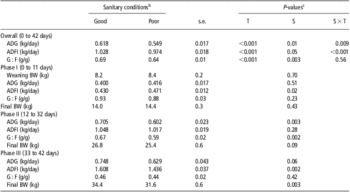
The poor sanitary conditions resulted in a decrease in average daily gain (ADG), average daily feed intake (ADFI) and gain to feed ratio (G : F) by 11%, 5% and 7%, respectively, for the overall experimental period (Table 3), when compared with the good sanitary conditions. The effect of sanitary conditions on performance differed between phases. During phase I, pigs kept in poor sanitary conditions consumed 41 g/day more than pigs kept in good sanitary conditions. Because feed was offered at a restricted level during the first 6 days post weaning, this difference concerned only the last 6 days of ad libitum intake. During phase II, ADG and G : F of pigs in poor sanitary conditions were, respectively, 15% and 12% lower compared with those in good sanitary conditions. The ADFI did not differ between sanitary conditions during the phase II. During phase III, ADG tended to be lower for pigs in poor sanitary conditions. The ADFI was significantly lower for pigs in poor sanitary conditions (−11%). At the end of phase III, pigs in poor sanitary conditions were 2.8 kg lighter than those in good sanitary conditions.
Consequences of the deterioration of sanitary conditions on pig performance during 42 days post weaningFootnote a

ADG = average daily gain; ADFI = average daily feed intake; G : F = gain to feed ratio.
a Values are least-square means; n = 10 pigs/sanitary condition; Phase I: starter diet, pigs housed in weaning unit; Phase II: weaner diet, pigs housed in weaning unit; Phase III: weaner diet, pigs housed in grower unit.
b In good sanitary conditions, pigs were housed in cleaned and disinfected rooms and received an antibiotic supplementation in contrast to pigs kept in poor sanitary conditions, which were housed in rooms that were not cleaned.
c Probability values for the effect of time (T), sanitary conditions (S) and the interaction S × T.
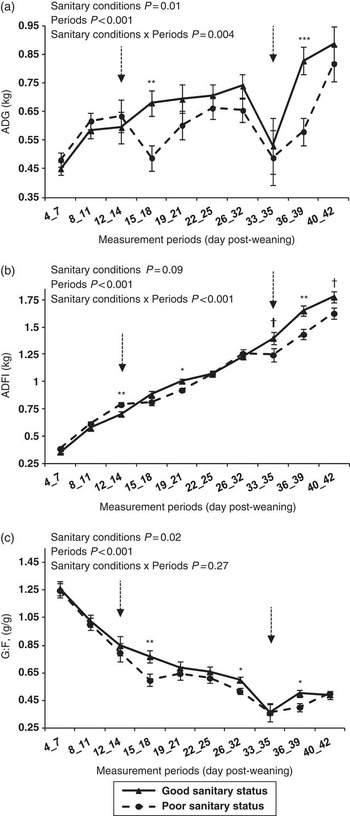
The diet change resulted in a decrease in ADG of pigs in poor sanitary conditions (0.49 ± 0.04 kg/day on days 15 to 18 v. 0.64 ± 0.04 kg/day on days 12 to 14; Figure 1a). In contrast, there was no decrease in ADG of pigs in good sanitary conditions following the diet change. Thus, a 28% difference in ADG was observed between both sanitary conditions at days 15 to 18. For pigs in poor sanitary conditions, 7 days were necessary so that ADG exceeded values observed before the diet change (Figure 1a). The housing change on day 33 resulted in a decrease in ADG of pigs in good sanitary conditions (0.53 ± 0.10 kg/day on days 33 to 35 v. 0.74 ± 0.04 kg/day on days 26 to 32). A reduction was also observed for pigs in poor sanitary conditions but the difference between periods was not significant. Following the initial decline in ADG, pigs in good sanitary conditions recovered more quickly than those in poor sanitary conditions (Figure 1a). Thus, ADG at days 36 to 39 was 30% lower in the poor sanitary conditions compared with the good conditions. In good sanitary conditions, ADG measured at the housing change was lower than that at the diet change (P = 0.05 between days 33 to 35 and days 15 to 18 within the good sanitary conditions), although ADG did not differ between these two stressors in poor sanitary conditions.
Average daily gain (a), in kg/d, average daily feed intake (b), in kg/d, and gain to feed ratio (c), in g/g, measured in pigs housed in poor or good sanitary conditions during 42 days post weaning (day 0). The two arrows indicate successively the diet change (starter to weaner diet) and the housing change (weaning to grower unit). Values are least-squares means and their respective standard error (LS means ± s.e.) calculated for 10 pigs per sanitary condition. Within a period, symbols †, *, ** and *** denote an effect of sanitary conditions, P < 0.10, P < 0.05, P < 0.01 and P < 0.001, respectively.

Neither the change of diet nor housing decreased ADFI in pigs in good sanitary conditions (Figure 1b). In contrast, for pigs in poor sanitary conditions, the two stressors led to a stagnation of ADFI. At the diet change (days 12 to 14), ADFI was 12% higher for pigs in poor sanitary condition. After the diet change (days 15 to 18), ADFI did not differ between the sanitary conditions, whereas a difference of 8% appeared thereafter. After transfer to the grower unit, ADFI was 11% lower for pigs in poor sanitary conditions, which tended to be significant and this difference was still observed later on.
The diet change affected the G : F only in pigs in poor sanitary conditions (Figure 1c). Thus, a 22% difference was observed between both sanitary conditions at days 15 to 18. Transfer to grower unit decreased the G : F both in pigs in poor (0.36 ± 0.06 at days 33 to 35 v. 0.52 ± 0.02 at days 26 to 32) and in good (0.37 ± 0.06 at days 33 to 35 v. 0.60 ± 0.02 at days 26 to 32) sanitary conditions.
Pig health
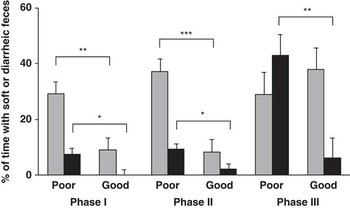
Rectal temperature of pigs was not affected by the sanitary conditions (data not shown) with an average of 39.3 ± 0.1°C for the overall experimental period. The number of days with diarrhoeic faeces was relatively low throughout experimental period, but was greater for pigs in poor than in good sanitary conditions (Figure 2, P < 0.001). For pigs in poor sanitary conditions, diarrhoeic faeces was more frequently observed during phase III (43% of the time) compared with the first two phases (<10%). The number of days with soft faeces was greater in pigs in poor sanitary conditions than those in good sanitary conditions (P = 0.01). In pigs in poor sanitary conditions, soft faeces were observed for 30% to 40% of the time across the three phases. In pigs in good sanitary conditions, the occurrence of soft faeces was low in phases I and II (both less than 10% of the time), and increased during phase III.
Percentage of time with soft (grey) and diarrhoeic faeces (dark bar) in each sanitary condition (poor and good) during the three phases of experiment: Phase I from day 0 to 11 post weaning; Phase II from day 12 to 32 post weaning; Phase III from day 33 to 42 post weaning. Values are least-squares means and their respective standard error (LS means ± s.e.) of percentage calculated for 10 pigs per sanitary condition. Within a phase, symbols *, ** and *** denote an effect of sanitary conditions, P < 0.05, P < 0.01 and P < 0.001, respectively.

Overall, the plasma concentration of haptoglobin was not modified by the sanitary conditions (1.45 and 1.38 ± 0.18 g/l in poor and good sanitary conditions; P = 0.77) but a tendency in the interaction was observed (P = 0.10). In phase II, plasma concentration of haptoglobin tended to be higher in pigs in poor than in good sanitary conditions (1.44 v. 0.86 ± 0.22 g/l; P = 0.06). In addition, it tended to increase with time in both conditions (from 1.27 ± 0.18 g/l in average on phase I to 1.82 ± 0.38 g/l in average on phase III; P = 0.07). Serum antibodies to swine influenza virus after vaccination tended to be higher in pigs in poor sanitary conditions compared with those in good sanitary conditions (titres of 1.11 and 0.88 ± 0.09, respectively, P = 0.11).
Behavioural observations
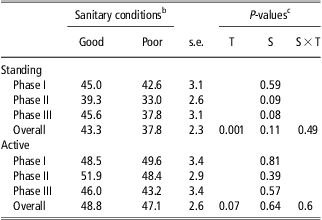
Overall, pigs in poor sanitary conditions were standing less than pigs in good sanitary conditions (Table 4), mostly because of more standing during phases II and III. A time effect was observed in pigs of both sanitary conditions, with pigs standing less often during phase II than during phases I and III. There was no difference between sanitary conditions on the percentage of active time and pigs were active for ∼50% of time. During the 28 days of observation, the time spent in drinking, maintenance and self-directed behaviours was less than 5% of the total active time and was not analysed further.
Consequence of the deterioration of sanitary conditions on posture and activity of pigsFootnote a
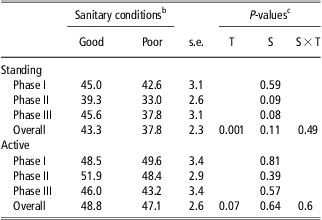
a Values are least-square means of percentage of time spent standing or active recorded during 50 min scan-sampling per day of observations; Phase I: n = 10 pigs × 25 scans × 7 days/sanitary condition; Phase II: n = 10 pigs × 25 scans × 14 days/sanitary condition; Phase III: n = 10 pigs × 25 scans × 7 days/sanitary condition; Overall experiment: n = 10 pigs × 25 scans × 28 days/sanitary condition.
b In good sanitary conditions, pigs were housed in cleaned and disinfected rooms and received an antibiotic supplementation in contrast to pigs kept in poor sanitary conditions, which were housed in rooms that were not cleaned.
c Probability values are for the effect of time (T), sanitary conditions (S) and the interaction S × T.
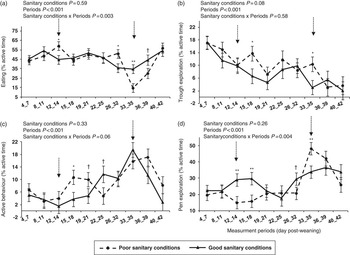
At the diet change, pigs in poor sanitary conditions spent 14% more time eating than those in good sanitary conditions (Figure 3a), which is consistent with the higher ADFI. Following the diet change, pigs in poor sanitary conditions spent 7% more time exploring the trough (Figure 3b) and had more active behaviour (Figure 3c) and spent 15% less time exploring the pen (Figure 3d) than those in good sanitary conditions. Before the housing change, pigs in poor sanitary conditions tended to spend less time exploring the pen (Figure 3d) and in active behaviours (Figure 3c) but spent 15% more time eating (Figure 3a) compared with pigs in good sanitary conditions. The housing change resulted in a strong increase in active behaviours in the two sanitary conditions (Figure 3c). In addition, pigs in poor sanitary conditions spent much more time exploring the pen (Figure 3d) but much less time eating (Figure 3a) compared with before the transfer. In pigs in good sanitary conditions, no modification in these activities was observed. Consequently, pigs in poor sanitary conditions spent 14% more time exploring the pen and 20% less time eating than pigs in good sanitary conditions after the housing change.
Main behavioural activities: eating (a), trough exploration (b), active behaviours (c) and pen exploration (d) observed in pigs housed in poor or good sanitary conditions. The two arrows indicate successively the diet change (starter to weaner diet) and the housing change (weaning to grower unit). Values are expressed in percentage of time recorded during 50 min scan sampling on 28 days of observations for 10 pigs per sanitary condition. Within a period, symbols †, * and ** denote an effect of sanitary conditions, P < 0.10, P < 0.05 and P < 0.01, respectively.

Discussion
Responses of pigs to the degradation of sanitary conditions
The experimental model of degradation of sanitary conditions was used to induce a low-grade inflammation resulting in a reduction of performance and health status (Williams et al., Reference Williams, Stahly and Zimmerman1997; Le Floc'h et al., Reference Le Floc'h, Le Bellego, Matte, Melchior and Sève2009 and Reference Le Floc'h, Matte, Melchior, van Milgen and Sève2010). The reduction in ADFI and ADG in poor sanitary conditions observed in this experiment agreed with conclusions from a recent meta-analysis (−4% in ADFI and −10% in ADG, n = 13 studies; Pastorelli et al., Reference Pastorelli, van Milgen, Lovatto and Montagne2012). The higher faecal scores and the trend in phase II for a higher plasma concentration of haptoglobin in poor sanitary conditions indicated that the degradation of sanitary conditions may have affected the health of pigs. However, the consequences of poor sanitary conditions appeared later in our study than in previous experiments (Le Floc'h et al., Reference Le Floc'h, Le Bellego, Matte, Melchior and Sève2009 and Reference Le Floc'h, Matte, Melchior, van Milgen and Sève2010). The shorter duration of the first phase (12 v. 21 days in previous experiments) would explain that only the effect of weaning was observed without difference between sanitary conditions. The feed restriction applied during the first 6 days post weaning may have attenuated the short-term negative consequences of the poor sanitary conditions but also limited the performance of pigs housed in the good conditions. During a restrictive feed period of 7 days post weaning, pigs had a lower faecal score and proportion of faecal haemolytic Escherichia coli but lower performance than pigs offered feed ad libitum (Rantzer et al., Reference Rantzer, Svendsen and Westrom1996).
Vaccination against swine influenza was used to measure the extent to which the specific immunity would be affected by differences in immune stimulation resulting from the sanitary conditions. Using a similar experimental model, Williams et al. (Reference Williams, Stahly and Zimmerman1997) observed higher titres of antibodies directed to specific pathogens present in the herd, in pigs in poor sanitary conditions compared with control pigs. In our experiment, all pigs were exposed to a controlled antigenic stimulation (the herd was confirmed to be free from influenza). The trend for a higher response to vaccination in pigs housed in poor sanitary conditions might suggest that the degradation of sanitary conditions stimulates the antigen-specific humoral response. Indeed, hypergammaglobulinemia is commonly associated with infection and it has been suggested that poor sanitary conditions could have a similar effect on immunoglobulin production (Mekhaiel et al., Reference Mekhaiel, Daniel-Ribeiro, Cooper and Pleass2011). Thus, the ability of pigs in poor sanitary conditions to cope with pathogen exposure could be improved through continual stimulation of immune system.
Adaptation to the diet change
The diet change modified performance, health and behavioural responses of pigs housed in the poor sanitary conditions, whereas it had no effect on those housed in the good sanitary conditions. Compared with the starter diet, the weaner diet contained more ingredients (four cereals v. one) and had a lower protein and a higher fibre content (Table 1). Indigestible material constitutes a potential substrate for microflora including pathogenic microorganisms that may increase the risk of digestive disorders (Hampson, Reference Hampson1994; Montagne et al., Reference Montagne, Pluske and Hampson2003; Montagne et al., Reference Montagne, Arturo-Schaan, Le Floc'h, Guerra and Le Gall2010). In addition, the poor sanitary conditions probably involved high bacterial pressure. Thus, the higher faecal scores in pigs housed in poor sanitary conditions suggests that these conditions may stimulate the development of digestive disorders following a diet change. Discomfort related to digestive disorders might also explain why pigs in poor sanitary conditions were standing less longer than those housed in good conditions (Bareille, Reference Bareille2007). The stagnation of ADFI, the strong decrease in ADG and G : F observed in pigs in poor sanitary conditions after the diet change are common features of disease and stressors (Wellock et al., Reference Wellock, Emmans and Kyriazakis2003; Kyriazakis and Houdijk, Reference Kyriazakis and Houdijk2007). The stagnation of ADFI could be also indicative of a feed aversion. Indeed, pigs can develop a feed aversion through the association between the sensory properties of the feed and post-ingestive effects such as abdominal pain caused by digestive disorders (Day et al., Reference Day, Kyriazakis and Rogers1998). Through learning, pigs can modify or redirect their feeding behaviour to cope with these possible stressors (Dantzer and Mormède, Reference Dantzer and Mormède1983). This may also explain why pigs in poor sanitary conditions spent more time exploring the trough and were generally more active following the diet change. In pigs in good sanitary conditions, the inclusion of antibiotics may have suppressed the negative consequences of the diet change. Antibiotics used in our study to discriminate between both sanitary conditions (Le Floc'h et al., Reference Le Floc'h, Le Bellego, Matte, Melchior and Sève2009) may have modulated the gut microflora, prevented the proliferation of pathogenic bacteria and had an anti-inflammatory effect (Niewold, Reference Niewold2007). During this particular event of the diet change, the absence or presence of antibiotics may explain the difference in the response between pigs reared in poor or good sanitary conditions.
The diet change also resulted in a change in form and texture of the pellets, which may affect pallatability and acceptability of the new feed (Guillou and Landeau, Reference Guillou and Landeau2000; Laitat et al., Reference Laitat, De Jaeger, Vandenheede and Nicks2004). Compared with the starter diet, the pellets of weaner diet were larger and harder, which is often associated with longer chewing times resulting in a longer duration of meals. In our study, pigs spent more time eating the weaner diet compared with the starter diet. Feed preference in pigs is negatively correlated with hardness and chewing effort (Solà-Oriol et al., Reference Solà-Oriol, Roura and Torrallardona2009). Diets requiring shorter chewing times and faciliting ingestion and digestion are often preferred (Rose and Kyriazakis, Reference Rose and Kyriazakis1991). The absence of modification in the feeding behaviours of pigs in good sanitary conditions may reflect a lower reactivity to the novelty associated with a more homogeneous and stable environment (Greenberg, Reference Greenberg2003). This lower reactivity to the new feeding situtation was supported by the increase in time spent exploring the pen after the diet change, by contrast with the realization of redirected behaviours towards trough in pigs of poor sanitary conditions. Redirected behaviours are typically considered as signals of maladjustement between farm animals and their environment (Wood-Gush and Vestergaard, Reference Wood-Gush and Vestergaard1989). The poor sanitary conditions and the individually housed conditions may be related to a stressful environment, promoting redirected behaviours. Moreover, the housing in pens has been reported to result in a redirection of the exploratory behaviour towards the pen in individually housed piglets, or towards penmates in group-housed piglets (Fraser et al., Reference Fraser, Phillips, Thompson and Tennessen1991).
The decrease in ADG observed after the diet change in pigs in poor sanitary conditions is partly explained by the stagnation in ADFI. In addition, behavioural adaptations induced by the stress reaction probably resulted in an increase in energy expenditure (Mormède et al., Reference Mormède, Foury and Meunier-Salaün2006). A reduction in ADG could also be due to an increase in nutrient requirements for defence functions in relation with the continuous stimulation of the immune system induced by inflammatory response (Klasing and Johnstone, Reference Klasing and Johnstone1991). However, the effect of the stimulation was less apparent here, because the plasma haptoglobin concentration was little affected by the sanitary conditions.
Adaptation to a new housing environment
The housing change affected performance, health and behaviour in the two sanitary conditions but the recovery was faster for pigs in good sanitary conditions. Moving into a new building involves a combination of different stressors. Pigs left the security of a familiar environment to discover another unfamiliar one after being confronted with succesive events including human handling, transport and mixing during transport and finally changes in space allowance in the new building. The decrease in ADG and G : F may have resulted from an increase in energy expenditure related with an increase in maintenance requirement and a decrease in the efficiency of using metabolizable energy for growth (del Barrio et al., Reference del Barrio, Schrama, van der Hel, Beltman and Verstegen1993; Heetkamp et al., Reference Heetkamp, Schrama, Schouten and Swinkels2002), because a reallocation of energy away from growth towards other processes and behavioural adaptations (Schrama et al., Reference Schrama, Parmentier and Noordhuizen1997). The release of catecholamines and glucocorticoids in a stressed animal may have induced these metabolic changes and permitted the rapid mobilization of energy for behavioural responses (Dantzer and Mormède, Reference Dantzer and Mormède1983), such as those underlying the increased in active behaviours observed in this experiment. Moreover, the trend for highest concentration of plasma haptoglobin and the higher faecal scores of pigs in both good and poor sanitary conditions suggests that the stress of housing change probably aggravated the digestive disorders (von Borell, Reference von Borell1995). This stressor could potentially stimulate an immune response (Dantzer, Reference Dantzer2001), which also leads to a change in nutrient partitioning away from growth (Klasing and Johnstone, Reference Klasing and Johnstone1991).
In pigs in poor sanitary conditions, the housing change induced a strong motivation for exploring behaviour. This might be due to the increase in uncleaned floor space, bringing more potential substrate to investigate. The reduction in ADG and G : F associated with the housing change was lower in pigs in poor sanitary conditions than in pigs in good sanitary conditions. The ability of farm animals to cope with stressors is influenced by learning processes (Wechsler and Lea, Reference Wechsler and Lea2007). Emotionally charged events are more easily memorized than events perceived as neutral (as perhaps in the case of the diet change for pig in good sanitary conditions) and a moderate stress facilitates the learning process (Boissy et al., Reference Boissy, Arnould, Chaillou, Colson, Désiré, Duvaux-Ponter, Greiveldinger, Leterrier, Richard, Roussel, Saint-Dizier, Meunier-Salaün and Valance2007). Thus, it is possible that prior exposure to a stressor (i.e. diet change) decreased the sensitivity to another stressor (i.e. housing change; Dantzer and Mormède, Reference Dantzer and Mormède1983). Our results suggest the existence of an interaction between the sanitary conditions and other stressors rather than an additive effect of both stressors. In a stable and homogeneous environment such as the good sanitary conditions, the ability to cope with a new situation decreases during growth (Broom and Johnson, Reference Broom and Johnson1993). Intrinsic animal factors such as age, early experience or psychological aspect of the stressor may modulate the perception to a stressful situation and can influence the response of the animal (Dantzer and Mormède, Reference Dantzer and Mormède1983). It is difficult to anticipate whether the same effect would have been observed if the order of stressors was reversed (i.e. housing change before diet change) and thus to conclude whether animals are able to better deal with certain types of stressor at specific ages. Finally, pigs in both sanitary conditions succeeded to cope with the stress of housing change, whereas pigs in good sanitary condition recovered more quickly than those in poor sanitary conditions. Although the differences in growth and behavioural responses between the two sanitary conditions were less marked at the end of experiment, pigs in poor sanitary conditions were lighter than those in good conditions. This indicated that weight difference between conditions was maintained with time.
Conclusion
This experiment confirmed the negative effect of poor sanitary conditions on performance and health but also showed the impact of sanitary conditions on the adaptation of pigs to stressors. The susceptibility of pigs to a diet change was aggravated in poor sanitary conditions. The housing change was a stressfull situation for all pigs irrespective of the sanitary conditions. In both sanitary conditions, pigs succeeded to cope with this stressor but the behavioural adaptation and the recovery of performance were faster in pigs in good sanitary conditions.
Acknowledgements
The authors gratefully acknowledge B. Carissant, H. Demay, F. Guerin, N. Mézière, V. Piedvache, P. Roger and P. Touanel from INRA–PEGASE for their invaluable and skillful technical assistance. This work was financially supported by the Région Bretagne (France).