

Implications
Our improved knowledge of the neurobiology governing the onset of maternal behaviour, and the importance of sensory stimuli from the neonate for maternal attachment, can offer practical guidance to improve offspring survival. In particular appropriate nutrition during pregnancy, management and sire selection to avoid difficult deliveries, allowing ewes the opportunity to lamb in a quiet and stress-free environment away from other ewes if they choose, and ensuring that ewes are exposed to amniotic fluids from the newborn lamb are important. Primiparous ewes are especially vulnerable to disturbance and need particular care to allow a bond to develop with the lamb.
Introduction
The function of maternal care is to promote improved offspring survival, by a range of strategies to provide the offspring with nutrition, thermoregulation, protection (both immunological and physical), comfort, and opportunities for social learning, particularly in higher animals. For mammalian livestock species there is a tendency to focus on the nutritional aspects of maternal care, which are vital for the early survival of the newborn through fuelling thermoregulation, and providing immunological protection via colostrum intake. However, the psychological components and opportunities for social learning provided by maternal care are also very important, with the duration that offspring are dependent on their mother increasing with complexity of the social environment (e.g. Avital and Jablonka, Reference Avital and Jablonka1994; Rosenblatt, Reference Rosenblatt2003; Russell and Lummaa, Reference Russell and Lummaa2009). Provision of opportunities for social learning may have been the driver for the evolution of maternal care, with other benefits co-evolving, as has been hypothesised, and suggests that we could pay closer attention to the non-nutritional benefits of maternal care in livestock husbandry.
The suite of behaviours and activities expressed by the mother to achieve the many benefits of maternal care vary with species-specific characteristics such as evolved social and reproductive strategy, litter size and offspring maturity at birth. This review will focus on maternal care in the sheep, as one of the most studied livestock species for these traits, particularly with respect to the neuroendocrine profile underpinning the onset of maternal care (e.g. Kendrick et al., Reference Kendrick, da Costa, Broad, Ohkura, Guevara, Lévy and Keverne1997; Dwyer, Reference Dwyer2008a). Lamb survival is dependent on the coordinated expression of behaviours of both ewe and lamb, but this review will be restricted to the behaviour of the ewe only, as the member of the partnership where we know most about the neuroendocrine basis of behaviour. The sheep is a seasonally breeding animal, which lives in a matriarchal social group and gives birth to typically one to two relatively large and precocious offspring that are able to follow their dam soon after birth. These evolved species-specific adaptations influence the behaviours expressed by the mother towards her newborn offspring: the ewe and lamb need to be able to identify one another and to rapidly develop an exclusive attachment. The costs of known non-offspring nursing are particularly high for mothers with small litters, especially if food is limited, and is not commonly observed in monotoccus mothers (Packer et al., Reference Packer, Lewis and Pusey1992). Offspring may attempt to steal milk from ewes, and this is exacerbated in sheep flocks where there may be many young simultaneously. Thus the ewe that can rapidly identify her own offspring is able to limit her lactational effort largely to her own offspring, so improving the chances of its, and her own, survival. The dual components of maternal care (nurturing and recognition) are achieved by the immediate licking and grooming behaviour expressed by the ewe, which contributes to maternal learning of the olfactory signature of her own offspring (Kendrick et al., Reference Kendrick, da Costa, Broad, Ohkura, Guevara, Lévy and Keverne1997; Poindron et al., Reference Poindron, Lévy and Keller2007), and cooperation with sucking attempts of the lamb, which promotes lamb attachment to its dam (Goursaud and Nowak, Reference Goursaud and Nowak1999). Maternal behaviour at birth is, therefore, characterised by high levels of licking and grooming (Lent, Reference Lent1974; Alexander, Reference Alexander1988), accompanied by a specific maternal vocalisation (low-pitched bleating) and cooperation with lamb attempts to find the udder and suckle, and an absence of rejection or avoidance of the lamb. These behaviours progress to the development of an exclusive attachment to the lamb (termed maternal ‘selectivity’, Poindron et al., Reference Poindron, Lévy and Keller2007), recognition via all sensory modalities, increased maternal vigilance, maintenance of a close spatial proximity and frequent sucking interactions (e.g. Dwyer and Lawrence, Reference Dwyer and Lawrence2005a). Following the successful establishment of maternal behaviour and the ewe-lamb bond the ewe will continue to express maternal behaviour throughout lactation, the quality of this subsequent care determined by the initial onset of maternal behaviour (Pickup and Dwyer, Reference Pickup and Dwyer2011). The purpose of this review is to consider the biological mechanisms whereby a ewe, which may have shown no interest in, or active avoidance of, a newborn lamb shortly before birth can show immediate and focused maternal attention after birth, even if she has never given birth before. The review will first consider current understanding about the neuroendocrine basis of maternal behaviour, then describe sources of individual variation in maternal care and their underlying biology. Finally the review will address how knowledge of these mechanisms can be utilised in a production setting to improve expression of these maternal behaviours and hence lamb survival.
The neurobiological basis for maternal behaviour
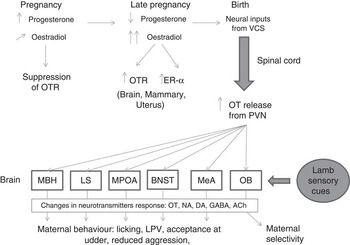
The onset of maternal behaviour at birth is critically dependent on the temporal sequence of events intimately associated with late pregnancy and parturition (illustrated in Figure 1). In brief, these are changes in the relative concentrations of oestradiol and progesterone in late gestation (specifically the decline in progesterone in the days before birth and an exponential rise in circulating oestradiol from the placenta (Kendrick and Keverne, Reference Kendrick and Keverne1991)), the stretching of the birth canal as the fetus is expelled from the uterus (vaginocervical stimulation, VCS) resulting in the central release of oxytocin from the paraventricular nucleus (PVN) of the hypothalamus (Keverne and Kendrick, Reference Keverne and Kendrick1992; Kendrick et al., Reference Kendrick, Lévy and Keverne1992a; Da Costa et al., Reference Da Costa, Guevara-Guzman, Ohkura, Goode and Kendrick1996), and sensory cues provided by the newborn lamb, particularly emanating from the amniotic fluids in which it is soaked (Lévy et al., Reference Lévy, Poindon and Le Neindre1983; Poindron et al., Reference Poindron, Lévy and Keller2007, Reference Poindron, Otal, Ferreira, Keller, Guesdon, Nowak and Lévy2010).
Schematic depicting the key physiological and neurological changes during pregnancy and birth associated with the onset of maternal behaviour. VCS=vaginocervical stimulation; OTR=oxytocin receptor; ER-α=oestrogen receptor-α; OT=oxytocin; PVN=paraventricular nucleus of the hypothalamus; MBH=mediobasal hypothalamus; LS=lateral septum; MPOA=medial pre-optic area; BNST=bed nucleus of the stria terminalis; MeA=medial amygdala; OB=olfactory bulb; NA=noradrenaline; DA=dopamine; GABA=γ-amino butyric acid; ACh=acetylcholine; LPV=low-pitched vocalisations.

Alone, neither maternal oestradiol nor VCS are effective in producing the full complement of maternal behaviours, but act in concert to bring about maternal responsiveness. Kendrick and Keverne (Reference Kendrick and Keverne1991) demonstrated that when ewes were treated with oestradiol and progesterone, progesterone alone or saline and presented with a newborn lamb none of the animals showed maternal care, although there was a reduction in butting and withdrawal in ewes pre-treated with both progesterone and oestradiol. Following artificial VCS however, ewes treated with oestradiol, and particularly those treated with progesterone and oestradiol, showed licking and affiliative behaviours towards the lamb accompanied by low-pitched bleating. Ewes not pre-treated with the sex steroids continued to show aggressive responses and withdrawal towards the lamb after receiving VCS (Kendrick and Keverne, Reference Kendrick and Keverne1991).
The relative concentration of oestradiol and progesterone act as a primer for the onset of maternal behaviour and need the presence of oestrogen receptor-α (ER-α) to exert their effects (Young et al., Reference Young, Wang, Donaldson and Rissman1998). Binding of oestradiol to ER-α stimulates an increase in the expression of oxytocin receptors (OTR) in several key regions of the brain (e.g. medial preoptic area (MPOA), ventromedial hypothalamus, lateral septum, medial amygdala, bed nucleus of the stria terminalis (BNST), PVN; Broad et al., Reference Broad, Lévy, Evans, Kimura, Keverne and Kendrick1999, Figure 1) associated with the expression of maternal behaviour. This up-regulation of OTR is inhibited by high relative concentrations of progesterone earlier in gestation (Broad et al., Reference Broad, Kendrick, Sirinathsinghji and Keverne1993), thus it is only when there is an increase in oestradiol and a decrease in progesterone in late gestation that the ewe becomes prepared to express maternal care. The ‘trigger’ for the expression of maternal behaviour is provided by VCS at delivery such that the onset of maternal care is exquisitely timed to coincide with the birth of the lamb. VCS engenders the release of central oxytocin via a spinal reflex (known as the ‘Ferguson Reflex’), terminating in the PVN of the hypothalamus (Da Costa et al., Reference Da Costa, Guevara-Guzman, Ohkura, Goode and Kendrick1996, Figure 1). The importance of this reflex has been shown in studies where the peripheral input was prevented following spinal anaesthesia (Krehbiel et al., Reference Krehbiel, Poindron, Lévy and Prud’homme1987) and onset of maternal behaviour was abolished. Maternal behaviour can be restored through the infusion of intracerebroventricular oxytocin (Lévy et al., Reference Lévy, Kendrick, Keverne, Piketty and Poindron1992).
Parturition, and the accompanying increase in central oxytocin, elicits an increase in the neurotransmitters acetylcholine, noradrenaline, glutamate, GABA and dopamine in the olfactory bulb (Keverne et al., Reference Keverne, Lévy, Guevara-Guzman and Kendrick1993; Lévy et al., Reference Lévy, Guevara-Guzman, Hinton, Kendrick and Keverne1993, Reference Lévy, Kendrick, Goode, Guevara-Guzman and Keverne1995), and an increase in noradrenaline and dopamine in the BNST, MPOA and PVN (Kendrick et al., Reference Kendrick, Lévy and Keverne1992a; Da Costa et al., Reference Da Costa, Guevara-Guzman, Ohkura, Goode and Kendrick1996). These brain regions are specifically associated with the nurturing and selectivity aspects of maternal care in the ewe.
The final cues in the sequence resulting in the successful expression of maternal behaviour are the behaviours and sensory information provided by the lamb. Initially the ewe is attracted not to the lamb but to the smell and taste of amniotic fluids, even though ewes are actively repulsed by these same cues only a day or so before parturition (Lévy et al., Reference Lévy, Poindon and Le Neindre1983; Arnould et al., Reference Arnould, Piketty and Lévy1991). During labour the ewe shows increasing interest in the amniotic fluids that have been spilt during the rupture of the amniotic sac (or indeed those of other lambing ewes), and this attraction is transferred to the newborn lamb whose birth coat is soaked in amniotic fluids. The importance of amniotic fluids for the onset of maternal care is shown by studies where the amniotic fluids have been removed from the newborn lamb by washing, which result in disturbances in the onset of maternal care, and may eliminate maternal care in inexperienced ewes (Lévy and Poindron, Reference Lévy and Poindron1987; Poindron et al., Reference Poindron, Otal, Ferreira, Keller, Guesdon, Nowak and Lévy2010). Likewise in ewes that have been rendered temporarily anosmic, maternal care, particularly of inexperienced animals, may be disrupted or prevented (Lévy et al., Reference Lévy, Poindon and Le Neindre1983). Prevention of physical interaction between ewe and lambs for the first 4 h after birth (licking or nursing) reduces maternal acceptance in primiparous ewes, although not in multiparous ewes (Otal et al., Reference Otal, Lévy, Cornilleau, Moussu, Keller and Poindron2009). These impairments were not seen in ewes only prevented from suckling their lambs, so emphasising the importance of olfactory information.
In addition to their role in the onset of maternal behaviour the olfactory cues provided by amniotic fluid also provide the basis of maternal specificity for her own lamb or ‘selectivity’ (Poindron et al., Reference Poindron, Lévy and Keller2007). This is the process by which the ewe rapidly learns the olfactory signature of her own lamb, generally within 30 min of birth, and thereafter restricts her maternal care to her own offspring, repelling the attempts of other lambs to approach or suckle. The period of maternal learning is temporally related to the elevated release of oxytocin in the brain (Keverne and Kendrick, Reference Keverne and Kendrick1992; Kendrick et al., Reference Kendrick, Lévy and Keverne1992a; Da Costa et al., Reference Da Costa, Guevara-Guzman, Ohkura, Goode and Kendrick1996; Kendrick, Reference Kendrick2000), and is accompanied by changes in neurotransmitter release profiles in the olfactory bulb when ewes are presented with their own or an alien lamb (Keverne et al., Reference Keverne, Lévy, Guevara-Guzman and Kendrick1993; Lévy et al., Reference Lévy, Kendrick, Goode, Guevara-Guzman and Keverne1995). This process is accompanied by a down-regulation of neurogenesis in the hippocampus and olfactory system, which may favour the retention of olfactory memories relating to offspring identity (Brus et al., Reference Brus, Meurisse, Franceschini, Keller and Lévy2010; Lévy et al., Reference Lévy, Gheusi and Keller2011). The reduction in neurogenesis is known to involve oestradiol (Lévy et al., Reference Lévy, Gheusi and Keller2011), further supporting a role for this hormone in organising maternal responses in the sheep.
Individual variation in maternal behaviour
When all the cues are present in the correct temporal sequence maternal behaviour and ewe-lamb bonding is elicited. However, there are several factors that are known to be associated with altered or absent expression of maternal behaviour. Impairments in maternal care can range from delayed onset of maternal behaviour, acceptance of only one of a pair of twins, or a complete absence of maternal responsiveness. Predispositions to these disturbances in maternal behaviour expression include maternal inexperience (specifically reduced maternal care in primiparous ewes; Dwyer and Lawrence, Reference Dwyer and Lawrence2000), some maternal genotypes (Poindron et al., Reference Poindron, Le Neindre, Lévy and Keverne1984; Le Neindre et al., Reference Le Neindre, Murphy, Boissy, Purvis, Lindsay, Orgeur, Bouix and Bibé1998; Dwyer and Lawrence, Reference Dwyer and Lawrence1998, Reference Dwyer and Lawrence2000; Dwyer et al., Reference Dwyer, McLean, Deans, Chirnside, Calvert and Lawrence1998), maternal undernutrition in gestation (Dwyer et al., Reference Dwyer, Lawrence, Bishop and Lewis2003), maternal psychological stress in gestation (Hild et al., Reference Hild, Coulon, Schroeer, Andersen and Zanella2011) and difficult delivery (Dwyer et al., Reference Dwyer, Lawrence, Bishop and Lewis2003; Darwish and Ashmawy, Reference Darwish and Ashmawy2011). The reason why these sources of variation in maternal behaviour have this influence can be at least partly related to their impact on the neurobiology underpinning the onset of maternal care.
Maternal experience
Ewes giving birth for the first time, as for many species, tend to give birth to smaller offspring, do not show as competent maternal care as more experienced ewes, and the mortality of their offspring is higher (Dwyer and Lawrence, Reference Dwyer and Lawrence2005a). Although primiparous ewes show as much total grooming or licking and low-pitched bleating as more experienced ewes (Dwyer and Lawrence, Reference Dwyer and Lawrence2000), they are slower to begin grooming their lambs, and show a higher frequency of behavioural disturbances such as aggression towards the lamb, withdrawal or lamb avoidance, and a lack of cooperation with lamb attempts to suck (Dwyer and Lawrence, Reference Dwyer and Lawrence1998, Reference Dwyer and Lawrence2005a). The data suggest that the primiparous ewes may be stimulated to express maternal behaviour but might be inhibited in their willingness to approach and interact with the lamb which represents a novel object and a potential source of fear. These behavioural disturbances are often short-lived, however, and the experience of interacting with and caring for the lamb is accompanied by a maturing of behavioural and physiological responses.
Primiparous ewes have been shown to have similar concentrations of circulating oestradiol in late gestation as multiparous animals (Dwyer and Smith, Reference Dwyer and Smith2008). However, multiparous ewes have a higher density of ER-α in the hypothalamic and limbic regions of the brain (Meurisse et al., Reference Meurisse, Gonzalez, Delsol, Caba, Lévy and Poindron2005) and are therefore more sensitive or reactive to similar circulating concentrations of oestradiol. Inactivation of MPOA in primiparous parturient ewes induces severe deficits in maternal behaviour which are much reduced in multiparous animals (Perrin et al., Reference Perrin, Meurisse and Lévy2007), suggesting that primiparous ewes may rely more on the involvement of this area of the brain than multiparous ewes for the onset of maternal behaviour. Parturition increases release of the neurotransmitters acetylcholine, noradrenaline, glutamate and GABA in the olfactory bulb of multiparous but not primiparous ewes (Keverne et al., Reference Keverne, Lévy, Guevara-Guzman and Kendrick1993; Lévy et al., Reference Lévy, Guevara-Guzman, Hinton, Kendrick and Keverne1993). Basal dopamine release, however, is greater in primiparous ewes compared with multiparous, but increases in response to parturition in both groups of ewe (Keverne et al., Reference Keverne, Lévy, Guevara-Guzman and Kendrick1993). The greater sensitivity of multiparous ewes, mediated through their increased number of OTR and potentiated neurotransmitter responses, may explain why these animals are less disturbed in their behaviour than primiparous ewes when some of the olfactory cues eliciting maternal behaviour are manipulated (e.g. washing the newborn lamb or anosmia; Poindron et al., Reference Poindron, Lévy and Keller2007).
Primiparous ewes have been shown, however, to develop selectivity at a similar rate to multiparous ewes (Keller et al., Reference Keller, Meurisse, Poindron, Nowak, Shayit, Ferreira and Lévy2003). This means that the sensitive period for developing an olfactory recognition of their lamb may only be present for the first 30 to 60 min after birth. If fearfulness of the lamb, or a delayed ability to switch from an attraction to the spilt amniotic fluids to an attraction for the lamb, prevents the ewe from interacting with her lamb during this time window she may fail to establish selectivity with her own lamb. Lack of development of maternal recognition will then result in rejection of her own offspring, which is sometimes seen with primiparous ewes. In fact separation of the ewe and lamb at birth for 4 h is more detrimental to acceptance of the lamb in primiparous ewes compared with multiparous (Otal et al., Reference Otal, Lévy, Cornilleau, Moussu, Keller and Poindron2009), suggesting that young ewes are more dependent on the maintenance of close contact with their lambs to be properly maternal than older ewes.
Genotype effects
Many studies, comparing several different breed combinations, have demonstrated breed differences in the expression of maternal behaviour, in terms of their ability to recognise their own offspring, willingness to remain at the birth site, lamb abandonment and differences in the expression of maternal affiliative and negative behaviours (Shillito-Walser, Reference Shillito-Walser1980; Alexander et al., Reference Alexander, Stevens, Kilgour, de Langen, Mottershead and Lynch1983; Poindron et al., Reference Poindron, Le Neindre, Lévy and Keverne1984; Le Neindre et al., Reference Le Neindre, Murphy, Boissy, Purvis, Lindsay, Orgeur, Bouix and Bibé1998; Dwyer and Lawrence, Reference Dwyer and Lawrence1998, Reference Dwyer and Lawrence2000; Dwyer, Reference Dwyer2008b; von Borstel et al., Reference von Borstel, Moors, Schichowski and Gauly2011). We have carried out a series of studies comparing Scottish Blackface (SBF) (a hill breed of sheep that is relatively unselected for production traits) to Suffolk ewes (a lowland breed intensively selected for growth characteristics). In these breeds, as is also true of other hill, upland and more primitive breeds which have been subjected to less human intervention, SBF ewes show higher levels of maternal care, in comparison to the Suffolk which, in common with other more intensively selected and reared animals, display greater variability in maternal behavior and express the poorest quality of maternal care (reviewed by Dwyer and Lawrence, Reference Dwyer and Lawrence2005a; Dwyer, Reference Dwyer2008b).
SBF ewes have higher circulating oestradiol concentrations in late gestation (Dwyer et al., Reference Dwyer, Dingwall and Lawrence1999), and show a greater pre-partum surge of oestradiol (Dwyer et al., Reference Dwyer, Gilbert and Lawrence2004), compared with Suffolk ewes. There is no consistent breed effect on plasma progesterone concentration, resulting in higher a oestradiol : progesterone ratio in SBF ewes in late gestation, which may lead to increased expression of OTR in SBF ewes. The elevated oestradiol concentration is positively correlated with the quantity of maternal grooming behaviour and frequency of low-pitched bleats (Dwyer et al., Reference Dwyer, Dingwall and Lawrence1999, Reference Dwyer, Gilbert and Lawrence2004). Basal oxytocin secretion to the periphery in late gestation, or at parturition, is not affected by ewe breed (Dwyer et al., Reference Dwyer, Gilbert and Lawrence2004), although plasma oxytocin concentrations in the immediate post-partum period are elevated in SBF ewes in comparison to Suffolk ewes. This latter may, however, be explained by increased ewe-lamb contact and suckling which are also known to increase circulating oxytocin (Fuchs et al., Reference Fuchs, Ayromlooi and Rasmussen1987; Nelson and Panksepp, Reference Nelson and Panksepp1998). The effect of breed on central OTR numbers and neurotransmitter release has not been investigated.
Although still to be tested it can be hypothesised that higher circulating oestradiol in the late pregnant SBF ewe mediates an upregulation of OTR in the limbic and hypothalamic areas of the brain which results in an increased expression of maternal behaviour. Our preliminary data also suggests that Suffolk ewes show delayed development of maternal selectivity (Dwyer et al., unpublished): these ewes continue to express maternal care to both their own and alien lambs for a longer period than SBF ewes.
Maternal nutrition in pregnancy
Ewes undernourished in pregnancy have reduced udder weight and mammary development (Mellor and Murray, Reference Mellor and Murray1985; Mellor et al., Reference Mellor, Flint, Vernon and Forsyth1987), delayed onset of lactation (Mellor et al., Reference Mellor, Flint, Vernon and Forsyth1987), reduced colostrum yield and milk production (Mellor and Murray, Reference Mellor and Murray1985; Hall et al., Reference Hall, Holst and Shutt1992; O’Doherty and Crosby, Reference O’Doherty and Crosby1996) and increased lamb mortality (Kleeman et al., Reference Kleeman, Walker, Walkley, Ponzoni, Smith, Grimson and Seamark1993; Hinch et al., Reference Hinch, Lynch, Nolan, Leng, Bindon and Piper1996; Rooke et al., Reference Rooke, Houdijk, McIlvaney, Ashworth and Dwyer2010). These ewes also display behavioral impairments, taking longer to interact with their lambs (Thomson and Thomson, Reference Thomson and Thomson1949), displaying more aggression to the lamb, spending less time grooming and more time eating after birth (Dwyer et al., Reference Dwyer, Lawrence, Bishop and Lewis2003), and are more likely to desert their lambs (Putu et al., Reference Putu, Poindron and Lindsay1988; Lindsay et al., Reference Lindsay, Nowak, Putu and McNeill1990), than well-fed ewes. In specific tests of the strength of attachment between ewe and lamb, undernourished ewes were less attached to their lambs than adequately fed ewes (Dwyer et al., Reference Dwyer, Lawrence, Bishop and Lewis2003). Our recent unpublished work suggests these impacts on maternal behaviour in sheep are particularly pronounced when ewes are undernourished in late pregnancy.
The potential role of the relative concentrations of oestradiol and progesterone in mediating differences in maternal care is also supported by data from gestationally undernourished ewes, which show a poorer quality of maternal care at parturition and also have a reduced oestradiol to progesterone ratio in late gestation (Dwyer et al., Reference Dwyer, Lawrence, Bishop and Lewis2003) in comparison to ewes fed adequately. In this case, however, the depressed ratio of oestradiol to progesterone derives from elevated progesterone concentrations in the undernourished ewes.
Difficult parturition
Ewes which experience a prolonged or difficult delivery are slower to begin grooming their lambs, show reduced grooming behaviour and fewer maternal (low-pitched) bleats, and are more likely to reject their lambs than ewes delivering after short or uncomplicated births (Dwyer et al., Reference Dwyer, Lawrence, Bishop and Lewis2003; Darwish and Ashmawy, Reference Darwish and Ashmawy2011). A prolonged or difficult birth is likely to be associated with pain and stress in the mother. Although not recorded in either of these studies, it is possible that a prolonged labour may lead to an increase in maternal circulating hormones (e.g. cortisol, vasopressin), as has been shown in goats and cattle (Hydbring et al., Reference Hydbring, Madej, MacDonald, Drugge-Boholm, Berglund and Olsson1999). Elevated plasma cortisol at delivery has been shown to be negatively correlated with the expression of maternal grooming behaviour, although not with negative behaviours (Dwyer et al., Reference Dwyer, Gilbert and Lawrence2004), which may account for some of the impact of a difficult birth on the expression of maternal behaviour. Further, if ewes are exhausted from a prolonged delivery, and are slow to stand and interact with their lambs, the sensitive period when they form a selective bond with their lamb may have passed, resulting in lamb rejection.
Ewe temperament
Temperament can be defined as the manner in which individuals react to novel or challenging situations that is repeatable over time (Bates et al., Reference Bates, Wachs and Vandenbos1995). Most studies attempting to assess temperament and its potential relationship to maternal care in sheep have focused on fearfulness, and measured individual variation in behavioural reactivity to different challenge situations (e.g. arena test, isolation box, corridor test, etc., reviewed by Dodd et al., Reference Dodd, Pitchford, Edwards and Hazel2012). The most studied relationship with maternal behaviour comes from work where Merino ewes were tested in an isolation box and an arena test (with human presence) with locomotor and vocal activity being recorded (Blache and Ferguson, Reference Blache and Ferguson2005). Animals were selected on these measures to produce lines of sheep that differed markedly in their response in the arena and isolation box tests. The lines have been described either as more active or less active on the basis of their activity in the tests (e.g. Beausoleil et al., Reference Beausoleil, Blache, Stafford, Mellor and Noble2008, Reference Beausoleil, Blache, Stafford, Mellor and Noble2012) or ‘nervous’ and ‘calm’ respectively in other studies (e.g. Bickell et al., Reference Bickell, Nowak, Poindron, Sébé, Chadwick, Ferguson and Blache2009; Hawken et al., Reference Hawken, Luckins, Tilbrook, Fiol, Martin and Blache2013). Analysis of the behaviour of these flocks in several test situations suggest that consistent behavioural differences exist with one line showing increased activity and vocalisation compared with the other in all test situations (Beausoleil et al., Reference Beausoleil, Blache, Stafford, Mellor and Noble2012). However, the more active sheep in some tests appeared more bold and less fearful than the less active sheep (Beausoleil et al., Reference Beausoleil, Blache, Stafford, Mellor and Noble2008), and other studies also show no between-flock difference in physiological responses in test situations that were not part of the selection paradigm (Hawken et al., Reference Hawken, Luckins, Tilbrook, Fiol, Martin and Blache2013). The most conservative interpretation is that flock variation in activity in specific tests exists, although whether this is related to an emotional response or temperament trait in the animals is not clear.
Studies on maternal care using Merino ewes that were selected for behavioural activity to isolation and in an arena test, have suggested that less active ewes spend more time on the birth site (Lindsay et al., Reference Lindsay, Nowak, Putu and McNeill1990) than more active ewes, and groom and bleat more frequently to their lambs (Murphy et al., Reference Murphy, Purvis, Lindsay, LeNeindre, Orgeur and Poindron1994). Lamb mortality was also lower in the less active ewes compared with the more active animals. However, more recent studies with these ewe lines have shown few differences in maternal behaviour between flocks (Bickell et al., Reference Bickell, Nowak, Poindron, Ferguson and Blache2010, Reference Bickell, Poindron, Nowak, Ferguson, Blackberry and Blache2011) and no effect on the development of maternal selectivity (Bickell et al., Reference Bickell, Nowak, Poindron, Sébé, Chadwick, Ferguson and Blache2009). There were also no differences in circulating oestradiol around parturition between the more or less active ewes (Bickell et al., Reference Bickell, Poindron, Nowak, Ferguson, Blackberry and Blache2011). In studies of non-selected sheep, a positive genetic correlation between activity in the isolation box and litter survival has been found (Plush et al., Reference Plush, Hebart, Brien and Hynd2011) suggesting, contrary to the results of Murphy et al. (Reference Murphy, Purvis, Lindsay, LeNeindre, Orgeur and Poindron1994), that selection for increased activity in the isolation box would lead to improved lamb survival.
Ewes previously selected for their ability to rear lambs show behavioural responses, such as a closer approach distance, in an approach avoidance test, indicative of increased ‘calmness’ or a better ability to cope with acute stress (Kilgour and Szantar-Coddington, Reference Kilgour and Szantar-Coddington1995; Hough et al., Reference Hough, Swart and Cloete2013) compared with unselected ewes or ewes with a lower rearing ability. Thus, although there appears to be some association between ewe temperament and maternal care in ewes the picture is not very clear, and how this is mediated is still unknown.
Maternal psychological stress in pregnancy
In rodents, maternal care (e.g. licking or grooming, arched-back nursing) is reduced in mothers that experienced psychological stress during pregnancy (Patin et al., Reference Patin, Lordi, Vincent, Thoumas, Vaudry and Caston2002; Smith et al., Reference Smith, Seckl, Evans, Costall and Smythe2004; Champagne and Meaney, Reference Champagne and Meaney2006). The reduction in maternal care appears to be related to a stress-induced reduction in OTR density (Champagne and Meaney, Reference Champagne and Meaney2006). In the sheep there is evidence for altered maternal behaviour following transport or social isolation in pregnancy (ewes showed a greater motivation to remain with lambs in the presence of humans if they had experienced isolation stress in pregnancy, but a lower motivation if they had been transported in pregnancy compared with untreated controls: Roussel et al., Reference Roussel, Hemsworth, Leruste, White, Duvaux-Ponter, Nowak and Boissy2006), although the authors suggest that this may be more related to responses to humans than a direct impact on ewe-lamb behaviour. Another study in sheep suggests that primiparous ewes that had been handled in an unpredictable and negative manner in late pregnancy showed more grooming behaviour after birth than primiparous ewes which were gentled (Hild et al., Reference Hild, Coulon, Schroeer, Andersen and Zanella2011), unlike the responses seen in the rodent studies. The impact of stress in pregnancy on the expression of maternal behaviour in sheep, therefore, is still unclear, and whether this is mediated by similar pathways to those seen in rodents is still to be investigated.
Practical applications
Management of pregnant and parturient ewes
The foregoing sections have demonstrated how the onset of maternal behaviour is critically dependent on appropriate physiological changes in the ewe and the timely exposure to sensory cues from the lamb to be successfully elicited. Primiparous ewes are particularly sensitive to small disruptions in the temporal sequence of events and behavioural disturbances are common if these are not optimal. The ewe is also sensitive to management and husbandry conditions, particularly in late pregnancy, that can disturb or alter the physiological signals leading to maternal care. How can this understanding of the neuroendocrine mechanisms underpinning the onset of maternal behaviour be useful in practice?
An understanding of the importance of the timing of various events in late pregnancy and during parturition, as well as the factors that can disrupt these events can help to design management activities to minimise the risks to the onset of maternal behaviour. For example, avoiding nutritional or psychological stresses, particularly in the last part of gestation when hormonal changes are most important for the successful elicitation of maternal behaviour, will help to optimise the ability of the ewe to show adequate maternal care. Another key area is recognition of the critical importance of the initial postpartum period for the development of ewe selectivity for the lamb. Management activities or interventions during this period, as well as the potential influence of other ewes in highly stocked areas, that cause ewe-lamb separation or otherwise interfere with the olfactory cues from the lamb, can prevent maternal ewes from developing an olfactory recognition memory for her own lamb. Thus, although maternal behaviour has been elicited, the ewe is unable to develop the second facet of maternal care, maternal selectivity, and will not recognise her lamb as her own.
In open areas there is some evidence that ewes will separate from the flock at parturition (Alexander et al., Reference Alexander, Stevens and Bradley1990), as is seen in wild sheep species (reviewed by Dwyer and Lawrence, Reference Dwyer and Lawrence2005a), which may minimise any possible disturbances to this important window for olfactory recognition. In housed situations, or where several ewes in various stages of parturition may be in close contact, ewes may swap or steal lambs from other ewes (e.g. Arnold and Morgan, Reference Arnold and Morgan1975) as parturient ewes can be physiologically ready to show maternal care to newly born lambs, and have not yet become selective for their own offspring. In some cases ewes may steal lambs before delivering their own lamb, which may then be rejected, or attempt to mother both their own and the lambs of other ewes, which can increase lamb mortality (Arnold and Morgan, Reference Arnold and Morgan1975). In studies where housed ewes were provided with cubicles, and opportunities to at least partially isolate themselves from other ewes at parturition, ewes chose to lamb in the cubicles and were more likely to remain with their lamb and less likely to experience interference from other ewes than animals lambing in the open pen (Gonyou and Stookey, Reference Gonyou and Stookey1983, Reference Gonyou and Stookey1985). Once the olfactory memory is established in the ewe, then short periods of ewe-lamb separation are not disruptive to the continued expression of maternal care (Lévy et al., Reference Lévy, Gervais, Kinderman, Litterio, Poindron and Porter1991).
For primiparous ewes, where disturbance can cause a complete absence of maternal behaviour or an inability of the ewe to bond effectively to her young, appropriate management is critical. Young ewes need to be given adequate time for maternal behaviour to develop and for the transfer of attraction for amniotic fluids to the lamb to occur before attempting to move animals away from the birth site. For example, primiparous ewes will frequently show behavioural disturbances as the lamb stands and attempts to suck, such as moving away or pushing or butting the lamb, but will continue to lick the lamb while it lies still. As ewes become more accustomed to the presence of the lamb, and the recognition memory for her own lamb becomes established, maternal behaviour improves and negative behaviours towards the lamb wane (Dwyer and Lawrence, Reference Dwyer and Lawrence1998). As primiparous ewes are particularly sensitive to the presence of amniotic fluid on the coats of their lambs for the elicitation of maternal behaviour (Lévy and Poindron, Reference Lévy and Poindron1987; Poindron et al., Reference Poindron, Otal, Ferreira, Keller, Guesdon, Nowak and Lévy2010), removal or contamination of amniotic fluids of the ewes own lamb with those of other animals is a greater risk to successful maternal care in these animals than in multiparous ewes.
Genetic selection for improved maternal care
The relationship between temperament and maternal care is still unclear: evidence exists that selection for improved maternal rearing ability is associated with less fearful behaviour in the arena test (Kilgour and Szantar-Coddington, Reference Kilgour and Szantar-Coddington1995; Cloete et al., Reference Cloete, Cloete and Hoffman2010) compared with ewes with lower rearing ability. However the converse that selection using isolation box test activity will lead to improved maternal behaviour and lamb survival is less well supported (Bickell et al., Reference Bickell, Nowak, Poindron, Sébé, Chadwick, Ferguson and Blache2009, Reference Bickell, Nowak, Poindron, Ferguson and Blache2010, Reference Bickell, Poindron, Nowak, Ferguson, Blackberry and Blache2011; Plush et al., Reference Plush, Hebart, Brien and Hynd2011). Nevertheless, genotype impacts on maternal care have been well described, and there is substantial evidence that this may be mediated via alterations in the physiological processes, particularly circulating oestradiol, that underpin the onset of maternal care. There is more work to be done in this area, however it has the potential to offer new methods to select for improved maternal care in ewes. The reductions in maternal care associated with a difficult delivery also offer an opportunity to improve the expression of maternal care, first through management practices to reduce the incidence of difficult births. Second, birth difficulty is known to vary by breed (Dwyer and Lawrence, Reference Dwyer and Lawrence2005b; Dwyer and Bünger, Reference Dwyer and Bünger2012) and has significant and moderate heritability (Matheson et al., Reference Matheson, Bünger and Dwyer2012). This suggests that including ease of delivery in selection goals for sheep can improve the expression of maternal care, as well as behavioural development in the neonatal lamb (Dwyer, Reference Dwyer2003) leading to improved survival.
Fostering
It is well known that, although practiced by many farmers (Ward et al., Reference Ward, Liste and Tinarwo2011), successful fostering of lambs is a difficult and sometimes unsuccessful process compared with polytocous species such as pigs or rodents. In these species, where bonding with individual animals in the litter does not occur, or only occurs at a later stage, fostered individuals can relatively easily be introduced and are reared with the dam’s own offspring. Fostering in sheep, however, is a risk factor for increased lamb mortality (Binns et al., Reference Binns, Cox, Rizvi and Green2002), and may result in lambs that are rejected, sometimes violently, by the proposed foster mother. A variety of methods to foster lambs have been used including masking or matching the odour of the foster lamb to that of the ewes own lamb (e.g. use of various unguents, such as Neatsfoot oil, or jackets (Alexander et al., Reference Alexander, Stevens and Bradley1985; Price et al., Reference Price, Dally and Hernandez2003), use of birth fluids and cervical stimulation (Basiouni and Gonyou, Reference Basiouni and Gonyou1988), restraining the ewe in stocks (Alexander and Bradley, Reference Alexander and Bradley1985), applying the skin of a dead lamb to the foster lamb (Alexander et al., Reference Alexander, Stevens and Bradley1987) and experimental hormonal manipulations on non-pregnant ewes with (Kendrick et al., Reference Kendrick, da Costa, Hinton and Keverne1992b; Dwyer and Lawrence, Reference Dwyer and Lawrence1997) or without VCS (Mellor et al., Reference Mellor, Dingwall and King1993). Of these, methods that use birth fluids or hormonal manipulations (although hormonal manipulations are unlikely to be practically or ethically possible on farm) with cervical stimulation, or use of a dead lamb skin, are the most successful in facilitating an immediate acceptance of the foster lamb by the ewe. Methods that transfer the odour of the ewes own lamb to the foster lamb were also successful, although often taking longer for the ewe to accept the new lamb (Alexander et al., Reference Alexander, Stevens and Bradley1985, Reference Alexander, Stevens and Bradley1989; Price et al., Reference Price, Dally and Hernandez2003), and achieved better and quicker success than restraint (Alexander and Bradley, Reference Alexander and Bradley1985). Thus the foster methods that make best use of the biological processes that underpin the onset of maternal responsiveness and selectivity at birth have the best success in inducing a ewe to accept another lamb.
Future research areas
Maternal care in the ewe has been the best studied of livestock species, although there is still much that is not yet known. In addition and crucially for the subject of this review, this detailed knowledge of maternal behaviour accumulated over the last 20 or so years has not, yet, led to any marked decrease in lamb mortality. There remain several avenues of research that could still be pursued, spanning the basic biological responses to practical applications.
The onset of maternal behaviour and early interactions with the lamb is accompanied by a very dynamic phase of hormonal and behavioural change, leading to alterations in central neural transmitter release and neurogenesis (e.g. Kendrick et al., Reference Kendrick, Lévy and Keverne1992a; Keverne et al., Reference Keverne, Lévy, Guevara-Guzman and Kendrick1993; Brus et al., Reference Brus, Meurisse, Franceschini, Keller and Lévy2010). However, the functional significance of these changes and how they may affect individual differences in maternal care and the development of maternal selectivity are still unknown. Further, the neurological basis of individual differences in expression of maternal care, and how environment factors which affect behavioural expression are mediated, are still to be completely unravelled. For example, although there is evidence supporting an organising role for circulating oestradiol in some differences in maternal care, this remains only correlational and whether oestradiol differences result in altered neuroendocrine processing (e.g. altered OTR numbers) is not known. In addition, although the role of olfactory information in the onset of maternal care is well established, whether other sensory information (e.g. vocal communication) also plays a role in influencing neuroendocrinological changes in the mother is not known.
In rodents, there is evidence that maternal care received by rat pups in the first week of life has a profound impact on the subsequent maternal care expressed by female offspring, which can be transmitted across generations (Champagne and Meaney, Reference Champagne and Meaney2001). Maternal grooming and arched-back nursing (a specific nursing posture in the rat), expressed across the light–dark cycle (Pena and Champagne, Reference Pena and Champagne2013), result in alterations in the epigenome of the pup (Szyf et al., Reference Szyf, Weaver, Cervoni, D'Alessio, Champagne and Meaney2003; Weaver et al., Reference Weaver, Cervoni, Champagne, D'Alessio, Sharma, Seckl, Dymov, Szyf and Meaney2004), and changed patterns of central oxytocin and steroid receptor expression (Pedersen and Boccia, Reference Pedersen and Boccia2002; Szyf et al., Reference Szyf, Weaver, Champagne, Diorio and Meaney2005; Pena and Champagne, Reference Pena and Champagne2013). Similar responses have also been seen in mice (Kikusui et al., Reference Kikusui, Isaka and Mori2005; Shoji and Kato, Reference Shoji and Kato2009). However, whether similar responses are seen in the sheep, a species where offspring are precocious and grooming occurs for a relatively short period after birth, are not known. There is evidence for altered lamb development following exposure to different levels of maternal care (Dwyer and Lawrence, Reference Dwyer and Lawrence2000) but this did not include assessment of subsequent maternal behaviour.
There is also some evidence of prenatal impacts (undernutrition, stress) on subsequent maternal care expressed by the mother (described above), although these studies have generally not considered the maternal care expressed by the offspring. In pigs, however, there is evidence that prenatal exposure to stress results in an altered maternal phenotype in the offspring (Jarvis et al., Reference Jarvis, Moinard, Robson, Baxter, Ormandy, Douglas, Seckl, Russell and Lawrence2006). In sheep, a species very often subjected to undernutrition in pregnancy, the potential role that this may have in shaping the subsequent behaviour of the mother and offspring, and its transmission to subsequent generations could be important in determining reproductive efficiency.
Genetic selection for increased maternal care has generally been achieved through selection for rearing ability or multiple rearing ability (Atkins, Reference Atkins1980; Cloete and Scholtz, Reference Cloete and Scholtz1998; Cloete et al., Reference Cloete, van Wyk, Scholtz and Gilmour2003). Historically also selection, through culling, for traits associated with survivability have resulted in the development of ‘easycare’ breeds, particularly in New Zealand (Fisher, Reference Fisher2003). Thus it is possible to alter maternal behaviour through genetic selection, and breed and line differences in maternal behaviour expression (described above) point to a genetic component to maternal behaviour. However, direct inclusion of measures of maternal behaviour in selection programmes are currently very difficult, as recording these traits accurately on large numbers of animals is virtually impossible. Several traits, including temperament, have been suggested as indirect measures that may be related to maternal behaviour. It is clear from the discussion above around the impact of ewe temperament on maternal behaviour and lamb survival, and even how temperament can be reliably measured, that this area would benefit from more research to define whether this could be a suitable proxy measure.
Finally, it is important to bear in mind that lamb survival depends fundamentally on the establishment of a bond between ewe and lamb, such that the lamb can obtain colostrum and milk from the dam, and the behaviour of both ewe and lamb contribute to lamb survival. Success in reducing lamb mortality must consider the behaviour of both partners in the interaction to achieve progress, the behaviour of either partner alone will not be sufficient to ensure survival. There has been significant recent progress in understanding the determinants of lamb neonatal behaviour (Cloete and Scholtz, Reference Cloete and Scholtz1998; Cloete et al., Reference Cloete, Scholtz, Gilmour and Olivier2002; Dwyer, Reference Dwyer2003; Dwyer and Morgan, Reference Dwyer and Morgan2006; Darwish et al., Reference Darwish, Abou-Ismail and El-Kholya2010). Further, practical ways to record lamb behaviour on farm, in some contexts, have been developed (Matheson et al., Reference Matheson, Rooke, McIlvaney, Ison, Jack, Bunger, Ashworth and Dwyer2011) and shown to have moderate heritability (Matheson et al., Reference Matheson, Bünger and Dwyer2012). However, we still know much less about the underlying neuroendocrinology governing individual variations in lamb behaviour compared with maternal behaviour, and how prenatal influences may alter expression of neonatal behaviours.
Conclusions
The ewe has been exceptionally well studied, compared with other livestock species, in terms of understanding the complex biological and environmental interactions that underpin the onset of maternal behaviour. In addition, ewes show marked selectivity for their own offspring and studies have unravelled the neurological pathways leading to the development of this olfactory recognition memory. Appropriate and timely expression of maternal behaviour in the ewe is a critical component in the survival and successful rearing of lambs, and so can have a direct impact on farm profitability. An improved understanding of the biological basis for the onset of maternal behaviour, and thus an appreciation of which events and critical time windows are most important for the ewe, will aid the development of appropriate management to facilitate the ability of the ewe to express these behaviours. Management practices that work with the biology of the ewe will be the most successful in ensuring that maternal care is expressed, so improving the welfare of the ewe and lamb, and the profitability of the farm.
Acknowledgement
SRUC receives grant in aid from the Scottish Government. The author thanks the two anonymous referees for their valuable comments on an earlier version of this paper.