INTRODUCTION
In recent years, there has been an increased interest in studies exploring the relationship between paleoenvironments and social systems, especially the rise and collapse of human civilizations (Weiss et al. Reference Weiss, Courty, Wetterstrom, Guichard, Senior, Meadow and Curnow1993; Grosjean and Núñez Reference Grosjean and Núñez1994; Hassan Reference Hassan1997; Possehl Reference Possehl1997; Sandweiss Reference Sandweiss1999; Cullen et al. Reference Cullen, Hemming and Hemming2000; Weiss Reference Weiss2000; Demenocal Reference Demenocal2001; Wu and Liu Reference Wu and Liu2004; Drysdale et al. Reference Drysdale, Zanchetta, Hellstrom, Maas, Fallick, Pickett, Cartwright and Piccini2006). Many lines of evidence illustrate that rapid and dramatic climate change may have contributed to social decline and even the demise of ancient civilizations (Dalfes et al. Reference Dalfes, Kukla and Weiss1997, Reference Dalfes, Kukla and Weiss2013). Climatic pressures can cause economic crises that fuel significant societal changes (Zhang et al. Reference Zhang, Lee, Cong, Baosheng, Qing, Jane and Yulun2011), including social innovation (Ziegler et al. Reference Ziegler, Simon, Hall, Barker, Stringer and Zahn2013), widespread abandonment, or substantial modifications in subsistence strategies (Li et al. Reference Li, Li and Shui1993; Demenocal Reference Demenocal2001; An et al. Reference An, Tang, Barton and Chen2005a; Xie et al. Reference Xie, Hu, Gu, Huang, Zhu and Huang2015). For example, climate change around 4.2 ka BP led to the collapse of numerous ancient civilizations in Egypt, the Indus, Mesopotamia, and China (Weiss et al. Reference Weiss, Courty, Wetterstrom, Guichard, Senior, Meadow and Curnow1993; Hassan Reference Hassan1997; Possehl Reference Possehl1997; Stanley et al. Reference Stanley, Chen and Song1999; Weiss Reference Weiss2000; Yu et al. Reference Yu, Zhu, Song and Qu2000; Demenocal Reference Demenocal2001; Dong et al. Reference Dong, Morgan, Chinenov, Zhou, Fan, Ma and Pechenkina2017). In some cases, subsistence strategies to cope with climate change (An et al. Reference An, Tang, Barton and Chen2005a; Dong et al. Reference Dong, Morgan, Chinenov, Zhou, Fan, Ma and Pechenkina2017) led to human dietary shifts (Liu et al. Reference Liu, Lightfoot, O’Connell, Wang, Li, Zhou, Hu, Motuzaitematuzeviciute and Jones2014; Ma et al. Reference Ma, Dong, Jia, Wang, Cui and Chen2016).
The Tianshan region, located at a geographical confluence between east and west in China, served as a bridge for trade, cultural exchanges, and human migration between Europe, Central Asia, and East Asia, following the “silk roads”. Archaeological studies have shown that during the Bronze Age (including 4.2 ka BP) on the Eurasian continent was a dynamic period that witnessed frequent human migrations and interactions. As a result, in east Eurasia, archaeological evidence indicates that the Afanasievo (ca. 3000–2500 BC), Okunevo (ca. 2500–1900 BC), and Andronovo (1900–1500 BC) cultures entered what is now Xinjiang, with a migration from western Siberia. During a similar period, the Siba culture, originally from Gansu, in the upper Yellow River area, occupied the Hami region in east Xinjiang. A component of the migration dynamics during this time included the exchange of crops, domesticated animals and technologies. Domesticated wheat and barley were first found in western Asia, and millet was first cultivated in northern China around 10,000 BP (Zeder Reference Zeder2008; Lu et al. Reference Lu, Zhang, Liu, Wu, Li, Zhou, Ye, Zhang, Zhang and Yang2009; Zhao Reference Zhao2011; Riehl et al. Reference Riehl, Zeidi and Conard2013). Western Asian crops did not arrive in Xinjiang until the early third millennium BC, evidenced by wheat and barley in the Xiaohe (Yang et al. Reference Yang, Yang, Li, Abuduresule, Hu, Wang and Jiang2014a), Gumugou (Zhang et al. Reference Zhang, Wang, Ferguson, Yang, Liu and Jiang2017) and Xintala sites (Zhao et al. Reference Zhao, Li, Zhou, Dodson and Ji2012) and more recently at the Tongtiandong site with a date of nearly 3000 BC (Yu Reference Yu2018). On the other hand, east Asian millet was introduced into Xinjiang from the Hexi Corridor around 3800 yr BP or even earlier, with the westward expansion of east Asian people, including the Siba culture (Li Reference Li2009). Hence, agriculture became highly diversified in Xinjiang from around 4000 cal yr BP, with commensurate changes in local human dietary patterns. However, the Tianshan region features distinct ecological zones which supported different agricultural practices among the many different human groups who settled there.
Carbon (δ13C) and nitrogen (δ15N) stable isotope signatures in humans have been shown to be a direct and dependable method of evaluating human diets in archaeological studies (Katzenberg Reference Katzenberg, Katzenberg and Saunders2008; Lee-Thorp Reference Lee-Thorp2008). Their isotopic signatures not only respond to the relative contributions from major food groups (plants vs. meat), but also indicating the different types of plants consumed. However, these factors are also influenced by climate. In this study, we analyze human and animal bones collected from the Tianshan region, to explore human subsistence strategy in the Bronze Age and Iron Age. We also compare these isotopic results in the Tianshan region with paleoclimate records to understand the effects of regional environment variations and temporal climate change on paleodiet.
STUDY AREA
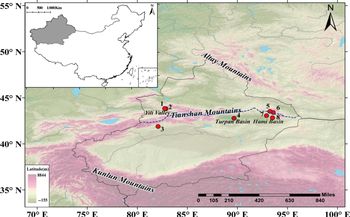
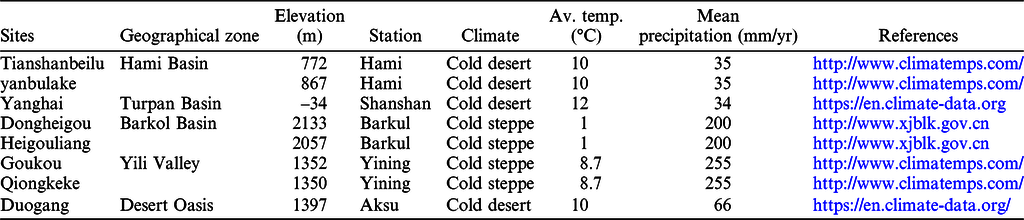
The Tianshan region is located in the middle of Xinjiang, northwest China, where the climate is controlled by the westerlies. The Tianshan Mountains are known as “the water tower of central Asia” due to the strong influences of high topography and high latitude. The Tianshan Mountains can be divided along the summit ridge line into two climate zones: north and south slopes (Figure 1). The north slope receives more precipitation than the south slope. Yili valley is the wettest region in north slope, with an annual precipitation of 417.6 mm. The Turpan-Hami basin is an arid desert with minimal rainfall (Yin et al. Reference Yin, Li, Meng, Wang and Liu2017). The contribution of C4 plants is negligible where the mean annual temperature (MAT) is below 17°C, so we presume that the modern natural vegetation in this region is dominated by C3 plants (Bird and Pousai Reference Bird and Pousai1997). The archaeological sites considered in this paper are shown in Figure 1. The geographic and meteorological conditions of each site are summarized in Table 1.
Archaeological sites of isotopic records from the Tianshan region. The dashed line is the north–south Tianshan boundary (modified from Yin et al. Reference Yin, Li, Meng, Wang and Liu2017) Red circle: 1. Goukou (Wang et al. Reference Wang, Wang, An, Ruan, Duan, Li and Dong2018), 2. Qiongkeke (Zhang and Li Reference Zhang and Li2006), 3. Duogang (Zhang et al. Reference Zhang, Chou, Zhang and Guo2014), 4. Yanghai (Si et al. Reference Si, Lv, Li, Jiang, Hu and Wang2013), 5. Dongheigou (Ling et al. Reference Ling, Chen, Wang, Chen, Ma, Ren and Xi2013; Ling et al. Reference Ling, Lan, Chen, Ma, Wang and You2016), 6. Heigouliang (Wang et al. Reference Wang, Fuller, Wei, Chang and Hu2015; Zhang et al. Reference Zhang, Chang and Liu2009), 7. Yanbulake (Cultural Relics Office 1989), 8. Tianshanbeilu (Wang et al. Reference Wang, Wei, Chang, Yu, Zhang, Wang, Hu and Fuller2017; Zhang et al. Reference Zhang, Chang and Liu2010).

Modern climate information for archaeological sites from Xinjiang Province.

Note: Climate type is classified according to the Köppen climate classification (Peel et al. Reference Peel, Finlayson and McMahon2007).
CHROMOLOGY
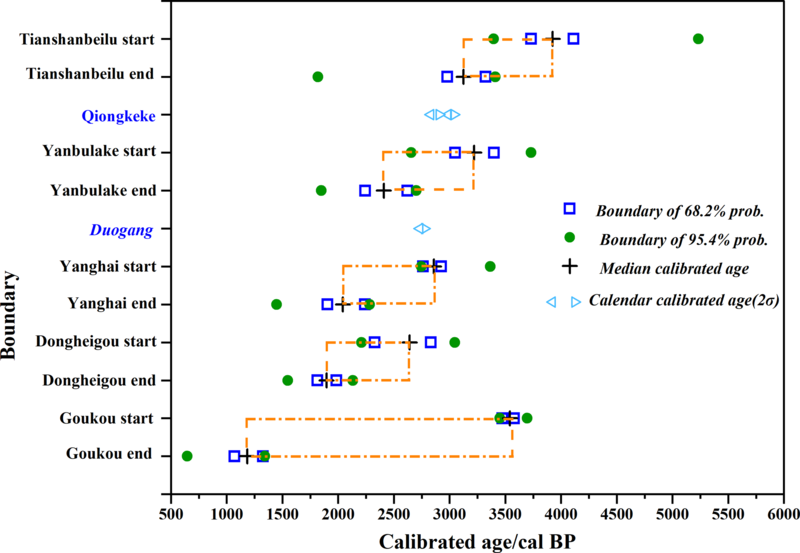
A total of 40 radiocarbon (14C) dates (Table S1) were retained and put into the program OxCal v4.3 (Bronk Ramsey Reference Bronk Ramsey1995, Reference Bronk Ramsey2001) and calibrated according to the IntCal13 curve (Reimer et al. Reference Reimer, Bard, Bayliss, Beck, Blackwell, Ramsey, Buck, Cheng, Edwards and Friedrich2013) in the Tianshan region. We obtained the ages of different periods based on Bayesian modeling (supporting information in supplementary file) with 37 dates. Besides, only 2 and 1 dates were found in Qiongkeke and Duogang, respectively, and were plotted in Figure 2 without model analysis.
The modeled age spans of 5 archaeological sites and calibrated age from 2 sites in the Tianshan region. Here the median-to-median range is used to determine age ranges of these site’s phases.

Figure 2 summarizes the revised chronology generated through the current research, based on the median-to-median range approach, and shows both the 68.2% and 95.4% limits of each boundary for comparative purposes. According to the modeled ages, the Goukou sites may commenced about ca. 3550 cal yr BP and terminated at ca. 1200 cal yr BP. The modeled median age of Goukou cemetery in the Bronze and Iron Age is about 3020 cal yr BP and 2470 cal yr BP, respectively. The Dongheigou site starts about ca. 2650 cal yr BP and ends at ca. 1900 cal yr BP, the median age is about 2240 cal yr BP. Archaeological evidence indicates that Heigouliang coexisted in same stage (Ren Reference Ren2008). Yanghai tomb appeared to earlier than Dongheigou, it starts around 2860 cal yr BP and lasts until ca. 2040 cal yr BP. The modeled median age of late Bronze and Iron Age are about 2800 and 2330 cal yr BP. As the modeled ages show that Yanbulake site appeared as early as 3220 cal yr BP and end at 2410 cal yr BP. The Yanbulake sample taken from the second period of the tomb has a modeled median age of 2710 cal yr BP. Tianshanbeilu site has a longer duration of ca. 850 years (period between 3920 cal yr BP and 3130 cal yr BP, median age 3510). As the Figure 2 shows, the calibrated age of Qingkeke and Duogang are ca. 2990–2780 cal yr BP and 2750 cal yr BP, separately.
ISOTOPE ANALYSIS
According to the theory of “you are what you eat” proposed by Kohn (Kohn Reference Kohn1999), carbon and nitrogen stable isotopic analyses have been widely used as an indicator of past human diet (Zhang et al. Reference Zhang, Wang, Xian and Chou2003). Since the body derives all its nutrients from the intake of food and drink, the isotopic ratio obtained from bone collagen reflects the diet over time (Ambrose Reference Ambrose1993). The δ13C values of two types of terrestrial plants: C3 (δ13C values between –20 and –34‰) and C4 (δ13C values from –9 to –16‰), vary distinctly due to their different photosynthetic pathways (Farquhar et al. Reference Farquhar, Ehleringer and Hubick1989; Tieszen Reference Tieszen1991). Previous research has defined a δ13C value of –18‰ as a boundary between mainly C3 and mixed C3/C4 diets, and –12‰ as the approximate limit between mixed C3/C4 diets and predominately C4 diets (Hedges Reference Hedges2003; Pearson et al. Reference Pearson, Buitenhuis, Hedges, Martin, Russell and Twiss2007). The ratio of δ15N increase with trophic level can be used to estimate the amount of animal protein in the diet, because there is an approximately 3–5‰ increase associated with each ascending level in the food web (Bocherens and Drucker Reference Bocherens and Drucker2003; O’Connell et al. Reference O’Connell, Kneale, Tasevska and Kuhnle2012). Nitrogen stable isotopic ratios of herbivores are 3–7‰, while δ15N values of carnivores and freshwater fish are higher than 9‰, and omnivorous animals have δ15N values between 7 and 9‰ (Lee-Thorp Reference Lee-Thorp2008). Combining δ13C and δ15N results can contribute to the understanding of human dietary habits and lifestyles.
Statistical analyses were performed using Origin 2017 for Windows. Student’s t-tests and one-way ANOVA analyses were employed to examine the data. The significance level was set at p < 0.001.
DISCUSSION
A comparison of isotopic results from 8 sites in the Tianshan region provides a regional overview of climate and human dietary habits and climate through time. The associated sites are shown in Figure 1 and include Tianshanbeilu (Zhang et al. Reference Zhang, Chang and Liu2010; Wang et al. Reference Wang, Wei, Chang, Yu, Zhang, Wang, Hu and Fuller2017), Yanbulake (Zhang et al. Reference Zhang, Wang, Xian and Chou2003), Heigouliang and Dongheigou (Ling et al. Reference Ling, Chen, Wang, Chen, Ma, Ren and Xi2013; Wang et al. Reference Wang, Fuller, Wei, Chang and Hu2015; Ling et al. Reference Ling, Lan, Chen, Ma, Wang and You2016), Yanghai (Si et al. Reference Si, Lv, Li, Jiang, Hu and Wang2013), Qiongkeke (Liu and Guan Reference Liu and Guan2002; Zhang and Li Reference Zhang and Li2006), Duogang (Zhang et al. Reference Zhang, Chou, Zhang and Guo2014), and Goukou (Wang et al. Reference Wang, Wang, An, Ruan, Duan, Li and Dong2018).
Faunal Isotopic Analyses in Tianshan Region
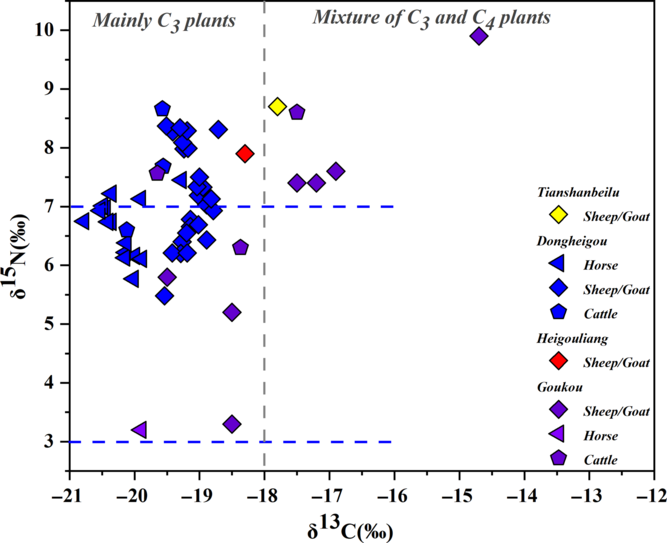
Isotope data are available from 55 animals from 4 archaeological sites in Tianshan, including Goukou (Wang et al. Reference Wang, Wang, An, Ruan, Duan, Li and Dong2018), Tianshanbeilu (Wang et al. Reference Wang, Wei, Chang, Yu, Zhang, Wang, Hu and Fuller2017), Dongheigou (Ling et al. Reference Ling, Lan, Chen, Ma, Wang and You2016), and Heigouliang (Wang et al. Reference Wang, Fuller, Wei, Chang and Hu2015) (Table S2 and Figure 3).
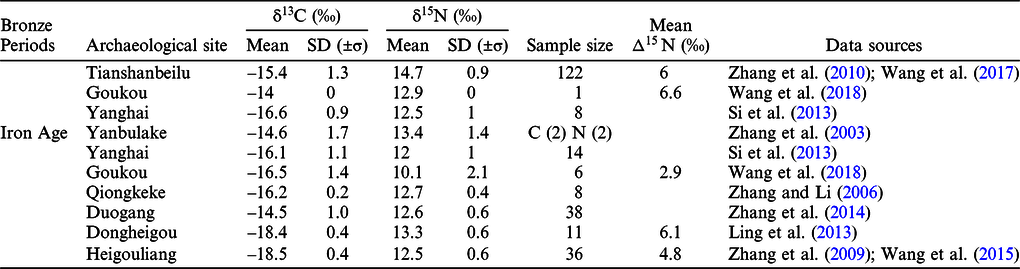
Summary of bone collagen carbon and nitrogen isotopic results of human from the other sites in the Tianshan region.

Note: Δ15 N = δ15Nhuman – δ15Nsheep/goat, considering the sheep/goat were supposed to be slaughtered more commonly for meat (Outram et al. Reference Outram, Kasparov, Stear, Varfolomeev, Usmanova and Evershed2012).
Carbon and nitrogen isotopic results for animals from different sites in the Tianshan region. δ13C values ≥ –12‰ reflect a predominately C4 diet, while values between –12‰ to –18‰ indicate a mixed C3/C4 diet. δ13C values ≤–18‰ reflect a predominately C3 diet (Hedges Reference Hedges2003; Pearson et al. Reference Pearson, Buitenhuis, Hedges, Martin, Russell and Twiss2007).

Stable isotope analyses of animals provide a baseline to understand the food web. The δ13C and δ15N values for animals (sheep/goat, horse and cattle; n = 57) have a wide range from –20.8‰ to –14.7‰ for δ13C (–19.2 ± 1.0‰) and 3.2‰ to 9.9‰ for δ15N (7.0 ± 1.2‰). The slightly higher δ15N values of sheep/goat, horse and cattle from the Tianshan region, as compared to the herbivores (3–7‰) at a lower trophic level (Ambrose Reference Ambrose1991), can be explained by their abnormal metabolisms in a dry environment (DeNiro and Epstein Reference DeNiro and Epstein1981; Gannes et al. Reference Gannes, Del Rio and Koch1998) and /or food consumed (plants) with high δ15N values (An et al. Reference An, Dong, Chen, Li, Shi, Wang, Zhang and Zhao2015). Besides, the δ13C values of some herbivores from Goukou and Tianshanbeilu fall in the range between –18‰ to –12‰ and indicate a diet rich in C4 plants, such as the common millet and foxtail millet were identified in Goukou (Wang et al. Reference Wang, Wang, An, Ruan, Duan, Li and Dong2018) and Hami (Zhang Reference Zhang1997). We infer that a C4-based agriculture was adopted in these sites during the Bronze Age. In contrast, all of δ13C results from herbivores in Dongheiggou and Heigouliang have lower values, less than –18‰, corresponding to floatation results of dominated C3 plant (more than 99%) (Jiang Reference Jiang2006; Jiang et al. Reference Jiang, Li and Li2007; Tian et al. Reference Tian, Jian, Wang, Pilgram, Zhao and Liu2017a; Tian Reference Tian2018), indicating a diet structure dominated by C3 plants. The isotope data from sheep in Goukou (δ13C:8.8%, δ15N:31.7%) also feature a much higher coefficient of variation than those from Dongheigou (δ13C:1.1%, δ15N:11.9%). This suggests that food sources from Goukou are more variable that those from Dongheigou (Di Lernia et al. Reference Di Lernia, Tafuri, Gallinaro, Alhaique, Balasse, Cavorsi, Fullagar, Mercuri, Monaco and Perego2013; Janzen Reference Janzen2015). We expect that a primarily nomadic lifestyle will introduce seasonal variations associated with migrations that include horizontal and vertical grazing on different type of crops.
In conclusion: first, we know that the dry environment in the Tianshan region may result in elevated δ15N values. Second, based on the isotopic results and floatation studies we infer that C4 crops (Panicum miliaceum) were widely cultivated in the Tianshan region during the Bronze Age and more than 99% of crops were naked barley in Dongheigou and Heigouliang in the Iron Age (Jiang Reference Jiang2006; Jiang et al. Reference Jiang, Li and Li2007; Tian et al. Reference Tian, Jian, Wang, Pilgram, Zhao and Liu2017a; Tian Reference Tian2018; Shao et al. Reference Shao, Zhang, Cong, Jia Peter and Wu2019).
Human Isotopic Analyses in the Tianshan Region
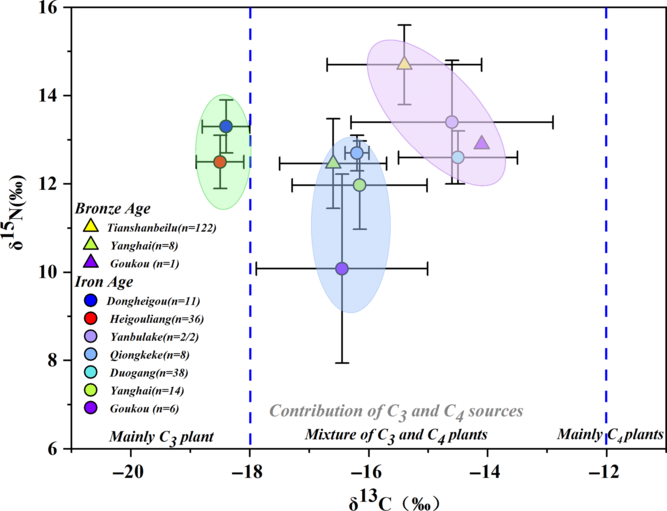
To better understand human dietary patterns in the Tianshan region, a summary of the isotopic data (n = 248) from the Bronze Age to the Iron Age is given in Table 2 and plotted in Figure 4. Considering the anomalous values that appeared in the Goukou results during the Bronze Age, this one offline datum will not be discussed here. The δ13C and δ15N values from humans range from –19.6 to –12.3‰ and 7.1 to 16.7‰, respectively. The human-herbivore nitrogen isotope offset (Δ15 N) is more than the accepted trophic-level offset (3–4‰), implying that animal protein received by humans were not only provided by domestic herbivores, but also from wild animals, especially in Tianshanbeilu. Dairy products may also contribute to this result (Yang et al. Reference Yang, Shevchenko, Knaust, Abuduresule, Wenying, Xingjun and Wang2014b). We infer that the inhabitants engaged in mobile herding economies, subsidized with crops and wild animal meat from the Tianshan Mountains. Next, we consider spatial climate zones and temporal change.
Carbon and nitrogen isotopic results for humans from different sites in the Tianshan region, Xinjiang. Green is the Barkol steppe zone; blue is the cold steppe climatic zone; pink is the cold desert climatic zone.

The Tianshan region is divided into two different climatic zones: (1) cold desert in the south, and (2) cold steppe in the north (Figure 1 and Table 1). However, the isotopic and archaeobotanical results show that the people from the Barkol steppe consumed primarily C3 plants, like naked barley, and thus the isotopic results from there differ from sites that feature a mixed C3/C4 diet in the eastern Tianshan during the Iron Age (Jiang et al. Reference Jiang, Li and Li2007; Tian et al. Reference Tian, Ma, Wang, Pilgram, Zhao and Liu2017b; Tian Reference Tian2018; Wang et al. Reference Wang, Wang, An, Ruan, Duan, Li and Dong2018). Barley was able to be cultivated in this marginal region due to its drought tolerance and frost resistance (Kulp and Ponte Reference Kulp and Ponte2000; Snyder and de Melo-Abreu Reference Snyder and de Melo-Abreu2005; Newton et al. Reference Newton, Flavell, George, Leat, Mullholland, Ramsay, Revoredo-Giha, Russell, Steffenson and Swanston2011; Guedes et al. Reference Guedes, Lu, Li, Spengler, Wu and Aldenderfer2014). In contrast, millets, which are also drought-tolerant, favor warm temperatures and have low frost resistance. The annual mean temperature in the Barkol steppe is only 1 °C, the lowest among all the sites considered here. Since C4 crops were consumed in the surrounding foothills (Tian Reference Tian2018), cultural factors are excluded here. Hence, we attribute the C3-based agriculture in the Barkol steppe to climate, influenced by the extremely cold environment, as suggested by modern vegetation research (Tang et al. Reference Tang, Shurun and Xinshi1999).
Since C3 and C4 crops were found in the other two zones, we can compare their human isotopic results and their different climate system. The isotopic results of Yanghai are similar to the northern Tianshan region and archaeological excavations found that the Yanghai culture was influenced by both the Chawuhu and Yanbulake cultures. Additionally, broomcorn millet and naked barley were found in Yanghai and plant remains indicate that Yanghai formerly experienced a humid climate (Jiang et al. Reference Jiang, Li and Li2007). Figure 4 illustrates the significance of climate on the isotopic results from different climate zones. One-way ANOVA results show that δ13C and δ15N ratios are significantly different between the steppe and desert climate zones (p < 0.001 of both carbon and nitrogen). Since C4 crops are resistant to drought and hot weather, they are more suitable for cultivation in dry regions. Therefore, climate favored the cultivation of C4 crops in south Tianshan. In general, stable nitrogen values are higher in the desert zone but lower in the steppe. According to δ15N research from plants on the Chinese loess plateau, and south Africa, it has been shown that δ15N decreases as precipitation increases (Liu and Wang Reference Liu and Wang2008; Aranibar et al., Reference Aranibar, Otter, Macko, Feral, Epstein, Dowty, Eckardt, Shugart and Swap2004; Swap et al. Reference Swap, Aranibar, Dowty, Gilhooly and Macko2010). Conversely, aridity has been shown to increase δ15N values (Robinson et al. Reference Robinson, Handley, Scrimgeour, Gordon, Forster and Ellis2000; Hartman Reference Hartman2011). Hence, the higher δ15N values observed in the southern Tianshan could be related to meat in the human diet, as well as reduced precipitation.
From a temporal perspective, human isotopic results from the Tianshan Mountains were divided into two periods: (1) Bronze Age (3 archaeological sites, n = 131) and (2) Iron Age (7 archaeological sites, n = 117). Mean δ13C values from humans for these two periods are –15.6 ± 0.9‰ (Bronze Age) to –16.5 ± 1.9‰ (Iron Age), and mean δ15N values are 14.7 ± 0.9‰ (Bronze Age) and 12.5 ± 1.0‰ (Iron Age). These isotopic ranges indicate a mixed C3 and C4 diet in humans, with a large quantity of meat in Tianshan throughout these two periods. One-way ANOVA results show that δ13C and δ15N ratios between these two periods are significantly different in the Tianshan region (p < 0.001 and p < 0.001, respectively). Considering the geographical environment influence, we discuss the temporal change of human isotopic results in both north and south of Tianshan. A highly significant difference was found in stable carbon and nitrogen isotopic results from south of Tianshan (p < 0.001 and p < 0.001), between the Bronze Age and Iron Age. In the northern Tianshan region (including Yanghai), less significant differences are seen for human δ13C (p < 0.5), with significant differences in δ15N (p < 0.015), between the Bronze Age and Iron Age. Such evidence suggests that a millet-based agriculture may have been broadly established in Xinjiang after the Bronze Age but varied from site to site. While elevated δ15N values in animal bones may be caused by a dry environment, it remains unclear whether decreasing δ15N values imply a wetter climate.
The Effects of Climate Change
In general, we find that the human stable carbon isotopic values can be influenced by climate. The types and proportions of agricultural crops (C3/C4) are also affected by climate. δ15N ratios in plants respond to precipitation (Liu and Wang Reference Liu and Wang2008; Aranibar et al. Reference Aranibar, Otter, Macko, Feral, Epstein, Dowty, Eckardt, Shugart and Swap2004; Swap et al. Reference Swap, Aranibar, Dowty, Gilhooly and Macko2010) and decrease with lower ratios under a wet climate and increase with higher values under a dry climate (Robinson et al. Reference Robinson, Handley, Scrimgeour, Gordon, Forster and Ellis2000; Hartman Reference Hartman2011). This effect is transmitted through plants to animals and humans. This trend is consistent with the higher δ15N values in the desert climate from the southern Tianshan region. Paleoclimate research also suggests that an increase in the intensity of the monsoon could motivate the expansion of C4 vegetation (An et al. Reference An, Yongsong, Weiguo, Zhengtang, Clemens, Li, Prell, Youfeng, Yanjun and Weijian2005b). This could be related to a dietary shift towards C3 foodstuffs when the climate became cold in Gansu province, the Hehuang region and the central plains, with the initiation of wheat or barley cultivation after these crops became available (Liu et al. Reference Liu, Lightfoot, O’Connell, Wang, Li, Zhou, Hu, Motuzaitematuzeviciute and Jones2014; Ma et al. Reference Ma, Dong, Jia, Wang, Cui and Chen2016).
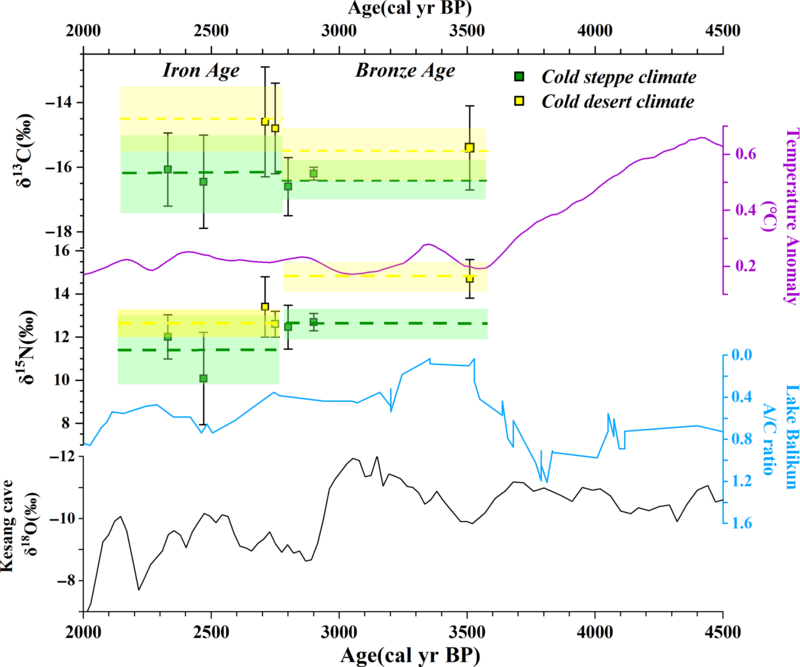
The climate in Xinjiang is controlled primarily by the westerlies, and direct or indirect effects on human isotope results associated with changes in the westerlies have not been documented. In an earlier section, we discussed the human isotopic results through time. Except for Heigouliang and Dongheigou, a decrease of δ15N and minor δ13C fluctuations in the Tianshan region occurred within a relative optimum period, from ca. 3800–530 cal yr BP, under a typical desert-steppe/meadow-steppe environment, according to high-resolution fossil pollen records from Barkol lake (Tao et al. Reference Tao, An, Chen, Tang, Wang, Lü, Li, Zheng and Zhao2010). Moreover, oxygen isotopes from Kesang Cave record an increasing δ18O trend, implying more precipitation over central Asia after 3000 cal yr BP (Cheng et al. Reference Cheng, Spötl, Breitenbach, Sinha, Wassenburg, Jochum, Scholz, Li, Yi and Peng2016). Paleoclimate records indicate only minor temperature changes in the northern hemisphere during 3600–2200 cal yr BP (Marcott et al. Reference Marcott, Shakun, Clark and Mix2013).
A comparison between isotope results and climate is shown in Figure 5. Barkol steppe was excluded from other regions because of a lack of Bronze Age sites. An increasing δ13C trend in the southern Tianshan region indicates stable C4-based agriculture was well developed in the desert than steppe climate zone under stable temperatures. The persistent decline in human δ15N values agrees with a period of increasing precipitation in the Tianshan region. Human δ15N values decreased as δ13C values increased in the south, while δ15N values decreased and δ13C values remained relatively stable in the north—a consequence of increased rainfall with stable temperature. Therefore, the climate influence on human paleodiet should not be ignored in future studies.
Comparison of human δ13C (a) and δ15N (c) results in Xinjiang (for the data references see Table 2) with climate records: (b) Northern Hemisphere (30–90°N) temperature anomaly (Marcott et al. Reference Marcott, Shakun, Clark and Mix2013) (purple thick curve); (d) Lake Balikun A/C ratio (Tao et al. Reference Tao, An, Chen, Tang, Wang, Lü, Li, Zheng and Zhao2010); (e) Kesang Cave δ18O record (Cheng et al. Reference Cheng, Spötl, Breitenbach, Sinha, Wassenburg, Jochum, Scholz, Li, Yi and Peng2016). Note: the dashed yellow and green lines represent mean isotopic values, the dashed yellow and green lines indicate the standard deviation of isotopic results during the different periods.

CONCLUSION
Based on the systematic analysis of animals and human stable isotope results from the Tianshan region, we conclude that animals and humans with a higher value of δ15N may closely relate with a drier environment and that humans engaged in mobile herding economies subsidized with crops and wild animal meat in the Tianshan Mountains. A C3-dominant agriculture in Barkol steppe was influenced by the extremely cold environment. Temporal dietary patterns show that δ15N of humans decreased with the increasing of precipitation, and spatial dietary patterns indicate that δ13C of humans decreased with lower temperature. Therefore, it can be implied that climate played a nonnegligible role in the human dietary study.
ACKNOWLEDGMENTS
We acknowledge Prof. Zhu and George S. Burr for their technical and editorial assistance. Additionally, we also grateful for the useful suggestions and detailed review comments made by Editor A. J. Timothy Jull and anonymous reviewers, which helped us to improve the manuscript substantially. This research was supported by the Strategic Priority Research Program of the Chinese Academy of Sciences (XDB 40000000, XDA23010302), the Program of the Chinese Academy of Sciences (132B61KYSB20170005) and the state Key Laboratory of Loess and Quaternary Geology (Y752YQ4207, SKLLQG1639).
SUPPLEMENTARY MATERIAL
To view supplementary material for this article, please visit https://doi.org/10.1017/RDC.2020.45