INTRODUCTION
Engaging in health-promoting behaviors, such as healthy eating, physical activity, and follow-up care, improves physical and psychological functioning (Berglund et al., Reference Berglund, Bolund and Gustafavsson1994; Knols et al., Reference Knols, Aaronson and Uebelhart2005; Osborn et al., Reference Osborn, Demoncada and Feuerstein2006; Kuchler et al., Reference Kuchler, Bestmann and Rappat2007) and health status (Berglund et al., Reference Berglund, Bolund and Gustafavsson1993), reduces risk of recurrence (Meyerhardt et al., Reference Meyerhardt, Giovannucci and Holmes2006), and lengthens overall survival (Meyerhardt et al., Reference Meyerhardt, Giovannucci and Holmes2006; Kuchler et al., Reference Kuchler, Bestmann and Rappat2007) in colorectal cancer (CRC) survivors. Evidence suggests that self-management programs both help individuals change behaviors (Von Korff et al., Reference Von Korff, Glasgow and Sharpe2002) and improve clinical outcomes (Newman et al., Reference Newman, Steed and Mulligan2004; Chodosh et al., Reference Chodosh, Morton and Mojica2005). Such programs have been used successfully in chronic disease management (Norris et al., Reference Norris, Engelgau and Narayan2001; Newman et al., Reference Newman, Steed and Mulligan2004; Warsi et al., Reference Warsi, Wang and LaValley2004; Chodosh et al., Reference Chodosh, Morton and Mojica2005) and lifestyle modification interventions, such as dietary change (Gillis et al., Reference Gillis, Caggiula and Chiavacci1995) and physical activity (Van Weert et al., Reference Van Weert, Hoekstra-Weebers and Grol2005). A few studies (Braden et al., Reference Braden, Mishel and Longman1998; Turton & Cooke, Reference Turton and Cooke2000; Cimprich et al., Reference Cimprich, Janz and Northouse2005; Korstjens et al., Reference Korstjens, May and Van Weert2008) have used self-management strategies with cancer survivors that show promise in stimulating adoption of a healthier diet (Turton & Cooke, Reference Turton and Cooke2000) and increased physical activity (Cimprich et al., Reference Cimprich, Janz and Northouse2005), and that improve quality of life (Korstjens et al., Reference Korstjens, May and Van Weert2008). The theory of self-regulation suggests that people can regulate their own behavior through an iterative process of monitoring behavior, judging effectiveness of behavioral strategies against a goal or standard, setting or revising goals and plans, implementing the plans, and returning to monitoring in order to evaluate the implemented strategies (Bandura, Reference Bandura1991; Bandura, Reference Bandura2005; Maes & Karoly, Reference Maes and Karoly2005).
The end of cancer treatment is conceivably a “teachable moment” (Demark-Wahnefried et al., Reference Demark-Wahnefried, Aziz and Rowland2005; Ganz, Reference Ganz2005), as patients have an opportunity for setting goals for their self-management as survivors (Stanton et al., Reference Stanton, Ganz and Kwan2005; McCorkle et al., Reference McCorkle, Ercolano and Lazenby2011). Previous studies conducted with breast and prostate cancer survivors indicate that they want to improve or maintain their physical health by engaging in physical activity, managing or losing weight, and eating a healthy diet (Demark-Wahnefried et al., Reference Demark-Wahnefried, Peterson and McBride2000; Lauver et al., Reference Lauver, Connolly-Nelson and Vang2007).
Goal setting is a way of helping patients make disease-related behavior changes (Gollwitzer & Oettingen, Reference Gollwitzer and Oettingen1998; Bradley et al., Reference Bradley, Bogardus and Tinetti1999); however, little is known about the goals of CRC survivors once they complete treatment. CRC survivors make up 11% of the cancer survivor population, have high rates of survival, and receive ongoing surveillance related to cancer and comorbidities. The majority are >65 years of age.
To assist post-treatment CRC survivors to engage in health-promoting behaviors, we must understand their goals (Rasmussen et al., Reference Rasmussen, Wrosch and Scheier2006). The purpose of this study was to identify and describe the health goals of CRC survivors who have completed cancer treatment.
METHOD
Participants
The first author conducted semistructured in-depth interviews that were completed between August 2008 and August 2009, with a convenience sample of 41 adult CRC patients attending three clinics in Houston, Texas. Eligible study participants met the following criteria: diagnosed with colon or rectal cancer at stages 0–III, 0–24 months post-treatment, and currently cancer free.
Recruitment and Data Collection
Eligible participants were identified through each clinic's medical record system or cancer registry. Invitation letters were sent to potential participants at two clinics. Patients were approached during their clinic appointments, with the approval of their oncologists and/or if the patients had not declined participation or further contact. Patients at one clinic were contacted by phone to confirm their interest and eligibility and schedule a time to complete the interview.
Study participants received clinic site-specific informed consent forms. Once informed consent was obtained, a 30–60 minute interview was conducted the same day by the first author, in a private room at the site. Study participants received a $15 gift card. All procedures were approved by each partnering institution's institutional review board, and the University of Texas–Health Science Center at Houston.
Interview Guide
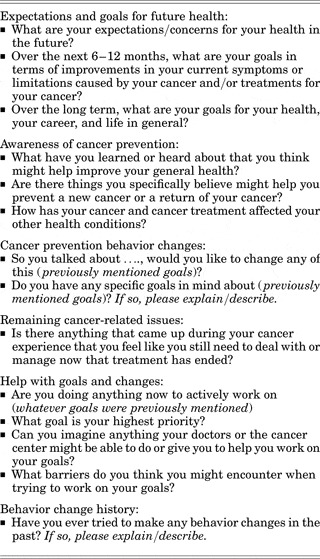
The research team developed the semistructured in-depth interview guide (Table 1), based on theories about goal setting (Locke et al., Reference Locke, Latham and Smith1990; Locke, Reference Locke1996; Strecher et al., Reference Strecher, Seijts and Kok1995; Bradley et al., Reference Bradley, Bogardus and Tinetti1999) and self-regulation (Bandura, Reference Bandura1991; Clark et al., Reference Clark, Becker and Lorig1991; Maes & Karoly, Reference Maes and Karoly2005), prior research in cancer survivorship (Turton & Cooke, Reference Turton and Cooke2000; Cimprich et al., Reference Cimprich, Janz and Northouse2005; Korstjens et al., Reference Korstjens, May and Van Weert2008), and research conducted by team members (Schulman-Green et al., Reference Schulman-Green, Naik and Bradley2006; Brown et al., Reference Brown, Bartholomew and Naik2007; Morrow et al., Reference Morrow, Haidet and Skinner2008). Topics of discussion included patients’ expectations and goals for their health, cancer prevention awareness, goals regarding cancer prevention behavior, unaddressed issues related to their cancer experience, and goals for health behavior change. Verbal probes were used to ensure comprehensive data collection and to clarify responses.
Semistructured in-depth interview guide

Note: Additional probing questions were asked for clarification or elaboration, in relation to specific goals identified by the study participant.
Data Analysis
Each interview was digitally recorded, transcribed verbatim, reviewed for accuracy, saved, and transferred into ATLAS.ti (Muhr, Reference Muhr1997) – a qualitative analysis software program – for coding, sorting, retrieval, and evaluation.
The first author reviewed 15 transcribed interviews to develop a code key. The code key was reviewed and 15 interviews were coded independently by a research assistant with qualitative research experience. Consensus was reached between the first author and the research assistant's individual codes to finalize the code key. Any differences in codes were discussed with the co-authors for clarification and finalization (Miles & Huberman, Reference Miles and Huberman1994). Once the code key was finalized, all transcripts were coded by the first author.
The goal of the analysis was to identify and group themes that emerged from participants’ responses. Identified codes were compared and grouped into themes according to a common element. Emergent themes were further examined using a matrix, to note any relationships or patterns across patient characteristics, such as gender, stage at diagnosis, and time since treatment end.
RESULTS
Overview
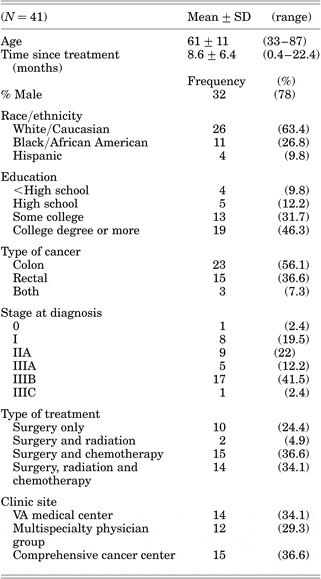
The sample was predominately male, white, and well educated (Table 2). Colon cancer was the principal diagnosis, with the majority diagnosed at stage III. All participants had surgery and most also had had chemotherapy, radiation, or both.
Participant demographic and clinical characteristics

Goals
General Goals
CRC survivors most commonly expressed an overarching goal to be healthy. This goal was typically described as a hope to remain cancer free. Many CRC survivors described their goal as getting back to normal or getting back to their regular pre-diagnosis activities. When asked about health goals, one woman said her goal was “To live my life, to get back to normal. To be able to do and go and what I did a year ago before all this happened. … Just work on physically getting back where I was and hopefully getting my life back” (57-year-old white female, stage IIIB colon cancer, 5 months post-treatment).
Some patients also discussed being healthy in conjunction with a general action plan, such as keeping up with medical appointments. One man explained his plan to “…try to figure out the things that I need to do to stay healthy so that this will not happen again, lose weight, and become physically fit, stay around a little bit longer so I can take care of my family, and see my grandkids grow up” (57-year-old Hispanic male, stage IIA colon cancer, <1 month post-treatment).
Health Behaviors
Many survivors discussed specific health behaviors as ways to maintain or achieve their overarching goal to be healthy (e.g., diet, physical activity, weight management, follow-up care, and quitting smoking). These behaviors were usually stated in combination with one another:
I think I'd like to get more handle on my weight and my exercise issues. … I think if I could lose some weight and get more exercise that would improve my health and it may improve my chances on cancer too. (65-year-old white male, stage IIIA colon cancer, 15 months post-treatment)
Some patients with health promoting goals also discussed brief action plans to achieving their health goal:
I like to bake and I eat sweets, which is a big problem, but I'm going to cut that out. I'm going to stop baking as much, and the things that I know I cannot handle I won't even keep them in the house. I don't even keep ice cream in the house. (65 year old black female, stage IIA colon cancer, 1 year post-treatment)
Additionally, some respondents had goals to maintain various health behaviors in which they were already engaged. When queried, these patients typically disclosed that they had engaged in health-promoting behaviors prior to their diagnosis of cancer.
Managing Residual Effects of Cancer
Many survivors had goals specifically related to dealing with or managing the residual effects of their cancer treatment. For example, patients with ostomies had goals for management or reversal of a colostomy or ileostomy. One man discussed how his ostomy limited his physical function, and his plan to get it reversed:
As long as I got the ileostomy I can't really do much weightlifting…. As soon as they figure that the pressure had gone down on the liver, they're going to try to set up a schedule to reverse it. (62-year-old Hispanic male, stage IIIA colon cancer, 4 months post-treatment)
A few patients went beyond the physical impact and discussed how ostomy affected them emotionally, their self-image and required support for dealing with a lifelong appliance:
…I was worried….How am I going to put people in my car and I've got a colostomy bag on. Cuz I just knew it was gonna be odors and embarrassing and things were gonna happen in front. I figured my life was over. … Cuz you think you're Mr. Tough Guy and then somebody tells you you're going to wear a bag on your stomach the rest of your life and you break down in tears. I mean that's what I did. And I know I'm not the only one. So there needs to be a little bit of a support group for people. (55-year-old white male, stage IIIB rectal cancer, 11 months post-treatment)
Additionally, several survivors had goals of mitigating treatment side effects, for example neuropathy. Patients expressed these as priority goals if they felt the condition was impeding their physical functioning:
I want the neuropathy to go away. My feet just hurt. … I try to convince myself the fact that they hurt is meaning that the nerves are building back. …in December I want to be able to walk and not have to worry about the cold weather and the different things that happen with neuropathy. … I just want to be able to get around without my feet hurting. (52-year-old white female, stage IIIB colon cancer, 13 months post-treatment)
For many of these patients, goals to manage or resolve residual cancer effects were competing with their goals of engaging in physical activity or eating a healthy diet. For example, a patient with an ostomy states:
I think diet has a big part to do with how you feel, and I'm looking forward to having this reversal. I'm looking forward to being able to eat a normal healthy diet. … I can't have the fiber and all the vegetables. I can't eat nuts and different fruits and things. I can't have what might make things complicated (52-year-old white female, stage IIIB rectal cancer, 1 month post-treatment).
In contrast, several patients saw residual side effects as being unresolvable or out of their control. For example, a patient who had neuropathy felt she could do nothing to fix the problem and she simply needed to be patient and allow it to wear off with time. Overall, many survivors described the residual effects of cancer as things to manage or resolve, and barriers to overcome.
Comorbid Conditions
There were a few patients whose goals were not influenced by their cancer experience; instead their goals were inspired by comorbid conditions. These patients were typically further past their last cancer treatment:
I'm overweight and I do have diabetes, and I've kind of ignored that for the last two or three years. In fact, I'm totally off the medicine right now. Every time I come in, I get a lecture about what damage could be happening that I need to get under control, so I've got to convince myself that I need to get back on the diabetes medicine. I've been putting that off for a long time. (55-year-old white male, stage IIIB rectal cancer, 11 months post-treatment)
Similarly to patients with residual cancer side effects, patients dealing with non-cancer health issues (i.e., diabetes and chronic back pain) also had goals to resolve these issues that were competing with their other health-promoting goals:
[My goal is] getting better and getting rid of the pain, and not from the cancer but from the lower back….That's definitely gonna be my biggest goal. And then once I can walk around, I'll take care of the rest….exercise. If ever I could get some pain relief I'd definitely be able to do that. (55-year-old white male, stage O colon cancer, 3 months post-treatment)
Barriers and Resources
When asked specifically about barriers to achieving their goals, most patients acknowledged themselves as the only thing that could hinder their achievement. Survivors were quick to take personal responsibility for their actions and success:
A doctor already gave me a suggested diet…the things that are good for me and the things that are not, but that's about all I need….I just come back for my checkups….I am determined, and usually if I'm determined to do something, I do it, I finish it…health-wise or anything else. (65-year-old black female, stage IIA colon cancer, 12 months post-treatment)
When asked about resources that would be helpful, most patients could not identify anything that could help them achieve their goals. Instead, most survivors talked about how satisfied they were with the care they had received and how now it was their personal responsibility to maintain or improve their health.
In addition, many respondents talked about the potential benefits of support from their peers, whether one-on-one or in a group. Typically, these same people were willing to return the favor to a future cancer patient:
It's one thing to hear it from the doctor that you'll be doing these things, but it's another thing to talk to somebody who's gone through the treatment, who's gone through the process,…so that they hear firsthand from somebody… (54-year- old Hispanic male, stage IIIB colon cancer, 21 months post-treatment)
Characteristics of Goals
None of our CRC survivors’ goals included characteristics of being specific, measurable, achievable, and realistic, or timed (Wade, Reference Wade2009). A few participants’ goals did include action plans or steps to achieve their goals. For example, one survivor discussed how he is maintaining physical activity by walking a mile each day, and that he tries to go a little bit farther every time. In another example, one survivor shared what he is doing to improve his diet, including using substitution.
Try to eat a little bit better. You know, I don't watch what I eat…, but I'm trying to learn how to eat some vegetables and things of that sort, taking a lot more vitamins, drinking orange juice instead of coffee. (41-year-old Hispanic male, stage IIA colon cancer, 22 months post-treatment)
Relationship between Goals and Patient Characteristics
Patients with specific medical issues discussed their goals in relation to resolving or managing a specific issue. Additionally, participants who had completed treatment within the previous 6 months most often discussed goals associated with their cancer experience, for example, coping with or resolving treatment side effects and getting back to normal.
Since the surgery I've lost a few pounds, because of my appetite, but that's one of my goals now is to get back and formulate a really good eating habit to protect my diet again, you know, to eat the right kinds of food, and to get back 100% within the next three weeks. (57-year-old Black male, stage I rectal cancer, <1 month post-treatment)
DISCUSSION
We found that patients’ goals were often diffuse or broad, and could be viewed as hopes or desires more than motivating goals or action plans. Patients expressed their goals in the way they wanted to “be” (e.g., be healthy) versus the things they needed to “do” (e.g., exercise or eat healthily) (Rasmussen et al., Reference Rasmussen, Wrosch and Scheier2006). These goals could be seen more as outcome goals versus behavior change goals. Patients also had goals that might have been more related to an acute care context, in which they wanted to return to normal or to their precancerous state once treatment ended. Patients did not seem to acknowledge having been transformed in permanent or long-term ways by the cancer and its treatment: a transformation that may that mean “getting back to normal” is not an option. Instead, cancer survivors may need to adjust to a “new normal.” Additionally, when patients did discuss behavior changes, their aspirations and action plans were expressed as generalities. These general goals might not be as helpful in managing the changes brought about by cancer and non-cancer comorbidities as would more specific goals and action plans.
The most useful or effective goals for achieving health behavior changes are fairly specific, moderately challenging but attainable, have a time frame, and also are accompanied by very specific plans (Doran, Reference Doran1981; Gollwitzer & Oettingen, Reference Gollwitzer and Oettingen1998; Bovend'Eerdt et al., Reference Bovend'Eerdt, Botell and Wade2009; Wade, Reference Wade2009). Oettingen and Gollwitzer (Reference Oettingen and Gollwitzer2002) suggest that people with broad goals or desires will not be stimulated to act on the goal, but need to take steps to turn these broad desires into specific, motivating goals. Bodenheimer and Handley (Reference Bodenheimer and Handley2009) further describe goals as being distal (general) or proximal (specific); the more specific the goal the more likely the patient will achieve it. Although patients’ broad goals were pertinent, they did not have the characteristics of goals that lead to motivation and planning (Locke & Latham, Reference Locke and Latham2002; Lorig & Holman, Reference Lorig and Holman2003; Bovend'Eerdt et al., Reference Bovend'Eerdt, Botell and Wade2009).
McCorkle and colleagues (2011) suggest that behavior change goals in cancer survivorship should be in the chronic care context and include behaviors across the cancer continuum. Using goal setting and self-management in chronic care could be a viable option for helping cancer survivors set realistic goals and action plans that will help change their behavior and improve their health outcomes. These goals would include managing sequelae of the cancer and its treatment, maintaining cancer screening and medical care follow-up to find recurrence or a new cancer early, and managing other chronic illnesses.
In this study, survivors reported three types of health-related goals related to the sequelae of their cancer treatment, the management of other chronic illnesses, and general health promotion. Individuals who had completed treatment more recently or who had significant residual treatment effects often had goals related to those residual issues (e.g., ostomy appliance or neuropathy). For some patients, these issues competed with their goals by serving as barriers to achieving other health-promoting goals, such as engaging in physical activity. This was also found in patients with non-cancer issues (e.g., back pain). Patients who discussed treatment side effects or complications in terms of chronic conditions seemed to have a different perspective. These patients seemed to recognize the need to balance competing goals (e.g., adjust to or reverse ostomy before moving forward with physical activity). They also seemed to understand that survivorship is different from simply “returning to normal.” These patients may require additional assistance in prioritizing their goals to minimize conflicts, setting realistic goals, and making action plans for managing chronic conditions or overcoming residual treatment effects. In caring for cancer survivors, special attention may be required for patients with residual treatment side effects and non-cancer issues. For example, patients with neuropathy may have trouble walking, which would hinder physical activity, and they would need a recommendation for an alternative exercise option, such as yoga.
Our respondents consistently saw themselves as being responsible for their health once treatment ended; however, chronic care research (Von Korff et al., Reference Von Korff, Gruman and Schaefer1997) suggests that a collaborative approach between patient and provider leads to goal achievement and better health outcomes (Wagner, Reference Wagner2000). In addition, it is not typical of healthcare providers to explicitly help patients define goals and make strategic plans to work toward them because 1) the acute problem was resolved and the patient should return to “normal,” and 2) there is a lack of time, interest, and training regarding goal assessment and goal setting (Schulman-Green et al., Reference Schulman-Green, Naik and Bradley2006).
The chronic care model of our cancer care infrastructure largely excludes post-treatment cancer survivors. Post-treatment cancer survivorship programs can align themselves with models that incorporate chronic care and self-management, including enhancing patients’ confidence in their ability to be proactive and empowered, and facilitating patient–provider communication and collaborative healthcare (Cimprich et al., Reference Cimprich, Janz and Northouse2005; McCorkle et al., Reference McCorkle, Ercolano and Lazenby2011). Patient–provider communication has been associated with improved performance in other chronic diseases, such as diabetes (Heisler et al., Reference Heisler, Bouknight and Hayward2002), and has been linked to better continuity of care and preventive services, and to optimal self-care (Sevick et al., Reference Sevick, Trauth and Ling2007).
Collaboration between patients and providers is increasingly important among cancer patients because of the complexities of medical care and self-care during and after treatment, including planning and maintaining follow-up care, managing residual treatment side effects, maintaining care for comorbid conditions, and dealing with psychosocial issues (Hack et al., Reference Hack, Degner and Parker2005). Studies have shown healthcare providers have a significant effect on health promotion behavior change in cancer patients, with even modest interventions (Jones et al., Reference Jones, Courneya and Fairey2004). Other studies show that healthcare providers can also be trained to help patients set goals and create action plans that foster behavior change (Handley et al., Reference Handley, MacGregor and Schillinger2006; MacGregor et al., Reference MacGregor, Handley and Wong2006; Langford et al., Reference Langford, Sawyer and Gioimo2007; Naik et al., Reference Naik, Kallen and Walder2008). Healthcare providers, especially non-physician providers (e.g., oncology nurses, case managers, social workers, and rehabilitation specialists), play a major role in chronic care, which requires a team approach (Miller, Reference Miller2008; Fenlon & Foster, Reference Fenlon and Foster2009; McCorkle et al., Reference McCorkle, Ercolano and Lazenby2011)
Results from this study are similar to other studies that indicate that cancer patients do have health-related goals, and that some are even taking steps to achieve those goals, even patients not far removed from treatment (Demark-Wahnefried et al., Reference Demark-Wahnefried, Peterson and McBride2000; Stanton et al., Reference Stanton, Ganz and Kwan2005; Lauver et al., Reference Lauver, Connolly-Nelson and Vang2007). This indicates that self-management with goal setting and action planning could be appropriate and well received by patients who are completing or have completed treatment. Self-management and goal setting have been successful in changing behaviors and improving health outcomes in patients with chronic diseases (Barlow et al., Reference Barlow, Wright and Sheasby2002; Chodosh et al., Reference Chodosh, Morton and Mojica2005; Handley et al., Reference Handley, MacGregor and Schillinger2006; DeWalt et al., Reference DeWalt, Davis and Wallace2009). A few studies (Cimprich et al., Reference Cimprich, Janz and Northouse2005; Stanton et al., Reference Stanton, Ganz and Kwan2005; Damush et al., Reference Damush, Perkins and Miller2006) indicate the same potential in post-treatment cancer survivors, and across the cancer continuum (McCorkle et al., Reference McCorkle, Ercolano and Lazenby2011). Additionally, as seen in our study, patients’ goals are specific to the individuals and their circumstances because each person will have unique physical and psychosocial issues after treatment. That individuality gives credence to the appropriateness of self-management and tailored interventions for cancer survivors.
Our study has a few limitations. The respondents comprised a convenience sample of CRC survivors, mostly white males with at least some college education. However, efforts were made to recruit a diverse sample by recruiting in three diverse clinic settings, resulting in 36% minorities, which is fairly consistent with the Houston, Texas population. Additionally, assessing healthcare providers’ perspectives, as well as those of families and friends of cancer survivors, could have been informative, considering the importance of patient–provider communication and social support (Gallant, Reference Gallant2003).
Our study suggests that cancer survivors need help developing goals that lead to behavior change. Our findings also suggest that cancer survivors needs and goals vary, and require a tailored approach. Patients being seen for follow-up care appointments with their oncologists or those who have returned to their primary care providers could benefit from a brief intervention with a healthcare provider (Fleming & Manwell, Reference Fleming and Manwell1999) other than their physician. An intervention may include assessing the patient's goals and the provider's goals, a discussion to set a mutually acceptable goal, and then an action plan for achieving the goal. Throughout the process, the patient and provider should have follow-up visits or consultations to assess progress, identify barriers, problem solve, and provide resources.
Many cancer survivors have comorbid conditions that may be barriers to achieving their health-related goals (Courneya et al., Reference Courneya, Friedenreich and Quinney2005; Rodriguez-Bigas et al., Reference Rodriguez-Bigas, Chang and Skibber2007). Future studies should focus on these patients, who may have varying needs to address. Overall, cancer survivors’ needs and goals vary and require more tailored programs.
ACKNOWLEDGMENTS
Nynikka Palmer was supported by a Predoctoral Fellowship, University of Texas School of Public Health, Cancer Education and Career Development Program – National Cancer Institute Grant #2R25CA057712 during this study and manuscript development, and is currently supported by a Postdoctoral Fellowship, Wake Forest University School of Medicine, Cancer Prevention and Control Program – National Cancer Institute Grant #5R25CA122061. Aanand Naik's efforts on this study were supported with resources and the use of facilities at the Houston Health Services Research and Development Center of Excellence (HFP90-020), Michael E. DeBakey Veterans Affairs Medical Center and a pilot grant from the Dan L. Duncan Cancer Center at Baylor College of Medicine. Dr. Naik receives additional support from the National Institute of Aging (K23AG027144) and the Doris Duke Charitable Foundation. We deeply appreciate the time and information offered to us by study participants. We give special thanks to the clinic staff for their support and to Jessica Skinner-Falco for her assistance on developing the codes for analysis. We thank Karyn Popham for editing assistance. The content is solely the responsibility of the authors and does not necessarily represent the official views of the National Cancer Institute or the National Institutes of Health.