Introduction
Cancer survival rates in the UK have been reported to be lower than in other countries in several Eurocare reports.Reference Berrino, De Angelis, Sant, Rosso, Bielska-Lasota and Coebergh1,Reference De Angelis, Sant, Coleman, Francisci, Baili and Pierannumzio2 The low survival rates have been extensively analysed, and the main cause for these delays seems to be related to an advanced stage at presentation because of delayed diagnosis.Reference Richards3–Reference Møller, Sandin, Bray, Klint, Linklater and Purushotham6
In 1997, in order to try to improve cancer outcomes, the UK government proposed the 2-week-wait referral pathway, whereby all suspected cancers must be seen by a specialist within 14 days from the referral.7 Three years later, the Department of Health implemented the two-week-wait referral pathway nationwide. Unfortunately, this new system showed a low cancer detection rate,Reference Langton, Siau and Bankhead8 and subsequently the National Institute for Health and Care Excellence (NICE) updated the guidelines for head and neck cancer in 20059 and 2015,10 adding more symptoms with a smaller positive predictive value in order to try to increase the sensitivity of these referrals.
It has been reported that the current two-week-wait system fails to detect early head and neck cancer,Reference McKie, Ahmad, Fellows, Meikle, Stafford and Thomson11 and hence there is a need to change the current referral pathways. There have been multiple attempts to improve outcomes, such as the head and neck cancer risk calculator,Reference Tikka, Pracy and Paleri12 with promising results, especially in its revised second version.Reference Tikka, Kavanagh, Lowit, Jiafeng, Burns and Nixon13 However, the coronavirus disease 2019 (Covid-19) pandemic has obliged us to implement a new consultation technique for new two-week-wait referrals, for example via telephone consultation, in order to comply with social distancing rules. It seems appropriate to consider this option in the long term.
This review aimed to describe the outcomes and associated patient satisfaction of head and neck cancer two-week-wait referrals managed initially via telephone consultation, in order to try to demonstrate its validity after the Covid-19 outbreak.
Materials and methods
This was a prospective study of results from two-week-wait head and neck cancer referrals using initial telephone consultation at a southwest London district general hospital over a three-month period from 23 March 2020 until 19 June 2020. The project was registered and approved as a clinical audit (registration number 2020/119). Ethical approval was deemed unnecessary because no patient identifiable data were collected and normal treatment was unaffected during the study.
During the beginning of the pandemic, and in view of the need for social distancing, it was decided to move all two-week-wait head and neck cancer referrals to telephone consultation. From 23 March 2020, all the referrals were changed by default to telephone appointments performed by a head and neck consultant surgeon. In our hospital, cancer services vetted all referrals with suspected laryngeal and pharyngeal cancer, or ear, nose and sinuses cancer, as well as 50 per cent of suspected thyroid cancer cases (the other 50 per cent were referred to general or endocrine surgery departments) and 50 per cent of suspected salivary cancer cases (the other 50 per cent were referred to the oral and maxillofacial surgery department), directing them to the ENT department. This process was performed by administrative staff on the basis of the referral form, as per the local standard operating procedure.
Prospectively collected data included: hospital identification number, age, gender, presenting symptoms, duration of symptoms, tests requested, need for face-to-face appointment and outcomes of the appointment (discharged or maintained in two-week-wait pathway). Presenting symptoms were classified according to the main symptoms reported by the patient in the first telephone appointment. These included symptoms outside the accepted national scope of two-week-wait referrals (for example tonsillar asymmetry or nasal mass) in order to better characterise the symptomatology. Symptoms encountered in fewer than five patients were grouped in the category ‘other’; these included hearing loss, mouth and tongue ulcers, and palate lump.
In order to assess patient satisfaction with and preference for telephone consultation against face-to-face consultation, patients were asked to rate the following statements using a Likert-type scale ranging from 1 to 10, with 1 being total disagreement and 10 being total agreement: (1) I prefer to have this telephone consultation than face-to-face; (2) this telephone consultation has addressed my concerns; and (3) I think I would have preferred this telephone consultation even in a non-Covid-19 crisis.
Finally, patients were asked if they were aware that they had been referred under the two-week-wait cancer pathway. The first 75 patients included in the analysis were asked to rate their satisfaction using the above statements.
Comparisons between qualitative variables were tested using the Fisher exact test. Logistic regression was used to predict satisfaction and outcome of the first telephone consultation according to presenting symptoms. In order to increase statistical power, only the three most common presenting symptoms in our series (sore throat, neck mass and hoarseness) were included in the analysis.
Results
After triage, a total of 203 patients were referred to the otolaryngology head and neck department, using the two-week-wait referral pathway, from 23 March 2020 to 19 June 2020. Excluding 11 patients (5.4 per cent) who did not answer the telephone, a total of 192 patients were included in the final analysis; 159 (82.8 per cent) of these telephone consultations were performed by the same head and neck consultant (AR).
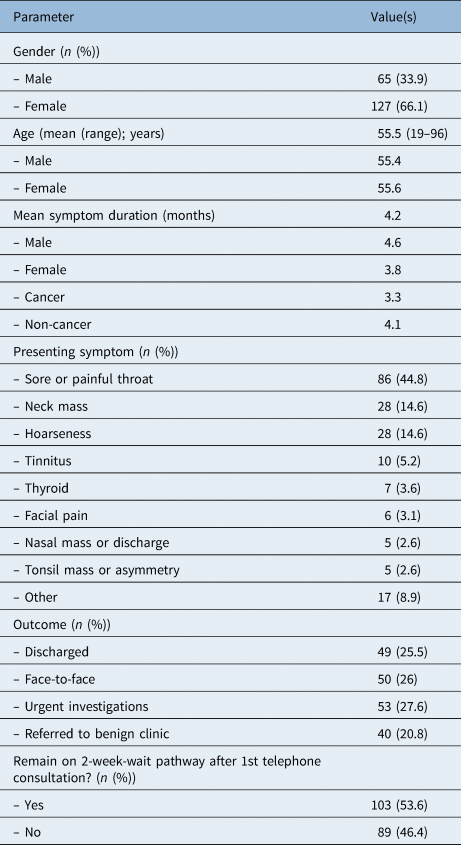
The most common presenting symptom, found in 86 patients (44.8 per cent), was defined as sore throat, throat discomfort or the feeling of something stuck in the back of the throat. All the presenting symptoms, as well as their frequency and duration, in addition to patient demographics and outcomes, are described in Table 1.
Patient demographics, presentation and duration of symptoms, and outcomes after first telephone consultation

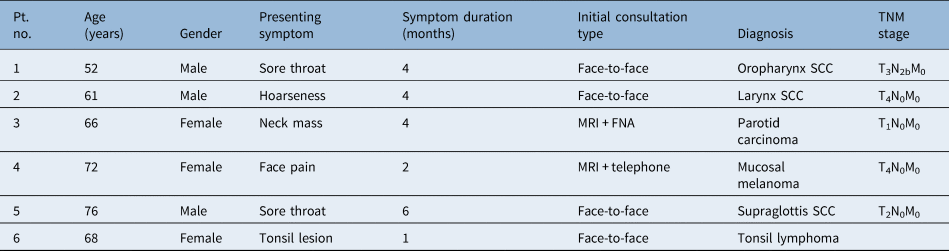
Of all the patients contacted, only six (3.1 per cent) went on to have a cancer diagnosis. The characteristics of these patients are summarised in Table 2. Of note, four (66.6 per cent) of these patients were asked to attend an urgent face-to-face appointment because there was a strong suspicion of cancer after the initial telephone consultation.
Summary of patients with cancer diagnosis

Pt. no. = patient number; TNM = tumour–node–metastasis; SCC = squamous cell carcinoma; MRI = magnetic resonance imaging; FNA = fine needle aspiration
Regarding patient satisfaction outcomes, patients expressed a preference for telephone consultation over face-to-face consultation (average of 9 on the rating scale), and stated that the telephone consultation addressed their concerns (average of 8.9 on the rating scale). In addition, although to a lesser extent (average of 7.2 on the rating scale), patients agreed that they would prefer a telephone consultation even after the Covid-19 crisis. Finally, 64 patients (84.2 per cent) confirmed that they were aware they had been referred to a head and neck cancer diagnosis clinic.
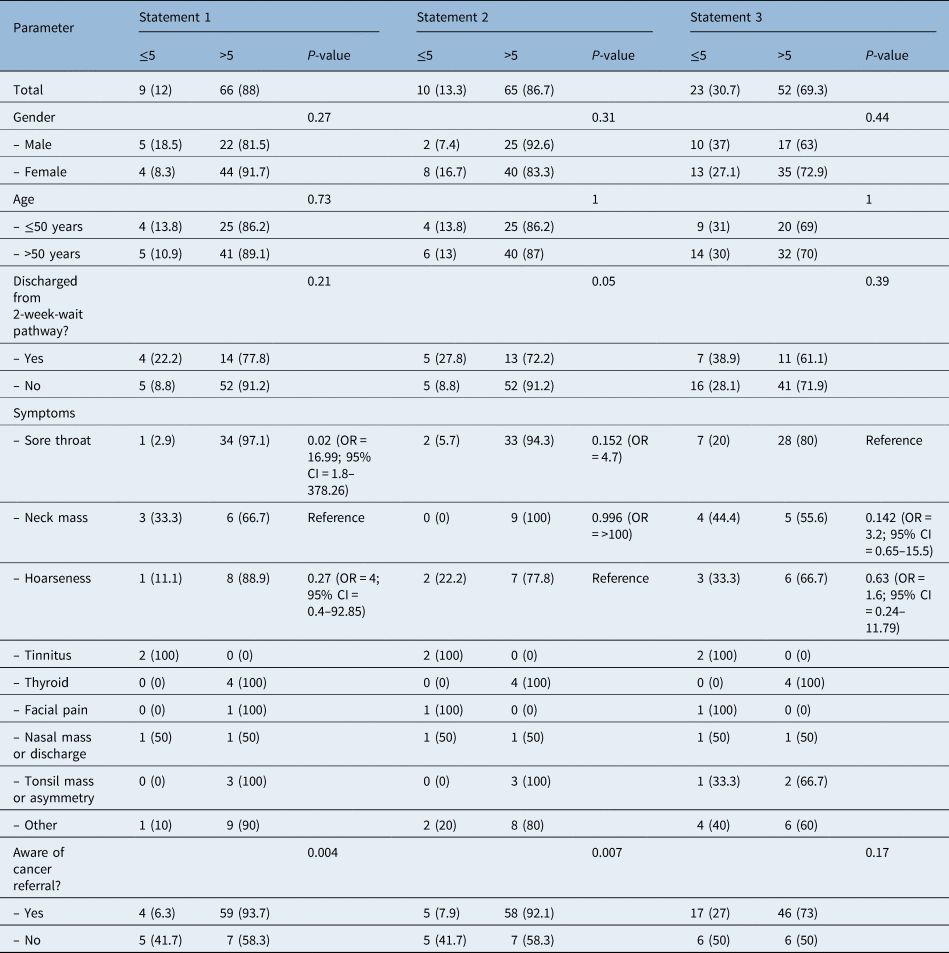
In order to try to identify patients who are less likely to be satisfied with a telephone consultation, we analysed those who scored 5 or lower for any of the aforementioned statements and compared them with those who scored more than 5 on every variable. The results are summarised in Table 3.
Summary of 75 patients scoring 5 or less on satisfaction statements compared to patients scoring more than 5

Data represent numbers (and percentages) of patients, unless indicated otherwise. Statement 1: I prefer to have this telephone consultation than face-to-face. Statement 2: this telephone consultation has addressed my concerns. Statement 3: I think I would have preferred this telephone consultation even in a non-Covid-19 crisis. OR = odds ratio; CI = confidence interval
Within our cohort, gender, age and outcome of the telephone consultation did not seem to affect patient satisfaction. However, the presenting symptom, as well as patients’ awareness of the consultation being a cancer referral, showed a statistically significant relation with patient satisfaction. With regard to preferring a telephone consultation over face-to-face consultation during the Covid-19 crisis, the only variables that influenced the patients’ response were, again, awareness of referral for cancer and the presenting symptom. Finally, the presenting symptom was the only variable identified to influence the preference for telephone consultation over face-to-face consultation after the Covid-19 crisis.
When comparing each of the three most common symptoms with a patient's preference for telephone consultation during the Covid-19 crisis (statement 1: ‘I prefer to have this telephone consultation than face-to-face’) and after it (statement 3: ‘I think I would have preferred this telephone consultation even in a non-Covid-19 crisis’), neck mass was equated with the lowest satisfaction (33.3 per cent answered 5 or lower on statement 1, and 44.4 per cent answered 5 or lower on statement 3). Patients presenting with sore throat showed a higher chance of being satisfied during the Covid-19 pandemic (p = 0.02) when compared with neck mass; no other differences were seen. Overall, all patients reported high satisfaction at the end of the consultation, with hoarseness showing the worst results (77.8 per cent answered more than 5 to statement 2 (‘this telephone consultation has addressed my concerns’)) compared with sore throat (94.3 per cent) and neck mass (100 per cent), although the differences were not significant.
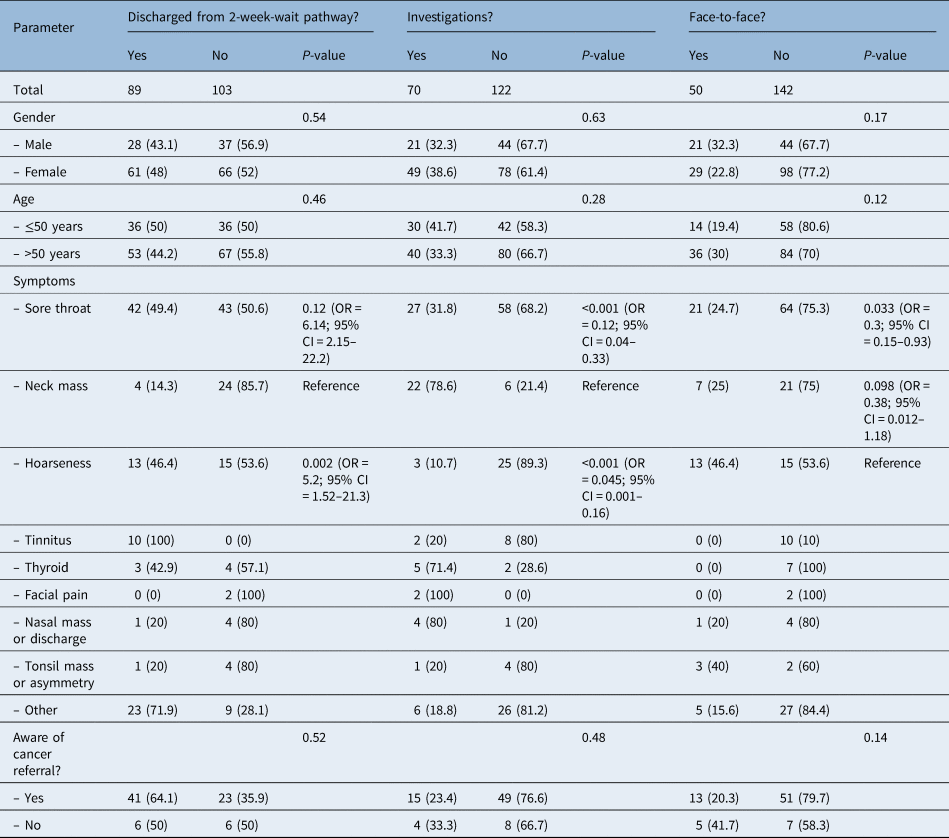
Finally, we tried to identify those variables that influenced the outcomes of the telephone consultation, the need for investigations and the need for urgent conversion to face-to-face consultation. These results are summarised in Table 4. Only the presenting symptom was identified as affecting these results. We also selected the three most frequent symptoms and tried to identify whether presenting symptoms influenced the outcome of the telephone consultation. The results showed that patients presenting with a neck mass were less likely to be discharged after the first telephone consultation than patients presenting with a sore throat (p = 0.12) or hoarseness (p = 0.002). In addition, these patients were more likely to require investigations than those with a sore throat (p < 0.001) and hoarseness (p < 0.001). Finally, patients presenting with hoarseness were more often required to attend a face-to-face consultation after telephone consultation (46.4 per cent), showing a significant difference when compared with sore throat (p = 0.033) but no significant difference compared with neck mass (p = 0.098).
Likelihood of discharge, tests or urgent face-to-face consultation according to demographics, presenting symptom or patient awareness of cancer referral

Data represent numbers (and percentages) of patients, unless indicated otherwise. OR = odds ratio; CI = confidence interval
Discussion
The early detection of cancer can improve treatment efficacy and patient prognosis.Reference Rimmer, Watson, O'Flynn and Vaz14 The Department of Health national guideline, revised in 2015, outlines the criteria for which patients should be referred urgently (within two weeks) to a head and neck clinician for review for suspected cancer.10 Detection rates using a two-week-wait head and neck cancer referral system are low (2.2–14.6 per cent);Reference Langton, Siau and Bankhead8,Reference Kumar, Drinnan, Mehanna and Paleri15 thus, refinement could improve detection rates and ensure that the right patients are seen in two-week-wait clinics, so as not to overload existing servicesReference Tikka, Pracy and Paleri12 and to improve efficiency. Our centre's own rate of conversion to cancer (from a two-week-wait head and neck cancer referral) correlates with these figures; in 2019, a total of 1567 head and neck cancer referrals were received, from which 39 cancers were diagnosed. This equates to a conversion rate of 2.5 per cent.
Since 1879, when the first telephone consultation was documented,16 the ability to consult by telephone has become an integral part of healthcare systems worldwide.Reference Vaona, Pappas, Grewal, Ajaz, Majeed and Car17 The British Medical Association, providing guidance for general practitioners in 2001, advised that ‘TC [telephone consultation], when correctly conducted can be considered to be safe and acceptable practice’.Reference Vaona, Pappas, Grewal, Ajaz, Majeed and Car17 In 2004, Bunn and colleagues (as cited in a Cochrane reviewReference Vaona, Pappas, Grewal, Ajaz, Majeed and Car17) described telephone consultation as the process whereby patients receive medical advice from one or more qualified healthcare professionals via the telephone. The authors concluded that telephone consultations appear to be safe, and that healthcare users were just as satisfied with them as with face-to-face consultations.
Telephone consultations have been implemented in different aspects of healthcare, including routine and emergency care, laboratory investigations, and health promotion.Reference Vaona, Pappas, Grewal, Ajaz, Majeed and Car17 The use of telemedicine (most commonly via video) in cancer care is already well established in the USA, with a long-proven record of high patient satisfactionReference Yunus, Gray, Fox, Allen, Sachdev and Merkel18 and cost-saving practice.Reference Thota, Gill, Brant, Yeatman and Haslem19 Similarly, other countries have provided evidence of increased telemedicine and its associated benefits.Reference Thaker, Monypenny, Olver and Sabesan20 The UK, however, does not have a well-established model for telephone consultation use in the initial management of urgent cancer referrals.
The recent Covid-19 pandemic has necessitated a dramatic change in clinical practice, to minimise ‘non-essential’ patients attending hospital. Different organisations have been forced to recommend the implementation of a new technique for two-week-wait head and neck cancer referrals,21,22 whereby patients are telephoned in order to minimise face-to-face interaction and comply with the UK government's social distancing recommendations.23 An initial report from a national audit evaluating telephone triaging of 1568 new two-week-wait head and neck cancer referrals showed that 54.7 per cent of the referrals avoided urgent face-to-face consultationReference Paleri, Hardman, Tikka, Bradley, Pracy and Kerawala24 by using the head and neck cancer risk calculatorReference Tikka, Kavanagh, Lowit, Jiafeng, Burns and Nixon13 during the same period of time (with only 3.1 per cent of cases diagnosed as cancer). These numbers are comparable to previously reported rates of conversion to cancer from two-week-wait head and neck cancer referrals (2.2–14.6 per cent),Reference Langton, Siau and Bankhead8,Reference Kumar, Drinnan, Mehanna and Paleri15 and to our own rate (3.1 per cent). We evaluated the usefulness of telephone consultation in order to consider its implementation in the long term.
Patient satisfaction is a growing concern in all aspects of healthcare, and, as the voice of the customer, it is a measure of quality.Reference Kruse, Krowski, Rodriguez, Tran, Vela and Brooks25 As with other healthcare delivery modalities, telephone consultation relies on reports of patient satisfaction because this is the only source of information that can report whether the treatment received met the patients’ expectations of care.Reference Cleary26
The recent coronavirus cancer review by NICE states that evaluating the patient's experience of cancer care during the pandemic is a key recommendation for ongoing research and provision of care.27 Patient satisfaction must be considered when assessing whether we can consider telephone consultation for new two-week-wait head and neck cancer referrals. Furthermore, identifying which symptoms are more likely to require investigations or face-to-face consultations could guide the creation of different pathways according to referral symptoms, enabling a more streamlined process.
Sore throat seems to be a valid symptom for telephone consultation according to our results. It showed good satisfaction rates and was associated with a high preference for telephone consultation even after Covid-19, with the highest rate of discharge after the first consultation (49.4 per cent) and lowest conversion to face-to-face consultation (20 per cent). Hoarseness, on the other hand, seems less suited to telephone consultation, showing the highest rate of conversion to face-to-face consultation for clinical evaluation (46.4 per cent), and the lowest rate of investigations requested after telephone consultation (10.7 per cent). Therefore, although telephone consultation can be considered to assess symptom severity, as well as associated symptoms and risk factors, in cases of hoarseness, it is less likely to be able to resolve patient concerns and will delay the pathway.
Finally, neck mass showed the highest rate of investigations (78.6 per cent) and fewest discharges (14.3 per cent), with good satisfaction rates. However, these patients reported the lowest preference for telephone consultation both during and after Covid-19. A good solution for this situation may be ‘straight to test’, followed by a face-to-face appointment to discuss the results. A similar pathway has already been implemented nationally for colorectal cancer.28 The scheme has been beneficial, with earlier diagnostics and treatment contributing to improved patient outcomes and satisfaction, as well as reduced hospital visits and fewer ‘did not attend’ appointments.28
The validity of telephone consultation for other symptoms is difficult to assess with our data; however, thyroid lumps could be easily included in the group of neck masses for pathway purposes, and tonsillar lesions or asymmetry could be included in the hoarseness group because of the need for clinical evaluation.
Our results indicate that patients’ awareness of cancer referral is also an important factor contributing to patient satisfaction, and it is important that the referrer explains the character of the consultation in order to manage patient expectations. A small number of patients (49 per cent) seem to be completely unaware of their general practitioner's concerns, according to previous publications29 as well as in our cohort (15.8 per cent). Although it has been reported that specifically explaining the reasons for the referral may leave the patient fearful of a potential cancer diagnosis,Reference Cummings and Vincent30 not stating them also creates a risk for undermining the problem, delaying appointments, or prioritising work or holidays.
Telephone consultation has shown benefits in other specialties, including lower healthcare costs, increased efficiency,Reference Pinto, Almeida, Pinto, Pereira, Oliveira and de Carvalho31–Reference Giordano, Scalvini, Zanelli, Corrà, Longobardi and Ricci33 shorter waiting times, and reductions in terms of travel, time off work and childcare costs.Reference Palcu, Munce, Jaglal, Allin, Chishtie and Silverstein34–Reference Agha, Schapira, Laud, McNutt and Roter36 Although it still needs to be proven, these advantages are expected in head and neck cancer two-week-wait referrals too, because of the low number of cancer diagnoses and the possibility of streamlining those patients whose first telephone evaluation raises suspicion of cancer. However, there are possible negative aspects that also need to be considered, including insufficient training or medico-legal vulnerability,Reference Paskins, Crawford-Manning, Bullock and Jinks37 and, specifically for two-week-wait head and neck cancer referrals, the possible increased number of tests requested when unable to perform a full head and neck examination.
In our study, 25.5 per cent of patients were discharged after the first telephone consultation; conversely, 26 per cent were asked to attend for face-to-face consultation after the initial telephone consultation. We tried to identify those variables that make patients more suitable for telephone consultation and improve its effectiveness. However, more studies need to be performed to further characterise those variables, and to analyse the cost benefits of head and neck cancer two-week-wait telephone consultation. This would be justified after telephone consultation has proved to be a valid option from a clinical point of view. Training is an important consideration, and it is essential that healthcare professionals feel confident in their skills to conduct and document the interview with accuracy and clinical competency. It is therefore important that healthcare professionals receive adequate training to enable them to carry out their clinical roles effectively.
There are some limitations to our study. There is a possible bias resulting from most of the consultations being performed by the same head and neck consultant, instead of trainees or other doctors. We also have to consider that, during the current Covid-19 situation, patients might be more likely to accept and be satisfied with a telephone consultation. Finally, because of the cancer pathway in our centre, only a small number of patients with thyroid problems, and no patients with oral cavity or lip lesions, have been evaluated. Nevertheless, this study shows that telephone consultation for new two-week-wait head and neck cancer referrals is a safe method, validating its use in the future, especially for specific symptoms.
• Telephone consultation for new two-week-wait head and neck referrals has not been well studied, but has been widely used in other healthcare aspects
• This study evaluates its value, including patient preference and satisfaction
• Telephone consultation is a valid option for new two-week-wait referrals, especially when the referral symptom is considered
• Most patients were satisfied with telephone consultation and this was only affected by patient awareness of cancer referral
• Patients with sore throat were more suitable for telephone consultation; those with hoarseness were more likely to require face-to-face consultation
• Patients with neck mass required further investigations more frequently than others
Conclusion
The Covid-19 crisis forced us to change our practices. For patients referred under the two-week-wait head and neck cancer pathway, that meant performing telephone consultation as a first assessment. This study shows that telephone consultation might be a valid initial encounter for the majority of two-week-wait head and neck cancer referrals going forward, especially when the main referral symptom is considered; specifically, telephone consultation for sore throat, ‘straight to test’ for neck lump and face-to-face consultation for hoarseness. The study also showed the relevance of patients being informed of the reasons for the referral, in order to manage patients’ expectations and improve patient satisfaction. This work shows the validity and safety of telephone consultation for two-week-wait head and neck cancer referrals. It sets the basis for a larger multicentric study once Covid-19 de-escalation has taken place, with the aim of assessing its long-term validity.
Competing interests
None declared