In the decades since the end of the Second World War, one of the most pressing and divisive issues that has come to dominate the political agendas of Western democracies is immigration, with most European publics expressing unease with migration to their countries. However, the range of potential implications of concern about immigration is not very well known. In some European countries, one of the most obvious implications is the rise of extremist, anti-immigration parties; this article considers another potential consequence of public concerns about immigration, reduced political trust. Given that many conceptualizations of system support include notions of community,Footnote 1 it is important to consider the potential effects of immigration on feelings of political community. Specifically, focusing on the British case where the consequences of concern about immigration are less obvious than in many other European countries, the article examines the relationship between concern about immigration and trust in politics.Footnote 2 Determining whether such a connection exists is important because trust in politics is thought to be crucial to effective policy making and compliance with government regulations.Footnote 3 Thus, understanding what produces trust and distrust is important. Although we have some understanding of the causes of political distrust, an additional piece of the puzzle of public distrust may be immigration, and particularly perceptions that migration is undermining the national community on which many believe democratic political institutions were built. The implications of this article's findings are of considerable importance because they point to the conclusion that rather than being an inconsequential sentiment in a country like Britain, the consequences of public worries about immigration are potentially very serious indeed, in that such concern is likely to be one of the forces undermining trust in the British political system.
The next section conceptualizes the dependent variable in this study – political trust – and outlines why concerns about migration are likely to be related to political trust; the section ends by proposing three specific hypotheses. The following section then explains why the British case is of particular interest and tests the proposed hypotheses using the panel component of the British Election Study (BES) of 2005. These results are compared to the 2002–03 European Social Survey (ESS). The latter is then further explored using an instrumental variables approach. The findings from all of these analyses provide support for the main contention of this article: concerns about immigration do appear to be undermining the functioning of the British political system by reducing levels of political trust.
Political trust, identity and immigration
This article is concerned with the relationship between perceptions of immigration and perceptions of the political system, particularly political trust. This section outlines what is meant by ‘political trust’ in this article and then discusses reasons why concern about immigration is likely to explain some of the variation in political trust. It then presents three specific hypotheses about the relationship between concern about immigration and political trust before proceeding to test these in the next section.
Political Trust
For some scholars, expressions of trust in a political institution are declarations that on average the agents operating within those institutions will prove trustworthyFootnote 4 or that the democratic institutions serve to select relatively trustworthy agents.Footnote 5 Miller and Listhaug argue that political trust ‘is a summary judgment that the system is responsive and will do what is right even in the absence of constant scrutiny’.Footnote 6 David Easton highlighted the importance of political community in maintaining stable political systems, arguing that political systems are thought to be prone to failure if political community is lacking – that is, if individuals in the system are not ‘sufficiently oriented toward one another’ and willing to support the existence of a group of individuals who can negotiate and settle differences.Footnote 7 So, among other things, stable political systems rely on a basic level of interpersonal connection and trust, as well as some degree of trust in elites and institutions running the system. As will be explained below, it is our contention that immigration is likely to pose problems for this notion of political community, thereby potentially undermining support for the political system.
Also of relevance here is Easton's distinction between diffuse and specific system support.Footnote 8 Easton conceptualizes diffuse support as a deep-seated set of attitudes towards politics and the political system that is relatively impervious to change. By contrast, specific support is related to the actions and performance of government or political elites. The assumption is that short-term policy failures should not directly erode diffuse regime support or support for the political community as a whole.
While this conceptual distinction may seem fairly clear, measuring diffuse versus specific support for the political system is less than straightforward. When we ask citizens whether they have trust or confidence in their national parliaments, presidents or governments, are we measuring their attitudes to the current set of leaders and policies or more general orientations to these institutions and elites?Footnote 9 Comparative analyses of survey questions pertaining to attitudes to government indicate that while there is overlap in individual-level perceptions of current authorities and attitudes to other aspects of the political system – for example, its institutions – perceptions of institutions appear to be empirically distinct from perceptions of current government officials.Footnote 10
This article is especially concerned with general orientations to political institutions and elites, and assumes – based on the above-mentioned comparative analyses – that indicators of trust and confidence can validly tell us something meaningful about these general orientations. Given that such items are, in fact, likely to tap into both types of support, in order to try to reduce the likelihood that our findings solely pertain to specific support, we (a) include multiple indicators of political trust; (b) control for known strong predictors of specific support; and (c) investigate the effects of concern about immigration on attitudes to the political system across multiple surveys.
The Relationship between Concern about Immigration and Political Trust
Most international relations scholars would argue that modern states – particularly modern European states – were built upon notions of shared identity and values. Some scholars believe that the creation of common identity resulted from modern advances in transport and printing, both of which are fairly important for the creation of a common language, which is, in turn, important for the articulation of common values across a large territory.Footnote 11 Others believe there may have also been an active attempt on the part of state leaders to construct such an identity.Footnote 12 Still others contend that common identity across large territories originates from a primordial human need for connection, and that modernization produced a transposition of notions of family (and particularly super-family) onto others living within state territory.Footnote 13 Many of these hypotheses imply a considerable amount of artificiality in the construction of national identities. Anthony Smith, however, contends that although the creation of the modern nation-state was made possible by economic and bureaucratic modernization (and particularly one key component of modernization – mass education), ‘the presence of a core ethnie around which strong states could be built’ made the creation of nations possible.Footnote 14 That is, such states have been built around shared cultural heritage and norms.Footnote 15 Evidence also indicates that these identities, including their civic, ethnic and cultural components, are still extremely relevant to citizens of European countries, including Britain.Footnote 16 Moreover, research on social identities has long pointed to the conclusion that identities – even artificially constructed laboratory-based identities – are meaningful to individuals because they contribute positively to self-esteem and self-image and because they help to provide clarity in a complex, confusing world.Footnote 17 The inference is, therefore, that long-established identities like national identities are even more relevant and powerful, no matter how artificial they may appear to the outside observer. Immigrants pose clear threats to these identities by bringing with them seemingly different values and ways of life; they are also perceived to threaten the economic resources of those among whom they have settled.Footnote 18 Particularly in countries like Britain in which the main myths of identity have not tended to include the myth of accepting migrants (compared to the myths of identity in the United States, for instance),Footnote 19 it may be unclear to many citizens how to reconstruct identity to incorporate newcomers. Newcomers who may be perceived as holding extremely different values from those of natives – Muslim migrants vis-à-vis a predominantly secular Britain, for instance – may be particularly difficult to reconcile with existing national identities.
The difficulty of coming to terms with new migrants, in turn, has potential implications for political systems. As noted above, political systems are thought to be prone to failure if there is an absence of political community – again, if individuals in the system are not ‘sufficiently oriented toward one another’ and willing to support the existence of a group of individuals who can negotiate and settle differences.Footnote 20 Some research into social capital has already come to the conclusion that immigration and multiculturalism may create problems for the former of these conditions (i.e., orientation towards one another), although it must be noted that the evidence is somewhat mixed.Footnote 21 Immigration, and more specifically, perceptions of immigration, may also create problems for the latter – i.e., the willingness to support the existence of a group of individuals who can engage in policy making – and reduce willingness to support the institutions through which these groups of elites govern. This is because feelings of disunity are not likely to apply solely to feelings of citizens for one another but are also likely to stretch to feelings about the elites in this community and the way the community is governed as well. Indeed, there is evidence from the United States that indicates that individuals tend to be increasingly less favourable towards using the institutions of the state to reduce poverty and provide welfare as a result of perceptions of cultural differences between groups who access these services.Footnote 22 Moreover, the British political system and its notions of political equality are argued to have been layered onto pre-existing cultural connections;Footnote 23 a perceived weakening of these cultural connections because of immigration is also likely to subsequently weaken attachment to this political system.
In short, it is clear that immigration creates widespread concern about political and social community and about social identities. Moreover, under conceptualizations of national identity before the era of mass immigration, the institutions through which elites governed the national polity were designed to govern and adjudicate between members of the national community. When individuals perceive that immigration has threatened that community, the institutions that govern them are likely to be called into question. That is, those most attuned to the effects of immigration on the national community may question the extent to which national political institutions exist to represent a national citizenry. Moreover, it is likely that individuals specifically blame their political elites and institutions for allowing large-scale migration in the first place and thus hold these elites and institutions in contempt as a result. While some of the prior research discussed above hints at the connection between immigration and perceptions of political systems, there has not yet been any investigation of this relationship. The analysis here takes a first step in filling this gap. We examine three specific micro-level propositions regarding the relationship between immigration and trust in politics:
HYPOTHESIS 1 Those expressing most concern about the impact of immigration on the national community will be least trusting of politicians and political institutions.
HYPOTHESIS 2 Those who believe the government has done a poor job of handling immigration will be least trusting of politicians and political institutions.
HYPOTHESIS 3 The relationship between concern about immigration and perceptions of government handling of immigration will be interactive: those who are most concerned about immigration and believe the government has handled the immigration issue poorly will be the least trusting of politicians and political institutions.Footnote 24
Immigration and political trust in Britain: the analysis
As mentioned above, in many European democracies, one of the most obvious results of large-scale immigration has been expression of anti-immigration sentiment via extremist parties such as the Front National in France, the Party for Freedom in the Netherlands (and in the 2002 and 2003 elections, Lijst Pim Fortuyn), or the Freedom Party in Austria and the more extreme Freedom Party breakaway party, the Alliance for the Future of Austria. In these cases, immigration-related concerns gain some expression in the ‘legitimate’ political institutions by achieving representation in these institutions, including becoming part of governing coalitions. The British political system, in contrast, provides very few institutional outlets for the expression of concern about immigration, despite the fact that anti-immigration sentiment is fairly strong in Britain.
For instance, even as early as the 1960s, roughly 85 per cent of British citizens felt that too many immigrants had been let into the country.Footnote 25 In the 1990s, approximately 65 per cent in Britain thought that immigrants abused the system of social benefits and that schools suffered where there were more immigrants.Footnote 26 The 2003 British Social Attitudes Survey indicated that 75 per cent of respondents were in favour of increased immigration restrictions, while the 2008 British Social Attitudes Survey indicated that 65 per cent of Britons believed immigration was a threat to their national identity.Footnote 27 Ipsos Mori poll data also indicate that since the late 1980s a majority in Britain think too many migrants have been let into the country.Footnote 28 In the 2009 Transatlantic Trends: Immigration survey, more than 60 per cent of British respondents stated that immigration was more of a problem than an opportunity, the highest of all countries included in the survey (the other countries were France, Germany, Italy, Canada, the United States, the Netherlands and Spain). The highest percentages of individuals claiming that immigrants take jobs from the native born and that immigration negatively affects national culture were found in Britain in that survey as well, and similar percentages were noted in the 2008 version of this survey.Footnote 29 Although it was traditionally assumed that Britain had less difficulty in reconciling immigration with national identity because British identity was predominantly civic in nature, evidence indicates that British identity also still has strong ethnic and cultural components,Footnote 30 which make inclusiveness towards immigrants and immigration extremely difficult. In addition, while the level of concern about immigration has always been high among the British public, the past decade has witnessed even larger-scale net migration to Britain, including a rise in the number of asylum seekers, along with rising uneasiness with Muslim migrants and minorities.Footnote 31 Thus, for the reasons discussed in the previous section, it seems very likely that such concerns would have a considerable impact on perceptions of the functioning of the British political system.
However, while parties like the British National Party (BNP) and United Kingdom Independence Party (UKIP) attempt to attract votes on the basis of public concern about immigration, most voters in Britain will not vote for either of these parties in general elections, presumably because they realize neither of these parties has any realistic chance of winning enough votes to win even a single parliamentary constituency, much less enough seats to take part in government. Although the BNP had begun to make some headway in local government elections in places like Yorkshire, Lancashire and East London, as well as in the 2009 European parliamentary elections, and despite fielding an unprecedentedly large number of candidates in the 2010 general elections, the party still failed to win even a single seat in the national parliament and only attracted 2.1 per cent of the popular vote, an increase of 1.2 percentage points on the 2005 general election.
In addition, while mainstream centre-right parties in other parts of Europe have provided an additional outlet for anti-immigration sentiment by co-opting the platform and rhetoric of the far-right (as is the case periodically in France, for instance), in Britain the two dominant political parties have often held similar policy positions on immigration, making it difficult for citizens to vote on this particular issue.Footnote 32 Specifically, both major parties have traditionally claimed to want to stem the flow of migration to Britain while simultaneously supporting policies to protect those already in Britain from discrimination.Footnote 33 Thus, distinguishing between the two parties on the issue of immigration may at times pose some difficulty for British citizens. Also of importance is that both parties appear to be somewhat divided on the issue of immigration, with former Labour cabinet ministers such as David Blunkett previously speaking fairly negatively about immigration and immigrantsFootnote 34 and more recently Frank Field, Margaret Hodge, John Denham, Jon Cruddas and Anne Cryer (among others) engaging in ‘tough talk’ on immigration, on the one hand, and Conservative party members expressing unease over the introduction of immigration or race into party rhetoric, on the other – although it must be noted that Labour is more internally divided over this issue than the Conservatives.Footnote 35 Even when the issue is specifically introduced by the Conservative party in an election – as in 2005 – it appears that other variables, such as leadership qualities and performance on policies other than immigration, are likely to be more important in explaining vote choices.Footnote 36 This article suggests that while immigration-related worries may have a limited impact on electoral outcomes in Britain, they may still affect the British political system by reducing trust in British politicians and political institutions for the reasons noted above: immigration is perceived as weakening the connection between citizens, on one hand, and institutions and politicians, on the other, because of a perceived threat to national community. Moreover, as also noted above, politicians and institutions are likely to be blamed for failing to control immigration adequately.Footnote 37
The 2005 British Election Study (BES)
As discussed above, we are interested here in perceptions of the political system as a whole and, therefore, we examine trust in multiple components of this system. In particular, we incorporate an indicator of trust in the key elected political institution in Britain, the national parliament. We also include an indicator of trust in politicians. In addition, we include an indicator of trust in an unelected institution, the police. Because these items are strongly connected to one another and scale very well and because prior research also indicates that they ought to be strongly connected to one another,Footnote 38 they have been combined into a single index of political trust, which ranges from 0 and 10, with high values representing higher levels of political trust (see Appendix A for question wording and scaling information). It was also expected that the combination of items would capture the systematic diffuse support component of political trust. It should be noted, though, that we have also examined the predictors of each item individually and the results are very similar to those reported below; that is, on the whole, the predictors of trust in the elected institution (parliament) and elected individuals are similar to the predictors of trust in our unelected body, the police, indicating that the findings are likely to pertain to general system support rather than solely to specific support for particular incumbents.
Prior research on perceptions of political systems and incumbents points to a wide range of potential explanations for individual-level differences in these perceptions, which we incorporate here. Echoing the major 1980s and 1990s electoral studies’ refrains of ‘It's the Economy, Stupid’ and drawing on Easton's model of the political system in which (perceived) outputs of the system are likely to produce short-term and long-term effects on perceptions of the system as a whole, many researchers have pointed to the role of economics in explaining differences in individual-level and aggregate-level perceptions of political institutions and incumbents. Thus, an economy that is performing poorly or perceptions that the national economy or one's own personal economic circumstances are declining (or are likely to decline) have all been argued to affect attitudes to political institutions and politicians, at least in the short term.Footnote 39 Perceptions of the functioning of political institutions are also important: if governments are perceived to be fair and open, if politicians can be held accountable, and if individuals perceive governments to be performing well along various policy dimensions, individuals are more likely to have favourable attitudes to political institutions and elites, again, at least in the short term.Footnote 40 Thus, levels of trust in politics are likely to be connected to the manner in which institutions function and whether citizens perceive governments to be performing well. More recently, scholars have linked distrust in politics to social capital, including voluntary and other informal participatory networks and interpersonal trust.Footnote 41 This article does not attempt to analyse the causality of this relationship, but simply introduces controls for social capital in the multivariate models below. Analyses also point to the effects of being electoral ‘losers’ – i.e., voting for a party that fails to get into government – and indicate that electoral losers may lose some degree of confidence in the political system in the short term.Footnote 42 The analysis below incorporates these potential explanations of variation in system support. As discussed above, it is expected that with these several indicators of specific support included in the model – particularly winning and losing, perceptions of government handling of specific policy areas, and perceptions of the economy – at least some of the remaining covariation between concerns about immigration and political trust is likely to be relevant to diffuse support.
This article makes strong claims about the impact of immigration on trust in British politics. Because of the strong claims being made, our primary aim in the analysis is to make the tests of our propositions as difficult as possible so that any evidence found in support of these propositions will be robust. We have tried to ensure robustness by introducing the strong controls noted above. We also investigate our propositions specifically using the British Election Study of 2005, which includes a short panel component. We take advantage of this panel component of the 2005 BES in order to help reduce the likelihood of (a) spurious relationships and (b) potential endogeneity problems. First, we incorporate a lagged dependent variable – that is, the respondent's level of political trust at t−1, which is measured in the BES pre-election survey conducted between February and April 2005.Footnote 43 This variable should help to reduce omitted-variable bias, providing a control for any predictors of political trust that are not controlled for via other independent variables. Secondly, our indicators of concern about the impact of immigration and perceptions of government handling of immigration will be measured at t−1, while all other controls (perception of government handling of other policy areas, economic perceptions, etc.) will be contemporaneous. With the incorporation of a lagged dependent variable and lagged expressions of concern about immigration and perceptions of government handling of immigration, any significant relationship that is found is highly likely to run in the hypothesized direction rather than the reverse (that is, concern about immigration predicts political trust rather than the reverse). Thus, because of the desire to control for a lagged level of trust and for the many other variables mentioned above, the 2005 BES is the best available recent dataset for conducting this analysis.
We begin by estimating the simple model of:

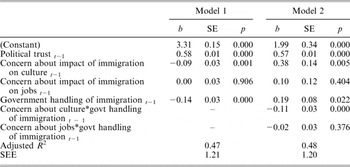
That is, political trust as measured in the post-election study will be predicted by political trust in the pre-election survey, concern about immigration in the pre-election survey, perceptions of government handling of immigration, also in the pre-election survey, and the interaction between the latter two. We have incorporated two separate indicators of concern about the impact of immigration – one of these measures concern about the effect of immigration on culture and the other measures concern about the impact of immigration on natives’ jobs.Footnote 44 Appendix A (on-line) provides the question wording for these variables and Table 1 provides the estimates of coefficients for Equation 1.
Political Trust and Attitudes to Immigration, BES 2005 Results (Simple Models)

Note: Coefficients are unstandardized OLS coefficients; see the text and Appendix A for the description of the variables and question wording; N = 2,386.
Model 1 tests Hypotheses 1 and 2, and the results indicate that concern about the impact of immigration on culture and perceptions of government handling of immigration both have independent effects on political trust. Concern about the impact of immigration on the jobs of natives appears to have no statistically significant effect on political trust. Given that our argument about the relationship between immigration-related worries and political trust revolved around notions of shared national culture, it is perhaps unsurprising that it is such concerns that have an impact on political trust. It is worth noting that the effects reported in Table 1 are the effects of concern about immigration and perceptions of handling of immigration by government even after including a lagged dependent variable in the model, and using lagged levels of concern about immigration. Model 2 of Table 1 tests the interactive effect of Hypothesis 3 and the results also provide support for this hypothesis. Again, the effect is only present for concern about the impact of immigration on culture, not jobs. We revisit this relationship below.
As discussed above, in order to help further ensure robustness, we control for the wide range of variables found to be related to attitudes to the political system or its incumbents in previous literature which were outlined briefly above: retrospective and prospective personal and national economic evaluations, evaluations of government performance across several policy areas (crime, health service, terrorism, the economy and taxation), social capital (interpersonal trust and participation in voluntary organizations), and loser versus electoral winner status. Following the work of Anderson and of Rohrschneider, we also incorporate controls for education, age, gender and income.Footnote 45 We introduce an additional control for left–right self-placement as an indicator of general ideological predisposition, as this is likely to be connected to both attitudes towards immigration and distrust of national political institutions, with those identifying with the far-right being most hostile towards immigration and towards national political institutions. Dummy variables are also included for Scotland and Wales. Note that all of these variables are measured contemporaneously, and thus our lagged independent variables will be competing against these contemporaneous measures. Again, this is done to help ensure a high level of robustness if the immigration–political trust relationship finds empirical support. In addition, the 2005 election took place at a time of heightened concern about Britain's involvement in Iraq and so we control for approval of involvement in the war.Footnote 46 Furthermore, as outlined above, the model incorporates a lagged dependent variable – that is, self-reported level of trust in the two institutions and politicians in the pre-election survey. Measures of all variables are provided in Appendix A, and the equation we estimate is as follows:

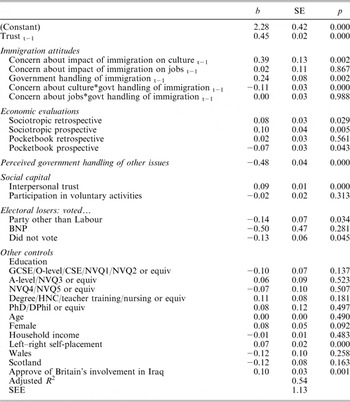
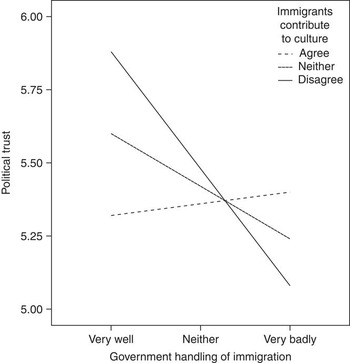
Table 2 provides the coefficients for this equation, and these generally confirm the findings from the simple models in Table 1; that is, concern about the impact of immigration on culture, perceptions of government handling of immigration and the interaction between these variables all appear to be statistically significant predictors of political trust. Figure 1 provides a graphical representation of the relationship between immigration concerns, perception of government handling of immigration and political trust.Footnote 47 The graph indicates that the impact of perceptions of government handling of immigration on political trust is stronger for those who believe immigrants have not contributed to British culture, while for those who believe immigrants have contributed to culture, the impact of perceptions of government handling of immigration is very limited. As noted above, the reported effect of the former is based on lagged indicators of these independent variables and incorporates a control for lagged level of political trust.
Political Trust and Attitudes to Immigration, BES 2005 Results (Full Model)

Note: Coefficients are unstandardized OLS coefficients; see the text and Appendix A for the description of the variables and question wording; N = 2,386.
Immigration and political trust, interactive effect. Note: Figure was created by substituting high, medium and low values for the immigration variables while holding all non-dichotomous variables at their means. All dichotomous variables (e.g., gender and region) were set to 0.

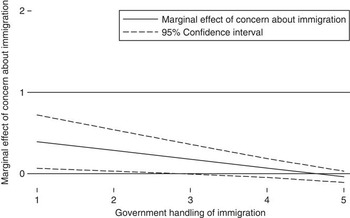
Figure 2 also illustrates the marginal effects of concern about immigration on political trust, depending on the level of perceived mishandling of immigration by government, including the standard errors around these effects.Footnote 48 The bands around the effects line indicate that we cannot have as much confidence in the effects at the highest levels of perceived government mishandling of immigration but the illustrations generally provide support for the interactive hypothesis. It is also worth noting that even without the interaction, concern about the impact of immigration on culture and perceiving government to have mishandled the issue were both independently related to political trust (i.e., in the non-interactive model). Thus, the evidence seems to suggest that perceptions of immigration are indeed affecting perceptions of government institutions and officials. It is also important to note that the relationship between attitudes to the impact of immigration on culture and perception of government handling of immigration on political trust was roughly similar across the three indicators of the dependent variable to the results reported here. That is, the interaction between concern about immigration and perception of poor handling of immigration appears to affect perceptions of the unelected institution, the police, as well as perceptions of parliament and politicians, again lending support to the notion that the relationship found here pertains to general system support.
Marginal effect of concern about immigration on political trust. Note: This method of displaying interactive effects is discussed in Thomas Brambor, William Roberts Clark and Matt Golder, ‘Understanding Interaction Models: Improving Empirical Analyses’, Political Analysis, 14 (2006), 63–82; see also, http://homepages.nyu.edu/~mrg217/interaction.htmlcode, last accessed 4 June 2011.

Immigration-related concerns are, of course, not the only strong predictors of political trust. Perceptions of government handling of other issues, economic evaluations, interpersonal trust, left–right self-placement, and approval of Britain's involvement in Iraq, as well as being an electoral loser, also predict political trust. However, the immigration variables are among the stronger predictors, despite not being measured contemporaneously. These findings support the propositions raised above: that worries about the impact of immigration on national culture and blaming the government for allowing increased immigration combine to create a group of citizens who are distrustful of their politicians and political institutions. Further implications of these findings will be discussed in the conclusion.
We have also analysed the relationship between concern about immigration, perceptions of mishandling of immigration, and respect for politicians and political institutions using the 2001 British Election Study (analysis not shown).Footnote 49 In some ways, the results are similar to those from the 2005 survey; namely, of the two indicators of concern about immigration, only concern about the cultural impact of migration achieves statistical significance by usual social science standards (i.e., p ≤ 0.05). In addition, the size of the effect of this variable on respect for politicians and institutions was somewhat larger than that in the 2005 analysis, with an unstandardized coefficient of 0.20 in the full ordinary least squares (OLS) model. On the other hand, the impact of perceptions of government handling of immigration on respect was not statistically significant in the multivariate model. In other words, in 2001, perceptions of mismanagement of immigration did not yet translate into negative perceptions of institutions and politicians. Moreover, there was no apparent interactive effect in 2001. So the multivariate analyses based on the 2001 election survey results appear to indicate that concern about the impact of immigration was having an effect on attitudes to politicians and institutions in 2001, but that perceptions of government mishandling of migration were not yet playing a significant role in predicting attitudes to politicians and institutions.Footnote 50
The 2002–03 European Social Survey (ESS)
Because the above analyses were conducted on data collected immediately before and after general elections, it is possible that the results are unusual. It is therefore important to attempt to investigate the results in differing circumstances. The 2002–03 European Social Survey was chosen for these purposes. This ESS was conducted shortly prior to the start of the unpopular war in Iraq (the final set of interviews was conducted in February 2003, and the Iraq War began 20 March 2003) and outside the context of a general election; it was also conducted prior to the large-scale influx of immigrants after the 2004 EU enlargement. This survey does not contain a panel component, nor does it contain the wide array of questions on perceptions of government handling of specific policies, including perceptions of government handling of immigration or asylum, nor the entire range of questions about economic perceptions included in the BES. However, we control for as many of the other predictors of political trust as possible, given these data limitations.
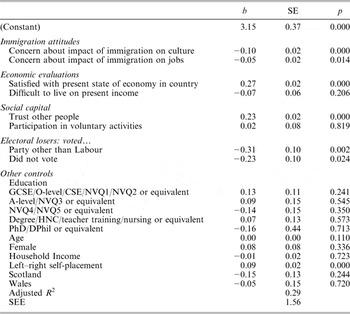
As with the BES analysis, we have combined the indicators of political trust to create a single 0–10 index (see on-line Appendix B for question wording and scaling information). Unfortunately, no questions were asked pertaining to perceptions of government handling of immigration or asylum and so Hypotheses 2 and 3 cannot be investigated. Instead, we provide a simple analysis of the relationship between concern about the impact of immigration on the national community and political trust, controlling for interpersonal trust, voluntary participation, the electoral loser effect, perceptions of the national economy, perceptions of one's personal economic situation, age, education, income, gender and left–right self-placement (see Appendix B for measures of these variables).
Table 3 presents the model for political trust in the British portion of the ESS. After controlling for the above-mentioned variables, the coefficients for concern about immigration achieve statistical significance, with a maximum impact of 1.5.Footnote 51 It must be noted that in contrast to the BES results, the indicators of concern about the impact of immigration on culture and on jobs both achieve statistical significance, although the effect of the latter is half the size of the former. The fact that the indicator of concern about the economic impact of immigration is significant in the ESS analyses and not significant in either of the BES analyses could be a result of a few factors. First, the immigration items in the ESS are measured on 0 to 10 scales rather than 1 to 5 scales, as is the case with the BES items. Also, the question about the impact of immigration on jobs is more balanced in the ESS than in the case of the BES (see Appendices A and B), which may have drawn out more nuanced views, which in turn affected responses to political trust questions differently. Finally, all items are measured within the same survey in the ESS. The difference in findings between the ESS and BES may, therefore, indicate that the contemporaneous effect of concern about jobs illustrated in Table 3 dissipates over time, but the more consistent and powerful identity-related effect remains even after several months, as shown with the BES analysis.
Political Trust and Attitudes to Immigration, ESS Results

Note: Coefficients are unstandardized OLS coefficients; see the text and Appendix C for the description of the variables and question wording; N = 1,707.
In order to confirm that these findings are not limited to the early part of the last decade, we have also investigated a model similar to that in Table 3 for the most recent round of the ESS (Round 4), which was fielded in Britain between September 2008 and January 2009 (analysis not shown). The results confirm that by 2008–09 concern about immigration was still having an impact on political trust. It is also important to note that we have analysed the effect of concern about immigration and each of our three indicators of political trust separately in the ESS, as was the case with the BES analyses, and the results are similar to those reported here. That is, concern about immigration affected attitudes to parliament, the police and politicians, indicating that the effects were not limited to elected institutions and politicians. Generally, then, these ESS results provide further confirmation of a connection between concern about the impact of immigration and political trust.
The 2002–03 ESS, an Instrumental Variables Approach
It is possible that perceptions of political institutions explain concern about migration, rather than the reverse, as has been hypothesized in this article; it is also possible that both of these perceptions respond to other factors that have been omitted from the models here. In addition, it is also possible that our measures of concern about immigration are measured with error. If these three problems exist, the OLS estimates reported above are biased and inconsistent. The extent and direction of the bias depends on the relative importance of each of these problems. If the main problem is that the direction of causality is reversed from what is hypothesized, OLS estimates are likely to overestimate the impact of concern about immigration. On the other hand, if random measurement error is the main problem, OLS estimates are likely to underestimate the impact of concern about immigration.
One solution to these problems is to use instrumental variables for potentially endogenous regressors – in this case, concern about immigration. An instrumental variables approach requires that we identify measures that are correlated with concern about immigration but otherwise uncorrelated with trust in institutions. That is, the instruments must have a significant partial correlation with concern about immigration controlling for all other exogenous determinants of political trust, while being uncorrelated with the error term.Footnote 52
Thus, in order to investigate further whether causality runs in the direction hypothesized in this article – i.e., whether concern about immigration does indeed affect perceptions of government institutions and politicians – we examine this relationship using an instrumental variables approach. Ideally, we would prefer to use this approach on the BES analyses, but these surveys were not designed to understand attitudes to immigration and finding instruments for the immigration variables in the BES datasets was impossible. The ESS 2002–03 questionnaire was, however, designed explicitly to investigate perceptions of immigration (among other things), and so finding adequate instruments for our indicators of attitudes to immigration is more likely with this survey.
Because of the difficulty of finding separate instruments for the two indicators of concern about migration used in the ESS analyses above, and because both indicators have statistically significant effects on political trust and are strongly correlated to one another (Pearson's r = 0.62), we have combined the two to create a measure of general concern about the impact of immigration. We have then searched for instruments for this index, focusing first on variables that should theoretically be related to concern about immigration but are not directly related to political trust. One of the key instruments that we use for concern about immigration is contact with immigrants in the form of friendships. A considerable body of research indicates that this form of contact has consistent, strong effects on attitudes to outgroups, including immigrants and minorities.Footnote 53 Feelings about having an immigrant as one's boss are also strong indicators of social distance and are significantly related to attitudes to immigration in the ESS. Other significant predictors of concern about immigration include expectations regarding qualifications for migration, namely that migrants speak the official language of the country, that they are committed to the way of life of the country, and that they be white. There is no theoretical reason to expect these variables to be directly related to political trust, but they ought to be (and are) related to general concerns about immigration. In order to strengthen the instrument, we searched this dataset for other variables that were strongly related to concern about immigration but not directly related to political trust. Several indicators of perceptions of where migrants come from were strongly related to the former but not to the latter, and these are incorporated as part of the instrument for concern about immigration (see on-line Appendix C).
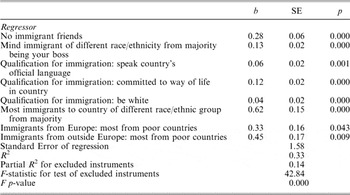
In order to investigate whether our instruments are significantly correlated with the potentially endogenous regressor, concern about immigration, we analyse the effect of the instruments on concern about immigration controlling for all exogenous variables that were included in the analysis in Table 3. The aim is to determine whether the instruments are significantly correlated with concern about immigration and have the anticipated signs, controlling for the included exogenous variables in the model. The results of this analysis are shown in Table 4. The coefficients on the instruments do indeed have the correct signs and are jointly significant. This is evaluated using the F statistic for the excluded instruments, which is 42.84 (significant at the p ≤ 0.001 level). This is clear evidence that the instruments are correlated with the endogenous regressor and thus satisfy the assumption that the selected instruments are relevant.Footnote 54
Ordinary Least Squares Estimates of Concern about Immigration, ESS 2002–03

Note: Coefficients are unstandardized OLS coefficients, controlling for all other exogenous predictors of political trust (see Table 3); see the text and Appendix C for the description of the variables and question wording; N = 1,600.
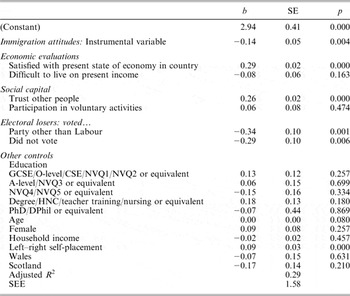
Table 5 provides the OLS estimates from the model in Table 3 using the instrumental variable in place of concern about immigration. The results confirm those in previous sections: concern about immigration has a significant effect on political trust. We now turn to the conclusion to discuss the implications of these findings.
Political Trust and Attitudes to Immigration, ESS Results with Instrumental Variables

Note: Coefficients are unstandardized OLS coefficients using instrumental variables; see the text and Appendices C and D for the description of the variables and question wording; N = 1,619.
Conclusion
While concern about immigration has had clear effects on the political landscape of Europe via the changing nature of European party systems, this article contends that the effects of such sentiment are also likely to be more subtle, operating via general feelings about the political system and the political community as a whole. The article illustrates these effects in the specific case of Britain. Successive periods of immigration in Britain have been met with discomfort with being a country of immigration by ordinary citizens. Prior research points to the conclusion that discomfort about immigration is rarely related to personal self–interestFootnote 55 and instead stems from concern about the effect of immigration on the national community and the threats that immigrants are perceived to pose to this community, including those related to identity and economic resources. This study indicates that such concerns may not be inconsequential in Britain but may instead lead to a weakening of ties between the governed and the governors by seemingly undermining the very basis on which such connections were originally built – the common sense of shared myths, history and culture. The potential consequences of reduced political trust are considerable because as noted above trust is crucial to effective policy making, compliance with government regulations, as well as engagement in civically moral behaviour. Political trust is also thought to be crucial to the representative relationship that lies at the heart of most democratic regimes. Although it is difficult to state definitively that our findings pertain to diffuse support in Britain, the evidence does point to the conclusion that across four different surveys (including the 2001 BES and 2008–09 ESS) and multiple indicators of political trust in the first decade of this century, feelings about the political system are very likely to have been affected by public perceptions of immigration and in 2005, by perceptions specifically of government handling of immigration. That is, the general findings are very likely to pertain to diffuse support.
The findings may be of considerable relevance to the growing body of research on the link between ethnic heterogeneity and trust. As noted above, the findings in this body of research are extremely mixed. The analysis here indicates that a potential missing component from these analyses is the perceptual component. As indicated in footnote 24, it is well established that perception often fails to mirror reality, and so analyses that only incorporate actual levels of migration or diversity may fail to find much effect precisely because perceptions are so very different from reality. We contend here that it is the perceptions that are important in explaining political trust. They could be important in explaining social trust as well. That is, perceptions of the negative consequences of immigration or diversity could be eroding both political and social communities upon which modern European democracies have been built.
While the most immediate response to the argument and findings presented here may be the simple one of ‘closing the gates’, such a solution would not solve the problem raised by this article. Whether or not British citizens like it, Britain has become a country of immigration and closing the gates would have no impact on the millions of immigrants and their families and descendants who are already in the country and consider it to be their home. Thus, perhaps an alternative solution is to revisit the construction of British identity, with the aim of more clearly establishing what British identity comprises and where the country's millions of foreigners fit within this construct. In addition, it is worth examining why concern about immigration is so much lower in some countries (e.g., Finland and Sweden) and whether those countries have adopted policies that might be relevant to British policy makers, such as rebuilding notions of community based on economic equality. At the very least, it must be recognized that immigration may be having long-term, unanticipated consequences for the functioning of the political system, which seem to require a more open debate and discussion.