Theory of mind, which involves the ability to infer or attribute mental states such as thoughts, feelings, and desires to the self and others, and understand how they influence behavior (Premack & Woodruff, Reference Premack and Woodruff1978; Sodian & Kristen, Reference Sodian, Kristen, Glatzeder, Goel and Müller2010), is an important aspect of social cognition that contributes to the development of social competence (Astington & Edward, Reference Astington, Edward, Tremblay, Boivin and Peters2010). However, theory of mind is not uniformly acquired. Stable individual differences in theory of mind performance have been observed across early childhood through adolescence (for review, see Hughes & Devine, Reference Hughes and Devine2015a) and predict negative social outcomes such as poor social skills, aggression, and peer rejection (e.g., Banerjee, Walting, & Caputi, Reference Banerjee, Watling and Caputi2011; Devine, White, Ensor, & Hughes, Reference Devine, White, Ensor and Hughes2016; Holl, Kirsch, Rohlf, Krahé, & Elsner, Reference Holl, Kirsch, Rohlf, Krahé and Elsner2017). Moreover, theory of mind deficits underlie the difficulties experienced in several forms of psychopathology including autism spectrum disorder (ASD; Baron-Cohen, Reference Baron-Cohen1995; Yirmiya, Erel, Shaked, & Solomonica-Levi, Reference Yirmiya, Erel, Shaked and Solomonica-Levi1998) and schizophrenia (Corcoran, Mercer, & Frith, Reference Corcoran, Mercer and Frith1995; Sprong, Schothorst, Vos, Hox, & Van Engeland, Reference Sprong, Schothorst, Vos, Hox and Van Engeland2007). While both social and biological influences have been proposed, there is a call for more integrated research on their complex interplay in contributing to individual differences in theory of mind. The current study investigated the roles of maternal behavior, oxytocin receptor gene (OXTR) methylation, and their interaction on toddlers’ early emerging theory of mind abilities.
In terms of social or environmental influences, theory of mind is thought to develop in part through social experiences (Carpendale & Lewis, Reference Carpendale and Lewis2004; Meltzoff & Gopnik, Reference Meltzoff, Gopnik, Baron-Cohen, Tager-Flausber and Lombardo2013). The family setting is important as the first context involving interpersonal interaction. Correspondingly, parenting practices, particularly maternal, have been related to children's early theory of mind (for reviews, see Miller, Reference Miller2016; Pavarini, de Hollanda Souza, & Hawk, Reference Pavarini, de Hollanda Souza and Hawk2013). Caregiving behavior that is sensitive and responsive (e.g., Cahill, Deater-Deckard, Pike, & Hughes, Reference Cahill, Deater-Deckard, Pike and Hughes2007) and comprises structure and discussion (e.g., Ruffman, Perner, & Parkin, Reference Ruffman, Perner and Parkin1999) provides opportunities for reasoning and encourages reflection on other perspectives, which facilitates learning about mental states and thus promotes the development of children's theory of mind abilities (Miller, Reference Miller2016). However, social influences only account for part of the variability in children's theory of mind abilities, as biological influences such as hormones and genes are also involved.
One biological factor that has received increasing attention for its role in the development of the social brain is the oxytocinergic system (for reviews, see Carter, Reference Carter2014; Donaldson & Young, Reference Donaldson and Young2008; Feldman, Monakhov, Pratt, & Ebstein, Reference Feldman, Monakhov, Pratt and Ebstein2016), which involves the production, binding, and signalling action of oxytocin. Oxytocin is a neuropeptide that functions peripherally as a hormone via bloodstream release and centrally as a neurotransmitter, where it binds to receptors in brain regions involved in social and emotion processing (Meyer-Lindenber, Domes, Kirsch, & Heinrichs, Reference Meyer-Lindenberg, Domes, Kirsch and Heinrichs2011). Several lines of investigation have implicated the oxytocinergic system in children's theory of mind abilities. For example, the intranasal administration of synthetic oxytocin has been associated with improved performance on, and increased neural activation during, completion of a theory of mind task among children and adolescents with ASD (Gordon et al., Reference Gordon, Vander, Bennett, Cordeaux, Lucas, Eilbott and Pelphrey2013; Guastella et al., Reference Guastella, Einfeld, Gray, Rinehart, Tonge, Lambert and Hickie2010). Levels of and changes in children's plasma and salivary oxytocin concentrations have also been associated with improved performance on, and increased neural activation during, theory of mind tasks (Gordon et al., Reference Gordon, Vander, Bennett, Cordeaux, Lucas, Eilbott and Pelphrey2013; Parker et al., Reference Parker, Garner, Libove, Hyde, Hornbeak, Carson and Hardan2014), as well as greater observed social reciprocity behavior (Feldman, Gordon, Influs, Gutbir, & Ebstein, Reference Feldman, Gordon, Influs, Gutbir and Ebstein2013). Single nucleotide polymorphisms (SNPs) in the OXTR gene have been related to performance on theory of mind tasks among preschool (Wu & Su, Reference Wu and Su2015) and school-aged (Slane et al., Reference Slane, Lusk, Boomer, Hare, King and Evans2014) children, as well as to a range of social cognition tasks (e.g., joint attention, empathy, cooperation, and self-recognition) among toddlers (Wade, Hoffmann, Wigg, & Jenkins, Reference Wade, Hoffmann, Wigg and Jenkins2014). Furthermore, alterations in the oxytocinergic system have been involved in the etiology of autism spectrum disorders (for review see Green, Taylor, & Hollander, Reference Green, Taylor, Hollander, Choleris, Pfaff and Kavaliers2013), which are characterized by theory of mind deficits.
To date, few studies have examined the interplay between the social and biological influences underlying individual differences in children's theory of mind. One study (Wade, Hoffmann, & Jenkins, Reference Wade, Hoffmann and Jenkins2015) demonstrated a gene–environment interaction between variation in OXTR SNP genotypes and maternal behavior, whereby more maternal cognitive sensitivity (e.g., identifying and responding to the child's cognitive needs and abilities) predicted better theory of mind performance among preschool-aged children with the major allele of the rs11131149 variant. A second study (McDonald, Baker, & Messinger, Reference McDonald, Baker and Messinger2016) observed a similar gene–environment interaction, such that better parent–child interaction quality predicted more empathic behavior among preschool-aged children with the minor allele of a different OXTR variant, rs53576. In both studies, no independent effect of the SNPs emerged, suggesting that it is crucial to consider gene–environment interactions in order to improve our understanding of individual differences in theory of mind. However, less is known about the potential influence of DNA methylation, a relatively stable genetic biomarker (e.g., How Kit, Nielsen, & Tost, Reference How Kit, Nielsen and Tost2012), of the OXTR gene on children's theory of mind abilities.
Research has recently begun to investigate functional outcomes of OXTR methylation. DNA methylation is a dynamic process whereby methyl groups attach to the 5-carbon of a cytosine ring typically in the cytosine-phosphate-guanine (CpG) context, which can block the recruitment and binding of transcription factors that allow for gene expression. Methylation in a promoter region of a gene, typically a CpG island (i.e., area with a high density of CpG sites, >200 bp; UCSC Genome Bioinformatics, 2009a), proximal to the transcription start site is generally associated with reduced gene expression (for review, see Jones, Reference Jones2012). DNA methylation within the OXTR CpG island, which has been classified as a promoter (ENCODE Project Consortium, 2012), can suppress gene transcription (Kusui et al., Reference Kusui, Kimura, Ogita, Nakamura, Matsumura, Koyama and Murata2001). In other words, OXTR methylation and concomitant reduction in mRNA decrease the production of oxytocin receptors, which would impact the functioning of the oxytocinergic system and in turn lead to different behavioral phenotypes (for review, see Kumsta, Hummel, Chen, & Heinrichs, Reference Kumsta, Hummel, Chen and Heinrichs2013). OXTR methylation has been associated with decreased mRNA levels in temporal cortex tissue (Gregory et al., Reference Gregory, Connelly, Towers, Johnson, Biscocho, Markunas and Pericak-Vance2009) and decreased levels of circulating oxytocin in blood plasma (Dadds et al., Reference Dadds, Moul, Cauchi, Dobson-Stone, Dobson-Stone, Hawes, Brennan and Ebstein2013). Some studies involving children and adolescents have linked increased OXTR methylation to theory of mind-related impairments such as poor social communication (Rijlaarsdam et al., Reference Rijlaarsdam, IJzendoorn, Verhulst, Jaddoe, Felix, Tiemeier and Bakermans-Kranenburg2017), callous-unemotional traits (Cecil et al., Reference Cecil, Lysenko, Jaffee, Pingault, Smith, Relton, Woodward and Barker2014; Dadds et al., Reference Dadds, Moul, Cauchi, Dobson-Stone, Dobson-Stone, Hawes, Brennan and Ebstein2013), and ASD diagnosis (Gregory et al., Reference Gregory, Connelly, Towers, Johnson, Biscocho, Markunas and Pericak-Vance2009), while others have found decreased methylation to be associated with social problems (e.g., Milaniak et al., Reference Milaniak, Cecil, Barker, Relton, Gaunt, McArdle and Jaffee2017; Yuksel, Yuceturk, Karatas, Ozen, & Dogangun, Reference Yuksel, Yuceturk, Karatas, Ozen and Dogangun2016). Examining the moderating role of social influences may help to elucidate these differential effects of OXTR methylation.
The current study aimed to investigate the social influences of maternal behavior as well as the biological influences of children's OXTR methylation, and their interaction, on children's early emerging theory of mind abilities. Given its potential regulatory role, we expected that increased methylation on a region within the OXTR CpG island would be associated with poorer performance on theory of mind tasks, whereas more optimal maternal behavior would be associated with better performance. We also hypothesized an interaction such that exposure to more optimal maternal behavior would buffer the impact of OXTR methylation on children's theory of mind performance.
Method
The present investigation forms part of a larger follow-up study on hormonal, genetic, and psychosocial factors in the developing mother–child relationship, of which other data are reported elsewhere (e.g., King et al., Reference King, Zelkowitz, Robins, Chen, Yerko, Zhou and Turecki2017; MacKinnon et al., Reference MacKinnon, Carter, Feeley, Gold, Hayton, Santhakumaran and Zelkowitz2018). All measures for the follow-up were administered during one laboratory assessment at approximately 2.5 years postpartum.
Participants
A community sample of mothers and their 2- to 3-year-old children agreed to participate in the follow-up study (n = 189 dyads). The assessment protocol was approved by the research ethics committee at the hospital where the research took place and was carried out in accordance with the Declaration of Helsinki. The participating women provided written informed consent for themselves and assent for their child. Inclusion criteria for the original study included a singleton pregnancy, minimum 18 years of age, and ability to understand the procedures and respond to questionnaires in English or French. The follow-up study data were collected between November 2012 and January 2015. At follow-up, the average age of mothers was 35.56 years (SD = 4.36), 91.0% reported being married or living with a partner, 63.8% were employed (48.4% full-time and 15.4% part-time), and 32.8% reported an average household income within $65,000–$104,999 and 29.5% within $25,000–$64,999. The average age of children was 2.89 years (SD = 0.38), and there was an equal number of males (49.7%) and females (50.3%). Compared to the women who did not return, those who participated in the follow-up study included fewer immigrants (52.8% vs. 33.9%; χ2 = 11.17, p = .001) and had more schooling (15.69 vs. 16.99 years average; t = –3.76, p < .001).
Measures
Background information
Sociodemographic information was collected including maternal age, marital status, employment status, as well as child sex and age.
Maternal behavior
Five minutes of free play with toys was filmed and coded using the Emotional Availability Scales (EAS; Biringen, Robinson, & Emde, Reference Biringen, Robinson and Emde2000), which assesses four dimensions of maternal interactive behavior: sensitivity (e.g., contingent responsiveness to the child's communications, acceptance, and affect regulation); structuring (e.g., supportive and appropriate organization of child's play, allowing exploration, and providing assistance when needed); nonintrusiveness (e.g., avoid overstimulating or interfering with child's play); and nonhostility (e.g., warmth, not being harsh or rejecting). Sensitivity was rated on a 9-point scale and the other dimensions on a 5-point scale, where higher scores indicate optimal behavior. The EAS has well-established test–retest reliability and construct validity (for review, see Biringen, Derscheid, Vliegen, Closson, & Easterbrooks, Reference Biringen, Derscheid, Vliegen, Closson and Easterbrooks2014). For this study, a random sample of videos (n = 59; 23.7%) was double coded and mean intraclass correlation coefficients (ICCs; single measure, absolute agreement) indicated satisfactory interrater reliability for all scales (ICCs = .51–.71), except nonhostility (ICC = .38), which likely reflects limited variance in scores and thus is not included in the analyses.
OXTR methylation
Saliva samples were collected using the Oragene™ OG-250 kit (DNA Genotek Inc., Ottawa, Canada). Mothers were asked to refrain from allowing children to eat or drink 30 minutes prior to collection in order to reduce the possibility of contamination from bacterial DNA. In accordance with the manufacturers’ instructions, DNA was extracted using the Oragene™ prepIT-CD2 kit (DNA Genotek Inc., Ottawa, Canada) and then 20 μl per participant underwent sodium bisulfite conversion using the EZ DNA Methylation-Gold Kit™ (Zymo Research, Irvine, CA, USA).
DNA primers for the OXTR gene were designed using MethPrimer software (Li & Dahiya, Reference Li and Dahiya2002) and the OligoAnalyzer tool 3.1 (Integrated DNA Technologies, 2015), as detailed in a previous report (King et al., Reference King, Zelkowitz, Robins, Chen, Yerko, Zhou and Turecki2017). Optimal annealing temperatures were established using the gradient ProFlex™ 96-well PCR System (Thermo Fisher Scientific, Waltham, MA, USA) and target amplicons were visualized on 1.5% agarose gel to validate lengths. Subsequently, bisulfite converted DNA was amplified using Kapa HiFi Uracil + ™ (Kapa Biosystems, Wilmington, MA, USA), following the manufacturer's instructions for polymerase chain reaction amplification and thermo-cycling. After the first round of amplification comprising 25 cycles with the target sequences, amplicons underwent an additional 15 cycles to bind Fluidigm™ common sequence primers (CS1-forward and CS2-reverse primers), which attach adaptor tags compatible with Illumina® universal indexes, and finally were pooled for each participant. Samples were subsequently purified using AmPure™ (Agencourt, Beverly, MA, USA) magnetic bead technology, quantified using Tape Station™ (Agilent Technologies, Santa Clara, CA, USA), diluted to 2 nmol for optimal cluster density, and sequenced using Illumina® MiSeq (Illumina, San Diego, CA, USA), in duplicate for quality control. Adaptor sequences were trimmed following Illumina® Fluidigm parameters and reads with a Phred quality score less than 20 were discarded. Bismark v0.14.4 and Bowtie 2.1.0 were used to align remaining reads with target regions. Only CpG sites with more than 20 reads were retained (Ziller, Hansen, Meissner, & Aryee, Reference Ziller, Hansen, Meissner and Aryee2015). The percentage of methylation was calculated for each CpG site by dividing the unconverted read counts by the total read counts. PhiX was used as a calibration control to provide an estimation of error rates. The data generated from MiSeq runs were batch-corrected using the limma package v.3.32.10 (Smyth et al., Reference Smyth, Ritchie, Thorne, Wettenhall, Shi and Hu2002) in R, then merged to create an average percent methylation score for each CpG site per participant.
We aimed to capture DNA methylation on the OXTR gene CpG island located on chromosome 3 between coordinates 8809306 and 8811279, corresponding to the Human GRCh37/hg19 assembly of the UCSC Genome Browser (UCSC Genome Bioinformatics, 2009b). We were able to extract data for 22 CpG sites (between 8809306 and 8809501) within a protein-coding region on exon 3 (Gimpl & Fahrenholz, Reference Gimpl and Fahrenholz2001; UCSC Genome Bioinformatics, 2013). According to the publicly available data from the Encyclopedia of DNA Elements (ENCODE Project Consortium, 2012) and WashU Epigenome Browser (Zhou, Li, Lowdon, Costello, & Wang, Reference Zhou, Li, Lowdon, Costello and Wang2014; Zhou et al., Reference Zhou, Maricque, Xie, Li, Sundaram, Martin and Wang2011), OXTR's 2.3-kb intergenic CpG island, which overlaps exon 3 and consequently the 22 CpG sites captured, displays moderate to strong promoter activity, specifically in cells found in saliva. For example, evidence suggests that the area captured on exon 3 may have important regulatory functions as indicated by the proximity of active histone marks such as H3K4Me3, transcription factor binding sites such as those for CTCF, and a 5' untranslated region or leader sequence where micro RNA can bind (Zhou et al., Reference Zhou, Maricque, Xie, Li, Sundaram, Martin and Wang2011, Reference Zhou, Li, Lowdon, Costello and Wang2014). We also captured DNA methylation on several other CpG sites between intron 2 and exon 1; however, coverage was not sufficient (e.g., less than 80% of sample data available) to include these in the analyses. The percent methylation scores for each of the 22 CpG sites captured on exon 3 were averaged to obtain children's overall mean percent of methylation for the 22-site region.
Theory of mind
Early theory of mind abilities were assessed by administering a battery of three tasks, which are demonstrated to be at the appropriate developmental level for use with 2-year-old children (Carlson, Mandell, & Williams, Reference Carlson, Mandell and Williams2004; Hughes & Esnor, Reference Hughes and Esnor2005, Reference Hughes and Ensor2007; Müller, Liebermann-Finestone, Carpendale, Hammond, & Bibok, Reference Müller, Liebermann-Finestone, Carpendale, Hammond and Bibok2012).
Visual perspective
This task assesses whether children understand that people cannot see when vision is obstructed, and is modeled after Müller et al.’s (Reference Müller, Liebermann-Finestone, Carpendale, Hammond and Bibok2012) adaptation of other blocked visual access tasks (Carlson et al., Reference Carlson, Mandell and Williams2004; Lempers, Flavell, & Flavell, Reference Lempers, Flavell and Flavell1977). The child is asked to show a toy to the mother, who is instructed to block her vision in a different way (e.g., closing eyes or turning around) on each of four trials. Children's responses are scored for attempts at correction (e.g., adjusting themselves, their mothers, or the toy) on a 5-point scale: 1 (no show or dropped toy in parent's lap and walked away), 2 (held toy near parent but no attempt at correction), 3 (partial correction), 4 (full correction but did not show the toy), and 5 (full correction and showed the toy). For this task, the possible range of total scores is from 4 to 20 points.
Pretend play
The pretend play task is modeled after Hughes and Esnor's (Reference Hughes and Esnor2005) adaptation of a previous version (Charman & Baron-Cohen, Reference Charman and Baron Cohen1997; Fein, Reference Fein1975). This task requires four objects: two realistic (e.g., toy horse and plastic grass) and two less realistic (e.g., horse and hay made from blocks). There are three conditions: baseline condition (two realistic), single substitution (one realistic, one unrealistic), and double substitution (two unrealistic). There are three trials for each condition: display (child asked to play with objects), modeling (experimenter pretends to feed horse), and suggestion (child asked to give horse something to eat). Children's responses in each of the nine trials are scored (1 point) for any use of pretend play actions (e.g., feeding horse), where the total score has a possible range from 0 to 9 points.
False-belief
The picture-book false-belief task (Hughes, Reference Hughes1998; Hughes & Esnor, Reference Hughes and Esnor2005) is modeled after Gopnik and Astington's (Reference Gopnik and Astington1988) approach. This task utilizes a peep-through picture book (Moerbeek, Reference Moerbeek1994) in which a picture of an eye is visible through a hole, but on the last page the eye is revealed to be a spot on a snake. Children are asked two force-choice questions to assess their understanding of false beliefs: “Before we turned the page, what did you think this would be, an eye or a spot?” and “Look, this is Charlie [a puppet is shown]. Charlie has never seen this book before. If we show him this picture, what will he think it is, an eye or a spot?” After each, a reality control question was asked: “What is it really, an eye or a spot?” Children receive a score of 1 point for each false-belief question if they correctly answer the control question, for a total score ranging from 0 to 2 points.
Task performance was filmed and subsequently reviewed for scoring. Tasks were double-coded for a random sample of children (n = 42; 23.6%), for which satisfactory interrater reliability was established (ICCs = .55–.90). The following method (see Hughes & Ensor, Reference Hughes and Ensor2007) was used to construct a single aggregate score for theory of mind. Scores on the visual perspective and pretend play tasks were significantly correlated (r = .233, p = .003); however, these were weakly related to performance on the false-belief task (r = .121, p = .133 and r = .154, p = .064, respectively). Partial correlations controlling for concurrent age, sex, number child-aged siblings, and verbal ability as well as maternal education produced the same pattern. The aggregate was computed by averaging standardized z scores from each task. Cronbach's alpha indicated moderate internal consistency between the standardized scores (α = 0.485). The aggregate was further supported by a principal component factor analysis with varimax rotation, which yielded a single factor solution explaining 49.32% of the variance with loadings ranging from .673 to .746.
Verbal ability
Children's verbal ability was measured using the vocabulary checklist of the MacArthur Communicative Development Inventory (CDI; Fenson et al., Reference Fenson, Marchman, Thal, Dale, Bates and Reznick2007); the Level II form is normed and used for all French-speaking children (Frank, Poulin-Dubois, & Trudeau, Reference Frank, Poulin-Dubois and Trudeau1997) and English-speaking children younger than 31 months of age (Fenson et al., Reference Fenson, Pethick, Renda, Cox, Dale and Reznick2000), and the Level III form is normed and used for English-speaking children 31 months of age and older (Fenson et al., Reference Fenson, Marchman, Thal, Dale, Bates and Reznick2007). Mothers were asked to indicate which of 100 words her child says, where higher scores indicate more advanced productive vocabulary. The CDI demonstrates good content and concurrent validity (Fenson et al., Reference Fenson, Pethick, Renda, Cox, Dale and Reznick2000, Reference Fenson, Marchman, Thal, Dale, Bates and Reznick2007).
Data analyses
Descriptive statistics, bivariate Pearson's r correlations, standardized scores, and principal component factor analysis were computed using SPSS Statistics 25 (IBM, USA). Regression-based moderation analyses with bootstrapping (20,000 resamples) and 95% bias-corrected confidence intervals (where crossing zero indicates nonsignificance) were conducted using Mplus 7.11 software (Muthén & Muthén, Los Angeles, CA, USA). Overall, 3.5% of the data was missing and covariance coverage ranged from 0.95 to 1.00. The number of children who completed each theory of mind task ranged from 157 to 183, due to noncompliance or administration error. Missing data were handled using pairwise deletion in SPSS and full information maximum likelihood in Mplus. Full information maximum likelihood estimates values based on all available data and thus produces unbiased model parameters (Enders, Reference Enders2010). Consistent with previous research on theory of mind development (e.g., Carlson et al., Reference Carlson, Mandell and Williams2004; McAlister & Peterson, Reference McAlister and Peterson2013), we controlled for children's age, sex, number of siblings between 1 to 12 years old, and verbal ability as well as maternal education (i.e., years of schooling). Given global DNA methylation has been observed to vary by race/ethnicity (e.g., Zhang et al., Reference Zhang, Cardarelli, Carroll, Fulda, Kaur, Gonzalez and Morabia2014), we used a dichotomous control variable for Western/non-Western origin (Kooijman et al., Reference Kooijman, Kruithof, Duijn, Duijts, Franco, IJzendoorn and Jaddoe2016) based on mothers’ self-reported country of birth (Stronks, Kulu-Glasgow, & Agyemang, Reference Stronks, Kulu-Glasgow and Agyemang2009).
Results
Descriptive statistics
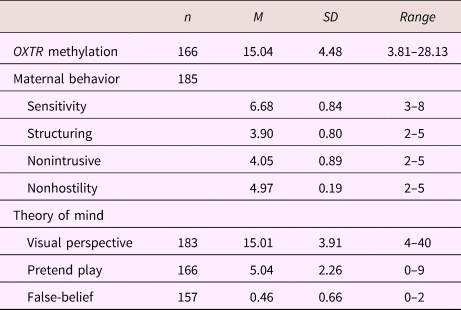
Descriptive statistics for the main study variables are reported in Table 1. Mean ratings fell within 1 SD of previous research on maternal behavior (Biringen, Matheny, Bretherton, Renouf, & Sherman, Reference Biringen, Matheny, Bretherton, Renouf and Sherman2010). Children's average OXTR methylation was within 1 SD of levels reported for individual CpG sites on exon 3 measured via cord blood (Cecil et al., Reference Cecil, Lysenko, Jaffee, Pingault, Smith, Relton, Woodward and Barker2014; Rijlaarsdam et al., Reference Rijlaarsdam, IJzendoorn, Verhulst, Jaddoe, Felix, Tiemeier and Bakermans-Kranenburg2017). Mean scores for each theory of mind task fell within 1 SD of studies using similar-aged samples of children (Hughes & Ensor, Reference Hughes and Esnor2005; Müller et al., Reference Müller, Liebermann-Finestone, Carpendale, Hammond and Bibok2012).
Descriptive statistics for main study variables

Note: Unstandardized theory of mind scores are presented; OXTR, oxytocin receptor gene.
Bivariate correlations
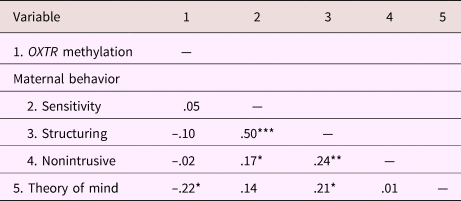
Bivariate correlations between the main study variables are presented in Table 2. Results indicated that more maternal structuring was associated with better theory of mind performance, while higher OXTR methylation was associated with worse theory of mind performance.
Bivariate correlations between main study variables

Note: OXTR, oxytocin receptor gene. *p < .05. **p < .01. ***p < .001.
Moderation analyses
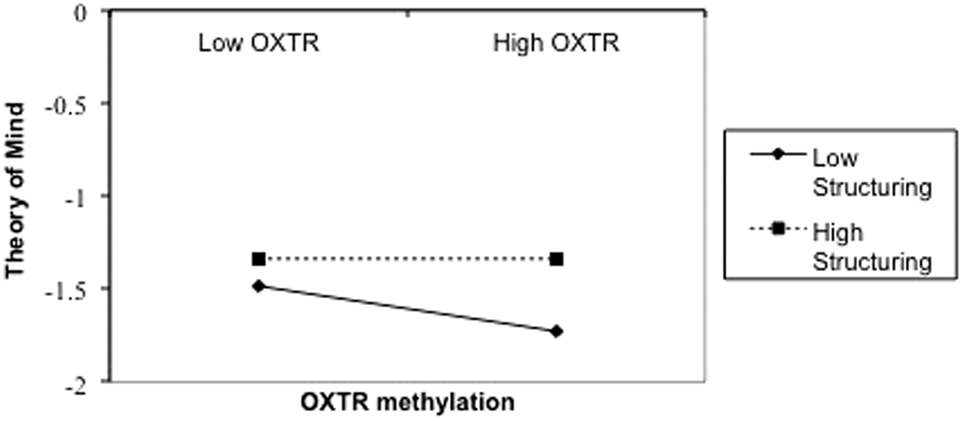
One model was tested that included children's OXTR methylation, three dimensions of maternal behavior, and their interactions. Maternal sensitivity (β = 0.045, b = –0.058, 95% CI [–0.124, 0.166]) and structuring (β = –0.031, b = –0.119, 95% CI [–0.327, 0.020]) did not emerge as significant individual predictors of theory of mind, while maternal nonintrusiveness (β = –0.227, b = –0.260, 95% CI [–0.384, –0.136]) and children's OXTR methylation (β = –0.529, b = –0.089, 95% CI [0.116, –0.065]) did. Bootstrap estimates also revealed a significant interaction (see Figure 1) between maternal structuring behavior and children's OXTR methylation on theory of mind performance (β = 0.259, b = 0.019, 95% CI [0.013, 0.024]), when controlling for children's age (β = 0.099, b = 0.301, 95% CI [0.011, 0.558]), sex (β = 0.059, b = 0.124, 95% CI [–0.067, 0.320]), ethnicity (β = 0.082, b = 0.243, 95% CI [–0.045, 0.505]), number of child-aged siblings (β = 0.098, b = 0.134, 95% CI [0.018, 0.272]), verbal ability (β = 0.126, b = 0.006, 95% CI [0.001, 0.010]), and maternal education (β = –0.039, b = –0.012, 95% CI [–0.047, 0.028]). The overall model explained 48.4% of the variance in children's theory of mind (R 2 = .484). Simple slopes analysis revealed that OXTR methylation was only related to theory of mind among children whose mothers displayed lower levels of maternal structuring behavior (i.e., 1.5 SD below the mean; b = –.039, p = .012).
Interaction between OXTR methylation and maternal structuring behavior on children's theory of mind performance. Theory of mind performance represents the standardized aggregate variable. OXTR methylation represents the mean percent of methylation across the 22 CpG sites captured on exon 3.

Discussion
The current study investigated the interplay of social and biological influences on individual differences in children's theory of mind. Maternal parenting behavior and children's OXTR methylation were differentially associated with early theory of mind abilities. An interaction also emerged such that methylation within exon 3 of the OXTR gene was negatively related to theory of mind performance among children whose mothers displayed less structuring, when controlling for several well-established predictors.
As expected, higher OXTR methylation was associated with worse theory of mind performance, which may reflect the impact of gene suppression on oxytocinergic system functioning. Given that the actions of hormones are exerted through binding to their receptors (Molnar & Gair, Reference Molnar, Gair, Molnar and Gair2012), increased methylation within the OXTR exon 3 protein-coding region may suppress the transcription and production of oxytocin receptors, which could potentially decrease cell receptivity to circulating oxytocin, and in turn may lead to reduced binding of oxytocin. Such downregulation of the oxytocinergic system could have a functional impact on social cognitive processing if it were to occur in the tissue of oxytocin-sensitive brain areas associated with theory of mind such as the amygdala and prefrontal cortex (e.g., Baron-Cohen et al., Reference Baron-Cohen, Ring, Wheelwright, Bullmore, Brammer, Simmons and Williams1999; Gallagher et al., Reference Gallagher, Happé, Brunswick, Fletcher, Frith and Frith2000; Gordon et al., Reference Gordon, Vander, Bennett, Cordeaux, Lucas, Eilbott and Pelphrey2013). The results of the current study are also consistent with previous research demonstrating that hypermethylation of the OXTR gene is associated with theory of mind-related deficits among children and adolescents (Cecil et al., Reference Cecil, Lysenko, Jaffee, Pingault, Smith, Relton, Woodward and Barker2014; Dadds et al., Reference Dadds, Moul, Cauchi, Dobson-Stone, Dobson-Stone, Hawes, Brennan and Ebstein2013; Gregory et al., Reference Gregory, Connelly, Towers, Johnson, Biscocho, Markunas and Pericak-Vance2009; Rijlaarsdam et al., Reference Rijlaarsdam, IJzendoorn, Verhulst, Jaddoe, Felix, Tiemeier and Bakermans-Kranenburg2017).
The results of the current study indicate that maternal parenting behavior moderates the influence of gene suppression on children's early theory of mind abilities, such that exposure to more structuring buffers the impact of higher levels of OXTR methylation, when the oxytocinergic system is presumably downregulated, while receiving less structuring is associated with poorer performance. This pattern is in line with the two previous studies (McDonald et al., Reference McDonald, Baker and Messinger2016; Wade et al., Reference Wade, Hoffmann and Jenkins2015) that demonstrated gene–environment interactions between OXTR polymorphisms and parental behavior on children's theory of mind and empathy. Taken together, these findings suggest that OXTR gene biomarkers, such as hypermethylation and “risk” alleles, confer susceptibility to the social influences of optimal and less optimal parenting on theory of mind abilities.
Of particular interest, maternal structuring, but not sensitivity, was associated with better performance on theory of mind tasks. The EAS structuring scale measures the supportive organization of a child's play and learning by matching responses to the child's needs for assistance or autonomy (Biringen, Robinson, & Emde, Reference Biringen, Robinson and Emde1998). It could be the case that mothers who engage in more optimal structuring are better able to recognize that children are struggling socially (i.e., those with higher OXTR methylation), and thus adjust their interaction style to provide more guidance and scaffolding, which may involve more explicit explanations about mental states and perspective taking that would in turn promote theory of mind abilities. The EAS sensitivity scale places more of an emphasis on the affective quality of interactions (Biringen et al., Reference Biringen, Robinson and Emde1998). Although a mother may demonstrate warmth and positive emotion, this alone may not be enough to facilitate learning about mental states and perspective taking, especially among children with higher methylation whose downregulated oxytocinergic system may be impeding theory of mind. It is also possible that these two dimensions of maternal behavior are differentially related to cognitive and affective components of social cognition. For example, Wade et al. (Reference Wade, Hoffmann and Jenkins2015) found that a measure of maternal cognitive sensitivity, which taps aspects of structuring such as interpreting a child's level of understanding and providing support that matches, was related children's theory of mind performance. McDonald et al. (Reference McDonald, Baker and Messinger2016) found that affective mutuality (i.e., emotional availability and shared positive affect), but not parent supportiveness (i.e., responsiveness to needs, balance of involvement, and respect for independence), was related to children's empathy, as measured by observed caring and concerned responses to parental distress. Sensitivity is known to influence children's emotional development (e.g., attachment security), whereas parenting that follows the child's cues and supports his or her engagement with the environment promotes cognitive development (for reviews, see Murray, Reference Murray2014; Murray, Cooper, & Fearon, Reference Murray, Cooper and Fearon2014). Contrary to expectations, exposure to more maternal intrusiveness was related to better performance on theory of mind tasks. Although the EAS intrusiveness scale reflects behavior deemed to be overstimulating or too directive that interferes with the child's play, simply providing more input may still be beneficial for learning about mental states and promoting perspective-taking abilities.
Maternal behavior was not related to children's OXTR methylation. DNA methylation patterns can be largely influenced by genetic variation in a heritable and stable manner throughout a lifetime (Gaunt et al., Reference Gaunt, Shihab, Hemani, Min, Woodward, Lyttleton and Relton2016; McRae et al., Reference McRae, Powell, Henders, Bowdler, Hemani, Shah and Montgomery2014). However, as an epigenetic process, DNA methylation is also considered to be responsive to environmental influences (for reviews, see Lewis & Olive, Reference Lewis and Olive2014; McGowan & Roth, Reference McGowan and Roth2015), particularly to significant stressors (e.g., abuse/neglect) during sensitive periods of development (e.g., perinatal). For example, perceptions of low maternal care in childhood were associated with increased OXTR methylation in adulthood (Unternaehrer et al., Reference Unternaehrer, Meyer, Burkhardt, Dempster, Staehli, Theill and Meinlschmidt2015), but not in the region of exon 3 captured in the current study. Of note, a previous study by our team using the same sample (King et al., Reference King, Zelkowitz, Robins, Chen, Yerko, Zhou and Turecki2017) revealed that exposure to maternal depression during pregnancy and the early postpartum period was not associated with OXTR methylation profiles among children. This finding is consistent with the lack of epigenetic effect of concurrent maternal behavior observed in the present study.
To our knowledge, this is the first study to provide empirical evidence for the association of DNA methylation of the OXTR gene, and its interaction with maternal behavior, with individual differences in theory of mind abilities among young children. The results should, however, be interpreted with a few methodological limitations in mind. Given the challenges of administering cognitive assessments to 2-year-old children (e.g., limited attention and verbal skills), only a few brief but engaging theory of mind tasks were selected for use in the current study. Consistent with previous research demonstrating that these tasks are developmentally appropriate (e.g., Hughes & Ensor, Reference Hughes and Esnor2005), only a small percent (6.3%) of children failed to complete two or more tasks. However, as the aggregate theory of mind score had only moderate internal consistency, future research would benefit from employing a wider variety of tasks and assessing other aspects of theory of mind (e.g., affective perspective taking). While we included several well-established covariates, we were not able to control for cell composition (e.g., epithelial and leukocyte) in the saliva sample. Therefore, differential methylation patterns between cell or tissue type (for review see Bakulski, Halladay, Hu, Mill, & Fallin, Reference Bakulski, Halladay, Hu, Mill and Fallin2016) may have obscured the measurement, though this is less likely to occur in high-density CpG islands (Slieker et al., Reference Slieker, Bos, Goeman, Bovee, Talens, van der Breggen and Heijmans2013). Similarly, we cannot assume that OXTR methylation profiles in salivary samples reflect those in brain regions implicated in theory of mind, although methylation in peripheral and central tissues have been found to be associated in some genome-wide studies (e.g., Davies et al., Reference Davies, Volta, Pidsley, Lunnon, Dixit, Lovestone and Mill2012; Farré et al., Reference Farré, Jones, Meaney, Emberly, Turecki and Kobor2015; Smith et al., Reference Smith, Kilaru, Klengel, Mercer, Bradley, Conneely and Binder2015). Individual differences in theory of mind performance may be inherited, as moderate heritability has been observed among younger, typically developing children, although environmental influences explain more variance following the transition to school (for review, see Hughes & Devine, Reference Hughes, Devine, Lamb, Lerner and Bonner2015b). In addition, DNA methylation patterns may differ by genotype (for review, see Meaburn, Schalkwyk, & Mill, Reference Meaburn, Schalkwyk and Mill2010). Unfortunately, our targeted amplicon approach did not allow us to investigate sequence variation at associated SNP loci in relation to the methylation findings. Future research should examine the allele-specific effects of OXTR methylation on theory of mind abilities. Finally, it is possible that other biological processes (e.g., dopaminergic reward system) not measured in the current study may underlie the buffering effect of maternal structuring. Nevertheless, the findings are suggestive of a potential interaction between gene and environmental influences, and thus further investigation in a larger, prospective sample is warranted.
Conclusions
The current study examined the interplay between environmental and biological factors, providing new evidence that both maternal behavior and children's OXTR methylation influence early emerging theory of mind abilities. Further, their statistical interaction suggests that maternal structuring behavior becomes particularly important for theory of mind when children's OXTR is more highly methylated. Maternal parenting behavior may buffer the potentially negative effects of OXTR methylation on oxytocinergic system functioning. Given the role of theory of mind deficits in psychopathology, elucidating such interactions between gene and environmental influences improves our understanding of risk and resilience, and in turn points to potential targets (i.e., children with high OXTR methylation) for early intervention (e.g., parent training).
Author ORCIDs
Anna L. MacKinnon, 0000-0002-1705-2048
Acknowledgments
We are grateful to the families who participated in this study. We thank Margot Kelly-Hedrick and Amanda Gentile for their research assistance.
Financial support
This project was funded by Operating Grant MOP-123354 from the Canadian Institutes of Health Research. Nancy Feeley is supported by a Senior Research Scholar Award from the Fonds de recherche du Québec—Santé. Anna L. MacKinnon was supported by Vanier Canada Graduate Scholarship CGV-127476 from the Canadian Institutes of Health Research.