There is a significant burden of childhood malnutrition in low- and middle-income countries.Reference Tchervenkov, Jacobs and Bernier1 The co-existence of CHD increases the likelihood and severity of malnutrition, which in turn adds to the prevailing challenges for the management of CHD.Reference Jenkins, Castaneda and Cherian2–Reference Reddy, Kappanayil and Balachandran4 Studies from high-income countries have shown normalisation of somatic growth if corrective surgery for CHD is performed early in life.Reference Weintraub and Menahem5–Reference Rhee, Evangelista, Nigrin and Erickson10 However, in low- and middle-income countries, due to resource constraints, corrective interventions for CHD are mostly performed late, leading to a vicious cycle of malnutrition, congestive heart failure, and infections.Reference Kumar and Shrivastava11
The catabolic state after cardiac surgery is a significant deterrent in performing early corrective operations for CHD in the presence of undernutrition. This catabolic state is potentially worsened by common co-morbid conditions in low-resource environments that include respiratory infections and sepsis.Reference Argent, Balachandran, Vaidyanathan, Khan and Kumar12
While studies from high-income nations have previously shown that early weight loss after cardiac surgery is overcome soon after discharge,Reference Weintraub and Menahem5–Reference Rhee, Evangelista, Nigrin and Erickson10 there are no prospective studies from low and middle-income countries on the early weight gain trends after congenital heart surgery. Factors that determine early nutritional recovery have not been adequately studied in the context of cardiac surgery. Identification of correctable factors for delayed or suboptimal recovery will enable better nutritional recovery after congenital heart surgery.
We sought to prospectively study the early post-operative weight trends in consecutive infants undergoing cardiac surgery. We also sought to identify pre-operative, operative, and post-operative factors that were associated with increased weight loss after surgery and poor weight gain following discharge.
Methods
This was a prospective observational study conducted in a tertiary referral hospital in Southern India. All children <1 year undergoing heart surgery for a period of 1 year from January 2018 to January 2019 were included in the study. The centre receives patients from a population of ~30 million in the state of Kerala and neighbouring regions. A detailed description of the study setting and the manner in which care is organised in the unit has been published previously.Reference Reddy, Kappanayil and Balachandran4
A pilot study was conducted on 18 babies and, based on the results of the mean and standard deviation of the change observed in pilot study, with 20% allowable error and 95% confidence, the sample size was estimated to be 140. The study was approved by the review board of the Institution as well as the Institutional Ethics Committee.
A comprehensive evaluation of determinants of malnutrition was performed at admission, which included demographic, birth-related, socio-economic factors, as well as feeding practices. Socio-economic status was classified using the modified Kuppuswamy scale.Reference Mishra and Singh13 All patients underwent an anthropometric evaluation at admission; z scores for weight and length were calculated using World Health Organization reference values. The weight and height of parents were recorded, and mid-parental height was estimated using standard formula.Reference Wright and Cheetham14 Pre-operative variables included associated genetic abnormalities proven by karyotyping or fluorescence in situ hybridisation, co-morbidities, pre-operative bacterial or fungal sepsis, ventilation, ICU stay, use of prostaglandin infusion, nil-per-oral duration, type of surgery (palliative/corrective), and risk stratification based on pre-operative Risk Adjustment for Congenital Heart Surgery-1 Score.Reference Cavalcante, de Souza and Pinto15 Details of feeding in the post-operative period such as cumulative nil-per-oral duration, time of initiation of feeds, and time to achieve full feeds were recorded. Full feeds were defined as nasogastric feed (standard infant formula or expressed breast milk) as per their total fluid requirement appropriate for post-operative day. Other parameters such as cardiopulmonary bypass time, aortic cross clamp time, re-exploration, delayed sternal closure, duration of mechanical ventilation and continuous positive airway pressure (non-invasive ventilation) administration in the post-operative period, any major cardiac events, evidence of liver, kidney or brain injury, re-intubation or evidence of culture positive bacterial or fungal sepsis were noted.
Recording of weight of the babies was conducted at admission, in post-operative ICU after extubation, after transfer to ward from ICU, at discharge, and after 1 month of discharge (first follow-up) using standardised electronic weighing scales. Percentage change in weight of the babies was calculated between admission and discharge as well as between discharge and first follow-up, respectively. The babies were dichotomised into two groups: those having poor weight gain (percentage change in weight < mean – 1 SD) and those having adequate weight gain (percentage change in weight ≥ mean – 1 SD).
Number and percentages were calculated for categorical variables. Mean and standard deviation were calculated in normally distributed variables, and median with interquartile range was used for variables that were not normally distributed. Chi-square test was applied for comparison of categorical variables. Independent sample t-test or Mann–Whitney U-test was used to compare continuous variables between poor weight gain and adequate weight gain groups. Forward conditional multiple binary logistic regression analysis was used to estimate the odds ratio (95% confidence interval) and prediction model. Statistical analysis was conducted using SPSS Version 20.0 for Windows (IBM Corporation, Armonk, NY, United States of America).
Results
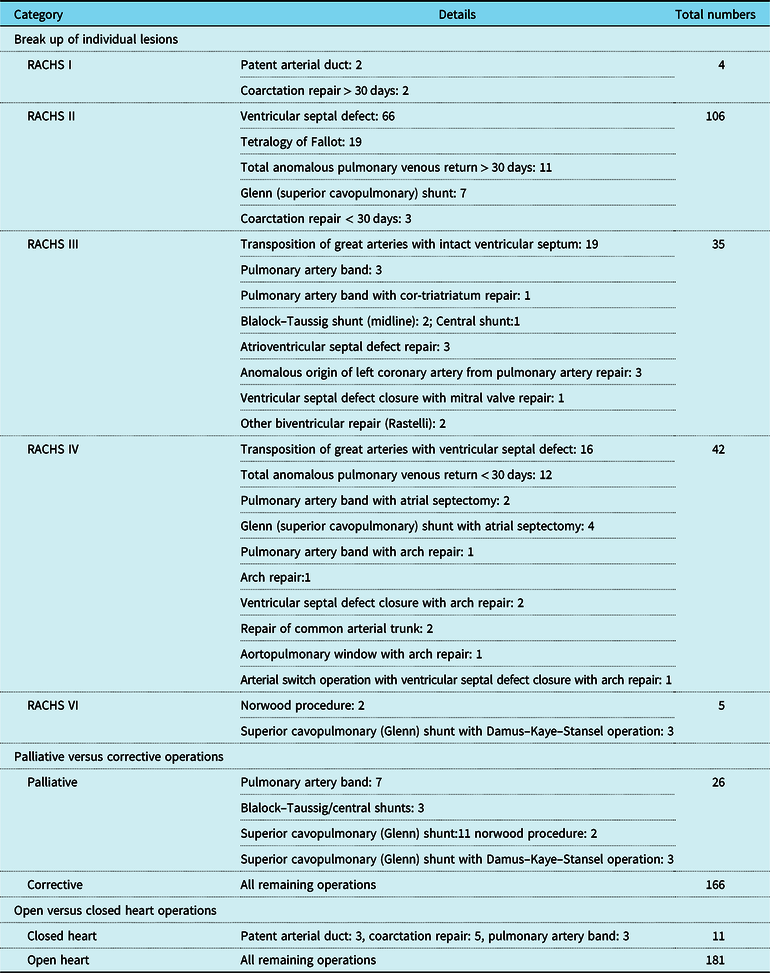
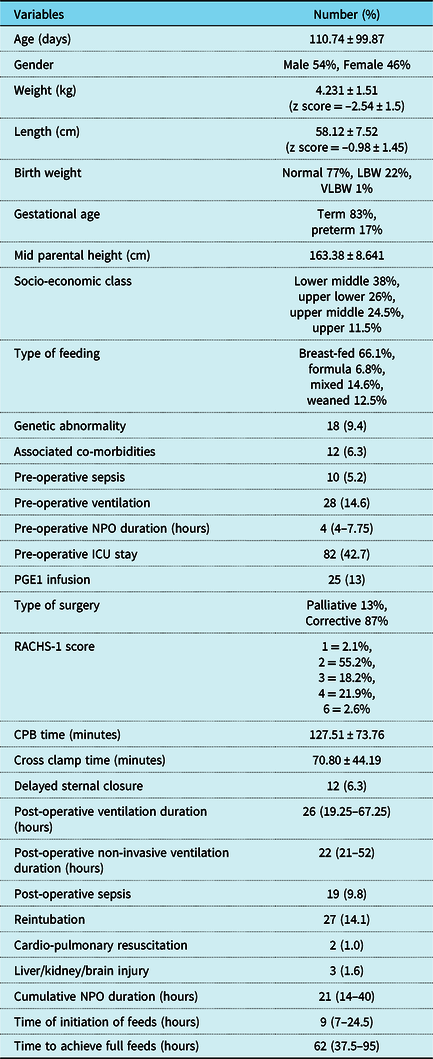
We had 194 infants that underwent cardiac surgery during the study period. Two babies died in hospital after surgery. Of the 192 babies enrolled in our study, eight were then lost to follow-up. Mean age of the babies was 110.7 ± 99.9 days. Mean weight of the babies at admission was 4.2 ± 1.5 kg (z score – 2.5 ± 1.5). Forty-two (22%) babies were low-birthweight infants, and this was not taken into account when calculating z scores. Of the 42 low-birthweight infants, 33 were preterm. Seventy-three (38%) belonged to lower middle socioeconomic class. There was a slight male preponderance (54%); 9.4% of babies had genetic abnormalities; 13% required prostaglandin infusion; 42.7% had a pre-operative ICU stay with 14.6% requiring mechanical ventilation. The majority of the babies were exclusively breast-fed (66.1%), and the incidence of pre-operative sepsis was 5.2%. Most of the surgeries belonged to Risk Adjusted Congenital Heart Surgery-1 category 2 (55.2%) followed by category 4 (21.9%) and category 3 (18.2%), respectively. Palliative surgeries constituted 13% of the total number of cases. Details of the case profile and nature of surgery are included in Table 1. Mean cardiopulmonary bypass time was 127.5 ± 73.8 minutes with aortic cross clamp time being 70.8 ± 44.2 minutes. Delayed sternal closure was required in 6.3% cases. The re-intubation rate was 14.1%, and the incidence of culture-positive sepsis in the post-operative period was 9.8%. The median cumulative nil-per-oral duration was 21 hours during the entire hospital stay (interquartile range 14–40 hours). The median duration of hospital stay was 11 days with an interquartile range of 8–17 days, and the median duration of post-operative ICU stay was 92 hours with an interquartile range of 72–160 hours.
Profile of lesions and types of operations performed in the 192 infants included in the study

RACHS = Risk Adjustment for Congenital Heart Surgery (RACHS-I method)
Table 2 shows the list of demographic, pre-operative, intra-operative, and post-operative variables of the infants who underwent cardiac surgery.
Demographic, pre-operative, intra-operative, and post-operative variables of 192 infants undergoing CHD operations

Mean ± SD is used for normally distributed variables, and median (interquartile range) is used for variables which are not normally distributed.
LBW = Low birth weight; NPO = nil per oral; PGE-1 = prostaglandin E1, RACHS = Risk Adjustment for Congenital Heart Surgery; VLBW = very low birth weight
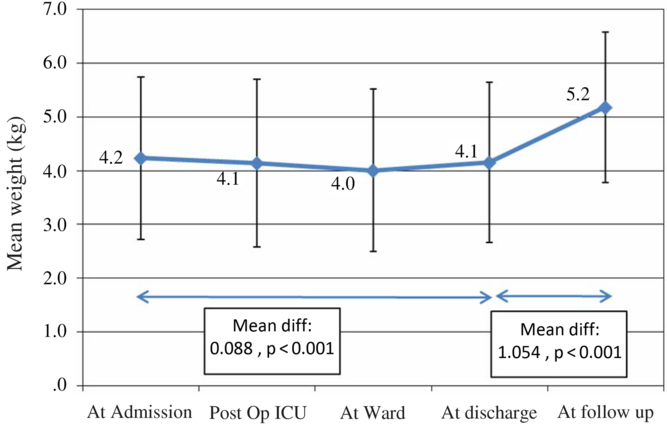
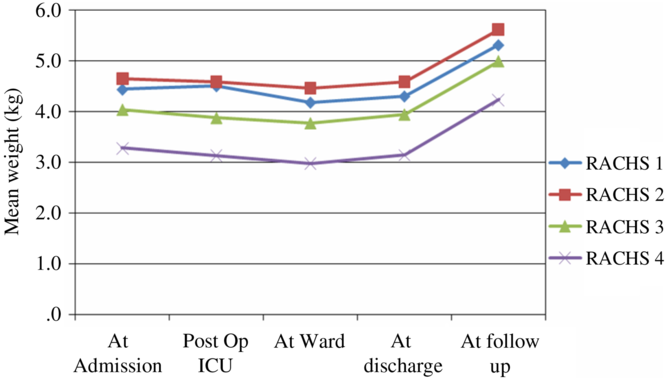
There was a slight decline in weight in the post-operative period; however, a significant improvement following discharge (Fig 1) was noted. Both the initial weight loss and the subsequent gain in weight were found to be statistically significant (p < 0.001). The median percentage decline in weight early after surgery was 1.6% (interquartile range −5.3 to +1.7), and the median percentage weight gain after surgery was 26.7% (interquartile range 15.3–41.8). A similar trend was apparent in all the surgical risk (Risk Adjusted Congenital Heart Surgery-1) categories (Fig 2).
Weight trends recorded at different time points illustrating the average trends for the entire group with standard deviations shown as vertical bars on each of the time points.

Weight trends recorded at different time points illustrating the average trend for the individual RACHS-1 categories with standard deviations shown as vertical bars on each of the time points. RACHS = Risk Adjustment for Congenital Heart Surgery.

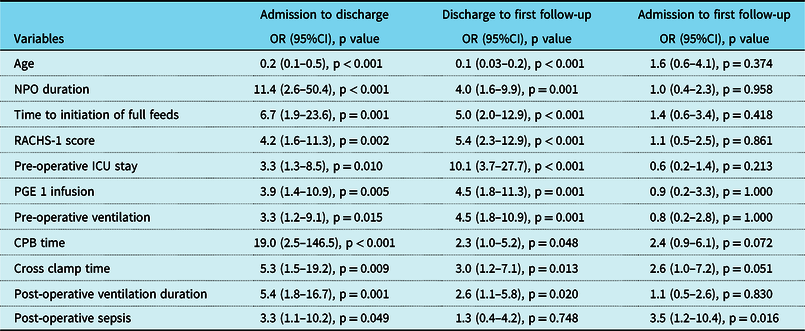
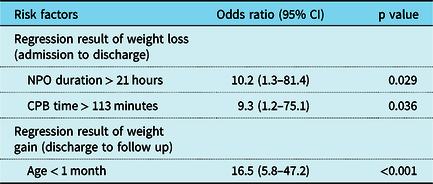
Table 3 shows the list of factors that were found to be significant on univariable analysis. They included age of the baby, Risk Adjusted Congenital Heart Surgery-1 score, prostaglandin infusion, pre-operative ventilation, pre-operative ICU stay, cardiopulmonary bypass time, cross clamp time, cumulative nil-per-oral duration, time of initiation of feeds, post-operative ventilation duration, and post-operative sepsis; however, cumulative nil-per-oral duration and cardiopulmonary bypass time were found to be the two most important factors associated with post-operative weight loss on multivariate analysis. Age was the only variable associated with weight gain following discharge. The results of multivariate logistic regression analysis of predictors of weight loss in the early post-operative period and the subsequent gain in weight are summarised in Table 4.
Results of univariable analysis on weight trends

CI = confidence intervals; CPB = Cardiopulmonary bypass; ICU = Intensive care unit, NPO = Nil per oral; OR = Odds ratio; PGE-1 = Prostaglandin E1; RACHS = Risk Adjustment for Congenital Heart Surgery
Results of multivariate analysis of factors associated with weight trends

CI = confidence interval; CPB = cardiopulmonary bypass; NPO = nil per oral
Discussion
The incidence of childhood undernutrition is particularly high in the low- and middle-income countries, and the presence of CHD further exaggerates its likelihood and severity. We have previously reported a high prevalence of undernutrition among CHD patients as reflected by z score of weight for age in a large cohort of patients with various CHD undergoing corrective as well as palliative surgeries.Reference Vaidyanathan, Roth, Rao, Gauvreau, Shivaprakasha and Kumar3, Reference Reddy, Kappanayil and Balachandran4, Reference Vaidyanathan, Nair and Sundaram16
The baseline demographic profile is fairly typical of what is seen in the low- and middle-income country environment and similar to what has been previously reported by us.Reference Reddy, Kappanayil and Balachandran4 A significant proportion of babies needed pre-operative ICU care, mechanical ventilation, and significant prevalence of pre-operative sepsis highlighting the pre-operative burden of undernutrition, heart failure, and infections. Delay in presentation is another potential factor contributing to baseline undernutrition. However, in our group of patients, the delay may have been lesser than typical for most low-resource environments.
Initially, the babies had significant loss of weight in the early post-operative period. The initial weight loss reflects the catabolic state after surgery as has been reported previously.Reference Finnerty, Mabvuure, Ali, Kozar and Herndon17 This catabolic state can potentially lead to muscle wasting, impaired immune function, and wound healingReference Finnerty, Mabvuure, Ali, Kozar and Herndon17 and may be particularly detrimental in the undernourished infant.Reference Argent, Balachandran, Vaidyanathan, Khan and Kumar12 The use of diuretics in babies with heart failure or fluid resuscitation in cyanotic infants could also have potential impact on the early weight trends.
The weight loss is largely universal and essentially similar across all Risk Adjusted Congenital Heart Surgery-1 categories (Fig 2). It was only associated with nil-per-oral duration in the post-operative period and cardiopulmonary bypass time duration that may reflect the overall complexity of the underlying CHD.
In spite of significant baseline malnutrition and a relatively high prevalence of co-morbid conditions, almost all patients showed weight gain following discharge (Fig 1). While univariable analysis showed several associations, on multivariable analysis, post-operative weight gain was not associated with any variable other than age (Tables 3 and 4). As expected, younger infants will experience greater growth. However, none of the other variables seem to matter once the child leaves the hospital.
We have previously reported that early corrective intervention results in significant improvement in nutritional status on short-term follow-up.Reference Vaidyanathan, Nair and Sundaram16 We have also previously shown that poor nutritional status, pre-operative pneumonia, and age do not increase mortality rates after ventricular septal defect repair.Reference Vaidyanathan, Roth, Rao, Gauvreau, Shivaprakasha and Kumar3 Additionally, we have also reported that pre-operative blood stream infection, pre-operative intensive care, and mechanical ventilation were strongly associated with adverse outcomes after infant cardiac surgery. However, failure to thrive and low birth weight were not found to adversely affect surgical outcomes.Reference Reddy, Kappanayil and Balachandran4
Cumulative nil-per-oral duration resulting from feeding interruptions in the early post-operative period was the only apparently correctable factor associated with early weight loss after surgery. Interruption of feeds in the post-operative period is fairly common, which is due to multiple factors including haemodynamic instability, poorly planned and failed extubation, non-invasive ventilation, and feed intolerance. The need to minimise feed interruptions in the post-operative period has been emphasised recently.Reference Argent, Balachandran, Vaidyanathan, Khan and Kumar12 However, it is possible that the reasons that contribute to nil-per-oral duration may be related to other factors that indicate the overall sickness of the child. Our study is not designed to identify these factors.
Limitations
The following limitations in the study methodology must be acknowledged:
There is variation introduced by the fact that the admission and discharge times are not fixed relative to surgical intervention. While this could influence the interpretation of in hospital weight trends, it is unlikely to influence post-discharge weight trends.
One of the outcome measures “sepsis” has been defined somewhat narrowly as positive bacterial or fungal culture. We acknowledge that there are potentially other infections that may have occurred in this group which would not have been reported if we had used other markers of probable sepsis.
About 30% of the operated patients were newborns who could have had weight changes due to being in the newborn period and not related to undernutrition.
This is a single-centre study. The conclusions will be strengthened if the results are replicated in a multi-centre study in low- and middle-income country settings.
The follow-up period is short. This was deliberate because we were seeking to understand early weight trends that had not been previously studied. We have previously examined the long-term recovery and identified variables to assess somatic growth after ventricular septal defect repair in severely malnourished infants and found that recovery of somatic growth is suboptimal in infants with severe pre-operative malnutrition.Reference Vaidyanathan, Roth, Gauvreau, Shivaprakasha, Rao and Kumar18
Conclusions
Weight loss is inevitable early after congenital heart surgery and is associated with complex surgery (cardiopulmonary bypass time duration) and cumulative nil-per-oral duration. After discharge, weight gain is almost universal and not associated with any of the perioperative variables, suggesting thereby that correction of the underlying cardiac defect leads to significant early catch-up growth.
Acknowledgments
The authors thank Mrs Steffi Bony and Mrs Rinku Roy, Medical Social Workers at the Department of Pediatric Cardiology and all the nurses in the Pediatric Cardiac ICU at the Amrita Institute of Medical Sciences and Research Centre, Cochin for their help in data collection. We would also like to express our gratitude to Dr Seshadri Balaji, Department of Pediatrics, Oregon Health and Science University, Portland, United States of America for reviewing this paper. We would also like to thank the International Quality Improvement Collaborative for Congenital Heart Disease (https://iqic.chboston.org/) for providing the database template that enabled much of the data analysis.
Financial Support
The authors assert that all procedures contributing to this work comply with the ethical standards of the relevant national guidelines on human experimentation (Indian Council of Medical Research) and with the Helsinki Declaration of 1975, as revised in 2008, and has been approved by the institutional ethics committee of the Amrita Institute of Medical Sciences and Research Centre.
Conflicts of Interest
None.